CLUSTER 6.3 TECHNICAL MONOGRAPH • PRODUCT SAFETY & CRITICAL DEFECT (AQL 0.0) ENGINEERING
Why a Single 1.0 mm Broken Sewing Needle Tip or Detached Snap Button Triggers Mandatory CPSC/Trading Standards Recalls—And How Our Zero-Tolerance Safety Gateways Protect Your Brand
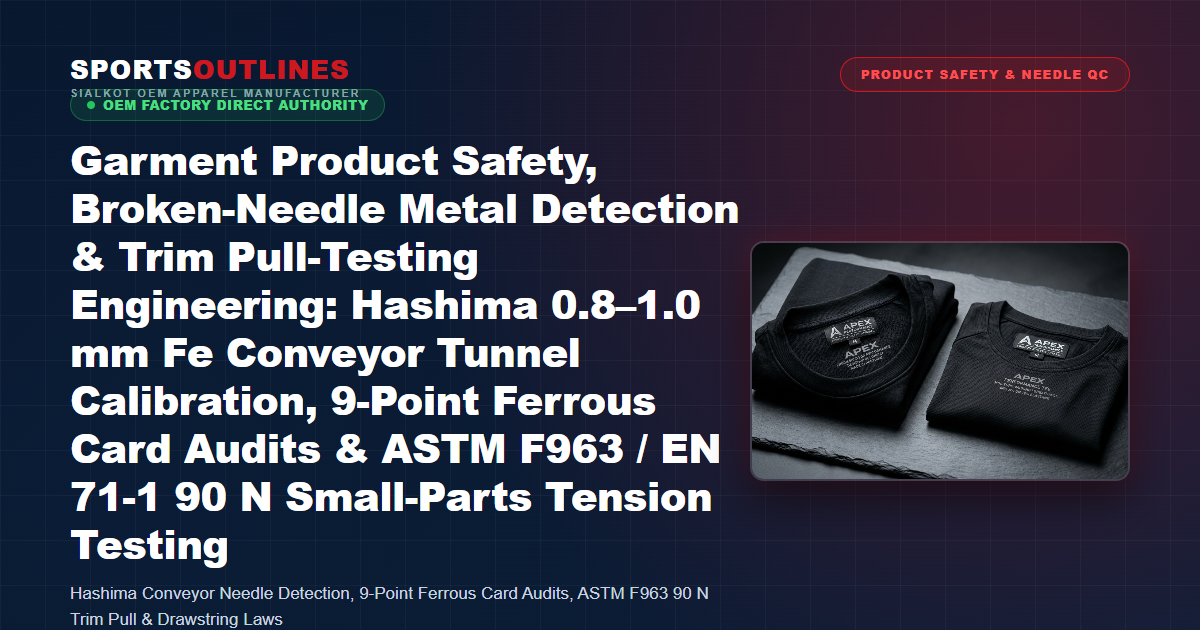
Under ISO 2859-1 AQL inspection engineering, physical product safety hazards are governed by Critical Defect Tolerance AQL 0.0 (`Ac = 0, Re = 1`): a single violation in a 5,000-unit shipment results in immediate 100% lot rejection, customs seizure, and multi-million-dollar product liability exposure. Whether it is a microscopic 1.0 mm steel needle tip embedded inside a 500 GSM fleece hoodie seam, a press-stud snap button that detaches under a toddler’s 70 Newton bite-and-pull force, or an illegal hood drawstring on a youth tracksuit, physical safety cannot rely on visual inspection alone. This engineering guide details our Closed-Loop Broken Needle Registry, Hashima® Dual-Wave 0.8–1.0 mm Fe Conveyor Metal Detection (9-Point Calibration Protocol), 90 N (20.2 lbf) Small-Parts Pull-Testing, and ASTM F1816 / EN 14682 Drawstring Safety Laws.
Technical Monograph Directory
- The Closed-Loop Broken Sewing Needle Policy: 1-for-1 Fragment Reconstruction & Magnetic Sweep Quarantine
- Hashima® Conveyor Tunnel Metal Detection: 0.8–1.2 mm Ferrous (Fe) Sensitivity & The 9-Point Calibration Matrix
- Non-Ferrous / Anti-Magnetic Metal Hardware Engineering: How Zippers, Snaps & Aglets Pass the Needle Detector
- 90 Newton (20.2 lbf / 10 Sec) Trim & Snap Pull-Testing: 16 CFR 1500.50, ASTM F963, EN 71-1 & BS 7907
- Youth & Adult Drawstring Strangulation/Entrapment Laws (ASTM F1816 / EN 14682) & Sharp-Point Auditing
- Frequently Asked Questions (FAQ) on Garment Needle Detection & Product Safety QC
1. The Closed-Loop Broken Sewing Needle Policy: 1-for-1 Fragment Reconstruction & Magnetic Sweep Quarantine
In industrial garment and combat gear factories supplying the United States, United Kingdom, and Canada, sewing machines operate at 4,000 to 6,000 stitches per minute. When an operator crosses a thick 6-ply fleece hood intersection or hits a zipper stop tooth, a high-carbon steel sewing needle (`Groz-Beckert` or `Organ` `Nm 70/10` to `Nm 110/18`) can snap into two or three razor-sharp fragments. If a 1.5 mm needle tip lodges inside the brushed fleece loop pile or inside a boxing glove foam liner, it is completely invisible to the naked eye during Inline DUPRO or Final Random Inspection (FRI).
1.1 The 5 Mandatory Floor Rules of Our Broken-Needle Control SOP
- Zero Loose Needles on the Sewing Floor: Sewing machine operators are strictly forbidden from keeping spare needles in their pockets, drawers, or pin cushions. Every single needle in the factory is locked inside the central QC Tool Crib.
- 100% Fragment Reconstruction & Tape-Down Log: To obtain a new needle from the Tool Crib supervisor—whether a needle is dull, bent, or broken—the operator must bring back the old needle. If the needle broke during sewing, 100% of the broken pieces (shank, shaft, eye, and point tip) must be recovered, aligned against a full-length reference needle gauge, and taped permanently into the Broken Needle Registry Book alongside the date, time, machine ID, operator ID, and bundle number.
- Immediate 3-Meter Radius Quarantine & Handheld Magnetic Sweep: If a broken needle tip (`even 0.8 mm`) cannot be found at the sewing head, the operator immediately flips their station placard to RED. The entire cut bundle at that workstation—plus all bundles within a 3.0-meter radius—are placed into a locked Red Quarantine Bin.
- Individual Panel Handheld Induction Scan (`Hashima HN-30S`): Every quarantined panel is scanned with a handheld high-sensitivity electromagnetic needle detector and passed through the main conveyor tunnel detector. If the missing fragment cannot be located and extracted, the entire contaminated garment or bundle is physically shredded and incinerated—never shipped.
- Ban on Scissors/Wire Cutters at Packing Tables: Only blunt-tip safety thread snips tethered to workstations via steel cables are permitted in the trimming and packing zone, and metal staples/pins are strictly banned throughout the facility.
2. Hashima® Conveyor Tunnel Metal Detection: 0.8–1.2 mm Ferrous (Fe) Sensitivity & The 9-Point Calibration Matrix
Even with a strict Broken Needle Log on the sewing floor, human error is eliminated at the final packing gate by passing 100% of finished, polybagged garments through an automated Hashima® Dual-Wave Electromagnetic Conveyor Tunnel Metal Detector (`Hashima HN-880C / HN-2870C`) located inside a physically walled-off “Metal-Free Clean Zone” directly adjacent to master carton sealing. Once a garment exits the clean-side of the conveyor tunnel, it goes straight into a 5-ply export master carton—never returning to the sewing or pressing floor.
2.1 The 9-Point Ferrous Sphere (`Fe`) Calibration Protocol (Executed Hourly)
Inside an electromagnetic induction tunnel (`typically 600 mm Wide x 120 mm High aperture`), magnetic flux density is strongest near the top and bottom search coils and weakest along the dead-center horizontal axis of the tunnel. If a QC technician only tests a calibration card flat on the conveyor belt, a broken needle sitting near the top of a thick folded puffer jacket or heavyweight hoodie could pass undetected. Therefore, our QC laboratory executes the 9-Point Spatial Calibration Audit at the start of every shift, after every 60 minutes of continuous operation, and after any power interruption:
- Calibrated Ferrous Sphere Test Card (`0.8 mm Fe`, `1.0 mm Fe`, or `1.2 mm Fe` Chrome-Steel Ball): A certified non-metallic acrylic test card encapsulating a microscopic ferrous sphere (`1.0 mm Fe` standard for adult sportswear and streetwear; `0.8 mm Fe` for baby/youth apparel; `1.2 mm Fe` for high-loft outerwear jackets with 150 mm tunnel height) is used.
- The 3 Width Positions × 3 Height Levels = 9 Spatial Points: Using a stepped non-metallic acrylic tower block, the `1.0 mm Fe` test card is sent through the tunnel at Left (`L`), Center (`C`), and Right (`R`) across Bottom (`B` — Belt Surface `0 mm`), Middle (`M` — Tunnel Center `60 mm`), and Top (`T` — Upper Coil Clearance `100 mm`): `L-B, L-M, L-T, C-B, C-M, C-T, R-B, R-M, R-T`.
- Mandatory 9/9 Auto-Reject & Belt-Reverse Trigger: The tunnel passes calibration ONLY if all 9 out of 9 spatial points trigger the audible buzzer, red strobe light, and automatic conveyor belt reversal (`100% detection rate`).
| Product Category & Target Demographic | Tunnel Aperture Height | Required Ferrous Sphere Sensitivity (`Fe`) | 9-Point Audit Frequency | Inspection Scope (Low-MOQ & Bulk) |
|---|---|---|---|---|
| Infant, Toddler & Youth Activewear / Gi Uniforms (Ages 0–14) | 100 mm – 120 mm | 0.8 mm to 1.0 mm Fe Sphere | Every 60 Minutes (9/9 Points) | 100% of Units + Sealed Anti-Contamination Carton |
| Adult Compression, Jerseys, T-Shirts & Tracksuits | 120 mm Standard | 1.0 mm Fe Sphere | Every 60 Minutes (9/9 Points) | 100% of Units (30–50 pc Low-MOQ & Bulk) |
| Heavyweight 500–600 GSM Hoodies & Puffer Jackets | 120 mm – 150 mm | 1.0 mm to 1.2 mm Fe Sphere | Every 60 Minutes (9/9 Points) | 100% of Units (Pre-verified Non-Ferrous Trims) |
| Boxing Gloves, MMA Gloves, Shin Guards & Headgear | 170 mm – 200 mm High-Clearance | 1.2 mm to 1.5 mm Fe + X-Ray / Handheld | Every 60 Minutes (9/9 Points) | 100% Foam Core Scan + 100% Final Pair Scan |
3. Non-Ferrous / Anti-Magnetic Metal Hardware Engineering: How Zippers, Snaps & Aglets Pass the Needle Detector
A critical engineering question asked by technical designers is: “If a hoodie has a heavy metal zipper, brass hood eyelets, and metal drawcord aglets, won’t the metal hardware set off the Hashima needle detector?” If a factory buys cheap, uncertified iron-core or nickel-plated steel trims from a local bazaar, the hardware will trigger false alarms—forcing the factory to turn off the needle detector and leave your shipment completely unprotected against broken sewing needles!
To ensure 100% compatibility with a `1.0 mm Fe` conveyor needle detector, our Bill of Materials (BOM) procurement SOP mandates strictly Non-Ferrous (“Needle-Detector Safe / N- Anti-Magnetic”) Metal Alloys:
- Non-Ferrous Metal Substrates: High-purity Copper/Brass (`CuZn37 / C2680`), Zinc Die-Cast Alloy (`Zamak #3 / #5`), Aluminum, or Austenitic 316L Non-Magnetic Stainless Steel—which generate zero ferromagnetic disturbance inside a ferrous induction field while a tiny 1.0 mm high-carbon steel sewing needle tip triggers an immediate alarm.
- Nickel-Free Electroplating (`EN 1811 < 0.5 μg/cm²/week`): Standard bright nickel plating is both a skin allergen (restricted under EU REACH Annex XVII Entry 27) and strongly ferromagnetic! All custom metal zipper sliders, pullers, snap buttons, eyelets, and aglets are finished using Nickel-Free White Bronze (`Cu-Sn-Zn`), Matte Black Epoxy/PVD, or Anti-Brass electroplating—passing both a pre-production Hashima Tunnel Trim Pre-Test and EU EN 1811 nickel-release lab audits.
4. 90 Newton (20.2 lbf / 10 Sec) Trim & Snap Pull-Testing: 16 CFR 1500.50, ASTM F963, EN 71-1 & BS 7907
The second major physical safety mandate in global apparel manufacturing is Small-Parts Detachment Prevention (Choking Hazard & Hardware Integrity). If a metallic prong-ring snap button on a varsity jacket, a riveted hood eyelet, a zipper slider tab, or a 3D heat-applied badge detaches from a garment, it creates an acute choking hazard for children (fit inside the 31.7 mm diameter CPSC Small Parts Cylinder under 16 CFR Part 1501) and a Major/Critical functional failure for adult outerwear.
4.1 The 90 N (20.2 lbf) for 10 Seconds Tension Pull-Test Protocol
Using a calibrated vertical Imada / SafQ Push-Pull Force Gauge Stand, our inline and pre-shipment QC inspectors clamp the attached hardware component (snap cap, socket, stud, eyelet, button, zipper slider, or drawcord aglet) and apply a steady axial tensile load ramping over 5 seconds to the statutory target load and holding continuously for 10.0 full seconds:
- US CPSC (`16 CFR 1500.51–53`) & ASTM F963 Standard: Requires holding 15.0 lbf (66.7 N) for 10 seconds (plus 0.45 N·m torque test) without partial or complete detachment.
- European / UK Harmonized Standard (`EN 71-1` & `BS 7907`) & Our Universal Factory Standard: Enforces the stricter global benchmark of 90.0 Newtons (20.23 lbf / 9.18 kgf) held for 10 seconds for all buttons, snaps, eyelets, rivets, and badges (and 70.0 N for components smaller than 6 mm).
- Zipper Top-Stop, Bottom-Stop & Pull-Tab Retention (`ASTM D2061 / BS 3084`): Zipper pull-tabs on YKK® `#5` and `#8` sliders must withstand ≥ 150 N to 250 N (33.7 to 56.2 lbf) axial pull, and top/bottom stops must exceed ≥ 90 N to 130 N without slider pull-off.
| Hardware / Trim Component | Governing Safety Standard | Minimum Pull Force & Hold Duration | Pinch-Setting / Backing Engineering Rule |
|---|---|---|---|
| Prong-Ring & S-Spring Press Snaps (Varsity / Coach Jackets) | EN 71-1 / BS 7907 / 16 CFR 1500.53 | ≥ 90.0 N (20.2 lbf) for 10 Seconds | Calibrated pneumatic die pinch-height (`±0.05 mm`) + internal 1.0 mm fusible non-woven washer |
| Two-Piece Brass Hood Eyelets / Grommets (`#00 / 8mm`) | ASTM F963 / BS 7907 | ≥ 150.0 N to 180.0 N for 10 Seconds | Tooth-grip counter-washer + internal cotton canvas/TPU reinforcement patch |
| Metal & Silicone Drawcord Aglets / Tips | EN 71-1 / ASTM F963 | ≥ 90.0 N to 120.0 N for 10 Seconds | 4-prong internal barb crimp + knotted core end inside metal tube |
| Zipper Slider Pull-Tab & Top/Bottom Stops (`#5 / #8`) | ASTM D2061 / BS 3084 | ≥ 150 N (Pull-Tab) / ≥ 90 N (Stops) | One-piece molded slider crown + ultrasonic bottom-stop reinforcement |
| Center-Back Waistband Drawcord Bartack Anchor | ASTM F1816 / EN 14682 | ≥ 250.0 N Continuous Pull | 28-stitch vertical lockstitch bartack through both waistband plies and cord core |
5. Youth & Adult Drawstring Strangulation/Entrapment Laws (ASTM F1816 / EN 14682) & Sharp-Point Auditing
If your sportswear or streetwear brand produces youth sizes (Academy Teamwear, Youth BJJ Gis, Kids Hoodies, or School Tracksuits in Sizes `2T` to `16 / Y-XL`), failing to comply with international children’s drawstring legislation is classified as a Substantial Product Hazard under US CPSC 16 CFR Part 1120 (`ASTM F1816`), European/UK `EN 14682:2014`, and Health Canada `SOR/2011-17`—resulting in immediate border confiscation at US Customs (CBP) or UK Trading Standards.
5.1 Mandatory Youth Drawstring Design Rules Enforced by Our CAD & QC Teams
- 100% Prohibition of Hood & Neck Drawstrings on Youth Upper Outerwear (`Sizes 2T to 12` in US / `Up to Age 14` in EU/UK): Youth hoodies, windbreakers, and track jackets must be manufactured with ZERO hood or neck drawcords (using elastic-bound scuba hoods or hidden Velcro tabs instead). Any youth hoodie imported into the US, UK, or EU with a neck drawcord is automatically seized as a strangulation hazard.
- Waist & Bottom Hem Drawstring Limits (`Sizes 2T to 16`): On youth joggers, sweatshorts, and Gi pants, waist drawstrings must extend no more than 75 mm (3.0 in) outside the eyelet channel when the garment is expanded to its maximum width, must be permanently bar-tacked at the center-back seam so the cord cannot be pulled out through one side, and must contain zero knots, toggles, or free-swinging plastic/metal bells at the ends (which catch in school bus doors or playground slides).
- Adult Hoodie & Jogger Drawcord Bar-Tacking: Even on adult hoodies and joggers, our sewing SOP applies a hidden center-back neck or center-back waist 28-stitch bartack so the drawcord never slips into the tunnel during tumble washing.
| Garment Zone & Age Group | US CPSC / ASTM F1816 Rule | EU / UK EN 14682:2014 Rule | Compliant Factory Construction Solution |
|---|---|---|---|
| Youth Hood & Neck Area (Sizes 2T–12 / Ages 0–14) | 100% BANNED (Zero strings/cords in hood or neck) | 100% BANNED up to Age 7; zero free ends Ages 7–14 | 3-panel ergonomic scuba hood or mock eyelet decorative stitch with zero cord |
| Youth Waist & Lower Hem (Joggers / Shorts / Gi Pants 2T–16) | Max 75 mm (3.0 in) free length @ full stretch; center-back bartack; zero toggles/knots | Max 140 mm (unfastened) / 200 mm; zero knots or 3D toggles at cord ends | Internal flat-braided cord bar-tacked at center-back with heat-sealed flat tips (≤ 70 mm) |
| Adult Hoodies & Sweatpants (Sizes XS–5XL) | Permitted; recommended ≤ 180 mm exposed length | Permitted; aglets must pass 90 N pull-test | 140–160 mm exposed cord + center-back anti-pull-out bartack + 120 N barbed metal/silicone aglets |
5.2 Sharp-Point (`16 CFR 1500.48`), Sharp-Edge (`16 CFR 1500.49`) & Monofilament Thread Auditing
Even when metal hardware stays attached at 90 N, poorly finished trims can lacerate an athlete’s skin during contact sports. Our QC floor executes three tactile and instrumental surface-hazard audits on 100% of production runs:
- CPSC Sharp-Point (`16 CFR 1500.48`) & Sharp-Edge (`16 CFR 1500.49` PTFE Tape) Gauges: Every molded zipper tooth, metal aglet crimp edge, and prong-snap ring is tested against the spring-loaded 1.02 mm x 1.27 mm slot of an official CPSC Sharp Point Tester (where a red indicator lamp illuminates if a burr penetrates 0.50 mm under 4.5 N force) and a rotating mandrel wrapped in PTFE tape for sharp edges.
- 100% Prohibition of Clear Nylon Monofilament (“Fishing Line”) Thread: Cheap factories frequently stitch woven labels and badges with transparent nylon monofilament thread so they don’t have to change thread colors. When cut and heat-sealed at the knot, monofilament forms a rigid, glass-sharp needle spike that scratches the wearer’s neck. Our factory strictly bans monofilament thread, using exclusively soft multifilament core-spun polyester or 28 kHz ultrasonic label edges.
- Zipper Garage Chin-Guards & Internal Placket Underlays: On all quarter-zip training tops, full-zip track jackets, and rashguards, the upper zipper top-stop is covered by a folded self-fabric Zipper Garage Chin-Guard to prevent metal-to-skin abrasion.
5.3 Daily QC Calibration Log & Certificate of Compliance (`GCC / CPC`) Issuance for 30–50 Piece Runs
Whether you order a 30–50 piece low-MOQ launch batch per style/colorway or a 5,000-unit retail program (following approval of your $45–$85 non-refundable prototype sample delivered in 7–10 business days), every shipment includes our signed Hashima 9-Point Needle Detection Log & 90 N Pull-Test Inspection Record—giving your brand the exact technical documentation required to issue a US Consumer Product Safety Improvement Act (`CPSIA`) General Certificate of Conformity (`GCC`) or Children’s Product Certificate (`CPC`).
| Safety Gate Sequence | Production Stage | Verification Method | Acceptance Criterion (AQL 0.0) |
|---|---|---|---|
| Gate 1: Trim Non-Ferrous & Nickel Audit | Incoming Trim Warehouse | Pre-scan 50 random zippers/snaps/eyelets through Hashima 1.0 mm Fe tunnel + EN 1811 check | 0/50 False Alarms; 100% Non-Ferrous Brass/Zamak |
| Gate 2: Snap/Eyelet Die Pinch Calibration | First-Piece Hardware Setup & Hourly | Digital micrometer pinch-height check + SafQ 90 N / 10-second pull test on 5 test swatches | 100% Hold ≥ 90.0 N (Zero detachment or fabric tear) |
| Gate 3: Broken Needle Tool-Crib Exchange | Continuous Modular Sewing Line | 1-for-1 fragment reconstruction taped in Broken Needle Registry; Red Quarantine if tip missing | 100% Fragment Accountability before issuing replacement |
| Gate 4: 100% Hashima Conveyor Tunnel Scan | Final Polybagged Clean-Room Carton Sealing | Hourly 9-Point `1.0 mm Fe` test card calibration + 100% conveyor passage of every garment | 100% Pass Rate; immediate direct-to-carton sealing |
5.4 Controlling Moisture Dielectric Drift, Belt Iron-Dust Contamination & Dual-Bridge Search Coil Architecture
Even when a factory purchases a genuine Japanese Hashima `HN-750G` or `HN-880C` conveyor needle detector, three operational floor variables can cause false alarms or—worse—mask a microscopic `0.8 mm Fe` broken needle tip if the quality engineering team does not enforce strict environmental and mechanical hygiene:
- Steam-Finishing Moisture & Ionic Conductivity Drift (`≤ 10%` Moisture Regain Rule): When heavyweight 380–450 GSM cotton/polyester fleece hoodies or Brazilian Jiu-Jitsu pearl-weave Gis exit the steam pressing table, residual moisture combined with trace ionic dyeing salts inside the fibers creates a weak conductive eddy-current signature as the garment moves through the magnetic search coils. If a damp garment is polybagged and scanned immediately after steaming, it will trigger false metal-detection rejections—tempting poorly trained operators to dial down the tunnel’s sensitivity knob from `Level 8` (`0.8–1.0 mm Fe`) to `Level 3` (`2.0 mm Fe`). Our Sialkot finishing SOP strictly forbids operator access to the sensitivity dial (which is locked behind a keyed supervisor security cover) and requires a mandatory 4-to-6-hour dehumidified cooling rack dwell until a digital pin-probe moisture meter verifies garment moisture below `10.0%` prior to polybagging and needle scanning.
- Conveyor Belt Microscopic Ferrous Dust Decontamination: Over thousands of garment passes, microscopic iron oxide dust from cardboard carton staples, ambient floor dust, or metallic screen-print shimmer inks can embed into the polyurethane conveyor belt surface. Whenever the belt seam passes under the dual-bridge search coils, embedded iron dust creates background electromagnetic noise. Every 4 hours (prior to executing the 9-Point `1.0 mm Fe` test card audit), our needle-room technicians wipe both the upper and lower conveyor belt surfaces with `99%` isopropyl alcohol and run the machine in “Belt Blank Self-Diagnostic Mode” for 3 full revolutions to confirm zero baseline magnetic noise (`0 LED bar fluctuation`).
- Isolated Power Line Conditioning & 2.5-Meter Electromagnetic Exclusion Zone: High-frequency servo motors on nearby bar-tacking machines, industrial ceiling fans, or voltage fluctuations on the factory grid can induce false magnetic spikes inside induction coils. Our needle-detection clean room powers the Hashima conveyor through an isolated online double-conversion sine-wave UPS voltage stabilizer and enforces a painted `2.5-meter` yellow floor perimeter where steel rolling racks, metal scissors, and mobile phones are strictly prohibited.
- 12-Month Archive of Timestamped Inspection Certificates for Brand Liability Protection: For every production lot—from a 30–50 piece low-MOQ launch drop to a 5,000-unit retail program—our QA department archives the signed 9-Point Ferrous Card Calibration Sheet, the Broken-Needle Tool-Crib Log, and the `90 N / 10-second` SafQ Trim Pull-Test Record in our cloud dossier for 36 months, providing immediate audit defense for Amazon, Target, Dick’s Sporting Goods, or European customs compliance audits.
6. Frequently Asked Questions (FAQ) on Garment Needle Detection & Product Safety QC
1. How does the 9-Point Ferrous Card Calibration work on a Hashima conveyor needle detector?
Because magnetic field strength inside an induction tunnel is weakest at the center height and varies from left to right, our QC team passes a certified 1.0 mm Ferrous (Fe) sphere test card through 9 exact spatial coordinates every 60 minutes: Left, Center, and Right across Bottom (belt surface), Middle (center height), and Top (upper clearance) using a stepped non-metallic acrylic block. All 9 points must trigger the alarm and belt-reversal lock before any garments are scanned.
2. How can a hoodie with metal zippers and brass eyelets pass through a metal detector without false alarms?
Hashima conveyor needle detectors operate on electromagnetic ferrous induction tuned to magnetic iron/steel (`Fe`). By specifying strictly non-ferrous, anti-magnetic hardware—solid Brass (`CuZn37`), Zinc Alloy (`Zamak #3/#5`), and Nickel-Free electroplating—your zippers, snaps, eyelets, and aglets pass smoothly through the tunnel while any high-carbon steel sewing needle fragment (`≥ 0.8–1.0 mm Fe`) triggers an instant rejection alarm.
3. What is the 90 Newton (20.2 lbf) small-parts pull test for snaps, eyelets, and aglets?
Under EN 71-1, BS 7907, ASTM F963, and 16 CFR 1500.53, attached hardware components are clamped in a calibrated force gauge and pulled with 90.0 Newtons (20.23 lbf / 9.18 kgf) of axial tension held continuously for 10 seconds. Zero detachment, prong loosening, or fabric tear-out is permitted.
4. Do 30–50 piece low-MOQ production runs undergo 100% conveyor metal detection and 90 N pull testing?
Yes. Product safety is a zero-tolerance Critical AQL 0.0 mandate regardless of order size. Every single garment in our 30–50 piece low-MOQ production runs passes through the calibrated Hashima 1.0 mm Fe conveyor tunnel prior to carton sealing, following hardware pull-test verification on your $45–$85 prototype sample (7–10 business days turnaround).