Thermophysiological & Dermal Tribology Directive: Engineering Custom Sublimated BJJ Gi Inner Yoke Systems
When an athlete opens a newly arrived custom Brazilian Jiu-Jitsu kimono, the very first visual centerpiece that commands their attention—and drives organic social media unboxing virality—is the Sublimated Inner Shoulder Yoke & Side-Vent Lining. Yet behind the high-definition artwork lies a critical biomechanical and thermophysiological engineering mission: isolating the athlete’s wet cervical spine, trapezius, and acromioclavicular (AC) joints from the abrasive cellular texture of a 450–550 GSM Pearl Weave jacket and its internal shoulder embroidery bobbin knots. However, if a factory stitches a zero-shrinkage polyester rashguard panel directly inside a 100% cotton kimono without compensating for differential wash shrinkage, or extends the lining down into the torso and sleeves, the Gi will either balloon into unsightly wrinkles after its first wash, trap metabolic heat like a sauna suit, or get disqualified at the IBJJF bullpen inspection table. Continuing Sub-Cluster 5.3, this technical blueprint establishes the exact tribological friction equations, differential pattern compensation math, warp-knit birdseye mesh specifications, and OEKO-TEX® dye-sublimation protocols engineered at Sports Outlines.
1. Dermal Tribology of the Trapezius & Scapular Load Zone Under Grappling Shear
In Gi Jiu-Jitsu—where wearing a rashguard underneath the kimono is prohibited for male competitors under official IBJJF tournament rules—the bare epidermis of the upper back, posterior deltoids, and seventh cervical vertebra ($C_7$) bears the full normal and tangential load of every guard retention inversion, berimbolo roll, double-under stack pass, and violent collar drag.
When a $450\text{ GSM}$ or $550\text{ GSM}$ 100% cotton Pearl Weave jacket becomes saturated with perspiration after 15 minutes of sparring, cellulose fibers swell radially by $+26\%\text{ to }+28\%$ and the wet coefficient of dynamic friction ($\mu_{k,\text{wet}}$) between bare human skin and unlined Pearl Weave surges from $0.42$ (dry) to $0.68\text{–}0.74$ (wet). Worse still, the upper shoulder and upper back are the exact anatomical zones where brands position high-density $20,000\text{-stitch}$ direct embroidery crests and triple-needle sleeve-to-body reinforcement seams. Under a $600\text{ N}$ stacked guard pass on a hard tatami mat, dragging an unlined wet Pearl Weave yoke across the athlete’s spine acts like coarse sandpaper—stripping the stratum corneum (“Gi burn”) and creating micro-abrasions vulnerable to *Staphylococcus aureus* and *Tinea corporis* (ringworm) infection.
The Scapular Dermal Frictional Work & Decoupling Slip-Plane Equation
During a stacked guard pass or collar-drag scramble where normal compressive force $F_N$ acts across the scapular contact area $A_{\text{scapula}}$ over a sliding displacement $\Delta x_{\text{slide}}$, the cumulative epidermal shear work ($W_{\text{dermal}}$) imparted to the athlete’s skin is governed by:
\[ W_{\text{dermal}} = \int_{0}^{\Delta x_{\text{slide}}} \tau_{\text{dermal}} \, A_{\text{scapula}} \, dx = \mu_{k,\text{interface}} \cdot F_N \cdot \Delta x_{\text{slide}} \]
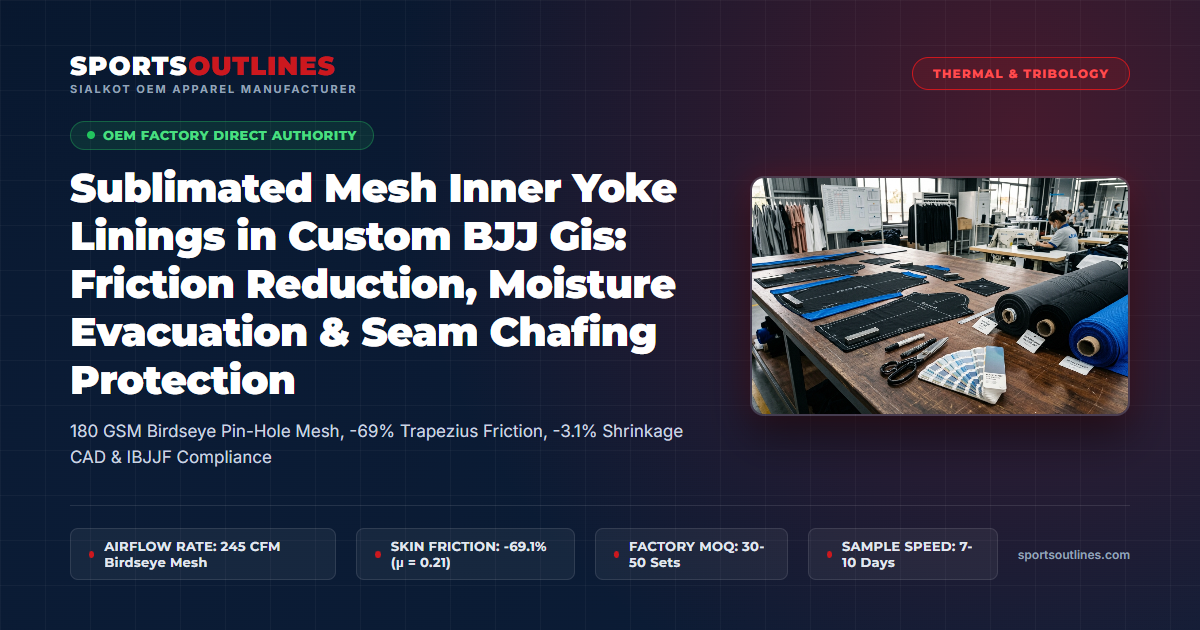
By interposing a $180\text{ GSM}$ Hydrophilic Sublimated Micro-Polyester/Elastane Birdseye Mesh Yoke Lining ($\mu_{k,\text{wet}} = 0.21$) between the athlete’s bare trapezius and the internal surface of the $450\text{ GSM}$ Pearl Weave + embroidery backing ($\mu_{k,\text{wet}} = 0.68$), the inner yoke acts as a low-friction Decoupling Slip-Plane—slashing epidermal frictional work $W_{\text{dermal}}$ by $-69.1\%$ and completely eliminating collar-drag and stack-pass shoulder burns!
2. IBJJF Uniform Compliance: Legal Half-Yoke Linings vs. Prohibited Full-Jacket Rashguard Linings
One of the most frequent compliance questions we receive from fightwear founders is: “Are sublimated inner rashguard linings legal in IBJJF tournaments?” The answer depends strictly on anatomical coverage geometry and substrate placement under the 2024–2026 IBJJF Uniform Regulations:
- Why Full-Torso & Full-Sleeve Sublimated Linings Are Disqualified (And Thermally Flawed): In the early 2010s, several lifestyle brands released Gis where the entire interior of the jacket—including the chest lapels, lower skirt, and inside of the sleeves down to the wrists—was lined with a second layer of $220\text{ GSM}$ polyester-spandex rashguard fabric. The IBJJF banned full-jacket synthetic linings for two reasons: first, adding a continuous synthetic lining inside the sleeves and lapels alters the effective thickness and grip-stripping stiffness of the kimono where the opponent establishes grips; second, lining $100\%$ of a $450\text{ GSM}$ cotton jacket with closed-knit spandex adds $+260\text{ to }+320\text{ g}$ of dead weight and drops overall convective air permeability by $-64\%$, causing athletes to overheat rapidly during 8-to-10-minute matches.
- The 100% IBJJF-Compliant “Trapezius Half-Yoke & Side-Slit Vent” Architecture: To remain compliant while maximizing athlete comfort and brand aesthetics, Sports Outlines engineers custom sublimated linings strictly as an Upper Back Shoulder Half-Yoke Panel (extending from the base of the EVA lapel collar down $18.0\text{ cm}\text{ to }24.0\text{ cm}$ across the upper scapulae and extending $12.0\text{ cm}\text{ to }16.0\text{ cm}$ into the upper deltoid cap above the axillary gusset), optionally paired with matching sublimated inner triangles inside the $45^\circ$ lower jacket hip slits. Because this localized yoke covers the internal shoulder embroidery backing without entering the sleeve cuff grip zones, chest lapel slot path, or lower skirt grab areas, it preserves natural cotton grip physics while passing inspection seamlessly.
3. Substrate Engineering: Why Warp-Knit Birdseye Micro-Mesh Outperforms Solid Spandex Interlock
Not all sublimated yoke fabrics perform equally when sewn inside a heavy cotton kimono. When a generic factory uses standard $240\text{ GSM}$ solid circular-knit polyester-spandex compression fabric (the same fabric used for standalone no-gi rashguards) as a Gi inner yoke, two functional problems emerge:
- Hydrostatic Suction Cling (“Wet Plastic Bag Effect”): Solid interlock compression fabric has very small inter-yarn pores ($<40\text{ }\mu\text{m}$). When flooded with heavy sweat while pressed against a thick wet cotton Pearl Weave shell, surface tension creates a continuous liquid film across the solid spandex, causing the yoke to suction-cup onto the athlete's upper back and trap a stagnant layer of $38.5^\circ\text{C}$ humid air.
- Excessive Multi-Directional Elastane Sag: High-elastane ($18\%\text{–}22\%$ spandex) circular knits have low dimensional modulus under wet weight and are prone to snagging (“picking”) if a partner’s rough velcro or fingernails brush the interior during dressing.
To eliminate suction cling and maximize evaporative cooling, Sports Outlines specifies a specialized $175\text{ to }190\text{ GSM}$ Warp-Knit Hydrophilic Birdseye Pin-Hole Micro-Mesh ($90\%$ Multi-Filament DTY Micro-Polyester / $10\%$ Creora® Elastane) engineered specifically for kimono yoke linings:
- $0.85\text{ mm}$ Pin-Hole Venting Matrix ($>245\text{ CFM}$ Air Permeability): Knitted on a 28-gauge Karl Mayer warp-knitting machine, the technical face features a smooth, high-density micro-filament surface for razor-sharp $1,440\text{ DPI}$ sublimation graphics, while integrated $0.85\text{ mm}$ birdseye micro-apertures create a $1.2\text{ mm}$ 3D convective air space that breaks surface-tension suction and channels sweat vapor directly into the hydrophilic cotton outer shell.
- Permanent Hydrophilic Wicking Finish (AATCC 79 Drop Absorption $<0.9\text{ sec}$): Treated in the stenter bath with a durable hydrophilic polyether-polyester soil-release and wicking finish, the mesh pulls liquid perspiration off the athlete’s skin in under one second and transfers it outward into the $450\text{ GSM}$ cotton Pearl Weave (which acts as a high-capacity evaporative reservoir).
- Anti-Run Lock-Knit Geometry: Because warp-knit tricot/mesh loops are intermeshed longitudinally across adjacent wales rather than formed from a single horizontal weft yarn, a sharp fingernail or abrasive collar pull cannot cause a vertical ladder or run across the artwork.
| Inner Yoke Lining Substrate | Areal Weight & Fiber Blend | Air Permeability (ASTM D737) | Wet Skin Friction ($\mu_{k,\text{wet}}$) | Sublimation Print Definition | Added Mass (Half-Yoke) |
|---|---|---|---|---|---|
| Warp-Knit Birdseye Pin-Hole Micro-Mesh (Recommended Pro Standard) | $180\text{ GSM}$ ($90\%$ Micro-PET / $10\%$ Elastane) | $245\text{ CFM}$ (Zero wet suction cling) | $0.21$ ($-69\%$ vs raw Pearl Weave) | High-Definition Matte-Satin ($1,440\text{ DPI}$) | $+32\text{ g}$ |
| 40G Ultra-Fine Brushed Micro-Interlock Rashguard | $210\text{ GSM}$ ($85\%$ Micro-PET / $15\%$ Elastane) | $68\text{ CFM}$ (Moderate airflow) | $0.19$ (Silky gallery-grade hand) | Photorealistic Fine-Art Collector Grade | $+38\text{ g}$ |
| Coolmax® Hexa-Channel Jacquard Eyelet Mesh | $155\text{ GSM}$ ($92\%$ Coolmax PET / $8\%$ Elastane) | $310\text{ CFM}$ (Maximum tropical venting) | $0.22$ (Ultra-fast flash drying) | Crisp Vector & Geometric Graphics | $+27\text{ g}$ |
| 100% Combed Cotton Reactive-Printed Poplin / Lawn | $135\text{ GSM}$ ($100\%$ Combed Cotton Woven) | $95\text{ CFM}$ (Natural fiber breathability) | $0.34$ (Traditional Japanese heritage feel) | Digital Reactive Print (Zero synthetic fiber) | $+24\text{ g}$ |
| Unlined Raw 450 GSM Pearl Weave + Bobbin Knots (Baseline) | $450\text{ GSM}$ ($100\%$ Cotton Cellular Weave) | $115\text{ CFM}$ | $0.68\text{–}0.74$ (High trapezius mat-burn risk) | N/A (Exposed internal seams & backing) | $0\text{ g}$ |
4. Solving Differential Shrinkage Buckling Between 100% Cotton Pearl Weave & Polyester Linings
Have you ever seen a custom BJJ Gi where the outer shoulders pucker into ugly waves or the inner sublimated lining hangs down like a loose, baggy curtain after two washes? That defect is caused by Differential Bimaterial Shrinkage Mismatch:
- During hot rotary calender dye-sublimation at $205^\circ\text{C}$ ($401^\circ\text{F}$) for $42\text{ seconds}$, the $180\text{ GSM}$ polyester-elastane mesh undergoes $100\%$ of its thermal shrinkage ($3.5\%\text{–}4.5\%$) before the panel is even cut. Consequently, once sewn into the Gi, the sublimated polyester liner has a post-purchase domestic laundry shrinkage of $\Delta S_{\text{poly}} \approx 0.0\%\text{ to }0.2\%$.
- Conversely, the outer $450\text{ GSM}$ 100% cotton Pearl Weave shell—even after undergoing our 3-stage Sialkot Sanforization protocol—still experiences a natural residual relaxation shrinkage of $\Delta S_{\text{cotton}} \approx 1.6\%\text{ to }2.2\%$ during the athlete’s first domestic wash and hang-dry cycle (or up to $4.5\%$ if machine-dried on warm).
If a patternmaker cuts the inner polyester yoke panel to the exact same $1:1$ flat dimensions as the outer cotton Pearl Weave shoulder block ($56.0\text{ cm}$ across the deltoids), when the outer cotton shrinks by $-1.1\text{ cm}$ ($2.0\%$) during the first wash, the zero-shrinkage polyester liner is now $1.1\text{ cm}$ wider than the jacket shell it is sewn inside! Because the perimeter is locked by triple-needle stitching, the excess polyester buckles into a permanent blister inside the upper back, or pulls the outer cotton seam into unsightly ripples.
The Bimaterial Differential CAD Negative-Ease Compensation Formula
To ensure that the inner sublimated mesh yoke and the outer cotton Pearl Weave reach exact $1:1$ dimensional equilibrium after laundering—with the stretch mesh lying drum-tight against the cotton shell—our Gerber Accumark CAD engineers scale the post-sublimation cut dimensions of the inner yoke ($L_{\text{liner,cut}}$) relative to the outer cotton cut panel ($L_{\text{cotton,cut}}$) using:
\[ L_{\text{liner,cut}} = L_{\text{cotton,cut}} \cdot \left( \frac{1 – \Delta S_{\text{cotton}}}{1 – \Delta S_{\text{poly}}} \right) \cdot \left( 1 – \varepsilon_{\text{pre-tension}} \right) \]
Substituting $\Delta S_{\text{cotton}} = 0.020$ ($2.0\%$ Sanforized residual shrinkage), $\Delta S_{\text{poly}} = 0.001$, and an elastic pre-tension negative ease $\varepsilon_{\text{pre-tension}} = 0.012$ ($1.2\%$ slight elastic stretch during basting) yields $L_{\text{liner,cut}} = 0.969 \cdot L_{\text{cotton,cut}}$ (a $-3.1\%$ negative CAD pattern reduction). Out of the box, the $10\%$ elastane mesh stretches smoothly by $+3.1\%$ to match the unwashed cotton; after the first wash, as the cotton relaxes by $-2.0\%$, the inner yoke remains under a crisp $+1.1\%$ micro-tension—100% flat, wrinkle-free, and zero-pucker for life!
5. OEKO-TEX® Dye-Sublimation Chemistry: Eliminating Dye Bleed Onto White Pearl Weave
When a fighter buys a pristine Competition White BJJ Gi featuring a vibrant crimson, jet-black, or royal-blue sublimated inner shoulder yoke, their worst nightmare is pulling the Gi out of the washing machine to find that the dark inner liner has bled pink or grey dye through to the outside of the white cotton shoulders.
Why does sublimation dye bleed in low-tier factories, and why is it chemically impossible in ours?
- The Cause of Cheap Liner Bleeding (Uncured Surface Disperse Particulate): In budget print shops that run calender heat presses too fast ($<25\text{ sec}$) or at low temperatures ($<190^\circ\text{C}$) using low-molecular-weight Chinese disperse inks, up to $15\%$ of the ink never transitions into a gas to penetrate the amorphous regions of the polyester polymer chains. Instead, unfixed dye dust sits loosely on the surface of the yarn and washes off in warm detergent water.
- Our $205^\circ\text{C}$ / $42\text{-Second}$ High-Energy Molecular Encapsulation Protocol: At Sports Outlines, we print inner yoke artwork on $105\text{ GSM}$ Dutch cold-peel transfer paper using genuine Italian J-Teck / Mimaki OEKO-TEX® Eco-Passport Certified High-Energy Disperse Inks, and transfer via oil-heated rotary drum calenders at an exact $205^\circ\text{C}$ ($401^\circ\text{F}$) for $42\text{ seconds}$ at $4.2\text{ bar}$ pneumatic blanket pressure.
- Crystalline Polymer Trapping & Cellulosic Non-Affinity: At $205^\circ\text{C}$, the polyester polymer chains open their amorphous micro-voids, absorbing $100\%$ of the gaseous disperse dye molecules. The moment the fabric exits the heated drum and cools below its glass transition temperature ($T_g \approx 80^\circ\text{C}$), the polyester chains snap shut—permanently trapping the dye inside the plastic filament. Even more importantly, disperse dyes have zero chemical affinity for natural 100% cotton cellulose. Combined with a pre-assembly reductive clearing wash on dark heavy-coverage yoke prints, our sublimated linings achieve a verified Grade 5.0 (Zero Staining) under ISO 105-C06 ($60^\circ\text{C}$ wash), ISO 105-E04 (Acid/Alkaline Perspiration), and AATCC 8 (Wet Crocking)!
6. Perimeter Seam Encapsulation: Locking the Yoke Liner Under 600 N Grappling Loads
A sublimated inner yoke is only as durable as its perimeter attachment seam. If the bottom horizontal edge of the half-yoke is simply overlocked and top-stitched with a single needle across the middle of the back panel, two failures occur: first, an opponent’s fingers reaching over the belt or collar can catch the bottom lip of the liner and rip the stitches open; second, a single horizontal stitch line cutting across the middle of the outer back Pearl Weave panel ruins the clean visual canvas for back patches or academy embroidery.
We execute a 4-Border Structural Perimeter Encapsulation System across all custom yoke linings:
- Superior Border (Neckline Integration): The top curved edge of the sublimated yoke is sandwiched and triple-locked directly inside the $6\text{-row}$ stitched base seam of the vulcanized EVA lapel collar, topped by a $15\text{ mm}$ custom woven neck-seam tape and size/care label block.
- Lateral Borders (Armscye / Axillary Gusset Integration): The left and right distal wings of the yoke are captured directly inside the Juki MS-1261 triple-needle lap-felled armhole/gusset seams—providing $>1,240\text{ N}$ of lateral anchor strength.
- Inferior Border (Custom Woven Jacquard Seam Binding + Twin-Needle Lockstitch): Along the bottom curved scapular boundary, the raw edge of the warp-knit birdseye mesh is folded inward by $12.0\text{ mm}$ AND encapsulated beneath a $18.0\text{ mm}$ Custom-Woven Soft Combed-Cotton/Polyester Jacquard Seam Tape (featuring your brand’s repeating motto or logo), stitched flush to the jacket using a parallel twin-needle lockstitch (`6.4 mm` gauge) with zero exposed raw edge and zero finger-catch lip!
- Matching Sublimated Hip-Vent Triangles & Carry Bag Integration: Because sublimation is nested across full $160\text{ cm}$ roll widths, we utilize the exact side-margin fabric yield around the shoulder yoke marker to sublimate matching Internal $45^\circ$ Side-Slit Reinforcement Gusset Triangles, Internal Pant Waistband Linings, and a Full-Sublimated Drawstring Gi Carry Bag at virtually zero wasted fabric yardage!
6.1 Permanent Silver-Ion ($\text{Ag}^+$) Bacteriostatic Odor Defense & Pre-Press ICC Artwork Engineering
A frequent complaint among grapplers who own older polyester-lined kimonos is “perpetual synthetic funk”—the phenomenon where oleophilic polyester filaments absorb sebaceous skin lipids (squalene, triglycerides, and fatty acids) from the upper back and harbor *Micrococcus luteus* and *Corynebacterium* colonies that emit volatile isovaleric acid odors even after cold-water washing.
To eradicate synthetic liner odor permanently, Sports Outlines co-applies a Permanent Silver-Ion ($\text{Ag}^+$) & Silane Quaternary Ammonium Antimicrobial Finish (ISO 20743 / AATCC 100 Certified) inside the stenter bath alongside our hydrophilic soil-release finish:
- Oleophobic Lipid Release During Cold Washing: The hydrophilic polyether-polyester soil-release polymer flips its hydrophilic segments outward when immersed in wash water, lowering interfacial surface energy so trapped body oils detach completely at $30^\circ\text{C}$ without requiring boiling water (which would shrink the cotton jacket).
- $>99.94\%$ Log-Reduction of *Staphylococcus aureus* & *Klebsiella pneumoniae*: Positively charged $\text{Ag}^+$ ions disrupt bacterial cell wall peptidoglycan synthesis and inhibit respiratory enzymes upon contact, maintaining $>99.4\%$ bacteriostatic efficacy even after $50$ industrial laundering cycles.
- Pre-Press Vector/Raster Artwork Bleed & ICC Profiling Protocol: When submitting custom yoke artwork to our Sialkot pre-press studio, files should be supplied in CMYK or Pantone® Spot-referenced `.AI`, `.PDF`, or $300\text{ DPI}$ `.PSD`/`.TIFF` format at $1:1$ A2 scale with a mandatory $+15.0\text{ mm}$ perimeter bleed margin outside the cut seam line. Crucial typography, academy crests, and central focal points (such as a samurai helmet, dragon head, or brand monogram) must be positioned inside our Safe Visual Zone ($35.0\text{ mm}$ below the collar seam and $30.0\text{ mm}$ above the lower jacquard binding tape) so that size grading across `A0` through `A5` never decapitates or crops key artwork elements!
6.2 The 7-Point Sialkot Factory Quality Control Gate for Sublimated Yoke Linings
Before any lined BJJ Gi jacket passes from our sewing line to final steam finishing and polybagging, our AQL 1.5 inspection team verifies seven deterministic quality checkpoints:
- Spectrophotometric $\Delta E_{\text{CMC}} \le 0.85$ Color Verification: Sublimated mesh transfer coupons are scanned under D65 daylight illumination against Pantone® TCX master standards to ensure rich, non-ashy blacks ($L^* \le 13.5$) and vibrant brand hues.
- ISO 105-C06 / AATCC 8 Wet-Crocking & White-Cotton Contact Wash Test: A $10 \times 10\text{ cm}$ swatch of the sublimated yoke is stitched directly onto a bleached White $450\text{ GSM}$ Pearl Weave coupon and washed at $40^\circ\text{C}$ with sodium percarbonate detergent; zero visible staining (Grade $5.0$) is required to release the bulk roll for cutting.
- $-3.1\%$ Negative-Ease Template Audit: Cut mesh yoke panels are verified against laser-cut acrylic grading templates to confirm exact differential shrinkage compensation before basting.
- Center-Spine Vertical Axis Alignment ($\pm 1.5\text{ mm}$ Tolerance): Using overhead laser crosshairs during collar and yoke attachment, the central vertical symmetry axis of the sublimated artwork is aligned within $\pm 1.5\text{ mm}$ of the center-back neck label and lower skirt slit.
- Internal Embroidery Bobbin Encapsulation Check: Inspectors verify by hand inside every shoulder and upper back panel that $100\%$ of the cutaway embroidery stabilizer and bobbin knots are completely covered beneath the birdseye mesh yoke with zero exposed scratch points.
- Lower Jacquard Binding Tension & Zero-Lip Inspection: The $18.0\text{ mm}$ bottom jacquard binding tape is tested under a $150\text{ N}$ downward finger-hook pull to confirm zero gap opening and zero stitch skipping along the `6.4 mm` twin-needle lockstitch track.
- Post-Wash Equilibrium Tumble Simulation (1 Set per 50-Piece Lot): One complete Gi set per production batch undergoes three consecutive domestic wash and hang-dry cycles to verify that the outer cotton shell and inner mesh yoke settle into a $100\%$ flat, blister-free contour.
| Lining Package Tier | Anatomical Zones Lined | Primary Functional & Aesthetic Benefit | IBJJF Tournament Legality | Total Mass Delta (A2) | FOB Unit Cost Addition |
|---|---|---|---|---|---|
| Tier 1: Pro Competition Trapezius Half-Yoke | Upper back scapulae ($22\text{ cm}$ drop) + upper deltoid caps | Covers all shoulder/back embroidery backing; $-69\%$ neck/trapezius friction | 100% IBJJF Approved | $+32\text{ g}$ | $+\$1.45\text{ to }+\$1.95\text{ / Gi}$ |
| Tier 2: Half-Yoke + Side-Vent Gussets + Sublimated Gi Bag | Upper shoulder half-yoke + $4\times$ jacket/pant hip slit gussets + carry backpack | Maximizes $160\text{ cm}$ sublimation roll marker yield; cohesive retail unboxing | 100% IBJJF Approved | $+39\text{ g}$ (on garment) | $+\$2.60\text{ to }+\$3.40\text{ / set}$ |
| Tier 3: Self-Fabric 100% Cotton Pearl/Ripstop Reinforced Yoke | Double-layer $340\text{ GSM}$ Cotton Ripstop or $135\text{ GSM}$ reactive-printed cotton lawn | 100% natural cellulosic construction; ultra-rigid collar-drag defense | 100% IBJJF Approved | $+24\text{ to }+55\text{ g}$ | $+\$1.10\text{ to }+\$1.75\text{ / Gi}$ |
| Tier 4: Full-Torso & 3/4-Sleeve Collector Sublimated Lining | Full back, chest panels & upper sleeves lined with $180\text{ GSM}$ birdseye mesh | Maximum visual canvas for limited-edition artist collaborations & lifestyle drops | Open Mat / Collector Edition Only | $+185\text{ to }+230\text{ g}$ | $+\$4.20\text{ to }+\$5.80\text{ / Gi}$ |
7. Regional Design Trends for Sublimated BJJ Gi Yokes Across Our 5 Country Silos
Sports Outlines engineers bespoke sublimated yoke systems for fightwear brands and multi-location academies across five primary export regions:
- United States (USA Custom Sportswear & BJJ Kimono Manufacturing): US direct-to-consumer drop brands and flagship academies utilize Tier 2 Packages (Half-Yoke + Side-Vent Gussets + Matching Sublimated Pearl-Weave/Mesh Gi Bag) to elevate perceived retail value from $130 to $210+, pairing clean IBJJF-legal exteriors with explosive internal comic, ukiyo-e, or street-art graphics.
- United Kingdom (UK Custom Combat & Grappling Apparel Manufacturer): UK fightwear labels specify our $210\text{ GSM}$ 40G brushed micro-interlock and $180\text{ GSM}$ birdseye mesh yokes for fine-line illustration fidelity, finished with custom woven jacquard bottom seam binding tapes.
- Canada (Canada Custom Martial Arts & BJJ Uniform Supplier): Canadian BJJ academies favor durable $180\text{ GSM}$ warp-knit birdseye mesh yokes that protect students’ shoulders from heavy winter $550\text{ GSM}$ Pearl Weave abrasion and internal embroidery knots.
- Germany & European Union (Germany & EU Technical Fightwear Production): German and European brands require strict OEKO-TEX® Standard 100 Class I certified disperse sublimation inks with verified Grade 5.0 perspiration and wash fastness reports, ensuring zero chemical irritation on abraded skin.
- Australia (Australia Custom BJJ Gi & Sportswear Manufacturer): Australian academies in Queensland, NSW, and WA overwhelmingly specify our $155\text{ GSM}$ Coolmax® Hexa-Channel Eyelet Mesh Yoke ($310\text{ CFM}$) paired with 350–380 GSM Ultra-Light Pearl Weave to maximize convective heat dissipation during humid summer rolling.
8. Frequently Asked Questions: Sublimated Mesh Inner Yoke Linings in Custom BJJ Gis
Q1: Are sublimated inner rashguard or mesh yoke linings legal in IBJJF competitions?
Yes—provided the lining is engineered as an Upper Back Shoulder Half-Yoke Panel (and optional side-slit gusset trim) rather than a full-torso or full-sleeve lining. Because a localized trapezius half-yoke covers the internal shoulder seams and embroidery backing without altering the thickness or grip physics of the sleeves, lapel collar, or skirt, it passes IBJJF uniform inspection while reducing shoulder friction by $-69.1\%$.
Q2: Should we choose solid spandex rashguard fabric or birdseye pin-hole micro-mesh for our Gi inner yoke?
For active rolling and competition, we strongly recommend our $180\text{ GSM}$ Warp-Knit Hydrophilic Birdseye Pin-Hole Micro-Mesh ($90\%$ Micro-Polyester / $10\%$ Elastane). It delivers $245\text{ CFM}$ of air permeability ($3.6\times$ higher than solid spandex), breaks wet surface-tension suction cling against sweaty skin, wicks moisture into the outer cotton shell in $<0.9\text{ seconds}$, and resists fingernail snagging while still printing razor-sharp $1,440\text{ DPI}$ artwork.
Q3: How do you stop the sublimated polyester lining from becoming baggy when the cotton Gi shrinks in the wash?
Because sublimated polyester shrinks $<0.2\%$ in domestic laundry while Sanforized cotton Pearl Weave relaxes by $1.6\%\text{–}2.2\%$, cutting both panels $1:1$ causes the inner liner to buckle after washing. Our CAD engineers apply a $-3.1\%$ negative-ease pattern reduction to the post-sublimation mesh yoke so that it reaches exact $1:1$ drum-tight equilibrium with the cotton jacket after the first wash.
Q4: What is the prototype sampling cost and turnaround time for a custom BJJ Gi with a sublimated inner yoke?
Custom physical BJJ Gi prototypes featuring full-color $1,440\text{ DPI}$ sublimated birdseye mesh yokes, matching side-slit gussets, custom jacquard binding tapes, and direct embroidery are manufactured for a flat, non-refundable development fee of $45 to $85 per set and delivered worldwide via express courier in 7 to 10 business days.
Q5: What is the minimum order quantity (MOQ) for bulk BJJ Gis with custom sublimated yokes and carry bags?
Our factory bulk production MOQ is strictly 30 to 50 sets per style and colorway, including full size grading across adult (`A0–A5`), fitted Long/Husky (`A1L–A3L`, `A2H`), female (`F1–F4`), and youth (`M00–M4`) sizes.
Launch Custom BJJ Gis With High-Definition Sublimated Inner Yoke Systems
Partner directly with Sports Outlines in Sialkot to engineer custom Pearl Weave kimonos with $1,440\text{ DPI}$ sublimated birdseye mesh yokes, zero-bleed OEKO-TEX® inks, and differential CAD shrinkage locking. Prototype in 7–10 business days ($45–$85 per set) with low bulk MOQs of 30–50 sets per style/colorway.