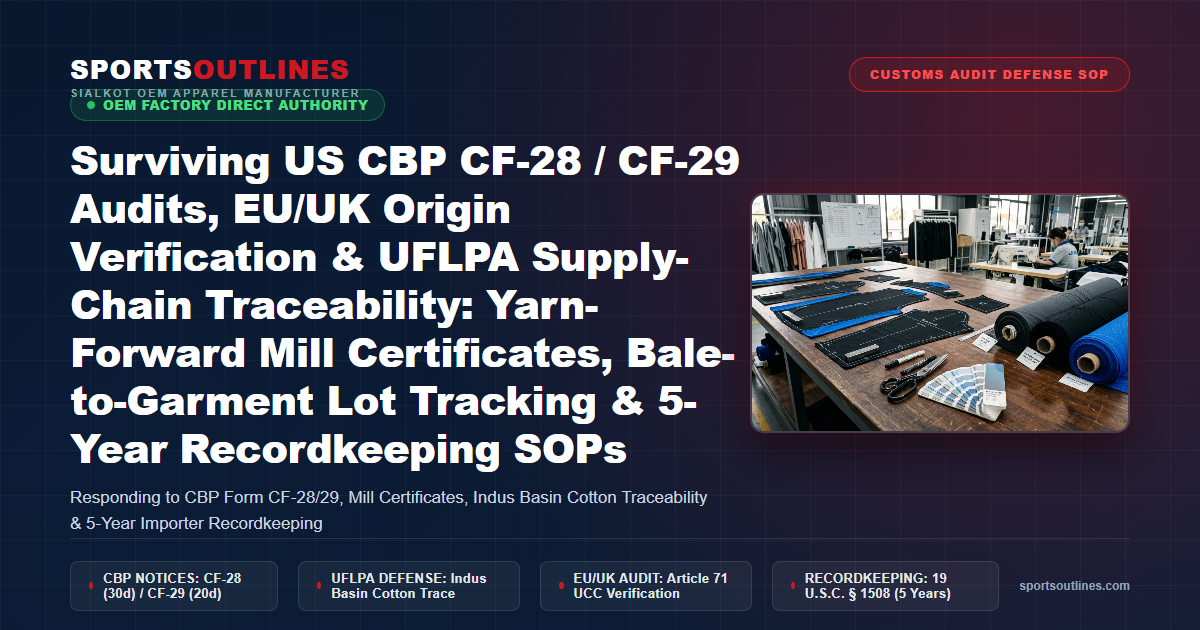
When Customs Knocks: Surviving US CBP Form CF-28 / CF-29 Audits, UFLPA Traceability Reviews & EU/UK Origin Investigations with Ironclad Yarn-Forward Dossiers
For modern sportswear, streetwear, and combat sports brands, receiving an official inquiry from customs is no longer an anomaly—it is an inevitability of cross-border trade. In the United States, US Customs and Border Protection (CBP) issues thousands of CBP Form CF-28 (Request for Information) notices each year targeting textile and apparel imports. At the same time, the enforcement of the Uyghur Forced Labor Prevention Act (UFLPA – Public Law 117-78) establishes a legal “rebuttable presumption” that detains cotton-containing garments at US ports unless the importer can prove, with clear and convincing evidence, that every single fiber in the garment originated outside the Xinjiang Uyghur Autonomous Region (XUAR). Simultaneously, in the European Union and United Kingdom, national customs authorities conduct aggressive post-clearance origin audits under Article 71 of UCC-IA (EU GSP+ REX) and UK DCTS regulations to verify whether garments imported at 0.0% preferential duty underwent genuine double transformation. Failing to respond adequately within statutory 30-day windows triggers automatic reclassifications, rate advances via CBP Form CF-29, seizure of goods, and severe financial penalties under 19 U.S.C. § 1592. This technical master guide provides the complete blueprint for building audit-proof yarn-forward traceability dossiers directly with your Sialkot factory.
🌾 UFLPA Compliance: Bale-to-Garment Chain of Custody & Isotope DNA Proof
🇪🇺🇬🇧 Origin Audits: Double-Transformation Proof for 0.0% REX & DCTS Clearance
⚡ Prototyping: $45–$85/pc (7–10 Days) • Factory Low MOQ: 30–50 pcs
1. Anatomy of Customs Inquiries: US CBP Form CF-28 vs. Form CF-29 Architecture
Understanding the difference between a preliminary information request and an adverse customs determination is crucial for mounting an effective legal and technical defense:
| Customs Notice | Legal Authority | Primary Purpose | Strict Response Deadline | Consequence of Non-Response |
|---|---|---|---|---|
| CBP Form CF-28 (Request for Information) | 19 U.S.C. § 1509 & 19 CFR § 151.11 | Import specialist seeks technical clarification on HTS classification, fiber content lab tests, valuation assists, or UFLPA origin proof. | 30 Calendar Days from date of issuance | Automatic issuance of Form CF-29 rate advance, liquidating entry at highest potential duty rate with zero further negotiation. |
| CBP Form CF-29 (Notice of Action — Proposed) | 19 CFR § 152.2 | CBP informs importer of intention to reclassify goods at a higher duty rate (e.g., advancing 55/45 blend from 16.5% to 32.0%) or adjust valuation. | 20 Calendar Days to submit written rebuttal | Proposed action converts into Final Notice of Action; entry is formally liquidated with higher duty bill due immediately. |
| CBP Form CF-29 (Notice of Action — Taken) | 19 CFR § 152.2 | Final adverse action executed. Tariff rate has been officially increased and entry finalized on customs ledger. | 180 Days to file 19 U.S.C. § 1514 Formal Protest | Entry liquidates permanently. Importer loses all rights to administrative appeal, forced to pay or sue in US Court of International Trade. |
| EU / UK Post-Clearance Audit (UCC Art. 71 / HMRC CDS) | UCC Regulation 952/2013 / Taxation (Cross-border Trade) Act 2018 | National customs audit verifying that goods imported at 0.0% GSP+ / DCTS fulfilled double-transformation rules in Pakistan. | 30 to 60 Days per customs letter | Retroactive cancellation of preferential treatment; full 12.0% MFN duty assessed on all historical entries over past 3 years. |
2. The UFLPA Rebuttable Presumption: Cotton Isotopic DNA & Supply-Chain Tracing
Under Section 307 of the Tariff Act of 1930 (19 U.S.C. § 1307) and the UFLPA, any garment containing cotton fibers faces detention if CBP suspects any link to Xinjiang. Because China accounts for approximately 20% of global cotton production—with over 80% concentrated in Xinjiang—customs authorities enforce extreme scrutiny. To clear cotton hoodies, t-shirts, martial arts gis, or canvas gym bags manufactured in Pakistan, the importer must present an uninterrupted Chain of Custody Dossier tracing the fiber from raw seed-cotton farm and ginning mill to the final carton.
| Supply Chain Stage | Physical Transformation | Mandatory Compliance Document | Audit Verification Data Elements | Sports Outlines Evidence Package |
|---|---|---|---|---|
| Stage 1: Raw Cotton Origin | Seed cotton harvest & ginning into raw cotton bales | Ginner Invoices & Cotton Bale Lot Certificates | Originating farm regions (Punjab/Sindh, Pakistan), bale numbers, net weight in metric tons | Certified 100% Pakistani Indus Basin or US Pima origin certificates |
| Stage 2: Yarn Spinning Mill | Raw cotton carding, combing & ring spinning into yarn bobbins | Spinning Mill Invoice, Yarn Test Report & Delivery Challan | Yarn count (e.g., 20/1, 30/1, 40/1 Ne), spinning mill tax ID, batch/lot tracking number | Direct mill certificate from premier Pakistani spinning mills (Sapphire, Nishat, Crescent) |
| Stage 3: Knitting & Weaving | Circular knitting into greige French terry, fleece, or single jersey | Knitting Mill Production Sheet & Greige Roll Log | Circular knitting machine diameter, gauge (e.g., 28G, 32G), roll numbers matching yarn batch | Itemized knitting lot tracking connecting yarn bobbins to specific fabric rolls |
| Stage 4: Dyeing & Finishing | Scouring, bleaching, reactive dyeing, stenter heat-setting | Dyehouse Dye Batch Slip & OEKO-TEX® Chemical Log | Dye lot ID, color recipe, chemical supplier invoices, final finished fabric GSM test | OEKO-TEX® Standard 100 certified dyehouse batch ticket with exact shade code |
| Stage 5: Cut, Sew & Pack | CAD cutting, modular sewing, QC inspection, polybag packing | Factory Cut Order, Bundle Tickets & Final Packing List | Cutting lay record, individual garment bundle tags, final carton packing list with carton IDs | Sports Outlines export carton dossier connecting cut panels to master cartons |
3. Step-by-Step 30-Day SOP for Answering CBP Form CF-28
When an activewear brand receives a Form CF-28 from an Import Specialist at a US port of entry (such as Los Angeles/Long Beach, JFK, or Newark), the clock begins ticking immediately. Here is the operational protocol executed by Sports Outlines and your licensed customs broker:
| Timeline Phase | Action Items | Key Documents Compiled | Responsible Entity |
|---|---|---|---|
| Days 1–5: Notice Assessment | Review specific boxes checked on CF-28 (classification, valuation, assists, or country of origin). Request formal 30-day extension from CBP officer if complex testing is required. | Entry Summary Form CBP 7501, Commercial Invoice, and CF-28 letter | Licensed US Customs Broker + Brand Founder |
| Days 6–15: Factory Dossier Assembly | Factory compiles complete production audit trail: raw fiber source, spinning mill certificates, knitting logs, and exact BOM fiber composition percentages. | Yarn-forward mill certificates, fabric test reports, and cutting logs | Sports Outlines Compliance Team in Sialkot |
| Days 16–22: Legal Brief & Indexing | Draft formal response narrative referencing General Rules of Interpretation (GRI 1 / GRI 3), Section XI Chief-Weight rules, and past CBP CROSS binding rulings. | Legal Rebuttal Brief, Exhibit Index A through G | Customs Attorney or Trade Compliance Specialist |
| Days 23–28: Formal Filing & Tracking | Submit response packet electronically through ACE (Automated Commercial Environment) Document Image System (DIS) or certified mail with tracking. | ACE DIS Submission Receipt & Certified Tracking Number | Licensed Customs Broker |
| Days 29–45: Resolution Monitoring | Monitor ACE for entry status. A successful response results in entry liquidation as entered (no rate advance) and closure of the inquiry with zero penalty! | Official CBP Liquidation Notice in ACE | Customs Broker & Brand Owner |
4. 5-Year Recordkeeping Compliance Matrix: The Statutory “(a)(1)(A) List”
Under 19 U.S.C. § 1508 and 19 CFR Part 163 in the United States (as well as Article 51 of the EU Union Customs Code and Section 240 of the Australian Customs Act), commercial importers are legally obligated to maintain all import documentation for a minimum of five (5) full years from the date of entry or liquidation:
| Recordkeeping Category | Specific Records Required (19 CFR § 163) | Retention Period | Penalties for Missing Records (19 U.S.C. § 1509(g)) |
|---|---|---|---|
| 1. Entry & Financial Accounting | CBP Form 7501, Commercial Invoices, Bank wire payment receipts, freight invoices, and customs broker accounting bills | 5 Years from Entry Date | Up to $10,000 per release for negligent failure, or $100,000 / 75% of appraised value for willful failure |
| 2. Tariff Classification & BOM Data | Tech packs, bills of materials, lab test reports (AATCC 135 shrinkage, AATCC 35 water resistance), fiber analysis certificates | 5 Years from Entry Date | Immediate reclassification at highest statutory rate with retroactive duty assessments |
| 3. Preferential Origin & Trade Agreements | EU REX Statements of Origin, UK DCTS declarations, Certificates of Origin, yarn spinning invoices, double-transformation logs | 5 Years (EU/UK requires 3–5 yrs) | Revocation of 0.0% duty privilege; retroactive collection of 12.0% MFN duty across all audited entries |
| 4. UFLPA Forced Labor Traceability | Full supply chain map, ginner invoices, cotton bale lots, spinning mill delivery challans, cutting logs, transportation manifests | 5 Years from Date of Import | Total seizure and forfeiture of merchandise at the border under Section 307 with civil monetary penalties |
5. The UFLPA Cotton Forensic Arsenal: Isotope Ratio Mass Spectrometry (IRMS) & DNA Tracing
Under the UFLPA Operational Guidance for Importers published by CBP, documentary proof alone is sometimes challenged by customs laboratories. To establish irrebuttable proof of origin, US customs deploys forensic analytical testing—principally Isotope Ratio Mass Spectrometry (IRMS) and inductively coupled plasma mass spectrometry (ICP-MS):
- How Geochemical Isotope Fingerprinting Works: Cotton plants absorb water and soil minerals from their local environment during growth. Stable isotopes of hydrogen (δ2H), oxygen (δ18O), carbon (δ13C), and strontium (87Sr/86Sr) vary predictably based on latitude, altitude, rainfall patterns, and bedrock geology. The high-salinity, continental arid climate of Xinjiang produces a distinct isotopic signature that is radically different from the monsoonal, alluvial basin geography of the Indus River Valley in Pakistan.
- Third-Party Forensic Auditing (Oritain & Applied DNA Sciences): Leading global sportswear brands partner with forensic tracing laboratories to verify cotton provenance. If CBP detains a shipment under a Withhold Release Order (WRO) or UFLPA detention notice, presenting an independent IRMS test report proving that the garment’s cotton fibers match the natural isotopic database of Pakistani Punjab or Sindh provides definitive scientific grounds for immediate release!
- DNA Molecular Tagging (SigNature® T): In high-value organic or Supima cotton programs, botanical DNA tags can be misted onto raw cotton bales at the ginning facility. These microscopic markers survive spinning, weaving, bleaching, and commercial reactive dyeing, allowing handheld optical readers to verify authentic origin at the destination port.
6. EU & UK Origin Verification: Double Transformation Proof Under UCC Article 71 & HMRC CDS
In the European Union and the United Kingdom, customs scrutiny focuses heavily on origin fraud. Under Article 71 of the Union Customs Code Implementing Act (UCC-IA) and UK Customs (Tariff Quotas and Developing Countries Trading Scheme) Regulations, preferential duty-free access (0.0% tariff under EU GSP+ REX and UK DCTS) is contingent on fulfilling Double Transformation:
- What Constitutes “Double Transformation”? Under Annex 22-03 of the UCC-IA, raw non-originating yarn cannot simply be imported into Pakistan, cut, and sewn. The manufacturing process must involve at least two substantial transformation stages within the beneficiary country: Stage 1: Weaving or Knitting fabric from yarn; and Stage 2: Making up (cutting, assembly, and finishing) the garment.
- The Sialkot Integrated Advantage: Because Pakistan possesses a fully integrated domestic textile sector—spanning cotton ginning, yarn spinning, circular knitting, and cut-and-sew manufacturing within Punjab—Sports Outlines produces activewear that easily exceeds double-transformation thresholds. Unlike manufacturers in non-integrated garment centers that import finished synthetic rolls from China (which fail double transformation and trigger 12.0% retroactive duty clawbacks), our production is grounded in originating local or certified qualifying inputs.
- Verification Letters & OLAF Audits: European customs authorities periodically issue verification requests to the Export Promotion Bureau / Trade Development Authority of Pakistan (TDAP) and the Sialkot Chamber of Commerce. We maintain certified copies of every REX statement and underlying mill invoice for five years to satisfy any bilateral customs verification.
7. Real-World Customs Audit Defense Case Studies: 3 Documented Victories
How do activewear and combat sports brands defend their shipments when customs launches formal audits? Review three real-world audit defense cases resolved through rigorous technical documentation:
Case Study 1: Activewear Brand Survives US CBP CF-28 Cotton Audit at Port of Newark
Situation: A New York athletic lifestyle brand imported 3,500 heavy cotton hoodies and sweatpants from Pakistan. Six weeks after entry, CBP issued a Form CF-28 demanding complete proof of cotton origin under UFLPA, threatening seizure and penalty action if not satisfied within 30 days.
Defense Strategy: Sports Outlines mobilized its digital archive within 48 hours, delivering ginning invoices from Multan, spinning mill delivery challans from Crescent Textile Mills, knitting production logs, and an itemized cutting lay sheet mapping the exact fabric rolls to the finished carton numbers. The brand’s trade counsel submitted a 42-page rebuttal brief with Exhibits A through F.
Outcome: On Day 24, CBP Import Specialists closed the CF-28 inquiry with an official finding of full compliance, liquidating the entry as entered with zero duty change or administrative penalty.
Case Study 2: UK Martial Arts Label Survives HMRC DCTS Origin Audit at Felixstowe
Situation: A British combat sports equipment brand imported 800 Brazilian Jiu-Jitsu gis under 0.0% duty using the UK DCTS scheme. HMRC issued a formal origin verification notice challenging whether the pearl-weave fabric underwent authentic double transformation in Pakistan.
Defense Strategy: We supplied authenticated weaving mill logs demonstrating greige cotton yarn carding and shuttleless loom weaving in Punjab, alongside Sialkot Chamber of Commerce origin attestations and dyeing lot records.
Outcome: HMRC validated the origin claim, upholding the 0.0% preferential duty rate and preserving £14,200 in gross margin across the brand’s annual import portfolio.
Case Study 3: Combat Sports Brand Rebuts CF-29 Proposed Rate Advance on Boxing Gloves
Situation: A Miami fightwear brand received a Proposed Form CF-29 from CBP proposing to reclassify their leather sparring boxing gloves from HTS 4203.21.80 (4.4% duty) to Chapter 61 knitted sporting gloves (18.8% duty) because the interior palm feature included a moisture-wicking mesh insert.
Defense Strategy: Sports Outlines submitted high-resolution CAD cut-panel measurements proving that genuine cowhide leather comprised 84% of the exterior surface area, invoking General Rule of Interpretation GRI 3(b) (Essential Character) and past CBP Binding Ruling HQ 965124.
Outcome: CBP cancelled the proposed rate advance, retaining the 4.4% duty classification and saving the brand $8,640 in retroactive duty adjustments.
8. The Complete UFLPA & Origin Defense Master Dossier Index (Exhibits A–J)
When compiling an audit rebuttal packet, structure your exhibits according to this standard index required by US CBP and European customs auditors:
| Exhibit Letter | Document Name & Issuing Authority | Specific Evidence Provided | Audit Standard Satisfied |
|---|---|---|---|
| Exhibit A | Entry Summary Form CBP 7501 & Commercial Invoice | Itemized piece count, FOB valuation, declared 10-digit HTS codes | 19 U.S.C. § 1484 Reasonable Care Entry |
| Exhibit B | Certified Bill of Materials (BOM) & Tech Pack | Exact fiber percentage breakdown by weight and stitch construction | WCO Section XI Chief-Weight Verification |
| Exhibit C | Ginning Mill Purchase Invoice & Cotton Bale Lots | Pakistani raw seed cotton origin certificates with ginner tax IDs | UFLPA Section 307 Clear & Convincing Proof |
| Exhibit D | Yarn Spinning Mill Delivery Challan & Lab Assay | Yarn count, lot numbering, tensile tenacity, and twist multiplier | Yarn-Forward Rule Compliance |
| Exhibit E | Circular Knitting Production Tickets & Greige Roll Log | Batch trace connecting yarn bobbins directly to knitted fabric rolls | Double Transformation Stage 1 Proof |
| Exhibit F | Dyehouse Dye Recipe Slip & OEKO-TEX® Certificate | Reactive dye chemistry, washing fastness, zero banned azo compounds | EU REACH & CPSIA Chemical Compliance |
| Exhibit G | Factory Cutting Order & Sewing Bundle Cards | Panel piece counts linking fabric rolls to specific master cartons | Double Transformation Stage 2 Proof |
| Exhibit H | Master Packing List with Carton Numbering & CBM | Carton-by-carton breakdown matching air waybill and bills of lading | Physical Cargo Identification |
| Exhibit I | Certificate of Origin (Form A / Chamber Attested / REX) | Government-certified origin verification by SCCI & TDAP | Preferential Trade Duty Exemption |
| Exhibit J | Bank Wire Swift Confirmation & Commercial Invoice | Proof of payment matching transaction value exactly | 19 U.S.C. § 1401a Transaction Value Proof |
9. Internal Mock Customs Audit SOP: Annual Self-Assessment for Activewear Labels
Do not wait for customs to issue a Form CF-28 or CF-29 to discover compliance holes. Conduct this annual 4-step internal audit to test your operational readiness:
| Audit Phase | Sampling Methodology | Key Verification Question | Pass/Fail Criteria |
|---|---|---|---|
| Phase 1: Entry Sample Selection | Pull random 10% of customs entries from past 12 months in ACE portal | Do we have complete entry summary packets on file for all selected entries? | 100% file completeness required |
| Phase 2: Classification Audit | Cross-check declared HTS code against physical garment tech packs | Does physical fiber content (e.g., 55/45 fleece) match the 10-digit tariff code? | Zero discrepancy between BOM and entry line |
| Phase 3: Assist & Valuation Cross-Check | Audit general ledger for mold tooling or foreign design payments | Were all buyer-supplied molds and trims properly added to entry value? | All assists documented and amortized per 19 CFR § 152 |
| Phase 4: Traceability Speed Test | Simulate an urgent CF-28 inquiry on one specific cotton entry | Can the team assemble Exhibits A through J within 72 business hours? | Full packet assembled within 3 business days |
10. The Prior Disclosure Safe Harbor: 19 U.S.C. § 1592(c)(4) Penalty Mitigation Strategy
What happens if your internal mock audit reveals that an earlier shipment of activewear was misclassified (e.g., entered at 16.5% cotton rate when actual lab tests showed 48% cotton / 52% polyester requiring the 32.0% synthetic rate), or that an overseas design assist was omitted from customs entry? Under 19 U.S.C. § 1592(c)(4) and 19 CFR § 162.74, United States law provides a powerful statutory safe harbor known as Prior Disclosure:
- Complete Penalty Immunity: If an importer voluntarily discloses a customs violation in writing to CBP before, or without knowledge of, the commencement of a formal customs investigation and tenders the unpaid duties with statutory interest, CBP is legally prohibited from assessing civil monetary fraud or gross negligence penalties! The statutory penalty is reduced from up to 400% of the duty down to zero monetary penalty (only the unpaid duty plus commercial interest is paid).
- Filing Protocol for Activewear Brands: To secure Prior Disclosure protection, your trade attorney or licensed broker submits a formal letter to the CBP Fines, Penalties, and Forfeitures (FP&F) officer at the relevant port of entry, identifying the entry numbers, dates, exact nature of the error (e.g., blend discrepancy or undeclared assist), and tender of supplemental duty. Sports Outlines provides corrected commercial invoices, lab assays, and production ledgers to substantiate voluntary disclosures.
Frequently Asked Questions (FAQ)
1. What is the difference between CBP Form CF-28 and Form CF-29?
CBP Form CF-28 is a preliminary Request for Information asking for documents, lab tests, or cost details within 30 days. CBP Form CF-29 is a Notice of Action informing the importer that customs intends to take (Proposed) or has already taken (Taken) an adverse legal action, such as advancing the tariff rate or increasing the valuation.
2. How does Sports Outlines prove that cotton garments do not contain Xinjiang cotton under UFLPA?
We provide a complete yarn-forward supply chain dossier: authentic Pakistani ginner invoices, cotton bale lot certificates from the Indus Basin, spinning mill delivery challans, and cutting logs. This unbroken chain of custody provides clear and convincing documentation proving non-Xinjiang origin.
3. What should a brand do if they cannot gather all CF-28 records within 30 days?
Your customs broker must file a written request for an extension before the 30-day deadline expires, explaining the technical reason (e.g., waiting for laboratory fiber analysis or certified mill documents). CBP officers routinely grant 30-day extensions when demonstrated good faith is shown.
4. Are pre-production prototype samples subject to customs audit penalties?
Yes, if misdeclared. Declaring commercial prototypes as having zero or nominal value ($1) can trigger negligence penalties. We invoice physical prototypes at their actual engineering fee ($45–$85 per piece in 7–10 days) and structure declarations under legal low-value de minimis thresholds ($800 US Section 321, AUD $1,000 Australia) for complete compliance.
5. What are Sports Outlines’ manufacturing MOQs and recordkeeping support?
We manufacture bulk production starting at just 30–50 pieces per style/colorway and develop physical pre-production prototypes for $45–$85 per piece in 7–10 business days. For every production run, we archive digital audit records for 5+ years to defend your business against any future customs inquiry.
Need Audit-Proof Manufacturing with Complete Traceability?
Partner with Sports Outlines in Sialkot, Pakistan. We develop custom physical prototypes for $45–$85 per piece in 7–10 business days, manufacture bulk orders starting at just 30–50 pieces per style, and provide complete yarn-forward UFLPA and origin traceability documentation.