Direct Manufacturer Answer: Sourcing Custom Heavyweight Fleece Sweatpants with Low MOQ
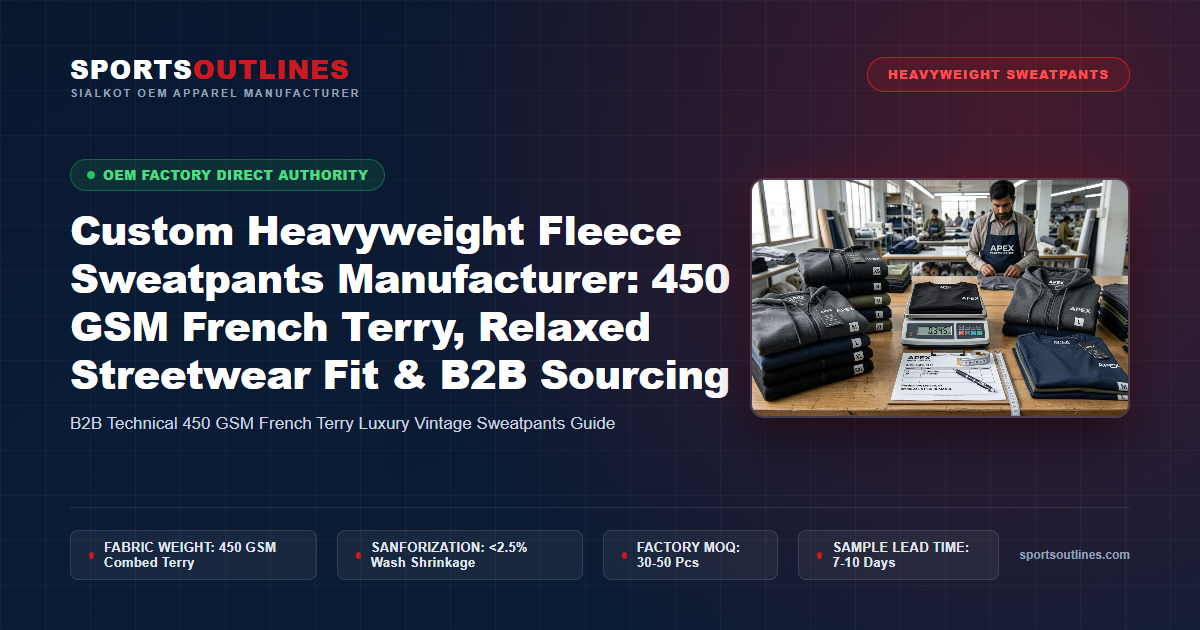
Manufacturing luxury custom heavyweight fleece sweatpants requires mastering heavy textile knitting, yarn tensioning, and pre-shrunk compacting. Standard commercial fleece tops out at 280–320 GSM and pills after three washes; authentic premium streetwear gym sweatpants demand 400–480 GSM 100% combed cotton 3-end loopback French terry or brushed fleece. The fabric undergoes industrial tubular compactor stabilization, constraining residual laundry shrinkage to under 2.5%. Features include a thick 6.0 cm gathered ribbed waistband, 2.5-inch ribbed leg cuffs, deep side slash pockets anchored to the front rise, and high-tensile twin-needle topstitching. Sports Outlines in Sialkot, Pakistan offers low factory MOQs starting at 30–50 pieces per style/colorway with sizes ranging from XS to 4XL.
- Low Production Minimums: 30–50 pieces per style/colorway with flexible sizing for boutique apparel brands.
- Physical Sample Prototyping: Pre-production physical prototypes delivered in 7–10 business days ($45–$85 per piece, non-refundable) to verify fabric heft, loopback pile, and pattern drape.
- Direct Sialkot Factory Floor: Connect with our production team via WhatsApp: +92 316 7932595 or sportsoutlines.com.
Over the last several seasons, high-end streetwear and fitness apparel have converged around luxury heavyweight basics. Discerning consumers, fitness influencers, and high-ticket gym apparel buyers increasingly reject flimsy, fast-fashion polyester fleece in favor of substantial, structured cotton sweatpants that hold their silhouette, drape cleanly over bulky training sneakers, and provide comforting thermal weight during cold-weather workouts.
However, manufacturing true 450 GSM fleece sweatpants presents severe technical hurdles that unequipped low-cost sewing shops cannot handle. Ultra-heavy cotton fleece requires high-torque industrial circular knitting machines, specialized low-tension dye vats, heavy-duty needle setups that do not chew or sever cotton yarns, and precise shrinkage pre-treatment. As an established custom heavyweight fleece sweatpants manufacturer in Sialkot, Pakistan, Sports Outlines provides brands with end-to-end technical mastery from yarn spinning to final garment finishing.
1. Textile Science: 3-End French Terry vs. Brushed Fleece at 400–500 GSM
In luxury activewear manufacturing, “heavyweight” is not merely an aesthetic term—it is a precise textile engineering metric. Standard promotional sweatpants typically weigh between 240 and 280 GSM, relying on loose, low-density knitting puffed up with aggressive brushing that rapidly sheds lint in the laundry. True heavyweight fleece sweatpants begin at 400 GSM and range up to 500 GSM, utilizing high-gauge knit density and specialized 3-end yarn configurations.
The 3-End Fleece Architecture (Face, Tie & Loop)
To achieve structural heft without stiffness, our knitting mills deploy German Mayer & Cie 3-thread fleece circular knitting machines. This technology knits three distinct yarns simultaneously:
- Face Yarn (30s/1 or 32s/1 100% Combed Cotton): The exterior face is knitted with fine, tightly twisted long-staple combed cotton yarns. This creates an exceptionally smooth, uniform surface that resists abrasion, eliminates pilling (Grade 4.5+ under ISO 12945-2), and serves as an ideal canvas for direct embroidery, screen printing, or garment dye washes.
- Tie Yarn (100D/36F Micro-Polyester or 40s/1 Cotton): A fine filament yarn hidden between the face and the back loop. This tie thread anchors the back loops firmly into the face knit, preventing loop pull-out, stabilizing fabric grain, and adding subtle mechanical cross-stretch.
- Back Loop Yarn (10s/1 or 12s/1 Ring-Spun Cotton): A heavy-count, low-twist cotton yarn that forms dense, uniform loops across the interior face. In unbrushed French Terry, these loops remain intact, providing natural breathability, moisture absorption, and an authentic vintage aesthetic. In brushed fleece, these loops are gently sheared and napped using wire-covered raising rollers, creating a cloud-soft, plush thermal insulating fleece layer.
| Fabric Characteristic | 3-End Unbrushed French Terry | 3-End Brushed Heavy Fleece | Standard Commercial Sweatpants |
|---|---|---|---|
| Weight (GSM) | 420–460 GSM | 450–480 GSM | 260–300 GSM |
| Yarn Spinning Tech | 100% Combed Ring-Spun Cotton | 80/20 Combed Cotton / Poly Core | Open-End Carded Cotton / Poly |
| Interior Texture | Crisp, uniform micro-loops | Ultra-plush sheared thermal pile | Loose, thin brushed fuzz |
| Lint Shedding (Wash 1-5) | Zero lint shedding | Negligible (<0.2g loss) | Severe fiber shedding |
| Garment Drape & Structure | Heavy, structured streetwear drape | Full, dense architectural silhouette | Flimsy, clings awkwardly |
2. Pre-Shrunk Compacting & Garment Dye Chemistry
One of the most frequent customer complaints regarding heavyweight 100% cotton sweatpants is excessive laundry shrinkage. Untreated heavy cotton knit can shrink anywhere from 8% to 14% in length after the first hot wash and machine dry, turning an ankle-length streetwear sweatpant into an awkward cropped jogger.
At Sports Outlines, we eliminate shrinkage complaints through rigorous two-stage textile stabilization:
- Industrial Compacting (Sanforization for Knits): After dyeing, fabric rolls pass through a Ferraro industrial felt compactor. Under controlled steam injection, intense heat (140°C), and compressive mechanical compaction, the knitted loops are physically compressed in length. This pre-relaxes internal yarn stress, locking residual dimensional change to less than 2.5% under AATCC 135 testing protocols.
- Garment Dyeing & Cellulase Bio-Polishing: For luxury vintage streetwear collections, we cut and sew sweatpants from unbleached PFD (Prepared For Dyeing) fabric and perform whole-garment reactive dyeing. The garments are tumble-washed in stainless steel dye vats at 60°C with natural cellulase bio-enzymes. The enzymes gently digest protruding microscopic surface fuzz, yielding an ultra-soft hand feel with authentic subtle fading along the pocket welts and seam lines without compromising tensile strength.
3. Silhouette Anatomy: The Relaxed Taper vs. Wide-Leg Streetwear Cut
Heavyweight sweatpants require distinct pattern geometry compared to lightweight training joggers. Because 450 GSM fleece possesses significant material thickness, tight skin-hugging cuts feel constrictive and bunch unnaturally behind the knees. Modern fitness brands succeed by offering one of two dominant silhouette blocks:
The Relaxed Athletic Taper (The “Gym-to-Street” Silhouette)
Featuring a generous 33 cm half-thigh measurement in size Medium, this cut allows full quad and hamstring expansion for muscular physiques. The outseam sweeps downward in a clean, gradual taper toward a heavy 2.5-inch (6.5 cm) elasticated ribbed cuff. The cuff opening measures 12.5 cm flat, creating the signature streetwear “stack” atop high-top training sneakers or lifestyle shoes.
The Open-Bottom Straight / Wide-Leg Silhouette
Increasingly popular in retro bodybuilding and luxury athleisure, this silhouette eliminates the elastic leg cuff entirely. The leg falls in a straight, wide line from knee to hem (22 cm to 24 cm half-hem width). An optional concealed bungee cord with a low-profile plastic toggle inside the hem allows the wearer to switch between wide-leg drape and gathered ankle cuffing on the fly.
| POM Specification (cm) | XS | S | M (Sample Base) | L | XL | 2XL | 3XL | Tolerance (±) |
|---|---|---|---|---|---|---|---|---|
| 1/2 Relaxed Waistband | 35.0 | 37.5 | 40.0 | 42.5 | 45.0 | 47.5 | 50.0 | ± 1.0 |
| 1/2 Stretched Waistband | 48.0 | 51.0 | 54.0 | 57.0 | 60.0 | 63.0 | 66.0 | ± 1.5 |
| 1/2 Hip Circumference | 50.0 | 53.0 | 56.0 | 59.0 | 62.0 | 65.0 | 68.0 | ± 1.0 |
| 1/2 Thigh Width | 30.0 | 31.5 | 33.0 | 34.5 | 36.0 | 37.5 | 39.0 | ± 0.8 |
| 1/2 Knee Width | 21.0 | 22.0 | 23.0 | 24.0 | 25.0 | 26.0 | 27.0 | ± 0.6 |
| 1/2 Ribbed Ankle Cuff Width | 11.5 | 12.0 | 12.5 | 13.0 | 13.5 | 14.0 | 14.5 | ± 0.5 |
| Inseam Length | 74.0 | 75.5 | 77.0 | 78.5 | 79.5 | 80.5 | 81.5 | ± 1.0 |
| Front Rise (incl. waistband) | 29.0 | 30.0 | 31.0 | 32.0 | 33.0 | 34.0 | 35.0 | ± 0.8 |
4. Luxury Hardware & Structural Sewing Details
In a luxury fleece garment, every stitch line communicates craftsmanship. Because 450 GSM fleece creates dense fabric layers when folded, sewing workstations must use ballpoint titanium needles (Schmetz SES #80 to #90) to pierce thick seams without severing cotton yarns.
- 6.0 cm Quilted Rib Waistband with 100% Cotton Tubular Drawcord: The waistband uses heavy 2×2 cotton rib (420 GSM) encasing 5.5 cm natural elastic. Through the center, we feed a heavy-gauge, 100% combed cotton tubular drawcord (16 mm diameter). Drawcord tips are secured with heavyweight zinc-alloy metal aglets or dipped rubber finishes.
- Diamond Crotch Gusset for Mobility Engineering: Heavyweight 100% cotton fleece has zero elastane recovery. If sewn with a standard 4-way cross seam in the crotch, athletes and streetwear wearers experience tight pinching and premature seam rupture during sitting, driving, or lunging. We engineer an elongated diamond crotch gusset panel (8.0 cm x 18.0 cm) cut on the bias. This diamond insert distributes kinetic groin stresses across four angled flatlock seam lines, delivering unrestricted mobility without adding bulk.
- Anchored Side Slash Pockets & Rear Patch Pocket: The front slash pocket bags are constructed from matching 180 GSM cotton jersey to prevent unwanted hip bulge. The pocket mouth is reinforced with a concealed interior 12 mm poly-twill stay-tape and double-needle topstitching. High-stress entry points receive automated 28-stitch dense bartacks. A single back right patch pocket features reinforced triangular bar-tacked corners, clean turned edges, and an optional concealed YKK snap closure.
- Twin-Needle Topstitched Flat Felled Seams: Outseams and center rises are joined with 5-thread safety sergers and reinforced with 1/4-inch gauge twin-needle topstitching using heavy Coats Epic poly-core thread. This reinforces the garment against bursting while flattening bulky seam allowances against the body.
5. Embellishment Technologies for Heavyweight Fleece
Heavyweight fleece provides a stable foundation for dimensional embellishments that elevate retail perceived value. Our Sialkot facility executes four primary branding techniques:
- High-Density 3D Puff Embroidery: Using 3.0 mm high-density EVA foam underlay, Madeira 40-weight polyester embroidery threads wrap around the foam to create sharp, raised lettering that stands out boldly on thick fleece. Digitizing software calculates 25% higher stitch density along border columns to cleanly bevel and conceal the foam edge.
- Chenille Lettering & Tackle Twill Appliqué: For collegiate and varsity streetwear aesthetics, chenille moss-stitch patches with felt border backing are stitched directly onto the thigh panel using zig-zag border embroidery. The loop pile mimics vintage athletic varsity uniforms with thick, plush texture.
- Silicone Plastisol 3D Screen Printing & Water-Based Discharge: Specialty high-viscosity silicone inks print through 40-mesh screens to create a tactile, rubbery 1.0 mm raised print that withstands machine washing without cracking. For vintage washed colorways, we formulate water-based discharge inks that bleach the reactive cotton dye out of the fabric surface and replace it with soft-hand pigment, leaving zero plastic ink feel.
- Laser-Cut Metal Plate Badges & High-Definition Damask Woven Labeling: Small, minimalist zinc-alloy or brass badges (matte black or antique silver) can be hand-riveted onto the rear pocket welt for an ultra-clean luxury presentation. Furthermore, interior branding features 50-denier high-definition damask woven labels sewn with natural cotton herringbone stay tape across the inner waistband for a zero-irritation luxury touchpoint.
6. Industrial Workstation Machinery & Needle Engineering for 450+ GSM Multi-Ply Seams
Sewing 450 to 500 GSM loopback French Terry requires extreme mechanical power and precise needle cooling. When joining the waistband or pocket bags to the main body, the sewing machine must penetrate through four to six plies of dense cotton knit—representing an aggregate fabric thickness of up to 6.5 mm. In amateur manufacturing facilities, standard sewing machines suffer needle deflection, skipped stitches, and friction-induced yarn burning.
In our Sialkot factory lines, we solve multi-ply fleece assembly through specialized machine setups:
- Titanium Nitride Coated Needles (Groz-Beckert Gebedur): We exclusively run titanium nitride coated needles (size 90/14 to 100/16 with medium ball points, style FFG/SES). The ultra-hard titanium coating resists needle bending under high penetration resistance, while the rounded ball point slips smoothly between cotton knit yarns without severing individual fibers.
- Synchronized Upper and Lower Differential Feed Dogs: To assemble the long outseams without stretching the fabric, our Juki DDL-9000C workstations employ computerized dual-drive feed systems. The upper walking foot and lower feed dog advance simultaneously, guaranteeing zero seam puckering or fabric slippage across the 105 cm leg length.
- Kansai Special Waistband Station with Silicone Thread Lubrication: Attaching a heavy 420 GSM 2×2 cotton rib waistband containing encased 5.5 cm natural elastic requires a dedicated 4-needle chainstitch workstation. We route our Coats Epic poly-core sewing thread through an automated liquid silicone lubrication bath. This cools the needle eye during continuous high-speed stitching (up to 4,200 stitches/min), preventing thread melting and stitch snapping.
- Flat Felled Seam Flattening Press (Hoffman Steam Calender): After sewing the bulky front and back rises, garments pass through industrial high-pressure steam utility presses (operating at 150°C with 5.5 bar pneumatic clamping). This flattens the multi-ply seam allowances, creating a smooth, flat interior that feels luxurious against bare skin.
7. Garment Dyeing Chemistry, Stone Washing & Enzyme Bio-Polishing
For upscale streetwear and fitness brands, color depth and vintage hand-feel are critical brand identifiers. Rather than utilizing basic piece-dyed fabric rolls that look flat and uniform, we specialize in advanced garment dye treatments carried out in our state-of-the-art washing facility:
- Low-Salt Reactive Garment Dyeing: Sweatpants assembled from raw, unbleached cotton are dyed in atmospheric rotary drum dyeing machines using Bifunctional Reactive Dyes (Remazol / Novacron chemistry). Operating at 60°C with a low liquor ratio (1:6), this process creates deep chemical covalent bonding with the cotton cellulose fibers, guaranteeing Grade 4.5+ wash fastness (AATCC 61) with zero post-purchase color bleeding.
- Neutral Cellulase Enzyme Bio-Polishing: To eliminate initial fabric stiffness and remove microscopic micro-fibrils that cause surface pilling, the dyed garments undergo an enzyme bath utilizing neutral cellulase enzymes (Denimax 35 U/g activity at pH 6.5). The enzymes selectively hydrolyze loose surface fibers, leaving the core cotton yarns intact. This delivers an unmistakable peach-skin, velvety hand-feel that feels broken-in from day one.
- Vintage Mineral & Acid Distress Washes: For distressed streetwear collections, we perform selective potassium permanganate (PP) spraying or pumice stone tumbling. The chemical reaction oxidizes surface dye along pocket rims, waistband folds, and outseam topstitching, mimicking years of authentic sun fading while preserving full fabric burst strength.
8. Production Economics: Low MOQ 30–50 Pcs, Prototyping & Unit Margins
Luxury heavyweight streetwear commands some of the highest retail margins in the activewear sector. While high-end brands retail 450 GSM sweatpants between $88 and $140 USD, factory-direct manufacturing costs remain highly accessible. At Sports Outlines, our low MOQ of 30–50 pieces per style/colorway allows founders to enter the luxury streetwear space without large capital requirements.
| Volume Tier | Production Quantity | FOB Unit Cost (450 GSM Terry) | Target DTC Retail Price | Gross Profit Margin (%) |
|---|---|---|---|---|
| Boutique Startup | 30–50 pieces | $21.50 – $24.50 | $88.00 – $110.00 | 75% – 78% |
| Scale Drop | 100–250 pieces | $18.00 – $20.00 | $88.00 – $110.00 | 79% – 82% |
| Commercial Volume | 500–1,000 pieces | $15.20 – $17.00 | $85.00 – $105.00 | 82% – 84% |
| Enterprise Run | 2,000+ pieces | $12.80 – $14.20 | $80.00 – $100.00 | 84% – 86% |
Sample Prototyping Terms: We develop complete physical prototype samples for $45 to $85 per piece (turnaround time 7 to 10 business days). This sampling cost covers individual CAD pattern tailoring, sample room master cutting, custom machine setup, and garment dye vat testing. Prototyping fees are strictly non-refundable and do not apply as credits toward future production invoices.
9. AQL 2.5 Industrial Quality Assurance Protocol
Heavy fleece manufacturing requires vigilant quality control to prevent issues like uneven pile, color bleeding, or seam unraveling. Every production batch is inspected under ISO 2859-1 AQL 2.5 standards:
- Raw Fleece GSM Verification: Circular fabric swatches (100 cm²) are cut using digital GSM round cutters across the left, middle, and right of each roll to guarantee uniform weight density (±3% tolerance).
- Color Fastness & Crocking Test (AATCC 8 / AATCC 61): Both wet and dry crocking tests verify that dark reactive dyes (black, vintage charcoal, chocolate brown) achieve Grade 4.5+ fastness, ensuring zero dye transfer to white sneakers.
- Needle Detection & Seam Safety: Finished garments pass through automated 9-point conveyor metal detectors to ensure zero broken needle fragments remain embedded in the thick fleece seams.
- Dimensional Stability Audit: Finished samples undergo 60°C commercial wash cycles with tumble dry. Total shrinkage along length and width must remain under 2.5%.
10. How to Launch Your Luxury Sweatpants Line with Sports Outlines
Partnering with our Sialkot factory provides complete transparency, direct manufacturer communication, and professional export logistics:
5-Step Production Roadmap
- Design Submission: Send your CAD flat sketches or physical reference samples. Specify fabric weight (420 vs. 480 GSM), finish (French Terry vs. brushed fleece), and wash type.
- Physical Prototyping ($45–$85): Our sample room knits, cuts, dyes, and sews your prototype within 7–10 days, delivered via express air courier.
- Fit & Wash Evaluation: Inspect the sample. Verify the heavy drape, waistband elasticity, drawcord weight, and wash softness.
- Low MOQ Bulk Production (30–50 pcs): Upon sign-off, we initiate bulk cutting and precision assembly. Production lead times average 18–25 business days.
- Global Delivery: We ship DDP (Delivered Duty Paid) via air express (DHL/FedEx) or ocean freight directly to your warehouse.
To discover how our fleece mastery pairs with our matching tops and bottoms, review our technical breakdown on French Terry vs Fleece for custom hoodies, explore our guide on custom fleece sweatshorts manufacturing, or check our international trade insights in our Canada sportswear manufacturing hub. Browse our full athletic catalog in our custom casual wear category.
Start Your Custom Heavyweight Sweatpants Production
Speak directly with our Sialkot manufacturing floor to discuss custom French Terry milling, vintage garment dyeing, and low MOQ production slots.
Chat on WhatsApp (+92 316 7932595)
Request Factory Direct Quote
Frequently Asked Questions (B2B Heavyweight Sweatpants FAQ)
What is the minimum order quantity (MOQ) for custom 450 GSM sweatpants?
Our factory MOQ starts at strictly 30 to 50 pieces per style/colorway. You can mix standard sizes (XS to 3XL) within this volume to test customer response with low inventory exposure.
How much does a physical sample prototype cost and what is the turnaround?
Pre-production physical prototype samples cost between $45 and $85 per piece, with a turnaround of 7 to 10 business days. Sample fees cover custom CAD pattern drafting, cutting, and sample room labor, and are strictly non-refundable without future bulk order credits.
How do you prevent 100% cotton sweatpants from shrinking in the wash?
All our heavyweight cotton fabrics undergo industrial felt compactor sanforization under steam and heat, compressing internal loops and locking residual laundry shrinkage to under 2.5% under AATCC 135 standards.
What is the difference between 3-end French Terry and brushed fleece?
3-end French Terry features tight unbrushed loops on the interior, providing breathable all-season comfort and zero lint. Brushed fleece shears and naps these loops into a plush, fuzzy pile that offers maximum thermal insulation.
Can you do custom vintage acid washes and pigment garment dyeing?
Yes. We offer complete piece and garment dye treatments, including reactive dyeing, mineral washes, acid washing, enzyme bio-polishing, and vintage sun-faded distress washes.