Bridging the Working Capital Chasm: How High-Growth Sportswear & Combat Sports Brands Finance Production from 50 Units to 5,000 Units
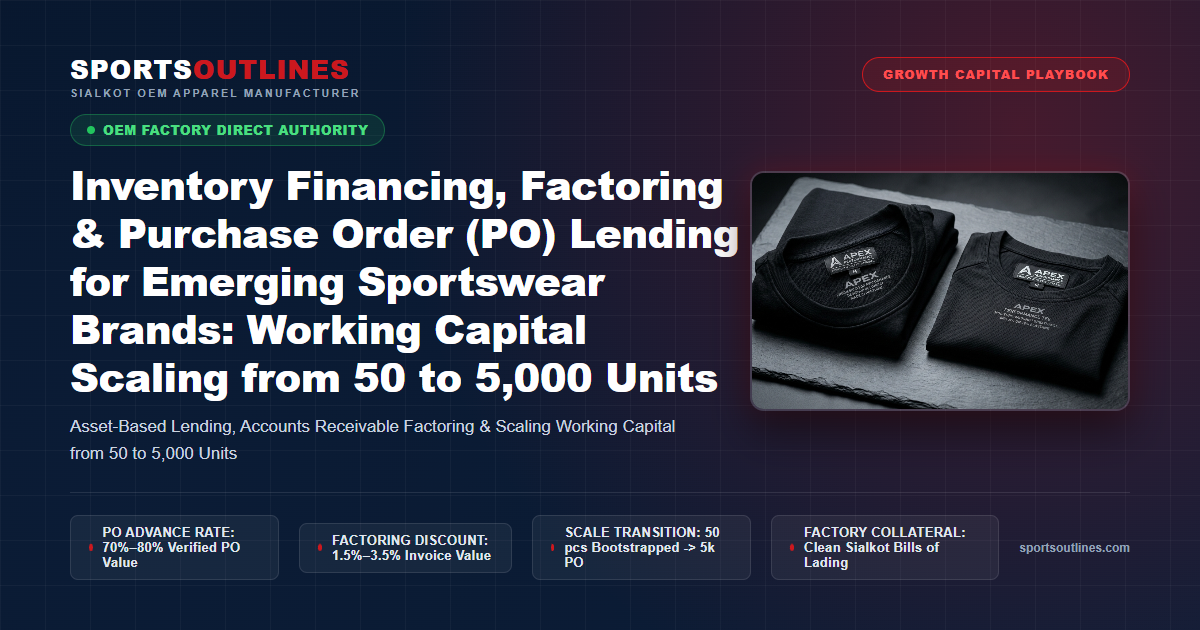
Every successful apparel founder encounters the dreaded Working Capital Chasm. It is remarkably straightforward to bootstrap your first 30–50 piece cut-and-sew drop in Sialkot using $5,000 of personal savings. However, when your initial drop sells out within 48 hours, influencer interest explodes, and major gym franchises or national retail buyers submit Purchase Orders (POs) for 2,500 to 5,000 garments, your personal bank balance becomes the bottleneck. Fulfilling a 5,000-unit technical activewear order requires $80,000 to $120,000 in immediate factory deposits, fabric procurement, and landed freight—capital that most emerging founders simply do not have in liquid cash. Surrendering 30% to 50% equity to venture capitalists or angel investors at this early stage is needlessly dilutive. The world’s fastest-scaling athletic brands solve this dilemma by leveraging non-dilutive working capital financing: Purchase Order (PO) lending, Accounts Receivable (AR) factoring, Asset-Based Inventory Lending (ABL), and Revenue-Based Financing (RBF). This institutional guide breaks down the underwriting criteria, legal structures, fee models, and factory documentation required to finance your production scale without sacrificing ownership.
📄 Accounts Receivable (AR) Factoring
📦 Asset-Based Inventory Lending (ABL)
💡 Non-Dilutive Equity Preservation
1. The Working Capital Chasm: Why Success Breaks Bootstrapped Cashflow
In classical business school case studies, business failure is attributed to poor product-market fit, defective quality, or weak sales. In contract apparel manufacturing, however, the most dangerous period for an enterprise is often immediately following an explosive sales breakthrough. This paradox is known as the Growth Liquidity Squeeze.
When you manufacture at an agile low MOQ of 30 to 50 pieces per style, your total capital exposure is minimal ($1,500 to $3,000). You pay an engineering prototype fee of $45 to $85 per piece (strictly non-refundable, 7–10 days turnaround), approve the sample, wire a 30% deposit, inspect the goods via digital video, pay the 70% balance, and fly the shipment via DHL express. Within 30 days, your website liquidates the drop, generating $6,000 to $9,000 in gross revenue.
However, when demand accelerates from 50 units to 1,000 or 5,000 units, the mathematical requirements of production scale outstrip retained earnings:
- Batch 1 (50 pieces): $1,250 production outlay → $4,500 retail sales → $2,250 retained net cash.
- Batch 2 Demand (250 pieces): Requires $5,500 production outlay. Your $2,250 retained cash leaves a $3,250 deficit!
- Batch 3 Demand (1,500 pieces): Requires $30,000 production outlay. Your retained cash is under $10,000, leaving a $20,000 deficit!
- Wholesale Order (5,000 pieces for a retail chain): Requires $95,000 production outlay with Net-60 payment terms. You face a near-$100,000 working capital deficit!
Founders who do not understand institutional credit architecture either turn down lucrative retail purchase orders or surrender 40% of their company to opportunistic equity investors. Understanding the four pillars of non-dilutive financing allows you to bridge this capital chasm cleanly.
Table 1: The 4 Non-Dilutive Capital Vehicles for Emerging Sportswear Brands
This comparison matrix outlines the mechanics, underwriting requirements, typical costs, and ideal use cases for the four primary inventory financing instruments.
2. Purchase Order (PO) Financing Mechanics: How Lenders Fund 100% of Manufacturing Outlay
Purchase Order (PO) financing is the single most powerful tool for an emerging apparel brand that lands a contract larger than its entire balance sheet. The operational beauty of PO financing is that underwriting is based on the creditworthiness of your customer, not your startup’s financial history.
If a major gym chain with 150 locations (e.g., Equinox, Gold’s Gym, UFC Gym) issues your combat sports label a confirmed purchase order for $150,000 worth of custom rashguards and boxing gloves, commercial lenders recognize that the credit risk lies with the gym chain’s ability to pay, not your young startup.
The 6-Step Chronological PO Financing Transaction Flow
- Customer Issues Written PO: Your buyer issues a formal, non-cancellable commercial purchase order detailing garment specifications, quantities, unit prices, delivery dates, and payment terms (e.g., Net-30).
- PO Finance Agreement Executed: You assign the purchase order to a specialized apparel PO finance company. The lender conducts credit due diligence on the wholesale customer.
- Lender Pays the Factory Directly: The PO lender issues an irrevocable Letter of Credit (L/C) or wires milestone payments (30% deposit, 70% balance) directly to Sports Outlines in Sialkot, Pakistan. Zero cash leaves your personal bank account.
- Manufacturing & AQL 2.5 Inspection: Sports Outlines cuts, sews, prints, and packages the garments. An independent inspection agency or digital 4K video dossier verifies zero-defect compliance with the PO specifications.
- Goods Shipped & Delivered: The finished garments are flown or freighted to the retail customer’s distribution center, generating a signed Proof of Delivery (POD).
- Customer Pays Lender Directly: The retail customer pays the invoice amount directly to the PO lender. The lender deducts their finance fee (typically 2.0% to 3.5% per 30 days) and remits the entire remaining net profit directly to your brand.
Table 2: Financial Case Study: Executing a 2,500-Unit Wholesale Order via PO Financing
This financial model illustrates the exact cash waterfall and net profit generated on a $125,000 retail order financed entirely with zero founder equity dilution.
3. What Lenders Require: The Factory Due Diligence & Quality Audit Checklist
While PO financing is accessible to young brands, commercial lenders perform stringent operational due diligence before wiring funds overseas. Lenders will not disburse capital to unvetted brokers, anonymous trading accounts, or factories lacking documented quality control capabilities. To approve a financing package, lenders demand four core institutional artifacts:
- 1. Production-Grade Tech Packs & POM Grading Tables: Lenders require finalized vector CAD sketches with detailed Points of Measure (POM) and seam callouts. This proves that garment specifications are locked and not subject to mid-production disputes.
- 2. Approved Physical “Golden Sample” Dossier: Proof that physical pre-production samples were evaluated and signed off by the retail buyer. At Sports Outlines, physical prototypes ($45–$85/pc, 7–10 days turnaround) serve as the legal golden sample benchmark sealed for bulk comparison.
- 3. Direct Factory Commercial Contract & Banking Verification: An open-book pro forma invoice and direct international manufacturing agreement directly from Sports Outlines (Sialkot, Pakistan) with verifiable corporate banking details (SWIFT / IBAN).
- 4. Third-Party or Factory ISO 2859-1 AQL 2.5 Inspection Warranty: The lender requires contractual commitment that funds will only be disbursed upon final pre-shipment random inspection meeting General Inspection Level II (AQL 2.5 Major / 4.0 Minor).
Table 3: Institutional Lender Due Diligence & Documentation Checklist
This checklist details the exact compliance documents required by apparel lenders, factoring firms, and trade banks.
4. Revenue-Based Financing (RBF): Scaling D2C Inventory via Daily Sales Payouts
While PO financing is tailored for B2B wholesale orders, pure-play direct-to-consumer (D2C) activewear brands selling through Shopify or TikTok Shop require a different capital vehicle. Because D2C brands sell directly to individual consumers, they do not possess a single large corporate purchase order to assign to a PO lender.
For these brands, Revenue-Based Financing (RBF) providers (such as Wayflyer, Clearco, Liberis, and Parker) have revolutionized e-commerce inventory funding. RBF platforms connect directly via API to your Shopify store, Google Analytics, and Stripe payment gateway. Rather than analyzing personal credit scores or demanding real estate collateral, their machine-learning algorithms evaluate:
- Trailing 90-Day Revenue Velocity: Minimum $10,000 to $25,000 in consistent monthly gross merchandise value (GMV).
- Customer Return & Chargeback Rates: Chargeback rates must remain under 0.8%, and product return rates must remain under 4.0%.
- Blended Customer Acquisition Cost (CAC) Stability: Verification that return on ad spend (ROAS) exceeds 1.8x on Meta and TikTok.
The Mechanics of Repayment
Once approved, the RBF provider injects $20,000 to $100,000 directly into your bank account. The funding carries a fixed fee—typically 6% to 10% flat (e.g., you receive $50,000 and repay $54,000 total). There are no monthly principal-and-interest deadlines. Instead, the platform automatically deducts a fixed percentage of your daily Shopify sales (typically 8% to 14%) until the total advance plus fee is repaid.
If sales surge during a product drop, the loan is repaid faster (e.g., 60 days); if sales slow during a seasonal trough, daily remittances decrease proportionately. This dynamic structure protects the brand from defaulting during low-sales months while providing immediate capital to fund large reorders with Sports Outlines.
Table 4: 90-Day Revenue-Based Financing (RBF) Cashflow Model ($40,000 Advance)
This table tracks daily revenue deductions and debt amortization for a D2C activewear brand scaling production from 100 to 1,200 units.
5. The 5-Phase Production Scaling Matrix: Moving from 50 to 5,000 Units Systematically
Scaling an apparel brand does not occur overnight. Successful founders execute a disciplined five-phase operational progression, matching their manufacturing volume in Sialkot with the appropriate capital vehicle at each stage:
- Phase 1: Validation Drop (30–50 Units per Style): 100% self-funded via personal bootstrap savings ($3,000–$5,000). Prototyping completed at $45–$85/pc (7–10 days). Goal: Validate fit, grading, fabric hand-feel, and retail demand with zero debt.
- Phase 2: Momentum Scaling (100–300 Units per Style): Reinvestment of 100% retained earnings from Phase 1 + early pre-orders. Goal: Build customer reviews, refine advertising creatives, and achieve break-even on fixed overhead.
- Phase 3: Revenue-Based E-Commerce Scale (500–1,500 Units): Onboarding of RBF platforms (Wayflyer/Clearco) based on trailing 90-day Shopify GMV. Direct injection of $25,000 to $50,000 into inventory production. Shift from air express to consolidated air cargo.
- Phase 4: B2B Wholesale Breakthrough (1,500–3,000 Units): Acquisition of regional gym chains, martial arts academies, or specialty athletic retailers. Deployment of Purchase Order (PO) financing to fund 100% of factory production costs without equity dilution.
- Phase 5: Enterprise Container Loads (5,000+ Units): Asset-Based Lending (ABL) against bonded warehouse inventory + bank lines of credit. Full container ocean shipping (40ft HQ), driving unit FOB costs down by 35% and maximizing gross enterprise margins.
A common error in Phase 3 is attempting to leap directly from 300 units to 5,000 units without testing intermediary sales velocity. Leaping straight to full container production before establishing predictable monthly inventory turnover increases holding costs and risks inventory obsolescence if a specific colorway underperforms. By utilizing Revenue-Based Financing and PO lending across intermediate runs of 500 to 1,500 units with Sports Outlines, founders preserve their balance sheet flexibility, validate all size curves, and generate verifiable audited sales records that unlock Tier-1 commercial bank lines when reaching Phase 5.
Table 5: The 5-Phase Sportswear Manufacturing Scaling Progression
This master matrix maps order volume, factory unit economics, capital vehicle, and logistics modes across the five phases of activewear enterprise growth.
6. Factoring Mechanics & Trade Credit Insurance: Mitigating Wholesale Default Risk
When an apparel brand transitions from direct-to-consumer (D2C) e-commerce into B2B wholesale distribution, they encounter the reality of trade credit. Unlike online consumers who pay immediately via credit card, commercial buyers—ranging from regional martial arts academies and gym chains to national sporting goods retailers—demand payment terms of Net-30, Net-60, or even Net-90 days.
This introduces significant default exposure. If a retail client enters bankruptcy or insolvency before paying their invoice, a small brand can be completely wiped out. To safeguard cashflow and maintain liquidity velocity, institutional apparel companies implement two complementary credit risk strategies:
- Recourse Factoring vs. Non-Recourse Factoring: Under recourse factoring, the factor advances 80% to 90% of the invoice value immediately. However, if the buyer defaults or fails to pay within 90 days, your brand must buy back the unpaid invoice from the factor. Under non-recourse factoring, the factoring company assumes 100% of the debtor’s bankruptcy credit risk. If the retailer goes bankrupt, the factor absorbs the loss entirely, protecting your cash reserves.
- Whole-Turnover Trade Credit Insurance (Allianz Trade / Euler Hermes / Coface): For brands with over $250,000 in annual wholesale volume, credit insurance policies cover up to 90% of unpaid invoices caused by buyer protracted default or formal bankruptcy. With credit insurance active, commercial banks and PO lenders immediately extend working capital credit lines at significantly lower interest rates because the underlying receivables are insured by AAA-rated underwriters.
Table 6 compares the four primary accounts receivable credit structures available to scaling activewear enterprises.
Table 6: Wholesale Accounts Receivable (AR) Protection & Factoring Comparison Matrix
This table compares fees, debtor bankruptcy protection, advance rates, and minimum qualification thresholds across four receivable financing models.
7. Partnering Direct with Sports Outlines: Seamless Lender Compliance & Scalability
When emerging sportswear and combat sports brands partner directly with Sports Outlines in Sialkot, Pakistan, they gain access to a manufacturing infrastructure built to support institutional financing:
Lender-Compliant Pro Forma Invoicing
We generate professional USD commercial invoices with itemized BOM breakdowns, HS tariff classifications, and milestone payment schedules accepted by major trade finance institutions worldwide.
Agile MOQs from 30 to 5,000+ Pieces
Start with our agile 30–50 piece low-MOQ runs for market validation, then seamlessly scale to thousands of units on identical sewing lines without changing supplier relationships.
Rapid 7–10 Day Prototyping ($45–$85/pc)
Develop physical pre-production samples in 7 to 10 business days for a transparent, non-refundable fee of $45 to $85 per piece. Lock golden samples for buyer and lender underwriting sign-off.
Direct L/C & Escrow Acceptance
Our corporate banking accounts in Pakistan accommodate formal Documentary Letters of Credit (L/C at Sight) and trade finance escrow disbursements from verified institutional lenders.
8. Frequently Asked Questions: Production Financing & Growth Capital
Can a startup apparel brand qualify for Purchase Order (PO) financing?
Yes! Unlike traditional bank term loans that demand three years of audited tax returns and physical real estate collateral, PO financing evaluates the creditworthiness of the commercial buyer issuing the purchase order. If an emerging combat sports or activewear brand receives a valid, non-cancellable PO from an established retailer, distributor, or gym chain, specialized apparel trade lenders will fund up to 100% of the manufacturing and freight costs.
What is the typical interest rate or fee for apparel PO financing?
Apparel PO lenders charge a fee based on the time capital remains outstanding, typically ranging between 1.8% and 3.5% per 30 days. If production and shipping take 45 days and your retail buyer pays on Net-30 terms (total duration = 75 days), the cumulative finance fee is approximately 4.5% to 6.0% of the advanced capital. On a garment with a 65% wholesale gross margin, this financing fee represents a negligible expense compared to the massive gross profit captured.
Why do physical prototypes carry a non-refundable $45–$85 fee?
Physical prototype sampling is an independent engineering discipline requiring dedicated master pattern-making, manual cutting, specialized machine configuration, ink preparation, and bespoke assembly. The $45 to $85 fee covers these dedicated skilled labor hours and single-garment materials on a fast 7 to 10-day turnaround, providing you with a sealed golden sample for buyer presentation and lender underwriting.
How does Accounts Receivable (AR) factoring differ from PO financing?
PO financing funds the production and shipping of goods *before* they are manufactured, paying the factory directly. AR factoring occurs *after* the goods have been manufactured, delivered to your retail buyer, and invoiced. The factor immediately advances 80% to 90% of the invoice value in cash, eliminating the 30 to 60-day waiting period for customer payment and immediately refilling your treasury.
Can I use Revenue-Based Financing (RBF) to fund production at Sports Outlines?
Yes. Many of our fast-growing D2C clients utilize platforms like Wayflyer or Clearco. Once the RBF lender approves your Shopify revenue history, the funds are deposited directly into your business checking account. You then wire standard milestone deposits (30% deposit / 70% balance upon AQL 2.5 video sign-off) to Sports Outlines to fund your bulk production run.
Scale Your Sportswear Production with Institutional Manufacturing Precision
Whether you are bootstrapping a 50-piece validation drop or scaling a 5,000-unit retail purchase order, partner directly with Sports Outlines in Sialkot, Pakistan. Access open-book FOB costing, rapid 7–10 day physical prototyping ($45–$85/pc), lender-compliant trade documentation, and seamless global logistics.