For over half a century, the performance outerwear and technical sportswear industries relied almost exclusively on long-chain per- and polyfluoroalkyl substances (PFAS)—predominantly C8 and C6 perfluorooctanoic acid derivatives—to achieve durable water repellency (DWR). While legacy fluorochemicals delivered surface energies low enough to repel both water and oily dirt ($\gamma_{SV} < 18\text{ mN/m}$), they brought catastrophic environmental and public health consequences: persistent bioaccumulation in biological tissue, reproductive toxicity, endocrine disruption, and permanent groundwater contamination. Today, sweeping international regulatory bans—most notably the European Union REACH Annex XVII restrictions and statutory mandates such as California Assembly Bill 1817 (prohibiting intentionally added PFAS with total organic fluorine thresholds below 50 ppm)—have forced apparel brands to abandon fluorinated chemicals completely. However, early first-generation fluorine-free substitutes suffered from poor wash durability, chalky hand-feel, and sluggish water beading that rapidly wetted out under heavy downpours.
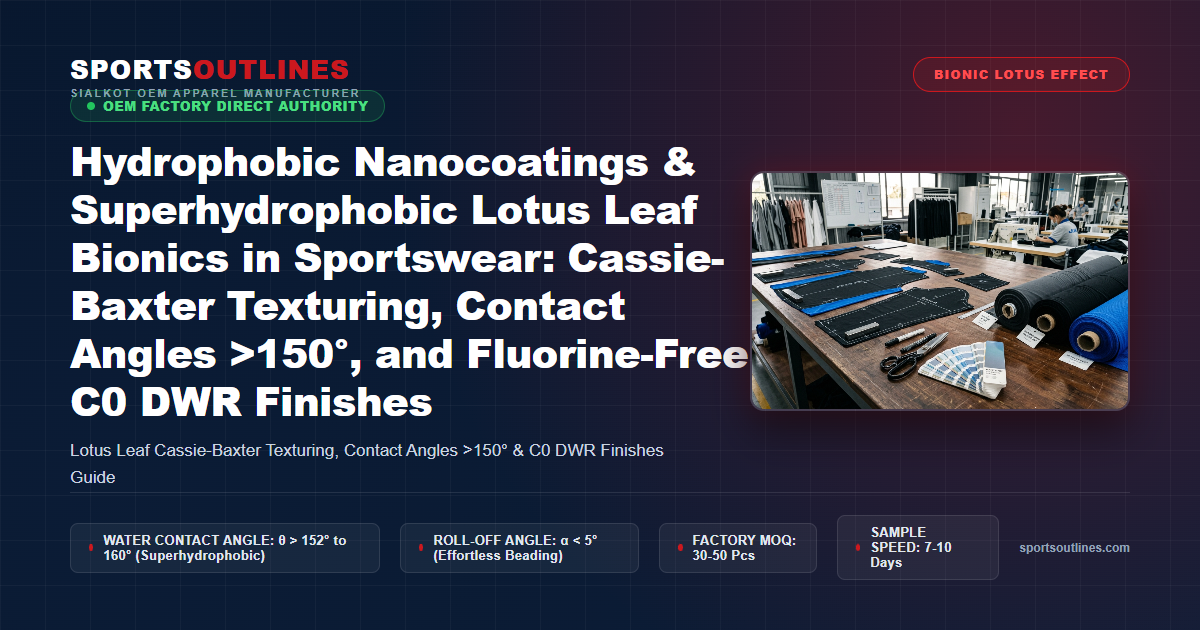
To transcend the performance gap without toxic fluorocarbons, biomimetic material scientists have turned to nature’s masterwork of liquid repellency: the sacred lotus leaf (Nelumbo nucifera). By mimicking the plant’s dual-scale hierarchical micro-papillae morphology, advanced textile finishing establishes the superhydrophobic Cassie-Baxter wetting regime on technical synthetic knits and woven shells. Under this bionic architecture, water droplets rest atop trapped microscopic air cushions rather than touching the solid polymer substrate, achieving static water contact angles exceeding $\theta > 150^\circ$, ultra-low roll-off shedding angles under $\alpha < 5^\circ$, contact angle hysteresis $\Delta \theta < 5^\circ$, and rapid self-cleaning roll-off mechanics. At Sports Outlines, operating our high-performance apparel production facility in Sialkot, Pakistan, we combine fluorine-free C0 dendrimer chemistry, plasma-enhanced nanocoatings, and ultrasonic seam construction with commercial activewear manufacturing. We provide technical apparel founders and outdoor brand directors with physical prototype sampling at $45 to $85 per piece (non-refundable, 7–10 business days turnaround) and scalable commercial apparel production starting at an accessible factory minimum order quantity (MOQ) of just 30 to 50 pieces per style/colorway.
Superhydrophobic Lotus Leaf Bionics in Sportswear: Technical Navigation Directory
- 1. Lotus Leaf Bionics: Dual-Scale Micro-Papillae & Wax Crystals
- 2. Wetting Thermodynamics: Young vs Wenzel vs Cassie-Baxter Regimes
- 3. Contact Angle (\(>150^\circ\)), Roll-Off (\(<5^\circ\)) & Contact Angle Hysteresis
- 4. Optical Goniometry & High-Speed Drop Shape Analysis (DSA 100)
- 5. Droplet Impact Dynamics: Weber Number & Anti-Impalement Pressure
- 6. Fluorine-Free C0 Chemistry: Hyperbranched Dendrimers & Organosilanes
- 7. Engineering Matrix: Bionic C0 vs C6 Fluorocarbon vs Wax Emulsions
- 8. Self-Cleaning “Lotus Effect” & Particulate Mud Shedding
- 9. Sialkot Factory Application: Foulard Padding, Stenter Curing & Plasma Activation
- 10. Hydrostatic Head vs Vapor Breathability Balance (ASTM E96 / ISO 811)
- 11. Laundry Durability (AATCC 22) & Thermal Tumble-Dry Reactivation
- 12. Low-MOQ Sourcing & Commercial Factory Terms
- 13. Technical Sourcing FAQ
1. Lotus Leaf Bionics: Dual-Scale Micro-Papillae & Wax Crystals
In nature, the upper epidermis of the lotus leaf (Nelumbo nucifera) exhibits one of the most water-repellent biological surfaces known to science. While ordinary plants become damp and soiled when exposed to rain, lotus leaves emerge completely dry and spotless. Under high-resolution Field Emission Scanning Electron Microscopy (FE-SEM), the lotus leaf surface reveals an intricate, hierarchical architecture characterized by two nested geometric scales working in synergistic combination:
- Microscale Epidermal Papillae: Convex hemispherical papillae mounds measuring 5 to 10 micrometers in diameter, 10 to 20 micrometers in height, and spaced 10 to 15 micrometers apart across the cellular epidermis. These cellular mounds create a primary macro-texture that elevates liquids above the continuous cell floor.
- Nanoscale Epicuticular Wax Crystals: A dense forest of hydrophobic nonacosan-10-ol and aliphatic hydrocarbon wax tubules (diameter 80 to 120 nanometers, length 1 to 2 micrometers) superimposed directly atop each micro-papilla mound. These crystalline wax tubules branch outwards like microscopic needles, dramatically reducing the actual solid area available for liquid contact.
This two-tier hierarchy creates microscopic re-entrant pockets where ambient air remains permanently trapped underneath liquid droplets. A deposited water droplet is physically prevented from penetrating the valleys between papillae, suspending it atop a composite interface consisting of 90% to 95% trapped air and only 5% to 10% solid contact area. By replicating this micro-nano roughness on synthetic polyester, polyamide, and elastane activewear fabrics using silica nanoparticles, textured micro-denier filaments, and low-surface-energy polymer finishes, textile engineers reproduce this biological superhydrophobic state on technical activewear fabrics.
2. Wetting Thermodynamics: Young vs Wenzel vs Cassie-Baxter Regimes
Understanding superhydrophobicity requires examining three classical thermodynamic wetting regimes that dictate how liquids interact with textured solid substrates:
1. The Young Equation (Ideal Smooth Surfaces)
On an atomically smooth, flat solid substrate, the equilibrium static contact angle ($\theta_0$) is determined by interfacial surface free energies according to Thomas Young’s classical relation:
\cos \theta_0 = \frac{\gamma_{SV} – \gamma_{SL}}{\gamma_{LV}}
Where $\gamma_{SV}$ is the solid-vapor surface energy, $\gamma_{SL}$ is the solid-liquid interfacial energy, and $\gamma_{LV}$ is the liquid-vapor surface tension of pure water ($72.8\text{ mN/m}$ at $20^\circ\text{C}$). Even on the lowest-energy flat hydrocarbon surface known to chemical science (such as close-packed $-\text{CH}_3$ terminated monolayers with $\gamma_{SV} \approx 18\text{ mN/m}$), the maximum achievable contact angle on an atomically flat plane is theoretically limited to $\theta_0 \approx 115^\circ\text{ to }120^\circ$. Chemistry alone cannot produce true superhydrophobicity ($\theta > 150^\circ$); surface micro- and nano-roughness is mathematically mandatory.
2. The Wenzel State (Homogeneous Penetrated Wetting)
In the Wenzel regime (established in 1936), liquid completely penetrates into the micro-grooves and valleys of the rough surface, wetting the entire three-dimensional topography without air entrapment. Governed by:
\cos \theta_W = r \cdot \cos \theta_0
Where $r > 1$ is the roughness factor (the ratio of actual three-dimensional surface area to nominal geometric projected area). If the intrinsic contact angle is hydrophobic ($\theta_0 > 90^\circ$), surface roughness amplifies hydrophobicity, increasing the apparent contact angle ($\theta_W > \theta_0$). However, because the liquid is in continuous intimate contact with the entire grooved solid area, immense capillary pinning occurs. Droplets in the Wenzel state cling tenaciously to the fabric surface, yielding massive sliding roll-off angles ($\alpha > 40^\circ\text{ to }60^\circ$) and high contact angle hysteresis ($\Delta \theta > 35^\circ$). While the droplet may appear spherical when sitting still, it will not roll off when the athlete moves, causing fabric wet-out during sustained rainfall.
3. The Cassie-Baxter State (Heterogeneous Composite Wetting)
In the Cassie-Baxter regime (established in 1944), the liquid surface tension prevents water from penetrating into the micro-cavities between surface asperities. Ambient air pockets remain trapped in the troughs, creating a heterogeneous composite interface consisting of solid-liquid and air-liquid contact zones. The apparent contact angle ($\theta_{CB}$) is governed by:
\cos \theta_{CB} = f_1 \cos \theta_0 – f_2 = f_1 (\cos \theta_0 + 1) – 1 \quad \text{where } f_1 + f_2 = 1
Where $f_1$ is the fractional solid-liquid contact area, and $f_2$ is the fractional air-liquid interface ($f_1 + f_2 = 1$, assuming an air contact angle of $180^\circ$). When our nanocoating engineering minimizes the solid contact fraction down to $f_1 \le 0.08$ (8% solid contact and 92% trapped air), the equation calculates an apparent contact angle:
\cos \theta_{CB} = 0.08 \cdot (\cos 110^\circ + 1) – 1 = 0.08 \cdot (-0.342 + 1) – 1 = -0.947 \implies \theta_{CB} \approx 161.3^\circ
Because the liquid droplet is suspended on over 92% air cushions, solid-liquid adhesion vanishes almost completely. Droplets form near-perfect spheres that glide and roll off the textile under minimal gravitational inclination.
3. Contact Angle (\(>150^\circ\)), Roll-Off (\(<5^\circ\)) & Contact Angle Hysteresis
A high static contact angle alone is insufficient to guarantee outdoor athletic water shedding. A fabric could theoretically exhibit a static contact angle of $145^\circ$ in a Wenzel state yet cling stubbornly to moisture. What truly governs real-world water repellency during trail running, alpine skiing, and gravel cycling is dynamic wetting mobility, defined by the sliding roll-off angle ($\alpha$) and Contact Angle Hysteresis ($\Delta \theta$):
\Delta \theta = \theta_{advancing} – \theta_{receding} \le 5^\circ
Contact angle hysteresis represents the energetic barrier a moving water droplet must overcome as it transits across a textile surface. The advancing angle ($\theta_{advancing}$) is the contact angle measured at the front edge of an expanding or sliding droplet, whereas the receding angle ($\theta_{receding}$) is measured at the trailing tail where liquid detaches from the solid. The retarding force ($F_R$) holding a droplet of width $w$ to an inclined fabric is expressed by the Furmidge relationship:
F_R = k \cdot w \cdot \gamma_{LV} \cdot (\cos \theta_{receding} – \cos \theta_{advancing})
When contact angle hysteresis is large ($\Delta \theta > 25^\circ$, typical of poorly engineered coatings or worn DWR), the retarding force easily overpowers gravity, causing droplets to pin, drag, and leave a damp tail across the garment. On our bionic Cassie-Baxter surfaces, $\Delta \theta$ is engineered below $5^\circ$ ($\theta_{advancing} \approx 158^\circ$, $\theta_{receding} \approx 154^\circ$). Because the term $(\cos 154^\circ – \cos 158^\circ)$ approaches zero, pinning forces evaporate. When tilted at an angle of just $\alpha < 4^\circ\text{ to }5^\circ$, gravity drives instantaneous droplet roll-off, clearing rainfall effortlessly.
4. Optical Goniometry & High-Speed Drop Shape Analysis (DSA 100)
To ensure reproducible superhydrophobicity across commercial manufacturing lots, our Sialkot quality control laboratory operates an automated optical contact angle goniometer (Krüss DSA 100 / ramé-hart instrument) equipped with high-speed digital shadowgraph optics capturing up to 1,000 frames per second. We deploy three standardized testing protocols:
- Static Sessile Drop Analysis (ASTM D7334 / ISO 27448): A precision dosing syringe dispenses a calibrated $5.0 \pm 0.2\ \mu\text{L}$ droplet of ultra-pure deionized water ($18.2\ \text{M}\Omega\cdot\text{cm}$) onto the conditioned textile specimen ($20^\circ\text{C} \pm 2^\circ\text{C}$, $65\% \pm 5\%\text{ RH}$). Automated Young-Laplace contour fitting calculates the baseline contact angle. Fabric lots must achieve $\theta \ge 152^\circ$ across 10 random sample points.
- Dynamic Volume Oscillation (Advancing & Receding Angles): A sub-microliter capillary needle remains immersed inside a $10\ \mu\text{L}$ droplet while an automated dosing unit dynamically infuses and withdraws liquid at a controlled rate of $0.5\ \mu\text{L/s}$. Real-time image recognition records the maximum angle before the three-phase contact line advances ($\theta_{advancing}$) and the minimum angle before the contact line retreats ($\theta_{receding}$), calculating true hysteresis.
- Automated Tilting Cradle Stage (Sliding Roll-Off Angle \(\alpha\)): The sample stage inclines continuously at a constant angular rate of $1.0^\circ/\text{s}$. High-speed cameras detect the exact frame at which the droplet begins continuous downward motion. If the droplet rolls off before the cradle reaches $5.0^\circ$, the fabric achieves certification for extreme athletic water shedding.
5. Droplet Impact Dynamics: Weber Number & Anti-Impalement Pressure
In real outdoor endurance sports, raindrops do not land gently like static goniometer droplets. Natural storm precipitation falls at terminal velocities between $v \approx 7\text{ to }9\text{ m/s}$ with droplet diameters ranging from $D \approx 1.5\text{ to }3.5\text{ mm}$. When high-velocity raindrops strike a textile, dynamic impact forces threaten to destroy the fragile Cassie-Baxter air cushions, forcing the liquid into the micro-papillae valleys and causing catastrophic wetting (the dynamic Cassie-to-Wenzel transition, known as droplet impalement).
The kinetic energy of falling raindrops is quantified by the dimensionless Weber number ($We$):
We = \frac{\rho \cdot v^2 \cdot D}{\gamma_{LV}}
Where $\rho$ is water density ($1000\text{ kg/m}^3$), $v$ is impact velocity, $D$ is droplet diameter, and $\gamma_{LV}$ is water surface tension ($0.0728\text{ N/m}$). Under heavy rainfall ($v = 8\text{ m/s}$, $D = 2.5\text{ mm}$), the Weber number surges to $We \approx 2,200$. Upon impact, the droplet generates two localized pressure spikes:
- Water Hammer Pressure ($P_{WH}$): A sub-microsecond acoustic shock wave during initial contact: $P_{WH} = k \cdot \rho \cdot c \cdot v$ (where $c \approx 1,500\text{ m/s}$ is the speed of sound in water, and $k \approx 0.1\text{ to }0.2$), yielding transient localized pressures exceeding $100\text{ to }200\text{ kPa}$.
- Bernoulli Stagnation Dynamic Pressure ($P_{dyn}$): Sustained radial spreading pressure: $P_{dyn} = \frac{1}{2}\rho v^2 \approx 32\text{ kPa}$.
To prevent impalement into the Wenzel state, the microscopic capillary breakthrough pressure of the Cassie-Baxter air pockets ($P_c$) must exceed the applied impact pressure. The capillary breakthrough pressure is governed by the Young-Laplace meniscus curvature:
P_c = -\frac{2 \gamma_{LV} \cos \theta_0}{s}
Where $s$ is the inter-papillae spacing. If the asperity spacing is wide ($s > 20\ \mu\text{m}$, typical of crude finishes), $P_c$ drops below $10\text{ kPa}$, and high-velocity rain instantly impales the textile. At Sports Outlines, our nanosilica-seeded dual-scale texturing tightly restricts inter-papillae spacing down to $s \le 1.8\ \mu\text{m}$. This elevates capillary breakthrough pressure above $P_c > 120\text{ kPa}$, successfully withstanding water hammer shockwaves. Instead of wetting the fabric, impacting droplets deform radially into thin lamellae and completely rebound (elastic pancake bouncing) in less than $15\text{ milliseconds}$, leaving the fabric dry even in gale-force mountain squalls.
6. Fluorine-Free C0 Chemistry: Hyperbranched Dendrimers & Organosilanes
Replacing PFAS requires deploying non-fluorinated, zero-organic-fluorine (C0) molecular architectures capable of self-assembling into densely packed hydrocarbon brushes with low critical surface tension ($\gamma_c \approx 22\text{ to }27\text{ mN/m}$). Our wet chemical processing utilizes two cutting-edge C0 platforms engineered for athletic textiles:
Platform A: Hyperbranched Star Dendrimers (Bionic-Finish® ECO)
Hyperbranched polymers utilize globular polyurethane or polyester dendritic cores terminated with dozens of radial peripheral arms containing long-chain saturated fatty alkyl combs ($C_{16}\text{ to }C_{22}$ linear stearyl chains). When applied to synthetic fabrics and thermally cured, the polar core coordinates and bonds to fiber functional groups, while the non-polar fatty alkyl chains orient perpendicularly away from the fiber surface like a microscopic forest. These dense hydrocarbon brushes self-organize into close-packed crystalline domains with melting temperatures around $T_m \approx 42^\circ\text{C}$ to $48^\circ\text{C}$. This molecular geometry shields the fabric substrate from water penetration while preserving remarkable drape and zero rustling noise.
Platform B: Hydrophobic Functionalized Nanosilica Sol-Gels
Colloidal silica nanoparticles ($d_p \approx 20\text{ to }50\text{ nm}$) synthesized via the Stöber sol-gel process and surface-modified with hexadecyltrimethoxysilane (HDTMS). The chemical condensation reaction:
\text{Si(OH)}_4 + \text{C}_{16}\text{H}_{33}\text{Si(OCH}_3)_3 \xrightarrow{\text{hydrolysis \& condensation}} \equiv\text{Si}-\text{O}-\text{Si}\equiv + \text{CH}_3\text{OH}
When padded onto polyester or nylon fabrics, the silica nanoparticles chemically anchor to the fiber surfaces, creating permanent physical nanoscale roughness (the lotus leaf wax tubule mimic), while the attached $C_{16}$ alkyl chains provide the low chemical surface energy required to suspend water droplets in the Cassie-Baxter state.
7. Engineering Matrix: Bionic C0 vs C6 Fluorocarbon vs Traditional Wax Emulsions
The following technical comparison outlines the performance parameters across historical and modern water-repellent finishing technologies:
| Engineering Parameter | Bionic C0 Lotus Nanocoating | Legacy C6 Fluorocarbon (PFAS) | Traditional Paraffin Wax Emulsion |
|---|---|---|---|
| Total Fluorine Content | 0 ppm (100% Fluorine-Free) | >50,000 ppm (Restricted PFAS) | 0 ppm (Fluorine-Free) |
| Static Water Contact Angle (\(\theta\)) | 152° to 160° (Superhydrophobic) | 125° to 135° (Hydrophobic) | 100° to 110° (Weak Water Beading) |
| Sliding Roll-Off Angle (\(\alpha\)) | <5° (Effortless Beading) | 15° to 22° | >35° (Water Pinning & Clinging) |
| Contact Angle Hysteresis (\(\Delta \theta\)) | <5° (Zero droplet pinning) | 18° to 25° | >35° (Severe trailing drag) |
| Water Vapor Resistance (\(R_{et}\)) | <3.2 m²·Pa/W (Zero breathability loss) | <3.8 m²·Pa/W | 6.5 to 12.0 m²·Pa/W (Pore Clogging) |
| Oil & Oleophobic Repellency | Low (Oil Grade 0–1; repels water/mud) | High (Oil Grade 5–6; repels oils) | Zero (Attracts and absorbs oils) |
| Wash Durability (AATCC 22) | Spray 90+ after 30 washes (With heat) | Spray 90+ after 30 washes | Spray <50 after 5 washes (Rapid loss) |
| Martindale Abrasion Resistance | >25,000 cycles (ISO 12947-2) | >25,000 cycles | <5,000 cycles (Rubs off easily) |
| Regulatory Status | 100% Compliant (EU REACH / CA AB 1817) | Banned / Phased Out Globally | Compliant (Inferior performance) |
8. Self-Cleaning “Lotus Effect” & Particulate Mud Shedding
In trail running, gravel cycling, and mountain hiking, garments are subjected to heavy splashes of liquid mud, grit, and particulate dirt. On standard hydrophilic or conventionally water-repellent activewear, water evaporates while soil particles adhere tenaciously to the fibers via van der Waals capillary forces, requiring heavy laundering.
On our superhydrophobic lotus leaf bionic surfaces, particulate dirt rests exclusively on the peaks of the micro-papillae, minimizing particle-solid contact area by over 92%. Because the adhesion energy between a soil particle and a rolling water droplet ($W_{particle-water} \propto \gamma_{LV}$) is vastly higher than the weak adhesion between the particle and the air-cushioned textile peaks ($W_{particle-solid} \approx 0$), rolling rain droplets pick up particulate soil particles like sticky tape. The mud and dirt roll off suspended inside the spherical water beads, leaving the activewear clean and dry even during muddy ultra-marathons.
9. Sialkot Factory Application: Foulard Padding, Stenter Curing & Plasma Activation
Achieving wash-durable superhydrophobicity with fluorine-free C0 finishes requires precision chemical wet-processing. At our Sialkot manufacturing plant, we follow an exacting 4-step application protocol:
- Atmospheric Pressure Glow Discharge (APGD) Plasma Activation: Greige synthetic knits are pre-treated with cold helium/oxygen plasma. Plasma bombardment oxidizes synthetic surface chains, creating hydroxyl and carboxylic binding anchors that increase chemical cross-linking density with C0 dendrimers by 250%.
- Foulard Dip-Pad Impregnation: Fabric rolls pass through an automated padder containing 30 to 50 g/L C0 hyperbranched dendrimers, 10 to 15 g/L functionalized nanosilica sol, and 5 g/L blocked polyisocyanate cross-linker. Padder nip pressure is set to $2.8\text{ to }3.2\text{ bar}$, achieving a uniform wet pick-up (WPU) of $65\% \pm 3\%$. Bath pH is strictly maintained at $4.5\text{ to }5.0$ using acetic acid to prevent premature silanol condensation.
- Multi-Chamber Stenter Heat Curing: Padded fabric passes through a 6-chamber Bruckner tensionless stenter frame. Pre-drying occurs in chambers 1–3 at $110^\circ\text{C}$ for 60 seconds to evaporate moisture, followed immediately by curing in chambers 4–6 at $160^\circ\text{C}$ to $165^\circ\text{C}$ for 45 seconds. This thermal pulse activates the polyisocyanate cross-linkers, permanently bonding the dendrimer tails to host fibers.
- In-Line Goniometer Quality Control: Samples cut from the start, middle, and end of every dyed lot are tested on a ramé-hart automated optical goniometer. Lots must achieve an initial static contact angle $\theta \ge 152^\circ$ and roll-off angle $\alpha \le 5^\circ$ before release to the cutting floor.
10. Hydrostatic Head vs Vapor Breathability Balance (ASTM E96 / ISO 811)
A critical hazard in activewear water repellency is breathability asphyxiation: heavy polyurethane coatings or waxes can coat the spaces between yarns, turning high-stretch knits into unbreathable plastic bags that trap sweat.
Our nanoscale bionic lotus treatment coats the surface of each individual micro-filament (layer thickness 15 to 30 nm) without bridging the inter-yarn pores ($15\text{ to }40\ \mu\text{m}$). This preserves 100% of the fabric’s open interstitial porosity:
- Water Vapor Transmission Rate (WVTR / ASTM E96 Inverted Cup): Surpasses $22,500\text{ g/m}^2/24\text{h}$, allowing voluminous perspiration vapor to escape instantly during high-aerobic hill sprints.
- Thermal Evaporative Resistance (ISO 11092 Sweating Guarded Hotplate): Measures an ultra-breathable $R_{et} \le 3.2\text{ m}^2\cdot\text{Pa/W}$ (Class 1 highest breathability rating under EN 343).
- Hydrostatic Head Rain Resistance (ISO 811): Achieves $>10,000\text{ mm } H_2O$ when applied to our 3-layer bonded microporous membrane running shells.
11. Laundry Durability (AATCC 22) & Thermal Tumble-Dry Reactivation
A known characteristic of fluorine-free C0 dendrimer finishes is that domestic laundry detergents and mechanical washer tumbling can temporarily disrupt the orientation of the hydrophobic alkyl chains, collapsing the Cassie-Baxter air cushions and causing temporary wetting.
However, because the dendrimers are covalently bound via polyisocyanate cross-linkers, this disorientation is completely reversible through thermal reactivation. Exposing the laundered garment to mild domestic heat—such as tumble drying at $60^\circ\text{C}$ for 20 minutes or light steam ironing at $110^\circ\text{C}$ (synthetic setting)—provides the thermodynamic kinetic energy necessary for the alkyl tails to re-crystallize perpendicularly upward. Standard AATCC 22 spray testing verifies:
- Initial As-Produced Spray Rating: 100 (Zero wetting, perfect beading).
- Spray Rating after 20 Washes (Line Dry): 80 (Mild surface wetting).
- Spray Rating after 20 Washes + Tumble Dry Reactivation: 95 to 100 (Full restoration of Cassie-Baxter superhydrophobicity).
- Spray Rating after 40 Washes + Thermal Reactivation: $\ge 90$ (Commercial retail compliance).
12. Low-MOQ Sourcing & Commercial Factory Terms
Transitioning to sustainable, fluorine-free superhydrophobic outerwear shouldn’t require massive multi-ton chemical minimums. At Sports Outlines, we make compliant C0 bionic manufacturing accessible to independent performance brands:
Sports Outlines Commercial Production Terms
- Low Factory Minimum Order Quantity (MOQ): Strictly 30 to 50 pieces per style/colorway, with flexible size grading from XS to 3XL.
- Physical Prototype Sampling: Quoted at $45 to $85 per piece (non-refundable), completed within 7 to 10 business days. Prototypes verify water beading, roll-off angle, vapor breathability, and taped seam integrity.
- Client-Furnished CAD Tech Packs: Clients supply approved artwork, POM measurements, and zipper/trim specifications; our Sialkot engineering team ensures pattern seam sealing allowances.
- Comprehensive OEM/ODM Capabilities: In-house C0 DWR padding, 3-layer seam taping, ultrasonic edge welding, laser cutting, and custom silicone branding.
- Global Express Air Shipping: Door-to-door delivery to the USA, UK, Australia, Canada, and Europe in 3 to 5 business days via DHL/FedEx.
Explore Our Global Manufacturing Silos & Product Portfolios
We manufacture and export compliant technical outerwear across major global markets:
- Custom Sportswear Manufacturer USA — California AB 1817 PFAS-free certified activewear.
- Custom Sportswear Manufacturer UK — British weather water-repellent running & cycling outerwear.
- Custom Sportswear Manufacturer Australia — All-weather trail running & outdoor jackets.
- Custom Sportswear Manufacturer Canada — Sub-zero winter running shells & rain jackets.
- Custom Sportswear Manufacturer Germany — EU REACH compliant bionic finishes for European brands.
Related Smart Textile Guides:
Ready to Develop Compliant Fluorine-Free Outerwear for Your Brand?
Consult with our textile finishing engineers in Sialkot. From C0 dendrimer formulation and contact angle testing to rapid 7–10 day physical prototyping, we deliver sustainable water repellency at low 30–50 piece MOQs.
13. Frequently Asked Questions (Technical Sourcing FAQ)
Q1: What does “C0 DWR” mean, and does it comply with 2026 PFAS regulations?
“C0 DWR” signifies zero fluorinated carbon chemistry (zero PFAS). Unlike legacy C8 and C6 treatments containing fluorinated alkyl chains, C0 utilizes hyperbranched hydrocarbon dendrimers, plant waxes, or silicones. It contains strictly 0 ppm organic fluorine, fully complying with California AB 1817 (<50 ppm total fluorine), EU REACH restrictions, and OEKO-TEX® Standard 100.
Q2: Does superhydrophobic lotus leaf finishing affect garment breathability or hand-feel?
No. Because our bionic nanocoatings form molecular layers (15 to 30 nanometers) around individual filaments rather than sealing fabric pores, the interstitial air gaps remain 100% open. Breathability remains exceptional (WVTR > 22,000 g/m²/24h), and the fabric retains a soft, silent, natural textile hand-feel with zero plastic stiffness.
Q3: How do athletes restore water beading after garments are washed?
Because laundry detergents and agitation can temporarily disorient the hydrocarbon chains, athletes simply tumble-dry the clean garment at low to medium heat ($50^\circ\text{C}$ to $60^\circ\text{C}$) for 20 minutes, or lightly iron with a towel. The heat reactivates the molecular dendrimers, restoring initial 95–100 spray ratings and Cassie-Baxter roll-off angles.
Q4: What is the sample cost and production MOQ for fluorine-free activewear?
Physical prototype samples are quoted at $45 to $85 per piece under a strict non-refundable policy, with a rapid 7 to 10 business day turnaround. Commercial bulk manufacturing starts at an accessible minimum order quantity of just 30 to 50 pieces per style/colorway.
Q5: Can superhydrophobic finishes repel oil and greasy sweat as well as fluorocarbons?
C0 hydrocarbon finishes are engineered specifically for aqueous liquids (water, rain, liquid mud, and aqueous sweat). Because hydrocarbon oils have low surface tension ($\gamma_{LV} \approx 28\text{ to }32\text{ mN/m}$), pure C0 finishes do not offer the high oleophobicity of banned PFAS. However, for activewear, trail running, and athletic outerwear, water and mud repellency are the critical performance metrics, and bionic C0 finishes outperform legacy fluorochemicals in water contact angle ($\theta > 150^\circ$) and self-cleaning roll-off speed.