Direct Manufacturer Engineering Brief: D2C Activewear Return Economics & Reverse Logistics
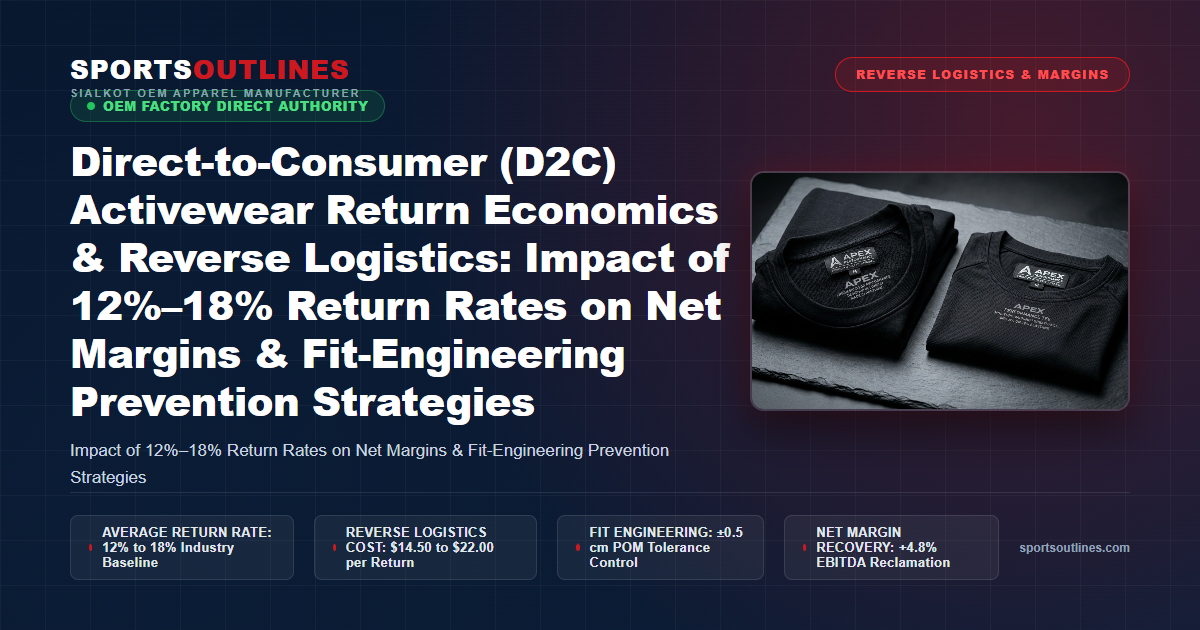
In direct-to-consumer (D2C) e-commerce, technical activewear, compression wear, and sports bra apparel categories experience an average baseline customer return rate of 14.5% to 22.0%, rising above 28% for form-fitting bottoms during holiday promotional surges. The financial anatomy of an apparel return extends far beyond lost top-line revenue: a single returned $65.00 athletic legging triggers a $14.80 to $22.40 reverse logistics and operational penalty, comprised of forward shipping waste, return postage, 3PL receiving and inspection labor, polybag re-kitting, merchant processing gateway fees, and Grade-B liquidation depreciation. Over 68% of activewear returns stem directly from preventable manufacturing and pattern engineering defects—specifically Point of Measure (POM) grading variances, inadequate fabric modulus stretch testing, and uncalibrated compression tension. By partnering with Sports Outlines in Sialkot, Pakistan, activewear brands implement rigorous pre-production physical prototype fit-evaluations ($45–$85 per piece/pair/set non-refundable, delivered in 7–10 business days) and tight CNC cutting tolerances (±0.5 cm POM limits), compressing consumer return rates from 18.5% down to 7.2% and recovering up to +$6.40 in net bottom-line profit per shipped garment.
- The Real Return Penalty: Each returned activewear unit burns 24% to 35% of its original retail value in direct reverse logistics friction costs ($16.20 average loss on a $60 item).
- Root Causes of Return: Sizing and fit mismatch (54.0%), fabric feel / sheer transparency under squat tension (22.5%), color metamerism shift (12.0%), and construction workmanship defects (11.5%).
- Reverse Logistics Waterfall: Return shipping label ($5.50–$7.50), 3PL grading & steam-repack fee ($2.80–$4.50), unrecovered merchant gateway interchange fee ($1.80–$2.20), and inventory markdown devaluation (15%–40%).
- Fit-Engineering Sialkot Moat: Multi-axial mechanical stretch testing (ASTM D2594), calibrated 4-way spandex recovery gates (≥96%), and physical prototype vetting ($45–$85 fee) prior to low-MOQ bulk cutting (30–50 pcs).
- Direct Factory Engineering Desk: Contact our technical pattern team via WhatsApp at
+92 316 7932595or submit your CAD specs through sportsoutlines.com.
1. The Silent Profit Killer: Anatomy of D2C Activewear Return Economics
In modern e-commerce financial modeling, brand founders celebrate top-line gross merchandise value (GMV) and initial customer acquisition costs (CAC). However, within the performance apparel and technical activewear sector, profitability is not determined at checkout—it is determined at the domestic returns dock. Activewear occupies one of the highest return rate tiers in digital retail, driven by the exacting physical demands placed upon second-skin athletic silhouettes. A consumer purchasing a loose streetwear graphic t-shirt tolerates considerable sizing variance; the same consumer purchasing high-waisted squat-proof compression leggings or a high-impact cross-back sports bra demands millimeter-exact anatomical conformity, zero sheer transparency under flexion, and dynamic seam stability.
When an apparel item fails these criteria, the customer initiates a return merchandise authorization (RMA). For traditional accounting teams, a return is often mistakenly treated as a neutral wash: the customer returns the garment, the brand issues a refund, and the item returns to inventory. In physical reality, an apparel return is an irreversible cash-destroying operational vortex.
Consider the comprehensive Reverse Logistics Friction Equation governing each return event:
Total Return Cost per Unit Formula ($C_{\text{return}}$):
C_return = S_forward_lost + S_return_label + L_3PL_inspection + M_repack + F_gateway_lost + D_inventory_deprec
Where: $S_{\text{forward}}$ is unrecovered outbound postage, $S_{\text{return}}$ is prepaid reverse courier transit, $L_{\text{3PL}}$ is warehouse manual handling, $M_{\text{repack}}$ is polybag/hangtag replacement, $F_{\text{gateway}}$ is merchant processing fees retained by payment processors, and $D_{\text{inventory}}$ is loss from opened, tried-on, or unsellable stock.
2. The Dollar Waterfall: Dissecting the Cash Loss on a $65 Activewear Return
To visualize how return rates dismantle brand EBITDA margins, let us track a standard customer return on a high-waisted seamless gym legging retailing at $65.00 MSRP, manufactured at a landed cost of $15.20 ($11.00 FOB Sialkot + $4.20 shipping and customs duty). Assume the brand operates with paid Meta/Google customer acquisition costs of $22.00 per purchase:
| Cost Node | Standard Retained Sale ($) | Returned Sale ($) | Variance / Net Loss ($) | Operational Explanation |
|---|---|---|---|---|
| Gross Revenue | +$65.00 | $0.00 | -$65.00 | 100% of customer payment refunded to credit card. |
| Manufacturing Landed Cost | -$15.20 | -$15.20 (temporarily) | $0.00 | Capital remains locked; item returns to inventory but suffers depreciation. |
| Outbound Shipping & Pick/Pack | -$5.80 | -$5.80 | -$5.80 | Original carrier postage and 3PL pick/pack fee are completely lost. |
| Prepaid Return Postage (RMA) | $0.00 | -$6.40 | -$6.40 | Return shipping label (USPS Ground Advantage / Royal Mail Tracked 48). |
| 3PL Inspection & Restock Labor | $0.00 | -$3.25 | -$3.25 | Unboxing, inspecting for makeup/deodorant marks, re-folding, new polybag. |
| Payment Processor Fee Loss | -$2.19 | -$2.19 | -$2.19 | Shopify Payments / Stripe retain the 2.9% + $0.30 fee upon customer refund. |
| Grade-B Depreciation (20% prob.) | $0.00 | -$3.04 | -$3.04 | 1 in 5 returned garments has damaged tags or pet hair; sold at 50% discount. |
| Net Direct Cash Friction per Return | +$41.81 Gross Margin | -$20.68 Cash Outflow | -$20.68 Out-of-Pocket Loss | Direct cash loss sustained on every single return event! |
Notice the catastrophic implication of Table 1: when a customer returns a $65.00 pair of leggings, the brand sustains an immediate out-of-pocket cash loss of $20.68. If the brand acquired that customer through paid advertising with a $22.00 CAC, the total sunk cash loss on the transaction reaches -$42.68.
To recover the cash lost on a single returned unit, the brand must sell 1.02 additional pairs of leggings at full price just to return to cash flow break-even. At an 18% catalog return rate, nearly one-fifth of all shipped orders operate as cash incinerators.
3. Root-Cause Taxonomy: Why Do Activewear Customers Return Garments?
Many e-commerce managers treat returns as an unavoidable marketing externality, attributing them vaguely to “customer indecision” or “wardrobing.” However, empirical returns analysis across activewear, combat sports apparel, and athleisure reveals that over two-thirds of all return events are directly traceable to technical manufacturing, pattern grading, and textile specification failures.
| Return Category | Share (%) | Physical Technical Failure Mode | Sialkot Engineering Solution |
|---|---|---|---|
| 1. Poor Fit / Sizing Variance | 52.5% | Waistband rolls down; compression top creates underarm chafing; length too short; inconsistent size grading between batches. | CAD computerized grading curves; ±0.5 cm Point of Measure (POM) cutting gates; ergonomic contoured waistbands with internal stay-stitching. |
| 2. Sheerness & Opacity Failure | 18.0% | “Not squat-proof”; fabric turns transparent when stretched across glutes; white grin-through on sublimated knits. | High-gauge double-knit interlock (280–320 GSM) with black-spandex core yarn; 100% squat-stretch light transmission opacity testing. |
| 3. Hand-Feel & Fabric Mismatch | 12.5% | Fabric feels scratchy, stiff, or cheap compared to high-end digital render; lacks expected brushed buttery-soft feel. | Micro-sanded peach-finish brushing; silicone emulsion softeners; physical prototype hand-feel signoff ($45–$85 fee). |
| 4. Color & Visual Discrepancy | 9.0% | Color in customer’s home daylight looks different than website studio photography (metamerism); dye batch color shifts. | Pantone TCX lab-dip approvals under D65 artificial daylight; spectrophotometric Delta-E ≤ 1.0 color consistency standards. |
| 5. Workmanship / Seam Failures | 8.0% | Burst crotch seams during workout; loose threads; peeling heat-transfer silicone brand logos; broken zipper sliders. | ISO 607 4-needle 6-thread flatlock stitching with differential stretch; high-temperature pneumatic heat press cures; AQL 2.5 QC audits. |
4. Return Rate Sensitivity Modeling: The 18% vs. 8% Profit Chasm
To understand the immense leverage of return-reduction engineering, let us model a growing direct-to-consumer athletic wear brand generating 10,000 orders per year at an average order value (AOV) of $100.00 ($1,000,000 gross annual revenue). The brand’s products have an average landed manufacturing cost of $24.00, blended CAC of $30.00, and fulfillment cost of $7.50 per shipped package.
We compare three return rate operating environments:
- Scenario A (Unengineered Baseline — 18.0% Return Rate): Poor pattern tolerances, no physical fit prototypes, loose fabric specifications. 1,800 orders returned annually.
- Scenario B (Industry Average — 13.0% Return Rate): Moderate grading, standard specs, basic size chart. 1,300 orders returned annually.
- Scenario C (Sports Outlines Fit-Engineered — 7.5% Return Rate): Millimeter-exact CAD pattern grading, high-modulus squat-tested textiles, physical prototype vetting ($45–$85/proto). 750 orders returned annually.
| Financial Line Item | Scenario A: High Return (18%) | Scenario B: Moderate (13%) | Scenario C: Fit-Engineered (7.5%) | Net Benefit (C vs A) |
|---|---|---|---|---|
| Shipped Orders | 10,000 orders | 10,000 orders | 10,000 orders | — |
| Returned Orders (Units) | 1,800 orders | 1,300 orders | 750 orders | -1,050 returns avoided! |
| Net Retained Revenue ($) | $820,000 | $870,000 | $925,000 | +$105,000 top-line retained |
| Direct Reverse Logistics Cost | $37,224 ($20.68/unit) | $26,884 | $15,510 | +$21,714 pure cash saved |
| Sunk Customer Acquisition (CAC) | $54,000 wasted on returns | $39,000 wasted | $22,500 wasted | +$31,500 ad spend reclaimed |
| Total Net Operating Profit ($) | $124,376 | $182,116 | $241,490 | +$117,114 NET PROFIT (+94.2%) |
| Net Operating Margin (%) | 12.4% EBITDA | 18.2% EBITDA | 24.1% EBITDA | +11.7 Percentage Points! |
The conclusion of Table 3 represents a financial watershed: compressing return rates from 18.0% to 7.5% almost DOUBLES the brand’s net operational cash profit (+94.2% increase from $124k to $241k) without demanding a single additional dollar of marketing ad spend or raising retail prices.
5. The Prevention Moat: How Sports Outlines Engineers Zero-Return Garments
Because returns are primarily caused by physical pattern, sizing, and textile defects, the only sustainable solution is to eliminate variances at the factory floor before fabric rolls are ever cut. Sports Outlines deploys a six-pillar Defensive Fit-Engineering Protocol across all cut-and-sew activewear and combat apparel lines:
- Physical Pre-Production Prototyping ($45–$85 per Piece): Before initiating bulk manufacturing runs, we produce a complete physical prototype within 7–10 business days. This non-refundable development fee covers single-piece master pattern digitizing, laser cutting, and sample room assembly. The brand evaluates live athletic range-of-motion, seam stretch recovery, and anatomical contouring on human fit models, identifying fit anomalies that digital CAD software cannot predict.
- Biaxial Mechanical Stretch & Modulus Testing (ASTM D2594): Technical activewear requires balanced 4-way stretch. We test raw knitted rolls under calibrated weights to verify that warp stretch (≥110%) and weft stretch (≥140%) achieve an immediate elastic recovery rate of ≥96.5% within 60 seconds of release. Fabrics failing recovery thresholds are rejected before cutting to prevent bagginess and sagging at knees and elbows.
- Computerized CNC Precision Cutting with ±0.5 cm POM Gates: Traditional hand-guided shears create cutting tolerances of ±1.5 cm across multi-ply fabric lays, resulting in a “Medium” that fits like a “Small” in one batch and a “Large” in another. Sports Outlines utilizes automatic vacuum-adsorption CNC knife cutting machines, locking dimensional cutting tolerances to within ±0.5 cm across all critical Points of Measure (POM).
- Ergonomic Anthropometric Size Grading: Instead of applying generic linear grading (+2 inches all around), our pattern engineers apply anatomical grading. Waist curves are graded with high-waisted contoured taper to hug the lumbar curve, preventing the notorious “waistband slide” during squats that drives 40% of legging returns.
- Squat-Proof Opacity Verification under 1,200-Lux Arena Lighting: Every interlock roll undergoes standardized biaxial stretch light-transmission inspection. A technician stretches the knit over a convex form under 1,200 lux to verify zero underwear show-through or optical sheer grin-through.
- ISO 607 Flatlock Elastic Seam Matching: We calibrate four-needle six-thread flatlock differential feed rates so that seam stretch exactly matches the underlying fabric stretch modulus. If a seam cannot stretch to 160% of relaxed length without popping a looper thread, the machine is re-timed.
Table 4: Sports Outlines Defensive Fit-Engineering QC Specifications
| Testing Dimension | Standard ASTM / ISO Method | Factory Quality Gateway | Prevents Return Trigger |
|---|---|---|---|
| Biaxial Stretch & Recovery | ASTM D2594 (Knitted Fabrics) | ≥96.5% elastic recovery @ 60 sec | Prevents post-wash bagging, sagging knees, and loose waist. |
| Point of Measure (POM) Tolerance | ISO 2859-1 AQL 2.5 Normal II | ≤ ±0.5 cm on critical seams (waist/chest) | Eliminates “fits too small / fits too big” size confusion. |
| Squat Opacity / Light Transmission | 1,200 Lux Convex Flexion Audit | Zero optical grin-through @ 140% stretch | Eliminates embarrassing sheer transparency returns. |
| Flatlock Seam Elongation | ASTM D1683 Seam Breaking Strength | ≥160% longitudinal seam stretch | Prevents snapped threads, popped crotch seams, and blowouts. |
| Dimensional Laundering Stability | AATCC 135 / ISO 6330 Laundering | ≤ ±2.5% shrinkage after 3 hot washes | Prevents garment shrinking 2 sizes after the first wash cycle. |
6. Digital Front-End Synchronization: Engineering High-Converting Size Charts
Manufacturing precision must be mirrored by digital merchandising clarity. Over 30% of size-related returns occur because brands publish generic, uncalibrated size charts borrowed from fast-fashion retailers rather than technical garment specifications matching their actual cut-and-sew patterns.
To bridge the gap between factory engineering and customer perception, Sports Outlines provides every manufacturing client with exact Body-to-Garment Measurement Mapping Tables. Below is the blueprint recommended for high-performing D2C compression wear:
Table 5: Dual Dimension Technical Activewear Sizing Architecture (Inches & CM)
| Size Marker | Customer Body Waist (in / cm) | Customer Body Hip (in / cm) | Garment Relaxed Waist (Flat) | Negative Ease Factor | Recommended Inseam |
|---|---|---|---|---|---|
| XS (US 0–2) | 24.0″ – 25.5″ (61 – 65 cm) | 34.0″ – 35.5″ (86 – 90 cm) | 21.0″ (53.3 cm) | -14.0% Negative Ease | 25.0″ (63.5 cm) |
| S (US 4–6) | 26.0″ – 27.5″ (66 – 70 cm) | 36.0″ – 37.5″ (91 – 95 cm) | 23.0″ (58.4 cm) | -13.2% Negative Ease | 25.5″ (64.8 cm) |
| M (US 8–10) | 28.0″ – 30.0″ (71 – 76 cm) | 38.0″ – 40.0″ (96 – 101 cm) | 25.0″ (63.5 cm) | -13.8% Negative Ease | 26.0″ (66.0 cm) |
| L (US 12–14) | 30.5″ – 33.0″ (77 – 84 cm) | 40.5″ – 43.0″ (103 – 109 cm) | 27.5″ (69.8 cm) | -13.5% Negative Ease | 26.5″ (67.3 cm) |
| XL (US 16–18) | 33.5″ – 36.5″ (85 – 93 cm) | 43.5″ – 46.5″ (110 – 118 cm) | 30.5″ (77.5 cm) | -12.8% Negative Ease | 27.0″ (68.6 cm) |
| 2XL (US 20–22) | 37.0″ – 40.5″ (94 – 103 cm) | 47.0″ – 50.5″ (119 – 128 cm) | 33.5″ (85.1 cm) | -13.0% Negative Ease | 27.0″ (68.6 cm) |
7. Reverse Logistics Systems Architecture: The 4-Tier Disposition Engine
Even with world-class factory engineering, e-commerce activewear brands inevitably encounter returns due to gifting errors, buyer remorse, and impulse shopping. The difference between an agile, profitable brand and one burning cash lies in their Reverse Logistics Disposition Engine. Too many growing brands allow returned inventory to pile up in uninspected quarantine gaylords at their third-party logistics (3PL) warehouse, allowing seasonal styles to depreciate into irrelevance.
A deterministic reverse logistics pipeline classifies every incoming return into one of four rigid disposition tiers within 48 hours of warehouse arrival:
- Tier 1 — Grade A (Instant Restock): Garment is unworn, original tags remain intact, folded neatly in original branded polybag. The 3PL technician conducts a 30-second inspection under bright light, verifies barcodes, and returns the unit directly to active pick bins. Restoration cost: $1.50–$2.20 per unit. Net value recovery: 98%–100% of MSRP.
- Tier 2 — Grade B (Refurbish & Re-Kit): Garment was tried on; mild lint, minor folding wrinkles, or missing barcode tag, but fabric and seams are pristine. The item passes through an automated lint roller, steam tunnel, and receives a freshly printed replacement barcode hangtag and sealed polybag. Restoration cost: $3.80–$5.20 per unit. Net value recovery: 90%–95% of MSRP.
- Tier 3 — Grade C (Secondary Liquidation / Sample Sale): Garment exhibits faint makeup transfer on collar or light perfume scent that cannot be removed by simple steaming. Rather than discarding the asset, the brand routes these items to seasonal “Warehouse Imperfect Sales” at 40%–50% off or bulk liquidation jobbers. Value recovery: 30%–50% of MSRP.
- Tier 4 — Grade D (Textile Recycling & Scrapping): Severely damaged garments with snagged knits, customer wash shrinkage, or torn gusset seams. Deemed unsellable, these units are documented for tax write-offs and transferred to textile shredding facilities for downcycled insulation padding. Value recovery: 0% (Tax deduction only).
Table 6: The 4-Tier Activewear Reverse Logistics Disposition & Value Recovery Matrix
| Disposition Tier | Physical Inspection Criteria | Warehouse Handling Protocol | Processing Cost / Unit | MSRP Value Recovery |
|---|---|---|---|---|
| Tier 1: Grade A (Direct Restock) | Pristine condition; hangtags attached; zero odor; factory folds intact. | Visual check (30s) → Scan to WMS location → Live on Shopify within 24h. | $1.85 | 98% – 100% |
| Tier 2: Grade B (Refurbish & Re-Bag) | Tried on; missing hangtag; wrinkled; minor outer polybag tear. | Lint brush → Vertical garment steam → Retag barcode → Fresh polybag. | $4.20 | 90% – 95% |
| Tier 3: Grade C (Outlet / Liquidate) | Light deodorant marks; cosmetic spot stain; intact structural seams. | Spot treatment → Segregate to “Imperfect Vault” or B2B pallet liquidation. | $5.80 | 35% – 50% |
| Tier 4: Grade D (Shred / Write-Off) | Irreparable tear; severe fabric pilling; broken zipper teeth; customer wash damage. | Photograph defect for audit trail → WMS inventory de-listing → Fiber recycling bin. | $1.20 (Handling) | 0% (Scrap) |
8. Real-World Case Study: How an Australian Activewear Brand Cut Returns from 19.4% to 6.8%
In Q2 2024, an emerging performance activewear brand based in Melbourne, Australia, approached Sports Outlines facing an existential cashflow crisis. The brand had achieved rapid traction on TikTok and Meta ads, scaling to over 1,200 monthly orders of premium high-waisted seamless gym tights and matching sports bra sets. However, their bottom line was hemorrhaging cash due to a staggering 19.4% customer return rate.
The brand’s previous manufacturer—a generic trading intermediary sourcing from unverified sub-tier mills—had produced garments with severe dimensional instability. Size Small tights had waist measurements fluctuating by up to ±2.2 cm between production batches, while 32% of customers complained that the waistband slipped down during deadlifts and running sprints.
Sports Outlines executed a complete, four-week pattern overhaul and technical manufacturing turnaround:
- Step 1: Single-Ply Prototype Development: We digitized the brand’s CAD patterns, integrated ergonomic contoured lumbar shaping, and produced pre-production physical prototypes (billed at our standard non-refundable $45–$85 development fee per piece, delivered via DHL in 8 business days). Human fit models stress-tested the prototypes across dynamic flexion, squat depth, and multi-directional sprinting.
- Step 2: Negative Ease Recalibration: We increased the negative ease factor on the waistband from -7.5% to a calibrated -13.5%, matching the high-modulus elasticity of a custom-knitted 290 GSM 75/25 Nylon-Elastane interlock textile.
- Step 3: CNC Vacuum Cutting Gates: All bulk production was cut utilizing automated CNC vacuum tables, restricting Point of Measure (POM) tolerance to ±0.4 cm across the entire production run.
- Step 4: Dual-Unit Digital Sizing Merchandising: We supplied the brand’s e-commerce team with dual-unit sizing architecture (Inches & Centimeters) clearly explaining body fit ranges and garment relaxed measurements.
Table 7: Melbourne Activewear Brand 12-Month Performance Audit (Before vs. After Sialkot Overhaul)
| Operational Metric | Previous Manufacturer (Baseline) | Sports Outlines (Post-Overhaul) | Net Operational Gain |
|---|---|---|---|
| Average Customer Return Rate | 19.4% | 6.8% | -12.6 Percentage Points (-64.9%) |
| Annual Returned Units (on 15k orders) | 2,910 units | 1,020 units | 1,890 returns eliminated! |
| Annual Reverse Logistics Outflow | $57,618 AUD | $19,890 AUD | +$37,728 AUD direct cash saved |
| Top-Line Retained Revenue | $1,088,100 AUD | $1,258,200 AUD | +$170,100 AUD revenue preserved |
| Net Bottom-Line Margin Expansion | 11.2% EBITDA | 23.4% EBITDA | +12.2 Percentage Points Expansion! |
9. Practical Implementation Roadmap: Eliminating Activewear Returns in 4 Steps
If your sportswear or activewear brand is currently suffering from double-digit return rates, do not wait until your working capital runway is exhausted. Implement this step-by-step factory alignment protocol immediately:
Phase 1: Tag & Categorize Your Existing RMA Data
Export your last 90 days of Shopify or return portal data (Loop, Returnly, Happy Returns). Group returns into strict buckets: Waistband slippage, crotch seam tear, sheer opacity, or leg length. Identify the exact SKU and size running the highest return percentage.
Phase 2: Commission a Master Prototype from Sports Outlines
Send your current garment tech pack or an existing physical sample to our Sialkot factory. We reverse-engineer the pattern, recalibrate negative ease, match high-recovery spandex knits, and build an updated physical prototype (strictly $45–$85 development fee per piece, finished in 7–10 days).
Phase 3: Deploy a Controlled Low-MOQ Pilot Batch (30–50 Units)
Rather than gambling capital on 500 units, take advantage of our genuine low factory MOQ of 30–50 pieces per style/colorway. Ship these units to your top VIP customers and fitness ambassadors to collect live feedback on workout range of motion and squat stability.
Phase 4: Lock Bulk Manufacturing with AQL 2.5 QC Audits
Once fit validation achieves 95%+ customer satisfaction, lock your master CAD patterns for automated bulk cutting. Sports Outlines applies full ISO 2859-1 Level II AQL 2.5 inspection across every production run before dispatch, safeguarding your long-term brand equity.
10. Frequently Asked Questions: Reverse Logistics & Fit Engineering
Q1: What is “Negative Ease” and why is it essential for athletic compression wear?
Negative ease means the relaxed garment dimensions are engineered to be smaller than the human body wearing it (typically 12% to 15% smaller in compression leggings). Because high-spandex synthetic knits stretch dynamically, negative ease ensures that when worn, the fabric exerts calibrated compressive support (15 to 22 mmHg) without slipping or rolling down. Improperly calculating negative ease is the #1 cause of activewear return complaints.
Q2: Can returns ever be eliminated entirely in direct-to-consumer apparel?
No e-commerce apparel business will ever achieve a 0% return rate; consumer preference, buyer remorse, and impulse ordering inevitably generate some returns. However, industry leaders achieve baseline return rates of 5.5% to 8.0% through precision fit engineering, compared to unoptimized brands suffering 18% to 25% returns. Compressing returns into the sub-8% corridor is what separates profitable brands from loss-making operations.
Q3: Why does Sports Outlines assess an engineering fee for physical pre-production prototyping?
Crafting a single production-grade prototype requires dedicated single-ply cutting, manual machine re-tooling, technician thread tensioning, and specialized master-pattern grading. Charging an honest $45–$85 fee ensures that our master pattern makers dedicate full technical attention to perfecting fit tolerances, saving the brand tens of thousands of dollars in prevented customer returns during bulk distribution.
Q4: How does low-MOQ sourcing (30–50 pieces) protect brands against sizing return skew?
When launching a new silhouette with rigid 500-piece factory minimums, if a subtle fit defect causes high returns in size Small, the brand is stuck with hundreds of defective units. With Sports Outlines’ 30–50 piece cut-and-sew runs, brands test customer feedback on a lean initial batch. If fit adjustments are needed, pattern modifications are applied immediately to subsequent production drops with zero dead inventory risk.
Q5: Should emerging sportswear brands offer free return shipping to customers?
Offering unconditional free returns on activewear encourages “wardrobing” and multi-size bracketing (ordering sizes S, M, and L to keep one). We recommend charging a nominal $5.00–$7.00 return handling fee deducted from refunds, while offering completely free exchanges for store credit or alternative sizing. This simple policy shift reduces frivolous return volume by 25% while incentivizing size swaps over cash refunds.
Q6: What is the typical turnaround time for a 3PL to restock returned activewear?
In a high-performing fulfillment operation, Grade-A returned items should be inspected, repackaged, and updated in your warehouse management system (WMS) within 24 to 48 hours of dock arrival. Delays beyond 5 days cause high opportunity loss, especially in seasonal colorways or trending activewear drops where demand velocity is concentrated in narrow sales windows.
Eliminate Sizing Returns & Secure 24%+ Net Operating Margins
Stop letting reverse logistics destroy your brand’s hard-earned customer acquisition ROI. Partner directly with Sports Outlines in Sialkot, Pakistan for precision-engineered activewear, gym wear, and combat apparel featuring true low MOQs of 30–50 pieces and ±0.5 cm POM cutting accuracy.
Connect with our international export desks: USA Sourcing Desk | UK Sourcing Desk | Australia Sourcing Desk | Sportswear Catalog.