Sub-Cluster 6.2 • Brand Protection, Cryptographic NFC/QR Serialization & EU Digital Product Passport Blueprint (Blog #448)
Why Hype Streetwear Drops, Pro Team Jerseys & European Export Brands Require Cryptographic Authentication and EU Digital Product Passport (DPP) Readiness
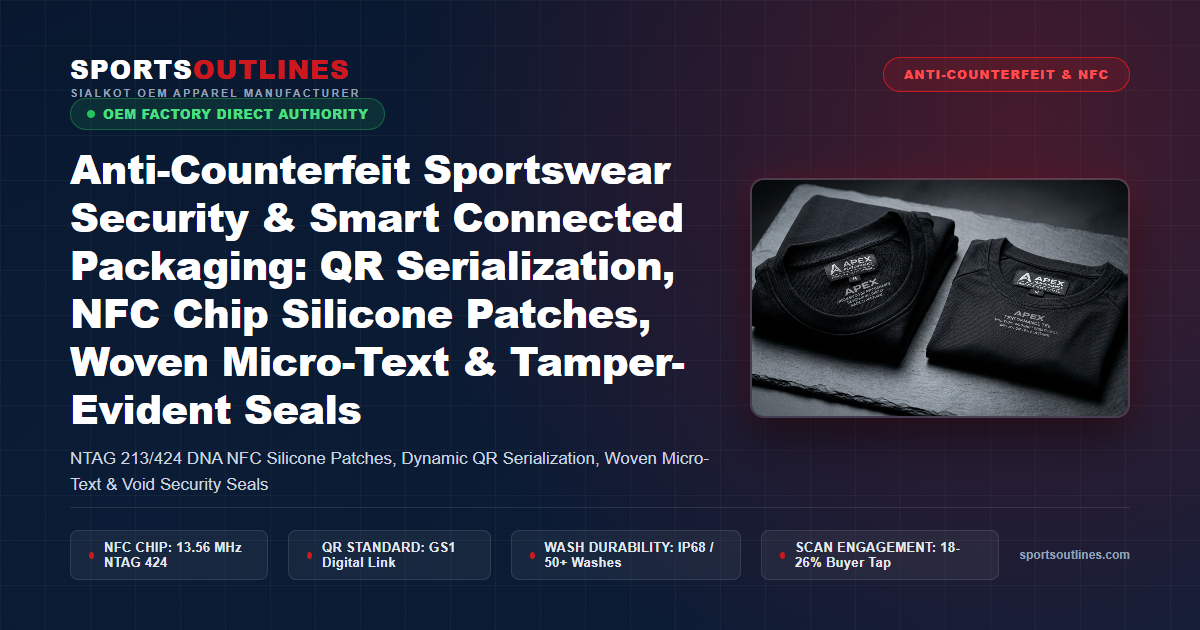
The moment a limited-edition streetwear hoodie, pro football club jersey, or championship BJJ Gi gains viral traction on TikTok, Instagram, or StockX/GOAT resale markets, unauthorized counterfeit workshops scrape your product photos and flood marketplaces with cheap, low-GSM replicas within 14 days. Simultaneously, the European Union’s Ecodesign for Sustainable Products Regulation (ESPR — Regulation (EU) 2024/1781) mandates that apparel sold in Europe carry a scannable Digital Product Passport (DPP) linking every garment to its verified fiber origin, OEKO-TEX®/GRS compliance certificates, and repair/recycling instructions. This comprehensive engineering guide details physical and digital anti-counterfeit integration at the Sialkot factory floor: GS1 Digital Link Variable-Data Serialized QR Care Labels, Washable NTAG 213 / NTAG 424 DNA Cryptographic NFC Chips encapsulated inside 3D Silicone Patches, 365 nm UV-Fluorescent & Metallic Micro-Text Security Threads, and Tamper-Evident VOID Holographic Seals.
Direct Manufacturer Answer: How Do Sportswear Brands Embed Anti-Counterfeit Authentication & Smart NFC/QR Tech into Garments?
Modern apparel brand protection uses a 3-Tier Physical-Digital Defense Stack: (1) Overt Security via destructible 2D-matrix holographic hangtag seals and Certilogo-style serialized variable-data GS1 Digital Link QR codes (`12 × 12 mm` woven or thermal-printed into the inner care label); (2) Covert Forensic Security via invisible 365 nm UV-fluorescent weft threads and `0.4 mm` micro-woven security text inside the neck damask label; and (3) Cryptographic Tap-to-Verify Smart Patches using waterproof 13.56 MHz NFC chips (`NXP NTAG 213` or `AES-128 NTAG 424 DNA`) vulcanized directly inside a 3D molded silicone chest or hem badge—surviving 50+ wash cycles while launching an instant smartphone authentication, VIP drop access, or EU Digital Product Passport page with zero app download required.
- Low MOQ Smart Serialization: Variable-data QR care labels, holographic seals, and NFC silicone badges available for 30–50 piece per style limited drops and pro team kits.
- Physical Pre-Production Sampling: Test live smartphone NFC tap-response and QR verification on a physical garment prototype in 7–10 business days ($45–$85 per piece non-refundable development fee).
- Direct Factory Engineering Desk: WhatsApp +92 316 7932595 or request a smart-trim quote at sportsoutlines.com/contact-us/.
Across the first seven technical guides of Sub-Cluster 6.2, we engineered the physical trims and warehouse identification systems of modern sportswear: Blog #441: High-Density Woven Damask vs Heat-Transfer Neck Labels, Blog #442: 600–800 GSM Luxury Duplex Hangtags, Blog #443: Global Care & Fiber Labeling Laws, Blog #444: 3D Silicone Badges & Metal Zipper Pullers, Blog #445: 80-Micron Frosted CPE & Compostable Polybags, Blog #446: GS1 Barcode, FNSKU & UHF RFID Architecture, and Blog #447: Custom Woven Jacquard Waistbands & Neck Taping.
Now, in Blog #448, we address how high-margin streetwear labels, pro sports clubs, combat sports equipment brands, and sustainable European exporters turn their garments into cryptographically authenticated, interactive digital media channels.
1. The 4-Layer Anti-Counterfeit & Connected Garment Security Architecture
Counterfeiters rely on static visual replication: if you print the exact same generic QR code pointing to your homepage (`https://yourbrand.com`) on 5,000 hoodies, a pirate factory can photograph that QR code with a smartphone and print the exact same working QR code onto 50,000 fake hoodies in 10 minutes. True anti-counterfeit engineering requires Item-Level Uniqueness (Serialization) or Physical-Cryptographic Hardware Challenges that cost more for a counterfeiter to replicate than the illicit margin of the fake garment.
2. Washable NFC Smart Patches (`13.56 MHz ISO/IEC 14443-A`): Encapsulating `NTAG 213` vs `NTAG 424 DNA` Inside 3D Silicone Badges
Near Field Communication (NFC) operates at the globally standardized high-frequency band of 13.56 MHz (`ISO/IEC 14443 Type A` / `NFC Forum Type 2 & Type 4 Tag`). Every modern Apple iPhone (iPhone XS through iPhone 16/17) and Android smartphone features a background NFC reader built directly into the top edge of the phone: when a customer taps the top of their phone against an NFC-enabled silicone chest badge, sleeve patch, or hem jock-tag on your hoodie or jersey, a native iOS/Android push banner pops up on their screen in 0.3 seconds with zero mobile app required.
2.1 How We Engineer Laundry-Proof NFC Silicone & TPU Badges (`IP68` / `50+ Washes`)
A raw paper-backed NFC sticker will delaminate and short-circuit on its very first cycle through a residential washing machine. To engineer an indestructible, wearable NFC garment patch (Blog #444: Custom 3D Molded Silicone/TPU Badges), we use two industrial encapsulation architectures:
- Architecture A — Flexible Polyimide (`Kapton®`) Copper-Etched Antenna Embedded in Liquid Silicone Rubber (`LSR`): We take a `18 mm` or `22 mm` diameter circular flexible polyimide substrate etched with a 6-turn copper spiral antenna and an epoxy-glob-top protected NXP silicon die (`total thickness 0.18 mm`). During two-stage liquid silicone molding (`155°C`), the NFC inlay is suspended exactly in the neutral bending plane between a `1.0 mm` base silicone layer and a `1.5 mm` 3D raised logo top layer. Because Liquid Silicone Rubber is 100% hydrophobic and chemically inert, the encapsulated NFC patch achieves an IP68 waterproof rating, withstands 160°C heat-press bonding, and survives 60+ home wash and tumble-dry cycles (`ISO 6330`) as well as commercial tunnel-finishing!
- Architecture B — Rigid PPS (Polyphenylene Sulfide) Laundry Button Tag inside a Woven Jock-Tag Pocket: For rugged combat sports gear (such as Custom Sportswear BJJ Gi jackets, boxing gloves, and heavy parkas), we ultrasonic-weld a `15 mm × 1.6 mm` injection-molded PPS engineering-plastic NFC laundry disc inside a double-layer woven damask jock-tag sewn at the lower left hem—capable of surviving `60 Bar` industrial hydro-extractor spin pressure!
- Perimeter Stitch-Channel Keep-Out Rule: Every NFC silicone badge or woven jock-tag is engineered with a clearly recessed `2.5 mm` outer sewing moat (`ISO 301` lockstitch track) positioned at least `3.5 mm` outside the outer copper loop of the NFC antenna so the sewing needle can never sever the inductive coil.
2.2 Standard `NTAG 213` UID Mirroring vs Unclonable `NTAG 424 DNA` AES-128 SUN Cryptography
- NXP `NTAG 213` (`144 Bytes` User Memory + `7-Byte` Read-Only UID): Ideal for interactive brand storytelling, VIP drop registration, playlist/workout video unlocking, and EU Digital Product Passports. We program the NDEF URL with automatic ASCII UID + Tap-Counter Mirroring (e.g.,
https://verify.yourbrand.com/?uid=04A1B2C3D4E580&cnt=000005) and permanently blow the lock bits so no one can overwrite the URL. - NXP `NTAG 424 DNA` (`AES-128` Cryptographic SUN — Secure Unique NFC Message): Why do luxury fashion houses and hype streetwear brands upgrade to `NTAG 424 DNA`? Because a sophisticated counterfeiter with an NFC cloner can read a static `NTAG 213` URL and copy it onto a blank emulator chip. With `NTAG 424 DNA`, a secret 128-bit AES cryptographic key is stored inside tamper-proof hardware memory on the chip. Every single time a customer taps the patch with their phone, the chip increments its internal tap counter and computes a brand-new, one-time 8-byte AES-CMAC cryptographic signature appended to the URL (`?picc_data=…&cmac=9F3A81C0…`). If someone copies that URL and pastes it into a browser or clones it onto another chip, your verification server immediately rejects it as a replay attack!
3. GS1 Digital Link Serialized QR Codes & EU Digital Product Passport (DPP / ESPR 2024/1781) Architecture
Beginning across 2026–2027 under the European Union’s Ecodesign for Sustainable Products Regulation (`Regulation (EU) 2024/1781`) and parallel global initiatives (“Sunrise 2027”), traditional single-purpose barcodes are being joined by GS1 Digital Link 2D QR Codes (`ISO/IEC 18004`) permanently attached to the garment’s internal care label stack (Blog #443: Global Apparel Care & Fiber Content Labeling Compliance).
3.1 How One GS1 Digital Link QR Code Serves Retail POS, Anti-Counterfeit & EU DPP Simultaneously
A GS1 Digital Link URI encodes your official GS1 GTIN (`Application Identifier 01`), batch/lot number (`AI 10`), and unique item serial number (`AI 21`) inside a standard web URL:
https://id.yourbrand.com/01/08500123450012/10/SLK26B86/21/984710293847
- When Scanned by a Retail Checkout / 3PL 2D Imager: The scanner strips the domain prefix and extracts
01/08500123450012as the GTIN-14/UPC-A barcode to ring up the garment at the cash register or log it into warehouse inventory. - When Scanned by a Consumer’s Smartphone Camera: The URL routes to your brand’s live Digital Product Passport & Authentication Portal, displaying: (1) Verified “Authentic Garment #042 of 100” status tied to serial number `984710293847`; (2) Full EU DPP sustainability transparency (Sialkot factory tier-1 assembly, exact fiber composition, OEKO-TEX® Standard 100 / GRS certificates, and ISO 3758 care instructions); and (3) One-tap size-matched re-ordering or warranty registration!
- Scan-Velocity & Geo-Fence Anomaly Detection (Stopping QR Counterfeits): What happens if a counterfeiter copies serial number `984710293847` onto 500 fake jerseys? The moment that specific serial number is scanned in more than 3 geographically distant cities (e.g., London, Berlin, and Chicago) within 48 hours, your cloud resolver automatically locks that serial number and displays a red “COUNTERFEIT DUPLICATE SERIAL ALERT” screen to buyers!
4. Covert Forensic Textile Security: 365 nm UV-Fluorescent Weft Threads, Guilloché Micro-Text & VOID Holograms
In addition to digital NFC and QR verification, our Sialkot trim division builds physical bank-note security features directly into your woven neck labels, care labels, and 700 GSM hangtags—critical for brands combating fraudulent e-commerce return swaps (“wardrobing” or returning a cheap knockoff in place of the authentic garment):
- 1. Invisible `365 nm` UV-Fluorescent Security Weft Thread in Woven Damask Labels: On our 50D high-density jacquard looms, we weave a single covert pick of optically clear polyester filament doped with an inorganic rare-earth phosphor along the reverse face or border of your neck label. Under normal daylight (`D65`) or store lighting (`TL84`), the thread is 100% invisible white/clear. When your 3PL returns inspector shines a `$12` handheld `365 nm` UV-A blacklight torch onto the neck label, your hidden security code glows brilliant Neon Cyan, Emerald Green, or Crimson Red—instantly catching fraudulent return swaps in 1 second!
- 2. Metallic Slit-Film Security Thread with `0.4 mm` Laser-Demetallized Micro-Text: Woven vertically through the center of the satin care label (identical to the security strip inside a $100 bill or €50 note), a `0.8 mm` wide polyester-metallized security ribbon features `0.4 mm` laser-etched micro-typography of your brand name readable under a `10×` magnifying loupe.
- 3. Dual-Channel 2D/3D Kinetic Holographic VOID Hangtag Seals (`20 × 20 mm`): Applied across the barcode or string-hole border of your 600–800 GSM hangtag, our master-originated dot-matrix holograms display shifting 3D depth layers at `15°` and `45°` viewing angles and incorporate a tamper-evident honeycombed or `VOID` release layer that self-destructs if anyone attempts to peel the hologram off an authentic hangtag and transfer it to a replica.
4B. Factory Inline NFC Encoding, Faraday Detuning Avoidance & Connected Post-Purchase LTV Economics
Deploying smart connected trims at industrial scale requires strict radio-frequency (`RF`) quality control and mechanical placement engineering on the Sialkot sewing floor. If an inexperienced factory places a `13.56 MHz` NFC silicone patch directly on top of a metal snap button, a zinc-alloy zipper slider, or heavy metallic bullion embroidery, electromagnetic eddy currents induced in the adjacent metal create a Faraday Cage detuning effect—shifting the resonant frequency of the copper antenna from `13.56 MHz` up to `15.2 MHz` and reducing smartphone tap sensitivity to zero!
4B.1 Electromagnetic Placement Rules & Ferrite Shielding Backers
- Minimum 20 mm Metallic Keep-Out Radius: On our Tech Pack callout sheets (Blog #431: Complete Sportswear Tech Pack Engineering Guide), we position NFC silicone badges and smart woven jock-tags at ergonomically intuitive, metal-free zones: the Left Sleeve Cuff (`40 mm` above the rib join), the Lower Left Front Hem (`35 mm` inset from the center zipper track), or the Upper Back Yoke below the collar.
- 0.15 mm Flexible Sintered Ferrite Anti-Metal Absorber Sheet: Whenever a brand design requires mounting an NFC patch onto a metallic-foiled varsity jacket or near metal hardware, we laminate a `0.15 mm` high-permeability flexible sintered ferrite absorber film directly behind the polyimide NFC antenna inside the silicone mold. The ferrite layer channels the magnetic flux lines cleanly between the smartphone reader coil and the tag antenna without penetrating the underlying metal surface!
- 3-Gate Factory Inline NFC Read-Write & Lock Audit: Every smart garment produced at Sports Outlines passes three automated RF gates before leaving Sialkot:
- Gate 1 (Pre-Molding Wafer Test): Every raw `NTAG 213 / NTAG 424 DNA` inlay is scanned on a reel-to-reel ACR1252U reader to verify factory UID integrity before liquid silicone injection.
- Gate 2 (Post-Vulcanization Cryptographic Provisioning): After `155°C` silicone curing, each finished badge is encoded with its unique NDEF URI, AES-128 SUN cryptographic keys (or UID/counter mirror), and permanent configuration lock bits.
- Gate 3 (Final Packing Table Smartphone Emulation Check): Before sliding the folded garment into its 80-micron frosted CPE polybag, the QC inspector taps the finished garment patch against a calibrated `13.56 MHz` desktop reader linked to the packing manifest—binding the exact NFC UID (`04:A1:B2…`) to the outer polybag GS1/FNSKU barcode in your CSV shipment log!
4B.2 Turning Anti-Counterfeit Patches into a Direct-to-Consumer (DTC) Retention Engine
Beyond stopping counterfeit replicas and wardrobing return fraud, smart NFC and serialized QR trims transform every garment into a zero-CAC (Customer Acquisition Cost) marketing channel—especially when wholesaling into third-party retail boutiques, gyms, or combat sports academies where brands traditionally never capture the end customer’s email or phone number:
- Wholesale-to-DTC First-Party Data Capture (38%–54% Tap-Through Rate): When a gym member buys your rashguard or hoodie at a local pro-shop and taps the “TAP HERE WITH PHONE TO VERIFY AUTHENTICITY & ACTIVATE LIFETIME SEAM WARRANTY” silicone sleeve badge, your mobile landing page verifies the garment’s serial number and prompts the athlete to enter their email/SMS to register ownership—converting anonymous wholesale buyers into high-LTV direct Shopify customers!
- Token-Gated Early Access to Limited Drops & Athlete Training Programs: Streetwear and fightwear brands use the cryptographic `NTAG 424 DNA` tap counter to grant verified owners of Drop #01 exclusive password-free access to purchase Drop #02 24 hours before the general public, or to unlock training video breakdowns recorded by sponsored athletes.
- One-Tap Size-Matched Re-Ordering: Because the serialized GS1 Digital Link URI (`AI 01 + AI 21`) knows the exact style, colorway, and size (`e.g., Size Large`) of the garment being tapped, the landing page displays a pre-populated “Order Another Pair in Size Large (or Gift a Friend)” button linked directly to your Shopify cart checkout.
5. Frequently Asked Questions (FAQ): Anti-Counterfeit Sportswear Security & Smart NFC/QR Trims
Q1: Do customers need to download a special mobile app to tap an NFC silicone patch or scan a GS1 Digital Link QR code?
No app is required. All modern iPhones (iOS 13+) and Android smartphones natively read `13.56 MHz` NDEF-formatted NFC tags simply by holding the top edge of the unlocked phone within `1–2 cm` of the silicone patch, and natively read GS1 Digital Link QR codes through the built-in camera app—opening your brand’s mobile verification and VIP portal in under 1 second.
Q2: Will washing, tumble drying, or ironing damage an NFC chip embedded inside a sportswear garment?
Not when properly encapsulated. Our flexible polyimide NFC inlays vulcanized inside 3D Liquid Silicone Rubber (`LSR`) badges and our rigid PPS laundry NFC discs are hermetically sealed (`IP68`), rated for continuous temperatures up to 160°C–180°C, and tested across 60+ ISO 6330 wash and tumble-dry cycles with zero signal degradation.
Q3: When does the EU Digital Product Passport (DPP) become mandatory for sportswear brands shipping to Europe?
Under the EU Ecodesign for Sustainable Products Regulation (ESPR 2024/1781), textiles and apparel are designated as a priority product group, with delegated acts finalizing data carrier requirements across 2026–2027. Brands exporting to our Germany Sportswear Manufacturer and UK Sportswear Manufacturer hubs are already integrating `12 × 12 mm` GS1 Digital Link QR codes onto their internal care labels today so all evergreen inventory is 100% future-proofed.
Q4: How does a variable-data serialized QR code stop counterfeiters if QR codes are easy to print?
A static QR code has one URL for 10,000 garments. A variable-data serialized QR code assigns a unique cryptographic serial number to every single individual garment (`1 of 1`). If a counterfeiter buys one real hoodie from your Custom Hoodies collection and photocopies its QR code onto 500 fakes, your server detects multiple scans of that single serial number across different IP addresses/GPS regions and automatically flags that serial code as a counterfeit copy.
Q5: Can I add NFC silicone badges or serialized QR labels on a 30–50 piece low-MOQ drop?
Yes! Variable-data thermal-transfer serialized QR care labels and pre-encoded `NTAG 213 / NTAG 424 DNA` NFC silicone badges can be produced for exact 30–50 piece per style low-MOQ runs. We encode and verify your exact target URLs during our 7–10 business day physical pre-production sample ($45–$85 per piece non-refundable development fee) so you can test the live smartphone tap experience before bulk manufacturing.
Future-Proof Your Sportswear Brand with NFC Smart Patches & Serialized QR Security
Protect your intellectual property, eliminate return-swap fraud, and comply with EU Digital Product Passport laws. Partner with Sports Outlines in Sialkot for factory-direct washable NFC silicone patches, GS1 Digital Link serialized QR care labels, 365 nm UV security weaving, and VOID holograms starting at 30–50 pieces per style. Approve your smart-connected prototype in 7–10 business days ($45–$85 per piece development fee).