B2B Apparel Sourcing & Industrial Infrastructure Verification
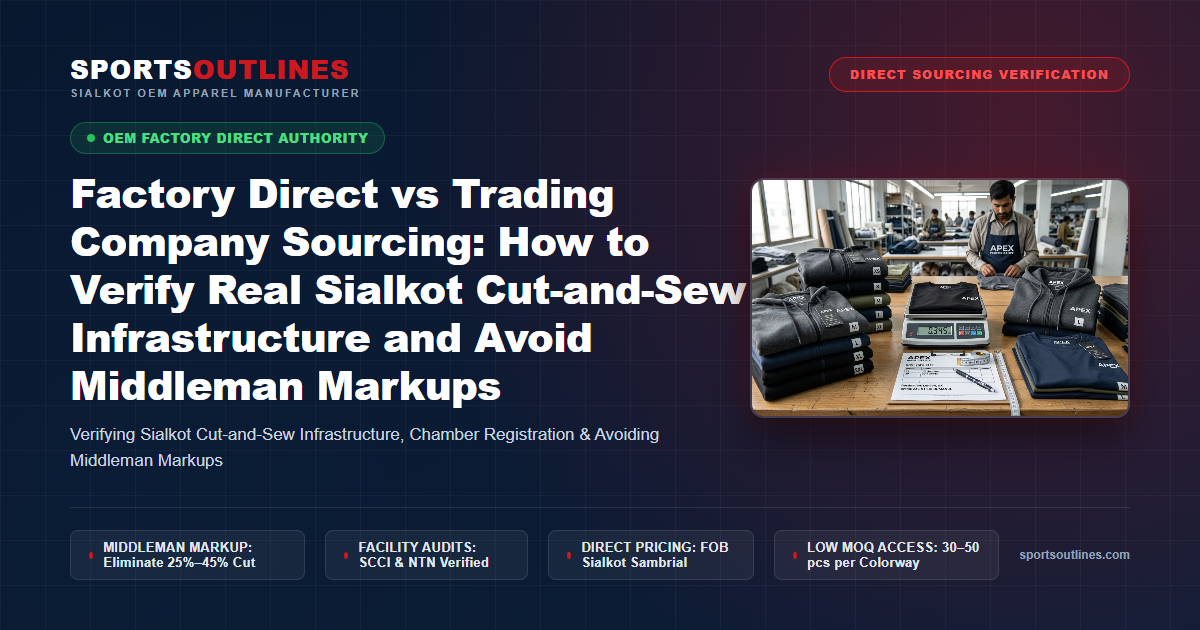
In global sportswear and activewear manufacturing, middleman markups silently erode between 20% and 40% of an emerging brand’s gross margin. Many online sourcing agents and “trading companies” present sleek English websites, claiming to own industrial manufacturing facilities in Sialkot, Pakistan, while operating out of small commercial offices or residential rooms. When technical production errors, flatlock seam blowouts, or delayed shipments occur, these brokers have zero technical control over the actual sewing floor. This guide provides international brands with an institutional verification playbook: auditing industrial machinery, validating SCCI export credentials, conducting live video walk-throughs, and partnering directly with authentic cut-and-sew manufacturers.
1. The Anatomy of Middleman Intermediation: How Trading Companies Operate
Sialkot, Pakistan, is the undisputed sports manufacturing capital of the world, generating billions in athletic apparel, combat fightwear, and leather goods annually. This global prestige has created a sprawling secondary industry of commercial brokers, export middlemen, and digital trading companies.
A trading company does not own fabric spreading tables, automated laser cutters, flatlock stitch machines, or steam press tunnels. Instead, their business model operates on information asymmetry:
- They launch modern Shopify or WordPress storefronts targeting keywords like “custom sportswear manufacturer low moq”.
- When an overseas buyer submits a tech pack, the trading agent takes the specifications to various local third-party cut-and-sew workshops in Sialkot.
- The agent adds a hidden 25%–40% broker margin onto the true factory FOB quotation.
- If an issue arises—such as poor colorfastness or loose waistbands—the broker cannot alter machine calibration because they do not control the factory floor.
Partnering directly with an established, asset-backed manufacturer like Sports Outlines eliminates middleman markups, gives you direct access to master pattern makers, and ensures complete manufacturing accountability.
The most damaging consequence of middleman intermediation is the Communication Latency Tax. In performance activewear, subtle engineering nuances—such as specifying a 4-thread differential feed ratio of 1:1.3 to prevent wave-rippling along curved princess seams—cannot survive four layers of email forwarding. When an overseas brand communicates with a non-technical sales broker, the message is simplified, distorted, or ignored by the time it reaches the sewing line mechanic. This results in repeated prototype failures, wasted sampling cycles, and months of lost retail season timing.
Furthermore, digital trading agencies routinely deploy sophisticated online façades: uploading stock 3D renders, downloading machinery photos from Japanese equipment manufacturer websites, and presenting staged showrooms. Verifying physical factory ownership through direct video walkthroughs and institutional chamber documentation is the only foolproof method to protect your brand capital.
Table 1: Structural Audit: Factory-Direct Manufacturer vs. Export Trading Company
| Operational Dimension | Direct Cut-and-Sew Factory (Sports Outlines) | Export Trading Company / Commercial Broker | Brand Sourcing Impact |
|---|---|---|---|
| Physical Capital Assets | Dedicated plant, sewing lines, cutting tables, boiler iron rooms | Commercial office space, laptops, mobile phones only | Real machines guarantee capacity and schedule adherence |
| FOB Pricing Transparency | True Bill of Materials (BOM) cost + direct factory labor | Factory base quote + 20% to 40% hidden middleman markup | Direct sourcing saves $3.50–$8.00 per garment |
| Quality Control Authority | Direct inline QC supervisors and ISO 2859-1 AQL inspectors | Secondhand status; cannot instruct sewing operators directly | Direct factory halts defects immediately on the line |
| Tech Pack Communication | Direct engineering dialogue with master pattern cutters | Telephone game: messages diluted through non-technical sales staff | Eliminates miscommunications and fit errors |
| Defect Liability & Rework | Contractual warranty: immediate rework, remake, or refund | Broker deflects blame to third-party workshop; disappears | Direct factory contractually absorbs defect risk |
| Prototyping Economics | Strict $45–$85/piece (7–10 days turnaround) | $120–$200/piece (Broker adds heavy sample margin) | Rapid iteration at authentic engineering cost |
2. The True Financial Toll: Margin Compounding & Markup Multipliers
To understand why trading companies undermine private label activewear brands, consider the mathematical breakdown of a heavyweight 450 GSM French terry hoodie.
In a direct factory relationship, you pay true manufacturing costs: yarn spinning, knitting, reactive dyeing, laser cutting, sewing labor, direct factory overhead, and an authentic manufacturer profit margin (12%–18%).
When dealing with a trading company, the broker must pay the sub-tier factory’s full cost and margin, and then stack their own 25%–35% markup on top. When imported into the United States or United Kingdom, destination customs duties (typically 16% to 32% for apparel) and ad-valorem taxes are applied to the inflated FOB invoice value.
Table 2: Financial Anatomy: Factory-Direct vs. Middleman Intermediated Cost Breakdown (450 GSM Hoodie)
| Cost Component | Factory Direct (Sports Outlines) | Trading Company / Broker | Financial Variance |
|---|---|---|---|
| Raw Fabric & Dyeing (450 GSM Terry) | $6.80 | $6.80 | Identical raw material cost |
| Cut, Sew, Trims & Screen Print | $4.20 | $4.20 | Identical manufacturing labor |
| Factory Overhead & Margin (15%) | $1.65 | $1.65 (Sub-tier factory profit) | Sub-factory earns standard margin |
| Trading Agent Broker Markup (30%) | $0.00 (Zero middleman) | $3.80 (Broker fee) | +$3.80 unearned middleman fee |
| Ex-Factory FOB Price | $12.65 | $16.45 | +$3.80 (+30.0% premium) |
| US Import Duty (16.5% HTS 6110.20) | $2.09 | $2.71 | +$0.62 higher customs tax on broker markup |
| Total Landed Cost (excl. freight) | $14.74 | $19.16 | +$4.42 extra cost per unit |
3. The 7-Point Factory Verification Audit: Remote Due Diligence Framework
International buyers cannot always fly to Pakistan before placing their initial order. Fortunately, you can verify whether an entity is a genuine manufacturing facility using seven rigorous remote verification protocols:
Table 3: Seven-Point Remote Verification Audit Framework
| Audit Checkpoint | Verification Requirement | Genuine Factory Response | Trading Company Red Flag |
|---|---|---|---|
| 1. Live Video Walk-Through | Unannounced live WhatsApp video tour of the sewing floor | Readily walks onto floor, introduces technicians, shows active lines | Excuses: “Security policy prohibits cameras”, or delays call by days |
| 2. SCCI Chamber Membership | Registration certificate with Sialkot Chamber of Commerce | Active corporate member certificate in registered company name | Cannot provide SCCI certificate or name mismatches |
| 3. Corporate Bank Account | Formal commercial banking details matching registered entity | Corporate bank account in Pakistan (Habib Bank, Meezan, Alfalah) | Requests payment to personal accounts, Western Union, or third-party LLC |
| 4. Machinery Line Audit | Specific machinery models (Yamato, Pegasus, Juki, Brother) | Detailed machinery count list and serial photo verification | Vague responses (“we have all modern stitching machines”) |
| 5. Government Tax NTN | National Tax Number (NTN) issued by Federal Board of Revenue | Verifiable NTN active in FBR online active taxpayer list (ATL) | Unregistered entity; unable to provide FBR tax documents |
| 6. Pattern Grading Capability | In-house CAD digitizing system (Gerber, Lectra, Optitex) | Master pattern maker demonstrates live CAD grading on screen | Subcontracts grading to external freelancers; delays replies |
| 7. Export Shipping History | Air airway bills (AWB) and ocean Bills of Lading (B/L) | Authentic masked DHL/FedEx/ocean shipping records to USA/UK/EU | No verifiable export documentation or recent manifests |
4. Red Flags: Identifying Shell Companies & Stolen Factory Images
The most common tactic among unverified middlemen is stealing high-resolution factory imagery from established industrial facilities and posting them on social media. Below are four unmistakable warning signs:
Table 4: Sialkot Apparel Sourcing Red Flags & Underlying Realities
| Observed Red Flag | Typical Middleman Explanation | Underlying Operational Reality | Action Required by Brand |
|---|---|---|---|
| Claiming Capability in Everything | “We make seamless tights, leather jackets, surgical scissors, and boxing gloves!” | Broker outsourcing to 10 unrelated workshops; zero technical focus | Disqualify immediately; demand dedicated activewear specialization |
| Refusal of Live Video Calling | “Our internet is down in the factory, we can only chat on WhatsApp text” | Broker is sitting in a living room without factory floor access | Never wire funds without seeing active machinery operating live |
| Personal Bank Account Details | “Transfer to our director’s personal account to save tax” | Unregistered tax evader; zero legal recourse if funds are stolen | Demand registered corporate IBAN/SWIFT under factory corporate NTN |
| Drastically Inconsistent Pricing | Quotes $5.00 for a complex jacket, then doubles quote during sampling | Broker has no understanding of true fabric GSM consumption or labor | Require open-book BOM cost breakdown prior to prototyping |
5. Sialkot Cut-and-Sew Machinery Audit: In-House Infrastructure
Manufacturing performance activewear and combat gear requires specialized industrial machinery. A generic commercial sewing workshop equipped only with basic single-needle lockstitch machines cannot properly construct technical four-way stretch athletic wear.
Table 5: Essential Industrial Machinery Infrastructure for Performance Athletic Apparel
| Machinery Classification | Technical Equipment Brand / Model | Primary Manufacturing Operation | Critical Quality Role in Sportswear |
|---|---|---|---|
| Four-Needle Six-Thread Flatlock | Yamato FD-62SD / Pegasus W600P | Seamless friction-free seams on leggings and rash guards | Guarantees chafe-free durability and high stretch elasticity |
| Differential Feed Overlock Machines | Juki MO-6814S / Siruba 747K | Side seaming and armhole assembly on stretch tees and shorts | Prevents seam puckering on high-recovery knit fabrics |
| Automated CO2 Laser Fabric Cutters | Golden Laser / Yueming High-Speed | Precision cutting of synthetic fabrics with heat-sealed edges | Eliminates edge fraying on microfibers and mesh panels |
| Industrial Rotary Sublimation Press | Eastsign Oil-Heated Calender Press | Continuous roll-to-roll and cut-panel sublimation transfer | Flawless color penetration with zero ghosting on fight shorts |
| Pneumatic Heat Press Stations | Stahls’ Hotronix Dual Air Fusion | Application of silicone logos, reflective films, and care tags | Exact pressure and temperature dwell preventing peel-offs |
6. Commercial Prototyping Governance: Transparent Engineering Fees
Brokers often bait prospective founders by promising “complimentary prototypes” or exorbitant “sampling fee reimbursements against future bulk production runs.” This is an immediate warning sign of middleman operation. Real cut-and-sew factories must pay their pattern cutters and master sample machinists professional wages to manually draft, single-ply cut, and construct pre-production garments.
At Sports Outlines, our prototype sampling policy is straightforward, transparent, and strictly enforced:
Sports Outlines Prototype Sampling Governance
Physical Prototyping Fee: Strictly $45 to $85 per piece, pair, or set based on technical garment complexity.
Turnaround Speed: Strictly 7 to 10 business days from technical pack confirmation and lab dip approval.
Non-Refundable Engineering Baseline: This fee covers genuine material waste, specialized technician labor, and pattern calibration. It guarantees dedicated sample line focus without artificial marketing markups.
7. Factory Low MOQ Reality: Direct Sourcing Flexibility
Trading companies often impose inflated minimums (500–1,000 pieces) because they must meet the volume requirements of the outside workshops they broker for, while taking their own profit cut.
Because Sports Outlines owns its physical cutting and sewing infrastructure in Sialkot, we offer authentic low MOQ agility: strictly 30 to 50 pieces per style or colorway. This allows emerging sportswear brands to launch bespoke private label collections with minimal inventory exposure. This 30 to 50 piece threshold provides direct factory access without forcing brands to compromise on custom cut-and-sew trims, custom woven neck labeling, or bespoke colorways, preserving complete brand individuality from day one.
Table 6: Production Volume Tiers: Direct Factory MOQ vs. Middleman Surcharges
| Production Volume Tier | MOQ per Style/Color | Sports Outlines Factory Direct Terms | Trading Company / Broker Reality |
|---|---|---|---|
| Boutique Brand Launch | 30–50 pcs | Standard agile cut-and-sew line scheduling | Refuses order, or adds 50% “small batch surcharge” |
| Core Collection Scaling | 100–300 pcs | Dedicated line; optimized fabric marker yields | Shifts production across multiple unvetted shops |
| Enterprise Sourcing | 500–1,000+ pcs | Full volume knitting discounts; open-book costing | Subcontracts to lowest bidder to pocket maximum spread |
8. Verification by Documentation: Official Pakistani Regulatory Credentials
Before signing a production agreement or sending deposit wires to any supplier in Sialkot, request the following official documents:
- Sialkot Chamber of Commerce & Industry (SCCI) Membership: Ask for a certified copy of their annual SCCI Certificate. Verify the corporate title directly through the Chamber’s public registry.
- FBR National Tax Number (NTN) Certificate: Verify that the entity is an Active Taxpayer listed with Pakistan’s Federal Board of Revenue.
- Form E Banking Verification: For formal commercial exports shipped via air or ocean, Pakistani customs regulations mandate the generation of an Electronic Form E (e-Form E) through the State Bank of Pakistan. Only genuine, registered manufacturers and exporters can generate authentic Form E filings.
- PRGMEA or PSGMEA Membership: Membership in the Pakistan Readymade Garments Manufacturers & Exporters Association or Pakistan Sports Goods Manufacturers & Exporters Association proves industry standing.
Table 9: Official Pakistani Regulatory Portals & Corporate Verification Pathways
| Regulatory Body | Public Online Verification Portal | Verification Requirement | Fraud Risk Mitigated |
|---|---|---|---|
| Federal Board of Revenue (FBR) | e.fbr.gov.pk (Online Active Taxpayer List) | Query factory 7-digit NTN number | Confirms active corporate tax compliance and legal registration |
| Sialkot Chamber of Commerce (SCCI) | scci.com.pk (Member Directory Search) | Verify company registration number & class | Prevents partnering with unaccredited fly-by-night brokers |
| Securities & Exchange Commission (SECP) | secp.gov.pk (Company Name Search) | Verify Corporate Universal Identification No (CUIN) | Confirms corporate directors and authorized capital structure |
| State Bank of Pakistan (SBP) / PSW | psw.gov.pk (Pakistan Single Window) | Electronic Form E financial export link | Guarantees legal foreign currency repatriation under banking law |
9. Factory Floor Layout & Production Flow: From Fabric Spreading to Finishing Tunnel
A genuine garment manufacturing facility is organized into distinct, linear engineering departments designed to maximize operational efficiency and prevent cross-contamination of lint and dust. In contrast, middleman brokers who rent temporary floor space display disorganized, cluttered workstations with zero progressive line flow.
Table 7: Industrial Plant Layout & Production Station Architecture
| Production Department | Dedicated Equipment & Infrastructure | Direct Factory Standard | Middleman Broker Deficiency |
|---|---|---|---|
| 1. Raw Material Storage | Climate-controlled fabric roll racks, 4-point inspection machine | Fabric rested 24 hours prior to cutting to eliminate shrinkage tension | Fabric stored on damp concrete floors; cut immediately |
| 2. Cutting Hall | 20-meter vacuum spreading tables, automated end cutters, CNC lasers | Computerized CAD marker plotting ensuring tight POM tolerances | Manual cardboard tracing with high inter-ply sizing drift |
| 3. Assembly Sewing Line | Modular progressive bundle system with dedicated flatlock & overlocks | Standard 12–14 stitches per inch (SPI); specialized thread tensioners | Inconsistent SPI; operators using generic cheap polyester thread |
| 4. Finishing & Ironing | Central industrial vacuum pressing tables, boiler steam irons, thread trimmers | Strict pre-set temperature parameters preventing synthetic fabric glaze | Domestic hand irons that scorch elastane and create fabric shine |
| 5. Metal Detection & Packing | Conveyor belt needle detector (Hashima), individual polybag sealing | 100% garments scanned for broken needle fragments prior to boxing | Zero metal detection; dangerous needle hazard for retail brands |
10. The Subcontractor Arbitrage Trap: How Brokers Exploit Cheap Sheds
The underlying mechanism that makes middleman trading companies dangerous is the subcontractor arbitrage model. When a trading agent quotes your brand $14.00 for a custom gym hoodie, their objective is not to deliver superior quality—their sole economic incentive is to find the cheapest possible workshop in the rural periphery of Sialkot that will stitch the garment for $8.00, pocketing the $6.00 spread.
These unvetted informal workshops lack social compliance audits, fire safety systems, or minimum wage enforcement. Furthermore, they use low-grade recycled core sewing threads, uncalibrated tension discs, and poorly trained piece-rate labor.
When you partner directly with Sports Outlines, your production runs exclusively on our owned, dedicated lines under certified supervisors who are contractually bound to ISO 2859-1 AQL 2.5 defect thresholds.
11. On-Site Factory Visit Protocol: Conducting an In-Person Audit in Sialkot
For athletic apparel founders visiting Pakistan, conducting a professional physical factory audit requires evaluating eight distinct inspection stations across the facility:
Table 8: Eight-Station Physical On-Site Factory Audit Checklist
| Audit Station | Physical Checkpoint | Standard Operating Protocol | Audit Pass Threshold |
|---|---|---|---|
| Station 1: Pattern CAD Room | Digitizer tablet, high-speed plotter, Clo3D/Gerber software | Live conversion of customer tech pack into master grading blocks | In-house CAD specialist present and active |
| Station 2: Fabric Warehouse | Elevated pallet storage, roll barcode tagging, humidity monitor | Stored at <65% relative humidity; zero contact with bare earth | Organized lot identification cards displayed |
| Station 3: Sample Prototyping | Dedicated sample room separate from bulk stitching line | Dedicated master technicians executing single-unit prototypes | Independent sample development queue ($45–$85/pc) |
| Station 4: Automated Cutting | Laser cutters, straight-knife cutters, ply number clamps | Ply height strictly controlled to avoid top-to-bottom sizing variance | Cut parts labeled with bundle tracking tickets |
| Station 5: Inline Sewing | Brand-name servo-motor stitching lines with LED task lighting | Quality inspection stations positioned after critical assembly steps | Defect defect bins (red boxes) audited hourly |
| Station 6: Screen Printing & Sublimation | Automatic carousel printing or continuous heat calenders | Exhaust ventilation active; wash-fastness testing lab nearby | Zero solvent odors in primary stitching halls |
| Station 7: Needle Detection | Calibrated 9-point conveyor needle detection scanner | Hourly sensitivity calibration with 1.2 mm ferrous test card | Daily needle calibration logbook signed by QA manager |
| Station 8: Packaging & Palletizing | 5-ply corrugated export cartons, desiccant pouches, strapping machine | Moisture meter reading ≤10% prior to final box sealing | Box weight and dimension verification matches manifest |
12. Production Milestone Banking: Structuring 30/70 TT Payments Safely
In overseas cut-and-sew apparel manufacturing, payment security is the bedrock of mutual trust. Genuine export factories operate on institutional commercial banking channels, typically structuring production payments under a 30% Deposit / 70% Balance telegraphic transfer (T/T) framework:
- 30% Production Deposit: Transferred upon signing the formal Apparel Manufacturing Agreement (AMA) and purchase order (PO). This capital funds dedicated raw fabric procurement, yarn knitting, and custom dye batches.
- 70% Final Balance: Released only after the finished bulk order passes final random inspection (FRI) under ISO 2859-1 Level II AQL 2.5 standards, with photographic and video proof or third-party inspection sign-off (SGS, QIMA).
Never agree to wire 100% upfront funds or send final payments before inspecting packed cartons. A direct factory welcomes independent third-party audits because transparent quality verification protects both parties.
Letter of Credit (L/C) vs. Telegraphic Transfer (T/T): Enterprise Scaling
While agile brand launches (30–50 pieces per style) operate most efficiently via telegraphic bank transfer (T/T), enterprise purchase orders exceeding $30,000 can be executed via Irrevocable At-Sight Letters of Credit (L/C) opened through Tier-1 international correspondent banks (such as Citibank, Standard Chartered, or HSBC).
Under an L/C structure, the buyer’s issuing bank guarantees payment to the manufacturer’s advising bank in Pakistan only upon presentation of clean, compliant export documentation: clean on-board Ocean Bills of Lading, SGS pre-shipment inspection certificates, commercial packing lists, and State Bank Form E filings. This financial instrument provides institutional risk mitigation for large-scale international apparel sourcing.
13. Frequently Asked Questions: Factory Direct vs. Trading Company Sourcing
Q1: How can I confirm an apparel supplier in Sialkot actually owns a physical factory?
Request an unannounced live WhatsApp video tour during local business hours (UTC+5). Ask to see the pattern-cutting tables, flatlock stitching machines, and finishing areas while speaking with line supervisors.
Q2: What is the typical markup charged by an overseas apparel trading company?
Apparel brokers and trading agents typically add 20% to 40% on top of authentic factory FOB production costs, significantly reducing the brand’s gross margins.
Q3: How much does physical prototype sampling cost at Sports Outlines?
Our physical prototype sampling fee is strictly $45 to $85 per piece, pair, or set, completed within 7 to 10 business days. This fee covers pattern making, single-ply cutting, and master machinist labor.
Q4: What is the factory minimum order quantity (MOQ) at Sports Outlines?
Our low factory MOQ is strictly 30 to 50 pieces per style or colorway, allowing emerging brands to produce custom cut-and-sew collections without excessive capital exposure.
Q5: Why do trading companies advertise complimentary prototypes while real factories charge an engineering fee?
Trading companies use complimentary prototype promises as marketing lures, baking the cost into hidden production markups. Real factories operate professional engineering sample rooms requiring direct compensation.
Q6: What is an SCCI membership certificate and why is it essential?
The Sialkot Chamber of Commerce & Industry (SCCI) is the official trade body in Sialkot. Only verified, tax-registered corporate entities can obtain annual membership certificates, ensuring accountability.
Q7: Can a trading company enforce quality control standards effectively?
Rarely. Because trading companies do not employ the machine operators or own the facility, they have minimal influence when defects arise and cannot enforce immediate line corrections.
Q8: What happens if a supplier requests payment to a personal bank account?
Never send commercial funds to a personal account. Legitimate export manufacturers in Pakistan maintain formal corporate bank accounts registered under their corporate tax NTN.
Q9: What stitching machines are required for technical activewear?
High-performance activewear requires four-needle six-thread flatlock machines (Yamato or Pegasus) and differential feed overlock machines to ensure elastic, chafe-free seams.
Q10: How do I begin working directly with Sports Outlines?
Connect with our technical factory desk on WhatsApp at +92 316 7932595 or submit your inquiry online. We provide open-book BOM costing, initiate physical prototyping ($45–$85/piece), and schedule live video facility tours.
Cut Out Middleman Markups — Source Factory-Direct in Sialkot
Partner directly with Sports Outlines for transparent cut-and-sew manufacturing. Benefit from open-book pricing, agile 30–50 piece minimums, and rapid 7–10 day prototyping ($45–$85/piece) backed by verified factory infrastructure.
International export desks: USA Sourcing Desk | UK Sourcing Desk | Australia Sourcing Desk | Sportswear Catalog.