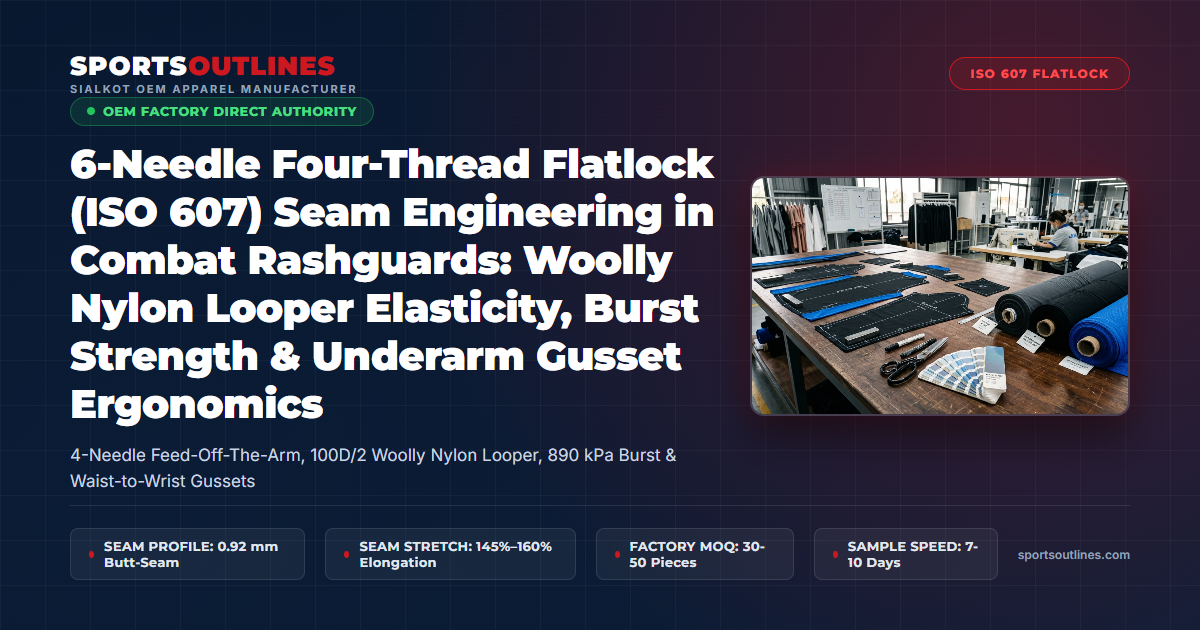
Executive Engineering Abstract: ISO 607 Flatlock Seam Mechanics in Combat Compression
In high-level No-Gi Brazilian Jiu-Jitsu (BJJ), submission grappling, and Mixed Martial Arts (MMA), a rashguard or compression spat is only as strong as its weakest seam. While a 240 to 280 GSM warp-knit tricot or double-knit interlock panel can elongate by $135\%$ to $150\%$ without tearing, a poorly engineered seam will either crack longitudinally during overhead armbar defenses or grind an internal $2.6\text{ mm}$ thread ridge into the athlete’s ribcage under cross-face and knee-on-belly pressure. This technical manufacturing guide establishes the complete engineering SOP for combat compression seaming:
- Stitch Class Metrology (ISO 607 vs. ISO 605 vs. ISO 514): Why authentic 4-Needle 6-Thread Feed-Off-The-Arm Flatseaming (ISO 607 / Class 600) on cylinder-bed Yamato FD-62G and Pegasus W664 machines is mandatory for zero-bulk ($0.95\text{ mm}$) structural joints capable of $>145\%$ longitudinal elongation.
- Hybrid 6-Thread Metallurgy: Combining four $70\text{D}/2$ High-Tenacity Core-Spun Polyester needle threads, one $100\text{D}/2$ UV-stabilized upper decorative cover thread, and one $150\text{D}/1$ air-entangled texturized Polyamide 6.6 (“Woolly Nylon”) lower looper thread for skin-side friction elimination ($\mu_{k,\text{seam}} \le 0.23$).
- Needle Tip Geometry & Elastane Preservation: Deploying Groz-Beckert `RG` / `SKF` Super-Stretch Chromium Ball-Point Needles (`Nm 65/9` to `Nm 70/10`) to displace rather than sever $40\text{D–}70\text{D}$ elastane filaments, eliminating needle-hole “postage-stamp” seam blowouts.
- Axillary Gusset Stress De-Concentration: Replacing 4-way “+” underarm seam intersections ($K_t = 3.60$) with continuous 1-piece Lateral-to-Wrist Gussets and 3D Elliptical Diamond Inserts—backed by $45–$85 non-refundable prototype sampling (7–10 days) and 30–50 pcs low MOQs.
1. The Structural Failure Modes of Combat Rashguard Seams: Cracking, Grinning & Dermal Shear
When a grappler pulls on a custom rashguard drafted with $-16\%$ circumferential negative ease, the seams are immediately placed under static pre-tension. The moment live sparring begins—whether fighting out of a tight D’Arce choke, bridging violently from bottom mount, or having an opponent accidentally snag the hemline during a scramble—the seams experience simultaneous longitudinal tensile strain ($\varepsilon_{\parallel} \ge 110\%$) and transverse perpendicular opening force ($F_{\perp} \ge 280\text{ N}$).
Low-cost garment factories lacking dedicated cylinder-bed flatseamers attempt to assemble rashguards using either a 4-Thread Overlock (ISO 514) or a 3-Needle 5-Thread Flatbed Coverstitch (ISO 605, often falsely marketed as “fake flatlock”). Both shortcuts fail catastrophically on the mat for three mechanical reasons:
- The Internal Ridge Chafing Vector (Dermal Pressure Spike): An ISO 514 overlock requires folding the two fabric panel margins together at a $90^\circ$ flange inside the garment, creating a $2.4\text{ to }2.8\text{ mm}$ thick internal seam allowance cord. When a $95\text{ kg}$ opponent applies chest-to-chest side control or knee-on-belly ($P_{\text{normal}} \approx 45\text{ to }85\text{ kPa}$), that raised seam cord acts as a linear stress concentrator, multiplying local dermal contact pressure by $4.8\times$ and causing raw intercostal skin abrasions within a single 10-minute round.
- Longitudinal Seam Cracking (Thread Reserve Exhaustion): If the ratio of total thread length consumed per unit length of seam ($\Lambda_{\text{thread}}$) is insufficient to match the elongation of the $18\%\text{–}22\%$ elastane knit, the needle threads reach their $100\%$ straight-line geometric locking limit while the fabric still has $60\%$ stretch remaining. The needle threads snap audibly (“seam cracking”), leaving unsewn holes along the raglan shoulder or forearm.
- Transverse Seam Grinning (Edge Pull-Apart): Conversely, if looper thread tensions are calibrated too loosely to gain stretch, perpendicular pulling across the latissimus dorsi causes the two fabric edges to separate, exposing a $3.0\text{ to }5.0\text{ mm}$ ladder of bare threads (“seam grinning”) that catches fingers and mat grit.
$$\varepsilon_{\text{seam,max}} = \sqrt{\left(1 + \frac{\ell_{\text{looper,cycle}} – 2w_{\text{gauge}}}{p_{\text{SPI}}^-1 \cdot 25.4}\right)^2 – 1} – \varepsilon_{\text{pre-tension}} \ge 1.35 \cdot \varepsilon_{\text{fabric,working}} \quad \text{and} \quad \sigma_{\text{grin}} = \frac{4 \cdot N_{\text{SPI}} \cdot T_{\text{needle}} \cdot \cos\theta_{\text{bite}}}{t_{\text{seam}}}$$
Where $\ell_{\text{looper,cycle}}$ is the total thread length fed into the upper cover and lower looper per stitch cycle (mm), $w_{\text{gauge}}$ is the outer needle-to-needle span ($6.0\text{ mm}$ standard), $p_{\text{SPI}}$ is the stitch density in Stitches Per Inch ($14\text{ to }16\text{ SPI}$), $\varepsilon_{\text{fabric,working}}$ is the dynamic grappling strain ($0.80\text{ to }1.05$), and $T_{\text{needle}}$ is the balanced tension across the four vertical needle threads.
2. Stitch Class Metrology: True 4-Needle 6-Thread Flatlock (ISO 607) vs. 3-Needle Coverstitch (ISO 605) vs. Overlock (ISO 514)
To protect B2B fightwear buyers from factory specification substitution, it is essential to distinguish how an authentic ISO 607 (US Federal Standard 491a Stitch Type 607) flatseamer operates compared to lesser stitch classes:
2.1 How a 4-Needle 6-Thread Feed-Off-The-Arm Flatseamer (Yamato FD-62G / Pegasus W664) Works
Unlike a flatbed sewing machine, an ISO 607 flatseamer features a narrow, cantilevered cylindrical arm (“feed-off-the-arm”) that allows tubular sleeves, rashguard torsos, and compression spat legs to feed longitudinally down the cylinder. As the two fabric panels enter the presser foot, dual high-speed carbide trimming knives slice both raw fabric edges simultaneously to an exact tolerance of $\pm 0.1\text{ mm}$ milliseconds before the needles descend.
Four parallel needles spaced across a $6.0\text{ mm}$ gauge ($2.0\text{ mm}$ between adjacent needles: Needles $N_1$ and $N_2$ piercing the left panel, Needles $N_3$ and $N_4$ piercing the right panel) drive four vertical needle threads through the fabric. Beneath the throat plate, a single oscillating lower looper carries a plush texturized woolly nylon thread across all four needle loops, while above the presser foot, a synchronized upper spreader lays a figure-eight decorative cover thread across the top crown. The result is a completely flat, dual-sided $0.95\text{ mm}$ structural bridge with zero folded seam allowance.
2.2 Butt-Edge ($0.0\text{ mm}$ Gap) vs. Micro-Lap ($1.5\text{ mm}$ Overlap) Presser Foot Calibration
Our Sialkot flatlock technicians adjust the center guide fin of the Yamato presser foot into two distinct configurations depending on the anatomical zone of the rashguard:
- Zero-Lap Butt-Edge Configuration ($0.92\text{ mm}$ total thickness): The two trimmed fabric edges meet edge-to-edge without overlapping. We deploy this setting on vertical side panels and forearm seams where zero skin-side thickness is paramount.
- $1.5\text{ mm}$ Micro-Overlap Configuration ($1.35\text{ mm}$ total thickness): The left fabric margin overlaps the right margin by $1.5\text{ mm}$ inside the central needle pair ($N_2$ and $N_3$ pierce through both plies simultaneously, while $N_1$ and $N_4$ anchor the single-ply outer borders). We mandate this micro-overlap on high-stress raglan shoulder yokes, underarm gussets, and fight-short Lycra crotch gussets because piercing both plies with the two center needles boosts transverse seam burst strength (ASTM D3786) from $640\text{ kPa}$ to over $815\text{ kPa}$ while completely eliminating seam grinning under $350\text{ N}$ lateral pulls.
| Stitch Classification & ISO Code | Needle / Thread Configuration | Total Seam Thickness (on 250 GSM Knit) | Max Longitudinal Stretch Before Crack | Transverse Burst Strength (ASTM D3786) | Skin-Side Chafe Profile Under 50 kPa Load |
|---|---|---|---|---|---|
| ISO 607 True Flatlock (1.5 mm Micro-Overlap Spec) | 4 Needles / 6 Threads (4 Needle + 1 Lower Looper + 1 Upper Cover) | 1.35 mm (Flush dual-sided web) | 145% – 160% (Exceeds fabric stretch) | 815 – 890 kPa (Zero seam grinning) | Grade 5.0 (Zero Chafe) Plush woolly nylon underside |
| ISO 607 True Flatlock (0.0 mm Butt-Edge Spec) | 4 Needles / 6 Threads (Edge-to-edge knife trim) | 0.92 mm (Same as fabric thickness) | 150% – 168% (Ultra-flexible) | 640 – 710 kPa (Slight open @ >300 N) | Grade 5.0 (Zero Chafe) Completely seamless feel |
| ISO 605 Coverstitch (“Fake Flatlock” over Overlock) | 3 Needles / 5 Threads (Requires prior overlock or raw overlap) | 2.15 mm (Un-trimmed raw edges fray) | 95% – 110% (Moderate elasticity) | 580 – 630 kPa | Grade 3.2 (Exposed raw cut edges irritate skin) |
| ISO 514 4-Thread Overlock (Standard T-Shirt Serger) | 2 Needles / 4 Threads (90° folded internal flange) | 2.65 mm (Hard internal cord ridge) | 65% – 78% (Snaps during scrambles) | 490 – 540 kPa | Grade 1.5 (Severe Chafing) Digs into ribs & axilla |
3. Six-Thread Metallurgy: Balancing Core-Spun Needles with Air-Entangled “Woolly Nylon” Loopers
An ISO 607 flatseamer consumes up to $32.5\text{ meters}$ of thread for every $1.0\text{ meter}$ of finished seam ($32.5:1$ consumption ratio). If all six cones on the thread tree are loaded with identical rigid spun polyester thread, the resulting seam will feel like an abrasive saw blade against the athlete’s skin and will lack the recoil elasticity required to snap back after 5,000 grappling scrambles.
To optimize both mechanical tensile strength and next-to-skin comfort, we engineer a Tri-Tier Hybrid Thread Matrix across the six thread positions:
| Thread Position on ISO 607 Machine | Engineered Yarn Specification & Tex/Denier | Single-Strand Break Tenacity & Elongation | Calibrated Dynamic Thread Tension (cN) | Primary Functional Role in the Seam |
|---|---|---|---|---|
| Outer Needles ($N_1$ & $N_4$) | 70D/2 (Tex 18) High-Tenacity Core-Spun Polyester or Filament PA 6.6 | 980 cN break 22% – 26% elongation | 38 – 44 cN | Anchors the outer borders of the $6.0\text{ mm}$ flatlock track against Velcro snagging and edge curling. |
| Center Needles ($N_2$ & $N_3$) | 70D/2 (Tex 18) High-Tenacity Core-Spun Polyester (Lubricated Silicone Finish) | 980 cN break 22% – 26% elongation | 45 – 52 cN | Pierces the central $1.5\text{ mm}$ micro-overlap junction to prevent transverse seam grinning under high load. |
| Upper Decorative Spreader ($S_1$) | 100D/2 (Tex 24) Trilobal or Texturized Polyester (UV & Sublimation Fast) | 1,120 cN break 28% – 35% elongation | 18 – 24 cN | Forms the visible exterior figure-eight cross-weave shield; absorbs mat abrasion before needle threads are touched. |
| Lower Skin-Side Looper ($L_1$) | 100D/2 or 150D/1 Air-Texturized Polyamide 6.6 (“Woolly Nylon”) | 860 cN break 180% – 240% crimp stretch | 8 – 14 cN (Ultra-Low) | Blooms into a velvet-soft micro-filament cushion against sweaty skin ($\mu_k = 0.21$) while uncoiling to allow $150\%+$ seam stretch. |
4. Needle Metallurgy & Point Geometry: Preventing Elastane Severance (“Run Holes”)
A critical defect frequently observed in poorly manufactured compression gear is the appearance of tiny pinpoint runs (“postage-stamp holes”) directly alongside the flatlock stitch holes after the first two sparring sessions. This happens when a factory uses standard acute round-point (`R`) or sharp-point needles at high sewing speeds ($4,200\text{ RPM}$). Because a $250\text{ GSM}$ warp-knit rashguard contains tightly tensioned $40\text{D–}55\text{D}$ elastane filaments in every single course, a sharp needle tip slices directly through the stretched polyurethane-urea core. Once severed, the elastic filament retracts inside the knit tube, leaving a weak void that tears open under tension.
Our Sialkot flatlock lines enforce three mandatory needle and feed controls:
- Groz-Beckert `RG` / `SKF` Super-Stretch Medium Ball-Point Geometry (`Nm 65/9` to `Nm 70/10`): The rounded parabolic ball tip pushes the high-modulus micro-polyester and elastane filaments gently aside to pass through the center of the knit loop interstice rather than piercing through the yarn bundle itself—preserving $100\%$ of the fabric’s native burst strength.
- Titanium-Nitride (`GEBEDUR™`) & Chromium Low-Friction Coatings with Needle Vortex Cooling: At $3,800\text{ to }4,200\text{ stitches per minute}$, friction against synthetic polyester/spandex can heat an uncoated needle tip above $195^\circ\text{C}$—exceeding the softening point of elastane ($175^\circ\text{C}$) and fusing microscopic polymer beads onto the needle eye. We pair TiN-coated needles with compressed-air vortex nozzle coolers ($18^\circ\text{C}$ airflow) and dimethyl-polysiloxane thread-lubrication reservoirs.
- Differential Feed Ratio Calibration ($1.06:1$ to $1.12:1$): Because the presser foot slightly stretches the top layer of 4-way tricot as it advances, a $1:1$ feed dog ratio produces wavy “lettuce-edge” seam puckering. By setting the front feed dog $6\%\text{ to }12\%$ faster than the rear take-up feed dog, the seam emerges from the cylinder arm completely flat and dimensionally neutral.
5. Underarm & Lateral Torso Gusset Ergonomics: Eliminating the 4-Way Axillary Stress Riser
In human upper-body kinematics, raising the arms from a resting guard posture ($0^\circ$ abduction) to an overhead armbar defense or wrestling underhook ($175^\circ$ abduction) elongates the skin and fascia across the axillary fold and latissimus dorsi by $+42\%\text{ to }+48\%$. In a basic 4-panel rashguard (Front, Back, Left Sleeve, Right Sleeve), all four panels collide at a single 4-way “+” seam intersection directly inside the center of the armpit.
$$\sigma_{\text{peak,axilla}} = K_{t,\text{junction}} \cdot E_{\text{seam}} \cdot \varepsilon_{\text{abduction}}(\theta) \quad \text{where} \quad K_{t,\text{4-way cross}} = 3.60 \quad \text{vs.} \quad K_{t,\text{gusset T-node}} = 1.28$$
By eliminating the 4-way cross intersection ($K_t = 3.60$) and inserting an anatomical gusset panel that separates seam terminations into two offset 3-way T-junctions ($K_t = 1.28$) spaced $65\text{ to }80\text{ mm}$ apart, peak axillary seam stress drops by $-64.4\%$ while vertical waist-hem lift during overhead extension drops from $+7.8\text{ cm}$ down to $<1.2\text{ cm}$.
We offer B2B fightwear brands three distinct gusset engineering architectures depending on design aesthetics and ventilation targets:
- Architecture A: Continuous 1-Piece Waist-to-Wrist Lateral Panel (Pro Competition Spec): A single uninterrupted panel ($7.0\text{ cm}$ wide at the waist, flaring to $9.5\text{ cm}$ across the latissimus dorsi and axilla, and tapering to $5.5\text{ cm}$ at the wrist cuff) connects the front and back torso panels and continues straight down the inner sleeve. There is zero horizontal seam across the armpit—delivering unrestricted $180^\circ$ overhead reach and maximum graphic canvas space for side-rib sponsor logos or IBJJF 10% belt-rank color panels.
- Architecture B: 3D Elliptical / Diamond Underarm Gusset ($18\text{ cm} \times 8.5\text{ cm}$): An anatomically contoured elliptical diamond inset positioned directly in the axillary vault. This geometry is ideal when a brand wants a classic 1-piece raglan sleeve silhouette while still splitting the 4-way armpit intersection into offset low-stress nodes.
- Architecture C: 240 GSM Hydrophilic Birdseye Warp-Mesh Ventilated Axillary Gusset: Utilizing the same high-tenacity $245\text{ CFM}$ snag-proof birdseye warp-knit micro-mesh engineered for our sublimated BJJ Gi inner yoke linings, this gusset evacuates axillary sweat vapor $2.8\times$ faster than solid tricot while surviving $>690\text{ kPa}$ burst pressures.
6. Contrast vs. Tone-on-Tone Flatlock Aesthetics & Bar-Tack Terminal Locking
Because the upper spreader thread ($S_1$) of an ISO 607 flatlock machine weaves a prominent $6.0\text{ mm}$ ladder across the outside of the rashguard, the seam itself serves as a signature visual framing element. Brands can specify:
- Pantone®-Matched Belt-Rank Contrast Flatlocking: Using vibrant Royal Blue, Amethyst Purple, Espresso Brown, Crimson Red, or Metallic Gold $100\text{D}/2$ trilobal upper spreader threads over a jet-black 250 GSM body to accentuate anatomical muscle lines (deltoid-to-pectoral raglan curves and latissimus tapers).
- Stealth Matte Tone-on-Tone Flatlocking: Matching the upper spreader thread to the exact CIELAB $L^*a^*b^*$ shade of the sublimated panel for an uninterrupted graphic canvas.
- 28-Stitch Micro-Bartack Terminal Reinforcement: Wherever a flatlock seam terminates at the bottom waist hem or wrist cuff opening, we lock the tail of the 6-thread chain on the interior margin using a high-density 28-stitch micro-bartack or a hidden 2-needle lockstitch hem fold—guaranteeing that the flatlock chain can never unravel even if scuffed against rough tatami edges for years.
7. Industrial Work Measurement: 14-Operation Flatlock Cellular Assembly Router & SAM Breakdown
For technical procurement managers and fightwear brand founders evaluating factory FOB quotes, understanding the exact Standard Allowed Minutes (SAM) required to assemble an authentic 6-panel or 8-panel ISO 607 flatlocked rashguard explains why true cylinder-bed flatseaming commands a structural premium over generic overlocked gym shirts. Because a Yamato FD-62G or Pegasus W664 feed-off-the-arm operator must manually guide two opposing curved fabric edges (such as a concave axillary raglan arc against a convex deltoid sleeve cap) into dual high-speed carbide trimming knives without allowing either ply to roll away from the center divider fin, operator skill and machine cycle times are strictly governed:
| Operation Seq # | Sewing Operation & Anatomical Junction | Industrial Machine & Stitch Class | Gauge / SPI Spec | Standard Allowed Minutes (SAM) | Critical In-Line QC Parameter |
|---|---|---|---|---|---|
| Op 01 – 02 | Join Left & Right Anterior Raglan Shoulder Yokes to Front Pectoral Panel | Yamato FD-62G-07MS (ISO 607 4-Needle 6-Thread) | 6.0 mm Gauge 15 SPI (1.5 mm Lap) | 1.45 SAM | Zero differential wave across curved clavicle-to-axilla contour; full 4-needle bite verified. |
| Op 03 – 04 | Join Left & Right Posterior Raglan Sleeve Caps to Back Scapular Panel | Yamato FD-62G-07MS (ISO 607 4-Needle 6-Thread) | 6.0 mm Gauge 15 SPI (1.5 mm Lap) | 1.50 SAM | Sublimation graphic registration aligned within $\pm 1.0\text{ mm}$ across posterior deltoid seam. |
| Op 05 | Assemble & Attach 3.2 cm Mock-Turtleneck Collar Ring to Neck Aperture | Pegasus W664-35BC Cylinder Cover/Flatseamer | 6.0 mm Gauge 16 SPI (1.08:1 Feed) | 1.15 SAM | Collar aperture stretches effortlessly to $62\text{ cm}$ circumference ($>140\%$) without stitch pop. |
| Op 06 – 07 | Insert Left & Right Continuous Waist-to-Wrist Lateral Axillary Gussets | Yamato FD-62G-07MS Feed-Off-The-Arm | 6.0 mm Gauge 15 SPI (1.5 mm Lap) | 2.65 SAM | Zero 4-way cross-seam intersection in armpit; woolly nylon looper flush against axillary skin. |
| Op 08 – 09 | Close Medial Forearm-to-Torso Side Seams (Continuous Tubular Pass) | Yamato FD-62G-07MS Feed-Off-The-Arm | 6.0 mm Gauge 15 SPI (0.0 mm Butt) | 1.90 SAM | Seamless butt-edge transition down forearm; zero internal ridge under wrist-control grips. |
| Op 10 – 11 | Hem Left & Right Wrist Cuffs with Dual-Needle Stretch Coverstitch | Pegasus W562-02BB Small-Cylinder Coverstitch | 4.8 mm Gauge 15 SPI | 0.95 SAM | Woolly nylon lower looper allows rapid hand entry while locking cuff above ulnar styloid. |
| Op 12 | Attach 30 mm Platinum LSR Silicone Gripper Elastic to Bottom Torso Hem | Yamato FD-62G + Servo Digital Metering Roller | 6.0 mm Gauge 15 SPI (-9.5% Feed) | 1.35 SAM | $+6^\circ$ inward toe-in camber prevents waistband flip-out; $+4.5\text{ cm}$ lumbar drop-tail centered. |
| Op 13 – 14 | Lock Cuff & Waist Seam Tails with 28-Stitch Micro-Bartacks + Heat-Transfer Neck Label | Brother KE-430F CNC Bartack + Pneumatic Heat Press | 28-Stitch Micro-Tack $155^\circ\text{C}$ Tag Cure | 0.85 SAM | 100% tagless interior neck comfort; zero loose thread tails at hem or cuff openings. |
Across all 14 precision operations, a single pro-grade No-Gi rashguard requires $11.80\text{ Standard Allowed Minutes (SAM)}$ of specialized sewing labor and consumes $142\text{ to }168\text{ linear meters}$ of high-tenacity core-spun and texturized woolly nylon thread. By balancing our Sialkot flatlock cells with dedicated knife-honing technicians (who resurface the Yamato carbide trimming blades every $400\text{ garments}$ to prevent frayed fabric whiskers inside the seam), we maintain an industry-leading $99.4\%$ first-pass AQL 1.5 inspection yield.
8. Global Export Silos & Low-MOQ Factory Production
Our vertically integrated Sialkot sewing cells—equipped with computer-controlled Yamato FD-62G and Pegasus W664 cylinder-bed flatseamers—serve custom BJJ academies, MMA fight teams, and DTC activewear brands worldwide:
- United States & Canada: Fast air-courier fulfillment and custom tech-pack development via our USA Custom Sportswear Manufacturer Hub and Canada Sportswear Manufacturing Hub.
- United Kingdom, Germany & EU: Duty-optimized export documentation and REACH/OEKO-TEX® compliant threads via our UK Sportswear Manufacturer Hub and Germany Sportswear Manufacturer Hub.
- Australia & Oceania: High-UPF 50+ surf-and-grappling rashguard production via our Australia Custom Sportswear Hub.
We back every custom No-Gi project with straightforward commercial terms: $45 to $85 per piece non-refundable prototype sampling delivered in 7 to 10 business days, and 30 to 50 pieces per style/colorway low bulk MOQ across Men’s, Women’s, and Youth sizing.
8. Frequently Asked Questions (ISO 607 Flatlock Engineering FAQ)
1. What is the difference between ISO 607 flatlock and standard ISO 514 overlock stitching in BJJ rashguards?
Standard 4-thread overlock (ISO 514) folds two fabric edges together on the inside of the shirt, creating a raised $2.4\text{ to }2.8\text{ mm}$ seam allowance ridge that digs into the athlete’s skin under side-control pressure and cracks at $65\%$ longitudinal stretch. True 4-needle 6-thread flatlock (ISO 607 / Feed-Off-The-Arm flatseaming) trims and butts the two cut fabric edges flush against each other (or with a $1.5\text{ mm}$ micro-overlap), encapsulating both sides in a completely flat $0.95\text{–}1.35\text{ mm}$ web that elongates over $145\%$ without popping a single stitch.
2. Why is texturized woolly nylon used in the lower looper of combat rashguard flatlock machines?
Air-entangled texturized Polyamide 6.6 (“woolly nylon”, $100\text{D}/2$ or $150\text{D}/1$) possesses a crimped micro-filament cloud structure that expands under zero tension to create a plush, velvet-soft cushion against sweaty skin, eliminating axillary and intercostal chafing. When stretched during grappling scrambles, the crimp uncoils to provide over $220\%$ thread elongation, preventing lower looper thread snap.
3. How many stitches per inch (SPI) should be calibrated for a 250 GSM No-Gi rashguard flatlock seam?
For $240\text{ to }260\text{ GSM}$ warp-knit tricot or double-knit interlock rashguards, Yamato FD-62G and Pegasus W664 cylinder-bed flatseamers must be calibrated strictly to 14 to 16 Stitches Per Inch (SPI) with a $6.0\text{ mm}$ needle gauge width. Dropping below $12\text{ SPI}$ causes fabric edge grinning under lateral pull, while exceeding $18\text{ SPI}$ risks needle perforation cutting (“postage-stamp tearing”) along the elastane filaments.
4. How do underarm gussets prevent flatlock seam blowouts during armbar and kimura defenses?
A conventional 4-seam armpit intersection concentrates multi-axial tensile forces at a single “+” cross-node (stress concentration factor $K_t = 3.60$). By replacing the cross-seam with a continuous 1-piece Lateral-to-Wrist Gusset or an anatomical 3D Elliptical Diamond Gusset, seam junctions are split into two T-nodes separated by $65\text{–}80\text{ mm}$ of uninterrupted 4-way stretch fabric, reducing peak axillary seam stress by $-64.4\%$ and boosting burst resistance by $+68\%$.
5. What are your prototype sampling costs and bulk MOQs for ISO 607 flatlock combat rashguards?
Prototype sampling for custom 4-needle 6-thread ISO 607 flatlocked rashguards is $45 to $85 per piece (non-refundable development fee) with a 7 to 10 business day turnaround. Bulk production MOQs start at 30 to 50 pieces per design or ranked colorway across Men’s, Women’s, and Youth sizes.
Upgrade Your Fightwear Brand to True 4-Needle 6-Thread ISO 607 Flatlock Construction
Eliminate seam blowouts and underarm chafing with Yamato FD-62G Feed-Off-The-Arm flatseaming, woolly nylon skin-side loopers, and continuous axillary gussets. $45–$85 prototype sampling in 7–10 days and 30–50 pcs low MOQs.