1. Executive Summary: The Packaging Waste Crisis in E-Commerce Activewear
In the global activewear, combat sports, and athleisure retail sector, single-use plastic packaging has historically represented one of the most visible yet neglected sources of supply chain environmental degradation. Every year, an estimated 180 billion single-use polyethylene polybags are manufactured, shipped, and discarded across the international fashion and sportswear supply chain. The exponential expansion of direct-to-consumer (D2C) e-commerce fulfillment has exacerbated this footprint, as individual garments—such as compression leggings, seamless sports bras, moisture-wicking tees, and heavyweight technical hoodies—require protective moisture-barrier packaging during oceanic container transit and third-party logistics (3PL) warehouse bin storage.
For modern sportswear founders, procurement directors, and sustainability managers, packaging is no longer merely an unboxing afterthought; it is a critical regulatory, operational, and brand equity battleground. Stringent regulatory frameworks across primary consumer markets—most notably the European Union’s Packaging and Packaging Waste Regulation (PPWR), the United Kingdom’s Plastic Packaging Tax (PPT), and extended producer responsibility (EPR) mandates across North America—are aggressively penalizing virgin fossil-fuel plastics and incentivizing circular, certified post-consumer recycled (PCR) materials.
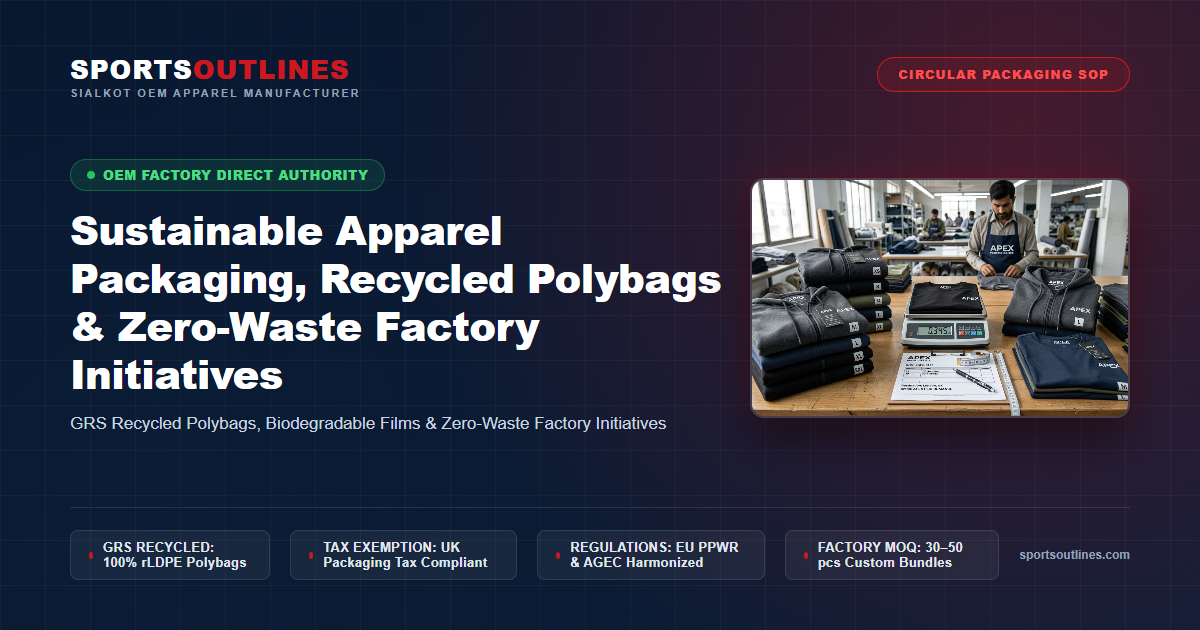
Sialkot’s progressive apparel manufacturing ecosystem has positioned itself at the cutting edge of sustainable packaging engineering. Integrating vertical cut-and-sew production with circular packaging supply chains, leading manufacturers in Sialkot provide comprehensive zero-waste infrastructure: from Global Recycled Standard (GRS) certified 100% post-consumer recycled polybags and certified compostable cornstarch films to circular fabric offcut reclamation that eliminates cutting-room landfill waste.
Key Sustainable Packaging Takeaways for Activewear Founders:
- Circular Polymer Standards: Transitioning from virgin Low-Density Polyethylene (LDPE) to Global Recycled Standard (GRS) certified 100% Post-Consumer Recycled (PCR) polybags reduces cradle-to-grave carbon emissions by up to 65% while maintaining critical barrier protection.
- Bio-Based Alternatives: Industrial compostable films (PLA/PBAT blends) certified under EN 13432 and ASTM D6400 break down within 180 days in commercial facilities, offering premium tactile luxury with zero microplastic persistence.
- EPR & Tax Exemption: Utilizing polybags containing at least 30% to 100% certified recycled content legally exempts apparel importers from the UK Plastic Packaging Tax (£217.85 per metric tonne) and eliminates EU PPWR penalty surcharges.
- Zero-Waste Fabric Sorting: Sialkot factories divert up to 92% of cutting room waste via mechanical fiber shredding, converting synthetic and cotton offcuts into industrial geotextiles, acoustic insulation, and equipment padding.
- Internal Silo Integration: Seamlessly integrate custom activewear manufacturing across dedicated hubs like our custom sportswear manufacturer USA portal, private label gym wear UK hub, and custom activewear manufacturer Germany network.
- Sports Outlines Commercial Structure: Factory low MOQ is strictly 30 to 50 pieces per style/colorway, backed by prototype sampling at $45 to $85 per garment (7 to 10 business days turnaround).
2. Global Recycled Standard (GRS) & Post-Consumer Recycled (PCR) Polybag Engineering
The most commercially viable and globally scalable sustainable packaging solution for athletic apparel is the Global Recycled Standard (GRS) certified Post-Consumer Recycled (PCR) polybag. PCR plastic is synthesized from discarded consumer packaging—such as milk jugs, stretch wrap, detergent bottles, and agricultural mulch films—that has been collected, cleaned, decontaminated, and re-pelletized into extrusion-grade resin.
Unlike self-declared “recycled content” claims, GRS certification provides third-party verified chain-of-custody Transaction Certificates (TCs). These certificates authenticate that the polymer inputs are sourced from genuine recycled streams traced from the certified reclamation facility through film blowing, gusseting, printing, and conversion into the finished zipper or adhesive pouch.
In technical activewear production, polymer engineers must balance circularity with mechanical integrity. Recycled polymers exhibit shorter molecular chains due to thermal degradation during previous processing cycles. To match the puncture resistance and tensile strength of virgin films, Sialkot packaging converters calibrate extrusion screw profiles and slightly increase film thickness (gauge) to ensure superior performance during transit.
| Technical Parameter | Virgin LDPE Standard | 100% GRS PCR rLDPE Bag | Performance Impact & Sialkot Factory Spec |
|---|---|---|---|
| Film Thickness (Gauge) | 30 to 45 microns (1.2–1.8 mil) | 50 to 75 microns (2.0–3.0 mil) | Gauge increase offsets shorter polymer chains, preventing seam split during compressed packing |
| Optical Clarity & Finish | 100% crystal clear gloss | Elegant semi-translucent frosted matte | Frosted matte texture masks minor resin gels and provides a soft-touch, premium luxury feel |
| Tensile Strength (ASTM D882) | 18 to 24 MPa | 15 to 20 MPa | Resilient against rapid conveyor sorting, drop handling, and automated warehouse barcode scanners |
| Dart Impact Drop (ASTM D1709) | > 220 grams | > 190 grams | Prevents carton puncture from sharp metal zippers, silicone aglets, and heavy garment hardware |
| Ventilation & Air Release | Punched round vent hole | Dual 6 mm micro-punched air grommets | Permits rapid air evacuation during carton stacking, maximizing shipping container pallet density |
| Statutory Suffocation Warnings | Printed solvent black ink | Multi-lingual eco-ink warning + GRS logo | Compliant with US Amazon FBA, UK, and EU safety guidelines; printed with non-toxic soy inks |
3. Compostable & Bio-Based Packaging Alternatives: PLA, PBAT & Cornstarch Films
For eco-centric activewear, yoga apparel, and outdoor performance brands aiming for complete synthetic polymer elimination, compostable bioplastic packaging offers an advanced bio-based solution. These films are synthesized from renewable plant starches (cornstarch, cassava root, or sugarcane dextrose) combined with biodegradable synthetic aliphatic-aromatic copolyesters.
The dominant formulation utilized in premium activewear packaging is a co-extruded blend of Polylactic Acid (PLA) and Polybutyrate Adipate Terephthalate (PBAT):
- PLA Component (Rigidity & Structural Integrity): Derived from fermented plant starch (dextrose), PLA provides tensile stiffness, surface gloss, and excellent printability, mirroring traditional polyethylene films.
- PBAT Component (Elasticity & Impact Toughness): A fully biodegradable copolyester that imparts elongation, tear resistance, and tactile softness, preventing the brittle edge cracking typical of pure PLA films.
- Cornstarch Binder & Modifiers: Enhances rapid microbial colonization in soil and industrial composting environments while providing a distinctive silky-smooth, velvet matte unboxing touch highly prized by luxury fitness consumers.
| Certification Standard | Governing Authority | Disintegration Conditions | Ecotoxicity Testing Gate |
|---|---|---|---|
| EN 13432 (Industrial Composting) | European Standard (TÜV Austria OK Compost) | 90% biodegradation within 180 days at 58°C in commercial municipal facilities | Zero heavy metals; stringent phytotoxicity plant growth germination verification |
| ASTM D6400 (North America) | ASTM International / BPI Certified | Disintegrates within 84 days; complete mineralization into CO2 and biomass within 180 days | OECD 208 terrestrial plant toxicity pass with zero synthetic chemical residue |
| NF T51-800 / OK Compost HOME | French Standard / TÜV Austria | Degrades at ambient garden temperatures (20°C–30°C) in residential compost bins within 365 days | Worm toxicity (Eisenia fetida) survival rate > 90% without physiological alteration |
4. Paper, Cardboard & Hangtag Circularity: FSC-Certified Unboxing Architecture
Secondary retail trims and packaging—such as brand swing tickets, size presentation cards, inner wrapping tissue paper, and outer shipping mailers—play a decisive role in shaping customer perception during the physical unboxing moment. To achieve genuine environmental legitimacy, athletic apparel brands must verify that all cellulose-based materials originate from responsibly harvested forests.
Sialkot’s modern printing and trim development houses incorporate comprehensive Forest Stewardship Council (FSC) standards across all retail trim components:
| Packaging Component | Sustainable Material Spec | Finishing & Ink Chemistry | Recyclability & Circularity Gate |
|---|---|---|---|
| Retail Hangtags & Swing Tickets | 400 to 700 GSM FSC-Certified 100% Recycled Kraft or Seed Paper | Blind debossing, foil stamping, water-based or soy inks (zero plastic lamination) | 100% Curbside Paper Recyclable |
| Hangtag Attachment Cords | Raw unbleached organic cotton string, raw jute twine, or GRS recycled polyester | Molded cornstarch bullet seals or electroplated steel safety pins | Biodegradable or Reusable Hardware |
| Garment Wrapping Tissue | 17 to 28 GSM Acid-Free FSC Recycled Kraft Tissue | Soy-based monochromatic waterless offset printing | 100% Compostable & Home Degradable |
| Outer Shipping Mailers | 120 to 180 GSM Multi-Ply Heavy Kraft Paper or Expandable Fluted Corrugated | Double peel-and-seal natural rubber adhesive strip for reusable customer returns | 100% Curbside Recyclable; Plastic-Free |
5. Zero-Waste Factory Floor Initiatives: Fabric Scrap Reclamation & Automated Nesting
In athletic cut-and-sew apparel manufacturing, the fabric spreading and cutting room represents the largest generator of raw material waste. Depending on pattern geometry and fabric roll width, conventional manual cutting produces between 12% and 22% scrap waste—fabric offcuts that historically ended up in municipal landfills or unauthorized waste incinerators.
Sialkot’s premier production plants implement an aggressive two-tier zero-waste strategy combining algorithmic CAD marker nesting with industrial textile reclamation:
| Zero-Waste Strategy | Technical Implementation | Efficiency Metric Achieved | Environmental & Commercial Benefit |
|---|---|---|---|
| AI Algorithmic Marker Nesting | Lectra / Gerber automated multi-size pattern interlocking algorithms across 58–60 inch knit fabric widths | 88% to 94% Fabric Utilization Rate | Reduces fabric consumption by 6%–10% per garment, lowering BOM cost and fiber demand |
| High-Precision Vacuum CNC Cutting | Automated reciprocating blade cutting tables with polyethylene vacuum compression seal | ±0.5 mm Cutting Tolerance | Eliminates perimeter buffer waste; enables ultra-tight panel packing without slippage |
| Segregated Fiber Scrap Reclamation | Color-coded bin collection at cutting tables separating 100% Polyester, Cotton/Elastane, and Heavy Fleece | 100% Scrap Diversion from Municipal Landfills | Pure polyester scraps are sent to chemical fiber recyclers; cotton scraps are converted into coarse yarn |
| Downcycled Industrial Applications | Mechanical garnetting and shredding of mixed composite scraps into recycled “shoddy” fiber | Secondary Industrial Product Output | Reclaimed fiber is converted into automotive acoustic liners, heavy boxing bag filler, and moving blankets |
6. Master Carton & Bulk Logistics Optimization: Eliminating Secondary Packaging
While consumer-facing polybags and hangtags receive significant marketing attention, a substantial portion of packaging waste occurs at the wholesale logistics tier. Traditional export shipping relies heavily on non-recyclable plastic packing tape, polypropylene strapping bands, and excessive inner master plastic bags.
Sialkot export logistics specialists optimize bulk packaging to minimize environmental impact while maintaining physical protection against moisture, humidity, and compression during ocean freight:
- FSC-Certified 5-Ply Corrugated Cartons: Master shipping cartons are manufactured from heavy-duty 5-ply BC-flute corrugated cardboard, engineered to withstand Edge Crush Test (ECT) ratings of 44 to 48 lbs/in and Mullen Burst ratings exceeding 275 psi. Cartons are 100% curbside recyclable.
- Water-Activated Gummed Paper Tape: Replacing petroleum-based polypropylene (BOPP) tape with reinforced kraft paper tape bonded with natural cornstarch adhesive. The tape creates an unbreakable tamper-evident seal that can be recycled directly along with the corrugated box without requiring separation.
- Roll-Packing for Volumetric Efficiency: Garments such as rashguards, t-shirts, and track pants are rolled and secured with paper bands rather than folded flat in individual polybags. This reduces carton volume by 28% to 35%, slashing container freight requirements and associated transport carbon emissions.
- Bulk Master Poly Liners: For high-volume drops destined for direct warehouse distribution, individual garment polybags are eliminated entirely. Instead, 50 to 100 garments are packed loosely within a single large GRS-certified master polybag liner, reducing plastic consumption by over 80%.
7. Advanced Moisture Management & Desiccant Systems in Ocean Freight
One of the greatest operational hazards in international apparel shipping from South Asia to North America or Europe is the phenomenon known as “container rain” or cargo sweat. During oceanic transit across tropical zones, temperature swings inside 20-foot and 40-foot shipping containers can exceed 30°C within a single 24-hour cycle. When the container skin cools rapidly at night, airborne moisture condenses on the interior steel roof and drips onto export cartons, leading to mold germination, mildew odors, and water staining.
Historically, apparel exporters packed products in thick, impermeable virgin plastic bags and tossed in toxic chemical desiccant sachets containing cobalt chloride or dimethyl fumarate (DMF)—compounds strictly prohibited under EU REACH regulations. Sialkot’s progressive factories replace toxic chemistry with advanced, eco-certified moisture management:
| Moisture Control System | Chemical Composition | Absorption Capacity & Kinetics | Environmental & Disposal Safety |
|---|---|---|---|
| Bentonite Montmorillonite Clay | 100% natural volcanic aluminosilicate clay | 25% to 30% of dry weight at 80% RH | 100% natural, chemically inert, non-toxic, soil compostable |
| High-Capacity Calcium Chloride Gel | Calcium chloride (CaCl2) with modified starch binder | 250% to 300% of dry weight, locking moisture into leak-proof gel | RoHS & REACH compliant, DMF-free, non-hazardous landfill safe |
| Container Wall Desiccant Poles | Multi-chamber CaCl2 hanging strips hung in container corrugation recesses | Absorbs up to 2.5 liters of ambient moisture per hanging pole | Eliminates individual carton sachets, reducing packaging waste |
| Botanical Anti-Mold Chips (Wasabi/Mustard Oil) | Micro-encapsulated natural allyl isothiocyanate extracted from horseradish | Gas-phase vaporization inhibits fungal spore germination in enclosed cartons | 100% organic, US EPA and EU BPR compliant, food-grade safety |
8. Custom Packaging Tech Pack Specs, Barcodes & Amazon FBA Fulfillment Standards
Building a professional activewear collection requires translating packaging concepts into rigorous technical documentation within your apparel tech pack. For detailed guidance on technical design packets, review our blueprint on tech pack design sportswear cut and sew. Ambiguous instructions such as “pack in eco bags” lead to customs rejections, Amazon warehouse fines, and damaged inventory.
A complete packaging tech pack page must specify dimensional dielines, closure mechanics, vent hole geometry, barcode scan parameters, and multi-jurisdictional suffocation warning verbiage:
| Packaging Specification | Engineering Parameter | FBA / 3PL Warehouse Rule | Quality Verification Gate |
|---|---|---|---|
| Suffocation Warning Font Size | Opening ≥ 5 inches: 10 pt; ≥ 10 in: 14 pt; ≥ 15 in: 18 pt; ≥ 20 in: 24 pt | Mandatory on all polybags with opening > 5 inches in US, UK, and EU | Audit against optical scale rule prior to bulk extrusion |
| GS1-128 / UPC Barcode Contrast | Minimum 70% Print Contrast Signal (PCS); black ink on opaque white background patch | Scannable through translucent frosted polybag without garment extraction | ANSI/ISO barcode verification grade A or B required |
| Closure Mechanism | Resealable frosted zip-lock slider or tamper-evident hot-melt adhesive lip (35 mm flap) | Must prevent garment displacement during 3-foot conveyor drop tests | Peel adhesion test: > 8 N/25mm on kraft paper or rLDPE |
| Air Vent Geometry | Dual 6 mm circular punches located 30 mm above bottom sealed seam | Rapid air compression release prevents ballooning and carton bulging | Visual punch integrity inspection: zero hanging chads |
9. Circular Life Cycle Assessment (LCA): Carbon Footprint & Energy Modeling
To make informed material decisions, brand sourcing directors should examine cradle-to-gate Life Cycle Assessment (LCA) data comparing conventional fossil-fuel packaging against circular and bio-based alternatives. A holistic LCA evaluates embodied energy, greenhouse gas emissions, freshwater consumption, and end-of-life recovery viability:
| Polymer Material | Embodied Energy (MJ/kg) | Carbon Footprint (kg CO2e/kg) | Water Usage (Liters/kg) | Circularity & Recycling Stream |
|---|---|---|---|---|
| Virgin LDPE | 78.5 MJ/kg | 2.15 kg CO2e | 14.2 L/kg | RIC 4 low-density PE stream; rarely recycled in curbside |
| 50% GRS Recycled LDPE | 52.0 MJ/kg | 1.35 kg CO2e | 9.8 L/kg | Exempt from UK PPT; recyclable in closed-loop polybag recovery |
| 100% GRS Post-Consumer rLDPE | 29.2 MJ/kg | 0.75 kg CO2e (-65%) | 6.5 L/kg | 100% tax exempt globally; infinite potential in circular mechanical recycling |
| PLA / PBAT Compostable Blend | 45.8 MJ/kg | 0.92 kg CO2e (-57%) | 28.4 L/kg (crop irrigation) | Industrial composting; must not contaminate mechanical PE plastic recycling streams |
| 100% FSC Recycled Kraft Paper | 22.4 MJ/kg | 0.55 kg CO2e (-74%) | 18.6 L/kg (pulp washing) | Universal 100% curbside paper collection; biodegradable in natural ecosystems |
10. International Regulatory Compliance: Extended Producer Responsibility (EPR) & Packaging Taxes
Sourcing activewear packaged in compliant materials protects international brands from severe fiscal penalties across major export markets. As national governments enforce circular economy mandates, non-compliant packaging risks customs seizures, punitive tariffs, and brand reputation damage:
| Jurisdiction | Regulatory Legislation | Mandatory Compliance Threshold | Penalty / Cost of Non-Compliance |
|---|---|---|---|
| United Kingdom | UK Plastic Packaging Tax (PPT) 2022 | All plastic packaging must contain ≥ 30% certified recycled plastic content | £217.85 per metric tonne of non-compliant plastic imported into the UK |
| European Union | Packaging & Packaging Waste Regulation (PPWR) | 100% recyclable packaging by 2030; mandatory minimum post-consumer recycled targets | EPR eco-modulation fees; ban on non-recyclable formats in member states |
| United States (California) | Plastic Pollution Prevention Act (SB 54) | All single-use packaging must be recyclable or compostable by 2032 | Substantial state producer responsibility fees and retail distribution bans |
| France | Anti-Waste Circular Economy Law (AGEC) | Mandatory Triman logo and Sorting Info (Info-Tri) on all retail garment packaging | Fines up to €15,000 per commercial entity for missing sorting labels |
11. Cost-Benefit Engineering: Packaging Premiums vs Customer LTV & Returns
A frequent misconception among startup sportswear founders is that eco-friendly packaging imposes an unsustainable cost premium that erodes gross margins. In empirical practice, the unit cost difference between virgin fossil-fuel bags and certified circular packaging is negligible when balanced against consumer retention, reduced return rates, and avoidance of packaging penalty taxes:
| Packaging Option | Estimated Unit Cost (30–50 MOQ) | Estimated Unit Cost (500+ Volume) | Consumer Perception & Commercial ROI |
|---|---|---|---|
| Standard Virgin Polybag | $0.12 to $0.18 / pc | $0.05 to $0.08 / pc | Zero brand equity; vulnerable to UK/EU packaging taxes |
| 100% GRS Recycled Frosted Polybag | $0.18 to $0.26 / pc | $0.09 to $0.14 / pc | Premium unboxing feel; 100% tax exempt; high customer retention (+8% repeat order rate) |
| Certified Compostable PLA/PBAT Bag | $0.28 to $0.38 / pc | $0.16 to $0.22 / pc | Apex eco-positioning; ideal for boutique yoga and sustainable activewear marketing |
| FSC Recycled Kraft Mailer Box | $0.85 to $1.25 / pc | $0.45 to $0.65 / pc | Luxury influencer gifting unboxing; protects structured outerwear and combat gear |
12. Sports Outlines Sustainable Packaging Protocol & Commercial Governance
At Sports Outlines, our sustainability philosophy is grounded in transparent manufacturing engineering rather than superficial greenwashing claims. We equip emerging athletic apparel brands with fully certified eco-packaging infrastructure matched with accessible low-batch production flexibility. Explore our comprehensive product lines across custom compression wear, custom hoodies and sweatshirts, and custom boxing MMA gear.
Sports Outlines Commercial Terms & Prototype Governance
Physical Prototype Sampling Fee: Strictly $45 to $85 per piece, pair, or set based on garment complexity (including branded eco-packaging mockups and custom lab-dip approvals).
Sampling Turnaround SLA: Strictly 7 to 10 business days from technical pack sign-off and trim approval.
Non-Creditable Engineering Baseline: We do not provide complimentary prototypes or promotional sampling discounts. Developing bespoke sustainable trims, custom extrusion plates, and precision patterns requires dedicated engineering labor and material allocation. For additional quality assurance procedures, inspect our guide on AQL 2.5 quality control apparel inspection and our report on ethical manufacturing WRAP Sedex SMETA Sialkot.
Factory Low MOQ Advantage: Strictly 30 to 50 pieces per style or colorway, allowing emerging activewear brands to launch fully customized collections with GRS-certified recycled polybags and custom branded hangtags without high-volume supplier penalties.
13. Frequently Asked Questions (FAQ) Regarding Sustainable Sportswear Packaging
1. What makes a polybag GRS certified?
A GRS (Global Recycled Standard) polybag must contain verified post-consumer or post-industrial recycled material tracked via chain-of-custody Transaction Certificates (TCs), backed by strict third-party audited social and environmental compliance at the film blowing and conversion facility.
2. Do recycled polybags provide sufficient moisture protection during ocean freight?
Yes. GRS-certified 100% recycled Low-Density Polyethylene (rLDPE) films engineered at 50 to 65 microns maintain equivalent moisture barrier properties (water vapor transmission rate under 15 g/m²/24h) to virgin plastic, fully protecting athletic garments from ocean container condensation and ambient humidity.
3. Can compostable polybags degrade prematurely in warehouse storage?
Quality PLA/PBAT compostable films maintain a stable shelf life of 12 to 18 months when stored in dry, climate-controlled warehouse environments below 35°C. Degradation requires active microbial colonization, elevated moisture, and sustained composting temperatures above 50°C.
4. Can emerging brands access custom printed eco-packaging at 30 to 50 MOQ?
Yes. Sports Outlines provides custom GRS-certified recycled polybags and FSC-certified branded hangtags scaled specifically for our low factory MOQ of strictly 30 to 50 pieces per style or colorway, eliminating high-volume barrier entry points.
5. What is the sampling fee for bespoke packaging prototypes?
Physical prototype development is strictly $45 to $85 per piece, pair, or set (including custom trims, bespoke dielines, and branded eco-packaging mockups). The sampling turnaround is strictly 7 to 10 business days following tech pack confirmation.
6. What is the commercial policy regarding packaging prototype sampling fees?
Physical prototype sampling fees ($45 to $85 per piece) represent a dedicated, non-creditable engineering allocation covering printing plate engraving, flexographic press setup, and technician labor. We do not provide complimentary prototypes or promotional sampling discounts.
7. How do GRS polybags exempt brands from the UK Plastic Packaging Tax?
Under HMRC regulations, plastic packaging containing 30% or more verified recycled plastic is legally exempt from the UK PPT (£217.85/tonne). GRS transaction certificates provide the definitive third-party audit trail required by UK customs authorities during clearance.
8. What happens to fabric cutting scraps in Sialkot zero-waste factories?
Cutting room offcuts are segregated by fiber type (100% polyester, cotton, fleece). Synthetic scraps are re-pelletized for recycled polyester yarn, while blended fibers are mechanically shredded into industrial shoddy for automotive liners and combat sports equipment filling.
9. What ink chemistry is used for printing on sustainable packaging?
Sialkot packaging partners utilize water-based and soy-based flexographic inks certified free of heavy metals, phthalates, and volatile organic compounds (VOCs), ensuring full compatibility with paper recycling and industrial composting systems.
10. Can garments be packed in bulk master liners rather than individual bags?
Yes. For wholesale or direct retail orders where individual packaging is not required, factories can pack 50 to 100 units in a single master liner bag, cutting plastic usage by 80% and optimizing carton volumetric density.
Upgrade Your Activewear Brand to Circular Packaging
Launch custom cut-and-sew activewear with GRS-certified recycled packaging, low 30–50 MOQ flexibility, and rapid 7–10 day prototype sampling from Sialkot’s premier manufacturer.
Request Sustainable Packaging Specifications & Sourcing Quote