1. Executive Summary: The Global Mandate for Ethical Sportswear Manufacturing
In the modern international activewear and athletic apparel economy, supply chain ethics are no longer an optional marketing talking point; they are an existential legal and commercial prerequisite. Major consumer jurisdictions—including the United States via the Uyghur Forced Labor Prevention Act (UFLPA) and Customs and Border Protection (CBP) withhold release orders, the European Union via the Corporate Sustainability Due Diligence Directive (CSDDD), and the United Kingdom via the Modern Slavery Act 2015—now impose severe financial and statutory liabilities on brands that fail to audit their tier-1 cut-and-sew and tier-2 material partners.
For emerging activewear, fightwear, and gym apparel labels, building a resilient brand requires partnering with manufacturing hubs that operate under transparent, accredited social compliance protocols. Sialkot, Pakistan, has evolved over the past three decades into South Asia’s foremost center for audited, socially responsible sporting goods manufacturing. Driven initially by the historic 1997 Atlanta Agreement that eradicated child labor from soccer ball stitching, Sialkot’s industrial community pioneered decentralized monitoring systems that established institutional benchmarks for fair labor, workplace safety, and gender inclusion.
This comprehensive technical blueprint deconstructs the two premier global auditing frameworks governing Sialkot’s cut-and-sew apparel industry: Worldwide Responsible Accredited Production (WRAP) and the Sedex Members Ethical Trade Audit (SMETA) 4-Pillar methodology. We explore the specific legal mechanics, on-site auditor verification protocols, wage calculations under Pakistani labor law, chemical effluent management, and the practical governance necessary to maintain flawless supply chain transparency.
Key Ethical Compliance Takeaways for Sourcing Directors:
- Dual Accreditations: WRAP evaluates comprehensive factory management systems against 12 core principles, while Sedex SMETA 4-Pillar audits inspect Labor Standards, Health & Safety, Environment, and Business Ethics.
- Statutory Wage Integrity: All production personnel must receive at least the provincial statutory minimum wage, recorded via biometric automated payroll and electronic bank disbursement.
- Working Hour Ceilings: Standard workweeks are legally capped at 48 hours, with overtime restricted to 12 hours per week, compensated at double the normal hourly wage rate.
- Occupational Health & Fire Safety: Facilities must feature dual emergency exit paths, illuminated fire exits, sprinkler systems, regular evacuation drills, and trained first-aid officers.
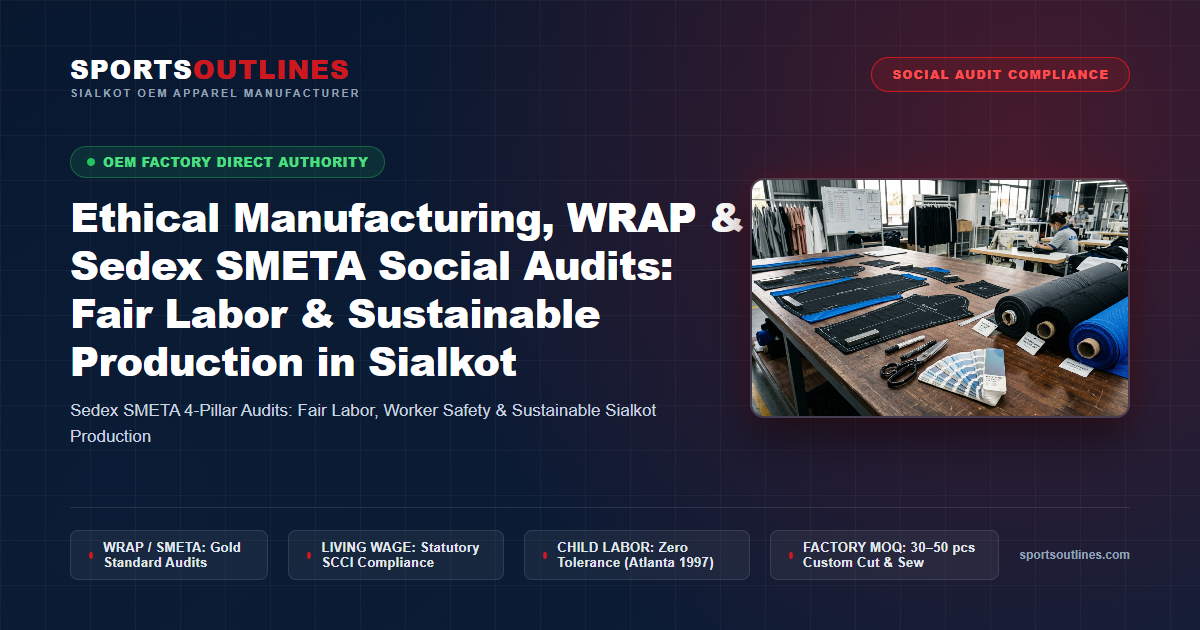
- Sports Outlines Verification: Factory low MOQ is strictly 30 to 50 pieces per style/colorway, with dedicated sampling at $45 to $85 per prototype (7 to 10 business days turnaround).
2. Anatomy of WRAP Certification: The 12 Principles in Sialkot Cut-and-Sew Plants
Worldwide Responsible Accredited Production (WRAP) is an independent, non-profit team of global social compliance experts dedicated to promoting safe, lawful, humane, and ethical manufacturing through certification and education. Unlike generic business standards, WRAP focuses specifically on the apparel, footwear, and sewn-products sectors. A WRAP certification demonstrates to North American and European retailers that an apparel production facility conforms strictly to internationally recognized labor standards.
To obtain and maintain WRAP certification, a cut-and-sew apparel facility in Sialkot must submit to unannounced third-party audits evaluating compliance across all 12 WRAP principles:
| Principle Number | WRAP Regulatory Principle | Specific Sialkot Factory Floor Application | Auditor Verification Method |
|---|---|---|---|
| Principle 1 | Compliance with Laws and Workplace Regulations | Compliance with Punjab Industrial Relations Act & Factories Act 1934 | Business licensing, NTN registration, SCCI membership verification |
| Principle 2 | Prohibition of Forced Labor | Zero bonded labor; workers retain national identity cards (CNIC) and passports | Confidential worker interviews and hiring agreement audits |
| Principle 3 | Prohibition of Child Labor | Strict 18+ age verification gate; mandatory biometric CNIC checks | Personnel files cross-referenced against NADRA civil database records |
| Principle 4 | Prohibition of Harassment or Abuse | Anti-harassment committee; zero tolerance for verbal, physical, or psychological coercion | Grievance box inspection and female worker sample interviews |
| Principle 5 | Compensation and Benefits | Statutory minimum wage plus overtime; EOBI and Social Security (PESSI) contributions | Digital bank deposit matching against payroll records |
| Principle 6 | Hours of Work | Max 48 regular hours/week; overtime capped at 12 hours/week; 1 rest day in 7 | Biometric electronic timecard data triangulation |
| Principle 7 | Prohibition of Discrimination | Equal pay for equal work regardless of gender, religion, sect, or ethnicity | Comparative wage audit across male and female stitching operators |
| Principle 8 | Health and Safety | Ergonomic task lighting, needle guards, eye shields, clean drinking water, PPE | Physical factory walkthrough and water filtration lab tests |
| Principle 9 | Freedom of Association & Collective Bargaining | Right to form worker management councils and union representation without retaliation | Meeting minutes of worker welfare committees (WWC) |
| Principle 10 | Environment | Safe textile scrap handling, solid waste recycling, energy metering | Environmental management system (EMS) records and disposal manifests |
| Principle 11 | Customs Compliance | Proper commercial invoicing, country of origin declaration, export documentation | Audit of export shipping records and WeBOC customs filings |
| Principle 12 | Security | C-TPAT compliant perimeter security, visitor badges, loading dock surveillance | CCTV coverage audits and container sealing protocol inspection |
3. Sedex SMETA 4-Pillar Audits: Structure & Methodology
While WRAP is primarily American-centric, European and UK activewear buyers frequently mandate the Sedex Members Ethical Trade Audit (SMETA) methodology. Sedex (Supplier Ethical Data Exchange) is an online platform that allows companies to share data on ethical and responsible business practices. SMETA is designed to reduce audit fatigue by providing a globally recognized audit format that multiple retailers can accept.
The SMETA methodology is structured into two variations: a 2-Pillar audit (covering Labor Standards and Health & Safety) and a comprehensive 4-Pillar audit, which adds Environmental Assessment and Business Ethics. For high-performance athletic apparel manufacturing, the 4-Pillar audit represents the gold standard:
| Pillar Area | Key Compliance Focus | Critical Evaluation Gate | Corrective Action Plan (CAPR) Horizon |
|---|---|---|---|
| Pillar 1: Labor Standards | Employment freely chosen, freedom of association, no child labor, fair living wages, non-excessive working hours | Triangulation of timecards, pay slips, and off-site private worker interviews | Immediate (Critical) to 30 Days |
| Pillar 2: Health & Safety | Machine guarding, fire evacuation routes, electrical wiring audits, chemical storage ventilation, sanitary facilities | 100% inspection of emergency exits, fire alarms, boiler certificates, and PPE usage | Immediate to 60 Days |
| Pillar 3: Environmental Assessment | Waste management, chemical storage containment, emissions monitoring, water usage tracking, environmental permits | Review of hazardous waste manifests, Punjab EPA permits, and recycling logs | 30 to 90 Days |
| Pillar 4: Business Ethics | Anti-bribery and corruption policies, transparent accounting, fair competition, whistleblower mechanisms | Review of anti-corruption training logs, anonymous reporting channels, and financial records | 60 to 90 Days |
4. Wage Compliance, Working Hours & Social Security Under Pakistani Labor Law
In apparel sourcing, wage and hour violations represent the most common non-conformances identified during social audits. To maintain certified status, Sialkot cut-and-sew manufacturers operate under strict adherence to provincial labor legislation enacted by the Government of Punjab, aligned with International Labour Organization (ILO) core conventions.
The table below details the legal framework governing wages, working hours, and social safety nets for apparel workers in Sialkot:
| Labor Domain | Statutory Requirement | Legal Reference | Audited Enforcement Protocol |
|---|---|---|---|
| Minimum Wage Base | Statutory baseline for unskilled labor; graded scales for semi-skilled and master machinists | Punjab Minimum Wages Act 2019 | Automated payroll records cross-checked against worker bank deposit receipts |
| Standard Working Hours | Maximum 9 hours per day; maximum 48 regular hours per 6-day working week | Factories Act 1934, Section 34 | Biometric fingerprint/facial recognition in-and-out time tracking |
| Overtime Compensation | Overtime strictly voluntary; paid at exactly 200% (2x) the standard hourly rate | Factories Act 1934, Section 47 | Audit formulas verifying hourly rate multiplier across timecards |
| Overtime Hour Cap | Maximum 12 hours overtime per week; total workweek cannot exceed 60 hours | WRAP & SMETA Operational Benchmarks | Timecard system programmed to lock out operators exceeding weekly caps |
| Mandatory Rest Day | At least one full 24-hour continuous rest period every 7 calendar days (typically Sunday) | Factories Act 1934, Section 35 | Zero entries allowed on biometric logs during factory shutdown days |
| Social Security (PESSI) | Employer contributes 6% of wages to provide free healthcare and maternity care | Punjab Employees Social Security Ordinance 1965 | PESSI official contribution cards issued to all registered personnel |
| Old-Age Benefits (EOBI) | Employer contributes 5% of minimum wage to provide retirement pensions and disability insurance | Employees’ Old-Age Benefits Act 1976 | EOBI registration slips and government treasury payment challans |
Biometric Ledger Integration & The Living Wage Progression Matrix
In traditional, non-compliant workshops, wage fraud often occurs through dual-ledger bookkeeping—presenting sanitized timesheets to external auditors while maintaining parallel handwritten logs for actual cash disbursements. WRAP and SMETA social auditors actively combat this via rigorous digital forensics:
- Triple Data Triangulation: Auditors cross-reference electronic biometric access terminal timestamps against production batch traveler sheets (route cards signed by line supervisors) and bank disbursement confirmation statements. If an operator is recorded signing off on a flatlock bundle at 19:30, but the timecard logs their departure at 17:00, an immediate critical non-conformance for record falsification is issued.
- Piece-Rate to Hourly Rate Floor Parity: While skilled sportswear machinists often prefer incentive-based piece-rate pay for high-speed productivity, compliant facilities guarantee an unconditional statutory hourly wage floor. Even during machine downtime, power switchovers, or fabric delay periods, workers are compensated at their guaranteed hourly rate.
- Living Wage Benchmarking (Anker Methodology): Leading international activewear brands increasingly require suppliers to measure compensation against the Global Living Wage Coalition (GLWC) Anker benchmarks. The table below outlines the compensation progression across skill tiers in audited Sialkot factories:
| Worker Skill Tier | Production Operational Role | Compensation Benchmark (PKR / USD Equiv) | Mandatory Non-Wage Benefits Included |
|---|---|---|---|
| Tier 1: General Labor | Thread trimming, polybag packaging, master carton loading | 100% to 110% Statutory Minimum Wage (~$135–$150/mo base) | PESSI medical cards, EOBI retirement account, subsidized cafeteria meals |
| Tier 2: Semi-Skilled Machinists | Single-needle lockstitch, elastic waistband overlock, bar-tacking | 125% to 145% Statutory Minimum Wage (~$175–$210/mo base) | Attendance bonuses, annual festival gratuities, overtime premium (200%) |
| Tier 3: Master Sewing Technicians | 4-needle 6-thread flatlock stitching, waterproof seam sealing, leather glove assembly | 160% to 210% Statutory Minimum Wage (~$230–$315/mo base) | Production efficiency bonuses, health insurance riders, paid skill training |
| Tier 4: Pattern Masters & Sample Room Heads | CAD grading block creation, 3D prototype modeling, pre-production sample drafting | 250% to 350% Statutory Minimum Wage (~$380–$550/mo base) | Executive healthcare, annual profit-sharing, full social security coverage |
5. Occupational Health & Factory Floor Fire Prevention Engineering
The safety of manufacturing personnel is a primary concern for international retailers. Tragedies in unregulated factories across South Asia over the past two decades led to the establishment of rigorous infrastructure standards that compliant Sialkot facilities implement meticulously.
In an audited cut-and-sew apparel facility, health and safety engineering encompasses structural stability, fire risk reduction, machine safety mechanisms, and air quality control:
| Safety Engineering System | Hardware / Physical Standard | Operational Maintenance SLA | Audit Inspection Failure Criteria |
|---|---|---|---|
| Emergency Egress Routes | Minimum 2 unobstructed stairwells per floor; outward-opening push-bar doors; illuminated exit signs with battery backup | Daily visual inspections by HSE officer; zero storage allowed in pathways | Any locked, obstructed, or inward-swinging exit door (Instant Fail) |
| Fire Detection & Suppression | Smoke/heat detectors; addressable alarm panel; dual-hose reel systems; ABC dry powder and CO2 extinguishers every 75 feet | Monthly pressure gauge testing; biannual full fire evacuation drills | Depressurized extinguishers or non-functional emergency alarms |
| Needle & Eye Guard Protection | Steel loop finger guards on all single-needle and overlock sewing heads; polycarbonate eye shields on eyelet buttonholers | Pre-shift machine technician inspection checklist | Any active sewing machine operating with detached finger guards |
| Personal Protective Equipment (PPE) | Stainless-steel chainmail mesh gloves for fabric cutting; active particulate masks in sublimation/screen printing areas | Free PPE issuance to 100% of workers; mandatory wearing policies | Cutter operating band knife machine without stainless mesh glove |
| Indoor Air Quality & Lighting | Industrial exhaust blowers; 500+ lux daylight LED task lighting at needle points; climate control maintaining 22°C–26°C | Biannual calibrated light meter and air particulate concentration testing | Inadequate illumination below 300 lux in fine-stitching zones |
| Potable Drinking Water & Sanitation | Reverse-osmosis (RO) water purification units; separate gender-segregated toilets at 1 per 25 workers | Quarterly biological and chemical water purity testing by ISO 17025 certified labs | Bacterial contamination in drinking supply or unhygienic washrooms |
6. Environmental Sustainability: Chemical Management (ZDHC) & Waste Protocols
Under Pillar 3 of SMETA and international environmental standards, athletic apparel manufacturers must ensure that textile chemicals, printing inks, and finishing treatments do not degrade the local ecosystem. The Zero Discharge of Hazardous Chemicals (ZDHC) Manufacturing Restricted Substances List (MRSL) provides the global framework for chemical safety.
In Sialkot, responsible cut-and-sew factories implement strict chemical management and solid waste sorting systems:
- OEKO-TEX Standard 100 Class I & II Certification: All synthetic sublimation inks, screen printing plastisols, water-based polyurethanes, and textile adhesives must be certified free of banned arylamines, phthalates, formaldehyde, and heavy metals (cadmium, lead, mercury).
- Secondary Chemical Containment: Screen printing chemical storage drums are placed on secondary containment pallets engineered to capture at least 110% of the volume of the largest container in the event of a catastrophic rupture.
- Effluent Treatment Plants (ETP): Where wet processing (dyeing or screen-washing) takes place, waste water passes through biological and chemical treatment plants to neutralize pH, eliminate suspended solids (TSS), and reduce chemical oxygen demand (COD) before discharge.
- Fabric Offcut Recycling: Pure polyester and blended cotton cutting table scrap is segregated by fiber type and sent to recycling partners for conversion into thermal insulation blankets, carpet underlayment, or recycled fiber yarn.
ZDHC MRSL Level 1–3 Conformance & Effluent Water Quality Standards
Under modern environmental audits, chemical compliance extends beyond simple finished-garment testing. The table below details the input chemical restriction thresholds and output wastewater discharge limits enforced in audited Sialkot production:
| Chemical / Parameter Category | Target Restricted Substances | ZDHC MRSL Maximum Allowable Limit | Laboratory Testing Standard |
|---|---|---|---|
| Alkylphenol Ethoxylates (APEO/NPEO) | Scouring agents, emulsifiers, print thickeners | < 100 ppm total sum | ISO 18254-1 (LC-MS/MS) |
| Phthalate Plasticizers | DEHP, DBP, BBP in plastisol screen print inks | < 50 ppm individual substance | ISO 14389 (GC-MS) |
| Carcinogenic Azo Dyes | Banned aromatic amines (Benzidine, 4-Aminobiphenyl) | < 20 ppm per amine | EN ISO 14362-1 / -3 (GC-MS) |
| Per- and Polyfluoroalkyl Substances (PFAS) | C8/C6 fluorocarbon DWR water-repellent coatings | Zero intentional use (PFAS-Free C0 DWR) | CEN/TS 15968 (Total Organic Fluorine) |
| Wastewater Effluent Discharge (ETP) | Chemical Oxygen Demand (COD) / Total Suspended Solids (TSS) | COD < 80 mg/L; TSS < 30 mg/L; pH 6.5–8.5 | APHA Standard Methods for Water Examination |
7. Sports Outlines Social Compliance Architecture & Commercial Sampling Governance
At Sports Outlines, our manufacturing ethos integrates ethical social compliance directly into our operational production lines. We reject the deceptive practices of subcontracted sweatshops and shadowy trading companies, maintaining complete open-door visibility for all brand partners.
Sports Outlines Commercial Terms & Prototype Governance
Physical Prototype Sampling Fee: Strictly $45 to $85 per piece, pair, or set based on technical complexity (pattern drafting, custom lab dips, specialized trims).
Sampling Turnaround SLA: Strictly 7 to 10 business days from technical pack sign-off and lab-dip confirmation.
Non-Refundable Engineering Baseline: We do not provide complimentary prototypes or promotional sampling discounts. Sialkot’s master sample rooms require specialized labor, genuine fabric consumption, and dedicated technician time. Compensating our artisans ethically begins at the prototype stage.
Factory Low MOQ Advantage: Strictly 30 to 50 pieces per style or colorway, empowering boutique brands and high-end fitness studios to produce fully custom cut-and-sew garments with complete social audit integrity.
8. Managing Buyer Audits: How International Sportswear Brands Conduct Inspections
When an emerging or established athletic apparel brand contracts a cut-and-sew production run, verifying factory compliance typically follows a three-stage audit workflow. Understanding this workflow allows sourcing executives to plan timelines accurately:
| Audit Phase | Key Inspection Activities | Inspection Agency Tools | Standard Deliverable |
|---|---|---|---|
| Phase 1: Opening & Documentation Review | Reviewing legal incorporation, building stability certificates, payroll logs, EOBI records, fire department NOCs | Sedex online data exchange, WRAP desktop database | Document verification log and initial compliance checklist |
| Phase 2: Physical Floor Inspection | Walkthrough of cutting, sewing, finishing, packing, boiler room, chemical storage, generator house, cafeteria, clinics | Photographic evidence, decibel sound meters, lux light meters | Floor non-conformance log and hazard identification list |
| Phase 3: Worker & Management Interviews | Confidential 1-on-1 and group worker interviews without management present; cross-verifying wage and overtime claims | Standardized ILO interview questionnaires in local language (Urdu/Punjabi) | Worker testimony correlation matrix and closing meeting CAPR |
Closing the Loop: Corrective Action Plan Reports (CAPR) & Remediation Verification
In professional social auditing, non-conformances identified during on-site inspections do not automatically trigger immediate disqualification unless critical zero-tolerance infractions (such as child labor, forced labor, or locked fire exits) are discovered. For standard minor or major findings (such as missing PPE signage, incomplete secondary chemical containment, or minor ergonomic issues), the factory management is issued an official Corrective Action Plan Report (CAPR):
- 30-Day Desktop Verification Window: For minor administrative non-conformances (e.g., updating emergency lighting testing logs or posting revised grievance policies in local languages), factories submit photographic and documentary evidence directly to the auditing agency’s portal without requiring an additional physical audit.
- 60-to-90 Day Follow-Up On-Site Audit: For physical infrastructure adjustments (such as adding mechanical ventilation to screen printing washrooms or upgrading machine needle guards), an accredited lead auditor revisits the plant to physically verify that engineering remediation has been executed according to statutory guidelines.
- Continuous Improvement Culture: Leading Sialkot manufacturers maintain permanent internal compliance officers who conduct bi-weekly mock audits, ensuring that factory operational standards remain permanently inspection-ready throughout high-season production cycles.
9. Regional Comparison: Sialkot Compliance vs Far East & South Asian Clusters
When evaluating manufacturing locations for ethical activewear production, brands must balance labor compliance, geopolitical stability, and order flexibility:
| Cluster Location | Typical Factory MOQ | Social Audit Transparency | Forced Labor / Geopolitical Risk | EU / UK Duty Rate Status |
|---|---|---|---|---|
| Sialkot, Pakistan (Sports Outlines) | 30 – 50 pcs / style | High (Independent Sedex / WRAP audited; direct factory access) | Zero UFLPA risk; indigenous Indus basin cotton | 0.0% Tariff (EU GSP+ REX / UK DCTS) |
| Guangdong / Zhejiang, China | 500 – 1,000 pcs | Moderate (High risk of unauthorized domestic subcontracting) | Severe US CBP UFLPA detention scrutiny; Section 301 tariffs | 12.0% standard tariff |
| Dhaka / Chittagong, Bangladesh | 2,000 – 5,000 pcs | High for mega-plants; low for secondary Tier-2 contractors | Low forced labor risk; political/strike volatility | 0.0% Tariff (EBA / LDC preference) |
| Binh Duong / Ho Chi Minh, Vietnam | 1,000 – 3,000 pcs | High (Conglomerate factory management) | Moderate (Raw material ties to Chinese supply chains) | EVFTA reduced rate (phased down) |
10. Frequently Asked Questions (FAQ) Regarding Ethical Sialkot Manufacturing
1. What is the difference between WRAP and Sedex SMETA audits?
WRAP is a certification body that awards formal certificates (Platinum, Gold, Silver) based on compliance with 12 labor principles, widely favored by American buyers. Sedex SMETA is an audit methodology and data-sharing platform favored by European and UK brands that outputs an audit report (CAPR) rather than a pass/fail certificate, allowing brands to review specific findings.
2. How does Sialkot prevent child labor in the apparel supply chain?
Following the historic 1997 Atlanta Agreement, Sialkot established a zero-tolerance regime for child labor monitored by the ILO and the Independent Monitoring Association for Child Labour (IMAC). Modern factories enforce mandatory biometric age verification cross-referencing national identification cards (CNIC) with NADRA databases.
3. Can emerging brands with orders of 30 to 50 pieces access audited factories?
Yes. Sports Outlines is structured specifically to provide ethical, compliant cut-and-sew manufacturing with a factory low MOQ of strictly 30 to 50 pieces per style or colorway. This allows growing brands to scale without sacrificing supply chain compliance.
4. What are the sampling terms and turnaround times at Sports Outlines?
Physical prototype development is strictly $45 to $85 per piece, pair, or set depending on design complexity. Turnaround time is strictly 7 to 10 business days following tech pack confirmation and lab dip approvals.
5. What is the commercial policy regarding prototype development costs?
Physical prototype development fees ($45 to $85 per garment) represent a dedicated, non-creditable engineering allocation that fairly compensates pattern masters, sample machinists, and laboratory technicians. To uphold rigorous ethical wage standards across our development lines, we do not provide complimentary prototypes or promotional sampling discounts.
6. How are overtime wages calculated in compliant Pakistani factories?
Under Section 47 of the Factories Act 1934, overtime work is voluntary and must be paid at double the worker’s ordinary rate of pay (200%). Overtime is capped at a maximum of 12 hours per week, with mandatory rest days enforced.
7. What social benefits are provided to Pakistani apparel workers?
Compliant employers contribute 6% of wages to the Punjab Employees Social Security Institution (PESSI) for comprehensive healthcare, maternity leave, and injury benefits, alongside 5% contributions to the Employees’ Old-Age Benefits Institution (EOBI) for retirement pensions.
8. Does Pakistani apparel production face US CBP forced-labor detention risks?
No. Unlike regions subject to US CBP Withhold Release Orders under the UFLPA, Sialkot cut-and-sew manufacturers utilize authentic domestic Indus basin cotton and transparently audited synthetic yarn supply chains with complete bale-to-garment traceability.
9. Can overseas buyers commission independent third-party audits?
Yes. Brand owners can appoint accredited inspection agencies such as SGS, QIMA, Intertek, or Bureau Veritas to conduct unannounced or semi-announced SMETA or custom code-of-conduct audits prior to releasing final bulk payment.
10. How do European buyers benefit from sourcing in Sialkot?
Under the EU GSP+ Registered Exporter (REX) system and the UK Developing Countries Trading Scheme (DCTS), apparel manufactured in Pakistan enters the EU and UK at 0.0% customs tariffs, saving 12.0% in import duties while fulfilling stringent social compliance standards.
Partner with an Audited, Ethical Sialkot Manufacturing Hub
Build your activewear and combat gear line with verified fair labor practices, low 30–50 MOQ production, and dedicated 7–10 day prototype sampling. Protect your brand reputation from Day 1.