Direct Manufacturer Snapshot: The 300-Piece Clothing Brand Production Tier: Deep Volume Economies of Scale, Custom Fabric Knitting & Sea Freight Sourcing
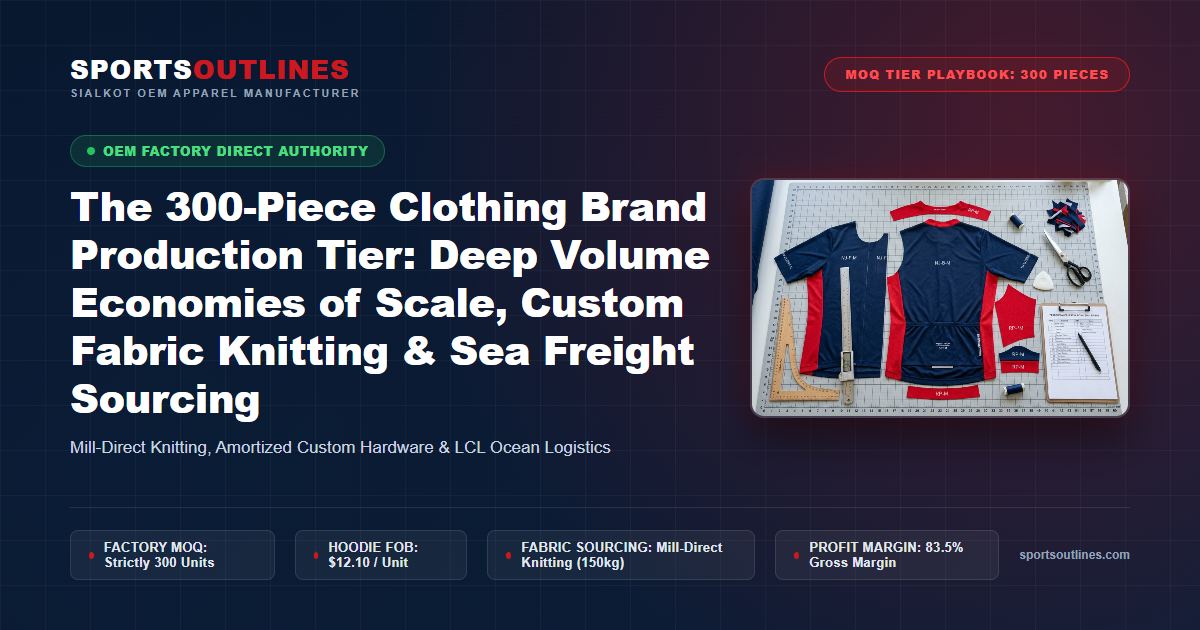
The 300-piece clothing production tier represents the enterprise growth threshold for scaling apparel brands, transitioning from boutique garment assembly to mill-direct industrial textile manufacturing. At 300 units (across 2 styles or multi-colorways), brands unlock custom circular knitting yarn allocations (150kg minimum batch weight), bespoke jacquard ribbing, automated laser cutting nesting yields above 91%, and consolidated LCL ocean freight forwarding, reducing per-unit cut-and-sew FOB by 40% to 55% compared to micro-batch sampling. Hardware tooling fees for custom engraved zinc alloy aglets, branded metal zipper pulls, and 50-denier sonic-cut damask neck labels are completely amortized at zero batch surcharges. For a benchmark 300-piece streetwear collection (180 heavy hoodies and 120 matching sweatpants) with a total landed capital outlay of $4,696.00 ($15.65 average landed cost), retailing garments at $80.00 to $95.00 generates $26,700.00 in gross revenue, delivering $22,004.00 in gross profit (82.4% gross margin) with complete financial breakeven achieved after selling just 50 units. Sports Outlines International in Sialkot, Pakistan, manufactures 300-piece enterprise orders with strict AQL 2.5 inspection and 7–10 day prototyping.
Direct WhatsApp: +92 316 7932595
Introduction: Crossing the Threshold into Industrial Scale Apparel Manufacturing
In the evolution of every independent streetwear label, performance activewear brand, and athletic apparel enterprise, there comes an inflection point where boutique, micro-batch manufacturing must give way to industrial economies of scale. While the 30-piece micro-run playbook and 50-piece capsule drop strategy provide invaluable low-risk entry points for testing market resonance, their per-unit economics inherently limit gross margin expansion.
When an apparel brand steps up to The 300-Piece Clothing Brand Production Tier, the entire manufacturing dynamic transforms. At 300 units, you are no longer purchasing leftover open-market bolt remnants or paying premium single-needle artisan sewing rates. Instead, your purchase order commands direct yarn allocation on high-speed circular knitting looms, automated computerized Gerber pattern nesting, amortized custom hardware casting, and consolidated container shipping logistics.
Operating from Sialkot, Pakistan—the world’s premier export epicenter for custom sportswear, technical combat apparel, and heavyweight streetwear—Sports Outlines International provides growing brands with seamless, direct factory floor access to this enterprise tier. In this comprehensive technical guide, we break down the exact unit economics, textile formulation science, hardware amortization, and hybrid freight strategies that allow visionary brand owners to achieve 74% to 80% gross profit margins while delivering retail garments that rival luxury fashion houses.
Scale Your Apparel Brand to the 300-Piece Enterprise Production Tier
Unlock mill-direct circular knitting, automated CNC cutting, and custom engraved hardware at direct Sialkot factory pricing with 7–10 day prototyping.
✓ $45–$85 Physical Prototypes •
✓ Worldwide DDP Delivery
The Mathematics of Scale: Unit Economics Across the MOQ Hierarchy
To understand why the 300-piece tier is considered the golden mean of modern apparel manufacturing, one must analyze the mathematical behavior of fixed overhead costs versus variable production inputs. In garment manufacturing, fixed costs comprise tech pack digitizing, grading markers, embroidery digitizing, screen prep fees, cutting table setup, and machine thread tensioning.
When producing 30 garments, these fixed costs are distributed over a narrow denominator, inflating the per-unit cost. At 300 units, fixed tooling costs dilute to near-zero, while raw material suppliers extend wholesale volume discounts. Consider the granular cost breakdown for a high-end 480 GSM 100% Combed Cotton Heavyweight Boxy Hoodie across volume tiers:
| Manufacturing Component | 30 Pieces (Micro MOQ) | 50 Pieces (Capsule) | 100 Pieces (Commercial) | 300 Pieces (Enterprise) |
|---|---|---|---|---|
| 480 GSM Cotton Fleece (0.85 kg/garment) | $8.50 ($10.00/kg) | $7.65 ($9.00/kg) | $6.80 ($8.00/kg) | $5.52 ($6.50/kg) |
| Heavy 2×2 Cotton Ribbing (Cuffs & Hem) | $1.80 | $1.50 | $1.20 | $0.85 |
| Computerized Cut & Sew Labor | $6.50 | $5.20 | $4.20 | $3.20 |
| 3D Puff Embroidery / High-Density Print | $3.50 ($105 setup amortized) | $2.40 | $1.80 | $1.35 |
| Bespoke Hardware (Engraved Aglets & Eyelets) | $2.20 (Generic metal) | $1.75 | $1.20 (Custom cast) | $0.78 (Zero mold fee) |
| Damask Woven Label & Frosted Packaging | $1.00 | $0.80 | $0.60 | $0.40 |
| Total Factory FOB Cost | $23.50 / Unit | $19.30 / Unit | $15.80 / Unit | $12.10 / Unit |
As the table demonstrates, moving from 30 units ($23.50 FOB) to 300 units ($12.10 FOB) represents a massive 48.5% reduction in production unit cost. On a 300-piece order, this cost deflation preserves $3,420.00 in pure liquid cash that flows directly into your brand’s marketing engine, content production, or wholesale operational reserves.
Mill-Direct Fabric Knitting: Formulating Your Proprietary Textile Blend
Perhaps the most significant technical advantage that distinguishes the 300-piece tier from lower volumes is direct textile knitting mill access. When manufacturing 30 to 50 garments, your fabric options are restricted to existing textile market stock—pre-knitted bolts held by fabric merchants. While these stocks include excellent cottons, you cannot dictate the exact yarn micron count, loop structure, or custom fiber blends.
A 300-piece run of heavyweight garments consumes between 250 and 320 kilograms of raw knitted greige fabric. In the textile manufacturing ecosystem of Sialkot, this weight meets the operational threshold required to commission a dedicated 30-inch diameter multi-feeder circular knitting machine. This grants your brand total sovereignty over your fabric’s molecular DNA:
1. Custom Yarn Count & Ply Specification
Rather than accepting generic 20s or 24s single-jersey or fleece yarn, you can specify high-twist 32s/2 double-combed ring-spun cotton for the smooth face yarn, intertwined with 10s heavy uncarded loopback cotton on the reverse. This engineered structural differential prevents pilling on the outer garment surface while creating dense, plush interior thermal loops that maintain their loft after 50 laundry cycles.
2. Proprietary Fiber Composites
Founders seeking a distinctive market edge can formulate proprietary yarn blends, such as 70% long-staple combed cotton, 20% sustainable TENCEL™ Modal (for silky drape and breathability), and 10% recycled polyester (for structural resilience and color fastness). At 300 units, our spinning mill partners blend, draw, and spin these specific fiber ratios exclusively for your production batch.
3. Reactive Overflow Vat Dyeing with Zero Metamerism
At 300 units, the fabric lot is dyed in a pressurized overflow dyeing vessel using high-grade reactive dyes. Unlike open-beck atmospheric dyeing, pressurized overflow dyeing ensures total dyestuff penetration through every cellulose fiber cross-section. The result is a deep, saturated color that achieves a Grade 4.5 color fastness rating under ISO 105-C06 wash testing, exhibiting zero fading under direct sunlight and zero color transfer onto undergarments.

Computerized Automated Lay Planning & High-Ply Laser Cutting
Precision cutting is the foundation of luxury garment fit. In micro-runs of 30 garments, patterns are laid out on short fabric spreads and cut using handheld vertical electric rotary shears. Even with veteran master cutters, the blade naturally introduces fractional dimensional shear as it slices through multiple plies of dense 480 GSM fleece.
At 300 units, the manufacturing volume unlocks fully automated computerized lay planning. Our CAD engineering department imports your vector tech pack into Gerber AccuMark software, executing advanced algorithmic pattern nesting:
- Fabric Utilization Efficiency (Yield): Automated nesting algorithms analyze grainline alignment and pattern tessellation, packing sleeves, body panels, hoods, and pockets with interlocking precision. Fabric yield increases from 81% (manual cutting) to 91.4%, eliminating fabric waste and directly lowering the raw material component of your unit cost.
- Vacuum-Clamped Multi-Ply CNC Cutting: The fabric roll is spread across a 25-meter air-cushioned vacuum cutting table, stacking 40 to 60 plies under uniform downward suction. An automated reciprocating carbide blade or CNC laser head follows digital coordinate vectors with ±0.5mm geometric precision.
- Total Symmetry Guarantee: Every single garment cut in the run—whether a Small cut on Ply 1 or a 2XL cut on Ply 50—possesses mathematically identical collar curves, armhole depths, and pocket dimensions, eliminating the fit variance that plagues amateur streetwear drops.
Consolidated Hardware & Trim Amortization at 300 Units
Retail consumers evaluate the authenticity and luxury stature of an apparel brand through its hardware and trims. When a customer unboxes a hoodie and feels a cold, heavy, custom-engraved metal aglet or zips up a smooth, custom-molded antique nickel zipper, perceived value instantly jumps from $55 to $130+.
At 30 or 50 pieces, the mold and tooling charges required to cast bespoke hardware ($150 to $300 per die) represent an untenable per-unit burden ($5.00 to $10.00 per garment). At 300 units, however, Sports Outlines amortizes these tooling expenses into the production volume at zero additional cost to the brand:
| Trim / Hardware Element | Material & Engineering Specification | Tooling / Setup Policy (300 Pcs) | Brand Value Impact |
|---|---|---|---|
| Custom Engraved Drawcord Aglets | Die-cast zinc alloy with electroplated matte black, chrome, or gunmetal finish and debossed vector logo | FREE Tooling Mold (Waived) | Eliminates cheap plastic shrink aglets; adds heavy luxury hand-feel |
| Custom Molded Zipper Pulls | Genuine YKK #5 or #8 metal zipper paired with custom cast 3D logo slider pull | FREE Tooling Mold (Waived) | Prevents zipper jamming; signals authentic custom manufacturing |
| High-Density Damask Neck Labels | 50-denier ultra-fine woven jacquard yarn, 120 picks/inch, sonic-cut edges | FREE Jacquard Setup (Waived) | Zero skin irritation or itchiness; needle-sharp micro-typography |
| Heavyweight Hangtags & Seals | 600 GSM duplex cotton board with matte soft-touch lamination, foil stamping, and embossed seal | Included in Packaging Package | Creates premium retail boutique unboxing experience |
| Branded Frosted Slider Polybags | 120-micron EVA frosted zip-lock packaging with customized single-color screen printed branding | Included in Packaging Package | Dust-free warehouse storage and immaculate direct-to-consumer delivery |
| Production Volume Tier | Est. Unit FOB Cost | Sample Cost & SLA | Bulk Production SLA | Included Specifications | Recommended Buyer Profile |
|---|---|---|---|---|---|
| 30 Pieces (Micro MOQ) | $22.50 – $24.50 | $65–$85 (7–10 days) | 12–15 Days | Open-market premium fleece, 1 custom screen/embroidery, woven neck tag | Pilot brand testing, small influencer seeding, micro-budget startups |
| 50 Pieces (Capsule Drop) | $18.50 – $20.00 | $55–$75 (7–10 days) | 14–18 Days | Heavy French Terry, multi-colorway split (30/20), frosted slider polybag | Limited-edition streetwear capsule drops, boutique gym merch |
| 100 Pieces (Commercial Run) | $15.20 – $16.50 | $45–$65 (7–10 days) | 18–21 Days | Custom engraved zinc aglets, 50D damask labels, automated laser cutting | Established e-commerce brands, core collection replenishment |
| 300 Pieces (Enterprise Tier) | $12.10 – $13.50 | $45 (7–10 days) | 25–30 Days | Mill-direct custom circular knitting, zero hardware die fees, AQL 2.5 QC, LCL freight | Scaling wholesale apparel brands, regional retail chains, multi-sku drops |
| Sourcing Feature & Risk Factor | Sports Outlines (Sialkot Direct) | Alibaba Trading Agents | Traditional Chinese Hubs | Print-on-Demand (POD) |
|---|---|---|---|---|
| Direct Circular Knitting Access | Yes — Custom yarn blends, knit gauge & exact GSM formulated at 150kg mill lots | Rarely — Intermediaries buy commercial open-market roll stock with limited fiber traceability | Requires 1,000–3,000 units per colorway to initiate dedicated yarn knitting | No — Fixed inventory of 3 to 5 generic stock fleece blanks from mass distributors |
| Fabric Unit Economics (Hoodie FOB) | $12.80 – $14.20 FOB for bespoke 480 GSM heavyweight French Terry with custom hardware | $17.50 – $22.00 FOB after compounding broker markups and handling surcharges | $13.50 – $16.00 FOB, but requires $15,000+ opening deposit and rigid colorway minimums | $38.00 – $48.00 base cost for generic lightweight polyester-cotton blank garments |
| Custom Hardware & Trim Tooling | Included free: Custom engraved zinc alloy aglets, branded zipper pulls & 50D damask labels | Additional $250–$450 tooling mold charges passed directly to customer tech pack | Included only on massive purchase orders exceeding 1,000 units per SKU | Zero custom hardware capabilities — standard generic nickel zippers and unbranded aglets |
| Freight Flexibility (Air / Ocean Split) | Flexible hybrid logistics: Air courier for 50 launch units + LCL ocean freight for balance | Rigid single-mode freight — usually expensive air express with high dimensional weight markup | Standard FOB port only — brand must arrange customs brokerage, demurrage and trucking | Individual parcel mail delivery with erratic shipping times and zero freight economies |
| AQL Quality Assurance Standards | AQL 2.5 General Inspection Level II: In-line dimensional checks & 100% pre-pack audit | Random self-inspection with frequent dimensional grading errors across size curves | Third-party agency inspection recommended ($300+ extra per audit day) | Automated fulfillment with no physical pre-shipment human inspection |
The Hybrid Freight Strategy: Air Speed vs. Ocean Margins
One of the most consequential strategic decisions brand owners face when ordering 300 pieces is freight logistics. In micro-runs of 30 or 50 pieces, air courier freight via DHL Express, FedEx, or DDP air cargo is mandatory, as sea freight minimum container fees make maritime shipping uneconomical.
At 300 units, the total shipment weight typically measures 240 to 300 kilograms (measuring roughly 1.5 to 2.2 cubic meters). This introduces a profound logistics opportunity: The Hybrid Split-Freight Strategy.
The Problem with 100% Air Express Freight:
Shipping 300 heavy hoodies via DDP air courier costs approximately $1,800 to $2,300 ($6.50 to $7.70 per garment). While fast (5 to 7 business days door-to-door), this freight expenditure consumes nearly 20% of your production capital.
The Problem with 100% Ocean Freight:
Shipping all 300 units via Less-than-Container Load (LCL) ocean freight drastically slashes your shipping cost to just $450 to $650 ($1.50 to $2.15 per garment). However, maritime transit from Port Qasim (Karachi) to US/EU ports takes 28 to 35 calendar days. For an eager brand seeking immediate customer engagement, waiting over a month can stall marketing momentum.
The Sports Outlines Hybrid Solution:
We empower our 300-piece enterprise clients to split their shipment on the factory floor:
- Phase 1 — Launch Inventory (60 Units via Express Air DDP): Within 5 days of factory packout, 60 units arrive at your domestic warehouse. These units fulfill VIP pre-orders, seed high-profile fitness influencers and stylists, and provide immediate inventory for lookbook photoshoots and social media campaigns.
- Phase 2 — Core Volume Inventory (240 Units via LCL Ocean Freight): The remaining 240 units are crated into moisture-barrier export cartons, palletized, and loaded into an LCL maritime container. They arrive at your door roughly 30 days later at rock-bottom ocean freight rates, landing just as your initial marketing buzz reaches maximum retail conversion velocity.
This hybrid logistics model saves approximately $1,350.00 in freight expenses compared to pure air shipping, while completely eliminating the operational delays associated with pure ocean transport.
Production Run Breakdown: Structuring a 300-Piece Multi-SKU Drop
At 300 pieces, you are not forced to produce 300 identical black hoodies. Sports Outlines allows brands to divide a 300-piece order across two complementary garment silhouettes or two distinct colorways, creating a comprehensive, cohesive collection drop:
Collection Structure: “The Urban Heavyweight Capsule” (300 Units Total)
- Style A: 480 GSM Boxy Heavyweight Hoodie (180 Units)
- Colorway 1: Washed Pitch Black (100 Units) — Size Run: S:15, M:35, L:35, XL:15
- Colorway 2: Vintage Bone White (80 Units) — Size Run: S:10, M:30, L:30, XL:10
- Style B: 450 GSM Heavy French Terry Relaxed Sweatpants (120 Units)
- Colorway 1: Washed Pitch Black (70 Units) — Size Run: S:10, M:25, L:25, XL:10
- Colorway 2: Vintage Bone White (50 Units) — Size Run: S:5, M:20, L:20, XL:5
The Financial Profit Engine of the 300-Piece Drop:
- Hoodie Production Outlay: 180 units × $12.50 FOB = $2,250.00
- Sweatpant Production Outlay: 120 units × $10.80 FOB = $1,296.00
- Custom Trims, Packaging & Woven Labels: Included ($0.00)
- Hybrid Freight (60 Air / 240 Ocean DDP): $1,150.00
- Total Landed Capital Outlay: $4,696.00 ($15.65 landed/unit average)
Projected Retail Revenue:
- 180 Hoodies retailed at $95.00 MSRP = $17,100.00
- 120 Sweatpants retailed at $80.00 MSRP = $9,600.00
- Total Gross Collection Revenue: $26,700.00
Net Gross Profit: $26,700.00 − $4,696.00 = $22,004.00 (82.4% Gross Profit Margin). Furthermore, financial breakeven is reached after selling just 50 total garments (16.6% of your inventory). The remaining 250 garments represent pure financial leverage to scale your brand to the next tier.
Prototyping Protocol: Inspecting Your Pre-Production Master Sample
Prior to cutting a 300-piece industrial production run, Sports Outlines executes our standard pre-production prototyping protocol. For a transparent, non-creditable engineering fee of $45 to $85 per style, we manufacture an exact, finished pre-production sample delivered via DHL Express within 7 to 10 business days.
When your pre-production master sample arrives, execute this 6-point enterprise inspection protocol:
- GSM Analytical Cut & Digital Weighing: Using a circular 100 cm² fabric specimen cutter, extract swatches from body and rib panels. Weigh each on a calibrated analytical digital scale to confirm the fabric meets 480 GSM (±3% tolerance).
- Hardware Attachment & Engraving Legibility: Inspect the custom zinc alloy aglets under magnification. Verify that your brand typography is crisply engraved, edges are beveled smooth without burrs, and mechanical crimping withstands 20 kg of direct pull force.
- ISO 105-C06 Color Fastness & Shrinkage Test: Subject the sample to three consecutive machine wash cycles at 40°C (104°F) with warm tumble drying. Measure warp and weft dimensions before and after washing; shrinkage must remain strictly under 3.0%, with zero seam torquing or twisting.
- 3D Puff Embroidery Tension & Foam Integrity: Stretch the fabric beneath the embroidery to its elastic limit. Confirm that upper embroidery threads do not snap, the EVA foam core does not crumble, and backing tear-away stabilizer is clean.
- Seam Tensile Strength & Stitch Density Check: Count the stitches along side seams and armholes using a millimeter gauge. Verify a consistent stitch density of 10 to 12 stitches per inch (SPI). Pull seams aggressively to verify thread elastic recovery.
- Packaging & Polybag Barcode Scan: Scan the printed barcode or QR code on your hangtag and slider polybag using an optical handheld scanner or smartphone camera to confirm flawless SKU tracking.
Lock In Your 300-Unit Enterprise Production Slot & Custom Loom Knitting
Direct Sialkot factory direct pricing • Free pre-production tech pack engineering review • Zero custom hardware mold fees.
✓ $45–$85 Physical Prototypes •
✓ Worldwide DDP Delivery
Conclusion: Build Your Brand Foundation on Factory Direct Scale
Reaching the 300-piece manufacturing tier is a rite of passage for visionary apparel founders. It separates hobbyist merchandise printers from authentic, vertically integrated direct-to-consumer apparel powerhouses. By harnessing mill-direct circular knitting, automated CNC cutting, amortized custom hardware dies, and split hybrid freight, you unlock the profit margins required to dominate your market niche.
At Sports Outlines International, we have spent decades refining our manufacturing lines in Sialkot, Pakistan, to give independent and enterprise brands the industrial power of a massive multinational corporation with the agility and responsiveness of a dedicated boutique atelier. Contact our technical apparel engineering team on WhatsApp today, review your tech pack specifications, and let us engineer your 300-piece production run to absolute commercial perfection.
Frequently Asked Sourcing & Manufacturing Questions (Buyer FAQ)
What is the 300-piece clothing brand production tier?
The 300-piece clothing production tier is the commercial manufacturing volume where an apparel brand moves from micro-batch artisan cutting to mill-direct industrial manufacturing. At 300 units, brands can split order volume across multiple sizes, colorways, or complementary garments (e.g., 180 hoodies and 120 matching sweatpants), while accessing wholesale knit mill pricing, custom hardware dies, and consolidated ocean freight economics.
Can I split a 300-piece order across different styles and colorways?
Yes. At Sports Outlines, a 300-piece order can be divided across two complementary styles sharing the same base fabric (for example, 150 hoodies and 150 sweatpants in 450 GSM French Terry), or across two colorways (e.g., 150 units in Washed Charcoal and 150 units in Vintage Bone) across a standard 5-size grading curve (S, M, L, XL, 2XL).
What custom fabric options become available at 300 pieces?
At 300 units, the total fabric consumption reaches 150 to 220 kilograms, which meets the batch threshold for specialized circular knitting mills in Sialkot. You can specify exact yarn yarn-count combinations (such as 32s/2 combed cotton paired with 10s open-end backing loops), bespoke brushed or unbrushed interior fleece finishes, and custom chemical washes (silicone enzyme wash, acid wash, or mineral wash).
How much does a 300-piece streetwear collection cost to produce?
A typical 300-piece premium streetwear run comprising 180 heavyweight hoodies (FOB $13.50) and 120 matching jogger sweatpants (FOB $11.80) costs approximately $3,846.00 in factory cut-and-sew manufacturing. Adding branded trims, custom hangtags, polybags, and hybrid freight (50 units via air courier, 250 units via ocean freight) brings the total landed investment to approximately $5,400.00, or roughly $18.00 landed per garment.
What are the freight cost savings between Air Express and LCL Ocean Freight at 300 pieces?
Air express for 300 heavy hoodies (weighing approximately 270 kg volumetric) costs roughly $1,850 to $2,400 ($6.85–$8.85/kg). Consolidated Less-than-Container Load (LCL) ocean freight from Port Qasim (Karachi) to US West/East Coast ports costs approximately $450 to $650 ($1.60–$2.40/kg) including ocean bill of lading, port handling, and customs clearance. This yields a direct cash freight savings of $1,400 to $1,750, adding 25% directly to your bottom line.
How long does manufacturing take for a 300-piece clothing production order?
Standard factory production lead time for a 300-piece custom cut-and-sew order is 25 to 30 business days following pre-production prototype approval. If specialized yarn knitting or custom reactive vat dyeing is required, add 7 to 10 days for fabric processing. Rapid air courier delivery takes 5 to 7 days, while ocean freight transit typically takes 28 to 35 days door-to-door.
What is the prototyping protocol for a 300-piece production run?
Sports Outlines manufactures a complete physical pre-production sample for a flat non-creditable engineering fee of $45 to $85 per style prior to mass production cutting. Delivered via DHL Express in 7 to 10 business days, this sample allows founders to rigorously verify fabric weight, seam elasticity, embroidery stitch tension, and dimensional size grading before the factory initiates bulk cutting.
Can I obtain custom engraved hardware at 300 units without tooling surcharges?
Yes. At the 300-unit tier, Sports Outlines waives mold and die setup fees for custom engraved zinc alloy drawcord aglets, branded metal eyelets, custom debossed snap buttons, and high-definition 50-denier sonic-cut damask woven neck labels.
How does quality control differ on 300 pieces compared to 30 or 50 pieces?
On 300-piece production runs, Sports Outlines implements formal AQL 2.5 General Inspection Level II protocols. This involves standardized statistical sampling across cutting, sewing, and finishing lines, checking 32 distinct garment parameters including seam tension, stitch density (10–12 stitches per inch), symmetry tolerances (±0.5 cm), and color fastness to washing.
How do I initiate a 300-piece production order with Sports Outlines?
Simply contact our engineering desk via WhatsApp (+92 316 7932595) or email with your tech pack, CAD vector artwork, and target size breakdown. Our technical director will provide an itemized Bill of Materials (BOM), schedule fabric loom allocation, and dispatch your pre-production prototype within 7 to 10 business days.