Sub-Cluster 5.7 • Olympic & Kodokan Judogi Loom & Structural Engineering
Executive Technical Summary: Compound Sashiko-to-Hishisashi Continuous Jacquard Loom Architecture, Sokuteiki Inspection Compliance & 2,200 N Grip Tensile Physics
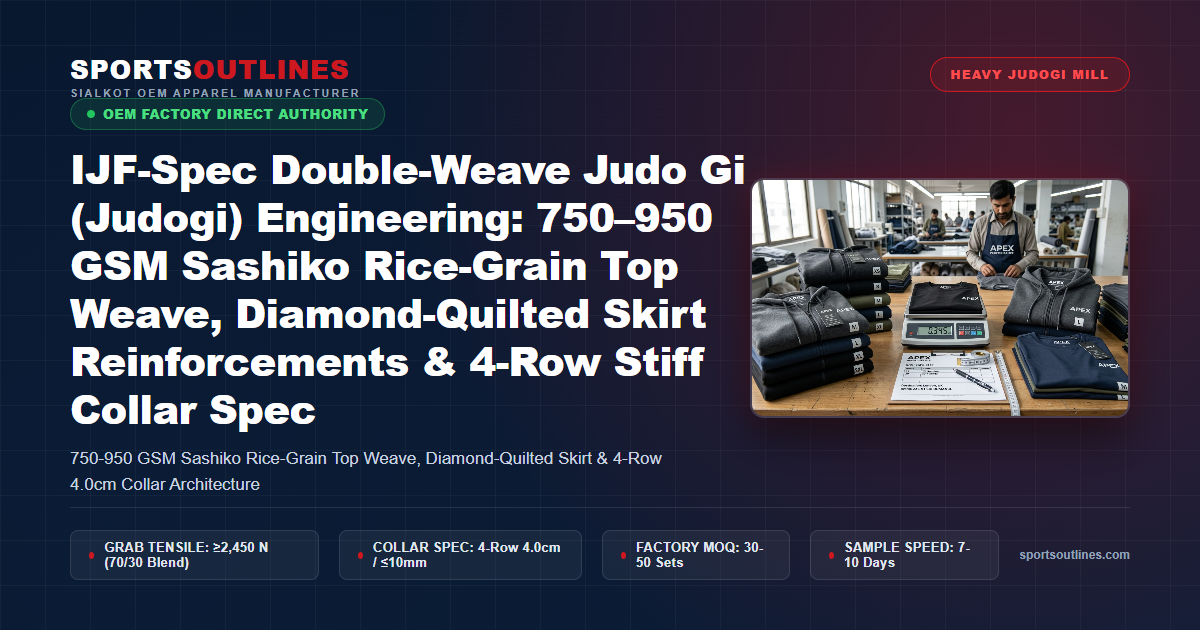
No garment in global athletics is subjected to higher peak biaxial tensile and torsional shear forces than a competitive Judo Gi (Judogi) during olympic-level Kumi-Kata (grip fighting) and explosive hip/shoulder throws (Seoi-Nage, Uchi-Mata, Harai-Goshi). Unlike Brazilian Jiu-Jitsu Gis—which use a uniform Pearl Weave throughout the entire jacket—an authentic Judogi is woven as a Bi-Zonal Continuous Loom Textile: a massive `700 to 950 GSM` upper Sashiko (Rice-Grain) Double-Weave across the chest, shoulders, and sleeves that transitions directly on the loom into a lower `Hishisashi` (Diamond-Quilted) skirt. Under strict International Judo Federation (IJF) pre-bout Sokuteiki gauge inspections, the jacket must weigh strictly `650 to 750 GSM` (post-wash), pass a `2,200 N` tensile grab test, and feature a `4.0 cm` wide, `≤ 1.0 cm` thick 4-row stitched collar that folds easily in a vertical bends-test. This B2B engineering dossier details Sialkot loom construction, 70/30 cotton-polyester shrinkage control, and Royal Blue (`Pantone 19-4052 TCX`) vs. Optical White tournament compliance.
When combat sports brands, national judo federations, and institutional martial arts distributors source custom Judo Gis (Judogi), confusing a BJJ Gi pattern with an IJF-specification Judogi results in immediate disqualification at tournament Sokuteiki (official wooden/aluminum measurement block) inspection tables. While a BJJ Gi is tailored with a snug torso and narrow sleeve apertures to deny the opponent grips during prolonged ground grappling (Ne-Waza), a competitive Judogi is governed by strict fair-play grip-accessibility rules: the sleeve opening must leave a mandatory `10.0 cm` vertical clearance gap (`Sokuteiki` cylinder passage) along the entire length of the forearm, the lapel crossover must exceed `20.0 cm` horizontally at the lower ribcage, and the collar (`Eri`) cannot exceed `10.0 mm` in thickness so it remains pliable enough for the opponent’s fingers to close a classic collar-and-sleeve grip.
At Sports Outlines, our Sialkot heavy-loom weaving and industrial saddlery-stitching facility manufactures custom single-weave (`450–550 GSM`), club double-weave (`650–700 GSM`), IJF-specification competition (`730–750 GSM`), and heavyweight traditional Kodokan/Master (`850–950 GSM`) Judogis engineered to survive thousands of high-velocity throws without lapel delamination or axillary seam rupture.
1. Bi-Zonal Judogi Loom Architecture: Upper Sashiko Rice-Grain vs. Lower Hishisashi Diamond Skirt
The upper torso and sleeves of a Judogi absorb massive concentrated point loads when a 100+ kg heavyweight judoka executes a two-handed collar yank or snaps an opponent downward to break posture (Kuzushi). Instantaneous dynamic grip forces on the lapel and deltoid sleeve seam routinely reach $1,650\text{ to }2,400\text{ N}$ ($168\text{ to }245\text{ kgf}$). Conversely, the lower skirt (`Suso`) of the jacket must remain thin, flexible, and compressible so the thick Judo belt (`Obi`) can cinch the skirt tightly around the iliac crest without slipping upward over the ribs.
1.1 Seamless On-Loom Weave Transition vs. Sewn Waist-Seam Construction
On entry-level `450–550 GSM` single-weave club Judogis, the upper rice-grain panel and lower diamond-weave skirt are woven on separate rolls and joined horizontally at the waist via a 3-needle feed-off-the-arm lap-felled seam. On our `730–750 GSM` IJF-Spec and `850–950 GSM` Heavyweight Double-Weave Judogis, our programmable heavy rapier looms execute a **Continuous On-Loom Structural Weave Transition**:
- Upper Zone — Double-Weave Sashiko (Rice-Grain): Uses heavy plied ring-spun warp cords (`10/3 Ne` or `8/2 Ne` combed cotton / high-tenacity polyester) interlaced with dual-layer backing picks. The coarse external rice-grain nodules resist abrasion while the smooth internal backing weave prevents skin chafing.
- Transition Zone — Integrated Waist Reinforcing Band: At the exact mid-torso marker line, the loom harness shifts pick density to weave a `35 mm` flat high-density transition band before switching into the lower skirt pattern—eliminating the bulky horizontal sewn waist seam on premium builds (or reinforcing it with an internal `40 mm` cotton twill tape on traditional two-piece backs).
- Lower Zone — Hishisashi (Diamond-Quilted Weave): Reduces effective fabric thickness by 28% while forming raised diamond friction pockets that lock mechanically against the internal ridges of a 12-row stitched Judo belt (`Obi`).
| Judogi Tier & Weave Class | Jacket GSM (Post-Wash) | Fiber Composition | Trouser Twill GSM | ISO 13934-1 Grab Tensile | Target Judo Segment |
|---|---|---|---|---|---|
| Single-Weave Youth / Club Judogi | 450 – 550 GSM | 100% Cotton or 60/40 Cotton-Poly | 240 GSM (8.5 oz Drill) | ≥ 1,650 N | Youth Dojo Beginners & Aikido/Jujutsu |
| Intermediate Double-Weave Judogi | 650 – 690 GSM | 75% Combed Cotton / 25% Polyester | 275 GSM (9.5 oz Twill) | ≥ 2,150 N | High School, Collegiate & Regional Senior |
| IJF-Specification Tournament Judogi | 730 – 750 GSM (Strict Gate) | 70% Combed Cotton / 30% High-Tenacity PET | 300 GSM (10.5 oz Sanforized) | ≥ 2,450 N (Exceeds 2,200N Gate) | National & International IJF-Rule Tournaments |
| 850 GSM Heavyweight Pro Double-Weave | 850 GSM | 80% Combed Cotton / 20% Polyester | 320 GSM (11.2 oz Heavy Twill) | ≥ 2,780 N | Traditional Kodokan Randori & Police/Military |
| 950 GSM Armor-Grade Master Judogi | 950 GSM | 100% Long-Staple Combed Ring-Spun Cotton | 350 GSM (12.0 oz Duck Canvas) | ≥ 3,100 N | Classical Kosen Judo, Kata & Heavyweight Sensei |
2. IJF Sokuteiki Inspection Compliance: Collar Stiffness, Sleeve Aperture & 70/30 Blend Physics
Prior to stepping onto the tatami at any IJF-governed tournament, every athlete’s Judogi is inspected using the **Sokuteiki** measurement device and a digital collar thickness caliper. Historically, manufacturers attempted to build 1,000+ GSM “stand-up armor” Judogis with rock-hard 6-row collars that prevented opponents from closing their fingers. In response, current IJF regulations enforce five non-negotiable physical specifications that we build directly into our Sialkot CAD patterns and textile finishing lines:
| IJF Sokuteiki Inspection Parameter | Mandatory Regulatory Limit | Sports Outlines Sialkot Factory Target | Engineering Implementation Method |
|---|---|---|---|
| 1. Jacket Fabric Mass (Post-Wash) | 650 to 750 g/m² (GSM) | 730 ± 12 GSM (After 3 ISO 6330 Washes) | Woven at 715 GSM raw + compressive Sanforization to 730 GSM |
| 2. Fiber Blend Ratio | Min 70% Cotton / Max 30% Synthetic | 70% Combed Cotton / 30% High-Tenacity PET | Intimate ring-spun blend boosts tensile to 2,450 N & cuts shrinkage |
| 3. Collar (Eri) Width, Thickness & Rows | Width: 4.0 cm max | Thickness: ≤1.0 cm | 4 Rows | 3.9 cm Width × 0.88 cm Thick (4 Stitch Rows) | Non-woven Sanforized cotton-felt core; passes vertical U-fold check |
| 4. Sleeve Length & Sokuteiki Cylinder Gap | Covers full wrist; ≥10.0 cm vertical gap | 10.8 – 11.5 cm Clearance (+2.2% Shrink Buffer) | Available in Standard & Slim/Y-Cut builds across 5 cm half-sizes |
| 5. Jacket Front Crossover & Skirt Drop | ≥20.0 cm overlap at bottom ribcage; covers buttocks | 23.5 cm Horizontal Overlap | Prevents jacket pulling open during prolonged grip exchanges |
| 6. Tournament Blue Chromaticity | Pantone 18-4051 to 19-4052 TCX | Pantone 19-4052 TCX (ΔE ≤ 0.8; Grade 4.5 Fastness) | Bifunctional reactive + high-energy disperse dual-stage vat dyeing |
3. Internal Stress-Point Armor: Shoulder Linings, Axillary Half-Moons & Knee Quilting
Even a 750 GSM Sashiko double-weave will eventually tear at seam junctions if stitched without internal stress-distribution backing panels. Every professional Judogi manufactured in our Sialkot facility incorporates five heavy-duty internal reinforcements:
- Double-Layer Sashiko Scapular & Clavicular Shoulder Lining: Extends from the collar neck band across both deltoids and 22 cm down the upper back, stitched with twin-needle lockstitch tracks to absorb overhead high-collar grip loads (O-Goshi and Uchi-Mata lifting vectors).
- Crescent Half-Moon Axillary (Armpit) Gussets: Double-layered Sashiko crescent patches sewn over the 4-way underarm intersection prevent seam splitting when an opponent violently rips a cross-sleeve grip sideways.
- 5-Row Reinforced Side-Slit Vent Boxes: The top apex of each lateral skirt vent (`14 cm` height) is armored with a `55 × 45 mm` woven twill backing patch secured by a 5-row rectangular box-stitch and dual 42-stitch bartacks.
- Extended Trouser Knee-to-Shin Quilted Armor: Judo trousers endure extreme mat friction during drop *Seoi-Nage* entries and *Ne-Waza* turnovers. We sew an internal `300 GSM` twill reinforcement panel extending from mid-thigh all the way to 8 cm above the ankle cuff, quilted in a diamond grid with heavy `Tex 80` thread.
4. Judogi Metric Height & Half-Size Grading Table (140 cm to 205 cm + Y-Slim Fit)
Because the IJF `Sokuteiki` sleeve-length and crossover rules leave only a narrow window between “too short (disqualified)” and “too baggy (disadvantageous to the wearer)”, top Judo brands offer **5 cm Half-Size Increments** (`160`, `165`, `170`, `175`, `180`, `185`, `190 cm`) in both **Regular (R)** and **Slim/Athletic (Y-Cut)** torso blocks:
| Judogi Size Tag (Regular & Y-Slim) | Cross-Sleeve Span (Post-Wash cm) | Jacket Back Length (cm) | Chest 1/2 Width (Reg / Y-Slim cm) | Sleeve Cuff 1/2 Width (Sokuteiki Gate) | Trouser Outseam Length (cm) |
|---|---|---|---|---|---|
| Size 2.0 / 150 cm | 142.0 cm | 71.0 cm | 54.0 cm / 51.0 cm | 17.5 cm | 87.0 cm |
| Size 2.5 / 155 cm | 147.0 cm | 73.5 cm | 56.0 cm / 53.0 cm | 18.0 cm | 90.5 cm |
| Size 3.0 / 160 cm | 152.0 cm | 76.0 cm | 58.5 cm / 55.0 cm | 18.5 cm | 94.0 cm |
| Size 3.5 / 165 cm | 157.0 cm | 78.5 cm | 60.5 cm / 57.0 cm | 18.8 cm | 97.0 cm |
| Size 4.0 / 170 cm | 162.0 cm | 81.0 cm | 63.0 cm / 59.5 cm | 19.2 cm | 100.0 cm |
| Size 4.5 / 175 cm | 167.0 cm | 83.5 cm | 65.5 cm / 61.5 cm | 19.5 cm | 103.0 cm |
| Size 5.0 / 180 cm | 172.0 cm | 86.0 cm | 68.0 cm / 64.0 cm | 20.0 cm | 106.0 cm |
| Size 5.5 / 185 cm | 177.0 cm | 88.5 cm | 70.5 cm / 66.5 cm | 20.5 cm | 109.0 cm |
| Size 6.0 / 190 cm | 182.0 cm | 91.0 cm | 73.0 cm / 69.0 cm | 21.0 cm | 112.0 cm |
5. Industrial SAM (Standard Allowed Minute) Manufacturing Router for Double-Weave Judogis
Sewing through two overlapping layers of 750–950 GSM Sashiko double-weave plus internal shoulder reinforcements (`> 2,400 GSM` combined seam thickness) requires ultra-heavy needle-feed and puller-feed industrial machinery equipped with titanium-nitride (`TiN`) coated `Nm 140/22` to `160/23` needles:
| Op Code | Judogi Manufacturing Operation | Heavy Industrial Machinery | 750 GSM IJF SAM | 950 GSM Master SAM | Quality Control Tolerance Gate |
|---|---|---|---|---|---|
| OP-01 | Bi-Zonal Sashiko/Hishisashi Weaving & Sanforized Pre-Shrinking | Heavy Rapier Loom + Compressive Sanforizer | 3.20 min | 4.10 min | Post-wash GSM 730±12; residual shrinkage ≤2.0% |
| OP-02 | Transition-Aligned CAD Panel Cutting & Half-Size Grading | Eastman Heavy-Duty Straight Knife + Laser Guide | 3.50 min | 4.20 min | Exact horizontal alignment of Sashiko-to-diamond line |
| OP-03 | Shoulder Stripe Tape, Deltoid Brand & Lapel Tip Embroidery | Tajima Heavy-Frame Embroidery + Tape Binder | 3.80 min | 4.00 min | Embroidered prior to shoulder lining lamination |
| OP-04 | Center-Back Seam Joining & 30 mm Internal Twill Tape Binding | Union Special 35800 Extra-Heavy Feed-Off-Arm | 3.90 min | 4.60 min | Internal back seam width ≤3.0 cm; tensile ≥2,500 N |
| OP-05 | Double-Sashiko Scapular Shoulder & Half-Moon Armpit Armor | Juki DLN-5410N Needle-Feed Heavy Lockstitch | 5.40 min | 6.20 min | Tex 105 bonded core-spun thread; zero skipped stitches |
| OP-06 | 4-Row Stiffened Collar (Eri) Core Assembly & Jacket Mounting | Kansai Special Heavy 4-Needle Puller Unit | 7.20 min | 8.80 min (5-Row) | Strict 3.9–4.0 cm width & ≤0.95 cm thickness (IJF spec) |
| OP-07 | Sleeve Cuff & Bottom Skirt Multi-Row Reinforcement Hemming | Adler Heavy Walking-Foot Lockstitch | 4.60 min | 5.30 min | Cuff hem fold ≤3.0 cm; resists grip tear-out |
| OP-08 | 5-Row Side-Vent Box Reinforcement & CNC 42-Stitch Bartacks | Juki AMS-210EN Programmable Pattern Sewer | 3.10 min | 3.40 min | Side vent shear resistance ≥1,400 N |
| OP-09 | Trouser Extended Knee-to-Shin Diamond Quilting & Gusset | Twin-Needle Heavy Lockstitch + Overlock | 4.80 min | 5.20 min | Dual-layer 600 GSM combined knee shield |
| OP-10 | Traditional Flat-Braided Cross-Drawstring Waistband & Loops | Single-Needle Lockstitch + Bartacker | 2.70 min | 2.90 min | Non-slip cotton-poly flat tape drawcord |
| OP-11 | Sokuteiki Cylinder Gauge Audit, Caliper Check & Metal Scan | Official Sokuteiki Block + Digital Caliper + Detector | 2.20 min | 2.20 min | 100% check on 10cm sleeve gap & ≤10mm collar thickness |
6. Sialkot Judogi FOB Pricing & Brand Margin Matrix (White vs. Tournament Blue)
Because Royal Blue (`Pantone 19-4052 TCX`) Judogis require high-fastness reactive/disperse vat dyeing so blue dye never rubs off onto white tatami mats or the opponent’s white Judogi (`ISO 105-X12` wet crocking Grade `4.5`), blue Judogis carry a standard `$2.50 to $3.80` dyeing differential over bleached optical white:
| Judogi Product Configuration | Total SAM | FOB Sialkot — White (30–50 Sets) | FOB Sialkot — Royal Blue (30–50 Sets) | DTC Retail / Federation MSRP | Brand Gross Margin |
|---|---|---|---|---|---|
| 450 GSM Single-Weave Club Judogi (+ Belt) | 28.5 SAM | $14.50 – $17.50 / set | $16.80 – $19.80 / set | $65.00 – $89.00 | 75% – 79% Gross Margin |
| 650 GSM Club Double-Weave Judogi | 38.0 SAM | $22.50 – $27.50 / set | $25.50 – $30.50 / set | $119.00 – $155.00 | 78% – 81% Gross Margin |
| 750 GSM IJF-Spec 70/30 Tournament Judogi | 44.4 SAM | $27.50 – $33.50 / set | $31.00 – $37.00 / set | $169.00 – $229.00 | 80% – 84% Gross Margin |
| 900–950 GSM Heavyweight Kodokan Master Gi | 50.9 SAM | $33.00 – $41.00 / set | $36.80 – $45.00 / set | $199.00 – $269.00 | 81% – 84% Gross Margin |
| 12-Row Stitched 4.5cm Judo Black/Rank Obi Belt | 6.5 SAM | $3.40 – $4.80 / pc | $3.60 – $5.20 / pc (All Rank Colors) | $22.00 – $35.00 | 82% – 86% Gross Margin |
7. Pre-Fight Sokuteiki Inspection Physics, Royal Blue Crocking Fastness & Seoi-Zekken Backpatch Engineering
At international Grand Slam, Continental Open, and national federation Judo tournaments, athletes undergo mandatory pre-bout uniform control (`Judogi Control`) immediately prior to stepping onto the tatami. A single geometric or material non-conformity results in forced reserve-uniform replacement or immediate disqualification (`Hansoku-Make`). Our Sialkot Judogi engineering team builds three tournament-critical compliance protections into every production run:
7.1 Sokuteiki Cylinder Passage & Post-Shrinkage Sleeve Allowance Engineering
During official inspection, the technical official slides a cylindrical **Sokuteiki gauge block** down the entire internal length of the sleeve with the Judoka’s arms extended horizontally forward at shoulder height. Under current rules, the sleeve cuff must completely cover the radial and ulnar styloid processes (the wrist joint) and maintain a minimum **`10.0 cm` internal vertical clearance** (`Sokuteiki` diameter) along the entire sleeve cylinder. Even when a 750 GSM 70/30 cotton-polyester Sashiko double-weave is mechanically Sanforized on our Sialkot compressive rubber-belt line, heavy three-dimensional rice-grain relief still exhibits a predictable `1.8% to 2.2%` warp relaxation over the first five cold-water washes and line-dryings. To guarantee that a newly purchased Judogi never shrinks short of the athlete’s wrist bones after washing, we engineer a calibrated `+1.8 cm` pre-wash sleeve length tolerance and `+1.2 cm` sleeve-circumference allowance into our factory master pattern blocks.
7.2 Tournament Royal Blue (`Pantone 19-4052 TCX`) Dual-Bath Reactive/Disperse Vat Dyeing & Zero-Crocking
Because Judo pits one athlete in an Optical White (`CIE Whiteness 148–155`) Judogi against an opponent in a Royal Blue (`Pantone 19-4052 TCX` / `#1D428A`) Judogi under intense sweat-soaked friction and `Ne-Waza` mat pinning, inferior sulfur-dyed or pigment-dyed blue uniforms transfer blue smudges onto the opponent’s white jacket and onto expensive PVC tatami mats. To achieve an **ISO 105-X12 wet rubbing (crocking) rating of Grade 4.5** and an **ISO 105-E04 perspiration fastness rating of Grade 5.0**, our wet-processing mill utilizes a **two-stage high-temperature disperse + bifunctional reactive dyeing protocol** on the 70/30 cotton-polyester yarn prior to final Sanforizing, followed by a triple cationic/anionic soaping wash-off and silicone-free hydrophilic softening.
7.3 Official Seoi-Zekken Back Numbers, Kanji Belt Embroidery & Shoulder Stripe Customization
For national Judo federations, collegiate squads, and premium B2B martial arts brands, we manufacture and pre-apply official `30 cm × 30 cm` tear-resistant woven backpatches (`Seoi-Zekken`) positioned exactly `3.0 cm` below the collar seam, featuring high-definition sublimated athlete family names, 3-letter IOC country codes, and sponsor boxes. Simultaneously, our heavy-frame Tajima embroidery cells execute custom woven shoulder-stripe branding (`5.0 cm` maximum width along the deltoid line), lower-left lapel tip brand crests (`25 cm²` maximum area), and deep-penetration Kanji/English name embroidery across 12-row `4.5 cm` black belts (`Obi`).
7.4 Youth Single-Weave (`450 GSM`) vs. Senior Double-Weave (`750–950 GSM`) Club Inventory Architecture
When structuring a profitable Judo equipment catalog, B2B distributors and multi-location academies must balance beginner entry affordability with elite tournament durability. For junior Judokas (`Sizes 110 cm to 150 cm`), a heavy 750 GSM double-weave jacket is overly rigid for developing fingers to grip and restricts shoulder mobility during breakfall (`Ukemi`) drills. We therefore engineer our 450 GSM Single-Weave Youth & Novice Judogi with the exact same bi-zonal visual aesthetic—a genuine Sashiko rice-grain upper weave paired with a diamond-quilted lower skirt and full knee-to-shin trouser reinforcement pads—plus an **elastic + internal drawcord hybrid waistband** on youth sizes `110 cm` to `140 cm` so young students can tie their pants quickly without instructor assistance. From `Size 150 cm (Size 2.0)` through `200 cm (Size 7.0)`, the assortment transitions seamlessly into our **650 GSM Club Double-Weave**, **750 GSM IJF-Spec 70/30 Tournament Double-Weave**, and **900–950 GSM Heavyweight Kodokan Master Double-Weave**, allowing a single brand to serve every athlete from first-day white belt (`Rokkyu`) to Olympic trialist and 6th-Dan Red-and-White (`Kohaku`) belt master.
8. Global Country Silos & Cross-Cluster Technical Network
Because heavy 750–950 GSM Judogis weigh `2.1 to 2.9 kg` per set, European and UK brands gain a massive competitive advantage from Pakistan’s **0.0% Duty-Free GSP+ (EU) and DCTS (UK)** status on cotton/poly-cotton martial arts uniforms (`HS Code 6203.22` / `6211.32`):
- USA Judo Club & Collegiate Brand Manufacturing: Explore our USA Custom Sportswear & Judo Gi Manufacturing Silo for USJA/USJF/USA Judo club and tournament supply.
- UK British Judo Association (BJA) Spec Supply: Visit our UK Custom Sportswear & Martial Arts Hub for 0.0% duty-free import of single-weave and double-weave Judogis.
- German & European EJU Brand Sourcing: Access our Germany Custom Sportswear & Judo Uniform Silo for Bundesliga and EJU-spec 750 GSM double-weave production.
- Canadian Judo Dojo & Provincial Team Supply: Review our Canada Custom Sportswear & Martial Arts Guide for Judo Canada-compliant sizing and French/English care labels.
- Australian Judo Academy & Brand Sourcing: Partner with our Australia Custom Sportswear & Martial Arts Hub for fast LCL sea and air cargo delivery.
Cross-reference our companion technical weave and lapel guides across Super-Cluster 5: BJJ Gi Pearl, Gold & Double-Weave GSM Tensile Engineering, Lapel Collar Core & Anti-Grip Stiffness Engineering, WKF-Compliant Karate Gi Kata vs. Kumite Engineering, and World Taekwondo (WT) Dobok Manufacturing Architecture.
9. Frequently Asked Questions (B2B Judo Gi / Judogi Manufacturing)
1. Why does an IJF-specification Judo Gi use a 70% Cotton / 30% Polyester blend instead of 100% cotton?
Blending 30% high-tenacity polyester with 70% combed ring-spun cotton boosts the Sashiko double-weave grab tensile strength above 2,450 N (comfortably exceeding the 2,200 N tournament gate) while reducing post-purchase laundering shrinkage from 6%–8% down to less than 2.0%. This ensures the athlete’s sleeves do not shrink short and fail the pre-fight Sokuteiki wrist-bone inspection.
2. What is the difference between a Judo Gi collar and a BJJ Gi collar?
A BJJ Gi collar contains a molded closed-cell EVA foam or vulcanized rubber core sewn with 6 to 8 rows of stitching. By contrast, a competitive Judo Gi collar is strictly prohibited from containing rigid foam or plastic cores; it must use a multi-ply Sanforized cotton-felt textile core sewn with exactly 4 rows of stitching, measuring no wider than 4.0 cm and no thicker than 1.0 cm so it folds easily in the vertical bends-test.
3. What is your prototype sampling cost and turnaround time for a custom Double-Weave Judogi?
Custom prototype sampling is strictly $45–$85 per set as a non-refundable development fee covering custom Regular or Y-Slim pattern grading, shoulder stripe tape weaving, custom brand embroidery on the shoulders/lapel tip, and Sokuteiki dimensional verification. Prototype samples are completed within 7–10 business days.
4. What is the minimum order quantity (MOQ) for White and Royal Blue Judogis?
Our low factory MOQ is strictly 30–50 sets per style/colorway (e.g., 30–50 White Judogis and 30–50 Royal Blue Judogis), with full freedom to mix Regular, Y-Slim, and 5 cm half-sizes (`150 cm` to `200 cm`) within each batch.
5. Can you embroider custom athlete family names and national country codes (back numbers / IJF backpatches)?
Yes. We provide direct Kanji/Latin name embroidery on the lower jacket lapel skirt, trouser hip, and 12-row black belts, as well as official-dimensioned sublimated back-number patches (`Seoi-Zekken`) pre-stitched or supplied loose for national federation squads.
Source Custom 750–950 GSM Double-Weave Judo Gis (Judogi) Direct from Sialkot
Partner with Sialkot’s heavy-loom Judogi specialists for bi-zonal Sashiko/diamond-skirt Judo uniforms engineered to pass Sokuteiki and 2,200 N tensile gates. Prototype sampling is strictly $45–$85 per set (non-refundable development fee, 7–10 business days turnaround) with low 30–50 set MOQs.