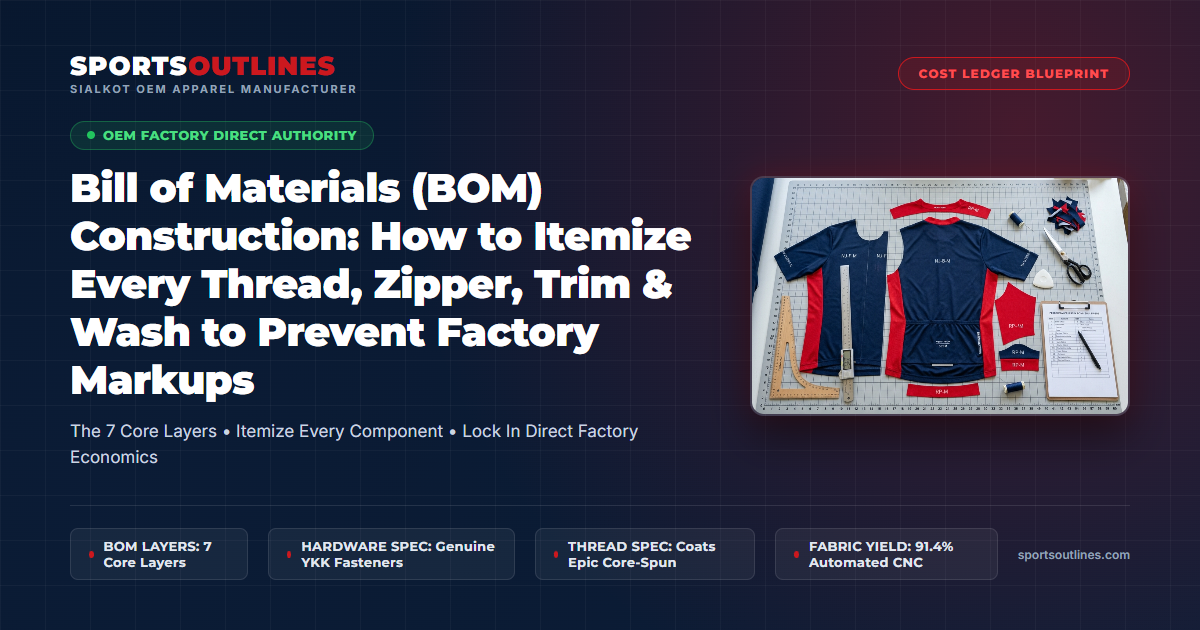
Direct Manufacturer Snapshot: Bill of Materials (BOM) Construction: How to Itemize Every Thread, Zipper, Trim & Wash to Prevent Factory Markups
An apparel Bill of Materials (BOM) is an exhaustive, itemized engineering register that accounts for every physical raw material, hardware fastener, structural trim, chemical wash process, and packaging component required to manufacture a single finished garment. In technical sportswear, luxury streetwear, and combat sports manufacturing, a complete BOM serves as the ultimate financial defense against unauthorized factory component substitutions and surprise mid-production cost markups. A professional apparel BOM itemizes 7 core manufacturing layers: 1) Primary Shell Textiles (exact yarn count, GSM, fiber blend, fabric yield, and price per kg/meter); 2) Secondary Lining & Ribbing Knits; 3) Structural Interfacings, Pocketings & Tapes (fusible non-wovens, seam sealing tapes); 4) Sewing & Assembly Threads (fiber, Ticket/Tex denier, SPI); 5) Mechanical Hardware & Fasteners (zippers, sliders, aglets, snap buttons with mold specs); 6) Brand Trims & Labeling (damask woven neck labels, care tags, hangtags); and 7) Packaging Materials (individual frosted EVA polybags, barcodes, silica gel, master export cartons). Sports Outlines International in Sialkot, Pakistan, operates on a 100% transparent, open-book BOM policy, providing itemized cost transparency and 7–10 day prototyping.
Direct WhatsApp: +92 316 7932595
Introduction: The Cost Ledger that Governs Apparel Profitability
In the competitive global apparel industry, the difference between a high-margin direct-to-consumer powerhouse and an insolvent fashion startup rarely comes down to marketing genius alone; it is fundamentally determined by component cost discipline. In garment manufacturing, every pocket lining, inner seam tape, drawcord aglet, zipper tooth, and wash chemistry treatment carries an exact financial cost. When these components are left ambiguous in supplier negotiations, factories quietly capture extra profit through stealth material substitutions, while billing the buyer premium prices.
The single most powerful instrument for establishing financial transparency, engineering repeatability, and contractual protection in apparel sourcing is the Bill of Materials (BOM). Serving as the granular component inventory within your apparel tech pack, a complete BOM itemizes every physical element required to construct one single unit of your garment.
Operating from Sialkot, Pakistan—the export epicenter of performance athletic teamwear, technical fight gear, and premium heavyweight streetwear—Sports Outlines International manufactures for leading brands worldwide on an uncompromised open-book standard. In this comprehensive technical guide, we break down The Bill of Materials Construction Masterclass. We dissect the 7 core component layers of an apparel BOM, demonstrate how to mathematically calculate net fabric consumption, expose common factory substitution tricks, and show you how our transparent factory direct contracts guarantee zero price escalation.
Have Your Garment BOM Audited by Sialkot Factory Engineers
Send us your design files or BOM spreadsheet on WhatsApp for a line-by-line material cost audit and direct factory counter-quote.
✓ $45–$85 Physical Prototypes •
✓ Worldwide DDP Delivery
The Master Bill of Materials: The 7 Core Component Layers
A professional garment BOM must never be a simple three-line table stating fabric, zipper, and print. In modern technical manufacturing, a complete BOM is organized into 7 distinct engineering layers. Consider the exhaustive BOM ledger for a luxury 450 GSM Heavyweight Streetwear Boxy Hoodie with Custom Metal Hardware:
| Layer | Component Description | Material & Engineering Specification | Consumption / Garment | Supplier / Brand Standard | Unit Cost |
|---|---|---|---|---|---|
| 1. Shell Fabric | Main Body, Sleeves, Outer Hood, Front Pocket | 100% Combed Cotton French Terry, 450 GSM, 32s/2 face + 10s loopback, pre-shrunk | 0.91 kg (Net yield 91.4%) | Sports Outlines Sialkot Mill | $6.82 ($7.50/kg) |
| 2. Trim Fabric | Wrist Cuffs, Bottom Waistband Ribbing | 95% Combed Cotton / 5% Spandex 2×2 Heavy Rib, 480 GSM, reactive dyed | 0.14 kg | Sports Outlines Sialkot Mill | $1.15 ($8.20/kg) |
| 3. Structural | Pocket Opening Stabilizer, Shoulder Seam Tape | 10mm non-woven fusible stay tape (shoulder) + 12mm twill reinforcement tape | 1.20 meters | Freudenberg Interfacings | $0.35 |
| 4. Sewing Thread | Structural Seams & Topstitching | Coats Epic 100% Poly Core-Spun (Ticket 120 assembly, Ticket 80 bar-tacks, 11 SPI) | 140 meters thread | Coats Group PLC (Certified) | $0.42 |
| 5. Hardware | Zipper, Aglets, Eyelets | Genuine YKK #5 Antique Nickel Reversible Zipper + 2x Engraved Zinc Alloy Aglets | 1 zipper + 2 aglets + 2 eyelets | YKK Fastening + Custom Die | $2.45 |
| 6. Brand Trims | Neck Label, Care Label, Hangtag | 50D Damask woven neck tag (sonic-cut) + satin care tag + 600 GSM duplex hangtag | 1 set per garment | Sports Outlines Private Label | $0.78 |
| 7. Packaging | Polybag, Silica, Master Carton | 120-micron frosted EVA slider zipper polybag + barcode sticker + double-wall export carton | 1 bag + 1/25th master box | Sports Outlines Export Pack | $0.65 |
| Total Bill of Materials Component Cost (FOB Sialkot): | $12.62 / Unit | ||||
When your production contract is grounded in an itemized BOM of this caliber, the factory is legally bound to the exact physical inputs. If raw cotton prices surge mid-run or dye chemicals fluctuate, your unit price remains permanently locked. There is zero room for the manufacturer to introduce mysterious “unexpected trim surcharges.”
The Mathematics of Fabric Consumption: How to Audit Fabric Yardage
In apparel manufacturing, fabric accounts for 50% to 65% of the total finished garment cost. Consequently, the fabric consumption formula is where deceptive factories inflate their profit margins through artificial “wastage padding.”
To audit your factory’s fabric consumption claims, use our standardized mathematical formula:
Mathematical Garment Fabric Consumption Formula:
Total Fabric Weight (kg) = [ Net Pattern Area (m²) × Fabric GSM (g/m²) ] ÷ [ Nesting Marker Yield (%) × 1,000 ]
Real-World Benchmark Calculation (Size L Heavyweight Boxy Hoodie):
- Net Pattern Surface Area: Sum of front body, back body, 2 sleeves, 2 double-layered hood panels, and 1 kangaroo pocket = 1.82 square meters.
- Specified Fabric GSM: 450 grams per square meter (0.450 kg/m²).
- Net Garment Weight: 1.82 m² × 450 g/m² = 819 grams (0.819 kg) of finished fleece in the garment.
- Automated Nesting Yield: In modern computerized Gerber AccuMark lay planning, fabric yield reaches 91.4% (meaning only 8.6% of the fabric bolt remains as cutting table remnants).
- Gross Fabric Required: 0.819 kg ÷ 0.914 = 0.896 kg (call it 0.90 kg) per hoodie.
The Factory Scam: In manual cutting shops, factories frequently tell founders: “A heavy hoodie takes 1.25 kilograms of fleece because cutting scrap is 25%.” If fabric costs $7.50/kg, billing you for 1.25 kg ($9.38) instead of the actual 0.90 kg ($6.75) represents an artificial $2.63 per garment markup ($263.00 on 100 units). At Sports Outlines, our automated vacuum-clamped CNC cutting tables achieve 91%+ yields, and we bill strictly for true engineering consumption.
Hardware Fasteners: The Critical Difference Between YKK and Clones
Zippers, aglets, and snaps are the mechanical moving parts of your garment. A broken zipper or cracked aglet is the fastest way to trigger a 1-star customer review and an expensive return.
In your BOM, never write “metal zipper.” Specify the exact technical fastener parameters:
- Fastener Brand: Specify Genuine YKK (Yoshida Kogyo Kabushikikaisha) or SBS certified athletic zippers. YKK zippers utilize precision-extruded brass or zinc teeth that undergo 10,000-cycle reciprocal glide testing with zero tooth dislocation.
- Gauge Size: Specify #5 (5mm tooth width) for standard hoodie plackets, or #8 (8mm heavy gauge) for luxury outerwear statement styling. Specifying a thin #3 dress zipper on a thick 450 GSM fleece hoodie will cause the zipper tape to tear out under tension.
- Slider Function: Specify “Auto-lock slider” (which locks in place when the pull-tab is flat against the teeth, preventing unintentional unzipping during movement) or “Non-lock slider” for casual streetwear styling.
- Aglet Metallurgy: Specify “Die-cast zinc alloy drawcord aglets with internal mechanical crimp anchor” rather than plastic shrink wrap. Zinc alloy provides cold luxury hand-feel and withstands commercial tumble drying without bending or peeling.

Thread & Seam Engineering: Specifying Coats Epic Core-Spun Thread
Many brand owners overlook sewing thread in their BOM, assuming that all thread is identical. In reality, thread failure is a primary cause of garment returns.
Low-grade factories assemble garments with cheap open-end spun polyester thread. Spun polyester has low tensile strength and high friction resistance; when sewn through heavy 450 GSM fleece, needle heat weakens the thread, causing seams to unravel after two wash cycles. In your BOM, always mandate Polyester Poly-Wrapped Core-Spun Thread (e.g., Coats Epic or A&E Perma Core):
- Continuous Filament Polyester Core: Delivers exceptional tensile breaking strength (exceeding 22 Newtons on Ticket 120), allowing seams to stretch alongside knitted fabric without snapping.
- Staple Polyester Outer Wrap: Provides a soft cotton-like luster, protects the inner core from friction heat during high-speed sewing, and absorbs silicone lubricating oils for buttery seam smoothness.
- Bar-Tack Thread (Ticket 80): Mandatory for kangaroo pocket stress points, drawcord exits, and side slit reinforcements to withstand heavy daily use.
| Production Volume Tier | Est. Unit FOB Cost | Sample Cost & SLA | Bulk Production SLA | Included Specifications | Recommended Buyer Profile |
|---|---|---|---|---|---|
| 30 Units (Micro MOQ) | $22.50 – $24.50 All-Inclusive | $65–$85 (7–10 days) | 12–15 Days | Fully itemized 7-layer BOM, stock certified fleece, single print placement, polybag | Pilot brand proof-of-concept founders demanding 100% material cost transparency |
| 50 Units (Capsule Drop) | $18.50 – $20.00 All-Inclusive | $55–$75 (7–10 days) | 14–18 Days | Custom lab dips, multi-color BOM matrix, damask woven label itemization | Streetwear capsule releases requiring multi-component material accounting |
| 100 Units (Commercial Tier) | $15.20 – $16.50 All-Inclusive | $45–$65 (7–10 days) | 18–21 Days | Free custom hardware tooling, automated laser cut marker, AQL 2.5 QC audit | Growing e-commerce brands scaling catalog depth with fixed component margins |
| 300 Units (Enterprise Scale) | $12.10 – $13.50 All-Inclusive | $45 (7–10 days) | 25–30 Days | Mill-direct circular knitting, zero hardware tooling fees, hybrid air/ocean DDP freight | Wholesale distributors and athletic teams requiring institutional BOM pricing |
| Sourcing Feature & Risk Factor | Sports Outlines (Sialkot Direct) | Alibaba Trading Agents | Traditional Chinese Hubs | Print-on-Demand (POD) |
|---|---|---|---|---|
| BOM Cost Itemization Transparency | 100% Open-Book BOM: Granular price per kg of fabric, per meter of ribbing, per zipper, and per label itemized upfront | Opaque black box quote: Single bundled number allowing agents to secretly substitute cheaper thread and lining | Itemized BOM provided only after non-refundable commercial development contracts ($2,000+) are executed | Zero BOM visibility — proprietary blank garments with frequent unannounced fiber blend substitutions |
| Raw Material Specification Control | Exact fiber micron, yarn count (e.g. 32s/2 combed cotton), and thread ticket numbers locked into binding contract | Generic descriptions (‘cotton blend’) allowing factories to secretly cut costs with 40% polyester filler | High material control, but rigid fabric minimums requiring 1,000+ meters per custom dye lot | Zero material control — fixed catalog blanks from mass apparel wholesalers |
| Hardware Fastener Authenticity | Genuine YKK zippers and certified zinc alloy aglets sourced directly from authorized manufacturers | Counterfeit or generic unbranded zippers that jam, split, and corrode after several laundry cycles | Authentic hardware available, but high mold setup fees ($250+) applied on orders under 1,000 units | Generic plastic zippers and flimsy shoelace drawcords with zero customization options |
| Fabric Wastage Buffer Policy | Zero wastage penalty billed to client: Computerized Gerber nesting yields 91%+; factory absorbs cutting scrap | Invoices client for 15% to 20% ‘unavoidable cutting table scrap’ over actual finished garment consumption | Requires 8% to 12% overage buffer purchased by brand with no reimbursement for remnant rolls | Scrap buffers hidden within inflated $35.00+ single-garment retail blank costs |
| Prototype Physical Verification Protocol | 7–10 business day physical prototype dispatch via DHL Express ($45–$85 flat non-creditable engineering fee) | Protracted 4 to 6-week sampling cycles with frequent material mismatches requiring expensive re-sampling | 4 to 6-week sample lead time with $150–$300 prototype development fees per garment style | Instant 3D digital rendering, but zero physical tactile material verification before customer delivery |
Packaging & Labeling Architecture in the BOM
The unboxing experience is your brand’s first physical touchpoint with your direct-to-consumer customer. A luxury hoodie delivered in a crinkly, thin polybag with a crooked, scratchy tag immediately degrades perceived value. Your BOM must itemize exact packaging specifications:
- Damask Woven Neck Label (50-Denier): Woven on high-speed electronic jacquard looms with 120 picks per inch. Specify ultrasonic sonic-cut edges, which melt and seal polyester threads microscopically smooth, eliminating the scratchy corners that cause customers to cut labels out.
- Duplex Heavyweight Hangtag: 600 GSM double-pasted cotton cardstock with soft-touch matte lamination, debossed logo, and attached via a black waxed cotton cord and matte black safety pin.
- Frosted EVA Slider Polybag: 120-micron frosted ethylene-vinyl acetate (EVA) with a smooth zipper slider, printed brand logo, and a 10mm punched air hole to prevent humidity condensation during international transit.
- Master Export Cartons: Double-wall heavy corrugated cardboard (BC-flute, 275 lb bursting test) holding 25 folded garments, sealed with reinforced water-activated gummed tape to prevent box crushing.
Chemical Washes & Fabric Finishing: Specifying Wet Processing in the BOM
A critical layer frequently omitted from amateur BOMs is Wet Processing & Chemical Finishing. When you touch a luxury hoodie from an elite streetwear label, its buttery soft hand-feel and relaxed drape are not purely the result of raw cotton fibers; they are engineered through specialized post-knitting chemical and mechanical washing treatments.
In your BOM, you must explicitly specify wet finishing chemistry to prevent factories from delivering stiff, raw greige fleece:
- Silicone Micro-Emulsion Enzyme Wash: Cellulase enzymes gently digest protruding microscopic surface fuzz fibers (reducing future pilling), while silicone micro-emulsions penetrate the yarn core, imparting a silky, fluid drape that feels broken-in from day one.
- Carbon Peaching (Sueding): The fabric surface passes under rotating diamond-grit abrasive rollers, creating a microscopic velour-like “peach skin” nap across the face of the fabric.
- Mineral & Acid Wash Aging: Pumice stones soaked in mild oxidizing solutions are tumbled with garments in industrial washers to produce authentic vintage fades along seam lines, ribbing joints, and pocket rims without degrading fabric tensile strength.
BOM Version Control: Managing Engineering Change Orders (ECOs)
As your brand iterates across multiple seasonal drops, components evolve. A hoodie that launched with a plastic zipper in Season 1 might upgrade to antique nickel YKK hardware in Season 2. Without disciplined version control, factory cutting floors often manufacture new orders using obsolete BOM specifications.
Every professional BOM generated by Sports Outlines features strict versioning metadata: BOM Version Number (e.g., v1.0, v1.1, v2.0), Effective Date, Engineering Change Order (ECO) Log, and Sign-Off Approvals. When an update occurs—such as shifting from a 3mm to a 4mm flat drawcord—our technical director issues a formal ECO, ensuring that every cutting table operator and trim supplier operates from the synchronized master record.
The BOM Verification Gauntlet: Inspecting Your Pre-Production Prototype
Before releasing funds for mass production cutting, your itemized BOM must be physically validated through a pre-production prototype. At Sports Outlines, we never cut bulk production fabric without prior physical sample sign-off.
For a flat, transparent non-creditable engineering fee of $45 to $85 per style, our Sialkot atelier constructs a complete, finished physical prototype delivered via DHL Express to your door within 7 to 10 business days. When your prototype arrives, execute this 6-point BOM compliance audit:
- GSM Analytical Cutter Test: Extract a circular 100 cm² specimen from body and rib panels using a mechanical sample cutter. Weigh each swatch on a digital scale to verify that body fleece measures 450 GSM (±3%) and ribbing measures 480 GSM.
- Thread Seam Tensile Inspection: Firmly grip the armhole and side seams and pull to maximum lateral stretch. Confirm that the core-spun thread stretches harmoniously with the fleece without snapping or thread popping.
- Hardware Scratch & Crimp Test: Check that drawcord aglets are tightly crimped and cannot be pulled off by hand. Inspect zipper teeth under bright light for smooth engagement and consistent electroplating.
- Laundering Shrinkage Gauntlet: Subject the sample to three consecutive machine wash cycles (40°C) with tumble drying. Measure all dimensions; confirm shrinkage remains strictly below 3.0% and side seams do not torque.
- Woven Tag Softness Verification: Rub the neck label vigorously against your neck skin; verify that sonic-cut edges produce zero skin scratching or irritation.
- Barcode Optical Scan Test: Scan the printed barcode on the polybag with a smartphone camera or handheld barcode reader; confirm instant, accurate SKU recognition.
Build Your Garment Line on a 100% Transparent Open-Book BOM
Direct Sialkot factory direct pricing • Free pre-production tech pack review • Zero hidden component markups.
✓ $45–$85 Physical Prototypes •
✓ Worldwide DDP Delivery
Conclusion: Build Your Apparel Brand on Transparent Engineering
In the modern fashion and sportswear landscape, successful brand founders do not rely on vague promises or casual handshake agreements. They master the architectural science of the Bill of Materials, transforming component itemization into their ultimate operational superpower. By locking in exact fiber yarn counts, genuine YKK hardware, Coats Epic threads, and transparent fabric consumption, you eliminate factory markups, protect your operating capital, and build an enduring, highly profitable apparel enterprise.
At Sports Outlines International in Sialkot, Pakistan, we believe that transparency is the bedrock of long-term commercial partnership. Our factory floor operates on complete open-book integrity, giving you direct factory direct pricing and world-class manufacturing precision across every single garment we cut and sew.
Contact our senior apparel engineering team on WhatsApp today. Send us your design concept, tech pack, or current BOM spreadsheet for a free, no-obligation engineering audit, and let us manufacture your custom collection to world-class standards.
Frequently Asked Sourcing & Manufacturing Questions (Buyer FAQ)
What is an apparel Bill of Materials (BOM)?
An apparel Bill of Materials (BOM) is an exhaustive technical document that itemizes every individual raw material, fabric, thread, trim, hardware fastener, label, chemical finish, and packaging component required to manufacture a single finished garment, along with consumption quantities, supplier codes, and per-unit costs.
Why is a granular BOM essential when working with clothing manufacturers?
Without a detailed BOM, a factory has full discretion to substitute cheaper materials—such as replacing combed cotton with carded cotton, using generic thread that snaps under tension, or replacing YKK zippers with cheap domestic clones. A granular BOM legally binds the factory to exact material specifications and prevents mid-production cost markups.
What are the 7 core component layers of an apparel BOM?
The 7 core layers are: 1) Primary Shell Fabric (yarn blend, GSM, width, yield); 2) Secondary Lining & Ribbing Fabric; 3) Interfacings, Pocketings & Tapes; 4) Sewing & Assembly Threads (Tex/Ticket denier, SPI); 5) Mechanical Hardware & Fasteners (zippers, aglets, snap buttons); 6) Brand Labels & Hangtags (damask neck tag, care label, barcode); and 7) Packaging Materials (polybags, silica gel, export master cartons).
How is fabric consumption calculated in a garment BOM?
Fabric consumption is calculated by multiplying the garment pattern area by fabric weight (GSM) and adding an automated cutting marker efficiency buffer. For example, a heavy 450 GSM boxy hoodie consumes approximately 1.85 square meters of fabric, weighing 0.83 kg, with a computerized cutting nesting yield of 91.4%, resulting in an exact net consumption of 0.91 kg per finished garment.
What is the difference between an apparel Tech Pack and a BOM?
A Tech Pack is the complete master blueprint containing design sketches, measurement spec sheets, size grading curves, seam callouts, and packaging instructions. The Bill of Materials (BOM) is a specific, crucial section within the tech pack that serves as the comprehensive inventory and pricing ledger for all physical components.
How does Sports Outlines structure its Bill of Materials contracts?
Sports Outlines provides a 100% transparent, open-book BOM for every production order. Every single material component—from the exact kilogram price of Sialkot combed cotton fleece to the price of our sonic-cut damask labels and genuine YKK zippers—is itemized with zero hidden surcharges or surprise fees.
How do factories exploit vague BOM descriptions to inflate profits?
If a BOM vaguely states ‘100% cotton fleece’, an unscrupulous factory will purchase open-market carded yarn rather than combed ring-spun yarn, saving $2.00/kg in raw material costs while delivering a garment that pills and shrinks. Specifying exact yarn counts (e.g., 32s/2 combed face with 10s loopback) eliminates this loophole.
What thread specifications should be included in an apparel BOM?
A professional BOM specifies sewing thread fiber (100% polyester core-spun), brand (e.g., Coats Epic or A&E Perma Core), Ticket number (Ticket 120 for general lockstitch assembly, Ticket 80 for heavy stress bar-tacks and pocket corners), color code, and stitches per inch (SPI 10–12).
What is the pre-production sample protocol after finalizing a BOM?
Once your BOM is approved, Sports Outlines manufactures a complete physical pre-production prototype for a flat non-creditable engineering fee of $45 to $85 per style. Delivered via DHL Express in 7 to 10 business days, the sample allows you to physically audit every specified BOM component before mass production begins.
How do I request an open-book BOM quote from Sports Outlines?
Send your tech pack, garment sketches, or component wishlist via WhatsApp (+92 316 7932595) or email. Our technical engineering desk in Sialkot will generate a granular, itemized Bill of Materials and transparent factory-direct quote within 24 hours.