Direct Manufacturer Answer: How to Manufacture Custom Heavyweight Rugby Jerseys
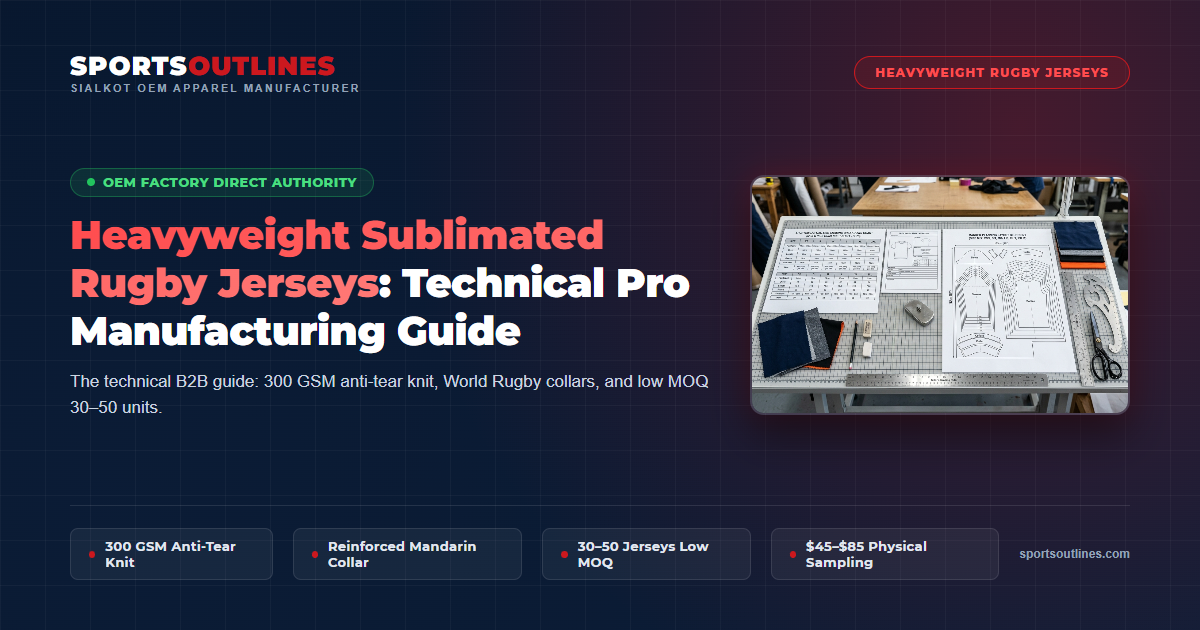
Manufacturing pro-grade custom sublimated rugby jerseys for Rugby Union and Rugby League requires heavy-density textiles engineered to survive extreme dynamic pulling forces in scrums, rucks, and mauls without tearing. Match-grade rugby jerseys utilize 280–320 GSM high-tensile interlock or double-knit polyester (100% polyester or 94% polyester / 6% spandex blend) delivering over 420 Newtons of tensile seam resistance and anti-grab slick face finishing. Critical construction specs include an anti-tear low-profile ergonomic mandarin collar or stretch loop neck (eliminating buttons or exposed metal hardware that could cause facial lacerations during contact), reinforced raglan shoulder yokes double-stitched with Tex-60 bonded core threads, heavy bar-tacked armhole junctions, and an optional interior silicone hem gripper band that anchors the jersey flush against rugby shorts. Factory direct low MOQ in Sialkot, Pakistan starts at 30 to 50 jerseys per style/colorway with mixed sizing from Youth M to Adult 5XL. Pre-production physical prototype samples cost $45 to $85 per custom piece completed in 7 to 10 business days.
- Textile Blend & Weight: 290–310 GSM Heavyweight Poly-Interlock or Ripstop Pique with high-burst tensile modulus.
- Collar Architecture: Ergonomic low-profile Mandarin stand collar, loop placket, or crossover stretch neck.
- Seam Engineering: 5-thread heavy safety overlock + twin-needle coverseam with reinforced 42-stitch bar-tack clusters.
- Anti-Grab Fit Options: Semi-Fitted Club Cut (traditional fit) and Pro Compression Cut (skin-tight anti-tackle fit).
- Printing Technology: High-definition full-dye sublimation using genuine Italian Kiian disperse dyes certified OEKO-TEX Standard 100.
- Factory Direct Low MOQ: 30–50 pieces per style/colorway across adult and youth size distributions.
- Physical Prototype Sampling: $45–$85 per custom jersey in 7–10 days (strict zero credit/refund policy).
- Direct Factory Sourcing: WhatsApp factory direct at +92 316 7932595 or sportsoutlines.com.
In international team sports, few garments endure more continuous, violent abuse than a rugby jersey. Across 80 brutal minutes of Rugby Union and Rugby League play, jerseys are grabbed by full-grown forwards in 900-kilogram scrum engagements, wrenched violently during breakdown rucks, and subjected to high-speed collar-tackles in open field play.
In the amateur era, rugby teams wore traditional heavy cotton jerseys that absorbed rainwater and sweat like sponges, adding up to 3 kilograms of water weight during muddy matches while stretching out into loose bags that opposing tacklers easily grabbed. Modern professional rugby engineering has revolutionized this space through heavyweight sublimated synthetic knits (280–320 GSM) that combine immense tensile tear resistance with zero water retention, permanent sublimation graphics, and anatomical anti-grab silhouettes.
At Sports Outlines in Sialkot, Pakistan, our rugby manufacturing division produces pro-spec match kits and training apparel for senior clubs, collegiate rugby unions, and independent teamwear distributors across the United Kingdom, Australia & New Zealand, USA, and Canada. This technical B2B manufacturing guide breaks down rugby textile physics, high-tensile collar engineering, scrum seam reinforcement, sublimation dye science, size grading, wholesale economics, and factory-direct low MOQ sourcing.
1. Mechanical Demands of the Rugby Breakdown: Scrums, Rucks & Mauls
A rugby jersey must operate as dynamic armor. Unlike American football where hard plastic pads absorb direct fabric friction, a rugby jersey rests directly against the player’s skin or over a lightweight 5mm EVA shoulder base layer. The garment must withstand four distinct physical stress mechanisms:
- Scrum Binding Forces: Front-row props and hookers bind directly onto the opponent’s jersey flank and collar. In a contested scrum pack generating over 8,000 Newtons of collective force, a loose or weak jersey will rip right down the side seam. The fabric must possess high surface slickness and immense stitch tensile strength.
- High-Speed Tackling Tensile Shock: When a ball carrier is tackled from behind by the collar or upper back, dynamic shock loads of 350 to 450 Newtons are concentrated onto a tiny 2-inch patch of fabric within 100 milliseconds. Weak collar seams unravel instantaneously.
- Ruck Ground Abrasion: Players diving onto frozen winter turf or rough grass endure extreme friction. Standard lightweight soccer knits (140 GSM) will burn, pill, and tear on contact with ground debris. Rugby requires high-density 280+ GSM double-knits.
- Hydrophobic Moisture Management: Played predominantly through cold, wet winter months in the UK, Europe, and Southern Hemisphere, cotton and cheap blended jerseys soak up mud and water, turning freezing cold and severely fatiguing players. Sublimated polyester sheds liquid mud while keeping internal core heat balanced.
2. Textile Science: 280–320 GSM High-Tensile Polyester Knits
At Sports Outlines, our textile research laboratory in Sialkot has developed two proprietary rugby knit architectures specifically engineered to dominate international contact standards:
A. 300 GSM Heavyweight Poly-Interlock (The Pro Forward Spec)
Knit from 75-denier high-tenacity filament polyester on high-gauge 28-cut double-knit circular machines. Both sides of the fabric present an ultra-dense, ultra-smooth face with zero open pores. The high areal density (300 GSM ± 5%) provides exceptional mechanical bursting strength (over 320 PSI per ASTM D3786). It is the premier choice for tight-five forwards, props, and locks who require maximum structural rigidity.
B. 280 GSM Poly-Spandex 4-Way Stretch (The Pro Backs Spec)
Engineered for fly-halves, centers, wingers, and fullbacks who prioritize lightning acceleration, evasive agility, and skin-tight fit. Blended from 94% High-Tenacity Polyester and 6% Spandex Elastane, this fabric provides 110% horizontal stretch with instantaneous snap-back recovery. The jersey clings tightly to the athlete’s torso like a second skin, eliminating even a centimeter of slack fabric for defenders to grip.
3. Collar Architectures: Safety, Choke-Resistance & Scrum Legality
In World Rugby Regulation 12, player equipment safety is strictly governed. Hard buttons, exposed metal snaps, and rigid zipper sliders are strictly prohibited on match jerseys to prevent facial lacerations, broken teeth, and eye injuries during scrum binding. Sports Outlines engineers three World Rugby compliant collar profiles:
A. The Modern Ergonomic Mandarin Stand Collar
The global benchmark of professional rugby (seen across Super Rugby, Gallagher Premiership, and Six Nations). A low-profile 1.25-inch stand collar engineered with an internal woven twill tape reinforcement band. The front throat area terminates in a reinforced V-notch with an elasticized stretch-insert. It shields the back of the neck against grass burn while sitting flush against the clavicle so opponents cannot hook their fingers inside.
B. The Traditional Loop / Placket Collar (Heritage Rugby Look)
Favored by classic university clubs and heritage rugby programs. Features a reinforced woven poly-twill turn-down collar with a concealed 2-button placket. To comply with safety regulations, we use shatter-proof soft rubber buttons double-anchored with cross-stitch bar-tacks and concealed behind a dual-layer fabric storm flap.
C. The Crossover Stretch Crewneck (Rugby League & 7s Spec)
The preferred silhouette for Rugby League (NRL, Super League) and fast-paced Rugby Sevens. Constructed from a 2-inch heavy rib-knit spandex band that overlaps cleanly at the throat. Offers zero grabbing points, complete throat freedom, and stretches easily when pulled on or off over tape and headgear.
4. Industrial Seam Engineering: 5-Thread Safety & Multi-Bartack Reinforcement
A rugby jersey is only as strong as its weakest seam. During a scrum collapse or collar tackle, shear forces act directly across panel joinings. Standard apparel factories using 3-thread overlock stitching will produce jerseys that burst open in their first game.

Sports Outlines enforces a multi-tier reinforcement protocol across every rugby seam:
- 5-Thread Heavy Safety Overlock (ISO 514): Combines a 3-thread overedge wrap with an independent 2-thread double-locked chainstitch running 4mm inside the edge, using heavy Tex-60 polyester core thread.
- Double-Needle Flat Coverseaming: All overlocked seams are flattened and secured with 1/4-inch twin-needle coverstitching. This lays the seam completely flat against the skin, preventing friction chafing under the armpits and across the collarbones.
- 42-Stitch Structural Bar-Tacks: Heavy automated bar-tack clusters are driven into eight high-stress junction points: collar V-notches, underarm cross-intersections, side seam split hem vents, and sleeve cuff edges.
- Internal Woven Twill Taping: The shoulder seams and collar back are reinforced with an internal 15mm heavy woven polyester herringbone twill tape that prevents the neck opening from stretching out of shape under repetitive pulling.
5. High-Definition Dye Sublimation & GPS Tracker Pockets
Modern rugby clubs demand unlimited multi-sponsor logos across the chest, sleeves, back, and collar. Digital dye sublimation gasifies disperse inks into the polyester yarn matrix at 205°C under high roller pressure. Sublimation guarantees that logos will never peel, crack, or abrade away during ruck contact.
Furthermore, for elite clubs and professional academies utilizing GPS performance monitoring systems (such as Catapult, STATSports, or GPSports), Sports Outlines integrates an internal GPS tracker pouch between the shoulder blades:
- Anatomical Positioning: Pouch is centered directly between the T2 and T4 vertebrae on the inner back yoke.
- Impact Foam Lining: Pouch is lined with 3mm soft neoprene or brushed tricot to cushion the GPS pod against the player’s spine during heavy tackles.
- Elastic Security Flap: Enclosed elastic fold-over flap prevents the tracker unit from dislodging during high-velocity collisions while permitting fast insertion and removal by team strength and conditioning staff.
6. Complete Size Grading & Cut Specifications (Club vs. Pro Fit)
Rugby rosters span an enormous spectrum of body morphologies—from 75-kilogram agile wingers to 125-kilogram powerful front-row props. Sports Outlines provides two distinct pattern grading systems:
7. Quality Assurance Protocols for Collision Contact Wear
At Sports Outlines, every custom rugby jersey is validated through our four-stage collision contact quality assurance framework before dispatch:
- Tensile Grab & Seam Rupture Testing (ISO 13935-2): Test swatches from joined collar and shoulder seams must sustain over 420 Newtons of tensile pulling load before structural yield.
- Martindale Heavy Abrasion Resistance (ASTM D4966): Fabric lots endure 25,000 continuous abrasion friction cycles to verify zero piling or fiber thinning under simulated scrum friction.
- Sublimation Colorfastness & Mud Wash Testing (ISO 105-C06): Printed panels undergo intensive commercial wash testing with mud and synthetic sweat solutions at 60°C, verifying zero dye leaching or staining.
- AQL 2.5 Audit & 9-Zone Needle Detection: 100% of finished jerseys pass through digital metal detection systems to guarantee zero broken needle fragments remain embedded in the garment.
8. B2B Wholesale Unit Economics & Distributor Profit Margins
In international retail teamwear markets (UK, Australia, New Zealand, and North America), branded sublimated rugby match jerseys (such as Canterbury, Gilbert, or KooGa) retail between £55.00–£75.00 ($70.00–$95.00 USD) each. Sourcing direct from our Sialkot factory unlocks exceptional profit margins:
9. Women’s Rugby Fit Engineering: Anatomical Contouring & Modesty Bust Darts
With women’s rugby growing at unprecedented rates globally (driven by the Women’s Rugby World Cup and Olympic Sevens), outfitting female athletes in scaled-down men’s boxy jerseys is unacceptable for pro-tier brands. Sports Outlines engineers dedicated female rugby patterns:
- Curved Thoracic & Bust Shaping: Tailored side-panel darts provide comfortable contouring around sports bras and breast tissue without pulling the collar forward during contact.
- Modesty Necklines: Mandarin collars feature a narrower, higher throat opening that eliminates cleavage exposure while maintaining full choke-resistance and head-turn agility.
- Slightly Flared Hip Sweep: The bottom hem pattern widens by 2 to 3 inches at the hips to accommodate female pelvic width, preventing the jersey from riding up during scrums or tackles.
10. Pro Detailing: 3D Silicone Crests & Interior Anti-Slip Gripper Bands
For professional clubs and boutique teamwear brands, premium finishes justify higher retail prices and elevate player confidence:
- 3D Raised Silicone Emblems: Direct embroidery on heavyweight rugby jerseys can cause interior friction against the chest. We apply flexible, 0.8mm high-density silicone team crests with fine micro-textures that withstand commercial muddy washes without cracking or peeling.
- Wave-Pattern Interior Silicone Hem Grippers: A 25mm elastic tape lined with a tacky silicone wave pattern is sewn into the lower inside hem. This silicone layer grips the rugby shorts, locking the jersey down so opposing tacklers cannot pull it up over the ball carrier’s head.
- Heat-Transferred Match Detail Badges: Commemorative tournament dates, fixture scripts (e.g., “Cup Final 2026”), and player cap numbers can be heat-bonded cleanly to the lower sleeve or upper chest.
11. Sourcing Sialkot: Factory Low MOQ 30–50 Units, Sampling & Logistics
Sports Outlines provides agile, transparent production terms tailored for independent rugby labels and clubs:
- True Low MOQ (30–50 Jerseys): Launch custom rugby match kits with as few as 30 to 50 jerseys per design, with complete freedom to mix sizes from Youth to 5XL across your forward and back rosters.
- Rapid Physical Prototype Sampling: We construct physical prototype samples for $45 to $85 per piece, dispatched via express air courier in 7 to 10 business days. (Note: Sports Outlines maintains a strict zero credit/refund policy on sample fees; this covers dedicated pattern drafting, custom sublimation calibration, and machine setup).
- Bulk Turnaround & Express Air Freight: Full team orders ship within 18 to 24 business days following sample approval. We provide door-to-door Delivered Duty Paid (DDP) air freight reaching the UK, Australia, New Zealand, USA, and Canada in 4 to 6 business days with zero customs delays.
Ready to Manufacture Custom Heavyweight Sublimated Rugby Jerseys?
Connect directly with our collision-sports pattern engineering team in Sialkot, Pakistan. Receive customized CAD mockups, exact textile swatches, and factory-direct pricing within 24 hours.
Frequently Asked Questions (B2B Rugby Jersey Sourcing)
Why are 280–320 GSM fabrics required for competitive rugby jerseys?
Heavyweight 280–320 GSM polyester interlocks provide over 420 Newtons of tensile resistance necessary to survive scrum binds and violent ruck pulling without ripping, while remaining lightweight and hydrophobic in wet weather.
Are your rugby jersey collars compliant with World Rugby Regulation 12?
Yes. All our collars feature either ergonomic low-profile mandarin necks, stretch loop plackets, or concealed soft rubber buttons with zero exposed metal or sharp plastic hardware, ensuring full World Rugby safety compliance.
What is the factory direct low MOQ for custom rugby jerseys?
Our factory direct low MOQ is 30 to 50 jerseys per style/colorway, with complete flexibility to mix adult and youth sizes across your order roster.
How much does a pre-production physical prototype sample cost?
Pre-production prototype samples cost $45 to $85 per piece, completed and dispatched in 7 to 10 business days via express air courier. We maintain a firm zero credit/refund policy on sample fees.
Can you manufacture rugby jerseys with internal GPS tracker pockets?
Yes. We integrate padded neoprene-lined GPS tracker pockets directly between the shoulder blades, featuring an elastic closure flap compatible with Catapult, STATSports, and GPSports units.
Explore Related Contact Teamwear & Athletic Manufacturing Guides:
- Custom Sublimated American Football Jerseys Manufacturing Guide
- Custom Integrated Football Pants: 7-Piece Pad Manufacturing Guide
- Custom 7v7 Flag Football Performance Uniforms Manufacturing Guide
- Sports Outlines Custom Teamwear Product Category
- Sourcing Custom Sportswear from Sialkot to the UK (B2B Low MOQ Guide)