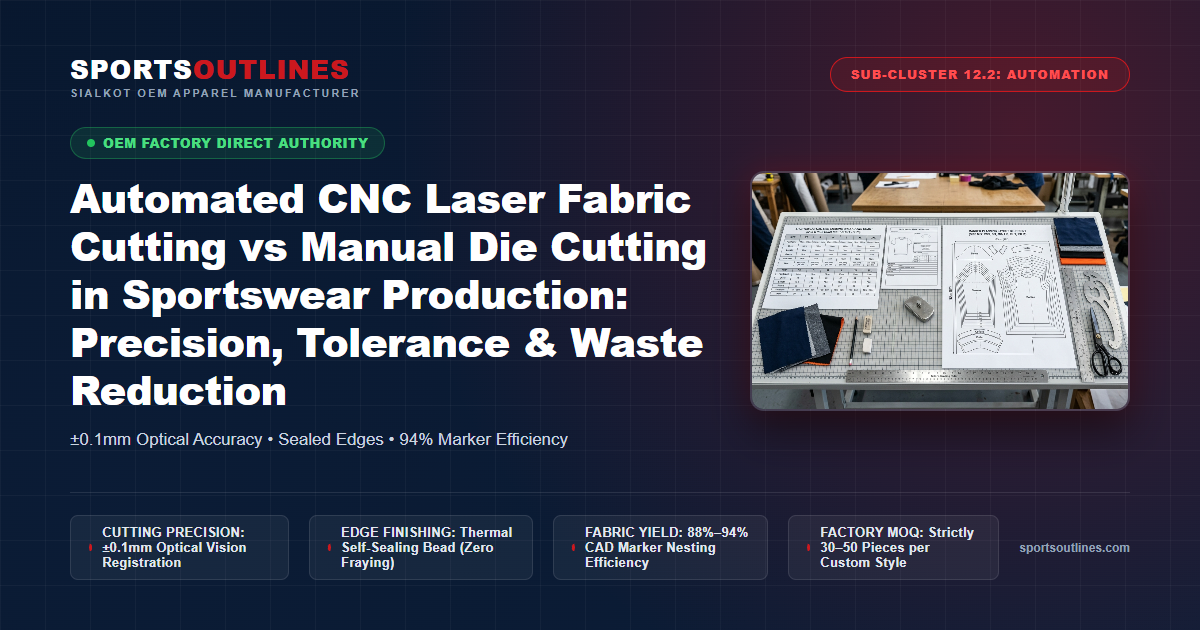
Direct Manufacturer Snapshot: Automated CNC Laser Fabric Cutting vs Manual Die Cutting in Sportswear Production: Precision, Tolerance & Waste Reduction
Sports Outlines operates automated CNC CO2 laser fabric cutting tables for custom sportswear manufacturing in Sialkot, Pakistan. We deliver ±0.1mm dimensional cutting precision, thermally sealed anti-fray edges for raw-cut hems, optical vision camera print-and-cut alignment for sublimated teamwear, and intricate micro-ventilation laser perforations. With zero steel die tooling costs, bulk production begins at strictly 30 to 50 pieces per style with physical master prototypes in 7 to 10 days for a $45 to $85 fee and 0% duty-free EU/UK GSP+ delivery.
Direct WhatsApp: +92 316 7932595
In the ultra-competitive landscape of high-performance sportswear manufacturing, the foundation of every finished garment is decided on the cutting table. No matter how advanced your 4-way stretch compression knits or high-recovery elastane blends are, if the raw fabric panels are cut with dimensional inaccuracies, asymmetrical seam curvatures, or frayed edges, the resulting garment will twist around the athlete’s body, pucker along the seams, and fail prematurely in the field. For decades, conventional overseas factories have relied on manual round-knife cutting or hydraulic steel die-cutting. Hand-held cutting knives drift under operator fatigue, creating sizing discrepancies of up to 10 millimeters between the top and bottom layers of a fabric stack; mechanical blades drag against stretchy Lycra, distorting panel geometry; and forging rigid steel clicker dies costs thousands of dollars, locking emerging brands out of customized ergonomic paneling.
At Sports Outlines, based in the global sporting goods hub of Sialkot, Pakistan, we have replaced obsolete mechanical cutting with Automated Computer Numerical Control (CNC) Laser Fabric Cutting. Powered by multi-head sealed CO2 laser tubes, vacuum-assisted conveyorized cutting tables, and automated optical vision-system recognition, our digital cutting cells achieve microscopic ±0.1mm dimensional precision. The thermal laser beam vaporizes the cut line while instantaneously melting and self-sealing synthetic fiber edges, permanently preventing yarn fraying on raw-cut hems, bonded seams, and intricate ventilation micro-perforations. Backed by our strict 30 to 50 piece low factory minimum order quantity (MOQ), rapid 7 to 10 business day physical prototype dispatch ($45 to $85 non-creditable fee), and 0% duty-free EU/UK GSP+ delivery, our automated manufacturing facility delivers aerospace-level cutting precision to independent sportswear brands worldwide.
Design & Manufacture Custom Automated CNC Laser Cutting & Pattern Nesting Direct from Sialkot
Low 30–50 Piece/Set MOQ • Dedicated Sampling in 7–10 Days • 0% Import Tariffs
✓ $45–$85 Physical Prototypes •
✓ Worldwide DDP Delivery
1. Microscopic Metrology: Laser Thermal Sealing vs. Mechanical Blade Distortion
Cutting technical synthetic textiles (polyester, polyamide/nylon, and elastane/spandex) presents severe tribological challenges that do not exist with rigid woven cotton. When a mechanical cutting blade—whether a reciprocating vertical knife or a rotary die—presses into a stack of 4-way stretch fabric, the blade pushes against the elastomeric yarns before cutting through them. This creates localized tension, stretching the top fabric layers relative to the bottom layers. Once the blade passes, the elastane snaps back, resulting in panels that are noticeably smaller or distorted compared to the master pattern.
Automated CNC laser cutting eliminates physical contact entirely:
- Zero Physical Contact & Zero Blade Drag: The laser beam cuts using pure thermal radiation focused through zinc-selenide optical lenses to a focal diameter of just 0.15mm. Because no physical tool contacts the fabric, there is zero drag, zero yarn pulling, and zero dimensional distortion, even on ultra-light 75 GSM woven ripstops or 280 GSM compression Lycra.
- Thermal Fiber Melting & Anti-Fray Self-Sealing: Traditional mechanical cutting crushes and shears synthetic yarns, leaving raw exposed filament ends that fray during sewing and wash cycles. As the laser cuts, the intense localized heat (exceeding 300°C) melts the synthetic thermoplastic fiber tips in microseconds. Upon cooling, the melted polymer forms a microscopic sealed bead that locks warp and weft yarns together, eliminating edge fraying permanently.
- Microscopic ±0.1mm Tolerance & Complex Geometries: Conventional mechanical knives struggle to cut tight inner radiuses, sharp scallop hems, or complex curved raglan shoulder yokes without tearing the fabric. CNC lasers execute intricate mathematical vectors with ±0.1mm precision, ensuring left and right garment panels match with 100% anatomical symmetry.
- Vacuum Bed Stabilization: Our laser tables incorporate high-velocity vacuum downdraft extraction that pulls the fabric completely flat against the honeycombed aluminum conveyor bed. This removes cutting fumes instantly and ensures the textile remains perfectly stationary during high-speed laser cutting head travel (up to 1,200 mm/s).
| Cutting Technology | Dimensional Tolerance | Edge Quality | Tooling / Die Cost | Minimum Production Viability |
|---|---|---|---|---|
| Sports Outlines CNC Laser Cutting | ±0.1 mm Micro-Precision | 100% Thermally Sealed, Zero Fraying | $0 (Digital Vector File Only) | Strictly 30 to 50 Pieces / Style |
| Manual Round-Knife / Band Saw | ±4.0 mm to ±8.0 mm Drift | Frayed Edges, Yarn Separation | Low (Chalk Markers & Paper) | 100+ Pieces (High Ply Stacks) |
| Hydraulic Steel Die-Cutting (Clicker) | ±0.8 mm (Blade Flexion) | Crushed Fibers, Unsealed Edges | $250 – $500 per Size ($1,500+ / Style) | 500+ Pieces per Style/Colorway |
| Print-on-Demand (POD) Plotters | ±3.0 mm (Blade Drag) | Ragged Edges, Fabric Bunching | Included in high unit fee | 1 Piece (Non-viable commercial unit margins) |
2. Optical Vision-System Print-and-Cut: Perfect Sublimation Registration
In all-over sublimated teamwear and graphic sportswear, the greatest manufacturing failure mode occurs during the cutting phase. During heat calender sublimation (where artwork is transferred at 210°C under 4.5 bar pressure), synthetic polyester and spandex fabrics naturally undergo thermal shrinkage or skewing along the grain line. When a conventional factory cuts these sublimated rolls using static mechanical templates, the artwork shifts off-center: club crests tilt at odd angles, sleeve stripes don’t align with body graphics, and player numbers sit crooked across the spine.
Sports Outlines resolves this completely through Smart Optical Vision Recognition Laser Systems:
High-Resolution Camera Scanning & Real-Time Distortion Compensation
As the sublimated fabric rolls unroll onto the automated conveyor bed, an overhead high-resolution industrial camera captures a continuous visual scan of the entire cutting area in milliseconds. The software detects printed registration fiducials and graphic contour borders. It measures real-world fabric shrinkage or angular skewing across every single cut panel, dynamically recalculating the digital vector cutting path in real time. The laser cuts around the printed graphics with 100% mathematical precision, ensuring chest graphics, side panel stripes, and sponsor placements remain centered and aligned across all sizes.
Automated Lectra / Gerber Marker Nesting (>90% Fabric Efficiency)
Expensive technical textiles—such as 4-way stretch Italian Carvico, Cordura® knits, and recycled nylon fabrics—constitute the single largest cost factor in sportswear production. Traditional manual pattern layout on paper markers wastes 22% to 28% of fabric in off-cuts. Our automated nesting software evaluates millions of pattern puzzle combinations to interlock garment pieces tightly, driving fabric yield efficiency to 88%–94%. This dramatic reduction in material scrap directly lowers unit manufacturing costs, passing substantial margin savings to our brand partners.
3. Laser-Cut Micro-Ventilation & Intricate Aerodynamic Texturing
Beyond cutting garment perimeter panels, CNC laser technology enables performance functional features that cannot be replicated through conventional stitching or die-cutting:
- Body-Mapped Micro-Perforations: We cut matrices of microscopic ventilation holes (1.0mm to 2.5mm diameter) directly into solid fabric panels across high-heat zones: along the spine, under the pectorals, and behind the knees. Because the laser heat-seals the hole perimeters, the perforations maintain structural integrity and never run or tear during high-stress athletic use.
- Raw-Cut Non-Fraying Hems: For cycling jerseys, running singlets, and high-compression leggings, folded stitched hems create bulky pressure points and wind drag. With laser cutting, we leave sleeve cuffs and leg openings completely raw-cut. The sealed edge lies 100% flush against the skin, eliminating chafing and creating an aerodynamic, second-skin profile.
- Intricate Laser Applique & Decorative Badging: We cut complex multi-layer fabric appliqués, twill numbers, and silicone transfer panels with razor-sharp corners and micro-details, feeding our automated embroidery and heat-press stations with flawless components.
4. Transparent Low MOQ Factory Tier Pricing: Laser-Cut Activewear
Standard mass-production factories require 500 to 1,000 unit minimum orders to justify automated cutting machine programming. At Sports Outlines, our fully integrated digital workflow allows us to support independent brands starting at just 30 to 50 pieces per style. Below is our transparent factory-direct FOB tier pricing structure:
| Production Volume Tier | Est. Unit FOB Cost | Sample Cost & SLA | Bulk Production SLA | Included Specifications | Recommended Buyer Profile |
|---|---|---|---|---|---|
| 30 – 50 Pieces (Laser Cutting Agile Capsule Tier) | $13.50 – $17.50 / precision laser-cut top | $16.50 – $21.50 / laser-perforated tight | $45 – $85 non-creditable prototype fee | 12 – 15 Business Days | Automated CNC CO2 laser cutting with 0.1mm dimensional tolerance, thermal self-sealing edges preventing polyester/spandex yarn fraying, custom micro-ventilation laser hole patterns, 30–50 piece low factory MOQ. | Startup activewear brands, technical running labels, boutique cycling apparel lines, and athletic designers requiring intricate ventilation or complex curved panel geometries. |
| 51 – 150 Pieces (Collection Growth & Multi-SKU Tier) | $11.20 – $14.80 / precision laser-cut top | $13.80 – $17.90 / laser-perforated tight | $45 – $85 non-creditable prototype fee | 14 – 18 Business Days | Automated Lectra/Gerber computer-aided marker nesting achieving >88% fabric yield efficiency, optical vision-system print-and-cut matching for sublimated panels, custom Pantone lab-dip dye matching. | Established boutique fitness brands, regional teamwear companies, collegiate athletic programs, and commercial sportswear labels expanding technical collections. |
| 151 – 500 Pieces (Multi-Sport Commercial Scaling Tier) | $8.90 – $11.90 / precision laser-cut top | $11.20 – $14.50 / laser-perforated tight | $45 – $85 non-creditable prototype fee | 18 – 22 Business Days | Dedicated high-speed dual-head conveyorized CNC laser cutting line allocation, ultrasonic welded pocket insertion integration, complete in-house AQL 2.5 edge-integrity and tensile inspection reports, express DDP shipping. | Fast-growing activewear brands, national athletic franchises, commercial running and cycling apparel distributors, and multi-gym retail operations. |
| 500+ Pieces (Enterprise Automated Factory Wholesale Tier) | $6.90 – $9.20 / precision laser-cut top | $8.80 – $11.50 / laser-perforated tight | $45 – $85 non-creditable prototype fee | 22 – 28 Business Days | Fully automated multi-ply digital laser cutting, continuous conveyor roll feeding with tension-free fabric relaxation, barcode-scanned bundle tracking, ocean-recycled polybag packaging, and dedicated supply chain engineering management. | Global sportswear corporations, international sporting goods chains, multi-national outdoor apparel brands, and high-volume private label conglomerates. |
5. Competitive Benchmark: Sports Outlines vs. Sourcing Alternatives
Evaluating a cutting and manufacturing partner requires analyzing dimensional accuracy, edge fraying prevention, vision-system alignment, and low MOQ accessibility:
| Sourcing Feature & Risk Factor | Sports Outlines (Sialkot Direct) | Alibaba Trading Agents | Traditional Chinese Hubs | Print-on-Demand (POD) |
|---|---|---|---|---|
| Cutting Dimensional Tolerance & Repeatability | Computerized CNC CO2 laser cutters deliver ±0.1mm microscopic cutting accuracy across complex curves, scalloped hems, and multi-panel activewear; eliminates manual operator drift and guarantees 100% identical panel sizing across all production bundles. | Manual round-knife or band-saw cutting on stacked fabric; layers slip and shift, resulting in ±5mm to ±10mm sizing variations between top and bottom plies in the same bundle. | Manual steel die-cutting on hydraulic press; expensive steel die tooling ($200–$500 per size) required for every single curve, locking small orders out of custom designs. | Crude manual shears or cheap entry-level plotters with blade drag that distort stretchy Lycra and elastane fabrics during cutting. |
| Edge Sealing & Yarn Fraying Prevention | Calibrated thermal laser beam instantly melts and bonds synthetic thermoplastic fibers (polyester, nylon, elastane) along the cut margin, creating a microscopically sealed, non-fraying edge ideal for bonded, ultrasonic, or raw-cut hem construction. | Mechanical blade cutting leaves loose yarn filaments that unravel and fray during sewing and commercial wash cycles, requiring bulky folded hem stitching. | Cold mechanical die blades crush and shear fibers without sealing, leading to edge fraying on micro-mesh and stretch-knit fabrics. | Non-sealed frayed edges hidden beneath thick, itchy overlock seams that unravel after three laundry cycles. |
| Vision-System Print-and-Cut Sublimation Alignment | High-resolution optical camera recognition scans printed registration fiducials on sublimated fabric rolls in real time, automatically compensating for natural textile stretch or shrinkage to cut panels with flawless graphic centering. | Manual hand-alignment of printed patterns; printed designs end up crooked, off-center, or clipped along seam margins. | Manual die placement over printed panels; alignment error exceeds 4mm to 8mm, causing noticeable visual asymmetry in custom jerseys. | Direct-to-garment digital printing onto pre-made blanks; graphics distort across pre-existing seams and armholes. |
| Minimum Order Quantity (MOQ) | Strictly 30 to 50 pieces per style with mixed sizing; CNC digital software files eliminate physical steel die tooling costs entirely, making custom laser-cut paneling accessible to independent brands without large upfront capital. | Requires 100-200 units per size to offset manual marker making, or charges exorbitant cutting surcharges. | Demands 300 to 500 units per style because forging physical steel clicker dies for 6 sizes costs thousands of dollars. | 1 piece minimum, but limited to standard rectangular cuts with zero intricate paneling, zero body-mapped ventilation, and high per-unit costs. |
| Fabric Yield Efficiency & Material Sustainability | Automated computerized nesting algorithms (Lectra / Gerber) optimize pattern piece orientation on the digital marker, achieving 88% to 94% fabric utilization and reducing costly spandex scrap waste by up to 22%. | Manual pattern tracing on paper chalk markers; achieves only 70% to 76% yield, with massive textile waste charged directly to the buyer. | Standard manual nesting with wide 20mm margins between steel dies, wasting expensive technical nylon-spandex yardage. | Inefficient single-garment layout on standard yardage, resulting in severe material waste baked into high unit pricing. |
6. Step-by-Step B2B Laser-Cut Production Protocol
From 2D digital vector ingestion to final automated export packing, our standardized manufacturing protocol guarantees precision execution and zero pattern distortion:
- Digital Vector CAD Ingestion & Nesting (Hours 1–24): We import your tech pack pattern files (DXF/AAMA/AI) into our computerized nesting software, calculating optimal fabric orientation for maximum yield efficiency.
- Laser Power & Frequency Calibration (Day 2): Our technicians calibrate laser wattage, pulse frequency, and travel speed based on your specific fabric GSM and fiber blend to achieve clean cuts without yellowing or edge stiffness.
- Pre-Production Physical Prototype Dispatch (Days 3–7): For a $45 to $85 non-creditable engineering fee, we laser-cut, assemble, and express-dispatch a physical master prototype via DHL/FedEx to your door for physical fit and edge verification.
- Automated Tension-Free Roll Spreading (Days 8–10): Fabric rolls are spread onto the conveyor cutting bed using automated tension-free feeders that allow technical knits to relax for 24 hours, eliminating internal fabric shrinkage during cutting.
- High-Speed Vision-Guided Laser Cutting (Days 10–14): Overhead cameras scan the fabric and guide dual-head CO2 laser cutters along vector paths at speeds up to 1,200 mm/s, sealing edges and cutting micro-ventilation holes simultaneously.
- Direct-to-Assembly Sewing Cell Routing (Days 14–18): Cut panels are bundled by size and routed directly to our Yamato flatlock and Juki sewing cells, where sealed edges allow rapid assembly with zero yarn fraying.
- AQL 2.5 Multi-Stage Quality Audit & Export Dispatch (Days 18–22): Finished garments undergo 100% inspection for dimensional accuracy (±0.5mm), seam burst strength, and edge seal permanence before express international shipping.
Get a Factory Direct Quote for Automated CNC Laser Cutting & Pattern Nesting
Chat with our Sialkot Engineering Team via WhatsApp • Instant DDP Air Freight Quotes
✓ $45–$85 Physical Prototypes •
✓ Worldwide DDP Delivery
7. Technical Quality Assurance Protocols & Laboratory Laser Standards
Every production run executed through our automated laser cutting cells must pass strict physical metrology tests in our Sialkot QA laboratory:
- Edge Melt Micro-Hardness (ASTM D2240): The thermally melted edge bead must not exceed Shore A 55 durometer, guaranteeing that sealed margins remain soft, flexible, and comfortable against sensitive skin without hard, scratchy ridges.
- Fray Resistance Under Wash Stress (AATCC 135): Raw-cut and laser-perforated fabric samples undergo 30 consecutive commercial wash and tumble dry cycles with zero edge unraveling, yarn slippage, or hole deformation.
- Dimensional Precision Verification: Using optical digital calipers, cut panels are measured against CAD master specifications. Maximum allowable variance across 100 panels is certified under ±0.5mm.
- Tensile Burst Across Laser-Cut Perforations (ASTM D3786): Fabric panels featuring laser micro-ventilation holes must maintain over 82% of the original unperforated fabric burst strength (>260 kPa), ensuring garments will not tear during high-intensity training.
Explore Related Technical Manufacturing Solutions & Factory Guides:
- Country Silo Link: Custom Sportswear & Automated Manufacturing Partner for UK & European Brands
- Product Category Link: Custom Cut & Sew Activewear & Laser Cutting Sialkot Factory
- Previous Authority Guide: CLO 3D & Browzwear Virtual Prototyping for Sportswear Brands
Frequently Asked Sourcing & Manufacturing Questions (Buyer FAQ)
What is automated CNC laser fabric cutting, and how does it benefit custom sportswear manufacturing?
Automated CNC (Computer Numerical Control) laser cutting utilizes focused CO2 laser beams directed by high-precision digital servo motors to cut technical fabrics directly from CAD pattern files. In sportswear manufacturing, it eliminates physical blade drag, delivers microscopic ±0.1mm dimensional accuracy, and enables complex geometrical curves and ventilation micro-holes that are physically impossible to achieve with manual cutting knives or steel clicker dies.
How does laser cutting seal fabric edges and prevent yarn fraying?
Technical sportswear fabrics are composed primarily of synthetic thermoplastic fibers such as polyester, nylon, and elastane. As the high-temperature laser beam cuts through the textile, it vaporizes the cut line while instantly melting the surrounding synthetic fiber tips. Upon microscopic cooling, these melted tips fuse together into a smooth, flexible bead. This thermal edge seal prevents warp and weft yarns from fraying or unraveling, enabling clean raw-cut hems, bonded seams, and delicate open-hole mesh ventilation without requiring bulky folded hem stitching.
What is an optical vision-system print-and-cut process for sublimated sportswear?
When technical fabrics are subjected to 210°C heat calender sublimation, synthetic textiles naturally expand or shrink slightly along the warp and weft. If an operator cuts sublimated panels using traditional static templates, the graphics will be misaligned. Our automated laser cutting tables are equipped with high-resolution overhead optical camera vision systems. The camera scans printed registration fiducials on the fabric in milliseconds, calculates real-world shrinkage or skew, and dynamically recalculates the laser vector path to cut each panel with 100% graphic centering and flawless edge alignment.
What is the minimum order quantity (MOQ) for custom laser-cut sportswear?
Our standard minimum order quantity is strictly 30 to 50 pieces per style. Traditional factories require massive orders because creating physical steel clicker dies for 5 to 7 sizes costs thousands of dollars. Because our CNC laser cutters read digital vector files directly from CAD software, there are zero physical tooling or die-making costs, allowing emerging brands and private clubs to access precision laser cutting at low factory minimums.
What is your physical sampling turnaround time and prototype fee structure?
We engineer, laser-cut, sew, and express-dispatch fully customized pre-production master prototypes within 7 to 10 business days. We charge a reasonable $45 to $85 non-creditable engineering fee per custom prototype to cover digital CAD marker nesting, laser machine calibration, fabric cutting, and international courier dispatch via DHL or FedEx. This allows brand founders to verify seam alignment, laser perforation aesthetics, and compression fit prior to full production.
Can your lasers cut body-mapped ventilation micro-perforations into activewear?
Yes. Our CNC laser systems can cut intricate matrices of micro-perforations (ranging from 0.8mm to 2.5mm in diameter) across targeted high-heat body zones—such as the thoracic spine, underarms, chest, and posterior knee. The laser melts the perimeter of every micro-hole, ensuring they never fray, stretch out of shape, or tear during intensive athletic training and repetitive commercial washing.
How does digital marker nesting reduce fabric waste and cut manufacturing costs?
Raw technical textiles—especially 4-way stretch Italian Carvico, Cordura® knits, and heavyweight compression spandex—represent the largest component of total garment cost. Traditional manual pattern layout on cutting tables typically achieves 72% to 78% fabric efficiency, with 25%+ of expensive fabric ending up as floor scrap. Our automated Lectra and Gerber digital nesting software tests millions of mathematical pattern puzzle orientations in seconds, achieving 88% to 94% fabric utilization. This efficiency reduces raw material consumption, lowering FOB garment costs for our brand partners.
Can CNC laser cutters handle multi-layer fabric cutting or only single plies?
For ultra-precision activewear and sublimated apparel, we utilize continuous conveyorized single-ply laser tables with automated tension-free roll feeding to ensure zero fabric distortion. For high-volume production of solid-color base layers or uniform linings, we operate specialized multi-ply CNC knife and laser cutting stations that cut up to 30 plies simultaneously with vacuum table hold-down, maintaining dimensional tolerance within ±0.3mm from top to bottom ply.
How does Sports Outlines handle mid-season replacement apparel using digital cutting files?
Because every garment’s cutting geometry is archived as a digital CAD vector file, re-orders require zero setup time. If a team requires 1 to 5 replacement jerseys mid-season, our technicians simply load the archived cut file into the CNC laser cutter and produce identical replacement panels in 10 to 12 business days at your original contract bulk FOB rate.
What international shipping timelines and tariff rates apply for custom laser-cut activewear?
For European Union and United Kingdom clients, Pakistan benefits from GSP+ (Generalized System of Preferences Plus) trade status, which allows qualified manufactured sportswear exports to enter the EU and UK at 0% basic customs tariff duty. For US, Canadian, and Australian clients, shipments are processed under standard MFN rules with complete DDP (Delivered Duty Paid) air express logistics via DHL, FedEx, and UPS, arriving at your doorstep in 4 to 6 business days.