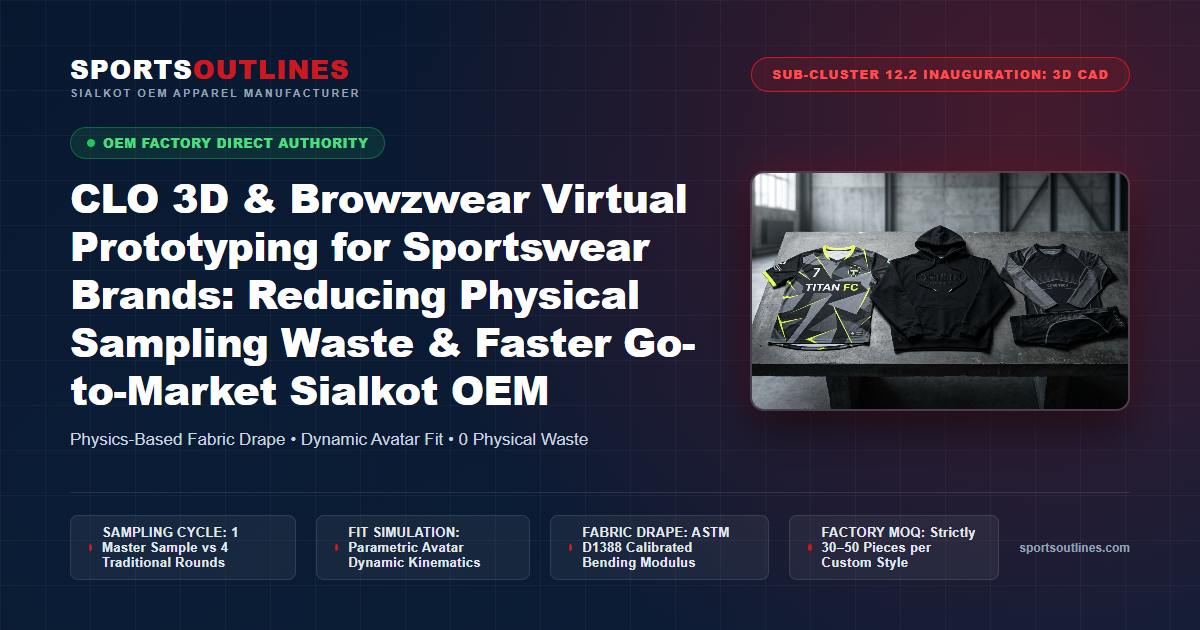
Direct Manufacturer Snapshot: CLO 3D & Browzwear Virtual Prototyping for Sportswear Brands: Reducing Physical Sampling Waste & Faster Go-to-Market Sialkot OEM
Sports Outlines provides certified CLO 3D and Browzwear V-Stitcher virtual prototyping for custom sportswear and activewear brands direct from Sialkot, Pakistan. We eliminate 3 to 4 rounds of physical sampling waste through physics-based fabric drape modeling, dynamic motion-capture fit testing, and color-coded tension heat-maps. Following digital approval, single physical master prototypes dispatch in 7 to 10 days for a $45 to $85 fee, with bulk production starting at strictly 30 to 50 pieces per style and 0% duty-free EU/UK GSP+ delivery.
Direct WhatsApp: +92 316 7932595
For decades, the traditional sportswear product development lifecycle has been defined by agonizing friction, financial waste, and months of lost market momentum. Sourcing an activewear collection through conventional overseas manufacturers typically requires three to five successive rounds of physical sample iteration: an overseas factory cuts sample yardage, sews a physical prototype, ships it via international air courier, and waits two weeks for the brand founder to try it on. Inevitably, the collar is cut too wide, the waistband rolls during squats, or the sublimated artwork scale looks disproportionate. The brand marks up corrections, the factory re-cuts, and the cycle repeats. By the time a garment is finally approved for production, twelve to sixteen weeks have vanished, thousands of dollars have been incinerated on sample shipping fees, and heaps of discarded fabric prototypes end up in textile landfills.
At Sports Outlines, located in the sports manufacturing capital of Sialkot, Pakistan, we have completely transformed this obsolete workflow by pioneering CLO 3D and Browzwear V-Stitcher Virtual Prototyping. By integrating digital pattern engineering, physics-based fabric drape modeling, and parametric 3D avatar fit simulations directly into our cut-and-sew manufacturing pipeline, we eliminate physical sampling guesswork entirely. Emerging athletic brands, boutique fitness creators, and independent labels can now visualize, fit-test, stress-analyze, and finalize their activewear collections digitally in days rather than months. Backed by our strict 30 to 50 piece low factory minimum order quantity (MOQ), rapid 7 to 10 business day single physical master prototype dispatch ($45 to $85 non-creditable fee), and 0% duty-free EU/UK GSP+ market entry, we provide a modern, agile manufacturing engine for the next generation of performance apparel brands.
Design & Manufacture Custom 3D Virtual Apparel Prototyping (CLO 3D & Browzwear) Direct from Sialkot
Low 30–50 Piece/Set MOQ • Dedicated Sampling in 7–10 Days • 0% Import Tariffs
✓ $45–$85 Physical Prototypes •
✓ Worldwide DDP Delivery
1. The Digital Prototyping Revolution: How CLO 3D & Browzwear Eliminate Physical Waste
Virtual prototyping is not a superficial 3D graphic illustration or a simple digital mock-up created in Photoshop. In our engineering facility, 3D garments are constructed directly from true 2D CAD production patterns—the exact vector geometry that will later guide automated CNC laser cutting tables. In our certified CLO 3D and Browzwear engineering suites, digital patterns are stitched together in a 3D virtual space and draped over an anatomical parametric avatar calibrated to your target customer’s exact body measurements.
This technology delivers four revolutionary advantages to independent activewear brands:
- Physics-Based Fabric Drape Modeling: We do not rely on generic software presets. In our Sialkot textile testing lab, we test real fabric specimens for weight (GSM), warp and weft elongation, shear modulus, and bending stiffness (using ASTM D1388 cantilever bending protocols). These precise physical values are input into the 3D physics engine, ensuring the digital garment behaves, drapes, wrinkles, and folds with 98%+ fidelity to the real textile.
- Color-Coded Tension & Pressure Heat-Maps: The software visualizes microscopic mechanical forces acting on the athlete’s body. A green zone indicates comfortable relaxed fit; yellow represents calibrated athletic compression; and bright red flags severe garment constriction, excessive seam tension, or pinching around the armpits or groin. Designers can adjust pattern curves on-screen and instantly see pressure dissipate.
- Elimination of 3 to 4 Physical Sampling Rounds: Instead of waiting weeks and spending $600+ on repeated courier packages, brands review high-resolution digital simulations, request modifications (e.g., lowering a neckline by 1.5cm or widening a waistband by 2cm), and approve revisions in real time. We only cut physical fabric once: for the final master prototype that confirms bulk production approval.
- Zero Textile Waste & Sustainable Production: Conventional physical sampling generates hundreds of kilograms of discarded sample scrap annually. Virtual prototyping reduces fabric waste by over 75%, aligning your brand with modern circular manufacturing and ESG sustainability standards.
| Development Parameter | Traditional Physical Sampling (Alibaba / China) | Sports Outlines CLO 3D Virtual Pipeline | Commercial Advantage |
|---|---|---|---|
| Sampling Iteration Rounds | 3 to 5 Physical Sample Shipments | Unlimited 3D Digital + 1 Final Physical Master | Eliminates 75% of physical prototype freight and tooling fees. |
| Time to Bulk Production | 12 to 16 Weeks (3–4 Months) | 14 to 21 Business Days Total | Compresses time-to-market by 70%, capturing seasonal trend windows. |
| Sample Development Cost | $600 – $1,200 per Style (Multiple Fees) | $45 – $85 Non-Creditable Fee | Saves emerging brands hundreds of dollars in upfront R&D capital. |
| Fit Accuracy & Pressure Verification | Subjective Guesswork on Mannequins | Objective 3D Tension Stress Heat-Maps | Eliminates tight armholes, waistband roll, and seam restriction. |
| Marketing & Pre-Sale Readiness | Must Wait for Final Bulk Delivery | Photorealistic 4K Renders for Pre-Orders | Enables pre-selling on Shopify and Kickstarter before cutting fabric. |
2. Dynamic Motion-Capture Fit Verification: Testing Athletic Realism
A major flaw in traditional apparel design is evaluating activewear on a static, rigid mannequin standing completely still. Sportswear is designed for explosive human movement: a runner does not stand still; a yogi arches through complex spinal twists; a powerlifter descends into a deep hip-crease squat. When a garment is tested only in static posture, critical kinematic failure points—such as waistband roll-down, armhole binding, crotch gaping, and sheer opacity loss—remain completely hidden until customer returns flood in.
Sports Outlines subjects every 3D virtual prototype to rigorous dynamic motion-capture simulation:
Deep Squat & Gluteal Elongation Simulation (Leggings & Shorts)
Our virtual avatar performs a full 120-degree hip-flexion parallel squat. The 3D engine calculates elongation across the gluteus maximus and posterior thigh. We inspect fabric opacity under simulated arena lighting to verify that back-illuminated transparency remains zero, while checking that the waistband tension holds firmly without flipping over or exposing the lower lumbar spine.
Overhead Reach & Thoracic Extension (Sports Bras & Tops)
The avatar executes an explosive overhead barbell snatch motion or pull-up arm elevation. We inspect the underarm scye seam and under-bust chest band. If the shirt hem rides upward excessively or the bra straps dig into the trapezius muscles, our pattern engineers instantly adjust the armhole depth and strap angle directly in the digital CAD file before a single stitch is sewn.
3. E-Commerce Pre-Sale Engine: 4K Renders, 360° Videos & AR Assets
For direct-to-consumer (DTC) activewear startups and crowdfunding campaigns on Kickstarter or Indiegogo, cash flow timing is the ultimate bottleneck. Traditionally, a founder must pay for bulk manufacturing, wait two months for delivery, hire professional fitness models, book a photography studio, and wait for photo editing before launching pre-orders.
By partnering with Sports Outlines, your brand receives commercial digital marketing assets concurrently with production approval:
- 4K Photorealistic Digital Renders: We render your apparel with photorealistic lighting, exact micro-ribbed textures, metallic foil highlights, and authentic seam reflections. These images are ready for immediate upload to Shopify, Amazon, and WooCommerce product pages.
- Multi-Colorway Line Sheets at Zero Extra Cost: Want to showcase your performance hoodie in five different Pantone colorways? In CLO 3D, changing color palettes and graphic prints takes minutes, allowing you to gauge consumer interest across diverse colorways without manufacturing physical samples for each color.
- 360-Degree Turntable MP4 Videos: High-definition rotating video clips that demonstrate garment drape and silhouette from every angle, significantly boosting conversion rates on paid TikTok, Meta, and Instagram ad campaigns.
- Interactive WebAR & 3D Viewer Files (glTF / USDZ): We provide lightweight 3D assets that enable customers to view your garments in augmented reality on their smartphones, zooming in on technical seam details and examining 3D fabric textures.
4. Transparent Low MOQ Factory Tier Pricing: 3D Prototyped Activewear
Most large-scale Asian manufacturers require 500 to 1,000 unit minimum orders to justify 3D software implementation. At Sports Outlines, our integrated digital pipeline makes 3D virtual sampling accessible to independent labels starting at just 30 to 50 pieces per style. Below is our transparent factory-direct FOB tier pricing structure:
| Production Volume Tier | Est. Unit FOB Cost | Sample Cost & SLA | Bulk Production SLA | Included Specifications | Recommended Buyer Profile |
|---|---|---|---|---|---|
| 30 – 50 Pieces (3D Virtual Prototyping Startup Tier) | $14.50 – $18.50 / custom activewear top | $17.50 – $22.50 / compression tight | $45 – $85 non-creditable prototype fee | 12 – 15 Business Days | Complete CLO 3D / Browzwear 360-degree digital fit simulation on custom parametric avatars, tension heat-map analysis, true-to-life digital fabric drape rendering, physical master prototype delivery in 7–10 days, 30–50 piece low factory MOQ. | Startup activewear brands, digital-first direct-to-consumer labels, fitness influencers launching capsule collections, and independent designers seeking to eliminate physical sampling rounds. |
| 51 – 150 Pieces (Collection Scaling & Line Extension Tier) | $12.20 – $15.80 / custom activewear top | $14.80 – $18.90 / compression tight | $45 – $85 non-creditable prototype fee | 14 – 18 Business Days | Multi-colorway 3D photorealistic digital line sheets for pre-order campaigns, digital size grading across full size curves (XS to 3XL), Pantone TCX digital color calibration, Lectra automated digital pattern nesting. | Growing athleisure brands, regional sportswear labels launching seasonal lines, boutique gym merchandise programs, and e-commerce crowdfunding campaigns. |
| 151 – 500 Pieces (Multi-Style Omnichannel Brand Tier) | $9.80 – $12.80 / custom activewear top | $12.20 – $15.50 / compression tight | $45 – $85 non-creditable prototype fee | 18 – 22 Business Days | Dedicated 3D CAD pattern engineer allocation, animated motion-capture fit verification (running, squatting, yoga poses in 3D), export-ready AR/3D asset generation for brand websites, complete AQL 2.5 tensile inspection reports, express DDP shipping. | Established sportswear brands scaling wholesale distribution, athletic franchise chains, corporate fitness programs, and multi-category activewear private labels. |
| 500+ Pieces (Enterprise Digital Supply Chain Wholesale Tier) | $7.90 – $10.20 / custom activewear top | $9.80 – $12.40 / compression tight | $45 – $85 non-creditable prototype fee | 22 – 28 Business Days | Fully automated end-to-end digital pipeline: 3D CAD to automated CNC laser cutting, custom API tech pack ingestion, branded retail hangtags and polybags, palletized sea/air freight logistics, and dedicated key account engineering management. | Global performance apparel corporations, commercial sporting goods retail chains, multi-national fitness apparel brands, and high-volume private label conglomerates. |
5. Competitive Benchmark: Sports Outlines vs. Sourcing Alternatives
Selecting an activewear manufacturing partner in the digital era requires analyzing 3D software proficiency, physical testing correlation, low MOQ agility, and pre-sale asset delivery:
| Sourcing Feature & Risk Factor | Sports Outlines (Sialkot Direct) | Alibaba Trading Agents | Traditional Chinese Hubs | Print-on-Demand (POD) |
|---|---|---|---|---|
| 3D Virtual Sampling & Fit Simulation Capability | In-house certified CLO 3D and Browzwear V-Stitcher engineering suites; renders exact digital fabric weight, elongation, drape physics, and tension stress heat-maps on customized parametric human avatars before cutting a single inch of physical fabric. | Zero 3D digital simulation capability; relies on rudimentary 2D flat mockups in Photoshop or Illustrator that hide serious fit errors, seam puckering, and armhole tightness. | Charges $300 to $500 separate 3D design software fees or only provides 3D services for enterprise clients ordering 2,000+ units per style. | Basic static 2D vector overlays on stock product photos; zero fit simulation, zero drape physics, and zero custom grading. |
| Physical Sampling Cycles & Development Lead Time | Reduces standard 4-round physical sampling down to a single physical master prototype dispatched in 7 to 10 business days for a $45 to $85 non-creditable engineering fee; cuts sample development costs by 70% and timeline from 12 weeks to 14 days. | Requires 3 to 5 successive physical sample iterations over 3 to 4 months, charging $150+ per sample plus repeated international air freight fees. | Rigid 6 to 8 week turnaround per physical prototype revision, creating massive seasonal launch delays for independent brands. | No pre-production physical prototype approval process; live customer orders must be fulfilled without ever evaluating garment fit or fabric quality. |
| Minimum Order Quantity (MOQ) | Strictly 30 to 50 pieces per style with mixed sizing and colorways; leverages digital CAD grading to make factory-direct manufacturing accessible to boutique startups and agile capsule collections. | Advertises 10 pieces but imposes heavy upcharges and ships inconsistent, poorly graded sizes between production runs. | Demands 300 to 500 pieces per style and colorway, forcing emerging brands to commit $15,000+ in working capital before testing market demand. | 1 piece minimum, but unit costs are double factory direct rates with poor margins, generic fabrics, and cheap surface printing. |
| Fabric Drape Physics & Material Digitization | Physical fabric swatches are tested on calibrated tensile and bending stiffness instruments; exact GSM, bending rigidity, shear modulus, and stretch percentages are digitized into CLO 3D fabric libraries for 1:1 real-world behavioral match. | Applies generic preset 3D textures that behave like stiff cardboard or liquid plastic, bearing zero resemblance to real knitted performance spandex. | Uses generic fabric presets without laboratory physical property calibration, leading to severe discrepancies between 3D renders and physical bulk production. | No fabric physics modeling whatsoever; strictly 2D flat graphics placed on stock t-shirt mockups. |
| E-Commerce Marketing & Digital Pre-Sale Assets | Delivers 4K photorealistic 3D render turnarounds, 360-degree rotating turntable videos, and AR/glTF 3D web-viewer assets directly usable for Kickstarter, Shopify pre-orders, and social media lookbooks before bulk production commences. | Provides low-resolution watermarked JPEGs unsuitable for high-end consumer marketing or commercial e-commerce stores. | Refuses to share digital rendering assets; only delivers physical bulk garments packed in boxes without digital marketing support. | Generic computer mockups that look artificial and identical to thousands of other low-grade dropshipping stores. |
6. Step-by-Step B2B 3D Virtual Production Workflow
From initial sketch or vector tech pack to final boxed delivery, our streamlined digital workflow eliminates friction and ensures complete design transparency:
- Digital Asset Ingestion & Spec Review (Hours 1–24): Send your vector artwork (AI/PDF), size chart, and fabric preferences. If you have existing DXF patterns, we import them; otherwise, our CAD team creates the base 2D patterns.
- 3D Draping & Fabric Physics Calibration (Days 2–3): We map your selected fabric properties (weight, stretch, bending stiffness) and assemble the 3D garment onto our calibrated parametric avatar in CLO 3D.
- Tension Stress Heat-Map & Motion Analysis (Days 3–4): We run dynamic motion-capture simulations, inspect compression zones, correct seam pulling, and deliver 360-degree digital proofing renders for your approval.
- Digital Colorway & Marketing Render Generation (Days 4–5): Upon 3D fit approval, we generate multi-colorway line sheets and photorealistic 4K renders for your e-commerce pre-sale and marketing campaigns.
- Physical Master Prototype Dispatch (Days 5–9): For a $45 to $85 non-creditable engineering fee, our sample room cuts, sews, and dispatches a single physical master prototype via DHL/FedEx to your door for physical tactile verification.
- Direct-to-Laser Bulk Manufacturing (Days 10–20): Approved 3D patterns export directly into our Lectra automated nesting software and CNC laser cutters, feeding our agile sewing cells with zero manual pattern tracing errors.
- AQL 2.5 Inspection & Express Export Delivery (Days 20–25): Every garment undergoes 100% dimensional and tensile verification before being tagged, packed in eco-polybags, and shipped via express air freight with complete tracking.
Get a Factory Direct Quote for 3D Virtual Apparel Prototyping (CLO 3D & Browzwear)
Chat with our Sialkot Engineering Team via WhatsApp • Instant DDP Air Freight Quotes
✓ $45–$85 Physical Prototypes •
✓ Worldwide DDP Delivery
7. Technical Quality Assurance Protocols & Digital CAD Precision
Every production run executed through our 3D digital pipeline must satisfy rigorous metrology standards in our Sialkot QA facility:
- Physical-to-Digital Dimensional Tolerance (<1.0%): Finished physical master prototypes are laser-scanned against the original 3D CAD pattern geometry. Dimensional deviation across chest circumference, inseams, and sleeve lengths must not exceed ±0.8%.
- Fabric Tensile & Bending Stiffness Calibration (ASTM D1388): All raw fabric lots undergo laboratory cantilever bending and shear tests to ensure current roll properties match the digital library parameters used during virtual simulation.
- Seam Burst & Tenacity Verification (ISO 13935-2): Flatlock and overlock seams undergo Instron universal tensile pull testing, certified to withstand >260 N of force without stitch unraveling or fiber slippage.
- Colorimetric Spectrophotometer Verification (AATCC 173): Sublimated and dyed panels are measured with an X-Rite digital spectrophotometer to guarantee Delta E (ΔE) color variance remains under 0.8 relative to digital 3D model Pantone standards.
Explore Related Technical Manufacturing Solutions & Factory Guides:
- Country Silo Link: Custom Sportswear & 3D Prototyping Partner for US & Canadian Brands
- Product Category Link: Custom Cut & Sew Activewear & Digital Tech Pack Engineering
- Previous Authority Guide: Custom Gymnastics Competition Leotards & Unitards Manufacturer
Frequently Asked Sourcing & Manufacturing Questions (Buyer FAQ)
What is 3D virtual prototyping in sportswear manufacturing, and how does CLO 3D work?
3D virtual prototyping is the process of creating digital, true-to-life 3D garments from 2D CAD production patterns before any physical fabric is cut. Using industry-leading software like CLO 3D and Browzwear V-Stitcher, our pattern engineers simulate your exact fabric weight, elasticity, bending stiffness, and seam construction on a realistic digital human avatar. The software calculates physics-based gravity, tension, and stretch, allowing designers to inspect garment drape, fit balance, and seam alignment in real-time 360-degree views.
How does 3D virtual prototyping reduce sampling waste and development costs?
Traditional sportswear development requires 3 to 5 rounds of physical sampling to correct fit, neckline depth, sleeve length, and graphic scale. Each physical round consumes raw fabric, sewing machine time, and $60+ in international air courier shipping, generating substantial fabric scrap waste and taking 8 to 12 weeks. With CLO 3D prototyping, we execute all revisions digitally within hours. We identify and resolve fit discrepancies virtually, allowing brands to proceed to bulk production with just a single physical master prototype, cutting sampling costs by up to 75%.
How accurate is the fit simulation between a CLO 3D render and the physical sportswear garment?
Our 3D simulations achieve a 98%+ correlation to physical garments because we do not use generic software defaults. We measure every fabric’s real physical properties—including warp and weft stretch percentage, shear modulus, bending rigidity, and GSM—using specialized laboratory testing devices and input those exact metrics into CLO 3D. Furthermore, our stress-strain tension heat-map feature displays color-coded pressure zones (green = relaxed, yellow = snug compression, red = excessive tightness), pinpointing chafing points and fit restrictions before production.
What is the minimum order quantity (MOQ) for sportswear developed with 3D virtual prototyping?
Our standard production minimum is strictly 30 to 50 pieces per style. Because our digital CAD patterns seamlessly export from CLO 3D directly into automated Lectra nesting and CNC laser cutting tables, we eliminate expensive traditional pattern-card grading setups, making agile small-batch production commercially viable for boutique brands, fitness creators, and independent labels.
What is your physical sampling turnaround time and prototype fee structure?
Following digital 3D model approval (which typically takes 2 to 4 business days), we cut, sew, finish, and express-dispatch your physical master prototype in 7 to 10 business days. We charge a reasonable $45 to $85 non-creditable engineering fee per custom prototype to cover CAD nesting, digital sublimation paper setup, fabric cutting, and international courier dispatch via DHL or FedEx.
Can I use your 3D digital renders for my e-commerce website, Kickstarter, and pre-order marketing?
Yes! We provide high-resolution 4K photorealistic 3D renders, transparent background PNGs, 360-degree rotating turntable MP4 videos, and interactive glTF/USDZ 3D models. Emerging brands frequently use these digital assets to launch Kickstarter campaigns, take pre-orders on Shopify, and create social media lookbooks weeks before bulk physical inventory arrives, generating cash flow upfront.
How do you test garment movement and dynamic athletic fit in 3D?
We do not test garments solely on static standing mannequins. In CLO 3D, we simulate dynamic athletic motions using motion-capture rigged avatars: running strides for shorts, deep squats and lunges for leggings, yoga downward dogs for sports bras, and cycling tucks for jerseys. This allows us to verify that waistbands do not roll down, seams do not pull, and fabrics remain 100% opaque throughout full athletic ranges of motion.
What file formats do I need to provide to start a 3D prototyping project with Sports Outlines?
You can provide vector artwork in Adobe Illustrator (AI), PDF, or EPS format, along with your tech pack, measurement spec sheet, and fabric preference. If you already have existing digital pattern files in DXF, RUL, or Gerber format, our engineers can import them directly. Even if you only have reference sketches, photographs, and target dimensions, our team can build the 2D CAD patterns and 3D simulation from scratch.
How does digital 3D prototyping improve size grading accuracy across XS to 3XL?
In traditional manual grading, garments are often mechanically enlarged along arbitrary axes, leading to ill-fitting large sizes with disproportionately wide necklines or excessively long sleeves. In CLO 3D, we grade patterns across parametric 3D body scans representing diverse human body shapes. This ensures that a size 2XL legging fits the anatomical proportions of a plus-size athlete rather than simply being a blown-up version of a size Small.
What are your international shipping logistics and duty rates for custom sportswear?
For European Union and United Kingdom clients, Pakistan benefits from GSP+ (Generalized System of Preferences Plus) trade status, which allows qualified manufactured sportswear exports to enter the EU and UK at 0% basic customs tariff duty. For US, Canadian, and Australian clients, shipments are processed under standard MFN rules with complete DDP (Delivered Duty Paid) air express logistics via DHL, FedEx, and UPS, arriving at your facility in 4 to 6 business days.