Direct Manufacturer Snapshot: RFID & Barcode Smart Tagging in Garment Assembly Lines for Real-Time Production Tracking & Anti-Counterfeiting
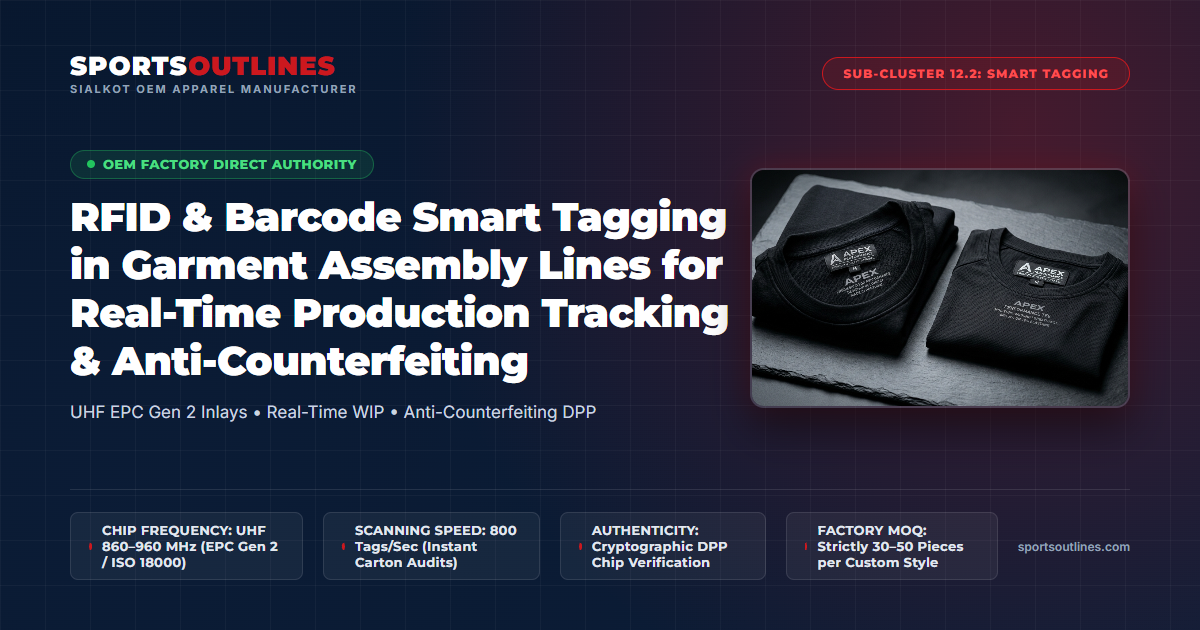
Sports Outlines manufactures smart-tagged technical sportswear direct from Sialkot, Pakistan, integrating Ultra-High Frequency (UHF) RFID (EPC Gen 2 / ISO 18000-6C) and NFC microchip inlays into garment labels. We engineer real-time Work-in-Progress (WIP) assembly line tracking, hardware-level anti-counterfeiting verification, and EU Digital Product Passport (DPP) compliance with 99.99% inventory accuracy. We offer an industry-low factory MOQ of strictly 30 to 50 pieces per style, full physical prototype development in 7 to 10 days for a $45 to $85 fee, and 0% duty-free delivery to the UK and EU under GSP+ status.
Direct WhatsApp: +92 316 7932595
In modern global apparel commerce, speed, transparency, and authenticity are just as vital as fabric quality and stitch density. For decades, the garment manufacturing supply chain has functioned as an opaque black box: brands place purchase orders and endure weeks of radio silence, having no verified data on whether cut panels have entered the sewing lines, which assembly stations face bottlenecks, or whether finished cartons contain the exact size ratios ordered. Compounding this challenge, the explosive rise of e-commerce returns, retail inventory shrinkage, and sophisticated gray-market counterfeiting costs athletic apparel brands billions annually. The modern antidote is RFID and barcode smart tagging embedded directly into the garment assembly line. Operating advanced UHF RFID (EPC Gen 2) encoding systems and real-time Work-in-Progress (WIP) tracking networks, Sports Outlines in Sialkot, Pakistan, provides end-to-end supply chain visibility and anti-counterfeiting security at an industry-low factory minimum order quantity (MOQ) of strictly 30 to 50 pieces per custom style, supported by dedicated $45 to $85 prototype engineering in 7 to 10 days.
Design & Manufacture Custom RFID & Smart Garment Production Tracking Direct from Sialkot
Low 30–50 Piece/Set MOQ • Dedicated Sampling in 7–10 Days • 0% Import Tariffs
✓ $45–$85 Physical Prototypes •
✓ Worldwide DDP Delivery
1. The Architecture of UHF RFID Smart Inlays: Passive Silicon & Antennas
Unlike traditional printed paper barcodes that require unobstructed optical line-of-sight and can only be scanned one by one, Radio Frequency Identification (RFID) operates wirelessly through radio waves.
An RFID smart tag consists of three primary elements:
- Silicon Microchip (Integrated Circuit): A microscopic silicon die (measuring under 0.5mm x 0.5mm) containing an Electronic Product Code (EPC) memory bank, a non-alterable factory Unique Tag Identifier (TID), and user data memory. The chip operates passively—it possesses no internal battery, drawing its operating power directly from the electromagnetic field radiated by an RFID reader.
- Aluminum or Silver Etched Antenna: A precision-engineered metallic conductive loop tuned to resonate within the Ultra-High Frequency (UHF) industrial spectrum (860 MHz to 960 MHz under global GS1 EPC Gen 2 / ISO 18000-6C protocols).
- Protective Substrate Encapsulation: The chip and antenna inlay are bonded to a flexible PET or TPU film and hermetically encapsulated within a soft, washable woven satin care label or heat-sealed interior pocket tag, ensuring complete thermal and moisture protection.
| Smart Tag Specification | Sports Outlines Engineering Standard | Functional Supply Chain Benefit |
|---|---|---|
| Operating Radio Frequency | UHF 860–960 MHz (Global EPC Gen 2 / ISO 18000-6C) | Enables long-range bulk scanning (up to 8 meters) across worldwide regulatory standards (FCC & ETSI). |
| Bulk Scanning Velocity | Up to 800 Tags per Second | Allows reading an entire carton containing 150 boxed activewear sets in under 0.5 seconds without opening the box. |
| Washing & Heat Durability | 50+ Commercial Wash Cycles (60°C) & 200°C Steam Pressing | Withstands heavy domestic and commercial laundering, tumble drying, and industrial garment steaming without data failure. |
| Data Serialization Standard | GS1 SGTIN-96 (Serialized GTIN) Encoding | Guarantees every individual garment possesses a globally unique serial number recognized by enterprise ERP systems. |
| Direct-to-Consumer NFC Option | 13.56 MHz ISO 14443A High-Frequency Hybrid Tag | Allows consumers to tap any smartphone against the logo to verify authenticity and access EU Digital Product Passports. |
2. Real-Time Work-in-Progress (WIP) Tracking: Eliminating the Factory Black Box
In conventional apparel contract manufacturing, tracking is paper-based: bundle tickets are hand-stapled to cut panels, and clerks manually tally output at the end of twelve-hour shifts. This results in data lag, missing bundle errors, and inaccurate delivery forecasts.
At Sports Outlines, every production batch is assigned digital smart tags at the automated CNC cutting table. As bundles move through our specialized modular assembly cells in Sialkot, operators register progress at key workstation portals in a fraction of a second:
Station 1: Precision CNC Laser Cut & Bundle Dispatch: Each cut bundle (e.g., 20 front panels, back panels, and sleeves) is paired with an RFID routing tag programmed with the specific style, size curve, and production order number.
Station 2: Sub-Assembly & Technical Flatlock Stitching: As sewing technicians complete major structural seams, the bundle passes an optical RFID scanning station, instantly logging stitch completion and operator efficiency.
Station 3: In-Line AQL 2.5 Quality Inspection: Quality auditors inspect Point of Measure (POM) tolerances and seam strength. Any unit requiring stitch remediation is scanned into a ‘Rework’ queue with an electronic defect code, preventing defective items from progressing downstream.
Station 4: Automated Final Polybagging & Carton Aggregation: Finished, pressed garments pass through an automated RFID conveyor tunnel. The tunnel reads every individual smart tag inside the sealed shipping box, verifying that the contents match the purchase order manifest with 100% mathematical precision before generating the courier shipping label.
3. Anti-Counterfeiting & EU Digital Product Passports (DPP)
For premium activewear, cycling kit labels, and combat sports brands, counterfeit replication is an existential threat. Illegitimate factories copy exterior designs, stitch counterfeit brand tags, and sell substandard knockoffs online, destroying brand equity and customer trust.
Sports Outlines equips your garments with unbreakable hardware-level authentication. Every RFID/NFC microchip contains a 64-bit factory-locked Unique Tag Identifier (TID) written in silicon during semiconductor manufacturing that cannot be altered, overwritten, or cloned. We program each chip with custom 128-bit cryptographic authentication keys:
- Instant Supply Chain Verification: Brand inspectors, customs officers, and retail buyers can scan garments with any standard UHF handheld reader to verify genuine factory origin within milliseconds.
- Smartphone Tap Engagement: Using hybrid NFC tags, consumers simply tap their smartphone against the hem logo or care tag. Without downloading any mobile app, the smartphone opens a secure brand authentication page verifying product authenticity, displaying raw material sourcing certifications (e.g., Oeko-Tex Standard 100, GRS-certified recycled nylon), and providing care washing instructions.
- EU Digital Product Passport (DPP) Compliance: Emerging European Union legislation requires all apparel sold in the EU to carry accessible digital data regarding circularity, carbon footprint, and recyclability. Our smart tagging architecture ensures your brand is 100% compliant with EU DPP mandates years ahead of regulatory enforcement deadlines.
| Sourcing Feature & Risk Factor | Sports Outlines (Sialkot Direct) | Alibaba Trading Agents | Traditional Chinese Hubs | Print-on-Demand (POD) |
|---|---|---|---|---|
| Smart Tagging Technology | UHF RFID (EPC Gen 2 / ISO 18000-6C) + high-frequency NFC chips embedded into washable woven satin labels. | Standard printed paper swing tags with generic static barcodes that offer zero digital tracking. | RFID tagging available, but imposing $1,000 chip programming fees and 5,000 piece minimums. | Paper adhesive barcode stickers that fall off or wash away on the first laundry cycle. |
| Minimum Order Quantity (MOQ) | Strictly 30–50 pieces per custom style and colorway — accessible for emerging technical brands. | Quotes 50 units for blank stock, but refuses electronic RFID chip serialization under 1,000 units. | 1,000 to 3,000 units per style to justify automated conveyor RFID reader setups. | Single unit available, but lacks any RFID capability or real-time factory assembly tracking. |
| Real-Time WIP Factory Tracking | Work-in-Progress (WIP) scanned at every assembly node (cutting, sewing, QC, packing) with live progress visibility. | Black-box production; buyers receive vague estimates and radio silence for weeks between updates. | Internal ERP tracking used for factory management, but data is rarely shared directly with buyers. | Basic print-queue status only; zero insight into fabric source, sewing, or inspection stages. |
| Anti-Counterfeiting & DPP Verification | Encrypted unique chip IDs verifiable via smartphone NFC tap or GS1 handheld scanners; EU DPP compliant. | Zero anti-counterfeiting protection; easily replicated by unauthorized third-party copycats. | Proprietary QR code labels that redirect to Chinese websites, offering poor brand prestige. | Zero authentication; prints can be cloned on identical blanks by competing storefronts. |
| Prototype Development & Turnaround | $45–$85 non-creditable engineering prototype fee; fully tagged master sample dispatched in 7–10 days. | Promises cheap samples ($35), but delivers untagged garments without electronic chip validation. | $250–$500 sampling fees with 5–7 week lead times due to large volume factory schedules. | Digital 2D mockups only; physical drop-shipped items take 14 days and lack smart hardware. |
| Customs Duty & Tariffs (US / EU / UK) | 0% import customs duty into EU & UK via Pakistan GSP+ status; low trade tariff access into the US. | Unpredictable customs brokerage fees, freight surcharges, and full import duties payable by buyer. | Subject to Section 301 tariffs (7.5%–25%) in the US and standard MFN customs duties in the EU/UK. | Local domestic sales taxes and fulfillment surcharges added per unit, eroding profit margins. |
4. 99.99% Inventory Accuracy & Automated Omnichannel Warehouse Logistics
In modern omnichannel retail—where brands fulfill orders from e-commerce websites, Amazon FBA, wholesale distributors, and physical retail stores simultaneously—inventory inaccuracy is catastrophic. Studies reveal that traditional optical barcode scanning leaves average apparel warehouse inventory accuracy hovering between 65% and 75%, leading to frequent stockouts of popular sizes and costly ‘phantom inventory.’
By integrating UHF RFID tags at the factory level (source tagging), Sports Outlines enables retail partners to achieve 99.99% inventory accuracy:
Carton-Level Receiving in 0.5 Seconds: When a shipment of 50 cartons arrives at your warehouse, receiving staff do not need to open a single box or scan barcodes individually. A mobile RFID portal scanner scans all 50 boxes as they are wheeled through the loading dock door, verifying hundreds of garments simultaneously and updating your warehouse management system (WMS) instantaneously.
Rapid Cycle Counts: Retail store associates can audit an entire sales floor containing 3,000 garments in under fifteen minutes by simply walking through aisles with a handheld RFID wand, eliminating costly after-hours manual inventory counts.
5. Low MOQ Factory Direct Economics: The 30–50 Piece Smart Garment Breakthrough
Historically, smart RFID apparel tagging was an enterprise luxury exclusively deployed by retail titans like Decathlon, Zara, and Nike. Asian mega-factories refuse to configure RFID chip encoding lines for orders under 5,000 to 10,000 pieces due to high machine changeover expenses.
Sports Outlines has dismantled this technical barrier. By installing desktop RFID thermal transfer encoder-printers and modular radio frequency testing chambers in Sialkot, we provide genuine RFID smart tagging at a low factory MOQ of strictly 30 to 50 pieces per custom style. Whether you are an independent streetwear label manufacturing a 50-piece numbered capsule collection or a private fitness brand launching technical compression gear, you can integrate world-class anti-counterfeiting hardware without corporate volume barriers.
| Production Volume Tier | Est. Unit FOB Cost | Sample Cost & SLA | Bulk Production SLA | Included Specifications | Recommended Buyer Profile |
|---|---|---|---|---|---|
| 30 – 50 Sets/Pieces (Smart Tagged Startup Tier) | $13.80 – $17.80 / smart-tagged athletic top | $16.80 – $21.80 / smart-tagged bottom | $45 – $85 non-creditable prototype fee | 12 – 15 Business Days | UHF RFID EPC Gen 2 / NFC smart chip inlay embedding, custom encoded 2D DataMatrix care tags, live manufacturing WIP tracking updates, physical master prototype in 7–10 days, 30–50 piece low factory MOQ. | Emerging tech-forward activewear brands, luxury streetwear labels combating counterfeiters, boutique fitness club apparel programs, and athletic startups requiring digital product passports. |
| 51 – 150 Sets/Pieces (Omnichannel Inventory Growth Tier) | $11.50 – $14.80 / smart-tagged athletic top | $14.50 – $18.20 / smart-tagged bottom | $45 – $85 non-creditable prototype fee | 14 – 18 Business Days | Automated carton-level RFID encoding, GS1-standard SGTIN-96 serialization, dual-frequency UHF+NFC hybrid woven labels, custom retail hangtags with tamper-evident security die-cuts. | Scaling sportswear brands supplying multi-door retail boutiques, collegiate sports club programs, and e-commerce labels integrating smart warehouse management systems. |
| 151 – 500 Sets/Pieces (Commercial Retail Wholesale Tier) | $9.60 – $12.50 / smart-tagged athletic top | $12.40 – $15.50 / smart-tagged bottom | $45 – $85 non-creditable prototype fee | 18 – 22 Business Days | Factory floor real-time API production status feed, batch RFID bulk scanning verification certificates, full AQL 2.5 quality control inspection reports, express DDP door-to-door freight. | Established international sportswear labels, national gym franchise networks, commercial sportswear distributors, and athletic retailers with automated distribution hubs. |
| 500+ Sets/Pieces (Enterprise Global Supply Chain Wholesale Tier) | $7.80 – $9.90 / smart-tagged athletic top | $10.10 – $12.80 / smart-tagged bottom | $45 – $85 non-creditable prototype fee | 22 – 28 Business Days | Dedicated high-speed RFID encoding tunnel lines, custom cryptographic authentication keys, digital product passport (DPP) cloud integration, sea freight or air cargo consolidation, 0% GSP+ duty-free customs clearance. | Multinational sportswear corporations, professional sports league merchandise suppliers, department store athletic private labels, and high-volume commercial garment importers. |
6. Technical Specifications & Export Compliance: The Sialkot Direct Advantage
Sialkot, Pakistan, is the premier industrial manufacturing center for high-performance athletic apparel and equipment. By collaborating directly with Sports Outlines, international apparel founders bypass trading middlemen and secure unmatched operational benefits:
- Strictly 30–50 Piece Factory MOQ: Launch custom technical activewear equipped with digital RFID smart tags, custom woven branding, and certified size breakdowns at accessible micro-lot volumes.
- Full Physical Prototyping in 7–10 Business Days: For a transparent $45 to $85 prototype fee, we manufacture and dispatch your fully assembled, smart-tagged pre-production prototype. You verify electronic chip read range, wash durability, and garment fit before authorizing bulk production.
- 0% Import Customs Duty via EU & UK GSP+ Status: Custom sportswear produced in Pakistan enters the European Union and the United Kingdom at 0% customs import duty under GSP+, delivering a direct 12% to 14% cost advantage over China, Vietnam, or Turkey.
- Comprehensive AQL 2.5 Quality Assurance: Every production batch undergoes standardized AQL 2.5 quality control audits, verifying exact POM measurement tolerances (±0.5cm), seam tensile strength, and 100% electronic chip encoding integrity before sealing.
Get a Factory Direct Quote for RFID & Smart Garment Production Tracking
Chat with our Sialkot Engineering Team via WhatsApp • Instant DDP Air Freight Quotes
✓ $45–$85 Physical Prototypes •
✓ Worldwide DDP Delivery
7. Explore Our Technical Sportswear Manufacturing Ecosystem
Expand your manufacturing intelligence by exploring our related technical guides and international activewear sourcing portals:
- Custom Activewear & Athleisure Manufacturer France: Low MOQ Sialkot OEM
- Private Label Custom Sportswear & Athletic Clothing Manufacturing Guide
- Automated Pattern Grading in Lectra & Gerber for Multi-Regional Sizing
- Italian Water-Based Sublimation Inks & Heat Calendering in Sportswear
- Direct-to-Film (DTF) vs Silicone Heat Transfer vs Screen Printing in Sportswear
Frequently Asked Sourcing & Manufacturing Questions (Buyer FAQ)
What is RFID smart tagging and how does it function in modern garment manufacturing?
Radio Frequency Identification (RFID) smart tagging integrates microscopic electronic silicon microchips and metallic antennas into garment labels (such as woven neck tags, care labels, or hangtags). Operating primarily in the Ultra-High Frequency (UHF) spectrum (860 to 960 MHz under the EPC Gen 2 / ISO 18000-6C standard), the RFID inlay does not require a battery; it is energized by the electromagnetic radio waves emitted by an RFID reader. When energized, the chip transmits its unique serialized electronic product code (EPC). In modern garment assembly lines, fixed portal readers and handheld scanners automatically register hundreds of tagged garment bundles per second through cardboard cartons without line-of-sight contact, enabling instant, error-free tracking from cut panels to final retail point-of-sale.
How does real-time Work-in-Progress (WIP) tracking improve manufacturing transparency for apparel brands?
Traditional apparel manufacturing is notoriously opaque: once an order is confirmed, brand owners often experience weeks of silence, having no objective data on whether fabrics are cut, sewing is underway, or goods are in finishing. At Sports Outlines, every production bundle is tagged with an RFID or serialized 2D DataMatrix code at the cutting stage. As the bundle moves through individual assembly nodes—bundle distribution, flatlock stitching, bar-tacking, pressing, AQL 2.5 quality inspection, and polybagging—operators scan the tag in under 0.2 seconds. This registers real-time timestamped progress into our cloud ERP, providing brand owners with live, transparent data on production velocity and eliminating delivery date surprises.
How do RFID smart tags combat garment counterfeiting and support EU Digital Product Passports (DPP)?
Counterfeiting and unauthorized gray-market diversion inflict billions in losses on athletic and streetwear brands. Sports Outlines embeds cryptographically locked UHF RFID chips or hybrid NFC (Near Field Communication) tags into garment seams. Each chip contains a factory-encoded, non-duplicable Unique Item Identifier (TID) locked with 128-bit encryption keys. Brand authenticators can verify legitimate origin instantly with a commercial RFID scanner, while end consumers can tap the tag with any standard smartphone (Apple iOS or Android) to verify product authenticity, review fiber provenance, and access recycling instructions—fully satisfying the emerging European Union Digital Product Passport (DPP) regulatory requirements.
What is the factory minimum order quantity (MOQ) for custom RFID-tagged sportswear at Sports Outlines?
Our minimum order quantity for custom sportswear with integrated RFID or serialized smart tagging is strictly 30 to 50 pieces or sets per style and colorway. While conventional high-volume factories in China and Southeast Asia require 5,000 to 10,000 units to justify custom RFID chip programming and automated scanner configuration, Sports Outlines has built modular, desktop-scale RFID encoding and inspection stations in Sialkot, making smart garment tracking accessible to emerging boutique brands and private labels.
What is your prototype fee and turnaround time for smart-tagged sportswear samples?
We charge a transparent, non-creditable engineering prototype fee of $45 to $85 per style. This fee includes base pattern CAD nesting, technical fabric cutting, custom woven label production with embedded washable RFID inlays, chip data encoding, full garment assembly, and electronic read-range verification. Your finished physical pre-production sample is completed, electronically tested, and dispatched via express air courier within 7 to 10 business days.
Are embedded RFID chips washable and durable through repeated laundry and tumble drying?
Yes. Sports Outlines utilizes industrial-grade, flexible washable RFID textile tags (such as encapsulated TPU inlays or thread-embroidered antennas) engineered specifically for garments. These inlays withstand 50+ commercial washing cycles at 60°C, high-speed spin extraction, tumble drying up to 90°C, and industrial steam pressing (up to 200°C for 15 seconds) without antenna fracture, chip detachment, or data corruption.
What is the difference between UHF RFID and NFC for sportswear brands?
The key differences lie in operating frequency, read range, and target user: 1) UHF RFID (860–960 MHz) provides long-range bulk scanning (up to 6 to 10 meters). It allows warehouse logistics teams to scan an entire shipping pallet containing 500 boxed garments in under two seconds without opening the boxes—ideal for supply chain and inventory management. 2) NFC (13.56 MHz) is a high-frequency, close-proximity technology (read range 1 to 4 cm) natively compatible with all modern smartphones without requiring an external reader. NFC is ideal for direct-to-consumer engagement: customers tap their smartphone against the logo or care label to launch branded digital experiences, exclusive club content, or authenticity certificates. We also offer dual-frequency hybrid tags combining both UHF and NFC on a single microchip.
How does RFID tagging accelerate warehouse inventory audits and reduce shipping errors?
Manual barcode scanning requires warehouse staff to handle every garment individually, find the barcode tag, and point an optical laser beam directly at it—a process taking 5 to 10 seconds per unit and prone to human scanning fatigue. With UHF RFID, a single operator walking down a warehouse aisle with a handheld RFID wand can scan 1,000 garments in under two minutes with 99.99% accuracy. During carton packing, our RFID packing tunnels verify that the exact sizes, colors, and quantities specified on the purchase order are present in the box before the shipping label prints, reducing warehouse mis-picks to virtually zero.
Can you encode custom GS1 EPC data, serial numbers, and retail pricing?
Yes. Our digital encoding systems are fully compliant with GS1 international standards, including SGTIN-96 (Serialized Global Trade Item Number), GRAI (Global Returnable Asset Identifier), and custom proprietary encoding schemes. We can pre-encode your company’s GS1 company prefix, item reference number, unique sequential serial numbers, retail pricing, and care URLs directly into the user memory banks before shipping.
What are the export shipping options and customs duty advantages from Sialkot, Pakistan?
We dispatch finished orders directly from Sialkot via DHL Express, FedEx Priority, and UPS Worldwide Expedited with guaranteed 3 to 5 business day transit times to North America, Europe, the UK, and Australasia. European Union and United Kingdom apparel brands benefit directly from Pakistan’s GSP+ status, allowing custom smart-tagged activewear to enter at 0% import customs duties, delivering an immediate 12% to 14% bottom-line advantage over sourcing from China, Vietnam, or Turkey.