Direct Manufacturer Snapshot: Direct-to-Film (DTF) vs Silicone Heat Transfer vs Screen Printing in Technical Sportswear: Durability, Stretch & Hand-Feel
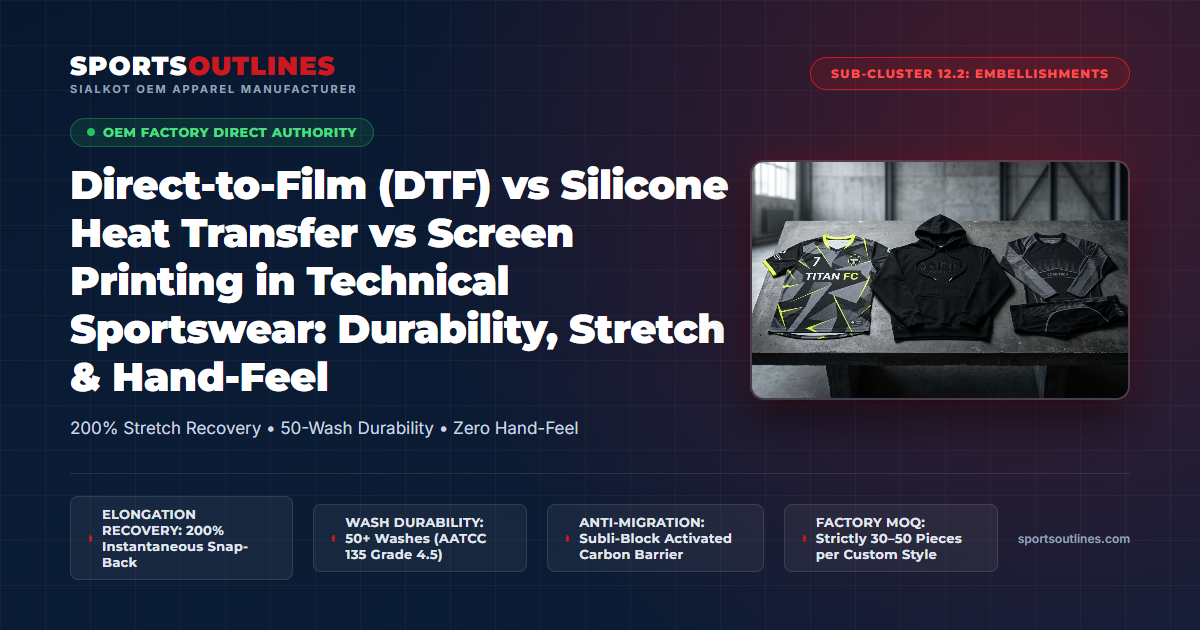
Sports Outlines manufactures custom branded technical sportswear direct from Sialkot, Pakistan, utilizing 3D molded silicone heat transfers, high-resolution Direct-to-Film (DTF) prints, and advanced water-based/silicone screen printing. We engineer 200% stretch-recovery silicone logos, anti-sublimation barrier transfers that eliminate dye migration on polyester, and tagless interior neck labels. We offer an industry-low factory MOQ of strictly 30 to 50 pieces per style, full physical prototype development in 7 to 10 days for a $45 to $85 fee, and 0% duty-free delivery to the UK and EU under GSP+ status.
Direct WhatsApp: +92 316 7932595
In modern athletic apparel engineering, branding is far more than a decorative visual mark—it is a functional component that directly governs garment stretch, breathability, skin comfort, and brand perception. When an athlete invests in premium sportswear, a cracked chest logo, a peeling neck tag, or a stiff, sweat-trapping plastisol graphic immediately degrades the brand’s reputation. Technical sportswear designers are faced with a pivotal engineering decision: Direct-to-Film (DTF) vs. 3D Molded Silicone Heat Transfer vs. Screen Printing. Each technology possesses distinct physical behaviors across stretch modulus, tactile hand-feel, wash durability, and production unit economics. At Sports Outlines in Sialkot, Pakistan, we operate comprehensive in-house embellishment laboratories equipped with high-resolution DTF printers, custom CNC silicone mold vulcanization, and automated textile printing carousels. We deliver luxury-grade athletic branding at a low factory minimum order quantity (MOQ) of strictly 30 to 50 pieces per custom style, supported by dedicated $45 to $85 prototype engineering in 7 to 10 days.
Design & Manufacture Custom Sportswear Branding Technologies (DTF vs Silicone vs Screen Printing) Direct from Sialkot
Low 30–50 Piece/Set MOQ • Dedicated Sampling in 7–10 Days • 0% Import Tariffs
✓ $45–$85 Physical Prototypes •
✓ Worldwide DDP Delivery
1. Comparative Embellishment Technology Breakdown: DTF vs Silicone vs Screen Printing
Choosing the correct embellishment process requires matching the graphic’s visual complexity and physical performance requirements to the textile substrate:
| Performance Attribute | 3D Molded Silicone Heat Transfer | Direct-to-Film (DTF) Transfer | Screen Printing (Water-Based / Silicone) |
|---|---|---|---|
| Tactile Hand-Feel | 3D raised, soft-touch matte rubber relief (0.5mm to 2.5mm thickness); ultra-luxurious. | Smooth, ultra-thin (0.08mm) film; soft hand-feel with flexible powder adhesive. | Zero-hand feel (water-based discharge) to supple elastic coat (silicone ink). |
| Stretch & Recovery | Exceptional (200% elongation, >98% instantaneous snap recovery); does not crack. | High (120% to 150% elongation); flexible TPU powder accommodates moderate stretch. | High with silicone stretch inks; low with standard plastisol inks. |
| Graphic Complexity | Best for bold geometric logos, typographic marks, and solid 1-to-3 color designs. | Unlimited; photorealistic CMYK gradients, fine lines (down to 0.5pt), micro-text. | Best for solid vector colors; complex halftone gradients require costly multi-screen setups. |
| Durability (AATCC 135) | 50+ industrial washes; impervious to sweat salinity, chlorine, and UV exposure. | 40 to 50 domestic washes; highly durable when cured with premium TPU powders. | 50+ washes for water-based/silicone; plastisol cracks over time. |
| Unit Economics at Low MOQ | Requires CNC mold tooling; highly cost-effective at 50+ units once mold is milled. | Zero tooling/screens; lowest unit cost and setup cost for 30–50 piece startup runs. | High initial screen setup charges ($25–$40 per color); optimal for 200+ unit runs. |
2. 3D Molded Silicone Heat Transfers: The Luxury Standard for High-Stretch Activewear
When examining tier-one global sportswear brands—such as Lululemon, Gymshark, Nike Pro, and Castelli Cycling—their primary chest logos and compression thigh branding are almost universally executed using 3D molded silicone heat transfers.
The production process begins with precision CNC high-speed milling of solid aircraft-grade aluminum negative molds. Liquid silicone rubber (LSR)—a platinum-cured, two-component elastomeric polymer—is injected into the mold cavity and subjected to high-temperature vulcanization (160°C to 180°C) under hydraulic pressure. Once the 3D silicone graphic is formed, a high-tenacity thermoplastic polyurethane (TPU) adhesive film is laminated onto the back of the silicone.
The technical advantages of silicone in athletic apparel are unmatched:
- Isotropic Elastic Modulus: Unlike vinyl or plastic inks that behave rigidly, silicone possesses an innate molecular elasticity that elongates over 200% in all directions, stretching synchronously with 4-way nylon-spandex compression fabrics without tension failure or micro-fissuring.
- Thermal & Chemical Resistance: Silicone is chemically inert; it does not degrade, become sticky, or dissolve when exposed to acidic human sweat, chlorinated pool water, or harsh athletic laundry detergents.
- Velvety Matte Aesthetics: Silicone provides a tactile, velvety matte finish that reflects quality, eliminating the cheap, shiny plastic appearance of commercial heat-transfer vinyl.
3. Direct-to-Film (DTF) Printing: Unmatched Agility for Multi-Color Graphics & Low MOQ
Direct-to-Film (DTF) has emerged as the most disruptive digital embellishment technology in modern garment manufacturing. In traditional screen printing, a 6-color graphic requires six separate photographic film positives, six mesh screens, precision registration setup, and ink squeegee calibration—costing hundreds of dollars before a single t-shirt is printed.
DTF eliminates all analog tooling. High-speed industrial inkjet print heads deposit pigmented water-based CMYK inks directly onto a clear release PET film, followed immediately by an opaque, high-density white ink backing layer. The printed wet film then passes through an automated shaker tunnel where a fine, pulverized thermoplastic polyurethane (TPU) hot-melt adhesive powder is uniformly dusted across the ink. The film travels through an infrared radiant heat tunnel, melting the powder into a smooth, elastomeric adhesive membrane.
For startup sportswear brands and private labels ordering 30 to 50 pieces, DTF provides unprecedented advantages:
- Zero Setup or Screen Fees: Brands can incorporate photorealistic artwork, complex color fades, subtle drop shadows, and multi-color team crests without paying screen setup charges.
- Crisp Micro-Typography: DTF accurately resolves intricate lines down to 0.3mm, making it the premier solution for razor-sharp, legible inside-neck care labels and size specification prints.
- Flexible Hand-Feel: By utilizing fine-grain TPU powders (80 to 200 microns) rather than coarse industrial powders, our DTF prints retain a soft, flexible hand feel that moves naturally with lightweight athletic textiles.
| Sourcing Feature & Risk Factor | Sports Outlines (Sialkot Direct) | Alibaba Trading Agents | Traditional Chinese Hubs | Print-on-Demand (POD) |
|---|---|---|---|---|
| Embellishment Technology Range | 3D molded silicone transfers, high-resolution DTF (CMYK+W), water-based discharge, & silicone stretch screen inks. | Standard PVC plastisol inks that crack, peel, and feel like stiff plastic cardboard on performance knits. | High quality silicone transfers, but charging $300–$500 custom mold fees and 1,000 unit minimums. | Low-grade DTG (direct-to-garment) or basic vinyl heat transfers that peel off after 3 domestic washes. |
| Minimum Order Quantity (MOQ) | Strictly 30–50 pieces per custom style and colorway — accessible for emerging technical brands. | Claims 50 units for generic stock tees, but demands 500–1,000 units for genuine silicone heat seals. | 500 to 2,000 units per graphic run due to automated press set-up and screen preparation costs. | Single unit available, but lacks stretch silicone, 3D embossing, and performance wash durability. |
| Stretch & Recovery Modulus | Up to 200% mechanical elongation with >98% instantaneous snap recovery matching 4-way Lycra® fabrics. | Zero stretch; plastisol prints crack and tear as soon as the athlete pulls the garment over shoulders. | Excellent stretch, but rigid film carriers can cause puckering on ultra-lightweight 80 GSM mesh fabrics. | Inelastic binders that shatter under tension, exposing raw fabric underneath and degrading print aesthetics. |
| Wash Fastness & Durability | Certified 50+ industrial washes (AATCC 135 / ISO 105-C06 Grade 4.5); zero edge curling or fading. | Peels and flakes within 5–10 domestic wash cycles; adhesive reacts poorly with body sweat. | 40+ wash durability, but requires lengthy lab dip approvals and expensive pre-testing charges. | Fades noticeably after the first wash; edges begin lifting after tumble drying. |
| Prototype Development & Turnaround | $45–$85 non-creditable engineering prototype fee; branded physical sample dispatched in 7–10 days. | Quotes low sample prices ($30), but provides heat press print tests on scrap cotton rags, not real performance fabrics. | $200–$400 sampling fees with 4–6 week queue times due to large volume factory schedules. | Drop-shipped blanks take 10–14 days and do not include custom neck labels or branded polybags. |
| Customs Duty & Tariffs (US / EU / UK) | 0% import customs duty into EU & UK via Pakistan GSP+ status; low trade tariff access into the US. | Hidden customs brokerage surcharges, high freight rates, and full import duties payable by buyer. | Subject to Section 301 tariffs (7.5%–25%) in the US and standard MFN customs duties in the EU/UK. | Local state sales taxes and individual shipment surcharges applied to every unit. |
4. Advanced Screen Printing: Water-Based Discharge & High-Density Silicone Inks
While DTF and silicone transfers dominate micro-lots and high-stretch logos, advanced screen printing remains the undisputed champion for large-format chest graphics, oversized back prints, and high-volume commercial production (200+ pieces).
However, traditional cheap plastisol screen printing—which deposits a thick, rubbery PVC layer that blocks fabric breathability and creates a sweaty ‘sweat patch’ on the chest—is unacceptable for technical activewear. Sports Outlines utilizes two advanced athletic screen printing formulations:
Water-Based Discharge Printing: Ideal for 100% cotton or high-cotton lifestyle athletic apparel. Discharge inks contain an active chemical reducing agent that strips the original reactive dye out of the cotton fibers, replacing it with water-based pigment. The result is a vibrant, breathable print with literally zero hand-feel—the fabric remains as soft and air-permeable as unprinted textile.
Silicone Screen Inks: For 100% polyester and nylon performance jerseys, we formulate specialized multi-layer silicone liquid screen inks. Formulated with high-stretch silicone bases, these inks pass through 110 to 180-mesh polyester screens and cure under catalytic heat. They deliver high-density relief, incredible color opacity, and 150% stretch recovery with zero risk of dye migration.
5. Preventing Dye Migration: The Science of Subli-Block Barrier Adhesives
The most prevalent and costly failure mode in branded polyester sportswear is dye migration (often called dye bleeding). Polyester fabrics are colored using disperse dyes at high heat (180°C to 200°C). When a standard heat transfer is applied to a red, royal blue, or black polyester shirt using a heat press (150°C), the heat re-activates the disperse dye molecules. Over the following 24 to 72 hours, these dye vapors migrate through the porous adhesive layer and contaminate white or light-colored printed areas, turning crisp white logos into dingy pink or muddy gray.
Sports Outlines completely eliminates dye migration by integrating Anti-Sublimation (Subli-Block) barrier layers into all our heat transfers. We deposit an active barrier layer containing microscopic activated carbon or specialized cross-linked polyurethane resins between the ink and the hot-melt adhesive. This barrier acts as an impermeable chemical shield, trapping disperse dye vapors and guaranteeing that white logos remain 100% snow-white throughout years of heavy laundering and competitive play.
6. Precision Heat Press Application: Temperature, Pressure & Dwell Time
Even the most expensive silicone transfer or DTF film will fail in the field if heat press application is improperly executed. Hand irons or cheap manual clamshell presses lack uniform temperature distribution and consistent clamping pressure, causing under-cured adhesives that lift at the edges or scorched fabrics.
In our Sialkot manufacturing facility, all heat transfers are applied using industrial pneumatic twin-station heat presses featuring digitally calibrated micro-controllers:
- Digital Temperature Uniformity (±1°C): Dual heating elements ensure edge-to-edge heat uniformity across the 40x50cm platen, maintaining exact temperatures (typically 145°C to 150°C for DTF; 155°C to 165°C for silicone) to melt adhesive resins without scorching sensitive nylon filaments.
- Calibrated Pneumatic Pressure (4 to 6 Bar / 60 to 85 PSI): Consistent hydraulic downforce drives the molten adhesive deep into the micro-interloopings of the textile yarns, creating a permanent mechanical and chemical interlock.
- Automated Dwell Timing (12 to 18 Seconds): Electronic timers ensure exact dwell cycles followed by automated platen release, eliminating human timing error and ensuring factory-perfect adhesion on every single production unit.
| Production Volume Tier | Est. Unit FOB Cost | Sample Cost & SLA | Bulk Production SLA | Included Specifications | Recommended Buyer Profile |
|---|---|---|---|---|---|
| 30 – 50 Sets/Pieces (Technical Embellishment Startup Tier) | $12.80 – $16.50 / custom branded athletic top | $15.50 – $19.80 / custom branded bottom | $45 – $85 non-creditable prototype fee | 12 – 15 Business Days | High-density 3D molded silicone heat transfers, multi-color CMYK+White digital DTF printing with TPU hot-melt powder, master prototype with custom branding in 7–10 days, 30–50 piece low factory MOQ. | Startup activewear brands, gym apparel private labels, fitness creators launching merchandise, and boutique sports clubs seeking luxury-tier branding without 500-unit minimums. |
| 51 – 150 Sets/Pieces (Collection Line Expansion Tier) | $10.50 – $13.80 / custom branded athletic top | $13.20 – $16.90 / custom branded bottom | $45 – $85 non-creditable prototype fee | 14 – 18 Business Days | Combination branding: silicone chest logos + DTF neck tags + reflective 3M Scotchlite heat seals, automated pneumatic heat press calibration, retail polybags with custom barcode stickers. | Scaling sportswear brands, crossfit affiliate gym gear lines, regional athletic teams, and digital direct-to-consumer e-commerce collections. |
| 151 – 500 Sets/Pieces (Commercial Wholesale Distribution Tier) | $8.90 – $11.50 / custom branded athletic top | $11.40 – $14.20 / custom branded bottom | $45 – $85 non-creditable prototype fee | 18 – 22 Business Days | Automated multi-station rotary screen printing with silicone stretch inks, high-speed roll-to-roll DTF production lines, complete AQL 2.5 50-wash durability reports, express DDP shipping. | Established athletic apparel brands, multi-club sports leagues, corporate fitness merchandise programs, and commercial activewear distributors. |
| 500+ Sets/Pieces (Enterprise Multi-Store Wholesale Tier) | $7.20 – $9.20 / custom branded athletic top | $9.50 – $11.80 / custom branded bottom | $45 – $85 non-creditable prototype fee | 22 – 28 Business Days | Dedicated branding production cells, custom silicone mold tooling, volume ink batching with exact Pantone TCX calibration, ocean freight or air cargo consolidation, 0% GSP+ duty-free customs clearance. | International sportswear corporations, national athletic franchise networks, department store private labels, and high-volume commercial fitness brands. |
7. Low MOQ Agility & The Sialkot Direct Supply Chain Advantage
Sialkot, Pakistan, is the undisputed international heartland of sports goods craftsmanship, producing technical apparel for world-class soccer federations, boxing champions, and Olympic athletics. By partnering directly with Sports Outlines, brand founders and purchasing managers bypass intermediaries and secure unmatched manufacturing benefits:
- Strictly 30–50 Piece Factory MOQ: We empower startup athletic brands to produce commercial-grade apparel with custom silicone branding, DTF neck tags, and retail-ready packaging at accessible low minimums.
- Rapid Physical Prototyping in 7–10 Business Days: For a transparent $45 to $85 non-creditable engineering fee, we build and dispatch your branded physical pre-production prototype. You verify the stretch recovery, wash durability, and logo precision before approving bulk production.
- 0% Import Customs Duty via EU & UK GSP+ Status: Garments manufactured in Pakistan qualify for Generalized Scheme of Preferences Plus (GSP+), entering the United Kingdom and European Union with 0% customs import duty, providing an immediate 12% to 14% landed margin advantage over Chinese or Vietnamese goods.
- Guaranteed Express Air Logistics: We deliver bulk shipments directly to your warehouse or retail location in 3 to 5 business days via DHL Express, FedEx Priority, or UPS Worldwide Expedited.
Get a Factory Direct Quote for Sportswear Branding Technologies (DTF vs Silicone vs Screen Printing)
Chat with our Sialkot Engineering Team via WhatsApp • Instant DDP Air Freight Quotes
✓ $45–$85 Physical Prototypes •
✓ Worldwide DDP Delivery
8. Explore Our Technical Sportswear Manufacturing Ecosystem
Expand your production knowledge by reviewing our dedicated manufacturing guides and regional activewear hubs:
- Custom Activewear & Athleisure Manufacturer USA: Low MOQ Private Label Sialkot OEM
- Seamless Circular Knitting Technology (Santoni): Compression Tights & Sports Bras
- Ultrasonic Fabric Welding & Thermobonding vs Traditional Stitching in Sportswear
- Digital Tech Pack Creation & Technical Specifications for Apparel Manufacturing
- CLO 3D & Browzwear Virtual Prototyping for Sportswear Brands
Frequently Asked Sourcing & Manufacturing Questions (Buyer FAQ)
What is the difference between Direct-to-Film (DTF), Silicone Heat Transfer, and Screen Printing for sportswear?
Each embellishment technology serves specific technical and aesthetic functions in technical apparel: 1) Silicone Heat Transfers utilize liquid silicone elastomer molded in CNC aluminum molds and backed by hot-melt polyurethane adhesive. They provide a luxurious 3D raised rubber hand feel, exceptional 200% stretch recovery, and unmatched resistance to abrasion and body oils—making them the gold standard for high-end activewear chest logos and compression leg branding. 2) Direct-to-Film (DTF) uses computerized inkjet heads to print pigmented water-based inks (CMYK + White) onto a PET film carrier, which is coated with elastomeric TPU hot-melt powder and cured. DTF excels at intricate multi-color gradients, photorealistic art, and micro-text neck labels at low quantities without screen preparation costs. 3) Screen Printing pushes liquid inks (such as water-based discharge or silicone inks) through tensioned mesh stencils directly onto fabric panels. It remains the most cost-effective method for high-volume single-color or dual-color graphics on athletic tops, providing ultra-soft hand feel and excellent breathability.
Which printing method is best for high-stretch 4-way Lycra and compression garments?
For 4-way stretch fabrics (such as 80/20 nylon-spandex compression tights and sports bras), 3D molded silicone heat transfers or silicone screen printing are technically superior. Standard plastisol or vinyl heat transfers are rigid and will crack, wrinkle, or tear as the fabric stretches over athletic musculature. In contrast, silicone possesses an elastomeric memory that stretches up to 200% along with the textile substrate and snaps back instantaneously without micro-cracking or edge lifting.
What is the minimum order quantity (MOQ) for custom branded sportswear at Sports Outlines?
Our minimum order quantity for custom branded sportswear featuring silicone heat transfers, DTF prints, or screen printing is strictly 30 to 50 pieces or sets per style, colorway, and graphic design. By operating in-house digital DTF printers, automated pneumatic heat presses, and modular silicone molding equipment, we eliminate the 500-unit factory minimums typical of conventional Asian branding houses.
What is your prototype fee and turnaround time for branded sportswear samples?
We charge a transparent, non-creditable engineering prototype fee of $45 to $85 per style. This fee covers complete graphic vector conversion, film printing, custom silicone mold tooling, pneumatic heat press calibration (temperature, pressure, dwell time), and garment assembly. Your finished physical branded pre-production sample is inspected, wash-tested, and dispatched via express air courier within 7 to 10 business days.
How durable are DTF prints compared to traditional vinyl heat transfers on technical fabrics?
Modern DTF printing substantially outperforms traditional cut-vinyl transfers in both durability and comfort. Vinyl transfers use thick PVC films that feel like a stiff plastic shield on the chest, trap body sweat, and peel along sharp edges after a few washes. DTF prints utilize flexible polyurethane hot-melt powders that melt directly into the microscopic weave of synthetic athletic textiles, resulting in a significantly thinner, softer hand feel, enhanced breathability, and certified durability exceeding 40 to 50 domestic laundering cycles (AATCC 135) without cracking or peeling.
Can you produce 3D raised silicone logos with matte, gloss, or metallic finishes?
Yes. Sports Outlines produces custom 3D molded silicone transfers in various thicknesses (ranging from 0.5mm subtle relief up to 2.5mm pronounced high-density relief). We offer velvety soft-touch matte finishes, high-gloss wet-look finishes, metallic brushed finishes (gold, silver, gunmetal), and retroreflective 3M glass-bead embedded silicone that illuminates brilliantly under automotive headlights for night-running safety.
How do you prevent heat transfer adhesive bleeding or dye migration on sublimated polyester fabrics?
Dye migration (where disperse dyes in sublimated polyester gas out and discolor white or light-colored heat transfers into an unsightly pink or gray) is a frequent defect in amateur sportswear manufacturing. Sports Outlines completely prevents dye migration by utilizing specialized ‘Anti-Sublimation’ or ‘Subli-Block’ adhesive barrier films. These films contain an activated carbon or aluminum oxide barrier layer that physically blocks disperse dye molecules from migrating through the adhesive carrier, guaranteeing that white logos remain 100% crisp and pure white over years of use.
What heat press parameters are critical for applying transfers to technical sportswear?
Applying transfers to delicate technical fabrics requires microscopic calibration of three interrelated variables: 1) Temperature: Typically 140°C to 155°C (284°F to 311°F) to activate TPU hot-melt adhesives without scorching or causing thermal glazing/shine marks on delicate nylon microfibers; 2) Pneumatic Pressure: High, uniform pressure (4 to 5 bar / 55 to 70 PSI) to force the liquid adhesive into the textile yarn matrix; and 3) Dwell Time: 12 to 15 seconds followed by a controlled cold-peel or warm-peel release based on specific film carrier chemistry.
Can you produce tagless inside neck labels and custom size specifications?
Yes. We engineer ultra-fine tagless interior neck labels using either soft-stretch single-color DTF prints or ultra-thin polyurethane heat transfers. These labels contain your brand logo, fabric content, country of origin (‘Made in Pakistan’), care washing symbols (ISO 3758), and size indicators. Because they are completely flat and ink-based, they eliminate itchy woven labels that cause neck irritation.
What are the export shipping options and customs duty advantages from Sialkot, Pakistan?
We dispatch finished production orders directly from our Sialkot facility via express international air couriers (DHL, FedEx, UPS) with guaranteed 3 to 5 business day delivery to North America, Europe, the UK, and Australia. UK and EU apparel brands benefit directly from Pakistan’s GSP+ status, allowing custom branded sportswear to enter duty-free at 0% import customs duty, saving 12% to 14% compared to sourcing from China or Vietnam.