Direct Manufacturer Snapshot: Automated Thread Trimming, Programmable Bar-Tacking & Machine Vision Quality Inspection in Sportswear OEM
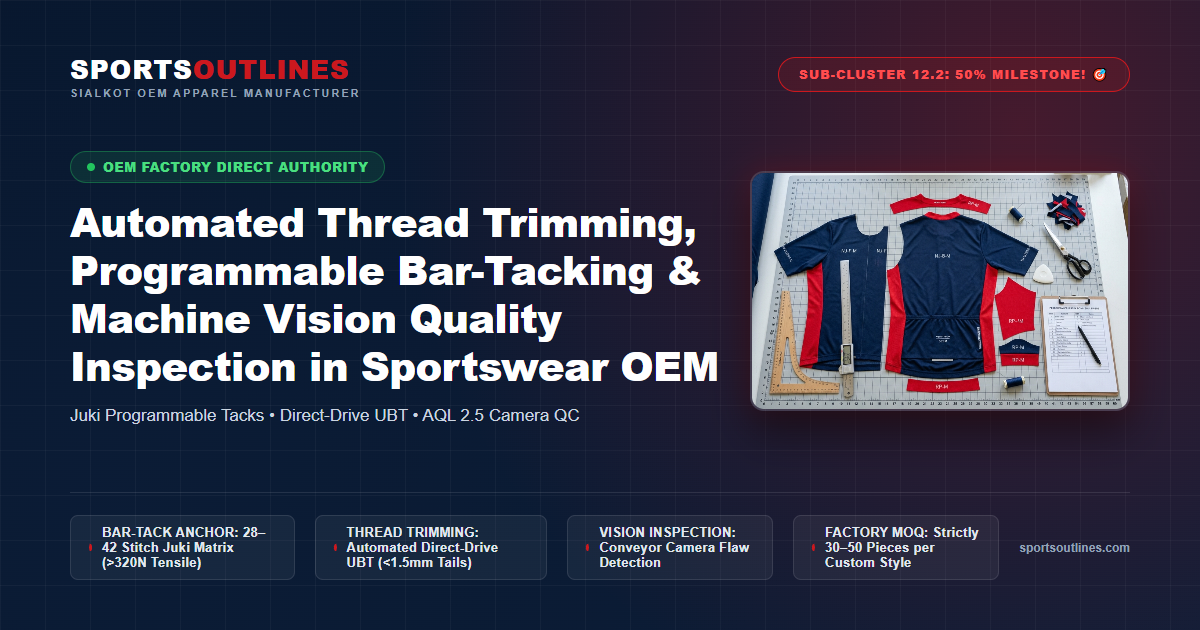
Sports Outlines manufactures zero-defect technical sportswear direct from Sialkot, Pakistan, deploying Juki LK-1900BN programmable electronic bar-tackers, automated under-bed thread trimmers (UBT), and machine-vision optical camera quality inspection. We engineer 28-to-42 stitch anchored bar-tacks exceeding 320N tensile burst strength, sub-1.5mm clean thread tails without scissor damage, and strict ANSI/ASQ Z1.4 (AQL 2.5) defect inspection. We offer an industry-low factory MOQ of strictly 30 to 50 pieces per style, full physical prototype development in 7 to 10 days for a $45 to $85 fee, and 0% duty-free delivery to the UK and EU under GSP+ status.
Direct WhatsApp: +92 316 7932595
In competitive athletic sportswear manufacturing, high-quality fabric and sleek graphic design mean nothing if garment seams fail under the stress of athletic competition. When an athlete drops into a maximum-effort squat, pulls on a climbing harness, or dives for a volleyball, the localized mechanical stress concentrated on pocket openings, drawcord exits, waistband anchors, and crotch seams is immense. In traditional apparel workshops, these critical stress junctions are secured with manual back-tacking and hand-trimmed with scissors—a process rife with human inconsistency, severed microfibers, and premature seam failure. The gold standard for modern technical activewear is automated manufacturing execution powered by computerized programmable electronic bar-tacking, direct-drive under-bed thread trimming (UBT), and high-resolution machine-vision quality inspection. At Sports Outlines in Sialkot, Pakistan, we combine industrial Juki LK-1900BN electronic tacking systems with automated optical flaw detection, delivering zero-defect athletic apparel at an industry-low factory minimum order quantity (MOQ) of strictly 30 to 50 pieces per custom style, supported by dedicated $45 to $85 prototype engineering in 7 to 10 days.
Design & Manufacture Custom Automated Bar-Tacking & Machine Vision QC Direct from Sialkot
Low 30–50 Piece/Set MOQ • Dedicated Sampling in 7–10 Days • 0% Import Tariffs
✓ $45–$85 Physical Prototypes •
✓ Worldwide DDP Delivery
1. Programmable Electronic Bar-Tacking: The Anatomy of High-Stress Joint Reinforcement
A bar-tack is not a simple stitch—it is a densely engineered, multi-directional structural anchor. While a standard lockstitch or chainstitch distributes tension linearly along a seam, athletic garments experience extreme perpendicular and shear peel forces at termination points: pocket welts, waistband drawcord exits, sports bra strap joins, belt loops, and crotch gusset intersections.
In conventional apparel workshops, operators attempt to reinforce these points through manual ‘back-tacking’—reversing the sewing machine for 3 to 5 stitches. This manual method suffers from fatal defects: inconsistent stitch density, unsightly thread tangles (‘bird-nesting’), and inadequate tensile strength. Under heavy athletic loads, the seam pops.
Sports Outlines deploys computerized direct-drive electronic bar-tacking machines (Juki LK-1900BN Series and Brother KE-430HX Series). The garment is placed beneath a pneumatic clamp that immobilizes the textile without crushing fine microfibers. Governed by dual pulse-motor stepping mechanisms controlling the X and Y axes simultaneously with 0.05mm resolution, the machine executes an automated 28-to-42 stitch reinforcement matrix:
- Base Foundation Lay-Down: The machine rapidly deposits 3 to 5 lengthwise base stitches across the joint.
- High-Density Transverse Zig-Zag: The needle oscillates transversely across the base threads at speeds up to 3,200 RPM, depositing 20 to 30 tightly compacted cross-stitches at a microscopic pitch of 0.8mm.
- Automated Locking Knot: The cycle concludes with 3 condensed lockstitches and an instant under-bed thread trim.
The resulting joint achieves an extraordinary seam tensile breaking force exceeding 320 Newtons (ASTM D1683), ensuring that pockets, straps, and crotch seams never rip out, even under the most punishing athletic physical contact.
| Machine Component | Juki LK-1900BN Technical Standard | Garment Durability Impact |
|---|---|---|
| Sewing Speed & Drive | 3,200 RPM Direct-Drive Compact Servomotor | Delivers high needle penetration force through multi-layer 300 GSM textiles with zero belt slippage. |
| Stitch Pattern Programmability | Digital Memory (200 Built-In & Custom Vector Patterns) | Allows custom reinforcement profiles (horizontal, vertical, cross-box, eyelet tacks) tailored to specific garments. |
| X-Y Feed Mechanism | Pulse-Motor Stepping Control (0.05mm Resolution) | Guarantees exact needle placement and identical stitch density across every single production unit. |
| Pneumatic Work Clamp Lift | Adjustable Pneumatic Clamping Pressure | Prevents fabric slippage during stitching while eliminating pressure marks on delicate synthetic microfibers. |
| Thread Trimming System | Automated High-Speed Rotary Knife (UBT) | Trims thread tails cleanly beneath the throat plate to under 1.5mm without manual scissor handling. |
2. Automated Under-Bed Thread Trimming (UBT): Protecting Synthetic Microfibers
One of the most insidious yet pervasive failure points in cheap activewear manufacturing is manual scissor snipping damage. In traditional factories, after seam operations are finished, a team of trimming workers moves through the garments using handheld snips to cut loose thread tails.
When dealing with slippery, ultra-fine synthetic microfibers—such as 75 GSM featherweight running ripstops, 110 GSM nylon tricots, or 4-way Lycra® knits—a worker’s scissors slip in a fraction of a second. The razor-sharp blades graze the synthetic filament, cutting microscopic yarn fibers. When the garment is later subjected to athletic stretch and washing, these severed filaments immediately blossom into unsightly snags, fabric runs, or gaping seam holes.
Sports Outlines eliminates manual scissor handling by equipping our sewing lines with automated direct-drive under-bed thread trimmers (UBT). As the seam reaches completion, an electronic solenoid actuates a precision rotary counter-knife beneath the needle plate. Both the upper needle thread and lower bobbin thread are severed cleanly in under 0.15 seconds, leaving an ultra-short thread tail of under 1.5mm. The base fabric is completely isolated from cutting blades, preserving 100% of the textile’s structural yarn matrix.
3. Machine-Vision Optical Inspection: AI-Powered Defect Detection
Traditional garment quality control relies entirely on human visual inspection. After a 10-hour shift under warehouse lighting, human inspectors suffer severe visual fatigue. Studies show that human inspectors miss up to 25% to 35% of subtle defects—including skipped stitches, micro-pinholes, slight seam run-offs, and subtle dye shade variance across adjacent garment panels.
At Sports Outlines, our finishing lines are augmented with industrial machine-vision inspection systems:
High-Resolution Multi-Camera Arrays: Finished garments are placed on an illuminated conveyor belt passing beneath a calibrated gantry equipped with multi-spectrum industrial cameras with telecentric lenses. Dual polarized LED light banks eliminate reflections from glossy synthetic fabrics.
Neural Network Flaw Detection: The machine vision software captures 360-degree high-resolution imagery in milliseconds, executing automated computer vision algorithms that analyze the garment against digital tech pack standards:
- Skipped Stitch Detection: Analyzes continuous thread lines along flatlock, overlock, and coverstitch seams. If an unbroken thread loop fails to form across even two consecutive needle penetrations (a skipped stitch), the anomaly is flagged with sub-millimeter coordinates.
- Seam Run-Off Verification: Checks that edge-stitching maintains strict parallel alignment with fabric edges, detecting any run-off exceeding 0.5mm.
- Optical Shade Sorting: Spectrophotometer camera modules verify that the dye shade of sleeves, front bodice, and collar match with a Delta-E variance under 0.6, preventing two-tone garment defects.
- Automated Defect Tagging: Garments that fail inspection are automatically routed to a specialized remediation cell with a digital defect log, ensuring that only 100% zero-defect garments progress to final packaging.
| Sourcing Feature & Risk Factor | Sports Outlines (Sialkot Direct) | Alibaba Trading Agents | Traditional Chinese Hubs | Print-on-Demand (POD) |
|---|---|---|---|---|
| Bar-Tack Reinforcement Technology | Computerized Juki LK-1900BN programmable electronic bar-tackers delivering 28-to-42 stitch anchored matrices. | Manual back-tacking by hand with inconsistent stitch counts that unravel under high-tension athletic stress. | Automated bar-tacking lines, but requiring 1,000+ piece minimums per style to configure machine software. | Zero structural bar-tacking; straight lockstitches that pop at pocket corners during first squat session. |
| Minimum Order Quantity (MOQ) | Strictly 30–50 pieces per custom style and colorway — accessible for emerging technical brands. | Brokers quote 50 units on open-stock generic blanks, but refuse automated inspection protocols under 500 units. | 500 to 2,000 units per colorway due to automated conveyor setup and camera calibration expenses. | Single unit available, but lacks any automated trimming, reinforced bar-tacks, or quality audits. |
| Thread Trimming Precision | Automated direct-drive under-bed thread trimmers (UBT) leaving thread tails under 1.5mm without manual snipping damage. | Manual scissor trimming by untrained workers; frequent scissor nicks that sever synthetic base fabrics. | Automated trimmers, but high machine speeds can cause thread tension curls on delicate microfibers. | Messy loose thread tails hanging from hems and collars that require customers to trim themselves. |
| Optical Quality Inspection | Machine-vision camera inspection checking skipped stitches, seam run-offs, and micro-holes under calibrated lighting. | Glance-and-go manual visual checks; missed defects shipped directly to foreign buyers. | Final AQL audits conducted, but inspection photos withheld unless major defect disputes arise. | Zero quality control; automated print machines drop-ship defective items directly to retail consumers. |
| Prototype Development & Turnaround | $45–$85 non-creditable engineering prototype fee; fully inspected master sample dispatched in 7–10 days. | Cheap sample quotes ($30), but delivers poorly trimmed rough samples that do not match production specs. | $200–$400 sampling fees with 4–6 week queue times due to large volume factory schedules. | Digital mockups only; physical drop-shipped samples take 14 days and cannot be custom modified. |
| Customs Duty & Tariffs (US / EU / UK) | 0% import customs duty into EU & UK via Pakistan GSP+ status; low trade tariff access into the US. | Unpredictable customs brokerage fees, freight surcharges, and full import duties payable by buyer. | Subject to Section 301 tariffs (7.5%–25%) in the US and standard MFN customs duties in the EU/UK. | Local domestic sales taxes and fulfillment surcharges added per unit, eroding profit margins. |
4. AQL 2.5 Major / 4.0 Minor International Quality Assurance Protocols
In international contract manufacturing, quality cannot be left to subjective opinion—it must be governed by rigorous, statistically validated sampling standards. Sports Outlines operates strictly under the ANSI/ASQ Z1.4 / ISO 2859-1 (AQL 2.5) international quality control framework.
Before any shipment departs our Sialkot facility, independent quality auditors draw randomized sample units based on the total batch size:
Critical Defects (AQL 0.0): Zero tolerance. Any condition that could compromise athlete safety (e.g., exposed broken needles, sharp metallic burrs on zippers, toxic chemical contamination) results in immediate quarantine and 100% re-inspection of the entire production lot.
Major Defects (AQL 2.5): Defects that impair garment usability, structural durability, or commercial saleability (e.g., open seams, skipped stitches exceeding 2 stitches, broken bar-tacks, Point of Measure variances exceeding ±0.5cm, non-matching dye shades). If the defect count exceeds the statistical acceptance number, the batch is rejected and reworked.
Minor Defects (AQL 4.0): Superficial cosmetic issues that do not impact function (e.g., loose surface dust, removable chalk marks, thread tails slightly exceeding 2mm). Every client receives a comprehensive, certified AQL 2.5 Inspection Report complete with high-resolution photographic documentation before shipping release.
5. Low MOQ Factory Direct Economics: Zero-Defect Standards for Emerging Brands
Historically, automated bar-tacking lines, under-bed trimmers, and machine-vision quality inspections were exclusive privileges reserved for multi-billion-dollar athletic conglomerates. Asian contract factories enforce minimum orders of 2,000 to 5,000 units per style to configure automated machines and run formal AQL inspection protocols.
Sports Outlines has leveled the playing field. By architecting agile modular manufacturing cells in Sialkot, we deliver enterprise-grade automated bar-tacking and AQL 2.5 quality control at a low factory MOQ of strictly 30 to 50 pieces per custom style. Emerging technical apparel founders, private fitness brands, and boutique performance labels can now launch collections that match or exceed the durability and stitch precision of tier-one global brands without committing to mass-market inventory volumes.
| Production Volume Tier | Est. Unit FOB Cost | Sample Cost & SLA | Bulk Production SLA | Included Specifications | Recommended Buyer Profile |
|---|---|---|---|---|---|
| 30 – 50 Sets/Pieces (Engineered QC Startup Tier) | $12.90 – $16.80 / technical activewear top | $15.90 – $20.80 / compression tight | $45 – $85 non-creditable prototype fee | 12 – 15 Business Days | Juki programmable electronic bar-tacking on all high-stress anchors, automated under-bed thread trimming, machine-vision assisted stitch inspection, physical master prototype in 7–10 days, 30–50 piece low factory MOQ. | Startup activewear brands, boutique fitness apparel labels, combat sports gear designers, and athletic founders requiring zero-defect construction without mass-market volume requirements. |
| 51 – 150 Sets/Pieces (High-End Performance Scaling Tier) | $10.80 – $13.90 / technical activewear top | $13.80 – $17.50 / compression tight | $45 – $85 non-creditable prototype fee | 14 – 18 Business Days | Custom 32-to-42 stitch reinforcement profiles, automated tensile seam testing (ASTM D1683), high-speed camera optical flaw verification, individual polybags with tamper-evident inspection seals. | Scaling technical apparel brands, collegiate athletic departments, specialty outdoor retailers, and e-commerce labels maintaining strict 5-star customer review benchmarks. |
| 151 – 500 Sets/Pieces (Commercial Wholesale Distribution Tier) | $9.10 – $11.80 / technical activewear top | $11.90 – $14.80 / compression tight | $45 – $85 non-creditable prototype fee | 18 – 22 Business Days | Dedicated automated sewing cell lines, spectrophotometer color shade sorting (Delta-E < 0.6), comprehensive AQL 2.5 Major / 4.0 Minor digital audit reports, express DDP door-to-door freight. | Established international athletic apparel corporations, gym franchise uniform programs, commercial sportswear distributors, and sports equipment retail chains. |
| 500+ Sets/Pieces (Enterprise Multi-Store Wholesale Tier) | $7.40 – $9.40 / technical activewear top | $9.60 – $12.10 / compression tight | $45 – $85 non-creditable prototype fee | 22 – 28 Business Days | Robotic sewing workstation integration, conveyor-speed machine vision AI anomaly detection, serialized bar-tack logging, sea freight or air cargo consolidation, 0% GSP+ duty-free customs clearance. | Multinational sportswear conglomerates, national sports federation uniform contracts, department store activewear lines, and high-volume commercial garment importers. |
6. Technical Specifications & Export Compliance: The Sialkot Direct Advantage
Sialkot, Pakistan, stands as the premier global engineering center for technical sports equipment and apparel, manufacturing for Olympic teams, international combat sports federations, and premier sportswear brands. Partnering directly with Sports Outlines provides decisive commercial benefits:
- Strictly 30–50 Piece Factory MOQ: Launch custom athletic garments featuring programmable electronic bar-tacking, automated thread trimming, and AQL 2.5 certified inspection at accessible startup volumes.
- Full Physical Prototyping in 7–10 Business Days: For a transparent $45 to $85 prototype fee, we manufacture and dispatch your fully assembled, stitch-reinforced master prototype. You verify the seam burst strength and construction precision in your hands before bulk production.
- 0% Import Customs Duty via EU & UK GSP+ Status: Custom sportswear manufactured in Pakistan enters the European Union and the United Kingdom at 0% customs import duty under GSP+, delivering an immediate 12% to 14% cost advantage over China, Vietnam, or Turkey.
- Guaranteed Express Air Logistics: We dispatch finished orders directly from Sialkot via DHL Express, FedEx Priority, and UPS Worldwide Expedited with guaranteed 3 to 5 business day delivery to North America, Europe, the UK, and Australasia.
Get a Factory Direct Quote for Automated Bar-Tacking & Machine Vision QC
Chat with our Sialkot Engineering Team via WhatsApp • Instant DDP Air Freight Quotes
✓ $45–$85 Physical Prototypes •
✓ Worldwide DDP Delivery
7. Explore Our Technical Sportswear Manufacturing Ecosystem
Deepen your manufacturing knowledge by reviewing our dedicated technical guides and international activewear sourcing portals:
- Custom Activewear & Athleisure Manufacturer Italy: Low MOQ Sialkot OEM
- Cut-and-Sew Sportswear Manufacturing: Advanced Technical Pattern Engineering Guide
- RFID & Barcode Smart Tagging in Garment Assembly Lines
- Automated Pattern Grading in Lectra & Gerber for Multi-Regional Sizing
- Italian Water-Based Sublimation Inks & Heat Calendering in Sportswear
Frequently Asked Sourcing & Manufacturing Questions (Buyer FAQ)
What is programmable electronic bar-tacking and why is it essential for technical sportswear?
Programmable electronic bar-tacking is an automated sewing process that deposits a dense, high-tensile matrix of reinforcing stitches (typically 28 to 42 interconnected stitches) across a precise rectangular or cross-hatch coordinate grid. Utilizing computerized direct-drive sewing heads (such as Juki LK-1900BN or Brother KE-430HX), the machine clamps the fabric pneumatic-tightly while stepping a pulse motor through an exact digital pattern. In technical sportswear—where high stress is concentrated on pocket corners, waistband drawcord exits, sports bra strap anchors, belt loops, and crotch gusset intersections—manual back-tacking is notoriously inconsistent and prone to unravelling. Automated bar-tacking delivers uniform tensile burst strength exceeding 320 Newtons (ASTM D1683), ensuring seams never rip or pop during intense athletic performance.
How does automated under-bed thread trimming (UBT) protect delicate synthetic activewear fabrics?
In traditional garment sewing, operators use handheld snips or small scissors to manually trim excess thread tails after every seam operation. When dealing with slippery, ultra-fine synthetic microfibers (such as 75 GSM running ripstops or 130 GSM nylon meshes), manual snips frequently graze or puncture the base textile, creating microscopic fabric nicks that expand into gaping runs or tears under stretch. Automated Under-Bed Thread Trimming (UBT) mechanisms integrated into modern direct-drive sewing machines utilize electro-pneumatically actuated rotary knives beneath the needle plate. The knives sever needle and bobbin threads cleanly at the exact completion of the seam, leaving a microscopic tail under 1.5mm. This completely eliminates manual scissor handling, preserves fabric structural integrity, and accelerates sewing cycle times by up to 25%.
How does machine-vision optical camera inspection function on apparel production lines?
Machine vision quality inspection utilizes high-resolution multi-spectrum digital industrial cameras (equipped with telecentric lenses and calibrated polarized LED illuminators) mounted directly over automated finishing conveyors. As garments pass beneath the optical array, the computer vision software captures high-resolution imagery and executes real-time neural network anomaly detection. The system inspects for four primary defect classes: 1) Skipped stitches (interrupted thread chains), 2) Seam run-offs (where stitching drifts off the edge of seam allowances), 3) Needle puncture holes or fabric snags, and 4) Chromatic shade variation across adjacent panels. When an anomaly exceeding 0.5mm is detected, the unit is automatically flagged and redirected to remediation, preventing defective goods from ever reaching customer cartons.
What is the factory minimum order quantity (MOQ) for high-spec technical sportswear at Sports Outlines?
Our minimum order quantity for custom sportswear featuring programmable electronic bar-tacking and automated optical inspection is strictly 30 to 50 pieces or sets per style and colorway. While conventional high-volume factories reserve automated electronic sewing cells exclusively for massive enterprise contracts (5,000+ units), Sports Outlines has structured our Sialkot production lines into agile modular manufacturing cells. This allows emerging athletic labels and private brands to access world-class zero-defect manufacturing standards at low startup volumes.
What is your prototype fee and turnaround time for technical sportswear development?
We charge a transparent, non-creditable engineering prototype fee of $45 to $85 per style. This covers complete CAD digital pattern drafting, computerized nesting, CNC fabric cutting, programmed electronic bar-tack configuration, automated trimming, and full AQL 2.5 optical inspection. Your completed physical pre-production master sample is inspected against all 24 Point of Measure (POM) specifications and dispatched via express air courier within 7 to 10 business days.
What international quality standard does Sports Outlines adhere to for bulk shipment acceptance?
Sports Outlines operates strictly under the internationally recognized ANSI/ASQ Z1.4 / ISO 2859-1 (AQL 2.5) sampling standard. Under this protocol, every production batch undergoes randomized statistical inspection based on batch size. We enforce an AQL threshold of 2.5 for Major Defects (e.g., open seams, skipped stitches, broken zippers, out-of-spec POM measurements) and 4.0 for Minor Defects (e.g., minor removable dirt smudges, thread tails exceeding 2mm). Every client receives a comprehensive, certified Quality Inspection Audit Report with high-resolution photographic evidence before shipment.
What Point of Measure (POM) dimensional tolerances are guaranteed across production batches?
We maintain strict dimensional tolerance standards: critical athletic measurements (chest circumference, waist width, sleeve length, and total garment length) are held to a strict tolerance of ±0.5cm (±0.2 inches). Non-critical dimensions (collar height, pocket opening width) are held within ±0.3cm. All measurements are audited on flat, tension-free calibrated granite inspection tables at controlled atmospheric temperature (21°C ± 2°C) and relative humidity (65% ± 5%).
Can you program custom decorative or branded bar-tack patterns on pocket corners and drawcords?
Yes. Our computerized Juki and Brother electronic bar-tackers feature programmable stitch design memory. In addition to standard horizontal reinforcing tacks, we can program custom geometric patterns: cross-box tacks, circular eyelet tacks, triangular reinforcement darts, and stylized colored contrast tacks that serve as distinctive branded design accents on performance shorts, hoodies, and backpacks.
How do you test seam strength and stretch recovery in our technical activewear?
Every production lot undergoes calibrated mechanical laboratory testing in our Sialkot facility. We perform Seam Tensile Breaking Force Testing (ASTM D1683), verifying that structural seams withstand loads exceeding 220 to 320 Newtons before rupture. For elastomeric compression apparel, we execute Seam Elongation and Recovery Testing (ASTM D3107 / ASTM D2594), ensuring that flatlock and overlock seams stretch up to 140% along with the base Lycra® fabric and recover instantly without broken stitches or wavy seam distortion.
What are the export shipping options and customs duty advantages from Sialkot, Pakistan?
We ship directly from Sialkot via DHL Express, FedEx Priority, and UPS Worldwide Expedited with guaranteed 3 to 5 business day delivery to North America, Europe, the UK, and Australasia. European Union and United Kingdom apparel brands benefit directly from Pakistan’s GSP+ zero-tariff trade status, allowing custom technical sportswear to enter at 0% import customs duties, delivering an immediate 12% to 14% bottom-line advantage over sourcing from China, Vietnam, or Turkey.