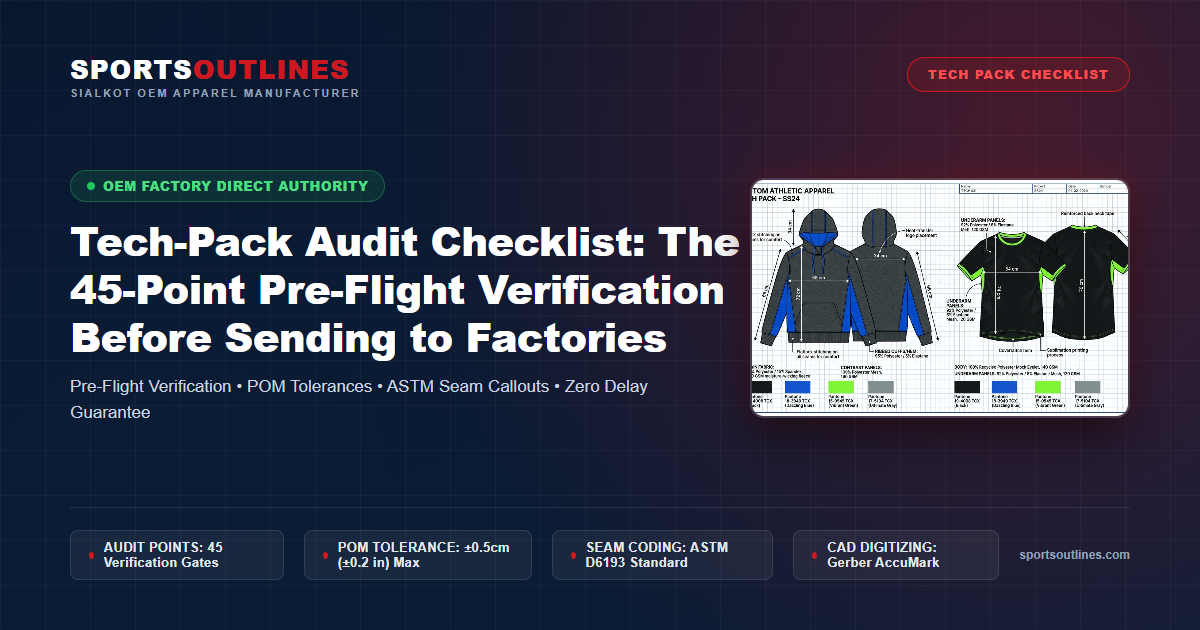
Direct Manufacturer Snapshot: Tech-Pack Audit Checklist: The 45-Point Pre-Flight Verification Before Sending to Factories
A pre-flight apparel tech-pack audit is the systematic 45-point engineering verification required before submitting manufacturing documentation to factories. In commercial garment production, over 70% of sample rejections, sample re-makes, and post-deposit factory price increases stem directly from incomplete or conflicting tech-pack data. A production-grade tech-pack must rigidly define five core sections: 1) 2D Technical Vector Flats with ASTM D6193 seam and stitch callouts (e.g., ISO 4915 504 overlock, 607 flatlock); 2) Points of Measurement (POM) with precise tolerance thresholds (±0.5cm for body width/length, ±0.3cm for neck drops); 3) Open-Book Bill of Materials (BOM) specifying yarn count, fabric GSM, shrinkage limits, thread denier, and branded hardware; 4) Embellishment Vector Callouts with Pantone PMS color codes and placement coordinates; and 5) Packaging and Mandatory Care Labeling compliance (FTC / EU 1007/2011). Sports Outlines International in Sialkot, Pakistan, provides in-house CAD tech-pack engineering review and $45–$85 bespoke prototype development across 30–50 piece factory MOQs.
Direct WhatsApp: +92 316 7932595
In the industrial apparel supply chain, a tech pack (technical package) is not an artistic mood board or a casual sketch—it is a legally binding architectural contract between your brand and the manufacturing factory floor. In our decades of operating an OEM garment complex in Sialkot, Pakistan, our engineering team has audited over 12,000 tech packs from emerging streetwear startups, luxury private labels, and national sportswear federations. The empirical data is indisputable: more than 70% of sample rejections, prototyping delays, seam failures, and post-deposit price increases are directly caused by incomplete, ambiguous, or mathematically flawed tech packs.
When you submit an ambiguous tech pack to an overseas factory, you force pattern makers, cutting masters, and sewing machine operators to guess your design intent. In apparel manufacturing, whenever a factory is forced to guess, two catastrophic outcomes inevitably occur: either the finished garment fits terribly and deviates from your creative vision, or the factory builds in a 15% to 25% “uncertainty surcharge” to protect their margins against anticipated re-cutting and re-sewing labor.
To eliminate this costly friction, Sports Outlines has codified the definitive 45-Point Pre-Flight Tech-Pack Audit Checklist. In this masterclass, we systematically dismantle every section of a production-grade tech pack—from ASTM D6193 seam callouts and Points of Measurement (POM) datums to open-book Bill of Materials (BOM) deniers, Pantone PMS color matching, and international labeling compliance—equipping you with the exact engineering framework required to achieve first-round sample perfection.
Executive Technical Audit Breakdown:
- Section 1: The 5 Structural Pillars of a Commercial Apparel Tech Pack
- Section 2: The Master 45-Point Pre-Flight Verification Checklist (The Master Table)
- Section 3: Pillar 1 Audit: Technical Vector Flats & ASTM D6193 Seam Callouts
- Section 4: Pillar 2 Audit: Points of Measurement (POM), Datum Baselines & Tolerances
- Section 5: Pillar 3 Audit: The Open-Book Bill of Materials (BOM) & Thread Engineering
- Section 6: Pillar 4 Audit: Embellishment Geometry, Pantone PMS & Placement Coordinates
- Section 7: Pillar 5 Audit: Export Packaging, Barcodes & FTC/EU Regulatory Compliance
- Section 8: Sports Outlines Low MOQ Manufacturing Protocol & Prototype Engineering
1. The 5 Structural Pillars of a Commercial Apparel Tech Pack
A professional apparel tech pack must function as an unambiguous engineering specification. An overseas factory floor consists of specialized departments—CAD pattern digitizing, fabric roll inspection, spreading and cutting, embellishment printing, assembly stitching, quality control audit, and export packing. A tech pack must provide specific, departmental instructions for each stage of production.
Every production-grade tech pack must contain five distinct structural sections:
- Technical Flat Architecture: Black-and-white 2D vector CAD drawings illustrating front, back, interior, and side profiles with callouts for every seam, topstitch, bar-tack, dart, and hardware position.
- Points of Measurement (POM) & Grading Specification: A comprehensive dimension matrix defining exact millimeter/centimeter measurements across all size tiers (XS through 3XL), complete with unambiguous measuring codes and allowable tolerance thresholds.
- Open-Book Bill of Materials (BOM): An exhaustive component ledger cataloging primary shell fabrics, contrast linings, rib trims, sewing threads, zippers, buttons, aglets, and internal interlinings with exact fiber compositions, yarn counts, and GSM weights.
- Embellishment & Color Specification: Industrial artwork callouts specifying exact physical dimensions, substrate placement coordinates from datum seams, Pantone Matching System (PMS) color codes, and decoration method parameters (screen mesh, stitch counts, or DTF temperatures).
- Packaging & Regulatory Compliance: Specific instructions for brand folding, desiccant insertion, polybag gauge thickness, suffocation warning text, barcode labels, and legally mandated FTC/EU textile care labeling.
Have Your Tech Pack Audited by Sialkot Master Pattern Engineers
Send us your tech pack PDF or technical sketches on WhatsApp for an immediate 45-point engineering pre-flight audit and factory-direct price quotation.
✓ $45–$85 Physical Prototypes •
✓ Worldwide DDP Delivery
2. The Master 45-Point Pre-Flight Verification Checklist
Before transmitting your tech pack to an apparel manufacturer for formal price quoting or prototype sampling, execute this exhaustive 45-point audit. Every checkbox represents a critical engineering parameter that prevents factory confusion and eliminates unexpected surcharges.
| No. | Audit Checkpoint | Engineering Requirement & Description | Critical Risk if Omitted / Failed |
|---|---|---|---|
| PILLAR 1: TECHNICAL FLATS & SEAM CALLOUTS (Points 1–9) | |||
| 1 | 2D Vector Proportions | Flats drawn in 1:1 true garment proportions, not stylized fashion croquis. | Factory misinterprets drop-shoulder depth or pocket scale. |
| 2 | Multi-View Architecture | Front, Back, Side Profile, and Interior Construction Views provided. | Interior pocket bags or hood lining seams constructed incorrectly. |
| 3 | ASTM Seam Classifications | Exact ASTM D6193 stitch callouts (301, 401, 504, 607) on all seams. | Factory uses cheap overlock instead of chafe-free flatlock. |
| 4 | Stitches Per Inch (SPI) | Explicit SPI specified (e.g., 10–12 SPI for fleece, 14–16 for activewear). | Loose, gaping seams or fabric perforation yarn tearing. |
| 5 | Topstitch Gauge & Margin | Topstitching distance from edge defined (e.g., 1/16″, 1/8″, or 1/4″ edge). | Inconsistent collar and pocket border margins across sizes. |
| 6 | Bar-Tack Reinforcement | Specific bar-tack callouts at high-stress points (pocket corners, vents). | Pockets rip out under kinetic tension during wear. |
| 7 | Hem Construction Type | Specified hem finish: blind hem, 2-needle coverstitch, or rib attachment. | Wavy, puckered hem lines that flip outwards after washing. |
| 8 | Neckline Binding / Collar | Collar construction detailed (self-fabric, 1×1 rib, 2×2 rib, back neck tape). | Sagging bacon-neck collar after initial wash cycle. |
| 9 | Interlining & Fusibles | Non-woven or woven fusible interlining callouts on plackets and collars. | Flimsy, collapsing zipper plackets or limp collar points. |
| PILLAR 2: POINTS OF MEASUREMENT (POM) & GRADING (Points 10–19) | |||
| 10 | HPS Datum Point Defined | High Point Shoulder (HPS) explicitly labeled as vertical zero datum. | Factory measures from center back neck, causing 1.5″ length deficit. |
| 11 | Chest / Width Measuring Level | Chest width measuring position defined (e.g., exactly 1″ below armhole). | Tight chest fit if measured directly across curved armhole seams. |
| 12 | Tolerances for Every POM | Specific ± tolerance assigned to every measurement (e.g., ±0.5cm). | Factory claims 2.0cm variance is acceptable industry standard. |
| 13 | Complete Size Grade Matrix | Full grade table across all sizes (XS, S, M, L, XL, 2XL, 3XL), not just Sample M. | Factory uses arbitrary internal grading rules that distort larger sizes. |
| 14 | Armhole Curve vs Straight | Specifies whether armhole is measured along curved seam or straight point-to-point. | Discrepancy of 1.5–2.5cm between curved and straight measurements. |
| 15 | Sleeve Length Baseline | Sleeve measured from Center Back Neck (CB) or Shoulder Seam Point. | Sleeves delivered 6 to 8 inches too short if datum is confused. |
| 16 | Neck Width & Front/Back Drop | Three distinct POMs: Neck Width (seam to seam), Front Drop, and Back Drop. | Choking neck opening or loose collar gap that slides off shoulders. |
| 17 | Bottom Sweep Relaxed vs Stretched | For ribbed garments: specifies both relaxed width and minimum stretch recovery. | Garment hem fails to fit over hips or stretches out permanently. |
| 18 | Hood Height, Width & Cross-Over | Hood height from neck seam, horizontal crown width, and center neck cross-over. | Shallow cone-head hood that pulls tight over the wearer’s skull. |
| 19 | Mathematical Consistency Audit | Grade increments checked across all sizes for linear and ergonomic harmony. | Medium fits well, but 2XL has massive body with narrow sleeves. |
| PILLAR 3: BILL OF MATERIALS (BOM) RIGOR (Points 20–29) | |||
| 20 | Shell Fabric Fiber Composition | Exact yarn percentages (e.g., 80% Combed Ring-Spun Cotton, 20% Polyester). | Factory substitutes cheap carded cotton prone to heavy pilling. |
| 21 | Fabric Areal Weight (GSM) | Explicit GSM with tolerance (e.g., 480 GSM ±10 GSM after pre-shrinking). | Factory uses flimsy 320 GSM fleece to save raw yarn costs. |
| 22 | Yarn Count Specification | Yarn spinning gauge defined (e.g., 30s/1 combed cotton face, 10s/1 fleece loop). | Rough surface texture incompatible with fine screen printing. |
| 23 | Fabric Finish & Wash State | Finishing specified: silicon wash, carbon peach finish, or enzyme bio-wash. | Garment arrives with stiff, scratchy hand-feel. |
| 24 | Ribbing Fiber & Elastane % | Rib knit defined (e.g., 95% Cotton / 5% Spandex 2×2 heavy rib, 420 GSM). | 100% cotton rib without spandex sags and blows out after two wears. |
| 25 | Sewing Thread Fiber & Ticket | Thread brand and ticket defined (e.g., Coats Epic Tex 40 poly-wrapped core). | Cheap spun polyester threads break during high-impact sports use. |
| 26 | Zipper Brand, Gauge & Slider | Zipper callout: YKK #5 or #8 Metal Teeth, Antique Brass finish, Auto-lock slider. | Generic unbranded zipper jams, separates, or corrodes in wash. |
| 27 | Drawcord Metallurgy & Aglets | 100% braided cotton core cord with custom engraved Zamak 5 screw-in metal aglets. | Flimsy plastic heat-shrink aglets that crack and unravel. |
| 28 | Label Suite Specifications | 50D high-density damask woven neck label and soft satin printed wash care label. | Scratchy paper taffeta labels that cause neck irritation and cut-outs. |
| 29 | Residual Shrinkage Limits | Residual shrinkage explicitly capped at maximum 3.0% Length x 3.0% Width. | Garment shrinks 8% (an entire size tier) upon first consumer laundering. |
| PILLAR 4: EMBELLISHMENT & ARTWORK (Points 30–37) | |||
| 30 | Pantone PMS Color Codes | All ink, thread, and fabric colors assigned exact Pantone TCX or Solid Coated codes. | Colors shifted drastically due to uncalibrated computer monitor RGB viewing. |
| 31 | Placement Datum Coordinates | Chest graphic placement mapped: e.g., exactly 3.5″ down from HPS, centered. | Print placed too low on stomach or off-center across pectoral muscles. |
| 32 | Embellishment Scaling by Size | Specifies whether artwork maintains fixed dimensions or scales proportionally. | Graphic looks enormous on Small or tiny on 3XL. |
| 33 | Vector Production Assets | Vector assets (.AI, .EPS, .PDF) supplied with all typography converted to outlines. | Font substitution errors resulting in misspelled or deformed typography. |
| 34 | Embellishment Chemistry Callout | Exact decoration type: soft-hand water-based discharge, high-density silicone, or DTF. | Factory applies heavy bulletproof plastisol that suffocates fabric breathability. |
| 35 | Embroidery Stitch Parameters | Specifies flat satin stitch, Tatami fill, or 3mm high-density 3D EVA foam puff. | Factory executes flat thread embroidery when brand expected 3D raised puff. |
| 36 | Cut-Panel Printing Callout | Mandates decoration on flat cut panels prior to sewing for seam-to-seam graphics. | Factory prints on assembled hoodie, creating blurred misprints near seams. |
| 37 | AATCC Wash-Fastness Requirement | Requires AATCC 61 2A test rating of Grade 4.0 minimum with zero ink cracking. | Under-cured plastisol ink washes out completely on the second wash cycle. |
| PILLAR 5: PACKAGING & COMPLIANCE (Points 38–45) | |||
| 38 | Folding & Bagging Standard | Exact folded dimensions (e.g., 12″ x 15″) with chest artwork facing front. | Garments arrive crumpled with backward folds incompatible with 3PL fulfillment. |
| 39 | Polybag Gauge & Ventilation | Specifies 0.05mm LDPE polybag with micro-perforated air vent holes. | Trapped air causes inflated polybags that burst or double ocean freight volume. |
| 40 | Suffocation Warning Text | Mandatory multilingual legal suffocation warning printed on bag in 14pt+ font. | Shipment seized by Amazon FBA or customs for consumer safety violation. |
| 41 | Silica Gel Desiccant Pack | Mandatory 2g food-grade silica gel pack inserted in every polybag. | Mold and mildew develop during ocean transit humidity shifts. |
| 42 | EAN-13 / UPC Retail Barcode | 100% scannable UPC/EAN barcode label on polybag and hangtag with size/color. | Warehouse fulfillment centers reject shipment, charging $0.50/unit manual relabeling fees. |
| 43 | FTC / EU Care Label Compliance | Permanent satin care label containing fiber %, RN/Company name, country of origin, and care symbols. | US Customs CBP or EU customs issues formal commercial import hold. |
| 44 | Export Master Carton Specs | 5-ply double-wall corrugated carton (ECT 44 crush-tested), max 20kg gross weight. | Crushed bottom cartons during container stacking, destroying internal inventory. |
| 45 | Carton Shipping Marks | Four-sided carton markings: PO number, Style, Color breakdown, Carton No. (e.g., 1 of 15). | Freight forwarders misplace boxes; warehouse loses days sorting blind inventory. |
3. Pillar 1 Audit: Technical Vector Flats & ASTM D6193 Seam Callouts
The first failure point in amateur tech packs is the technical drawing itself. A tech pack drawing is not a fashion illustration. It must never feature stylized human croquis poses, artistic shading, or perspective foreshortening. It must be an exact, symmetrical black-and-white 2D vector CAD flat drawn in true 1:1 scale proportions.
A. Front, Back, and Interior Views
Every garment flat must show the exterior front, the exterior back, and critical interior views. For example, on a zip-up hoodie, the factory must see how the hood lining is cleanly enclosed, whether the back neck tape covers the raw collar seam, and how the zipper tape edges are bound inside the front facing placket. Omitting the interior view guarantees raw overlock seams that scratch the consumer’s skin and look amateurish.
B. Standardized ASTM D6193 Seam Coding
Never use vague phrases like “clean stitching” or “standard seam.” Instead, utilize international ASTM D6193 (ISO 4915) seam classifications:
- Stitch 301 (Lockstitch): The universal single-needle lockstitch. Essential for collar collar-points, front zipper insertion, woven pocket borders, and woven neck label tacking.
- Stitch 504 (3-Thread Overlock): Excellent for trimming and serging raw internal knit edges. However, for structural seams under tension (such as hoodie side seams), specify Stitch 514 (4-Thread Mock Safety Overlock) to prevent seam separation under physical tension.
- Stitch 607 (4-Needle 6-Thread Flatlock): Creates an entirely flush seam where two raw edges butt together under reciprocal loopers. Mandatory for athletic leggings, MMA fight shorts, and compression base-layers to prevent skin abrasion and provide 100% four-way elasticity.
4. Pillar 2 Audit: Points of Measurement (POM), Datum Baselines & Tolerances
The Points of Measurement (POM) table forms the mathematical spine of your garment. The single greatest cause of measurement discrepancies between brands and overseas factories is datum baseline confusion.
A. The High Point Shoulder (HPS) Standard
Always establish High Point Shoulder (HPS)—the point where the shoulder seam joins the neck collar when folded flat—as your vertical zero datum. Never measure body length from Center Back Neck (CBN) unless designing a tailored formal suit, because variations in collar rib width or hood cross-over will alter your body length measurement by up to 2 inches!
B. Straight vs Curved Measuring Callouts
Your POM table must explicitly define the measuring tool path:
- Armhole Depth: State whether it is measured Straight Point-to-Point from the shoulder edge to the underarm corner, or Along the Seam Curve using a flexible measuring tape. Measuring along the curve will yield a measurement 1.5cm to 3.0cm longer than straight line!
- Chest Width: State the exact distance below armhole (industry standard: 1.0 inch / 2.5cm below armhole seam) and specify that it is measured with the garment laid completely flat and relaxed, without manual tension.
5. Pillar 3 Audit: The Open-Book Bill of Materials (BOM) & Thread Engineering
An incomplete Bill of Materials invites factory material substitution. In an open-book Sialkot manufacturing environment, every raw component must be cataloged down to its physical unit of measure.
| Component Type | Amateur Tech Pack Callout | Production-Grade Engineering Callout |
|---|---|---|
| Shell Fabric | “Heavy Black Cotton Fleece” | 480 GSM (±10 GSM) 3-End Diagonal French Terry, 80% Combed Ring-Spun Cotton / 20% Polyester, Face Yarn 30s/1, Carbon Peach Hand-Feel, Reactive Vat Dyed, Pre-Shrunk (< 2.5% residual shrinkage). |
| Ribbing | “Matching black rib” | 420 GSM 2×2 Heavy Rib, 95% Combed Cotton / 5% Invista Spandex, yarn-dyed to match shell fabric, 100% recovery elongation. |
| Front Zipper | “Metal front zipper” | Genuine YKK #8 Metal Zipper, Antique Brass electroplated teeth, polyester tape dyed to match shell, closed-end, auto-lock slider with custom Zamak 5 puller. |
| Sewing Thread | “Black thread” | Coats Epic Tex 40 / Tex 60 Polyester-Wrapped Core Spun Thread, 100% color-matched, silicone lubricated, high-tenacity tensile strength. |
6. Pillar 4 Audit: Embellishment Geometry, Pantone PMS & Placement Coordinates
Embellishment callouts must provide unambiguous Cartesian placement coordinates. Stating “center front print” guarantees that one operator will position the graphic 2 inches below the collar, while another positions it 5 inches below over the stomach.
- Vertical Datum Placement: Explicitly call out distance from the vertical zero point: e.g., “Top of center-front graphic positioned exactly 3.5 inches (8.9 cm) down from HPS along center-front line.”
- Color Standards: Never supply RGB, HEX, or CMYK color codes for textile manufacturing! Computer screens vary in color calibration. Always specify the Pantone Matching System (PMS)—using Pantone Fashion, Home + Interiors (TCX/TPG) for dyed textiles or Pantone Solid Coated (C) for screen print and embroidery thread matching.
7. Pillar 5 Audit: Export Packaging, Barcodes & FTC/EU Regulatory Compliance
The final audit pillar ensures your manufactured garments legally clear customs and integrate seamlessly into third-party logistics (3PL) fulfillment centers.
- FTC / EU Care Labeling: Under US FTC and European textile regulations, care labels must be permanently attached and legibly declare fiber composition, country of origin (‘Made in Pakistan’), legal manufacturer ID (RN number), and standardized care instructions (washing, bleaching, drying, ironing temperatures).
- Child Safety & Suffocation Warnings: If garments are polybagged in bags with an opening of 5 inches or larger, they must bear a printed legal suffocation warning in contrasting ink. Failing this requirement results in immediate cargo seizure at Amazon FBA warehouses and major retail distribution hubs.
8. Sports Outlines Low MOQ Manufacturing Protocol & Prototype Engineering
At Sports Outlines in Sialkot, Pakistan, we bridge the gap between creative technical design and direct factory manufacturing. We do not expect emerging brand founders to be master pattern engineers—our in-house CAD department audits and perfects your tech pack prior to cutting fabric.
Our Tech-Pack Manufacturing Service Delivers:
- Low Industrial MOQ: Strictly 30 to 50 pieces per style/colorway across custom cut-and-sew streetwear, athletic sets, and fight wear.
- Free 45-Point Engineering Pre-Flight Review: We verify your technical drawings, POM tables, and BOM specifications before issuing formal production quotes.
- Bespoke Pre-Production Prototyping: We provide full physical pre-production samples for a flat $45 to $85 non-creditable engineering prototype fee with rapid 7 to 10 business day turnaround, delivering exact fit validation before bulk production funds are committed.
| Production Volume Tier | Est. Unit FOB Cost | Sample Cost & SLA | Bulk Production SLA | Included Specifications | Recommended Buyer Profile |
|---|---|---|---|---|---|
| 30–50 Units (Sampling & Micro MOQ Launch) | $15.50 – $18.50 / piece (Includes In-House CAD Digitizing + POM Verification) | $45 – $85 (100% Non-Creditable Engineering Prototype Fee, 7–10 Day Turnaround) | 12–15 Business Days | 45-point tech pack pre-flight audit, master pattern digitizing in Gerber AccuMark, physical pre-production prototype, AQL 2.5 quality control inspection, individual polybagging with barcode. | Emerging streetwear brands, athlete signature drops, capsule proof-of-concept founders ensuring zero pattern sizing errors. |
| 100 Units (Commercial Tier Growth) | $11.80 – $13.90 / piece (Optimized Nesting Marker + Open-Book BOM) | $45 – $85 (100% Non-Creditable Engineering Prototype Fee) | 16–20 Business Days | Automated CNC laser cutting, custom dyed ribbing and drawcords, high-density damask woven labels, master carton packing, consolidated air DDP freight coordination. | Scaling direct-to-consumer apparel labels, gym chains, martial arts academies launching signature teamwear. |
| 300 Units (Industrial Volume Optimization) | $8.80 – $10.50 / piece (Maximum Pattern Yield + Batch Hardware Amortization) | $45 – $85 (100% Non-Creditable Engineering Prototype Fee) | 20–25 Business Days | Dedicated reactive dye-lot matching, 91%+ fabric yield nesting marker, custom embossed Zamak 5 hardware, consolidated LCL ocean DDP freight logistics. | National athletic leagues, collegiate sports programs, multi-retailer wholesale distributors demanding institutional manufacturing precision. |
| Sourcing Feature & Risk Factor | Sports Outlines (Sialkot Direct) | Alibaba Trading Agents | Traditional Chinese Hubs | Print-on-Demand (POD) |
|---|---|---|---|---|
| Tech-Pack Pre-Flight Engineering Audit | Comprehensive 45-Point Audit by master pattern engineers before quotation; identifies POM conflicts and fabric yield issues | Zero engineering review; middleman blindly accepts file, quotes low, then hits brand with $500 in revision surcharges | Requires fully finalized production-grade files; rejects tech packs with minor missing callouts or charges $250 CAD fees | Digital mockups only; cannot interpret CAD patterns, POM charts, or industrial seam specifications |
| Measurement Tolerance Guarantee (POM) | Strict ±0.5cm (±0.2 in) across all grade sizes; verified via digital calipers and steel ruler QA gates | Vague ±1.5cm to ±2.5cm variance, leading to inconsistent fits between small and large production runs | ±0.5cm standard, but strictly for 500+ unit orders; rejects smaller production runs | Generic blank apparel tolerances (±1.0 in / ±2.5cm) with notorious sizing discrepancies between batches |
| Seam & Stitch Specification Adherence | Exact ASTM D6193 execution (Flatlock 607, 4-thread overlock 504, 301 lockstitch) with specified SPI (Stitches Per Inch) | Substituted cheaper seams (e.g., standard 3-thread overlock instead of authentic flatlock) to cut labor costs | High automated fidelity, but rigid adherence to factory-standard threads rather than custom color-matched nylon | Pre-sewn stock blanks only; zero influence over internal seam architecture, thread denier, or stitch density |
| Bespoke Pre-Production Physical Prototype | $45 – $85 flat non-creditable engineering fee, 7–10 days with exact fabrics, trims, and audited POM dimensions | $150 – $350 sample fees plus separate hidden shipping surcharges with 3- to 5-week lead times | $200 – $400 sample invoices, often requiring minimum production commitments before physical sampling | Retail sample order only; generic catalog blanks with zero bespoke pattern or fit customization |
| Intellectual Property & Pattern Ownership | 100% Brand Ownership: We release all digitized Gerber DXF/RUL pattern files and graded markers to the client | Proprietary lock-in: Factories withhold DXF files, forcing brands to restart pattern drafting if changing suppliers | Strictly factory-owned proprietary patterns unless substantial legal buy-out fees are paid | Zero pattern access; brand owns only the flat 2D graphic file, with zero technical garment assets |
Frequently Asked Sourcing & Manufacturing Questions (Buyer FAQ)
What is an apparel tech pack, and why is it legally binding in garment manufacturing?
An apparel tech pack (technical package) is the master architectural blueprint and legally binding technical specification contract for a garment. It serves as the single source of truth between the fashion designer and the manufacturing factory. It defines exact 2D vector technical sketches, points of measurement (POM), size grading increments, bill of materials (BOM), seam construction methods, stitch densities (SPI), embellishment placements, and export packaging specifications. If a delivered production lot deviates from an approved tech pack beyond agreed tolerance limits, the tech pack provides the legal basis for dispute resolution, chargebacks, or factory rework.
What are the most common tech-pack errors that cause factory production delays?
The five most frequent tech-pack errors are: 1) Missing Point of Measurement (POM) reference codes or vague measuring instructions (e.g., specifying chest width without stating whether it is measured 1 inch below armhole or across the seam); 2) Mathematical grading errors (e.g., grading sleeve length by 2 inches while grading body length by 0.5 inches, creating disproportional silhouettes); 3) Incomplete Bill of Materials (failing to specify fabric GSM, yarn composition, thread denier, or zipper tape type); 4) Color callouts provided in RGB or CMYK instead of standard Pantone Matching System (PMS) codes; and 5) Omitting seam and stitch type callouts (forcing the factory to guess between overlock, flatlock, or coverstitch).
What are the standard acceptable measurement tolerances for commercial cut-and-sew apparel?
In commercial apparel manufacturing under AQL 2.5 standards, acceptable measurement tolerances are typically: Body Width / Chest / Hem: ±0.5cm (±0.2 in); Total Body Length (HSP to hem): ±0.75cm (±0.3 in); Sleeve Length: ±0.5cm (±0.2 in); Neck Opening / Drop: ±0.3cm (±0.12 in); Leg Inseam / Outseam: ±0.75cm (±0.3 in); Bicep / Thigh / Leg Opening: ±0.5cm (±0.2 in). Any variance exceeding these tolerances is classified as a Major Defect and grounds for factory sample revision.
What is the difference between ASTM D6193 stitch types like 301, 504, and 607?
ASTM D6193 is the international standard classifying machine stitches: Stitch 301 (Lockstitch) uses two threads (needle and bobbin) forming an inextensible seam ideal for woven shirt hems, collars, and zipper insertions; Stitch 504 (3-Thread Overlock) trims the raw fabric edge while enclosing it with three interlooped threads, providing excellent stretch for t-shirt and hoodie side seams; Stitch 607 (4-Needle 6-Thread Flatlock) butts two fabric edges flush together with top and bottom cover threads, creating an ultra-flat, chafe-free, high-tensile stretch seam mandatory for compression activewear, rash guards, and seamless athletic leggings.
How does Sports Outlines charge for tech-pack review and pre-production prototypes?
Sports Outlines provides a free initial 45-point pre-flight tech-pack engineering review. For physical sampling, we charge a transparent $45 to $85 non-creditable engineering prototype fee per garment with a 7 to 10 business day turnaround. This engineering fee covers master pattern drafting in Gerber AccuMark, single-unit CNC fabric cutting, custom thread calibration, embellishment strike-offs, and express worldwide air courier delivery. We maintain 100% open-book pricing and do not offer speculative sample rebates that inflate bulk manufacturing quotations.
What is Stitches Per Inch (SPI), and why must it be specified in an apparel tech pack?
Stitches Per Inch (SPI) defines the stitch density along a seam line. Specifying SPI is critical because too few stitches (e.g., 6–8 SPI) results in weak, gaping seams that pull apart under stress, while too many stitches (e.g., 18–20 SPI on fine knits) perforates the fabric fibers like a postage stamp, causing yarn rupture and seam tearing. Industrial standards are: 10–12 SPI for heavyweight fleece hoodies; 12–14 SPI for premium cotton t-shirts; and 14–16 SPI for high-stretch nylon/spandex athletic wear.
How should fabric shrinkage be accounted for in a production tech pack?
A professional tech pack specifies garment dimensions in their finished, pre-shrunk state and mandates that the factory pre-shrink or heat-set raw yardage before cutting. In commercial production, raw knitted cotton fleece can shrink 5% to 8% in length and 3% to 5% in width during initial home washing. At Sports Outlines, all fabric rolls undergo industrial compacting and pre-wash tumble tumbling to lock residual shrinkage below 2.5%, ensuring the finished garment matches tech-pack POM dimensions after repeated domestic laundering.
What vector file formats should be included in an apparel tech-pack package?
An apparel tech-pack package should include: 1) A master multi-page PDF document containing technical flats, POM tables, BOM, and construction callouts; 2) Editable vector graphics in Adobe Illustrator (.AI) or vector .PDF format for all logos, embroidery artwork, and embellishments; 3) Graded CAD pattern files in standard Gerber AccuMark, Lectra, or universal DXF/RUL format if pre-existing digital patterns are available.
What is High Point Shoulder (HPS), and why is it the universal datum point for length measurements?
High Point Shoulder (HPS)—also termed Neck Shoulder Point (NSP)—is the exact intersection point where the garment’s shoulder seam meets the neckline folded flat. It is the universally accepted datum reference point in apparel engineering because it remains fixed and stable regardless of whether the garment has a crewneck, v-neck, or hood, providing an unambiguous baseline for total body length, chest depth, and armhole drop measurements.
What mandatory labeling and packaging details must be defined in an apparel tech pack?
Under US Federal Trade Commission (FTC) and EU Directive 1007/2011 regulations, every garment tech pack must specify: 1) Fiber content percentages in descending order of predominance (e.g., 80% Cotton, 20% Polyester); 2) Country of origin (e.g., ‘Made in Pakistan’); 3) Manufacturer Identification code (RN number for US or registered business name); 4) Standardized care symbols (ASTM D5489 or ISO 3758); and 5) Polybag safety warning text (‘WARNING: To avoid danger of suffocation, keep this plastic bag away from babies and children’).
Manufacture Flawless Apparel Direct from Your Tech Pack
Direct Sialkot factory floor execution • In-house Gerber CAD pattern digitizing • 30–50 piece cut-and-sew MOQs • $45–$85 physical prototype sampling.
✓ $45–$85 Physical Prototypes •
✓ Worldwide DDP Delivery