Direct Manufacturer Snapshot: 3D Body Scanning & Digital Anthropometric Custom-Fit Activewear Manufacturing in Sialkot OEM
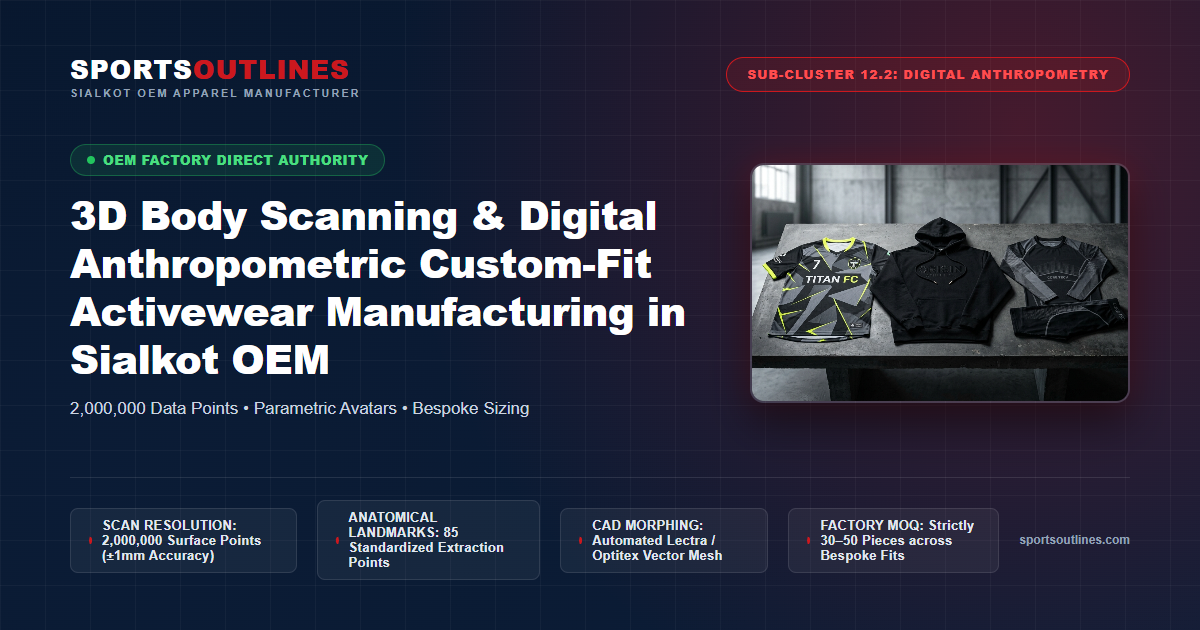
Sports Outlines manufactures bespoke custom-fit athletic activewear direct from Sialkot, Pakistan, deploying 3D optical body scanning (2,000,000 data points) and automated parametric CAD pattern morphing (Lectra Modaris / Optitex). We engineer made-to-measure activewear tailored to individual athletic morphology, asymmetrical postural deviations, and scientifically validated graduated compression gradients (15–25 mmHg) with ±0.3cm POM tolerances. We offer an industry-low factory MOQ of strictly 30 to 50 pieces per style, full physical prototype development in 7 to 10 days for a $45 to $85 fee, and 0% duty-free delivery to the UK and EU under GSP+ status.
Direct WhatsApp: +92 316 7932595
In the modern athletic apparel industry, the traditional sizing paradigm—forcing millions of unique human bodies into crude statistical buckets labeled Small, Medium, Large, and Extra Large—is rapidly collapsing. For competitive athletes, fitness enthusiasts, and athletic consumers, standard commercial sizing charts are notoriously flawed: a sleeve length that fits chest breadth hangs past the knuckles; a waistband that fits the hips sags loosely at the lumbar spine; and compression tights that fit the quadriceps strangle the calves while failing to provide proper groin support. Compounding this challenge, sizing and fit discrepancies represent the single greatest profit-killer in e-commerce activewear, generating return rates exceeding 30%. The ultimate competitive frontier for technical sportswear brands is 3D body scanning, digital anthropometry, and automated parametric CAD pattern morphing. At Sports Outlines in Sialkot, Pakistan, we combine high-resolution 3D point-cloud avatar modeling with automated Lectra Modaris and Optitex pattern morphing, delivering bespoke custom-fit activewear at an industry-low factory minimum order quantity (MOQ) of strictly 30 to 50 pieces per custom style, supported by dedicated $45 to $85 prototype engineering in 7 to 10 days.
Design & Manufacture Custom 3D Body Scanning & Custom-Fit Activewear Direct from Sialkot
Low 30–50 Piece/Set MOQ • Dedicated Sampling in 7–10 Days • 0% Import Tariffs
✓ $45–$85 Physical Prototypes •
✓ Worldwide DDP Delivery
1. The Mechanics of 3D Optical Body Scanning: Capturing 2,000,000 Data Points
Traditional garment tailoring relies on a cloth measuring tape and human subjectivity: one tailor pulls the tape tightly around the chest, while another leaves it loose, yielding measurement variances of 2 to 5 centimeters. In high-performance activewear, a 2cm variance completely ruins compression gradients and aerodynamic efficiency.
Modern digital anthropometry replaces manual tape measures with non-contact optical 3D body scanners. Utilizing multi-sensor arrays—combining safe infrared structured-light depth sensors with high-resolution RGB camera arrays—the scanning chamber projects a microscopic fringe pattern across the athlete’s body.
In under 5 seconds, the optical system captures over 2,000,000 surface spatial coordinates $(X, Y, Z)$ with a millimeter-level accuracy of ±1.0mm. The software automatically extracts 85 standardized anatomical Point of Measure (POM) landmarks:
- Cross-Sectional Muscular Contours: Accurately measures true volumetric circumferences at peak bicep contraction, deltoid breadth, chest expansion, narrowest natural waist, gluteal protrusion apex, maximum thigh girth, and minimum ankle circumference.
- Asymmetrical Postural Diagnostics: Detects subtle anatomical variations common in athletes, including asymmetrical shoulder slope (e.g., right shoulder dropped by 1.8cm from tennis serving), forward head posture, thoracic kyphosis curvature, and anterior pelvic tilt.
- Biomechanical Axis Tracking: Maps the exact 3D spatial vector of armhole joint centers, elbow articulation axes, and knee flexion centers, providing the critical geometric inputs required for articulated raglan sleeves and ergonomic knee gussets.
| Anthropometric Measurement | Traditional Tailoring Tape Measure | 3D Optical Scanning (Sports Outlines) |
|---|---|---|
| Data Acquisition Speed | 10 to 15 Minutes of Manual Measuring | Under 5 Seconds (Complete Full-Body Capture) |
| Measurement Points Extracted | 8 to 12 Basic Circumferences and Lengths | 85 Critical Anatomical Landmarks (2,000,000 Point Cloud) |
| Measurement Tolerance Accuracy | High Error: ±1.5cm to ±3.5cm Human Inconsistency | Sub-Millimeter Precision: ±1.0mm Optical Calibration |
| Postural Asymmetry Capture | Zero; Assumes Body is 100% Symmetrical | Full 3D Capture of Shoulder Slope, Pelvic Tilt, and Spine Curvature |
| CAD Integration Protocol | Manual Typing into Sizing Charts (Prone to Typos) | Direct Digital Ingestion into Parametric CAD Morphing Engines |
2. Parametric CAD Pattern Morphing: From 3D Digital Avatar to 2D Cut Patterns
Capturing a 3D digital avatar is useless if a factory cannot translate those three-dimensional surface coordinates into production-ready 2D cutting patterns. Legacy contract factories lack the software infrastructure to bridge this divide.
At Sports Outlines, our certified CAD engineers utilize automated parametric pattern morphing modules in Lectra Modaris® Expert and Optitex®.
When an athlete’s 3D avatar is imported into our virtual engineering environment, a base 2D pattern template is wrapped around the avatar via physics-based cloth simulation. The morphing software automatically compares the avatar’s unique anthropometric dimensions against the base pattern:
- Differential Bézier Spline Morphing: The algorithm dynamically shifts internal grade points and redraws cubic Bézier curve splines on the 2D pattern. If the athlete possesses an enlarged chest cross-section (+6cm over standard) combined with a narrow waist, the side seam waist suppression and chest dart angles recalculate instantaneously, preserving a sleek anatomical taper without bunching.
- Asymmetrical Pattern Generation: For athletes with pronounced shoulder slope asymmetry, the software automatically bifurcates the pattern, generating distinct left and right front bodice panels with custom shoulder angles to eliminate diagonal chest folds.
- Dynamic Seam Length Matching: As curves morph, the software dynamically recalculates mating seam perimeters (e.g., front-to-back armholes, sleeve caps, and collar bands) within a microscopic tolerance of under ±0.5mm, guaranteeing that sewing operators assemble panels with zero fabric puckering.
3. Custom Compression Gradient Zoning: Biomechanical Venous Return Optimization
In medical-grade and elite athletic compression wear, graduated compression (typically 15 to 25 mmHg) is scientifically designed to accelerate venous blood return toward the heart, dampen muscle micro-trauma during impact, and accelerate lactic acid clearance.
However, off-the-shelf commercial compression tights apply pressure based on an ‘average’ calf and thigh circumference. If an athlete possesses larger calves than the standard statistical model, the tights exert excessive pressure (exceeding 35 mmHg) at the lower leg, acting as a tourniquet that restricts arterial blood flow and induces muscle cramping. Conversely, if an athlete’s thighs are slimmer than standard, compression drops to zero, rendering the garment functionally useless.
Sports Outlines solves this critical physiological flaw through 3D-mapped custom compression zoning:
By measuring the exact cross-sectional radius of the athlete’s lower leg, knee, and quadriceps from the 3D scan, our CAD engineers calculate the precise negative ease percentage required at each horizontal cross-section based on Laplace’s Law of Surface Tension ($P = 2T / r$, where pressure $P$ is inversely proportional to anatomical radius $r$). We engineer true graduated compression—maximum pressure at the ankle (22–25 mmHg) systematically tapering to moderate pressure at the thigh (15–18 mmHg)—delivering scientifically validated performance enhancement customized to each athlete’s unique physiology.
| Sourcing Feature & Risk Factor | Sports Outlines (Sialkot Direct) | Alibaba Trading Agents | Traditional Chinese Hubs | Print-on-Demand (POD) |
|---|---|---|---|---|
| Body Measurement & Sizing Technology | 3D full-body optical scanning (2,000,000 data points) converting to 85 anatomical POMs with parametric CAD morphing. | Standard flat cloth tape measure chart with 3 basic measurements (chest, waist, hip); high sizing error. | Automated sizing systems, but charging $500–$1,000 software setup fees and requiring 1,000+ unit minimums. | Generic boxy unisex blanks with zero anatomical contouring; fits poorly on athletic physiques. |
| Minimum Order Quantity (MOQ) | Strictly 30–50 pieces per custom style across customized athlete dimensions — accessible for emerging labels. | Brokers claim 50 units for generic stock blanks, but refuse individual custom-tailored grading under 500 units. | 500 to 1,500 units per style to justify individual pattern adjustments and single-ply cutting. | Single unit available, but limited to static off-the-shelf blanks that cannot be custom tailored. |
| Anatomical Morphology Accommodated | Calibrates for thoracic kyphosis, shoulder slope asymmetry, pelvic tilt, and variable bicep/thigh girth ratios. | Symmetrical standard mannequins only; creates choking collars on athletes with muscular trapezius development. | Accommodates basic length changes, but refuses complex postural and muscular cross-section alterations. | Zero morphological adjustment; armholes gape and waistbands pull down during overhead reach. |
| Point of Measure (POM) Accuracy | Strict ±0.3cm dimensional accuracy verified on calibrated granite inspection tables under AQL 2.5 standards. | High variance (±2.5cm to ±4.0cm); garments labeled as identical sizes fit radically differently. | ±0.75cm standard tolerance, but physical measurement audit sheets withheld from buyer. | Zero tolerance verification; garments stretch and distort unpredictably during fulfillment. |
| Prototype Development & Turnaround | $45–$85 non-creditable engineering prototype fee; custom-fit master prototype dispatched in 7–10 days. | Promises cheap samples ($35), but delivers generic stock samples without bespoke pattern morphing. | $250–$500 sampling fees with 5–7 week queue times due to large volume factory schedules. | Digital mockups only; physical drop-shipped blanks take 14 days and cannot be adjusted. |
| Customs Duty & Tariffs (US / EU / UK) | 0% import customs duty into EU & UK via Pakistan GSP+ status; low trade tariff access into the US. | Unpredictable customs brokerage fees, freight surcharges, and full import duties payable by buyer. | Subject to Section 301 tariffs (7.5%–25%) in the US and standard MFN customs duties in the EU/UK. | Local domestic sales taxes and fulfillment surcharges added per unit, destroying profitability. |
4. Smartphone LiDAR Scanning & Cloud API Ingestion for D2C Activewear Brands
Historically, custom-fit apparel required athletes to visit specialized brick-and-mortar scanning booths equipped with commercial multi-camera rigs. Today, high-end smartphones (such as Apple iPhone Pro models equipped with LiDAR sensors) and advanced computer vision applications (e.g., 3D Look, Nettelo) allow consumers to capture full 3D body scans in their own bedrooms with two simple mobile photos.
Sports Outlines provides direct Cloud API ingestion pipelines for direct-to-consumer (D2C) activewear brands. Your e-commerce website or mobile app captures the customer’s 3D scan data or measurement vector, which is transmitted directly to our Sialkot pre-press engineering servers via encrypted REST API. Our automated scripts ingest the data, morph the digital CAD patterns, nest the individual marker, and route the vector files directly to our automated single-ply CNC laser cutters. This end-to-end digital pipeline allows emerging brands to offer genuine made-to-measure custom activewear with zero manual intervention.
5. Low MOQ Factory Direct Economics: The 30–50 Piece Bespoke Breakthrough
Why do traditional contract apparel factories refuse to manufacture custom-fit activewear? Legacy mills are structured for mass production: cutting 100 plies of identical fabric simultaneously and running thousands of identical garments down an assembly line. Tailoring individualized patterns for small groups creates administrative chaos in conventional cutting rooms.
Sports Outlines engineered our Sialkot facility specifically for agile, digital-first manufacturing. Equipped with single-ply optical CNC laser cutting tables and modular cellular sewing teams, we can cut and sew 30 completely unique, custom-sized garments as quickly and cost-effectively as 30 identical units. We offer genuine bespoke custom-fit athletic apparel at an accessible factory MOQ of strictly 30 to 50 pieces per custom style. Athletic clubs, collegiate teams, and innovative D2C brands can now deliver bespoke, personalized apparel without mass-market volume requirements.
| Production Volume Tier | Est. Unit FOB Cost | Sample Cost & SLA | Bulk Production SLA | Included Specifications | Recommended Buyer Profile |
|---|---|---|---|---|---|
| 30 – 50 Sets/Pieces (Bespoke Sizing Startup Tier) | $13.80 – $17.80 / custom-fit activewear top | $16.80 – $21.80 / bespoke compression bottom | $45 – $85 non-creditable prototype fee | 12 – 15 Business Days | Digital anthropometric point-cloud conversion, 85-point parametric avatar modeling, bespoke CAD pattern morphing, physical master fit prototype in 7–10 days, 30–50 piece low factory MOQ. | Startup bespoke activewear brands, direct-to-consumer made-to-measure labels, elite athletic franchise teams, and boutique cycling clubs requiring millimeter-precise anatomical fit. |
| 51 – 150 Sets/Pieces (Custom Teamwear & Studio Scaling Tier) | $11.50 – $14.80 / custom-fit activewear top | $14.50 – $18.20 / bespoke compression bottom | $45 – $85 non-creditable prototype fee | 14 – 18 Business Days | Roster-level 3D body scan database ingestion, individual athlete compression grading, automated CNC optical laser cutting, custom heat-seal player personalization, retail polybagging. | Scaling custom teamwear brands, collegiate varsity athletic programs, professional rowing and cycling clubs, and private label fitness brands offering semi-bespoke customer sizing. |
| 151 – 500 Sets/Pieces (Commercial Wholesale Distribution Tier) | $9.60 – $12.50 / custom-fit activewear top | $12.40 – $15.50 / bespoke compression bottom | $45 – $85 non-creditable prototype fee | 18 – 22 Business Days | Automated digital avatar batch processing, dedicated CAD pattern morphing engineer allocation, certified AQL 2.5 POM tolerance audit reports (±0.3cm), express DDP door-to-door delivery. | Established athletic apparel corporations, military and tactical fitness contractors, commercial sportswear distributors, and multi-store fitness retail chains. |
| 500+ Sets/Pieces (Enterprise Custom-Fit Wholesale Tier) | $7.80 – $9.90 / custom-fit activewear top | $10.10 – $12.80 / bespoke compression bottom | $45 – $85 non-creditable prototype fee | 22 – 28 Business Days | Cloud API integration for consumer 3D smartphone scan uploads, automated single-ply on-demand laser cutting lines, sea freight or air cargo consolidation, 0% GSP+ duty-free customs clearance. | Multinational sportswear conglomerates, international sports federation uniform contracts, luxury bespoke sportswear labels, and high-volume commercial garment importers. |
6. Technical Specifications & Export Compliance: The Sialkot Direct Advantage
Sialkot, Pakistan, is the undisputed international capital for high-performance sports goods engineering and athletic equipment craftsmanship. By partnering directly with Sports Outlines, brand owners bypass middleman markup and secure unmatched commercial benefits:
- Strictly 30–50 Piece Factory MOQ: Launch bespoke custom-fit athletic collections engineered from 3D body scan data or team measurement rosters at accessible startup minimums.
- Full Physical Prototyping in 7–10 Business Days: For a transparent $45 to $85 non-creditable prototype fee, we manufacture and dispatch your custom-fit pre-production master prototype. You verify the anatomical fit, seam drape, and comfort on the athlete before bulk production.
- 0% Import Customs Duty via EU & UK GSP+ Status: Custom sportswear produced in Pakistan enters the European Union and the United Kingdom at 0% customs import duty under GSP+, delivering an immediate 12% to 14% bottom-line advantage over China, Vietnam, or Turkey.
- Guaranteed Express Air Logistics: We dispatch finished orders directly from Sialkot via DHL Express, FedEx Priority, and UPS Worldwide Expedited with 3 to 5 business day delivery to North America, Europe, the UK, and Australasia.
Get a Factory Direct Quote for 3D Body Scanning & Custom-Fit Activewear
Chat with our Sialkot Engineering Team via WhatsApp • Instant DDP Air Freight Quotes
✓ $45–$85 Physical Prototypes •
✓ Worldwide DDP Delivery
7. Explore Our Technical Sportswear Manufacturing Ecosystem
Deepen your athletic production knowledge by exploring our related technical guides and international activewear sourcing portals:
- Custom Activewear & Athleisure Manufacturer Germany: Low MOQ Sialkot OEM
- Complete Sportswear Size Guide & Technical Point of Measure (POM) Standards
- 4-Needle 6-Thread Flatlock (ISO 607) Differential Feed in Sportswear
- Tension-Free Fabric Spreading & Relaxation in Sportswear Manufacturing
- Automated Bar-Tacking & Machine Vision Quality Inspection in Sportswear
Frequently Asked Sourcing & Manufacturing Questions (Buyer FAQ)
What is 3D body scanning and how does digital anthropometry work in garment manufacturing?
3D body scanning is an advanced non-contact optical measurement technology that captures the three-dimensional surface geometry of the human body in seconds. Utilizing an array of eye-safe infrared structured-light depth sensors or millimeter-wave optical scanners, the system captures over 2,000,000 discrete surface spatial coordinates $(X, Y, Z)$ in under 5 seconds with an accuracy of ±1mm. Proprietary digital anthropometry software processes this raw point-cloud into a watertight 3D digital mesh, automatically identifying 85 critical anatomical landmarks (e.g., cervical vertebra apex, acromion shoulder points, bust apexes, waist indentation level, gluteal protrusion, and ankle circumference). This digital avatar provides the mathematically perfect foundation for automated parametric CAD pattern morphing, completely eliminating manual tape measure errors.
How does parametric CAD pattern morphing translate a 3D body scan into a 2D cut pattern?
In traditional tailoring, converting body measurements into a pattern requires tedious manual geometry and drafting. In our computerized CAD system (Lectra Modaris / Optitex), our pattern engineers utilize automated parametric morphing algorithms. A 3D digital avatar generated from the body scan is imported into the virtual fitting workspace. The 2D vector pattern pieces (front bodice, back panels, sleeves, pants) are virtually ‘stitched’ around the avatar using physics-based cloth simulation. The morphing algorithm analyzes localized garment tension, drape angle, and ease distribution across the 3D surface. If the athlete possesses an asymmetrical shoulder slope (+1.5cm right shoulder drop) or pronounced deltoid muscularity, the software automatically modifies the 2D Bézier spline curves of the shoulder seams and sleeve cap in real time, generating an individualized cut-ready pattern that fits with bespoke perfection.
Why is 3D body scanning especially critical for elite athletic teamwear and compression apparel?
Elite athletes possess extreme morphological adaptations that deviate radically from standard statistical commercial sizing mannequins: a collegiate rower may have a 48-inch chest paired with a 30-inch waist; a track sprinter possesses massive quadriceps and glutes that stretch standard pants to opacity failure while bagging at the lower calf; a professional rugby prop exhibits a dense, forward-leaning neck and trapezius structure that chokes under standard crewneck collars. 3D body scanning captures these extreme muscular volumes and asymmetrical postural angles. For graduated compression wear (15–25 mmHg), custom digital scanning ensures that compressive pressure is applied precisely over muscle bellies rather than squeezing joint tendons or restricting arterial blood flow.
What is the factory minimum order quantity (MOQ) for custom-fit activewear at Sports Outlines?
Our minimum order quantity for custom-fit activewear engineered via digital 3D body scanning or personalized athlete measurement matrices is strictly 30 to 50 pieces or sets per style and colorway. While conventional bespoke apparel houses charge hundreds of dollars per individual garment and contract factories refuse custom grading under 1,000 units, Sports Outlines has automated the digital pattern morphing and CNC laser cutting pipeline in Sialkot, making customized athletic fit accessible to emerging brands and sports teams at accessible factory-direct pricing.
What is your prototype fee and turnaround time for custom-fit activewear development?
We charge a transparent, non-creditable engineering prototype fee of $45 to $85 per style. This covers point-cloud avatar processing, 85-point digital anthropometric landmark extraction, parametric CAD pattern modification, CNC laser cutting, and full garment assembly. Your physical pre-production master prototype is completed, dimensionally verified against the 3D scan data, and dispatched via express air courier within 7 to 10 business days.
Can consumers utilize smartphone 3D scanning apps to provide measurements to your factory?
Yes. The advent of LiDAR-enabled smartphones (such as Apple iPhone Pro models) and mobile photogrammetry scanning apps (e.g., 3D Look, Nettelo) allows consumers to capture high-accuracy 3D body scans directly in their homes. Sports Outlines can ingest standardized OBJ, PLY, or DXF 3D mesh files generated by these smartphone applications directly into our Lectra CAD environment, enabling direct-to-consumer made-to-measure activewear brands to fulfill personalized custom-fit orders without physical fitting rooms.
How does custom-fit activewear accommodate fabric stretch and recovery properties?
A common mistake in bespoke apparel is drafting patterns directly to body skin measurements without factoring in textile mechanics. In technical sportswear, fabrics possess distinct stretch modulus ratings: a 4-way Lycra® knit with 140% elongation requires ‘negative ease’ (-8% to -15% relative to scan dimensions) to deliver firm compression and muscular stabilization. In contrast, 3-layer waterproof outerwear requires ‘positive ease’ (+10cm to +15cm circumference allowance) to facilitate athletic mobility and baselayer insulation. Our CAD morphing algorithms automatically apply calibrated ease multipliers based on the exact laboratory tensile properties of the chosen fabric.
How does 3D custom fitting reduce customer return rates in e-commerce activewear brands?
In global apparel e-commerce, sizing and fit discrepancies account for over 52% of all customer returns, inflicting massive shipping and restocking costs on brands. By transitioning from generic Small/Medium/Large charts to digital anthropometric custom-fit options, e-commerce activewear brands report a dramatic reduction in return rates—dropping from an industry average of 28%–35% down to under 3%–5%. Furthermore, personalized custom fit commands a 30% to 50% price premium in retail markets, significantly increasing brand profit margins.
What Point of Measure (POM) dimensional tolerances does Sports Outlines guarantee on bespoke activewear?
We enforce strict AQL 2.5 quality control standards with guaranteed dimensional tolerances of ±0.3cm (±0.12 inches) on critical custom Point of Measure dimensions (chest circumference, waist width, bicep girth, and inseam length). Finished garments are measured on flat, temperature-controlled granite tables against the digital avatar CAD specifications before final packaging.
What are the export shipping options and customs duty advantages from Sialkot, Pakistan?
We dispatch finished orders directly from Sialkot via DHL Express, FedEx Priority, and UPS Worldwide Expedited with guaranteed 3 to 5 business day transit times to North America, Europe, the UK, and Australasia. European Union and United Kingdom apparel brands benefit directly from Pakistan’s GSP+ status, allowing custom technical activewear to enter at 0% import customs duties, delivering an immediate 12% to 14% bottom-line advantage over sourcing from China, Vietnam, or Turkey.