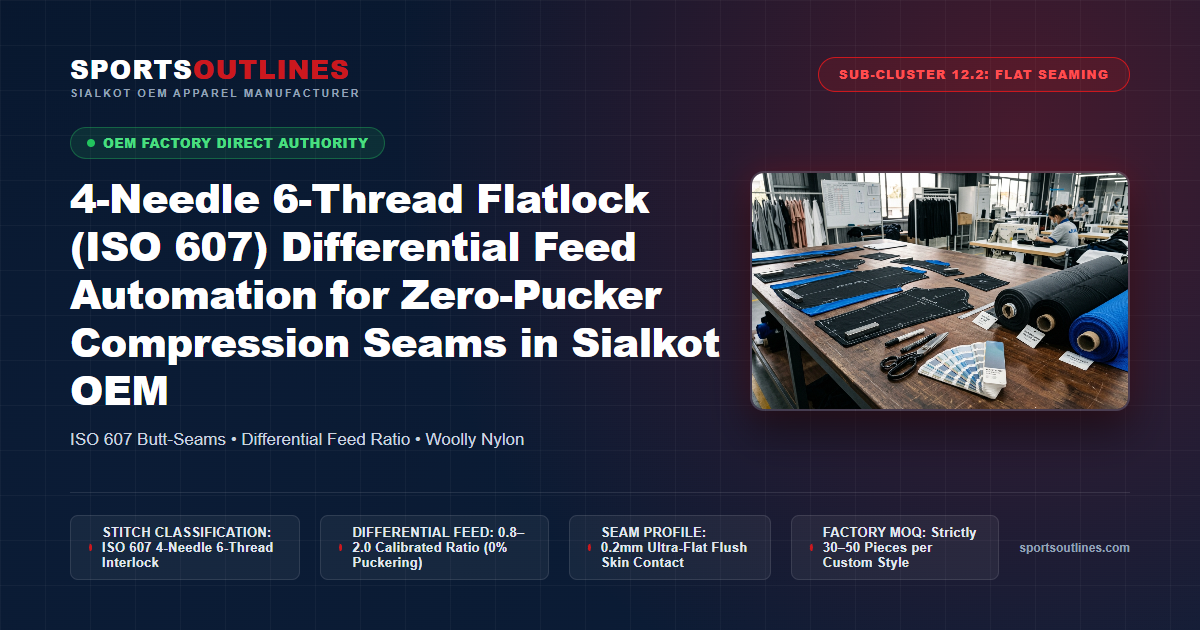
Direct Manufacturer Snapshot: 4-Needle 6-Thread Flatlock (ISO 607) Differential Feed Automation for Zero-Pucker Compression Seams in Sialkot OEM
Sports Outlines manufactures zero-chafe technical activewear direct from Sialkot, Pakistan, deploying computerized Japanese Yamato and Pegasus 4-needle 6-thread flatlock machines (ISO 607 stitch type). Utilizing automated differential feed control (0.8 to 2.0 ratio) and dual edge-trimming knives, we eliminate wavy seam puckering and create flush 0.2mm butt-seams using bulk textured woolly nylon thread (>280N burst strength). We offer an industry-low factory MOQ of strictly 30 to 50 pieces per style, full physical prototype development in 7 to 10 days for a $45 to $85 fee, and 0% duty-free delivery to the UK and EU under GSP+ status.
Direct WhatsApp: +92 316 7932595
In technical compression apparel, high-performance rash guards, and seamless-feel activewear, the interior seam is where a brand’s engineering credibility is proven. When an athlete wears a pair of compression tights during a grueling two-hour training session, their skin is subjected to constant pressure, sweat salinity, and thousands of repetitive cycles of mechanical friction. If the interior seam features an abrasive raised ridge or uneven tension puckering, the athlete suffers painful friction burns, chafing, and red linear pressure welts. The undisputed international benchmark for zero-chafe athletic apparel construction is 4-needle 6-thread flatlock stitching (ISO 607) executed with automated differential feed control. At Sports Outlines in Sialkot, Pakistan, we operate modern Japanese Yamato and Pegasus computerized flat seaming machines equipped with dual edge-trimming knives and micro-calibrated differential feeds. We deliver ultra-flat, indestructible butt-seams at an industry-low factory minimum order quantity (MOQ) of strictly 30 to 50 pieces per custom style, supported by dedicated $45 to $85 prototype engineering in 7 to 10 days.
Design & Manufacture Custom 4-Needle 6-Thread Flatlock (ISO 607) Direct from Sialkot
Low 30–50 Piece/Set MOQ • Dedicated Sampling in 7–10 Days • 0% Import Tariffs
✓ $45–$85 Physical Prototypes •
✓ Worldwide DDP Delivery
1. The Mechanics of the ISO 607 Flatlock Stitch: Dual-Covered Butt-Seam Architecture
To appreciate the engineering superiority of 4-needle 6-thread flat seaming, one must examine its microscopic structural architecture. Classified under the International Organization for Standardization as the ISO 607 stitch type, this seam is fundamentally different from conventional overlock (ISO 504/514) or lockstitch (ISO 301) seams.
In standard overlock sewing, two pieces of fabric are placed face-to-face, stitched together, and the seam allowance is folded over to one side. This creates an unavoidable 1.2mm to 1.8mm thick structural ridge on the inside of the garment that rubs directly against the skin.
In contrast, a genuine 4-needle 6-thread flatlock machine produces a true butt-seam:
- Simultaneous Edge Trimming: As the two fabric panels enter the sewing foot, dual high-speed reciprocating carbide knives trim away microscopic edge margins (approximately 1.5mm) on both plies, creating pristine, razor-straight raw edges that abut perfectly flush without overlapping.
- Four Vertical Needles: Four precision needles penetrate the abutting fabric edges simultaneously across a 5.2mm or 6.0mm seam gauge, anchoring the two panels securely.
- Top Spreader & Bottom Looper Coverage: An upper spreader mechanism weaves a continuous zig-zag thread across the top exterior face of the seam, while a lower looper weaves a matching zig-zag network beneath the needle plate.
The resulting joint is completely flat on both sides (0.2mm profile height), with the cut fabric edges completely encapsulated within a continuous matrix of interlooped microfilaments. There is zero raw edge exposure, zero folded seam allowance, and zero internal friction ridge.
| Machine Component | Yamato / Pegasus Technical Standard | Activewear Performance Impact |
|---|---|---|
| Needle & Thread Configuration | 4 Needles, 1 Upper Spreader, 1 Lower Looper (6 Threads) | Distributes tensile loads across 6 independent thread paths, preventing single-point seam breakage. |
| Seam Gauge Width | 5.2 mm (Standard) to 6.0 mm (Heavy Compression) | Provides wide surface contact area that distributes pressure evenly across muscle groups. |
| Edge Trimming System | Dual Upper and Lower Carbide Rotary Knives | Trims fabric edges flush ahead of needles, eliminating folded seam allowances and bulk. |
| Sewing Velocity | Up to 4,200 Stitches per Minute (Direct-Drive) | Delivers high needle penetration force through multi-layer 320 GSM Lycra® with zero skipped stitches. |
| Thread Consumption Ratio | Approximately 18 to 22 Meters of Thread per Meter of Seam | Creates a dense, elastomeric thread matrix that elongates up to 140% along with high-recovery knits. |
2. Differential Feed Automation: Eliminating ‘Wavy Bacon Seams’ and Puckering
The greatest challenge when sewing high-stretch elastomeric textiles (such as 4-way Lycra®, micro-mesh, or heavy compression knits) is controlling fabric feeding under the sewing foot. If a sewing machine relies on a single feed dog, the mechanical friction of the presser foot drags against the top fabric layer while the bottom feed dog pushes the lower layer forward.
In elastic fabrics, this uneven dragging force stretches the material as the needles penetrate. Once the seam exits the machine, the stretched yarns snap back, causing the seam to ripple into an unsightly, wavy distortion colloquially known as the ‘wavy bacon seam’ defect.
Sports Outlines eliminates this failure through computerized differential feed automation. Our Yamato and Pegasus flatlock machines feature two independent, synchronized feed dog mechanisms beneath the throat plate: a front main feed dog and a rear differential feed dog.
By adjusting the Differential Feed Ratio (calibrated from 0.8 to 2.0), our technicians control the relative stroke length of the two feed dogs:
- Gathering / Positive Feed (>1.0 Ratio): When sewing high-stretch 80/20 nylon-spandex leggings, the front feed dog travels at a longer stroke than the rear feed dog, gently feeding micro-slack into the fabric directly under the needles. This counteracts the drag of the presser foot with mathematical precision, ensuring that the finished seam lies 100% flat and smooth against the cutting table with zero rippling.
- Stretching / Negative Feed (<1.0 Ratio): When sewing low-modulus mesh inserts or slippery lightweight running tops, the differential ratio is adjusted to provide slight tension, preventing fabric bunching and puckering.
3. Thread Tribology: Bulk Textured Woolly Nylon vs. Cheap Spun Polyester
Even the most advanced flatlock machine will produce an abrasive, uncomfortable seam if threaded with low-grade commercial sewing thread. Budget contract factories cut corners by using cheap spun polyester threads for all six thread positions. Spun polyester consists of short staple fibers twisted together; under athletic friction, these coarse fibers stick out like tiny barbed hooks, irritating sensitive skin and causing severe itching.
Sports Outlines engineers all flatlock activewear using premium bulk-textured microfilament threads (woolly nylon and micro-denier texturized polyester):
- Plush Looper & Spreader Coverage: For the interior lower looper and exterior upper spreader threads, we utilize continuous-filament textured polyamide (woolly nylon). As these threads pass through the looper eyelets, the microscopic filaments bloom into a velvety, cloud-like yarn ribbon that completely encases the needle threads. The interior seam feels as soft as cashmere against the athlete’s skin.
- High-Tenacity Core-Spun Needle Threads: For the four vertical needle positions—which bear the direct tensile stress of garment expansion—we utilize high-tenacity continuous filament polyester core-spun thread (such as Coats Gramax® or Gütermann Mara®). This thread delivers exceptional tensile strength (>18 cN/dtex) and heat resistance, preventing thread melting or snapping during intense physical activity.
| Sourcing Feature & Risk Factor | Sports Outlines (Sialkot Direct) | Alibaba Trading Agents | Traditional Chinese Hubs | Print-on-Demand (POD) |
|---|---|---|---|---|
| Flat Seaming Machinery & Stitch Type | Genuine Japanese Yamato & Pegasus 4-needle 6-thread flat seamers producing authentic ISO 607 interlock seams. | Standard 3-needle or 4-needle overlock mock flatlock that curls and forms an abrasive raised ridge inside. | Automated flatlock lines, but strictly requiring 1,000+ unit commitments per style and colorway. | Basic 2-thread overlock with rough polyester thread that rubs against skin and causes severe chafing. |
| Minimum Order Quantity (MOQ) | Strictly 30–50 pieces per custom style and colorway — accessible for emerging technical brands. | Brokers claim 50 units for generic stock, but demand 500+ units for genuine 4-needle 6-thread flat seaming. | 500 to 2,000 units per colorway due to lengthy flat seamer threading and looper calibration. | Single unit available, but lacks genuine flatlock machines; garments are sewn with standard chainstitch. |
| Differential Feed Puckering Control | Computerized differential feed ratio (0.8 to 2.0) micro-adjusted to match exact fabric stretch modulus, 0% puckering. | Fixed feed dogs that push or drag fabric unevenly, creating unsightly ‘wavy bacon’ seams along legs. | Good feed control on standard knits, but high sewing speeds can stretch lightweight 130 GSM meshes. | Zero feed adjustment; seams ripple and stretch out of shape as soon as the needle pierces the knit. |
| Seam Profile & Skin Comfort | Ultra-flat, two-sided flush seam with zero internal ridge; bulk textured woolly nylon thread for soft skin contact. | 1.2mm thick internal seam ridge sewn with scratchy monofilament polyester that cuts into skin under sweat. | Smooth seam profile, but requires high volume to justify soft-thread looper changeovers. | Bulky overlock edge that unravels under washing friction and leaves deep red pressure marks on skin. |
| Prototype Development & Turnaround | $45–$85 non-creditable engineering prototype fee; fully flat-locked master sample dispatched in 7–10 days. | Cheap sample quotes ($35), but delivers mock-stitched garments that do not represent genuine flatlock. | $200–$400 sampling fee with 4–6 week queue times due to large volume factory schedules. | Digital mockups only; physical drop-shipped samples take 14 days and cannot be custom modified. |
| Customs Duty & Tariffs (US / EU / UK) | 0% import customs duty into EU & UK via Pakistan GSP+ status; low trade tariff access into the US. | Unpredictable customs brokerage fees, freight surcharges, and full import duties payable by buyer. | Subject to Section 301 tariffs (7.5%–25%) in the US and standard MFN customs duties in the EU/UK. | Local domestic sales taxes and fulfillment surcharges added per unit, eroding profit margins. |
4. Tensile Burst Strength & Dynamic Athletic Elongation Testing
In athletic competition—such as Brazilian Jiu-Jitsu guard passes, rugby scrums, or powerlifting squats—garment seams are subjected to violent, multi-directional tensile shock loads. If a seam lacks sufficient elongation, the thread snaps instantly, causing an embarrassing wardrobe malfunction.
Sports Outlines subjects every production batch of flatlock activewear to calibrated mechanical laboratory testing in our Sialkot quality assurance facility:
Seam Tensile Breaking Force Testing (ASTM D1683 / ISO 13935-2): Test specimens cut across the flatlock seam are clamped in an electronic tensile testing frame and pulled to destruction. Our engineering threshold requires that 4-needle 6-thread flatlock seams withstand loads exceeding 280 to 340 Newtons before thread failure—far exceeding the tear threshold of the base fabric itself.
Dynamic Seam Elongation & Recovery Testing (ASTM D3107): Because an ISO 607 flatlock stitch consumes up to 22 meters of thread per linear meter of seam, the interlocking stitch matrix functions as an elastomeric mechanical spring. The seam elongates up to 140% of its relaxed length synchronously with high-modulus Lycra® fabrics, snapping back instantly with >98% recovery without broken stitches or wavy distortion.
5. Low MOQ Factory Direct Economics: Solving the Flatlock Startup Challenge
Why do high-volume Asian manufacturers demand 1,000 to 2,000 units for flatlock apparel? Threading a 4-needle 6-thread flatlock machine requires guiding six separate thread cones through intricate tension discs, silicon lubricating baths, looper cams, and needle eyes. Calibrating needle-to-looper clearance (which must be held within 0.05mm) and setting differential feed dogs for a specific fabric weight requires 2 to 3 hours of expert technician labor. High-volume mills refuse to halt production lines for small runs.
Sports Outlines has optimized our Sialkot manufacturing floor specifically for rapid machine calibration and micro-lot execution. We provide genuine Japanese 4-needle 6-thread flatlock manufacturing at a low factory MOQ of strictly 30 to 50 pieces per custom style. Emerging technical athletic brands, boutique yoga labels, and private fitness founders can now offer elite zero-chafe compression apparel without carrying thousands of units in warehouse inventory.
| Production Volume Tier | Est. Unit FOB Cost | Sample Cost & SLA | Bulk Production SLA | Included Specifications | Recommended Buyer Profile |
|---|---|---|---|---|---|
| 30 – 50 Sets/Pieces (Flatlock Startup Tier) | $12.80 – $16.50 / flatlock performance top | $15.80 – $20.50 / compression tight | $45 – $85 non-creditable prototype fee | 12 – 15 Business Days | Yamato / Pegasus computerized 4-needle 6-thread flatlock stitching (ISO 607), micro-adjusted differential feed calibration, bulk textured woolly nylon thread, physical master prototype in 7–10 days, 30–50 piece low factory MOQ. | Startup activewear brands, boutique yoga studios, fitness creators launching private label capsule lines, and performance apparel designers requiring pro-grade flat seaming without 500-unit minimums. |
| 51 – 150 Sets/Pieces (Compression Apparel Scaling Tier) | $10.60 – $13.80 / flatlock performance top | $13.50 – $17.20 / compression tight | $45 – $85 non-creditable prototype fee | 14 – 18 Business Days | Multi-needle differential balancing for complex panel curves, integrated crotch gusset flat seaming, contrast color thread stitching options, custom heat-seal branding, full size curve grading (XS to 3XL). | Growing athleisure labels, crossfit gym apparel lines, endurance running merchandise programs, and e-commerce activewear brands expanding into technical compression collections. |
| 151 – 500 Sets/Pieces (Commercial Wholesale Distribution Tier) | $8.90 – $11.60 / flatlock performance top | $11.60 – $14.50 / compression tight | $45 – $85 non-creditable prototype fee | 18 – 22 Business Days | Dedicated automated flatlock cell allocation, automated suction thread chain cutting, certified AQL 2.5 tensile seam burst reports (>280 N), express DDP door-to-door delivery. | Established athletic apparel corporations, professional sports team uniform suppliers, commercial activewear distributors, and multi-store fitness retail chains. |
| 500+ Sets/Pieces (Enterprise Volume Wholesale Tier) | $7.20 – $9.20 / flatlock performance top | $9.40 – $11.90 / compression tight | $45 – $85 non-creditable prototype fee | 22 – 28 Business Days | Continuous synchronized flat seaming workstations, custom thread color dyeing to exact Pantone standards, sea freight or air cargo consolidation, 0% GSP+ duty-free customs clearance. | Multinational sportswear conglomerates, department store private label athletic lines, national marathon event merchandise contracts, and high-volume commercial garment importers. |
6. Technical Specifications & Export Compliance: The Sialkot Direct Advantage
Sialkot, Pakistan, is globally celebrated as the premier engineering center for high-performance athletic apparel and equipment. By partnering directly with Sports Outlines, international athletic brand founders secure unmatched operational benefits:
- Strictly 30–50 Piece Factory MOQ: Launch custom athletic lines featuring authentic 4-needle 6-thread flatlock construction, contrast color styling, and custom branding at accessible startup minimums.
- Full Physical Prototyping in 7–10 Business Days: For a transparent $45 to $85 prototype fee, we manufacture and dispatch your fully flat-locked pre-production master prototype. You verify seam flatness, stretch recovery, and skin comfort in your hands before authorizing bulk production.
- 0% Import Customs Duty via EU & UK GSP+ Status: Custom sportswear manufactured in Pakistan enters the European Union and the United Kingdom at 0% customs import duty under GSP+, delivering a direct 12% to 14% landed margin benefit over China, Vietnam, or Turkey.
- Comprehensive AQL 2.5 Quality Assurance: Every finished garment is inspected under strict AQL 2.5 quality control criteria, verifying that all six threads are perfectly interlooped with zero skipped stitches and exact POM tolerances (±0.5cm).
Get a Factory Direct Quote for 4-Needle 6-Thread Flatlock (ISO 607)
Chat with our Sialkot Engineering Team via WhatsApp • Instant DDP Air Freight Quotes
✓ $45–$85 Physical Prototypes •
✓ Worldwide DDP Delivery
7. Explore Our Technical Sportswear Manufacturing Ecosystem
Deepen your athletic production knowledge by exploring our related technical guides and international activewear sourcing portals:
- Custom Activewear & Athleisure Manufacturer UK: Low MOQ Private Label Sialkot OEM
- Cut-and-Sew Sportswear Manufacturing: Advanced Technical Pattern Engineering Guide
- Tension-Free Fabric Spreading & Relaxation in Sportswear Manufacturing
- Automated Bar-Tacking & Machine Vision Quality Inspection in Sportswear
- RFID & Barcode Smart Tagging in Garment Assembly Lines
Frequently Asked Sourcing & Manufacturing Questions (Buyer FAQ)
What is 4-needle 6-thread flatlock stitching and how does the ISO 607 stitch type function?
The 4-needle 6-thread flatlock stitch—classified internationally under ISO 4915 as the ISO 607 stitch type—is the ultimate structural seam for high-performance athletic apparel. The machine operates with four vertical needles, one lower looper thread beneath the needle plate, and one upper spreader thread traversing the top of the fabric. As the machine operates, dual precision trimming knives slice off microscopic edge margins on both fabric plies immediately ahead of the needles. The four needle threads penetrate both fabric edges simultaneously, while the upper spreader and lower looper threads interloop and cover the raw edges completely on both the exterior and interior faces. The result is a seamless butt-joint where the two fabric panels meet edge-to-edge with absolute zero seam allowance overlap, creating an ultra-flat, dual-sided smooth joint that eliminates friction against the athlete’s skin.
What is differential feed in flatlock machines and how does it prevent ‘wavy seams’ or puckering?
Differential feed utilizes two independently driven feed dog mechanisms (a front main feed dog and a rear differential feed dog) located beneath the sewing throat plate. When sewing high-stretch elastomeric knits (like 4-way Lycra®), the front feed dog and rear feed dog can be set to travel at different stroke rates: 1) Gathering Ratio (>1.0): The front feed dog moves faster than the rear, slightly compressing or gathering the fabric ahead of the needles. This prevents the sewing foot from stretching the elastic knit, completely eliminating the unsightly ‘wavy bacon seam’ defect. 2) Stretching Ratio (<1.0): The rear feed dog moves faster, tensioning loose or slippery textiles. At Sports Outlines, technicians calibrate the differential feed dial in micro-increments (from 0.8 to 2.0) based on calibrated textile modulus testing, guaranteeing that seams lie 100% flat and smooth without puckering or rippling.
What are the primary differences between genuine flatlock (ISO 607) and mock flatlock (overlock)?
Many budget manufacturers deceptively advertise ‘flatlock’ stitching when they are actually using a 3-needle or 4-needle overlock machine (ISO 504/514) that has been ironed flat. A mock flatlock still possesses an internal folded seam allowance (a raised 1.0mm to 1.5mm ridge) on the inside of the garment that rubs painfully against the skin and unravels under high tension. Genuine ISO 607 flatlock produces a true butt-seam with zero internal ridge, requires specialized 6-thread flatlock machines (which cost four to five times more than standard overlock machines), and delivers 140% multi-directional stretch with tensile burst strength exceeding 280 Newtons.
What is the factory minimum order quantity (MOQ) for custom flatlock activewear at Sports Outlines?
Our minimum order quantity for custom activewear featuring genuine 4-needle 6-thread flatlock stitching is strictly 30 to 50 pieces or sets per style and colorway. While conventional factories in China and Southeast Asia demand 500 to 1,000 units per colorway due to the complex looper threading (6 separate thread paths) and machine timing required for flat seamers, Sports Outlines has structured agile modular sewing cells in Sialkot, making commercial-grade flatlock compression apparel accessible to emerging brands.
What is your prototype fee and turnaround time for flatlock compression samples?
We charge a transparent, non-creditable engineering prototype fee of $45 to $85 per style. This covers digital CAD pattern drafting, computerized nesting, CNC laser cutting, specialized 4-needle 6-thread machine looper calibration, thread color matching, and full garment assembly. Your physical pre-production master sample is inspected for seam stretch and flatness, and dispatched via express air courier within 7 to 10 business days.
Which types of threads are utilized for the looper and spreader in high-performance flatlock seams?
For maximum wearer comfort, Sports Outlines utilizes premium bulk-textured microfilament polyamide (woolly nylon) or air-textured polyester for the lower looper and upper spreader threads. These microfilaments untwist and bloom into a cloud-like, velvety plush surface that completely encloses the needle stitches. This ensures that the interior of the seam feels like brushed cotton against the athlete’s skin, eliminating the abrasive friction associated with cheap, stiff spun-polyester threads.
Can you execute contrast color flatlock stitching for visual design accents?
Yes. Contrast flatlock stitching is one of the most effective visual design techniques in technical activewear. Because the upper spreader thread is prominently visible on the exterior of the garment, we can thread the spreader with high-contrast accent colors (such as neon lime, electric blue, coral, or metallic silver) while matching the needle threads to the base fabric, creating dynamic athletic contour lines that accentuate muscle definition.
How does 4-needle flatlock handle 4-way stretch in compression tights and rash guards?
Because the ISO 607 stitch incorporates four separate needle threads interlocked with complex zig-zag looper paths, the stitch itself functions as an elastic spring. When the athlete pulls on a tight compression garment or bends their knee during a deep squat, the stitch structure elongates up to 140% in length and expands laterally without putting breaking tension on individual thread strands. In laboratory tensile testing (ASTM D1683), our flatlock seams withstand loads exceeding 280 Newtons before rupture.
What Point of Measure (POM) dimensional tolerances are maintained on flatlock compression apparel?
We enforce strict AQL 2.5 quality control standards with guaranteed dimensional tolerances of ±0.5cm (±0.2 inches) on all critical Point of Measure dimensions (waist width, hip circumference, inseam length, and thigh circumference). Seams are inspected under magnification to ensure that all six thread interloopings are 100% formed with zero skipped stitches or needle cuts.
What are the export shipping options and customs duty advantages from Sialkot, Pakistan?
We dispatch finished orders directly from Sialkot via DHL Express, FedEx Priority, and UPS Worldwide Expedited with guaranteed 3 to 5 business day delivery to North America, Europe, the UK, and Australasia. European Union and United Kingdom apparel brands benefit directly from Pakistan’s GSP+ status, allowing custom technical activewear to enter at 0% import customs duties, delivering an immediate 12% to 14% bottom-line advantage over sourcing from China, Vietnam, or Turkey.