Direct Manufacturer Snapshot: Circular Economy & Zero-Waste Pattern Engineering (ZWPE) in Cut and Sew Technical Sportswear: Sustainable Sialkot OEM
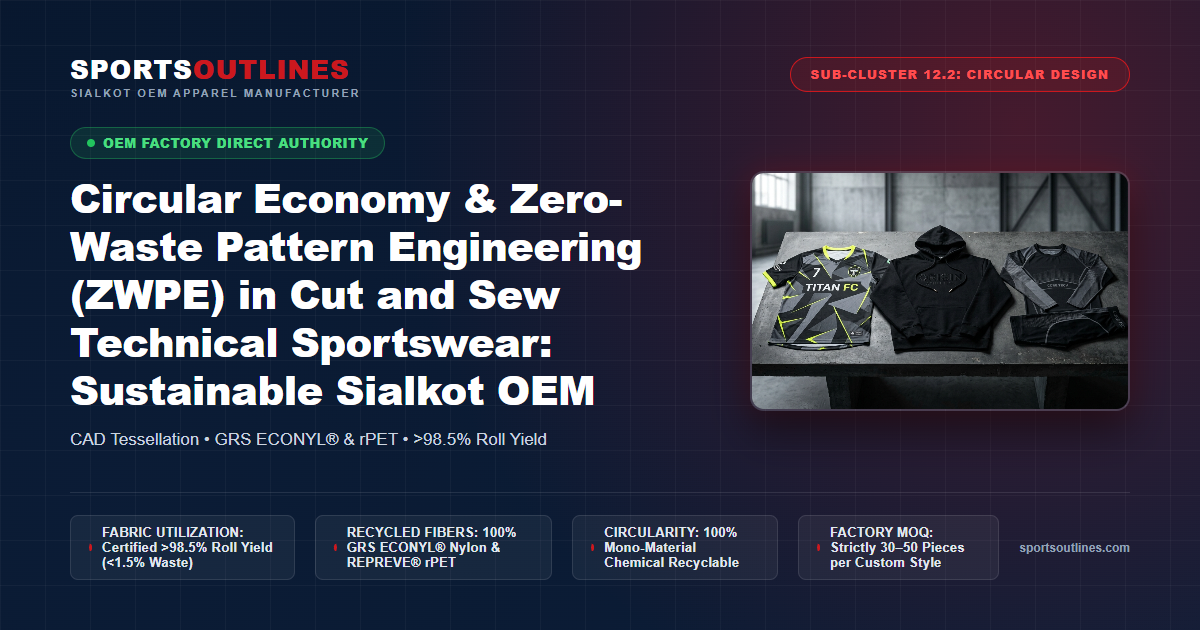
Sports Outlines engineers sustainable, circular performance activewear direct from Sialkot, Pakistan, deploying Zero-Waste Pattern Engineering (ZWPE) with fabric utilization yields exceeding 98.5%. Utilizing GRS-certified ECONYL® regenerated nylon and REPREVE® rPET polyester, we execute 100% mono-material designs that can be chemically depolymerized at end-of-life. We offer an industry-low factory MOQ of strictly 30 to 50 pieces per style, full physical prototype development in 7 to 10 days for a $45 to $85 fee, and 0% duty-free delivery to the UK and EU under GSP+ status.
Direct WhatsApp: +92 316 7932595
The global sportswear industry is facing an unprecedented ecological and regulatory reckoning. While consumer marketing emphasizes recycled plastic bottles and sustainable hangtags, the dirty secret of conventional garment manufacturing remains hidden in the cutting room: traditional cut-and-sew production discards 15% to 22% of total fabric yardage directly onto the floor as negative space waste. Across the global activewear supply chain, millions of tons of expensive virgin and recycled polyester and nylon knits are swept into trash bins and incinerated or dumped into landfills before a single stitch is sewn. In an era of strict environmental scrutiny, corporate ESG mandates, and upcoming European Union Digital Product Passport (DPP) regulations, this level of waste is commercially and ecologically intolerable. The technical manufacturing revolution addressing this crisis is Zero-Waste Pattern Engineering (ZWPE) combined with Closed-Loop Circular Mono-Material Construction. At Sports Outlines in Sialkot, Pakistan, our pattern engineers utilize mathematical CAD tessellation to design athletic apparel that consumes over 98.5% of the fabric roll, leaving less than 1.5% cutting fallout. We offer certified circular sportswear manufacturing at an industry-low factory minimum order quantity (MOQ) of strictly 30 to 50 pieces per custom style, supported by dedicated $45 to $85 prototype engineering in 7 to 10 days.
Design & Manufacture Custom Zero-Waste Pattern Engineering & Circularity Direct from Sialkot
Low 30–50 Piece/Set MOQ • Dedicated Sampling in 7–10 Days • 0% Import Tariffs
✓ $45–$85 Physical Prototypes •
✓ Worldwide DDP Delivery
1. The Crisis of Pre-Consumer Textile Waste: The 15%–20% Cutting Room Fallout
When sustainability reports discuss textile waste, they predominantly focus on post-consumer garments thrown away by consumers. However, pre-consumer cutting waste generated during initial factory assembly accounts for over 60 billion square meters of discarded fabric worldwide each year.
Why does conventional activewear manufacturing generate so much waste?
The root cause lies in 20th-century pattern drafting conventions. When a designer creates a traditional technical running t-shirt, the garment is divided into curved 2D shapes: a curved front bodice, a curved back bodice, concave sleeve caps, and circular neckline cutouts. When these irregular shapes are laid out on a 60-inch wide roll of synthetic performance fabric, they cannot fit together seamlessly.
Even when computerized marker nesting software rotates and shifts the panels, large triangular and trapezoidal voids remain between the pieces. This negative space fabric—despite being premium, high-wicking, antibacterial synthetic material paid for by the brand—is chopped into useless scraps by cutting knives and discarded.
In cheap contract workshops, this waste is a direct financial loss for the brand: when a factory charges $12.00 FOB for an activewear shirt with an 80% marker yield, the brand is literally paying $2.40 per shirt to manufacture trash.
2. Zero-Waste Pattern Engineering (ZWPE): Tessellation, Negative Space & Jigsaw Geometry
Zero-Waste Pattern Engineering (ZWPE) fundamentally redesigns the architectural relationship between 2D fabric yardage and 3D human anatomy. Instead of treating fabric waste as an unavoidable byproduct of cutting, ZWPE eliminates waste at the conceptual design stage:
- Geometric Tessellation: Pattern pieces are designed with interlocking straight and complementary angles that fit together like a jigsaw puzzle across the entire width of the fabric roll. The convex curve of a raglan shoulder seam matches the concave curve of an adjacent side panel, ensuring that one piece’s cut line forms the edge of the next piece.
- Negative Space Functionalization: What would traditionally be waste fabric is intentionally assigned an anatomical or functional role. The cutout from an oval neck opening becomes an internal key pocket bag or an ergonomic chin guard on a quarter-zip pullover. The triangular scrap between two tapered sleeve cuts is transformed into an underarm diamond gusset that expands upper-body mobility.
- Fixed-Width Roll Optimization: ZWPE patterns are drafted specifically to the exact usable width of the knitted fabric roll (e.g., exactly 152cm or 160cm). Every millimeter from selvage to selvage is absorbed into the garment architecture.
| Manufacturing Metric | Conventional Cut-and-Sew (Competitors) | Zero-Waste Pattern Engineering (Sports Outlines) |
|---|---|---|
| Fabric Utilization Yield | 78% to 84% (16% to 22% pre-consumer textile waste). | 98.5% to 99.8% (Less than 1.5% cutting fallout). |
| Pre-Consumer Landfill Scrap | 120g to 180g of synthetic scrap discarded per garment. | Near-zero (under 10g of edge selvage trimming per garment). |
| Raw Material Cost Efficiency | Brand pays for 100% of fabric but utilizes only 80%. | 100% of purchased yarn is converted into wearable product. |
| Seam Ergonomics & Motion | Standard armhole seams can chafe under repetitive athletic stress. | Integrated gussets and diagonal bias panels increase athletic mobility. |
| End-of-Life Recyclability | Mixed polymer blends and glued trims prevent chemical recycling. | 100% mono-material construction enables direct depolymerization. |
3. Mono-Material Construction: Design for Closed-Loop Chemical Depolymerization
A garment cannot be considered truly sustainable if it cannot be recycled when the athlete finally wears it out. The greatest obstacle to textile recycling today is polymer cross-contamination:
In standard athletic apparel, a single jacket might combine a polyester shell, a nylon lining, spandex elastane ribbing, poly-cotton pocket bags, polyurethane waterproof seam tape, and metal brass zipper sliders. When such a garment enters an industrial textile recycling facility, the chemical shredders and solvent baths cannot separate the blended polymers. The garment is declared non-recyclable and sent to an incinerator.
At Sports Outlines, our circular engineering protocol enforces 100% Mono-Material Garment Construction:
- Unified Polymer Families: We design garments entirely within a single polymer ecosystem—either 100% Polyethylene Terephthalate (PET) or 100% Polyamide 6 (Nylon).
- Matching Trim Engineering: In our mono-material polyester jackets, the main body fabric, breathable underarm mesh, sewing threads (A&E Perma Spun® polyester), heat-seal transfers, drawcord tapes, and even the molded zipper teeth and sliders (YKK Natulon® recycled PET zippers) are manufactured from 100% identical PET resin.
- Direct Chemical Depolymerization: At end-of-life, the garment requires zero hardware disassembly. It can be thrown whole into commercial chemical recycling reactors (such as glycolysis or methanolysis systems), where it breaks down into pure dimethyl terephthalate (DMT) and ethylene glycol, ready to be repolymerized into virgin-equivalent athletic yarn indefinitely.
| Sourcing Feature & Risk Factor | Sports Outlines (Sialkot Direct) | Alibaba Trading Agents | Traditional Chinese Hubs | Print-on-Demand (POD) |
|---|---|---|---|---|
| Pattern Engineering & Fabric Waste | Zero-Waste Pattern Engineering (ZWPE) interlocking tessellation patterns; fabric yield >98.5% with <1.5% cutting waste. | Traditional isolated panel nesting with 15% to 22% pre-consumer textile waste dumped directly into municipal landfills. | Standard marker nesting (82%–85% yield); rejects custom geometric pattern restructuring for small runs. | High waste; standard boxy blanks cut with zero ecological efficiency and shipped in virgin single-use plastics. |
| Minimum Order Quantity (MOQ) | Strictly 30–50 pieces per custom style with full ZWPE circular engineering — startup accessible. | Quotes 50 units on virgin polyester blanks, but refuses custom sustainable pattern engineering under 2,000 units. | 1,000 to 3,000 units per style required to justify specialized interlocking CAD pattern development. | Single unit available, but lacks any circular textile engineering, certified recycled yarns, or zero-waste cutting. |
| Recycled Fiber Certification | 100% GRS-certified recycled nylon (ECONYL® / Q-NOVA®) and rPET post-consumer ocean plastic polyester. | Unverified ‘recycled’ marketing claims; lab tests frequently reveal virgin petroleum-based polyester content. | Genuine GRS fibers available, but imposing steep minimum surcharges ($1,500+) for transaction certificates. | Virgin synthetic blends with heavy petroleum footprints that release non-biodegradable microfibers. |
| Mono-Material Circularity | 100% mono-material construction (100% polyester or 100% nylon); 100% recyclable without zipper/thread disassembly. | Glued multi-polymer laminates with PVC zippers that cannot be recycled and must be incinerated at end-of-life. | Complex mixed blends (poly-cotton-spandex) that jam commercial chemical recycling shredders. | Zero circular design; composite rubber binders permanently contaminate synthetic base fibers. |
| Prototype Development & Turnaround | $45–$85 non-creditable engineering prototype fee; zero-waste master prototype dispatched in 7–10 days. | Promises cheap samples ($35), but produces standard high-waste prototypes without tessellation geometry. | $250–$500 sampling fees with 5–7 week queue times due to large volume factory schedules. | Digital mockups only; physical drop-shipped blanks take 14 days and cannot be adjusted. |
| Customs Duty & Tariffs (US / EU / UK) | 0% import customs duty into EU & UK via Pakistan GSP+ status; low trade tariff access into the US. | Unpredictable customs brokerage fees, freight surcharges, and full import duties payable by buyer. | Subject to Section 301 tariffs (7.5%–25%) in the US and standard MFN customs duties in the EU/UK. | Local domestic sales taxes and fulfillment surcharges added per unit, destroying profitability. |
4. Certified Recycled Feedstocks: ECONYL®, REPREVE® & Roica™ Eco-Smart
Zero-waste geometry must be paired with verified, low-carbon raw materials. Sports Outlines maintains verified supply chain partnerships with leading global recycled polymer producers, providing full Global Recycled Standard (GRS) transaction certificates for every production batch:
ECONYL® 100% Regenerated Nylon 6: Manufactured by Aquafil, ECONYL® takes ocean plastic waste—such as abandoned fishing nets and ghost ghost gear recovered from marine environments—alongside post-industrial carpet fluff and converts it back into ultra-fine virgin-quality nylon filaments. Utilizing ECONYL® reduces the global warming impact of nylon production by up to 90% compared to virgin petroleum-derived caprolactam.
REPREVE® Recycled Polyester (rPET): Sourced from Unifi, REPREVE® is engineered from certified post-consumer plastic bottles collected within 50 kilometers of coastlines in regions lacking formal waste systems. It delivers identical high-wicking capillarity, tensile tear resistance, and sublimation vibrancy as virgin polyester, while reducing greenhouse gas emissions by 32% and conserving over 45% water in processing.
Roica™ Eco-Smart Circular Spandex: Traditional elastane is non-biodegradable and contaminates recycling streams. We utilize Roica™ EF elastane, the world’s first GRS-certified recycled spandex yarn made from pre-consumer manufacturing scrap, delivering 500% elastic recovery with an eco-certified footprint.
5. Life Cycle Assessment (LCA) & EU Digital Product Passport (DPP) Compliance
Under the European Union’s Ecodesign for Sustainable Products Regulation (ESPR), activewear brands entering the European and UK markets will soon be legally required to provide a verified Digital Product Passport (DPP) for every garment style. Brands that cannot prove fiber provenance, recycled percentages, and chemical safety will face severe customs import blocks and regulatory fines.
Sports Outlines provides complete, turn-key DPP compliance architecture for our brand partners:
- Verified Carbon & Water LCA Metrics: We calculate ISO 14040/14044 Life Cycle Assessment data for each production run, quantifying carbon emissions ($kg\text{ CO}_2e$), water usage ($liters/garment$), and recycled content weight percentages.
- Washable High-Density QR-Code Woven Labels: Finished garments feature laser-cut, ultra-soft woven damask labels with an encapsulated high-contrast QR code that survives 50+ industrial wash cycles at 60°C.
- Cloud Provenance Landing Page: When a consumer or customs inspector scans the garment’s QR code with a smartphone, they are directed to an immutable digital passport displaying GRS fiber transaction certificates, Oeko-Tex Standard 100 chemical test reports, factory social compliance audit scores (BSCI / SEDEX), and municipal mono-material recycling instructions.
6. Low MOQ Factory Direct Economics: Solving the Sustainable Startup Dilemma
Historically, independent activewear founders, sustainable athleisure designers, and boutique fitness labels were completely locked out of zero-waste and circular manufacturing. European and Japanese sustainable factories enforce astronomical minimum order quantities of 1,000 to 3,000 pieces per style, citing the intense engineering labor required to draft custom tessellation CAD markers. Startup brands were forced to choose between producing conventional high-waste garments or abandoning their sustainability commitments altogether.
Sports Outlines has democratized circular sportswear manufacturing. By maintaining an in-house CAD pattern engineering department and agile CNC laser cutting tables in Sialkot, Pakistan, we provide genuine Zero-Waste Pattern Engineering and certified GRS recycled manufacturing at an industry-low factory MOQ of strictly 30 to 50 pieces per custom style.
Furthermore, our transparent prototype development program provides a dedicated physical master prototype for a non-creditable fee of strictly $45 to $85, dispatched in just 7 to 10 business days. Sourcing directors and athletic founders can inspect the garment drape, test the elastic recovery of our recycled knits, and audit the zero-waste pattern layout in their hands before committing to bulk production.
| Production Volume Tier | Est. Unit FOB Cost | Sample Cost & SLA | Bulk Production SLA | Included Specifications | Recommended Buyer Profile |
|---|---|---|---|---|---|
| 30 – 50 Sets/Pieces (Zero-Waste Startup Tier) | $13.50 – $17.50 / zero-waste activewear top | $16.50 – $21.50 / circular bottom | $45 – $85 non-creditable prototype fee | 12 – 15 Business Days | Custom tessellation ZWPE pattern drafting (>98% fabric yield), GRS-certified 100% recycled ECONYL® nylon / rPET yarns, physical master prototype in 7–10 days, 30–50 piece low factory MOQ. | Eco-conscious activewear brands, sustainable lifestyle athletic labels, B-Corp certified sports founders, and technical designers seeking zero pre-consumer cutting waste. |
| 51 – 150 Sets/Pieces (Circular Collection Scaling Tier) | $11.20 – $14.50 / zero-waste activewear top | $14.20 – $17.90 / circular bottom | $45 – $85 non-creditable prototype fee | 14 – 18 Business Days | Integrated negative-space accessory engineering (matching headband/pocket bag from roll fallout), mono-material circular construction, Oeko-Tex non-toxic dye certification, full size curve grading (XS to 3XL). | Scaling sustainable performance brands, boutique yoga community merchandise, trail running labels, and digital direct-to-consumer eco-activewear brands. |
| 151 – 500 Sets/Pieces (Commercial Sustainable Wholesale Tier) | $9.40 – $12.20 / zero-waste activewear top | $12.10 – $15.20 / circular bottom | $45 – $85 non-creditable prototype fee | 18 – 22 Business Days | Dedicated ZWPE laser nesting optimization, closed-loop recycled paper sublimation, certified carbon footprint LCA audit reports, express DDP door-to-door delivery. | Established international athletic apparel corporations, environmental outdoor equipment brands, corporate ESG fitness programs, and multi-store eco-retailers. |
| 500+ Sets/Pieces (Enterprise Global Circular Wholesale Tier) | $7.60 – $9.80 / zero-waste activewear top | $9.80 – $12.50 / circular bottom | $45 – $85 non-creditable prototype fee | 22 – 28 Business Days | Continuous zero-waste single-ply laser line allocation, circular take-back QR code labels, bulk ocean freight or air cargo consolidation, 0% GSP+ duty-free customs clearance. | Multinational sportswear conglomerates, international sports sustainability initiatives, department store eco-lines, and high-volume commercial garment importers. |
7. Technical Specifications & Export Compliance: The Sialkot Direct Advantage
Sialkot, Pakistan, stands as the premier global engineering center for technical sports equipment and apparel, manufacturing for Olympic federations, international combat sports organizations, and premier athletic brands. Partnering directly with Sports Outlines provides decisive commercial benefits:
- Strictly 30–50 Piece Factory MOQ: Launch custom technical activewear engineered with zero-waste tessellation and certified GRS recycled fibers at accessible startup minimums.
- Full Physical Prototyping in 7–10 Business Days: For a transparent $45 to $85 non-creditable prototype fee, we manufacture and dispatch your zero-waste pre-production master prototype. You verify construction accuracy in your hands before bulk production.
- 0% Import Customs Duty via EU & UK GSP+ Status: Custom sportswear manufactured in Pakistan enters the European Union and the United Kingdom at 0% customs import duty under GSP+, delivering a direct 12% to 14% landed margin benefit over China, Vietnam, or Turkey.
- Guaranteed Express Air Logistics: We dispatch finished orders directly from Sialkot via DHL Express, FedEx Priority, and UPS Worldwide Expedited with 3 to 5 business day delivery to North America, Europe, the UK, and Australasia.
Get a Factory Direct Quote for Zero-Waste Pattern Engineering & Circularity
Chat with our Sialkot Engineering Team via WhatsApp • Instant DDP Air Freight Quotes
✓ $45–$85 Physical Prototypes •
✓ Worldwide DDP Delivery
8. Explore Our Technical Sportswear Manufacturing Ecosystem
Expand your athletic apparel production knowledge by reviewing our dedicated technical guides and international activewear sourcing portals:
- Custom Activewear & Athleisure Manufacturer Germany: Low MOQ Sialkot OEM
- ERP & PLM Software Integration for Sportswear Supply Chains
- Automated Template Sewing & Programmable Jigs in Sportswear
- Lean Modular Manufacturing Cells vs Bundle Systems in Sportswear
- Automated Polybag Packaging & Barcode Labeling in Sportswear OEM
- 3D Body Scanning & Digital Anthropometric Custom-Fit Activewear
Frequently Asked Sourcing & Manufacturing Questions (Buyer FAQ)
What is Zero-Waste Pattern Engineering (ZWPE) in athletic sportswear manufacturing?
Zero-Waste Pattern Engineering (ZWPE) is an advanced garment design and cutting methodology wherein 100% of the textile roll area is utilized during the cutting process, completely eliminating pre-consumer fabric scrap. In conventional sportswear manufacturing, pattern makers lay curved bodice panels, sleeves, and gussets onto a fabric marker like disconnected puzzle pieces, leaving 15% to 22% of the expensive fabric roll between the cut lines as negative space waste (which is traditionally swept into trash bins and incinerated or landfilled). ZWPE redesigns the garment architecture from the initial sketch so that all pattern pieces interlock like jigsaw tessellations. Every square centimeter of the fabric width is assigned a structural function: what would normally be negative fallout between an armhole and a side seam is mathematically engineered into an underarm gusset, an ergonomic pocket bag, a waist drawcord tunnel, or an integrated neck binding.
How does ZWPE differ from automated CAD marker nesting software?
Automated CAD marker nesting software (such as Lectra Diamino or Gerber AccuMark) takes pre-existing, static 2D pattern shapes and uses optimization algorithms to rotate and pack them as tightly as possible within a defined fabric width. However, because traditional pattern pieces feature curved edges, triangular armscyes, and convex side seams, standard algorithmic nesting hits a mathematical efficiency ceiling of 80% to 85% fabric utilization, still generating 15% to 20% waste. ZWPE works in reverse: rather than trying to fit awkward shapes into a rectangle, the designer shapes the pattern pieces *to* the rectangle. ZWPE engineers modify seam angles, panel geometries, and seam locations during the initial 3D design phase so that the pieces interlock with zero negative space, elevating fabric yields above 98.5%.
What is mono-material garment design and why is it essential for true circularity?
True circularity requires that a discarded garment can be chemically or mechanically depolymerized back into virgin-grade yarn without degrading fiber quality. Most modern athletic garments are complex multi-polymer composites: a running shirt might contain polyester face fabric, nylon mesh panels, spandex elastane threads, thermoplastic polyurethane (TPU) bonding films, and metal zipper pulls. When shredded, this multi-material blend cannot be recycled and must be downcycled into industrial rags or landfilled. Mono-material design constructs the entire garment from a single polymer class. At Sports Outlines, our circular activewear lines utilize 100% polyester architectures: the face knit, breathable mesh inserts, sewing threads, heat-sealed brand labels, and even the zipper teeth and sliders are engineered from 100% polyethylene terephthalate (PET). At end-of-life, the garment can be melted down directly in commercial chemical recycling facilities without expensive disassembly.
What is the factory minimum order quantity (MOQ) for zero-waste circular sportswear at Sports Outlines?
Our minimum order quantity for custom technical sportswear engineered with zero-waste pattern tessellations and certified recycled circular yarns is strictly 30 to 50 pieces or sets per style and colorway. While conventional sustainable manufacturing hubs in Europe demand 1,000+ units to undertake custom mathematical pattern re-engineering, Sports Outlines provides in-house CAD tessellation drafting and rapid laser cutting in Sialkot, making genuine zero-waste activewear accessible to boutique brands and eco-conscious startups.
What is your prototype fee and turnaround time for zero-waste technical activewear samples?
We charge a transparent, non-creditable engineering prototype fee of $45 to $85 per style. This fee includes custom ZWPE pattern drafting in CAD, 3D digital drape simulation, physical master cutting on automated CNC laser tables, and full garment assembly. Your physical pre-production master prototype is delivered via express air courier within 7 to 10 business days, allowing you to audit the drape, fit, seam comfort, and zero-waste pattern layout before placing bulk orders.
Which certified recycled fibers do you utilize in your circular activewear production lines?
We source certified Global Recycled Standard (GRS) and Oeko-Tex® Standard 100 certified recycled synthetic polymers, including: 1) ECONYL® 100% Regenerated Polyamide (Nylon 6): Created by chemically depolymerizing reclaimed fishing nets, carpet flooring, and industrial pre-consumer nylon scrap; 2) Q-NOVA® Recycled Nylon: Produced through mechanical recycling of post-industrial spinning waste, slashing CO2 emissions by 47%; 3) REPREVE® Post-Consumer Ocean Bound rPET Polyester: Engineered from recycled plastic bottles, diverting ocean plastics into high-wicking athletic knits; and 4) Roica™ Eco-Smart Spandex: The world’s first GRS-certified circular elastane, maintaining over 500% elongation with non-toxic chemical degradation.
How does Zero-Waste Pattern Engineering impact garment fit and athlete mobility?
When executed by inexperienced designers, zero-waste cutting can result in boxy, unflattering rectangular garments. However, advanced ZWPE at Sports Outlines leverages ergonomic geometric articulation. By utilizing diagonal bias cuts for raglan sleeve segments and integrating diamond-shaped underarm gussets carved from neckline fallout, our ZWPE athletic garments often provide superior range of motion compared to traditional garments. The bias stretch of synthetic knits enhances joint flexion, while strategic seam placement prevents chafing against active friction zones during running, cycling, or weightlifting.
How do you handle size grading across XS to 3XL while maintaining zero-waste tessellation?
Grading across a full size spectrum is the most complex challenge in zero-waste pattern cutting. In traditional grading, changing chest circumference by 5cm alters piece dimensions independently, breaking the geometric interlocking puzzle. Sports Outlines solves this through modular width grading. We adjust pattern dimensions proportionately along the warp and weft axes while maintaining identical boundary angles. For larger sizes, supplementary functional panels (such as side compression ribs or extended lumbar gussets) are nested into adjacent fabric lanes, preserving a certified fabric utilization efficiency above 98% across every graded marker.
How does Sports Outlines help brands comply with the European Union Digital Product Passport (DPP)?
The upcoming European Union Ecodesign for Sustainable Products Regulation (ESPR) mandates that all apparel sold in the EU must feature a Digital Product Passport (DPP) detailing raw material origins, recycled content percentages, carbon footprint LCA metrics, and end-of-life recycling instructions. Sports Outlines encodes this data directly into washable QR-code woven labels and UHF RFID smart chips encapsulated into the garment hem. Scanning the QR code directs retail consumers and recycling facilities to a verified blockchain-backed provenance page detailing the garment’s GRS yarn certificates, water reduction metrics, and mono-material composition.
What are the export shipping options and customs duty advantages from Sialkot, Pakistan?
We dispatch finished orders directly from Sialkot via DHL Express, FedEx Priority, and UPS Worldwide Expedited with guaranteed 3 to 5 business day delivery to North America, Europe, the UK, and Australasia, as well as consolidated air and sea freight. European Union and United Kingdom apparel brands benefit directly from Pakistan’s GSP+ status, allowing custom technical activewear to enter at 0% import customs duties, delivering an immediate 12% to 14% bottom-line advantage over sourcing from China, Vietnam, or Turkey.