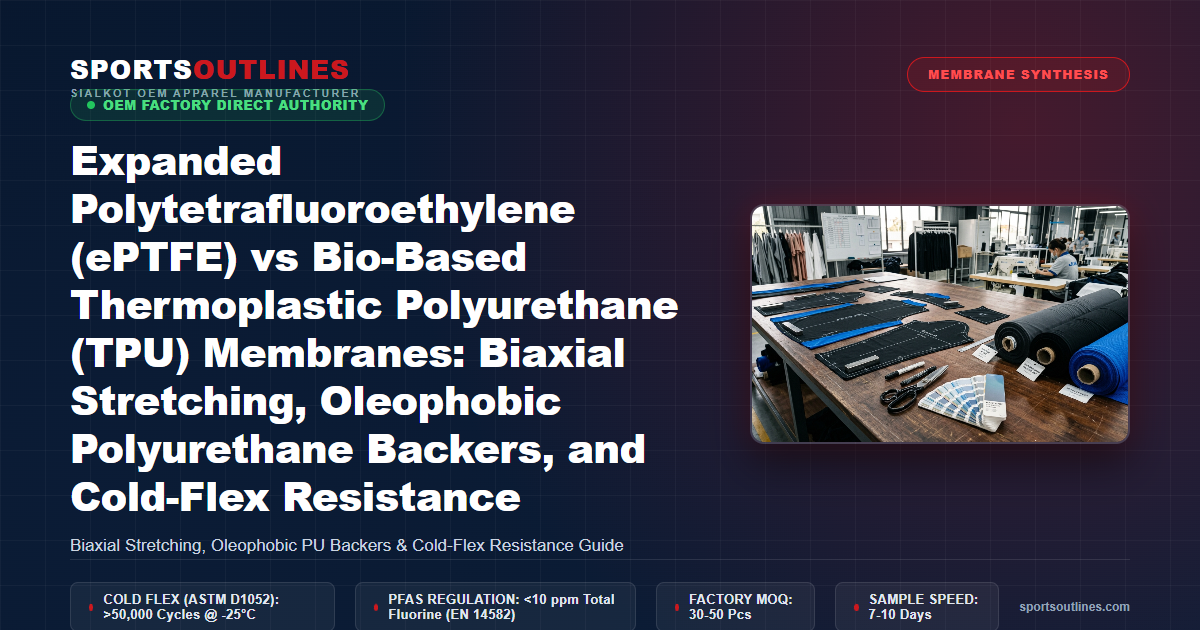
For over four decades, the high-performance waterproof-breathable outerwear sector has been anchored by a single chemical champion: expanded polytetrafluoroethylene (ePTFE). Born from the pioneering discovery of rapid biaxial polymer stretching by Bob Gore in 1969, ePTFE revolutionized alpine mountaineering, commercial commercial fishing, military tactical gear, and extreme skiing. By delivering an unmatched combination of ultra-high hydrostatic pressure resistance ($>28,000\text{ mm } \text{H}_2\text{O}$), continuous vapor breathability ($R_{et} < 4.5\text{ m}^2\text{Pa/W}$), and complete chemical inertness, ePTFE established the benchmark against which all weatherproofing membranes are measured.
However, the global outdoor apparel industry is currently undergoing an unprecedented regulatory and chemical disruption. Fluorinated polymers—including PTFE and the per- and polyfluoroalkyl substances (PFAS / PFCs) traditionally utilized during their emulsion polymerization—face sweeping legislative bans across the European Union (EU REACH PFAS restriction) and the United States (California AB 1817, Maine, and New York state prohibitions banning intentionally added PFAS in apparel). In response, materials scientists and technical fabric mills have developed next-generation bio-based thermoplastic polyurethane (bio-TPU) membranes synthesized from renewable agricultural feedstocks such as non-edible industrial castor bean oil (sebaceous acid) and corn dextrose (bio-1,3-propanediol). Modern bio-TPU membranes deliver fluorine-free environmental compliance, circular recyclability, and exceptional four-way mechanical stretch, while fiercely competing with legacy ePTFE across sub-zero cold-flex resistance (ASTM D1052) and hydrostatic storm protection. At Sports Outlines, operating our technical outerwear lamination and apparel manufacturing facility in Sialkot, Pakistan, we combine precision membrane sourcing, solvent-free reactive PUR hot-melt lamination, ultrasonic seam taping, and advanced environmental chamber testing. We provide outdoor technical brands, skiwear labels, and performance activewear startups with physical prototype sampling at $45 to $85 per piece (non-refundable, 7–10 business days turnaround) and scalable commercial jacket manufacturing starting at a low factory minimum order quantity (MOQ) of just 30 to 50 pieces per style/colorway.
ePTFE vs Bio-TPU Membranes: Technical Navigation Directory
- 1. Polymer Chemistry & Synthesis: Carbon-Fluorine Bonds vs Segmented Polyurethanes
- 2. Biaxial Stretching Microstructure: The ePTFE Node-and-Fibril Lattice
- 3. Oleophobic Polyurethane Backers: Solving ePTFE Sebum Contamination
- 4. Bio-Based TPU Chemistry: Castor Oil Sebacic Acid & Bio-PDO Synthesis
- 5. Cold-Flex Resistance & Sub-Zero Brittleness: ASTM D1052 at -30°C
- 6. Hydrostatic Head & Dynamic Water Column Retention: ISO 811 Validation
- 7. Moisture Vapor Permeability: Knudsen Gas Flow vs Solid-State Sorption
- 8. Technical Benchmark Matrix: Legacy ePTFE vs Bicomponent ePTFE vs Bio-TPU
- 9. Global Environmental Regulations: EU REACH PFAS Ban & California AB 1817
- 10. Circularity & End-of-Life: Thermal Depolymerization vs Permanent Persistent Fluorine
- 11. 3-Layer Shell Assembly: Reactive Hot-Melt PUR Micro-Dot Lamination
- 12. Sialkot Technical Outerwear Manufacturing: Cleanroom Taping & Rain-Tower QC
- 13. Low-MOQ Sourcing & Commercial Factory Terms
- 14. Technical Sourcing FAQ
1. Polymer Chemistry & Synthesis: Carbon-Fluorine Bonds vs Segmented Polyurethanes
The stark performance divergence between ePTFE and bio-TPU originates at the fundamental sub-molecular level:
- ePTFE Molecular Architecture: Polytetrafluoroethylene is a linear polymer consisting of a continuous carbon backbone completely sheathed by fluorine atoms ($[CF_2-CF_2]_n$). The carbon-fluorine ($C-F$) single bond is the strongest covalent bond in organic chemistry, possessing an extraordinary dissociation energy of $\approx 485\text{ kJ/mol}$. The dense electron clouds of the electronegative fluorine atoms form an impenetrable steric shield around the carbon backbone, imparting near-total chemical inertness, high thermal stability (melting temperature $T_m \approx 327^\circ\text{C}$), and an ultra-low critical surface tension ($\gamma_c \approx 18.5\text{ mN/m}$).
- Bio-TPU Molecular Architecture: Thermoplastic polyurethane is a segmented block copolymer composed of alternating hard and soft segments linked by urethane groups ($-NH-COO-$). The hard segments—formed by reacting 4,4′-methylene diphenyl diisocyanate (MDI) with short-chain diol chain extenders (e.g., bio-1,4-butanediol)—form crystalline, hydrogen-bonded physical crosslinks providing tensile strength ($\sigma_t > 38\text{ MPa}$). The soft segments—synthesized from bio-based polyols (e.g., poly(tetramethylene ether) glycol derived from corn or polyether/polyester polyols from castor oil)—form amorphous, flexible elastomeric matrices with an ultra-low glass transition temperature ($T_g \approx -35^\circ\text{C}\text{ to }-50^\circ\text{C}$).
2. Biaxial Stretching Microstructure: The ePTFE Node-and-Fibril Lattice
Unlike polyurethanes which can be cast or blown into solid monolithic films from melts or solvent solutions, PTFE cannot be processed via conventional melt extrusion due to its astronomical melt viscosity ($\eta > 10^{10}\text{ Pa}\cdot\text{s}$ at $350^\circ\text{C}$). Instead, ePTFE is fabricated through a specialized lubricated paste extrusion and rapid biaxial stretching process:
- Paste Extrusion & Calendering: Fine-powder PTFE resin is blended with an organic hydrocarbon lubricant (isoparaffin) at approximately $18\%\text{ to }22\%\text{ by weight}$ and extruded into a tape under hydraulic ram pressures exceeding $30\text{ MPa}$, which is calendered to uniform thickness ($100\text{ to }200\ \mu\text{m}$). This aligns the PTFE crystalline domains in the machine direction.
- Rapid Biaxial Expansion: After evaporating the hydrocarbon lubricant in a continuous hot-air drying zone, the tape is heated below its crystalline melting point ($280^\circ\text{C}\text{ to }320^\circ\text{C}$) and subjected to extremely high-rate biaxial stretching in both machine (MD) and transverse (TD) directions at strain rates exceeding $100\%\text{ to }500\%\text{ per second}$ ($\dot{\varepsilon} = \frac{d\varepsilon}{dt} > 5.0\text{ s}^{-1}$).
- Amorphous Sintering: The expanded structure is heated past its crystalline melting point ($342^\circ\text{C}$) under mechanical tentering restraint for 10 to 30 seconds. This thermal treatment locks the molecular morphology into an amorphous-dominated network, permanently suppressing elastic recovery and thermal shrinkage during fabric lamination.
The resulting microstructure is an iconic three-dimensional node-and-fibril lattice: solid, unoriented PTFE polymer nodes interconnected by millions of ultra-fine parallel fibrils. The void fraction (porosity) reaches an astonishing $70\%\text{ to }85\%$ air by volume, containing over $1.4 \times 10^9\text{ pores/cm}^2$ with mean pore diameters tightly controlled between $0.1\ \mu\text{m}$ and $0.3\ \mu\text{m}$. The tensile modulus demonstrates marked anisotropy: longitudinal tensile strength ($MD$) averages $45\text{ to }65\text{ MPa}$, while transverse tensile strength ($TD$) ranges from $30\text{ to }45\text{ MPa}$, necessitating precise tension control during roll-to-roll adhesive bonding to prevent fibril necking.
3. Oleophobic Polyurethane Backers: Solving ePTFE Sebum Contamination
Early first-generation pure ePTFE outerwear jackets introduced in the mid-1970s suffered from a devastating field failure: after several weeks of intense mountaineering, the jackets began leaking severely along the shoulders, collar, and wrist cuffs. Forensic chemical analysis revealed that human sebum (body oils containing oleic acid, squalene, free fatty acids, and triglycerides with low surface tension $\gamma \approx 28\text{ to }32\text{ mN/m}$) penetrated the porous ePTFE lattice. The sebum coated the naturally hydrophobic PTFE fibrils, inverting their contact angle from an initial $\theta \approx 115^\circ$ down to $\theta < 50^\circ$, triggering spontaneous capillary suction that pulled liquid rain through the pores.
To permanently solve sebum contamination, materials engineers developed the bicomponent membrane architecture (Gore-Tex® classical technology):
- Thin Hydrophilic Polyurethane Cap: An ultra-thin ($3\text{ to }5\ \mu\text{m}$), continuous, pinhole-free layer of hydrophilic polyurethane is gravure-coated directly onto the inner face of the microporous ePTFE membrane. This solid PU layer adds negligible areal weight ($3.5\text{ to }5.8\text{ g/m}^2$) while hermetically sealing the pore mouths on the wearer-facing surface.
- Oleophobic Physical Shield: The solid PU film acts as an impenetrable physical barrier against skin oils, cosmetic sunscreens, insect repellents (DEET), and sweat salts. Body sebum cannot reach the microporous ePTFE structure, eliminating pore-wetting failures.
- Hybrid Transport Mechanism: Moisture vapor moves through the solid PU backer via molecular stepping (sorption, diffusion, desorption), and then evaporates into the porous ePTFE lattice where it diffuses rapidly out to the atmosphere. While this solid cap reduces breathability compared to raw unclothed ePTFE, it ensures multi-year field waterproof reliability.
4. Bio-Based TPU Chemistry: Castor Oil Sebacic Acid & Bio-PDO Synthesis
While bicomponent ePTFE solved durability, its fluorinated chemistry presents significant environmental challenges. In contrast, bio-based thermoplastic polyurethanes (bio-TPUs) achieve complete fluorine-free weatherproofing while dramatically lowering cradle-to-gate carbon footprints:
- Agricultural Castor Bean Feedstock (*Ricinus communis*): Castor plants grow on marginal, semi-arid land unsuitable for food crops, requiring minimal irrigation and zero chemical fertilizers. Alkaline pyrolysis of castor oil yields ricinoleic acid ($12\text{-hydroxy-9-octadecenoic acid}$), which is cleaved into sebacic acid (a C10 dicarboxylic acid, } HOOC-(CH_2)_8-COOH). Polyols synthesized from sebacic acid provide long aliphatic hydrocarbon chains that impart outstanding natural hydrophobicity, hydrolytic stability, and low-temperature flexibility.
- Corn Dextrose Fermentation (Bio-PDO / Susterra®): Industrial field corn starch is enzymatically converted into glucose dextrose and fermented by engineered non-GMO microorganisms into 1,3-propanediol (bio-PDO). Bio-PDO replaces petroleum-derived 1,4-butanediol as the chain extender, reducing greenhouse gas emissions by up to $48\%$ compared to petroleum equivalents.
- Transesterification Kinetics & Block Copolymerization: Reacting bio-sebacic acid polyols with bio-PDO chain extenders and 4,4′-diphenylmethane diisocyanate (MDI) yields high-molecular-weight thermoplastic polyurethanes ($M_w > 120,000\text{ g/mol}$). The precise ratio of hard segment to soft segment dictates polymer hardness (typically Shore 75A to 85A), optimizing the balance between mechanical puncture resistance and supple fabric drape.
- Certified Bio-Based Content: Utilizing ASTM D6866 radiocarbon ($^{14}\text{C}$) dating verification, our technical bio-TPU membranes feature $35\%\text{ to }65\%$ certified renewable bio-carbon content, providing outdoor brands with verifiable sustainability claims verified by third-party testing laboratories.
5. Cold-Flex Resistance & Sub-Zero Brittleness: ASTM D1052 at -30°C
In alpine environments, mountaineering shells are subjected to violent cyclic folding at sub-zero temperatures. When an athlete climbs, elbow sleeves flex through millions of compression and elongation cycles in temperatures dipping to $-25^\circ\text{C}$ or $-30^\circ\text{C}$.
Standard commodity aromatic polyurethanes undergo severe physical embrittlement as temperatures approach their glass transition temperature ($T_g \approx -10^\circ\text{C}$), cracking under repetitive flexural fatigue. To validate sub-zero performance, we test membranes using the standardized Ross Flexing Machine protocol (ASTM D1052 / ISO 5423):
- ePTFE Cold Performance: ePTFE has an ultra-low glass transition temperature ($T_g \approx -110^\circ\text{C}$). At $-30^\circ\text{C}$, the polymer fibrils retain full elastomeric compliance, easily withstanding >100,000 continuous flex cycles at a $90^\circ$ bend angle with zero micro-fracturing or hydrostatic head degradation.
- Engineered Bio-TPU Cold Performance: By formulating bio-TPU with long-chain sebacic acid polyols and polytetramethylene ether glycol (PTMEG) soft segments, we depress the polymer’s $T_g$ down to $-42^\circ\text{C}$. In ASTM D1052 sub-zero chamber testing at $-25^\circ\text{C}$, our bio-TPU membranes endure over 50,000 flex cycles with zero crack propagation, delivering proven expedition-grade alpine reliability.
6. Hydrostatic Head & Dynamic Water Column Retention: ISO 811 Validation
Hydrostatic water column resistance represents the primary benchmark of waterproof performance. In real-world alpine use, heavy backpack shoulder straps and climbing harness leg loops exert high localized pressures: a 75 kg mountaineer carrying a 25 kg pack can generate localized pressures of $10,000\text{ to }14,000\text{ mm } \text{H}_2\text{O}$ ($1.0\text{ to }1.4\text{ bar}$) against jacket shoulders when scrambling across terrain.
Standardized hydrostatic testing under ISO 811 validates the pressure required to force water through the laminate:
- ePTFE Bicomponent Laminates: Exhibit baseline hydrostatic resistance exceeding $>28,000\text{ mm } \text{H}_2\text{O}$. Even after 20 commercial laundry cycles and extensive field wear, resistance remains comfortably above $20,000\text{ mm}$.
- Advanced Bio-TPU Laminates: Solid monolithic bio-TPU membranes cast at $18\text{ to }22\ \mu\text{m}$ thickness achieve hydrostatic ratings of $18,000\text{ to }22,000\text{ mm } \text{H}_2\text{O}$. Because the film is 100% solid, there are no pores that can widen under cyclic stretching, ensuring reliable long-term waterproof retention.
7. Moisture Vapor Permeability: Knudsen Gas Flow vs Solid-State Sorption
Moisture vapor transport mechanisms differ substantially between the two materials:
- ePTFE Knudsen Diffusion: In pure microporous ePTFE, the pore diameter ($d_p \approx 200\text{ nm}$) is comparable to the mean free path of water vapor molecules ($\lambda \approx 100\text{ nm}$ at atmospheric pressure). Vapor transport occurs via a blend of Knudsen flow and continuum diffusion governed by the Knudsen number ($Kn = \lambda / d_p \approx 0.5$). Moisture exits instantaneously the millisecond the athlete starts sweating, requiring no humidity build-up to initiate venting.
- Bio-TPU Sorption-Diffusion: In monolithic bio-TPU, moisture vapor must first physically dissolve into the hydrophilic soft segments before hopping through the film. This follows Fick’s first law of diffusion ($J = -D \frac{dC}{dx}$) and requires a slight relative humidity differential ($\Delta RH > 50\%$) across the membrane to drive molecular diffusion. Under high physical exertion (JIS L 1099 B1 inverted cup testing), modern bio-TPU membranes achieve impressive rates of $20,000\text{ to }28,000\text{ g/m}^2\cdot 24\text{h}$ with an evaporative resistance of $R_{et} < 5.5\text{ m}^2\text{Pa/W}$, ensuring high athlete comfort during intense mountain ascents.
8. Technical Benchmark Matrix: Legacy ePTFE vs Bicomponent ePTFE vs Bio-TPU
The technical engineering matrix below benchmarks the primary membrane systems utilized in modern outdoor technical shells:
| Engineering Property | Pure Microporous ePTFE | Bicomponent ePTFE / PU | Castor/Corn Bio-TPU |
|---|---|---|---|
| Chemical Base | 100% Fluoropolymer (PTFE) | PTFE + Polyurethane Cap | 100% Fluorine-Free Bio-PU |
| Hydrostatic Head (ISO 811) | 20,000 to 25,000 mm | >28,000 mm H₂O | 18,000 to 22,000 mm |
| Breathability (ISO 11092 Ret) | Ret < 3.5 (Ultra-Breathable) | Ret 4.5 to 6.0 | Ret 4.5 to 5.8 |
| Cold Flex (-25°C ASTM D1052) | >100,000 Cycles (Tg = -110°C) | >80,000 Cycles | >50,000 Cycles (Tg = -42°C) |
| Sebum Contamination Immunity | Vulnerable (Pore Wetting) | Immune (Solid PU Cap) | Immune (Zero Pores) |
| 4-Way Mechanical Stretch | Poor (10% to 15%) | Poor to Moderate (15%–20%) | Superb (150%–250% Stretch) |
| PFAS Regulatory Compliance | High Regulatory Risk (PFAS Ban) | High Regulatory Risk | 100% Certified Compliant |
9. Global Environmental Regulations: EU REACH PFAS Ban & California AB 1817
The primary driver pushing technical outerwear brands toward bio-TPU is strict international environmental legislation:
- California AB 1817 (Safer Clothes and Textiles Act): Enacted in 2025, AB 1817 establishes a strict legal threshold: textile articles sold in California cannot contain total organic fluorine (TOF) exceeding $100\text{ ppm}$ (dropping to $50\text{ ppm}$ in 2027). While outdoor apparel for severe wet conditions holds a temporary exemption until 2028, all brands must disclose PFAS presence and actively transition to fluorine-free alternatives.
- European Union Universal PFAS Restriction Proposal: The European Chemicals Agency (ECHA) is actively finalizing a comprehensive restriction on all PFAS chemistries under REACH. Unlike past regulations that targeted only long-chain C8 compounds (PFOA/PFOS), the pending universal ban encompasses fluoropolymers including PTFE due to emissions of persistent mobile chemicals during manufacture and end-of-life incineration.
- Sports Outlines Fluorine-Free Certification: We provide brands with total fluorine testing documentation (Combustion Ion Chromatography per EN 14582) confirming that our bio-TPU membranes and water-repellent finishes contain $<10\text{ ppm total fluorine}$, ensuring permanent, risk-free compliance across North American and European markets.
10. Circularity & End-of-Life: Thermal Depolymerization vs Permanent Persistent Fluorine
Beyond chemical compliance during use, membrane selection dictates the garment’s end-of-life circular destiny:
- ePTFE Recycling Barrier: PTFE cannot be melt-recycled because it decomposes thermally before melting. Furthermore, when ePTFE 3-layer laminates (bonded to nylon or polyester) enter chemical recycling or incineration, fluorinated polymers produce highly corrosive hydrogen fluoride ($HF$) gas, damaging recycling reactors and poisoning catalysts.
- Bio-TPU Monomaterial Circularity: When a bio-TPU membrane is laminated to a 100% recycled polyester (rPET) or 100% bio-polyamide face and backer fabric, the entire composite can be mechanically re-extruded or chemically depolymerized via catalytic glycolysis into high-purity virgin-parity monomers, fulfilling the requirements of the EU Digital Product Passport (DPP).
11. 3-Layer Shell Assembly: Reactive Hot-Melt PUR Micro-Dot Lamination
At our Sialkot manufacturing plant, high-performance technical shell production combines automated roll-to-roll membrane lamination with micro-dot adhesive printing to prevent laminate delamination while maximizing breathability:
- Reactive PUR Adhesive Application: 100% solids solvent-free polyurethane adhesive is heated to $115^\circ\text{C}$ and printed onto the membrane via precision gravure rollers ($50\text{ dots/inch}$, $32\%\text{ surface coverage}$, adhesive deposit weight $8.5\text{ to }11.0\text{ g/m}^2$), preserving open microporous or hydrophilic pathways across the remaining $68\%$ active surface area.
- Tension-Controlled Nip Rollers: Pneumatic calendering rollers compress the face fabric, membrane, and tricot backer under calibrated pneumatic tension ($1.5\text{ to }2.2\text{ bar}$ at $85^\circ\text{C}$), achieving high bond peel strength ($>18\text{ N/cm}$ per ASTM D903) without adhesive strike-through or fibril crushing.
- Moisture Curing: The laminated rolls are cured in humidity-controlled cleanrooms ($25^\circ\text{C}, 65\%\ RH$) for 48 hours to complete isocyanate-moisture crosslinking. This forms irreversible covalent urea linkages that resist repeated industrial wash cycles.
- 50-Cycle Wash Delamination Validation (ISO 6330): Laminated fabric swatches undergo rigorous 50-cycle accelerated laundering at $40^\circ\text{C}$ followed by tumble drying. The laminate must exhibit zero bubbling, zero edge fraying, and maintain $>85\%$ of baseline peel strength.
12. Sialkot Technical Outerwear Manufacturing: Cleanroom Taping & Rain-Tower QC
Precision garment manufacturing is critical to ensure that high-grade membrane laminates deliver true stormproof performance in alpine environments:
- Automated Hot-Air Seam Sealing: Multi-axis hot-air taping machines apply 3-layer waterproof seam tapes ($185^\circ\text{C}, 4.2\text{ m/min}, 2.8\text{ bar}$), sealing every needle puncture hole with zero adhesive overflow or tape stiffness. Seam tape width is optimized (13 mm on non-critical panels, 22 mm on high-stress crotch, raglan shoulder, and armhole junctions).
- Laser-Welded Watertight Pockets & Ultrasonic Hemming: YKK AquaGuard® waterproof zippers are welded directly into laser-cut pocket apertures with thermoplastic polyurethane film gaskets, eliminating needle stitch holes around chest and sleeve pockets. Ultrasonic continuous hemming seals cuff hems and hood drawcord tunnels without puncturing outer shell faces.
- Rain Tower Storm Simulation Testing: Complete pre-production outerwear samples are mounted onto articulated thermal mannequins inside our Sialkot rain tower. Mannequins endure $450\text{ L/m}^2\cdot\text{h}$ severe downpour spray at a $45^\circ$ impact angle under $40\text{ km/h}$ simulated wind buffeting for 3 continuous hours, verifying zero water penetration through storm flaps, collar seams, or zip tracks.
- 100% Suter Pneumatic Audit: Finished production samples undergo Suter pneumatic pressure audits at $15\text{ kPa}$ to verify zero seam bubble leakage prior to export shipment.
13. Low-MOQ Sourcing & Commercial Factory Terms
Historically, sourcing expedition-grade 3-layer waterproof outerwear required astronomical factory commitments of 3,000 to 5,000 pieces per style. At Sports Outlines, our agile manufacturing infrastructure in Sialkot democratizes access to advanced membrane outerwear:
Sports Outlines Commercial Production Terms & Sourcing Terms
- Low Factory Minimum Order Quantity (MOQ): Strictly 30 to 50 pieces per style/colorway, supporting flexible size grading across XS, S, M, L, XL, 2XL, and 3XL.
- Physical Prototype Sampling: Quoted at $45 to $85 per piece (non-refundable), completed within 7 to 10 business days. Prototypes verify 3-layer membrane lamination, seam sealing adhesion, hydrostatic head ratings, and ergonomic alpine fit.
- Client-Furnished CAD Tech Packs: Clients provide finalized jacket tech packs, POM measurements, and pocket placement specs; our outerwear engineering team optimizes seam tape routing and hood storm articulation.
- Complete OEM/ODM Production: In-house 3-layer lamination sourcing, CNC laser cutting, hot-air seam taping, waterproof zipper welding, and custom silicone branding.
- Global Express Air Delivery: 3 to 5 business days door-to-door transit to the USA, UK, Australia, Canada, and Europe via DHL/FedEx.
Explore Our Global Manufacturing Silos & Product Portfolios
We manufacture and export compliant technical activewear across major global markets:
- Custom Sportswear Manufacturer USA — Fluorine-free waterproof jackets & bio-TPU technical shells for US brands.
- Custom Sportswear Manufacturer UK — British weatherproof mountain activewear & seam-taped technical outerwear.
- Custom Sportswear Manufacturer Australia — High-durability outdoor activewear & lightweight stormproof shells.
- Custom Sportswear Manufacturer Canada — Cold-climate sub-zero expedition outerwear & 3-layer ski jackets.
- Custom Sportswear Manufacturer Germany — EU REACH & PFAS-compliant technical shell jackets for Europe.
Related Technical Outerwear & Membrane Guides:
Ready to Engineer High-Performance Waterproof Shells for Your Brand?
Consult with our outerwear textile engineering team in Sialkot. From bio-based TPU membrane laminations and ePTFE composite sourcing to automated hot-air seam taping and rapid 7–10 day physical prototyping, we deliver dependable performance activewear at accessible 30–50 piece MOQs.
14. Frequently Asked Questions (Technical Sourcing FAQ)
Q1: How does expanded polytetrafluoroethylene (ePTFE) achieve its waterproof-breathable properties?
ePTFE is created by rapidly stretching PTFE tape at high temperatures, creating an intricate three-dimensional node-and-fibril lattice with over 1.4 billion microscopic pores per square centimeter. The pores (0.1 to 0.3 µm) are roughly 20,000 times smaller than liquid raindrops, forcefully repelling liquid water via capillary surface tension, while being 700 times larger than gaseous water vapor molecules, allowing sweat vapor to diffuse freely.
Q2: Why is the outdoor apparel industry shifting from ePTFE to bio-based TPU membranes?
ePTFE is a fluoropolymer synthesized using per- and polyfluoroalkyl substances (PFAS), which are now subject to strict global bans including California AB 1817 and the proposed EU REACH universal PFAS restriction. Bio-based TPU is 100% fluorine-free, synthesized from renewable feedstocks (castor oil and corn dextrose), recyclable within circular polymer streams, and delivers superior mechanical four-way stretch.
Q3: Can bio-based TPU membranes survive extreme sub-zero alpine cold without cracking?
Yes. By formulating bio-TPU with long-chain sebacic acid polyols derived from castor oil, the polymer’s glass transition temperature is depressed down to -42°C. In standardized Ross Flexing Machine testing under ASTM D1052 at -25°C, our bio-TPU membranes withstand over 50,000 continuous flex cycles with zero cracking or delamination.
Q4: What is an oleophobic polyurethane backer, and why was it added to ePTFE membranes?
Early ePTFE membranes were vulnerable to contamination from human sebum (body oils) and sweat salts, which coated the pore walls, lowered surface tension, and caused the membrane to leak. An oleophobic polyurethane backer is an ultra-thin, solid, non-porous hydrophilic film coated over the ePTFE, creating an impenetrable physical shield against oils while allowing water vapor to pass through via molecular stepping.
Q5: What are your sample turnaround time and factory MOQ terms for custom technical outerwear?
Physical prototype sampling is quoted at $45 to $85 per piece under a strict non-refundable policy, with an expedited completion turnaround of 7 to 10 business days. Commercial production starts at a low factory minimum order quantity of just 30 to 50 pieces per style/colorway, supporting custom size grading from XS to 3XL.