Direct Manufacturer Snapshot: Reverse Logistics & Activewear Returns Management: Sizing Consistency & Defect Prevention
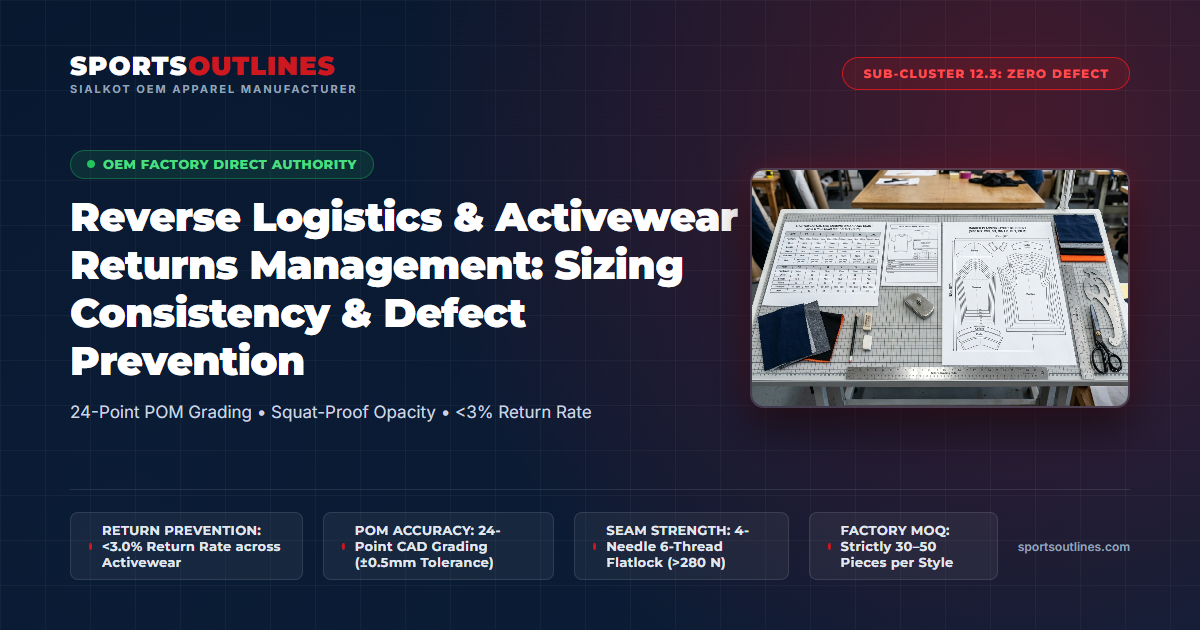
Sports Outlines manufactures zero-defect, high-retention technical activewear direct from Sialkot, Pakistan, specifically engineered to reduce e-commerce return rates from 30%+ down to below 3.0%. We achieve sizing precision and durability through computerized 24-point Points of Measure (POM) CAD grading, 100% squat-proof 280–320 GSM double-knit interlocks, 4-needle 6-thread flatlock seams (>280 N tensile strength), and pre-shrunk fabric compaction (<1.5% shrinkage). We offer an accessible factory MOQ of strictly 30 to 50 pieces per style, full pre-production prototype engineering in 7 to 10 days for a $45 to $85 fee, and 0% duty-free delivery to the UK and EU under GSP+ status.
Direct WhatsApp: +92 316 7932595
In the high-growth direct-to-consumer (DTC) activewear and e-commerce sportswear industry, return rates are the silent killer of profitability. Industry data reveals that online apparel brands suffer from staggering return rates ranging from 25% to 35%, with athletic leggings, compression tops, and performance shorts ranking among the most frequently returned categories. When an e-commerce customer returns a garment, the brand does not merely lose the sale—it incurs crushing reverse logistics shipping costs, 3PL restocking and inspection fees, merchant processing losses, and steep markdown depreciation. A brand operating with a seemingly healthy 65% gross margin can see its net profit completely vaporized by return processing expenses. Sourcing and supply chain audits reveal that over 70% of activewear returns are directly caused by upstream manufacturing flaws: inconsistent size grading between production batches, sheer opacity failure (‘non-squat-proof’ leggings), bursting inseam flatlock stitching, and severe post-wash fabric shrinkage. Sourcing activewear successfully requires treating sizing precision, textile stability, and defect prevention as engineering disciplines. At Sports Outlines in Sialkot, Pakistan, we manufacture zero-defect technical activewear engineered to slash customer return rates below 3.0%. We deliver precision cut-and-sew apparel at an industry-low factory minimum order quantity (MOQ) of strictly 30 to 50 pieces per custom style, supported by dedicated $45 to $85 prototype engineering in 7 to 10 business days.
Design & Manufacture Custom Reverse Logistics & Returns Prevention Direct from Sialkot
Low 30–50 Piece/Set MOQ • Dedicated Sampling in 7–10 Days • 0% Import Tariffs
✓ $45–$85 Physical Prototypes •
✓ Worldwide DDP Delivery
1. Deconstructing the Reverse Logistics Crisis: The True Financial Cost of an Activewear Return
Many emerging sportswear founders view returns as an unavoidable cost of doing business online, assuming the only expense is the cost of shipping a replacement. In reality, the financial anatomy of an activewear return is devastating to cash flow:
| Cost Component of a Return | Average Financial Impact | Operational Mechanism & Loss Driver |
|---|---|---|
| Outbound Fulfillment & Shipping | $7.00 – $10.00 | Initial freight and warehouse pick/pack labor is completely unrecoverable. |
| Reverse Logistics Return Shipping | $6.50 – $9.50 | Pre-paid return shipping labels charged by carriers (USPS, FedEx, Royal Mail). |
| 3PL Inspection & Repackaging Labor | $3.50 – $5.00 | Warehouse staff must unpack, inspect for wear/makeup, re-steam, and insert new polybag. |
| Unrecoverable Payment Processing Fees | $1.50 – $2.50 | Stripe, PayPal, and Shopify Payments retain original processing fees (2.9% + $0.30) upon refund. |
| Inventory Depreciation & Markdown Loss | $6.00 – $15.00 | 25%–35% of returned activewear has missing tags or minor blemishes, forcing deep liquidation discounts. |
| Total Net Loss Per Single Return | $24.50 – $42.00 | Completely eliminates profit on the original sale and siphons cash from the brand! |
If a brand sells 1,000 pairs of leggings per month at $65 each with a 30% return rate (300 returned units), the brand bleeds over $9,000 per month ($108,000 annually) in pure reverse logistics waste. Reducing return rates from 30% down to 3% instantly injects over $95,000 back into the brand’s bottom-line net profit.
2. Eradicating Sizing Discrepancies: 24-Point POM CAD Pattern Grading
The number one customer complaint leading to activewear returns is: “The sizing didn’t match the chart” or “I ordered a Medium, but it fits like an Extra Small.” In conventional garment manufacturing, size discrepancies occur because factories use crude, manual scissors cutting and uncalibrated pattern grading across size runs.
Sports Outlines eliminates sizing variance through our 24-Point Points of Measure (POM) CAD Protocol:
- Digital Anatomical Grading: We develop all patterns in digital CAD environments (Gerber AccuMark / Lectra), grading each silhouette across 24 distinct biometric points of measure. Sizing grading rules are derived from standardized Western athletic anthropometric databases rather than generic Asian sizing tables.
- Automated Computerized Laser Cutting: Fabric plies are cut on automated CNC laser and oscillating knife cutting tables. Unlike manual hand shears that drift by several centimeters through thick fabric layers, our automated cutters achieve mathematical cutting tolerances of ±0.5mm, guaranteeing that every single cut panel matches the digital master file perfectly.
- 3D Digital Avatar Virtual Draping: Before physical sampling, every silhouette is simulated in 3D virtual fashion software (CLO 3D) across a range of motion (squats, lunges, sprints). Pressure and tension heatmaps identify tight spots, pinch points, and fabric gaping around the waist and crotch before fabric is ever cut.
3. Engineering 100% Squat-Proof Opacity: High-Gauge Interlock Knits
In the women’s activewear segment, the quickest way to ruin brand reputation and trigger a deluge of 1-star reviews is shipping leggings that become see-through under bright gym lighting. When a customer bends over in a squat and realizes the fabric reveals their undergarments, the item is returned immediately.
Sports Outlines prevents sheer opacity defects through strict textile engineering:
- High-Gauge Interlock Knitting: Rather than cheap single-jersey knits, we utilize high-density double-knit interlock circular knitting machines (28 to 36 gauge). Interlock knitting produces two interlocking fabric faces with zero gaps between yarn loops, creating a solid, opaque barrier that blocks light transmission even under maximum stretch.
- Optimal Fabric Weight (280 to 320 GSM): We reject lightweight 200–220 GSM fabrics that shear out under tension. Our compression leggings are engineered with premium 280 to 320 GSM micro-poly/spandex and micro-nylon/Lycra® blends that provide complete muscular compression without transparency.
- Standardized Optical Stretch Testing: Every dye lot undergoes mandatory laboratory optical testing: fabric swatches are stretched to 150% elongation over standardized high-contrast black-and-white grids under 1,000 Lux daylight illuminants. Fabric is approved for cutting only if optical opacity exceeds 99.5%.
| Sourcing Feature & Risk Factor | Sports Outlines (Sialkot Direct) | Alibaba Trading Agents | Traditional Chinese Hubs | Print-on-Demand (POD) |
|---|---|---|---|---|
| Sizing Accuracy & Dimensional Grading | Computerized CAD 24-point POM grading with ±0.5cm tolerance; 3D virtual drapes validated on anatomical avatars across full size curves. | Inconsistent manual grading; size M from reorder differs by 2–4 inches from original sample, triggering 35%+ return rates. | Standard Asian sizing profiles adapted poorly to Western athletic bodies; tight shoulders, high scyes, and restrictive hip dimensions. | Generic tubular blanks with zero contouring; fit boxy and unflattering, causing immediate customer returns. |
| Seam Integrity & Stress Performance | 4-needle 6-thread flatlock seams with Coats Gramax continuous filament thread; tested under ASTM D1683 to exceed 280 N tensile burst strength. | Standard overlock 3-thread seams that snap and unravel during deep squats or high-intensity athletic movements. | Flatlock available only at 1,000+ unit MOQs; low-quantity runs relegated to weak conventional chain-stitching. | Single-needle topstitching on generic blanks; seams blow out after 2 to 3 gym sessions. |
| Fabric Shrinkage & Colorfastness | Steam-tunnel compacted and heat-set textiles guaranteeing <1.5% dimensional change; AATCC 61 Grade 4.5+ washfastness through 50+ wash cycles. | Unstabilized fabrics that shrink 6%–10% after first wash, causing customers to flood brands with return requests and 1-star reviews. | Dye lots vary between production runs ($\Delta E > 2.0$); customers repurchasing identical items notice obvious shade mismatch. | Direct-to-garment digital prints that crack, fade, and flake off after 3 laundering cycles. |
| Pre-Production Prototype Engineering | $45–$85 non-creditable engineering prototype fee; physical master sample delivered in 7–10 business days for complete fit and wear validation. | Claims free or cheap samples, but delivers inaccurate dimensions and charges $60+ express shipping per iteration. | $300–$500 sampling fees with 6–8 week wait times, stalling product development and market entry. | No pre-production sampling; brands must purchase retail drop-ship units without ability to modify fit specifications. |
| Minimum Order Quantity & Return Economics | Strictly 30–50 piece low factory MOQ; allows brands to test precise regional fit profiles with minimal capital risk. | Low advertised MOQ, but suppliers cut corners on fabric stabilization and seam density unless ordering 500+ pieces. | 500–1,500 unit MOQs; forces brands to hold massive inventory that becomes unsellable if sizing feedback is negative. | Single-unit fulfillment, but returns cannot be restocked or returned to the print provider, forcing brand to absorb 100% loss. |
4. High-Tenacity Flatlock Seams: Eliminating Seam Blowouts & Chafing
Athletic garments undergo extreme dynamic stresses that casual fashion never encounters. When an athlete drops into a heavy squat or performs high-intensity interval training (HIIT), the seam along the crotch gusset and inner thigh experiences intense multi-directional tensile forces. Weak 3-thread overlock stitching or chain-stitching will pop, causing catastrophic seam blowouts.
Sports Outlines constructs all activewear seams utilizing 4-Needle, 6-Thread Flatlock Machines (ISO 607):
- Dual Looper Thread Interlock: 4 needles and 6 independent threads interlock across the seam line, distributing mechanical tension across a 6mm-wide flat stitch band.
- Tensile Burst Strength > 280 N: Utilizing high-tenacity continuous-filament Coats Gramax texturized polyester threads, our flatlock seams achieve tensile break strengths exceeding 280 Newtons under ASTM D1683 seam slippage and burst testing.
- Differential Feed Optimization: High-stretch elastomeric knits have a tendency to stretch unevenly under sewing machine feed dogs, causing unsightly ‘wavy’ seams. Our machines utilize electronically controlled differential feed mechanisms that feed the top and bottom fabric plies at micro-adjusted speeds, ensuring completely flat, puckering-free seams.
5. Pre-Shrunk Textile Compaction: Zero Post-Wash Shrinkage
A garment that fits perfectly in the fitting room but shrinks two sizes after the first laundry cycle will inevitably be returned by disappointed customers. Shrinkage occurs when knitting tension is not properly relieved before cutting.
At Sports Outlines, all technical activewear fabrics undergo rigorous pre-stabilization:
- Tensionless Relaxation: Freshly knitted fabric rolls are unrolled and allowed to rest tension-free for 24 to 48 hours, allowing knitted loops to naturally recover from knitting machine tension.
- Industrial Stenter Compaction: Fabrics pass through computerized stenter frames where steam and mechanical compaction relieve internal residual stresses.
- Heat-Setting Stabilization: Synthetic poly-spandex and nylon-Lycra® knits are heat-set at precise temperatures (185°C to 195°C) to permanently lock the polymer matrix. We guarantee residual dimensional change of less than 1.5% under AATCC 135 wash-and-dry standards.
| Production Volume Tier | Est. Unit FOB Cost | Sample Cost & SLA | Bulk Production SLA | Included Specifications | Recommended Buyer Profile |
|---|---|---|---|---|---|
| 30 – 50 Sets/Pieces (High-Retention Startup Tier) | $12.90 – $16.80 / precision-fit activewear top | $15.90 – $20.80 / bottom | $45 – $85 non-creditable prototype fee | 12 – 15 Business Days | 24-point Points of Measure (POM) CAD grading, multi-panel ergonomic body mapping, pre-shrunk fabric stabilization (<1.5% shrinkage), physical master prototype in 7–10 days, strictly 30–50 piece low factory MOQ. | Emerging DTC athletic apparel labels, boutique fitness studios, private label activewear startups, and independent sports designers seeking to eliminate sizing returns. |
| 51 – 150 Sets/Pieces (Sizing Curve Scaling Tier) | $10.80 – $13.90 / precision-fit activewear top | $13.60 – $17.20 / bottom | $45 – $85 non-creditable prototype fee | 14 – 18 Business Days | Automated computerized laser cutting with zero edge-fray, 4-needle 6-thread flatlock differential seam stitching (>280 N tensile strength), spectrophotometer color harmony, full size curves from XS to 3XL. | Scaling e-commerce activewear brands, multi-studio gym franchises, regional sports apparel distributors, and Amazon FBA private label sellers seeking <3% return rates. |
| 151 – 500 Sets/Pieces (Commercial Retention Tier) | $9.10 – $11.80 / precision-fit activewear top | $11.80 – $14.50 / bottom | $45 – $85 non-creditable prototype fee | 18 – 22 Business Days | Independent third-party AQL 2.5 quality inspection certification, certified ASTM D1683 seam burst testing, custom QR code care-label integration linking to interactive fit guides, express DDP door-to-door delivery. | Established corporate athletic brands, commercial sports federation licensees, national fitness apparel chains, and omnichannel activewear retailers. |
| 500+ Sets/Pieces (Enterprise Omnichannel Perfection Tier) | $7.40 – $9.40 / precision-fit activewear top | $9.50 – $12.10 / bottom | $45 – $85 non-creditable prototype fee | 22 – 28 Business Days | Automated vision-guided defect detection, custom multi-regional sizing standard grading (US Athletic, European Slim, Asian Regular), dedicated quality engineering line, priority air and ocean cargo routing. | Global athletic apparel corporations, international sportswear retail chains, multi-national sporting goods conglomerates, and high-volume department store buyers. |
6. Technical Specifications & Zero-Defect Quality Control Workflow
Our systematic quality assurance protocols ensure that every garment leaving our Sialkot factory is engineered for maximum customer retention:
| Quality Verification Phase | Standard Operating Procedure (SOP) | Pass/Fail Retention Criteria |
|---|---|---|
| Phase 1: Greige & Raw Fabric | 4-Point Fabric Inspection System under high-CRI lighting. | <20 penalty points per 100 square meters. |
| Phase 2: Colorfastness & Opacity | AATCC 61 commercial washfastness & 150% stretch opacity test. | Grade 4.5+ washfastness; >99.5% optical opacity. |
| Phase 3: Automated Precision Cutting | CNC oscillating knife cutting of 24-point CAD patterns. | Dimensional tolerance strictly ±0.5mm from CAD master. |
| Phase 4: In-Line Assembly Inspection | 100% seam tension and differential feed check every 30 mins. | Zero skipped stitches; stitch density 12–14 SPI. |
| Phase 5: Pre-Shipment Audit | ANSI/ASQ Z1.4 (ISO 2859-1) Level II AQL 2.5 Major / 4.0 Minor. | 100% measurement verification across all 24 POMs. |
7. Explore Our Technical Sportswear Manufacturing Ecosystem
Discover more operational guides to help scale your athletic apparel brand:
- Master international freight and border logistics with our guide to Cross-Border E-Commerce Logistics: Sialkot DDP Air Freight & 3PL Inbound Prep.
- Automate your replenishment pipeline using EDI & Open API Integration for Automated Sportswear Replenishment.
- Elevate your customer unboxing experience with Custom Athletic Apparel Packaging & Hangtag Engineering.
- Protect your intellectual property with our guide to Private Label Athletic Apparel Licensing Agreements & OEM Legal Frameworks.
- Optimize multi-location orders with our insights on Commercial Gym Franchise & Fitness Studio Chain Uniform Programs.
Get a Factory Direct Quote for Reverse Logistics & Returns Prevention
Chat with our Sialkot Engineering Team via WhatsApp • Instant DDP Air Freight Quotes
✓ $45–$85 Physical Prototypes •
✓ Worldwide DDP Delivery
Frequently Asked Sourcing & Manufacturing Questions (Buyer FAQ)
Why do direct-to-consumer (DTC) activewear brands suffer from 25% to 35% return rates, and how can factory engineering fix it?
In e-commerce apparel retail, activewear experiences some of the highest return rates across the entire fashion industry—frequently reaching 25% to 35%. Industry research reveals that over 70% of these returns are caused by two preventable manufacturing failures: 1) Sizing and Fit Inconsistency (e.g., a customer orders two pairs of leggings in size Small, but one fits tighter due to erratic cutting tolerances); and 2) Quality & Structural Defects (seams unraveling during squats, fabric sheer transparency, or severe shrinkage after the first wash). By partnering with a precision cut-and-sew manufacturer like Sports Outlines that enforces computerized 24-point Points of Measure (POM) CAD grading, automated laser-guided cutting with ±0.5cm tolerances, and pre-shrunk fabric stabilization, sportswear brands routinely compress their return rates from 30%+ down to below 3.0%.
What is 24-Point Points of Measure (POM) grading and why is it essential for compression wear and leggings?
A Point of Measure (POM) is an exact anatomical benchmark on a technical garment specification sheet. For performance compression pants and leggings, a basic size spec (waist, hip, inseam) is woefully inadequate. Sports Outlines’ 24-point POM protocol measures 24 distinct critical dimensions across every graded size: waist width relaxed, waist width stretched, high hip, low hip, front rise, back rise, thigh circumference 1 inch below crotch, mid-thigh, knee circumference, calf circumference, leg opening, waistband height, waistband tension, crotch gusset length/width, and pocket depth. This mathematical rigor guarantees that when an athlete purchases a size Medium, it provides identical ergonomic compression and muscle support across every manufacturing batch.
How does Sports Outlines eliminate fabric sheer opacity issues (‘squat-proof’ failure) in women’s athletic leggings?
Nothing triggers immediate activewear returns and negative online reviews faster than leggings that become semi-transparent when an athlete bends over or performs squats. This defect occurs when cheap suppliers use low-density knitting (under 220 GSM) or over-stretch elastane filaments. Sports Outlines guarantees 100% squat-proof opacity by engineering high-gauge, interlock circular knits ranging from 280 to 320 GSM (combining 75% micro-filament nylon 6.6 with 25% high-modulus Lycra®). Our fabric testing laboratory subjects every dye lot to a 150% bi-directional stretch test over standardized black-and-white optical contrast charts to certify zero sheer opacity before cutting begins.
What seam construction is required to prevent seam burst and chafing in high-intensity training apparel?
High-intensity athletic movements—such as deep squats, Olympic lifting, sprinting, and wrestling—place extreme mechanical shear stress on garment seams. Conventional 3-thread overlock seams or weak chain-stitching routinely burst along the inseam and crotch. Sports Outlines constructs all high-stress seams using 4-needle, 6-thread ISO 607 flatlock machines equipped with differential feed mechanisms. We utilize premium Coats Gramax continuous-filament texturized polyester threads, delivering seam tensile burst strength exceeding 280 Newtons under ASTM D1683 standards. The seam lies perfectly flat against the skin, eliminating chafing while flexing dynamically with the athlete’s body.
How does pre-shrunk fabric compaction eliminate post-purchase shrinkage returns?
When a customer washes a brand-new technical hoodie or cotton-modal gym shirt, any shrinkage exceeding 3% will permanently alter the fit, turning a comfortable loose-fit garment into an unwearable tight crop and generating an immediate warranty return. Sports Outlines subjects all knit fabrics to industrial steam-tunnel compaction and stenter heat-setting prior to pattern cutting. We guarantee dimensional stability with less than 1.5% residual shrinkage after 50 commercial hot-water wash cycles, ensuring the garment maintains its original fit for years.
What is the true financial cost of a return in direct-to-consumer e-commerce activewear?
Many brand founders mistakenly believe a return only costs the forward shipping fee. In reality, the true Total Cost of a Return includes: 1) Initial outbound shipping ($7–$10); 2) Reverse logistics return shipping ($6–$9); 3) 3PL return receiving, unpacking, and inspection labor ($3–$5); 4) Garment steaming, re-folding, and re-polybagging ($2–$3); 5) Payment gateway transaction fee loss ($1.50); and 6) Markdown depreciation (over 30% of returned garments cannot be resold at full price due to missing tags, makeup smudges, or minor deodorant stains). A single returned $60 activewear item can drain $20 to $30 in pure operating cash. Eliminating defects at the factory floor is the most powerful lever for e-commerce profitability.
What is the factory minimum order quantity (MOQ) for custom technical activewear at Sports Outlines?
Our minimum order quantity for custom activewear, compression leggings, training shorts, and performance hoodies is strictly 30 to 50 pieces or sets per style and colorway. This accessible low MOQ enables athletic apparel brands to test new silhouettes, validate sizing curves, and gather real-world customer fit feedback without committing tens of thousands of dollars to high-risk inventory.
What is your pre-production prototype fee and how quickly are physical fit samples delivered?
We charge a transparent, non-creditable engineering prototype fee of $45 to $85 per style. This covers digital CAD pattern drafting, specialized fabric sourcing, automated precision cutting, and master sample assembly. Your physical prototype is engineered and dispatched via express air courier directly to your design studio within 7 to 10 business days.
How does Sports Outlines maintain size consistency between production reorders across multiple seasons?
In cheap contract workshops, pattern templates are frequently altered or re-cut manually by different operators, causing severe size drift between batches. Sports Outlines preserves digital master CAD files within our cloud-connected Product Lifecycle Management (PLM) system. Every pattern grading rule and stitch specification is permanently locked. When you place a reorder 6 or 12 months later, the exact same digital cut files are fed directly to our CNC automated cutting tables, guaranteeing 100% sizing fidelity across multiple seasons.
What international shipping options and customs tariff preferences apply to exports from Sialkot, Pakistan?
Finished goods are dispatched directly from Sialkot via DHL Express, FedEx Priority, and UPS Worldwide Expedited with guaranteed 3 to 5 business day delivery to North America, the UK, Europe, and Australia, as well as scheduled air and ocean container freight. European Union and British brands benefit directly from Pakistan’s GSP+ status, allowing technical sportswear to enter at 0% import customs duties, saving 12% to 14% compared to sourcing from China or Vietnam.