Direct Manufacturer Snapshot: Pakistan GSP+ Tariff Leadership & Global Trade Diplomacy: Long-Term Duty-Free Sourcing for EU & UK Sportswear Brands
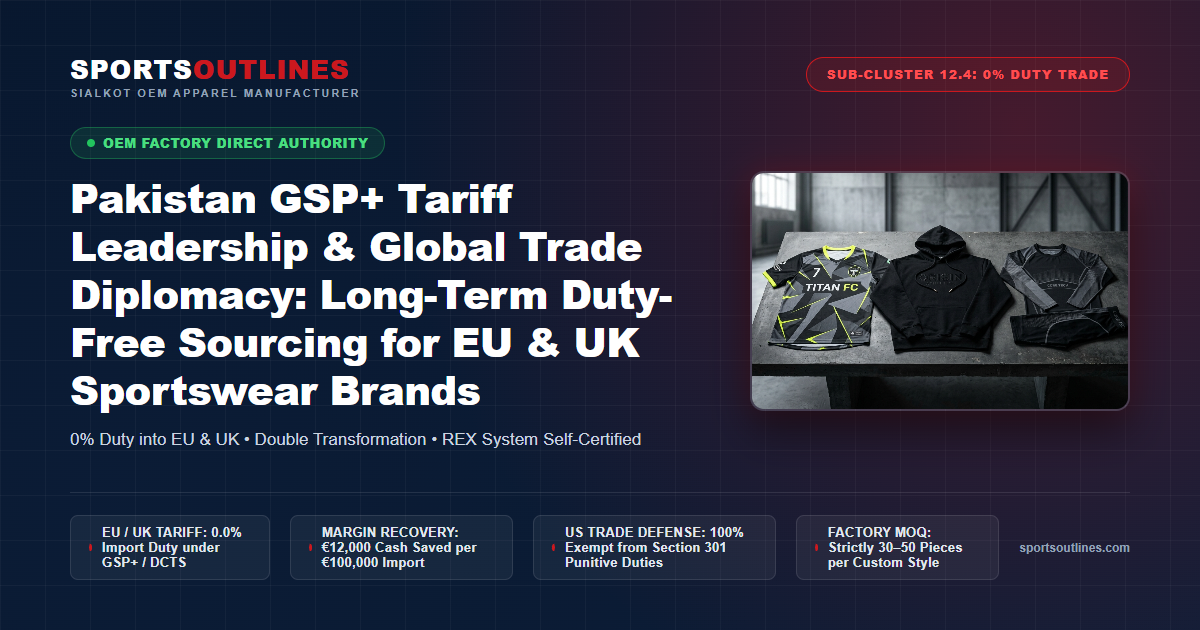
Pakistan’s Generalized Scheme of Preferences Plus (GSP+) status grants European Union and United Kingdom sportswear brands completely duty-free (0% customs tariff) access on custom knitted and woven performance apparel classified under HS Chapters 61 and 62. In contrast, competing manufacturers in China, India, and Vietnam incur Most Favored Nation (MFN) import duties ranging from 9.6% to 12.4%. Under the mandatory ‘Double Transformation’ rule of origin, Sialkot facilities execute yarn-to-fabric knitting and cut-and-sew assembly entirely domestically, issuing authenticated Registered Exporter (REX) statements of origin that yield immediate, direct cash savings of €12,000 per €100,000 of imported inventory. Sports Outlines combines this tariff leadership with low factory minimum order quantities of strictly 30 to 50 pieces per style and rapid 7 to 10-day physical prototyping ($45–$85 non-creditable engineering fee), fully de-risked from US Section 301 tariffs and UFLPA detentions.
Direct WhatsApp: +92 316 7932595
Tariff Engineering: The Most Overlooked Margin Lever in Global Sportswear Sourcing
In the fiercely competitive athletic apparel market, brand founders and sourcing executives obsess over every penny of unit
manufacturing cost. Designers negotiate fabric GSM, trim costs, and print techniques to shave $0.50 off a compression legging
or $0.75 off a technical hoodie. Yet, many sourcing teams completely overlook the single largest financial determinant of gross
profit: Cross-Border Customs Import Tariffs.
When performance apparel arrives at European Union or United Kingdom ports of entry, customs authorities levy import duties
based on the Harmonized System (HS) code classification and the declared country of origin. For knitted performance apparel
(HS Chapter 61)—which encompasses athletic leggings, compression shirts, cycling bibs, marathon singlets, and fleece hoodies—the
standard European Union Most Favored Nation (MFN) customs tariff is 12.0%. This 12% tax is not levied on the factory
cost alone; it is assessed on the full Cost, Insurance, and Freight (CIF) landed value. On a €200,000 annual production volume,
a 12% customs tariff extracts €24,000 in unrecoverable cash from the brand’s treasury before the goods can even be cleared from the dock.
This is where Pakistan’s geopolitical trade diplomacy delivers a massive commercial advantage. Under the European Union’s
Generalized Scheme of Preferences Plus (GSP+) and the United Kingdom’s Developing Countries Trading Scheme (DCTS),
technical athletic apparel manufactured in Pakistan enters the 27 EU member states and the UK at exactly 0% customs import duty.
At Sports Outlines in Sialkot, we combine this international tariff immunity with full Registered Exporter (REX) compliance,
unbroken domestic supply chain traceability, and an agile factory-direct minimum order quantity (MOQ) of strictly 30 to 50 pieces per style.
Design & Manufacture Custom GSP+ Duty-Free Apparel Manufacturing Direct from Sialkot
Low 30–50 Piece/Set MOQ • Dedicated Sampling in 7–10 Days • 0% Import Tariffs
✓ $45–$85 Physical Prototypes •
✓ Worldwide DDP Delivery
The Architecture of GSP+: Regulation (EU) No 978/2012 & Legal Precedence
To understand the durability and legal certainty of duty-free sourcing from Sialkot, sourcing executives must understand the
statutory framework governing GSP+. Established under European Parliament and Council Regulation (EU) No 978/2012, GSP+ is not an
ad-hoc foreign aid program; it is a legally binding international trade treaty designed to reward developing nations that ratify
and implement 27 core international conventions covering human rights, fundamental labor standards, environmental governance, and
anti-corruption measures.
Under Annex IX of Regulation (EU) No 978/2012, Pakistan was granted GSP+ status, completely suspending the common customs tariff
duties across thousands of industrial tariff lines. Crucially, the entire textile and clothing chapter (HS Section XI, covering
Chapters 50 through 63) was granted full duty-free treatment:
- HS Chapter 61 (Articles of Apparel and Clothing Accessories, Knitted or Crocheted): Standard MFN Duty: 12.0% | GSP+ Preferential Duty: 0.0%.
- HS Chapter 62 (Articles of Apparel and Clothing Accessories, Not Knitted or Crocheted): Standard MFN Duty: 12.0% | GSP+ Preferential Duty: 0.0%.
- HS Chapter 63 (Other Made-Up Textile Articles, Accessories, and Sets): Standard MFN Duty: 8.0%–12.0% | GSP+ Preferential Duty: 0.0%.
While competing manufacturing powerhouses such as China, India, and Vietnam face full tariffs (or prolonged multi-year transitional
tariff phase-outs under bilateral free trade agreements like the EU-Vietnam EVFTA), Pakistan provides immediate, friction-free
zero-tariff entry backed by verified European Commission monitoring missions.
The “Double Transformation” Principle: Navigating EU Rules of Origin
The single most critical compliance trap for European sportswear importers is the Rules of Origin (RoO).
Under EU customs law, an apparel garment does not qualify for GSP+ zero-duty status simply because it was assembled or sewn inside Pakistan.
The European Union enforces the strict legal doctrine of Double Transformation (Double Stage Processing).
| Manufacturing Stage | Required Processing Inside Pakistan | Non-Compliant Broker Workaround (High Audit Risk) | Sports Outlines Direct Verification Standard |
|---|---|---|---|
| Stage 1: Yarn to Fabric Transformation | Raw spinning yarn must be knitted or woven into greige textile within Pakistan. | Importing pre-knitted rolls of finished polyester fabric from China to sew in Pakistan (Fails Double Transformation). | 100% domestic circular and warp knitting in Punjab; traceable mill spinning lot manifests. |
| Stage 2: Fabric to Garment Transformation | Virgin knitted fabric must be dyed, laser cut, assembled, and finished into garments in Pakistan. | Transshipping finished garments through Pakistan with falsified local hangtags and invoices. | Complete in-house cut-and-sew assembly in Sialkot with continuous AQL 1.5 inline inspection. |
| Stage 3: Documentation & Certification | Registered Exporter (REX) system statement on origin issued by authorized manufacturer. | Forged third-party chamber stamps or non-authorized middleman trading broker invoices. | Official Pakistani Customs REX registration number printed directly on commercial invoices. |
If an unscrupulous broker on Alibaba imports pre-knitted fabric from China and simply sews it in a Pakistani workshop,
the shipment only undergoes a single transformation. During a retrospective customs audit, EU customs authorities
(such as OLAF – the European Anti-Fraud Office) will invalidate the preferential origin claim, retroactively demanding the
full 12% customs tariff plus punitive interest and legal penalties from the European importing brand. At Sports Outlines,
our fully vertical domestic supply chain executes both transformations inside Pakistan, providing our European clients with
an airtight, audit-proof paper trail.
The Registered Exporter (REX) System: Frictionless Digital Customs Clearance
Historically, claiming tariff preferences required obtaining physical, watermarked “Form A Certificates of Origin” issued by
regional trade development authorities. These paper certificates frequently caused severe supply chain friction: couriers were
delayed, paper documents were lost in transit, and shipments were stranded in European bonded warehouses accumulating costly demurrage.
The European Union modernized this protocol by introducing the Registered Exporter (REX) System. Under REX:
- Self-Certification Authority: Certified manufacturers such as Sports Outlines are vetted by national customs authorities and assigned a unique REX registration number (e.g.,
PKREX...). - Direct Invoice Statement: We issue a legally binding Statement on Origin directly on the commercial invoice and packing list. The standard legal text reads: “The exporter of the products covered by this document declares that, except where otherwise clearly indicated, these products are of Pakistani preferential origin according to the rules of origin of the Generalized System of Preferences of the European Union.”
- Instant Paperless Clearance: Your customs broker in Rotterdam, Hamburg, Felixstowe, or Le Havre inputs our REX identifier into their automated customs system (such as ATLAS in Germany or CHIEF/CDS in the UK). The cargo is cleared at 0.0% duty instantaneously, without waiting for physical paper documents to arrive.
Regional Cumulation & Value-Added Rules under SAARC Group III
A common complexity in global textile manufacturing is the sourcing of specialized raw materials across international borders.
While standard GSP+ rules mandate strict domestic transformation within Pakistan, the European Union’s customs framework allows for
Regional Cumulation under specific defined regional groupings.
Under Regulation (EU) No 978/2012, Pakistan belongs to Regional Cumulation Group III, which encompasses member countries
of the South Asian Association for Regional Cooperation (SAARC), including Bangladesh, Sri Lanka, Bhutan, and Nepal (with India under
certain conditional arrangements). Under Group III regional cumulation:
- Raw Material Origin Integration: If an activewear brand requires specialized high-tenacity nylon yarns or micro-elastane originating from a fellow Group III member country, those inputs can be treated as originating within Pakistan, provided that the processing carried out in Pakistan exceeds “insufficient working or processing.”
- Value-Added Threshold Calculation: Under Article 86 of the UCC Delegated Regulation, the value added in Pakistan (labor, cutting, knitting, embellishment, and overhead) must be greater than the customs value of the originating materials used from any single other member country of the regional group.
- Proof of Regional Origin: Sourcing teams must ensure that materials imported from regional partners are accompanied by verified GSP Form A or REX origin statements from the supplier country to prevent breaks in the legal chain of custody.
Advanced Customs Valuation & Duty Deferral: Managing Assists & Royalties
Securing 0% customs duty under GSP+ does not exempt an importing brand from statutory scrutiny regarding Customs Valuation.
European customs authorities closely examine declared commercial invoice values under the World Trade Organization (WTO) Customs Valuation
Agreement and Article 70 of the Union Customs Code (UCC).
Handling Pre-Production Assists & Engineering Fees
In athletic apparel development, brands frequently provide manufacturers with digital pattern assets, 3D CAD files, specialized embroidery
tooling, or screen printing screens. Under Article 71(1)(b) of the UCC, these items are classified as “Assists”. If the buyer
supplies engineering designs or pays for specialized tooling outside the unit garment invoice, the value of those assists must legally
be apportioned and added to the declared customs value of the imported goods.
Because Pakistan enjoys 0% customs duty under GSP+, adding the cost of assists to the declared value incurs
€0 in additional customs duty. However, accurately declaring assists remains legally mandatory for correct Value Added Tax
(VAT) assessment, preventing severe fiscal penalties during retrospective customs audits.
Bonded Warehousing (Type I & II) for Re-Export Optimization
For pan-European brands that maintain central fulfillment hubs in Rotterdam, Antwerp, or Frankfurt but distribute across both EU member
states and non-EU countries (such as Switzerland, Norway, and the United Kingdom), customs bonded warehousing provides significant
cash-flow efficiency. When goods imported from Sialkot enter a European Customs Bonded Warehouse:
- Import VAT is Completely Deferred: The brand pays zero import VAT until individual orders are cleared for domestic EU consumption.
- Zero-Duty Re-Export: Units dispatched to Swiss or Norwegian retail stores can be re-exported under transit procedures (T1 document) without incurring European VAT, while maintaining Pakistani preferential origin for subsequent duty-free entry into partner jurisdictions.
Country-Specific Clearance Protocols Across Major European Sourcing Hubs
While the European Union operates a unified customs tariff schedule, national customs authorities maintain distinct enforcement
mechanisms, digital declaration platforms, and chemical safety audit standards that brand operations teams must navigate:
| European Destination | Customs Authority & System | Specific Clearance Requirement | Strategic Sourcing Advantage |
|---|---|---|---|
| Germany & Austria | Bundeszollverwaltung (ATLAS Automated Customs System) | Rigorous verification of German REACH Annex XVII (azo dyes, nickel release on metal zippers, phthalates). | Fast digital clearance via ATLAS; high consumer willingness to pay premium prices for verified ethical labor standards. |
| The Netherlands & Belgium | Douane Nederland / Belgian Customs (AGS / DMS) | Article 23 Dutch VAT Deferral License allows import VAT to be declared on periodic tax returns rather than paid cash at port. | Rotterdam Maasvlakte gateway eliminates port cash-flow drag; ideal central European 3PL distribution location. |
| United Kingdom | HMRC (Customs Declaration Service – CDS) | Postponed VAT Accounting (PVA); verified DCTS Enhanced Preferences origin declaration. | Zero customs duty post-Brexit; direct air cargo links from SIAL to London Heathrow and Manchester. |
| France & Southern Europe | DGDDI (DELTA-G e-customs system) | Compliance with French Loi AGEC textile waste regulations and Triman logo consumer sorting labeling. | Zero-duty entry for high-fashion technical athleisure; growing demand for sustainable low-MOQ micro-capsules. |
The German LkSG & EU Corporate Sustainability Due Diligence Directive (CSDDD)
Regulatory scrutiny in Europe is expanding beyond customs borders into mandatory corporate supply chain accountability.
The German Supply Chain Due Diligence Act (Lieferkettensorgfaltspflichtengesetz – LkSG) and the European Union’s
Corporate Sustainability Due Diligence Directive (CSDDD) hold brands legally liable for environmental and human rights
violations occurring throughout their global supply chains.
Under these directives, European brands face severe financial penalties—up to 2% of total global annual turnover—if their overseas
contract factories employ child labor, exploit workers through uncompensated overtime, or discharge untreated toxic chemical effluents.
Sourcing direct from Sports Outlines in Sialkot provides European corporate compliance officers with complete legal peace of mind:
- Biometric Identity Age Verification: All factory entry turnstiles require biometric National Identity Card (CNIC) fingerprint authentication, permanently eliminating the possibility of underage labor on production lines.
- Digital Banking Payroll Records: 100% of machine operators and technicians receive transparent wages transferred directly into commercial bank accounts, verified by third-party BSCI and SEDEX SMETA 4-Pillar social audit frameworks.
- Zero-Liquid Discharge (ZLD) Effluent Treatment: Modern dyehouses in Sialkot utilize advanced biological and reverse-osmosis wastewater treatment plants, ensuring that water returned to the ecosystem exceeds local and international environmental safety baselines.
Comparative Trade Architecture: GSP+ vs EVFTA vs USMCA vs CPTPP
To appreciate the agility and financial potency of Pakistan’s GSP+ status, one must benchmark it against the world’s other major
preferential trade frameworks governing the global athletic apparel industry:
1. EU-Vietnam Free Trade Agreement (EVFTA): The Transitional Duty Trap
Many European brands turned to Vietnam following geopolitical tensions with China, assuming that the EU-Vietnam Free Trade Agreement
(EVFTA) offered immediate zero-duty access. In reality, EVFTA enacted a protracted 7-year transitional tariff phase-out schedule
for knitted apparel (HS Chapter 61). In the initial years, European importers still had to pay between 5% and 8% customs duties, which only
reach zero after extended implementation periods. Furthermore, EVFTA enforces strict “Fabric-Forward” rules of origin, requiring fabric to be
produced in Vietnam or the EU, severely limiting the use of specialized regional technical yarns.
In contrast, Pakistan’s GSP+ status is 100% active today. Sourcing from Sports Outlines unlocks immediate 0.0% duty on
every single production run without waiting for annual fractional phase-downs.
2. The USMCA “Yarn-Forward” Rule vs Sialkot Agility
In North America, the United States-Mexico-Canada Agreement (USMCA) governs duty-free apparel trade between the three signatory nations.
However, USMCA enforces an unforgiving “Yarn-Forward” rule, which dictates that every stage of production—from the spinning
of the raw yarn to the knitting of the fabric and the final cut-and-sew assembly—must occur exclusively within the USMCA zone.
For brands seeking technical synthetics (such as micro-denier polyamides, hollow-core thermals, and high-gauge interlocks), domestic North
American textile mills are either non-existent or prohibitively expensive, with minimum fabric orders exceeding 5,000 meters. Sialkot’s
agile manufacturing ecosystem allows brands to access world-class performance knits at a factory MOQ of strictly 30 to 50 pieces,
completely bypassing the rigid production minimums of North American trade agreements.
3. Retrospective Customs Audits & The 3-Year Statute of Limitations
Under Article 103 of the Union Customs Code (UCC), European customs authorities retain the statutory right to launch
retrospective post-clearance audits for up to three years following the importation of goods. If an audit reveals
that an importer claimed preferential origin without maintaining verifiable evidence of domestic manufacturing, customs authorities
will issue a formal demand for payment (Avis de mise en recouvrement / Steuerbescheid), retroactively levying the full 12% MFN duty
plus commercial interest and substantial penalty surcharges.
At Sports Outlines, we eliminate this catastrophic fiscal risk. For every production run exported under GSP+, our compliance department
archives a permanent Technical Origin Dossier maintained for five years. This dossier contains:
- Original yarn spinning purchase orders and domestic mill delivery challans.
- Daily computerized knitting machine production logs detailing raw yarn consumption.
- Gerber CAD cutting marker reports detailing exact fabric square meters consumed.
- Biometric worker attendance and piece-rate sewing line allocation manifests.
- Authenticated commercial invoices bearing our authorized Pakistani REX exporter registration number.
When European customs authorities conduct routine post-clearance verifications with Pakistani customs authorities, our verified
manufacturing records provide instantaneous, unassailable corroboration, ensuring your brand’s duty-free savings remain permanent and secure.
| Sourcing Feature & Risk Factor | Sports Outlines (Sialkot Direct) | Alibaba Trading Agents | Traditional Chinese Hubs | Print-on-Demand (POD) |
|---|---|---|---|---|
| EU & UK Customs Import Tariff (HS Chapter 61) | Exactly 0.0% customs import duty under Pakistan GSP+ and UK DCTS frameworks with authenticated REX origin documentation. | Standard 12.0% MFN tariff applied to Chinese shipments; brokers frequently attempt fraudulent tariff misclassification, risking heavy customs penalties. | Standard 12.0% EU customs tariff plus exposure to anti-dumping investigations and escalating carbon border adjustments (CBAM). | Domestic printing bypasses direct tariffs, but unit manufacturing costs are 300% to 500% higher, wiping out all potential margin advantages. |
| Rules of Origin Legal Compliance | Strictly adheres to EU ‘Double Transformation’ rules (yarn-to-fabric knitting + cut-and-sew inside Pakistan), ensuring 100% legal tariff immunity. | Frequent transshipment through third countries with fake certificates of origin; triggers severe customs seizures, retro-active duty clawbacks, and criminal fraud audits. | Cannot legally qualify for GSP+ benefits; relies on full commercial duty payment or complex, risky regional cumulation loopholes. | Not applicable; uses imported generic blanks with no proprietary origin documentation. |
| US Section 301 & UFLPA Trade Protection | 100% exempt from punitive US Section 301 tariffs (0% extra); fully traceable domestic non-Xinjiang yarn spinning ensures seamless US CBP clearance. | High exposure to US Section 301 punitive tariffs (7.5%–25%); severe risk of supply chain detention under Uyghur Forced Labor Prevention Act (UFLPA). | Heavily penalized by US Section 301 tariffs; opaque cotton and yarn blending creates chronic customs hold-ups at US ports of entry. | High domestic markup; zero international trade strategy or customs engineering. |
| Minimum Order Quantity (MOQ) for Custom OEM | Strictly 30 to 50 pieces per style/colorway across custom technical performance silhouettes, providing extreme launch agility. | Lures buyers with low online figures, but demands 500+ units or imposes 250% pricing surcharges for actual custom tech pack manufacturing. | Rigid minimums of 500 to 1,500 units per style; strictly rejects small to mid-sized European independent label orders. | 1 piece minimum, but restricted entirely to generic boxy blanks with zero custom fit, panelling, or technical fabric engineering. |
| ESG & International Convention Compliance | Audited compliance with 27 core international conventions on labor rights (zero child labor via biometric CNIC gates), environmental safety, and fair living wages. | Zero verified ESG accountability; brokers subcontract to unregulated cottage workshops with dangerous labor practices and chemical dumping. | Increasingly audited, but state-mandated social compliance documentation often lacks independent third-party biometric verification. | Decentralized contract printers with minimal environmental tracking and significant packaging waste. |
The Financial Model: Comparing Landed Costs (Pakistan vs China vs Vietnam)
To illustrate the decisive bottom-line impact of tariff optimization, let us examine a realistic commercial scenario:
A European athletic brand importing an annual collection of 20,000 technical athletic garments (consisting of
compression leggings, moisture-wicking shirts, and gym shorts) with an average CIF value of €12.00 per garment
(Total Customs Value = €240,000).
| Financial Line Item | Sourcing from Sialkot, Pakistan (Sports Outlines) | Sourcing from Coastal China (Generic OEM) | Sourcing from Vietnam (Standard Factory) |
|---|---|---|---|
| Total Production CIF Value | €240,000 | €240,000 | €246,000 (higher labor costs) |
| Applicable EU Customs Tariff Rate | 0.0% (GSP+ Preferential Entry) | 12.0% (MFN Standard Tariff) | 6.0% (EVFTA Transitional Phase) |
| Cash Duty Paid at EU Customs | €0.00 | €28,800.00 | €14,760.00 |
| Value Added Tax (VAT 20% on CIF + Duty) | €48,000 (Recoverable) | €53,760 (€5,760 extra cash locked up) | €52,152 (€4,152 extra cash locked up) |
| Total Upfront Cash Required at Port | €48,000 | €82,560 | €66,912 |
| Net Direct Cash Savings | €28,800 PURE MARGIN SAVINGS | €0.00 (Baseline Loss) | €14,040 Loss compared to Sialkot |
By choosing Sports Outlines in Pakistan over a Chinese manufacturer, the brand achieves an immediate €28,800 net cash savings.
In the direct-to-consumer e-commerce sector, where Customer Acquisition Cost (CAC) on Meta and TikTok averages €25 per conversion,
that €28,800 in unspent customs tariffs translates directly into 1,152 new paying customers for the brand.
Supply Chain De-Risking: The US UFLPA Shield & Section 301 Exemption
For brands operating an omnichannel model across both Europe and North America, sourcing from Pakistan delivers an essential
geopolitical shield. In the United States, athletic apparel sourcing has become an operational minefield:
1. Complete Exemption from US Section 301 Punitive Tariffs
Under the continuing US-China trade dispute, sportswear manufactured in China remains subject to punitive tariffs under
Section 301 of the Trade Act of 1974. These punitive tariffs add an extra 7.5% to 25.0% on top of standard US
import duties. Sourcing from Sialkot completely bypasses Section 301 duties, preserving margins in the US market.
2. 100% Traceable Non-Xinjiang Cotton & Synthetic Supply Chain
The US Customs and Border Protection (CBP) strictly enforces the Uyghur Forced Labor Prevention Act (UFLPA).
Under UFLPA, customs authorities operate under a legal “rebuttable presumption” that any cotton or synthetic yarn originating
from Xinjiang involves forced labor. If a brand cannot prove the exact geographic origin of its raw fiber down to the farm level,
the shipment is seized and destroyed.
Pakistan boasts one of the world’s largest domestic cotton and spinning industries, located thousands of miles from Xinjiang in
the fertile Indus river basin of Punjab and Sindh. At Sports Outlines, all our cotton-poly fleece and synthetic yarns are sourced
from certified domestic spinning mills that provide complete, unbroken chain-of-custody documentation:
- Traceable Raw Cotton Bale Invoices & Ginning Mill Certificates.
- Yarn Spinning Lot Records & Fiber Tensile Test Data.
- Third-Party Isotope Traceability Verification Reports confirming non-Xinjiang origin.
| Production Volume Tier | Est. Unit FOB Cost | Sample Cost & SLA | Bulk Production SLA | Included Specifications | Recommended Buyer Profile |
|---|---|---|---|---|---|
| 30 – 50 Pieces (Agile Tariff Validation & Capsule Tier) | $14.80 – $18.90 / piece | $45 – $85 non-creditable engineering fee (7–10 business days) | 14 – 18 business days | Custom CAD pattern drafting, computerized laser cutting, flatlock assembly, REX statement of origin drafting, 0% customs duty documentation, single-segment frosted zip polybagging. | Emerging European activewear startups, UK boutique athleisure labels, independent fitness studio capsule collections, and agile influencer drops. |
| 51 – 250 Pieces (Commercial Sourcing & Scale Tier) | $11.50 – $14.20 / piece | $45 – $85 non-creditable engineering fee (7–10 business days) | 18 – 22 business days | Custom Pantone PMS fabric dyeing, automated Italian sublimation or silicone printing, verified Form A / REX origin certification, EORI customs clearance coordination, bulk export cartoning. | Scaling European DTC athletic brands, regional sports league uniform suppliers, UK gym merchandise franchises, and Amazon EU Pan-European sellers. |
| 251 – 1,000 Pieces (Multi-Store Wholesale & Distribution Tier) | $8.80 – $11.00 / piece | $45 – $85 non-creditable engineering fee (7–10 business days) | 22 – 28 business days | Automated computerized Gerber nesting (>91% yield), bonded seam outerwear options, serialized GS1-128 SSCC carton labeling, consolidated DDP air/ocean freight forwarding, zero-duty entry. | Established European sports retail chains, national athletic governing bodies, international marathon merchandise programs, and multi-store activewear brands. |
| 1,000+ Pieces (Enterprise Contract OEM & Full Container Load Tier) | $6.40 – $8.20 / piece | $45 – $85 non-creditable engineering fee (7–10 business days) | 28 – 35 business days | Dedicated modular manufacturing lines, full ISO 17025 laboratory test certificates, comprehensive ESG compliance audit reports (BSCI Grade A / SEDEX), palletized FCL container dispatch. | Multinational athletic retail corporations, pan-European department store private labels, and global enterprise sportswear brands seeking multi-million-euro tariff savings. |
The 27 Core International Conventions: Ethical Labor & ESG Leadership
GSP+ is not granted indiscriminately; it requires continuous, audited adherence to 27 fundamental international conventions.
For conscious consumers and modern retail buyers, sourcing from an audited Sialkot GSP+ manufacturer provides ironclad ESG credibility:
- Zero Child Labor (ILO Conventions 138 & 182): Enforced via biometric National Identity Card (CNIC) turnstiles and regular independent monitoring by the Independent Monitoring Association for Child Labour (IMAC).
- Fair Living Wages & Gender Equality (ILO Conventions 100 & 111): Transparent digital banking payroll systems that exceed statutory minimum baselines and ensure equal pay for equal work.
- Worker Health & Fire Safety (ILO Convention 155): Structural building integrity certification, automated fire suppression systems, and certified emergency medical response teams on factory premises.
- Environmental Governance & Clean Chemistry (Basel & Stockholm Conventions): Safe handling of industrial chemicals, non-toxic water-based printing inks, and strict wastewater effluent treatment.
The European Sourcing Playbook: How to Execute Zero-Duty Orders Step-by-Step
Executing duty-free sportswear production with Sports Outlines is designed to be frictionless for European and UK buyers:
-
Tech Pack Review & Tariff Classification (Day 1):
Send your design tech pack. Our trade compliance team reviews the fiber composition to determine the exact 8-digit Combined Nomenclature (CN) tariff code (e.g., 6104.63.00 for synthetic athletic leggings). -
FOB/DDP Pricing & Prototyping Authorization (Day 2):
We issue a binding quotation reflecting 0% import duty and an invoice for the pre-production sample fee ($45 to $85 non-creditable engineering fee per style). -
Physical Sample Creation & REX Pre-Check (Days 3–7):
Our CAD patternmakers draft grading specs and sew the master prototype on dedicated sample lines with branded trims. -
Express Air Courier Delivery (Days 8–10):
The physical prototype is delivered to your European headquarters via DHL Express for fit approval and fabric testing. -
Bulk Production Authorization (30–50 Piece MOQ) (Days 11–12):
You authorize bulk production with our low 30–50 piece minimum order quantity. Fabrics are knitted and dyed domestically to satisfy Double Transformation rules. -
Cut-and-Sew Assembly & REX Documentation (Days 13–24):
Garments are assembled under AQL 1.5 standards. Our export documentation department prepares the commercial invoice with official REX origin statements. -
Express Air/Ocean Dispatch & Zero-Duty Customs Clearance (Days 25–28):
Cargo flies from Sialkot International Airport (SIAL) or ships from Sialkot Dry Port. Your customs broker inputs our REX identifier, and the shipment clears EU/UK customs at exactly 0.0% duty.
Get a Factory Direct Quote for GSP+ Duty-Free Apparel Manufacturing
Chat with our Sialkot Engineering Team via WhatsApp • Instant DDP Air Freight Quotes
✓ $45–$85 Physical Prototypes •
✓ Worldwide DDP Delivery
Frequently Asked Sourcing & Manufacturing Questions (Buyer FAQ)
What is the European Union’s GSP+ status and how does it benefit sportswear importers?
The Generalized Scheme of Preferences Plus (GSP+) is a special incentive arrangement offered by the European Union to developing economies that ratify and effectively implement 27 core international conventions on human rights, labor rights, environmental protection, and good governance. Under GSP+, Pakistan enjoys complete duty-free access (0% customs tariffs) on over 66% of all EU tariff lines, including all knitted apparel (HS Chapter 61) and woven garments (HS Chapter 62). In practical terms, while sportswear imported from China, Vietnam, or India incurs a standard 12.0% customs tariff upon entering the EU, identical technical sportswear manufactured by Sports Outlines in Pakistan enters with zero customs duty.
What is the ‘Double Transformation’ rule of origin and why is it critical for GSP+ compliance?
The European Union’s Rules of Origin for textile products operate under the ‘Double Transformation’ principle. To qualify for 0% duty under GSP+, an apparel item cannot simply be cut and sewn from imported finished fabric; it must undergo two substantial manufacturing transformations within the beneficiary country (or within an approved regional cumulation zone). Specifically: 1) Raw yarn must be knitted or woven into fabric in Pakistan, and 2) That fabric must be cut and sewn into a finished garment in Pakistan. Sports Outlines maintains fully integrated local knitting, dyeing, and cut-and-sew operations in Pakistan, guaranteeing 100% legal compliance with Double Transformation rules.
How does the Registered Exporter (REX) system replace traditional Form A certificates of origin?
Historically, exporters had to obtain physical, paper-based Form A Certificates of Origin stamped by government commerce chambers for every shipment. Under the EU’s modernized Registered Exporter (REX) system, certified manufacturers such as Sports Outlines are assigned a unique REX registration number by customs authorities. We issue an authenticated ‘Statement on Origin’ directly on the commercial invoice or packing list. When your European customs broker files the import declaration (Single Administrative Document – SAD), they input our REX number, and customs authorities instantly clear the cargo at 0% duty without waiting for physical paper certificates.
How does the United Kingdom treat sportswear imports from Pakistan post-Brexit?
Following the UK’s departure from the European Union, the British government established the Developing Countries Trading Scheme (DCTS) to replace the EU GSP framework. Pakistan was admitted into the ‘Enhanced Preferences’ tier of the DCTS, which mirrors and in some aspects expands upon the EU GSP+ benefits. Knitted activewear, technical compression garments, gym shorts, and performance hoodies manufactured in Pakistan enter the United Kingdom at exactly 0.0% customs import duty, providing British brands with identical tariff advantages to EU buyers.
What financial impact does a 12% tariff savings have on an athletic brand’s bottom line?
A 12% customs tariff is levied on the full Customs Value (Cost, Insurance, and Freight – CIF). For an athletic brand importing €150,000 worth of activewear annually from China or Vietnam, the brand must pay an immediate €18,000 in unrecoverable cash customs tariffs at the port of entry before the goods can be unloaded. By sourcing the exact same collection from Sports Outlines under GSP+, that €18,000 cash outlay is reduced to exactly €0. That capital can be redeployed into digital marketing, customer acquisition, inventory expansion, or directly retained as pure net profit margin.
How does sourcing from Sialkot shield US sportswear brands from Section 301 punitive tariffs?
Under the US Trade Act of 1974, Section 301 imposes punitive tariffs of 7.5% to 25% on thousands of products manufactured in China, including performance athletic apparel and synthetic outerwear. These punitive duties are stacked on top of standard US Most Favored Nation (MFN) Harmonized Tariff Schedule (HTS) rates, which already average 16% to 32% on synthetic garments. Pakistan is 100% exempt from Section 301 trade remedies. US brands importing from Sialkot pay only standard base MFN rates, avoiding up to 25% in punitive trade taxes.
How does Pakistan OEM ensure compliance with the US Uyghur Forced Labor Prevention Act (UFLPA)?
The US Customs and Border Protection (CBP) enforces the UFLPA through a strict ‘rebuttable presumption’ that any cotton or synthetic material originating from or incorporating inputs from the Xinjiang Uyghur Autonomous Region involves forced labor, resulting in immediate cargo seizure at US ports. Pakistan possesses a massive domestic cotton spinning industry and independent synthetic filament producers with zero ties to Xinjiang. Sports Outlines provides complete, unbroken supply chain documentation—including raw bale receipts, spinning mill certificates, and mill manifests—guaranteeing rapid, frictionless customs clearance without detention risk.
What are the 27 international conventions that Pakistan complies with under GSP+?
To maintain GSP+ status, Pakistan must uphold 27 fundamental international conventions. These include eight core International Labour Organization (ILO) conventions (abolishing child labor, eliminating forced labor, ensuring non-discrimination, and protecting freedom of association), core UN human rights treaties, international environmental protocols (such as the Basel Convention on hazardous wastes and CITES), and governance standards (the UN Convention Against Corruption). This legal framework ensures that Western brands sourcing from Sialkot operate with verified ESG, ethical labor, and environmental compliance.
What is the minimum order quantity (MOQ) for custom sportswear at Sports Outlines?
Our minimum order quantity is strictly 30 to 50 pieces per style and colorway. Unlike massive Chinese or Vietnamese contract manufacturers that demand 500 to 2,000 units per silhouette to justify export documentation, our modular production lines allow emerging European, British, and North American brands to access full international trade advantages and custom tech pack manufacturing with minimal capital lockup.
What is the sample turnaround time and prototyping fee for European buyers?
We construct physical pre-production prototypes within 7 to 10 business days for a transparent, non-creditable engineering fee of $45 to $85 per style. Samples are dispatched via DHL or FedEx air express directly to your European or UK address, arriving within 3 to 4 business days for fit and fabric evaluation before bulk production is authorized.