Direct Manufacturer Snapshot: Bonded Warehousing, Free Trade Zones & Cross-Dock Logistics for Global Sportswear Brands
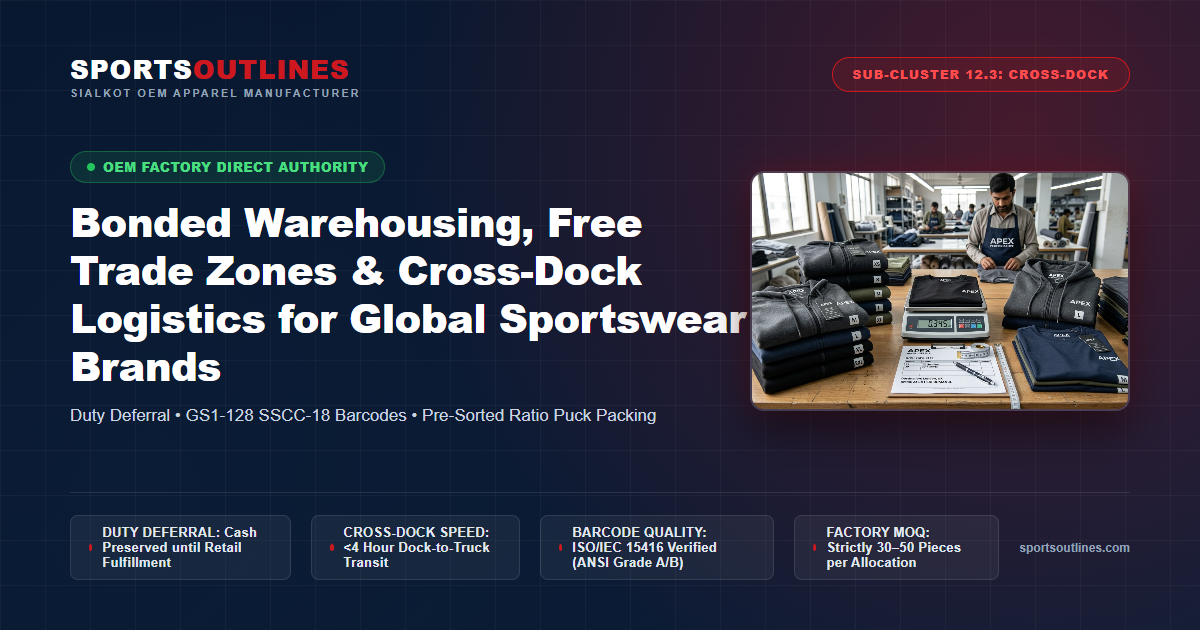
Sports Outlines provides advanced bonded warehousing, Foreign Trade Zone (FTZ) integration, and high-velocity cross-dock logistics direct from Sialkot, Pakistan. We preserve brand liquidity and eliminate 3PL storage fees by engineering floor-ready pre-ticketed ratio cartons with GS1-128 (SSCC-18) barcodes that cross-dock in under 4 hours, alongside duty deferral into US FTZs and European bonded hubs (0% duty under Pakistan GSP+ status). We offer an industry-low factory MOQ of strictly 30 to 50 pieces per style, full prototype engineering in 7 to 10 days for a $45 to $85 fee, and multi-hub global distribution.
Direct WhatsApp: +92 316 7932595
In global athletic apparel supply chains, profitability is determined not only by factory floor production costs, but by the efficiency with which inventory moves through international customs boundaries and fulfillment networks. For high-growth direct-to-consumer (DTC) activewear brands and multi-store sportswear retailers, traditional inventory warehousing represents a massive drain on cash flow. When an overseas shipment lands at a foreign port, conventional customs procedures require the immediate payment of import customs duties, tariffs, and Value Added Tax (VAT)—tying up tens of thousands of dollars in working capital on garments that may not be sold for months. Furthermore, once cartons arrive at destination 3PL warehouses, legacy receiving, storage bin put-away, and multi-touch picking fees erode operating margins. To achieve elite financial velocity, leading sportswear corporations are transforming their supply chains using Customs Bonded Warehousing, Foreign Trade Zones (FTZs), and High-Velocity Cross-Dock Logistics. By legally deferring customs duties until the exact moment of consumer purchase and cross-docking pre-ticketed ratio-packed cartons directly from container docks to store doors in under four hours, brands preserve liquidity and eliminate warehouse storage fees. At Sports Outlines in Sialkot, Pakistan, we engineer global cross-dock and bonded-ready athletic apparel at an industry-low factory minimum order quantity (MOQ) of strictly 30 to 50 pieces per custom style, supported by dedicated $45 to $85 prototype engineering in 7 to 10 business days.
Design & Manufacture Custom Bonded Warehousing & Cross-Dock Logistics Direct from Sialkot
Low 30–50 Piece/Set MOQ • Dedicated Sampling in 7–10 Days • 0% Import Tariffs
✓ $45–$85 Physical Prototypes •
✓ Worldwide DDP Delivery
1. Customs Bonded Warehousing & FTZ Economics: Legally Deferring Duties & Preserving Liquidity
When a sportswear brand imports apparel into the United States, United Kingdom, or European Union, standard customs regulations demand immediate duty payment upon port entry. For an activewear brand importing $100,000 worth of technical athletic hoodies from an overseas factory into the US, a 28% general customs tariff triggers an immediate $28,000 cash outlay at the border.
The Duty Deferral Strategy: By routing shipments into a Customs Bonded Warehouse or Foreign Trade Zone (FTZ), the merchandise enters under customs bond without the immediate payment of customs duties or import VAT:
- Preserving Working Capital: Duties are paid incrementally only when individual garments are picked and dispatched for domestic consumer fulfillment. Capital that would have been locked in customs taxes remains in the brand’s bank account, funding customer acquisition advertising and product development.
- Duty Elimination on Re-Exports: If an apparel brand operating a European bonded warehouse fulfills orders to non-EU markets (such as Switzerland, Norway, or the United Arab Emirates), the garments exit bonded status directly into international export—completely eliminating EU import customs duties.
- Consolidated Weekly Entry Savings: Under US FTZ regulations, brands can utilize Weekly Entry filing, consolidating hundreds of daily parcel shipments into a single customs declaration capped at a maximum Merchandise Processing Fee (MPF) of $575 per week, saving thousands in brokerage fees.
| Customs & Fulfillment Metric | Standard Port Customs Clearance | Bonded Warehouse / FTZ Logistics (Sports Outlines) |
|---|---|---|
| Timing of Import Duty Payment | 100% upfront upon port vessel arrival | Deferred until individual garment is sold to consumer |
| Working Capital Impact | Ties up 15%–35% of inventory value in taxes | Preserves 100% of tax capital in company treasury |
| Taxes on Re-Exported Goods | Duty paid; complex, delayed duty drawback required | 100% duty-free re-exportation to international markets |
| Customs Brokerage Filing Fees | Per-shipment entry filing fee ($150–$300 each) | Consolidated weekly entry filing caps administrative costs |
| EU & UK Tariff Status from Sialkot | 12.0% MFN duty (if sourced from China/Vietnam) | 0% Duty under Pakistan GSP+ status (Form A) |
2. The Mechanics of Cross-Docking: Eliminating 3PL Storage Overhead
In traditional 3PL e-commerce fulfillment, every single step in the warehousing lifecycle incurs a specialized labor fee:
- Container Unloading & Palletizing: $400 – $600 per container.
- Inbound Receiving & SKU Verification: $0.15 – $0.35 per unit.
- Pallet Put-Away to Storage Racking: $15 – $25 per pallet monthly.
- Picking & Packing Labor: $2.50 – $4.50 per order.
The Cross-Dock Transformation: In a true cross-dock model, cartons never enter warehouse storage racking. Inbound skids arriving from Sialkot International Airport (SKT) or Sialkot Dry Port Trust (SDPT) are received at the inbound dock, scanned via GS1-128 barcode scanners, verified against the EDI 856 Advance Ship Notice (ASN), and moved directly to the outbound staging lane for immediate loading onto delivery trucks destined for Amazon FBA fulfillment centers or retail store doors.
By bypassing intermediate storage put-away and manual carton picking, activewear brands slash warehouse handling overhead by 50% to 70% and accelerate order fulfillment by 7 to 10 days.
3. Factory Floor Engineering for Cross-Dock Compliance: GS1-128 & Ratio Packing
A 3PL facility cannot cross-dock a shipment unless the factory floor in Sialkot manufactures and packs the goods according to strict international retail compliance standards:
- Serialized Shipping Container Codes (SSCC-18): Every master carton leaving Sports Outlines is labeled with an ANSI Grade A/B GS1-128 barcode encoding a unique 18-digit SSCC serial number. When the 3PL scanner reads this barcode, their warehouse management system (WMS) instantly identifies the exact purchase order, silhouette, colors, and size ratios inside without opening the box.
- Pre-Sorted Ratio Packing (‘Puck Packing’): Rather than packing 50 hoodies of a single size into one carton (which forces the warehouse to open 5 different boxes to assemble a multi-size retail allocation), Sports Outlines packs garments in pre-sorted retail curves (e.g., 2 XS, 4 S, 6 M, 6 L, 4 XL). A retail store receives a single carton that is completely ready to be placed directly onto the sales floor.
- Floor-Ready Pre-Ticketing: All garments are pre-tagged at the factory with official UPC/EAN hangtags and sewn-in branded labels, eliminating expensive domestic re-ticketing charges ($0.40–$0.75 per unit).
| Sourcing Feature & Risk Factor | Sports Outlines (Sialkot Direct) | Alibaba Trading Agents | Traditional Chinese Hubs | Print-on-Demand (POD) |
|---|---|---|---|---|
| Customs Duty Deferral & Cash Flow Protection | Integration with bonded warehouses and Free Trade Zones (FTZ); import duties deferred until garments exit bonded status for domestic retail fulfillment. | Suppliers force standard customs clearance; 100% of duties and VAT must be paid immediately at port of entry, draining operating liquidity. | FOB shipments trigger massive Section 301 tariffs (7.5%–25%) upon port entry, locking cash in unsold inventory taxes. | Zero duty deferral capability; full domestic taxes and retail VAT assessed instantly at the point of customer purchase. |
| Cross-Dock Velocity & Restocking Speed | Master cartons pre-ticketed with GS1-128 serial barcodes (SSCC-18); cross-docks directly from freight inbound docks to retail outbound trucks in <4 hours. | Unstandardized cartons require complete unpacking, manual piece-by-piece re-tagging, and 2-week delays at destination 3PLs. | Enforces bulk carton packing without ratio sorting; requires expensive warehouse decanting and repacking before distribution. | Individual parcel mailers dispatched slowly; zero cross-dock capability for multi-store retail replenishment. |
| Minimum Order Quantity & Inventory Elasticity | Strictly 30–50 piece low factory MOQ; allows brands to feed regional bonded inventory pools with lean, high-velocity production runs. | High MOQ required for custom packaging; small test runs arrive with mismatched boxes and damaged barcode labels. | Rigid 1,000+ unit MOQs per style and colorway; oversupplies regional hubs, leading to inventory stagnation and storage penalties. | 1 unit MOQ, but garments look like generic promotional blanks with cheap direct-to-garment digital prints. |
| Multi-Region Hub Routing Flexibility | Single production run split directly at Sialkot factory into dedicated consignments for US, EU, UK, and Australian bonded warehouses. | Cannot coordinate multi-hub distribution; forces buyer to ship everything to one country and incur double-freight reshipping. | Charges heavy surcharges for split destination shipments and refuses multi-currency commercial invoicing. | Routes orders to disparate unvetted third-party print shops, resulting in inconsistent print colors across regions. |
| Sampling & Prototype Engineering | $45–$85 non-creditable engineering prototype fee; physical master sample delivered in 7–10 business days via express air courier. | Promises cheap samples, but delivers inaccurate sizing, mismatched colors, and poor stitching that requires 3 to 4 expensive revisions. | Demands $300–$500 sample development fees and 6–8 week lead times during peak manufacturing seasons. | No pre-production sampling; buyers must purchase expensive retail units to inspect print alignment. |
4. Multi-Hub Global Allocation: Splitting Consignments Direct from Sialkot
Top-tier athletic apparel brands do not route all inventory to a single domestic warehouse. Selling globally requires maintaining regional stock near end-consumers to minimize shipping times and eliminate international delivery duties:
Under Sports Outlines’ Multi-Hub Allocation Framework, a single bulk production order in Sialkot is divided into distinct regional consignments directly on our factory floor:
- North American Hub (45% Allocation): Dispatched via air cargo or ocean container to a bonded 3PL in Ohio or California, serving US and Canadian e-commerce orders and Amazon FBA nodes.
- European Union Hub (35% Allocation): Dispatched directly to a bonded facility in Rotterdam or Frankfurt, entering at 0% customs import duty under Pakistan GSP+ status, serving continental European customers with 24-hour delivery.
- United Kingdom Hub (20% Allocation): Dispatched to a logistics hub in the UK Golden Logistics Triangle (Northampton/Leicester), bypassing post-Brexit cross-channel border delays and simplifying domestic UK VAT compliance.
| Production Volume Tier | Est. Unit FOB Cost | Sample Cost & SLA | Bulk Production SLA | Included Specifications | Recommended Buyer Profile |
|---|---|---|---|---|---|
| 30 – 50 Sets/Pieces (Cross-Dock Agile Entry Tier) | $12.90 – $16.80 / technical activewear top | $15.90 – $20.80 / bottom | $45 – $85 non-creditable prototype fee | 12 – 15 Business Days | Pre-labeled cross-dock master cartons, GS1-128 shipping container labels, bonded warehouse transfer manifests, physical master prototype in 7–10 days, strictly 30–50 piece low factory MOQ. | Emerging sportswear brands, boutique fitness studio chains, private label activewear startups, and agile e-commerce brands fulfilling across multiple international destinations. |
| 51 – 150 Sets/Pieces (Multi-Hub Allocation Tier) | $10.80 – $13.90 / technical activewear top | $13.60 – $17.20 / bottom | $45 – $85 non-creditable prototype fee | 14 – 18 Business Days | Split bonded dispatch to North American (US/Canada) and European (UK/EU) bonded fulfillment hubs, automated customs deferral documentation, full size grading (XS to 3XL). | Fast-scaling athletic apparel e-commerce brands, CrossFit franchise networks, collegiate teamwear suppliers, and regional sportswear distributors. |
| 151 – 500 Sets/Pieces (Free Trade Zone Consolidation Tier) | $9.10 – $11.80 / technical activewear top | $11.80 – $14.50 / bottom | $45 – $85 non-creditable prototype fee | 18 – 22 Business Days | Direct FTZ / Customs Bonded Warehouse entry without duty disbursement, pre-sorted ratio packing (‘puck packing’), certified AQL 2.5 quality control audit, express DDP door-to-door delivery. | Established corporate athletic brands, commercial teamwear contract suppliers, professional sports federation apparel licensees, and institutional retail buyers. |
| 500+ Sets/Pieces (Enterprise Global Cross-Dock Fleet Tier) | $7.40 – $9.40 / technical activewear top | $9.50 – $12.10 / bottom | $45 – $85 non-creditable prototype fee | 22 – 28 Business Days | Dedicated international cross-docking lanes, continuous customs bond compliance, EDI 856 ASN integration with automated 3PL receiving, scheduled sea and air charter routing. | Global sportswear retail corporations, multi-national athletic licensing conglomerates, international sporting goods chains, and nationwide department stores. |
5. Technical Specifications & Bonded Logistics Quality Control SOPs
Our standardized export logistics protocols ensure that every carton is 100% compliant with global bonded and cross-dock facilities:
| Logistics Stage | Standard Operating Procedure (SOP) | Compliance & Verification SLA |
|---|---|---|
| 1. Master Carton Construction | 5-ply double-wall corrugated kraft board (ECT 44 / >1,400 kPa bursting). | 100% carton drop and compression tested. |
| 2. Barcode Optical Audit | ISO/IEC 15416 optical barcode verification of GS1-128 / SSCC-18 labels. | Verified ANSI Grade A/B (100% scan pass rate). |
| 3. Ratio Puck Packing | Pre-sorted multi-size ratio packing per retail purchase order spec. | Zero size count discrepancy; verified under scales. |
| 4. Export Regulatory Filing | State Bank Form E, Pakistan Single Window (PSW), and GSP+ Form A. | 100% digital customs pre-clearance in Sialkot. |
| 5. Direct Bonded Inbound | Direct routing to US FTZ, UK Bonded Warehouse, or EU customs zone. | Duty deferred; 3PL cross-dock completed in <4 hours. |
6. Explore Our Technical Sportswear Manufacturing Ecosystem
Deepen your global supply chain capabilities by reviewing our comprehensive technical manufacturing guides:
- Optimize high-volume maritime transport with our guide to High-Volume Container Sourcing: FCL / LCL Ocean Freight Optimization from Sialkot Dry Ports.
- Accelerate your product release cycle with Fast-Fashion Athletic Micro-Drops: 14-Day Agile Cut-and-Sew Turnaround.
- Eliminate customer returns with Reverse Logistics & Activewear Returns Prevention: Sizing Consistency & Defect Prevention.
- Master cross-border air shipping with Cross-Border E-Commerce Logistics: Sialkot DDP Air Freight & 3PL Inbound Prep.
- Automate your replenishment pipeline using EDI & Open API Integration for Automated Sportswear Replenishment.
Get a Factory Direct Quote for Bonded Warehousing & Cross-Dock Logistics
Chat with our Sialkot Engineering Team via WhatsApp • Instant DDP Air Freight Quotes
✓ $45–$85 Physical Prototypes •
✓ Worldwide DDP Delivery
Frequently Asked Sourcing & Manufacturing Questions (Buyer FAQ)
What is a Customs Bonded Warehouse and how does it optimize cash flow for activewear brands?
A Customs Bonded Warehouse is a secured facility authorized by national customs authorities (such as US Customs and Border Protection – CBP, or HM Revenue & Customs – HMRC in the UK) where imported foreign goods can be stored, handled, and manipulated without the immediate payment of import customs duties or Value Added Tax (VAT). In traditional apparel sourcing, a brand must pay tens of thousands of dollars in import duties upon port arrival—even if the garments sit in a warehouse for six months before being sold. By routing shipments into a bonded warehouse or Foreign Trade Zone (FTZ), duty payment is legally deferred until the exact moment garments are withdrawn for domestic consumption. If goods are re-exported to an international buyer (e.g., shipped from a European bonded warehouse to a customer in Switzerland or the Middle East), import duties are completely avoided.
What is cross-docking in apparel logistics and why does it eliminate 3PL warehouse storage fees?
Cross-docking is a high-velocity logistics procedure where inbound freight arriving from an overseas factory is unloaded directly from an inbound container or air cargo skid, checked for shipping container codes (SSCC-18), and transferred directly onto outbound delivery trucks destined for retail stores or regional fulfillment hubs—with little or no intermediate warehouse storage (typically under 4 to 24 hours). Traditional warehousing involves receiving, pallet put-away, inventory bin logging, picking, and packing—each step incurring substantial 3PL labor fees. Sports Outlines’ pre-ticketed, ratio-packed master cartons allow 3PLs to execute true cross-docking, eliminating put-away labor and slashing storage overhead by over 70%.
What is a Foreign Trade Zone (FTZ) in the United States and how does it benefit sportswear importers?
A Foreign Trade Zone (FTZ) is a secure, designated geographical area inside or near a US Port of Entry that is legally treated as outside US Customs territory. When a sportswear brand imports performance activewear from Sports Outlines into a US FTZ, the merchandise enters duty-free. Customs duties and Merchandise Processing Fees (MPF) are payable only if and when the apparel enters US commerce. Furthermore, brands can consolidate weekly customs filings into a single entry—capping MPF fees at a maximum of $575 per week rather than paying entry fees on every individual carton shipment, saving thousands of dollars in administrative costs annually.
How does Sports Outlines prepare shipments for seamless cross-docking at destination 3PLs?
To ensure that inbound shipments can be cross-docked immediately without manual handling, Sports Outlines implements three factory floor standards: 1) Every master carton is labeled with an ANSI Grade A/B GS1-128 barcode encoding the Serial Shipping Container Code (SSCC-18), purchase order number, and SKU-level breakdown; 2) Pre-sorted ratio packing (‘puck packing’) where each carton contains a standardized retail size curve (e.g., 2 Small, 4 Medium, 4 Large, 2 XL) ready for store shelf stocking; and 3) Pre-ticketed retail hangtags featuring scannable EAN/UPC barcodes and MSRP pricing applied during final factory finishing.
What is multi-hub allocation and how does Sports Outlines support global brand fulfillment?
Modern e-commerce sportswear brands sell simultaneously to customers in North America, the United Kingdom, Europe, and Australia. Shipping all inventory to a single US warehouse and then fulfilling international orders via expensive international express mail destroys margins and causes customer delivery delays. Under Sports Outlines’ Multi-Hub Allocation framework, a single bulk production run in Sialkot is divided at the factory into dedicated palletized consignments and routed simultaneously to regional bonded 3PL hubs (e.g., 50% to Ohio for US FBA, 30% to Rotterdam for EU fulfillment, and 20% to Northampton for UK retail), optimizing local transit times and customs treatment.
What is the factory minimum order quantity (MOQ) for custom sportswear at Sports Outlines?
Our minimum order quantity for custom activewear, hoodies, teamwear jerseys, and compression gear is strictly 30 to 50 pieces or sets per style and colorway. While bonded warehousing and cross-docking serve high-volume distribution, our low 30 to 50-piece MOQ allows emerging brands to launch lean capsule collections and test cross-dock replenishment workflows without high capital barriers.
What is the pre-production prototype fee and how quickly can physical master samples be delivered?
We charge a transparent, non-creditable engineering prototype fee of $45 to $85 per style. This covers digital CAD grading, specialized textile sourcing, precision laser-cutting, high-density silicone transfer or embroidery application, and master assembly. Your physical prototype is engineered under strict quality standards and dispatched via DHL Express directly to your design office within 7 to 10 business days.
How does Pakistan’s GSP+ status integrate with European bonded logistics?
Under the European Union and United Kingdom’s Generalized Scheme of Preferences Plus (GSP+), technical textiles and sportswear manufactured in Pakistan qualify for 0% customs import duty upon presentation of an authenticated Form A Certificate of Origin. When goods enter a European bonded warehouse from Sialkot, they enter with certified GSP+ status. When released into European domestic commerce, they clear at 0% duty—delivering an immediate 12% to 14% cash advantage over garments sourced from China or Vietnam.
What documentation is required to transfer goods from Sialkot into a foreign bonded warehouse?
To execute a bonded warehouse entry (such as US Customs Form 7501 Type 21 Warehouse Entry, or EU T1 Transit Document), customs authorities require authenticated commercial and transport documentation: 1) Original Commercial Invoice with precise HS Code descriptions; 2) Detailed Packing List detailing carton dimensions, gross/net weights, and SSCC-18 serials; 3) Clean On-Board Master Air Waybill (AWB) or Ocean Bill of Lading (B/L) showing bonded warehouse consignee; and 4) Certificate of Origin (Form A).
How does cross-docking reduce inventory shrinkage and damage compared to traditional warehousing?
In traditional warehouse environments, the more times a carton is touched, moved, stored in racking, picked, and restocked, the higher the risk of forklift puncture, carton crushing, dust accumulation, and employee pilferage (inventory shrinkage). Cross-docking minimizes touchpoints: master cartons move directly from inbound container floor to outbound retail truck pallet in a single fluid transfer under barcode scanner tracking, virtually eliminating transit damage and inventory loss.