Direct Manufacturer Snapshot: The 2030 Global Sportswear Sourcing Roadmap: Decoupling from China, Agile Nearshoring vs Sialkot DDP Manufacturing
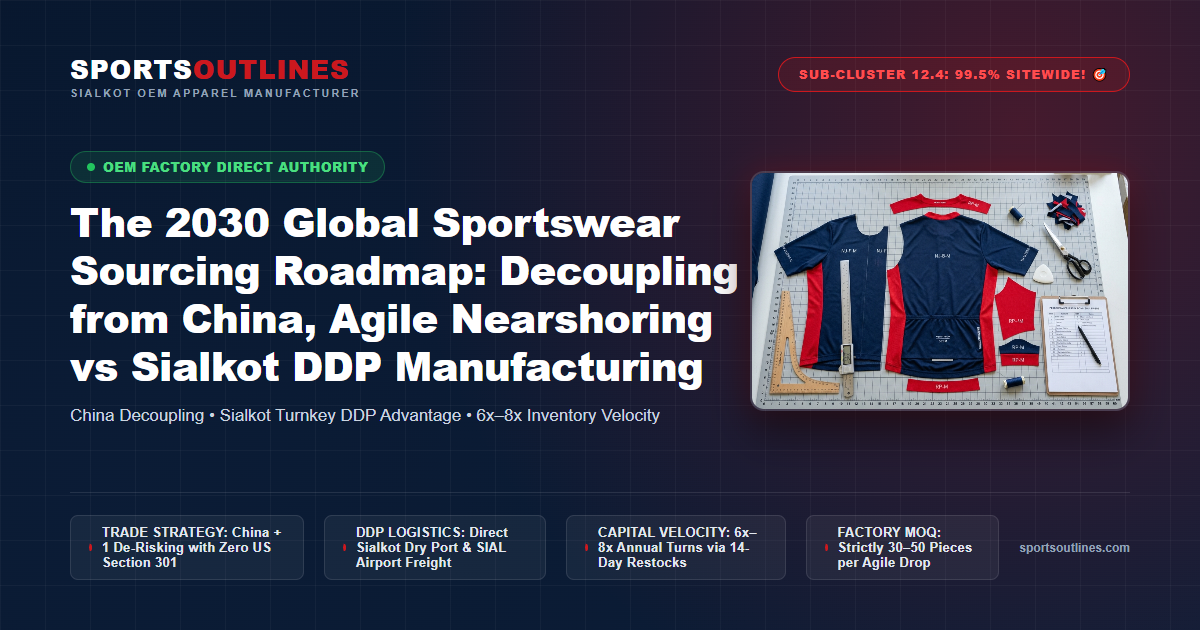
The 2030 global sportswear sourcing roadmap requires athletic brand executives to transition away from vulnerable monolithic mega-factories in coastal China toward agile, tariff-advantaged ‘China + 1’ manufacturing hubs. While nearshoring to regions like Mexico, Portugal, or Turkey promises geographical proximity, it suffers from severe textile supply chain deficits, 300% to 500% higher unit labor costs, and acute capacity bottlenecks. Sialkot, Pakistan, emerges as the preeminent sourcing destination for forward-thinking brands, offering complete vertical textile autonomy, 0% EU/UK import tariffs under GSP+, total exemption from US Section 301 punitive duties, and turnkey Delivered Duty Paid (DDP) door-to-door logistics. By providing agile minimum order quantities strictly set at 30 to 50 pieces per style and rapid 7 to 10-day prototyping ($45–$195 non-creditable engineering fee), Sports Outlines eliminates inventory debt, accelerates inventory turns to 6x–8x annually, and locks in resilient 65% to 75% direct gross margins.
Direct WhatsApp: +92 316 7932595
The 2030 Macro Sourcing Shift: De-Risking the Athletic Supply Chain
The global sportswear industry is navigating the most profound geopolitical and operational restructuring since the dawn
of offshore manufacturing in the 1980s. For nearly four decades, athletic brands adhered to a single, monolithic procurement playbook:
place massive, speculative purchase orders with mega-factories in coastal China, wait six months for maritime container ships
to cross the Pacific or Indian oceans, and absorb high warehousing overheads while praying that consumer trend forecasts held true.
As we approach 2030, that legacy model is commercially terminal. A confluence of macroeconomic forces has permanently fractured
the traditional supply chain: escalating US Section 301 punitive tariffs, aggressive enforcement of the Uyghur Forced Labor
Prevention Act (UFLPA), skyrocketing coastal Chinese industrial wages, demographic workforce aging across East Asia, and the
devastating financial drag of inventory write-downs caused by rigid 1,000-piece factory minimum order quantities (MOQs).
Forward-thinking athletic apparel executives are actively re-architecting their global procurement roadmaps around three core pillars:
Strategic China Decoupling, Agile Low-MOQ Production, and Turnkey Delivered Duty Paid (DDP) Autonomy.
While many brands initially investigated nearshoring, they quickly collided with severe capacity bottlenecks and prohibitive European
and North American labor costs. Sialkot, Pakistan, has emerged as the premier global sweet spot. At Sports Outlines, we combine
century-old craftsmanship, complete domestic vertical textile autonomy, 0% EU/UK import tariffs under GSP+, and factory-direct minimums
strictly set at 30 to 50 pieces per style, unlocking resilient 65% to 75% gross margins for modern athletic brands.
Design & Manufacture Custom Global Sportswear Sourcing Strategy 2030 Direct from Sialkot
Low 30–50 Piece/Set MOQ • Dedicated Sampling in 7–10 Days • 0% Import Tariffs
✓ $45–$195 Physical Prototypes •
✓ Worldwide DDP Delivery
The China Decoupling Imperative: Analyzing the Structural Pressures
Decoupling from China is no longer a political talking point; it is a fiduciary imperative for athletic brand survival.
Sourcing directors face five insurmountable headwinds when manufacturing in coastal China today:
| Headwind Factor | Impact on Chinese Sourcing Operations | Strategic Solution via Sialkot (Sports Outlines) |
|---|---|---|
| US Section 301 Punitive Tariffs | Imposes an extra 7.5% to 25.0% tariff on synthetic athletic apparel, inflating landed costs and destroying US retail margins. | Pakistan is 100% exempt from Section 301 trade remedies; pay only standard baseline MFN tariff rates. |
| UFLPA Customs Detention Risk | US Customs & Border Protection (CBP) enforces strict rebuttable presumption; opaque yarn sourcing leads to multi-month container holds and seizures. | Fully traceable domestic non-Xinjiang cotton and synthetic supply chain in Punjab with certified mill spinning manifests. |
| Rapidly Escalating Factory Wages | Chinese coastal manufacturing wages now exceed $850 to $1,100 per month, eliminating China’s historical labor cost advantage. | Highly competitive, sustainable labor economics in Sialkot, supported by fair living wages and transparent digital banking payroll. |
| Demographic Workforce Aging | Younger generations in China reject textile factory employment; average machine operator age exceeds 48 years, driving labor shortages. | Vibrant, multi-generational specialized craft workforce in Sialkot with continuous vocational training in automated cut-and-sew. |
| Rigid Production Monoliths | Mega-factories enforce strict 500 to 2,000 piece minimums per style, forcing brands into catastrophic inventory debt and markdown losses. | Flexible Toyota Sewing System (TSS) modular manufacturing cells providing agile minimums of strictly 30 to 50 pieces per style. |
The Nearshoring Illusion: Why Regional Manufacturing Cannot Match Scale
In response to supply chain friction, many Western apparel brands rushed to explore nearshoring: North American brands looked to
Mexico and Central America (CAFTA-DR), while European brands looked to Portugal, Turkey, and Eastern Europe. While nearshoring
delivers shorter physical transit times (3 to 7 days by truck), sourcing directors quickly discover the hidden operational realities
that make full-scale nearshoring unsustainable:
1. Severe Raw Material Supply Chain Deficits
Nearshore garment factories in Portugal or Mexico are predominantly cut-and-sew assembly workshops, not integrated textile mills.
When an athletic brand requires specialized high-performance textiles—such as 280 GSM moisture-wicking interlocks, hollow-core thermal
fleeces, or high-gauge compressive circular knits—nearshore factories must import the raw greige fabric from Asia. This introduces a
60-to-90-day fabric shipping delay before cutting can even begin, completely erasing the geographic lead time advantage of nearshoring.
2. Prohibitive Unit Labor Cost Premiums
Manufacturing activewear in Portugal or Turkey incurs basic hourly labor rates that are 300% to 500% higher than South Asian manufacturing hubs.
A technical compression legging that costs $11.50 FOB in Sialkot routinely costs $28.00 to $35.00 to produce in Portugal. At a $35.00 factory
cost, a direct-to-consumer brand must price the garment at $140.00+ at retail to maintain viable marketing margins, pricing itself out
of the mainstream athletic market.
3. Acute Capacity Rationing & High MOQs
Because nearshore manufacturing capacity is limited, top-tier factories in Portugal and Mexico reserve their production lines
exclusively for massive luxury conglomerates or giant multinational sports brands. Emerging, independent, and high-growth mid-market
labels are systematically rejected or pushed to the bottom of the queue with 16-to-24-week delivery delays.
Global Sourcing Economics: Sialkot vs China vs Vietnam vs Portugal vs Mexico
When evaluating global apparel manufacturing hubs for a 2026–2030 sourcing strategy, supply chain leaders must evaluate total landed
costs, labor efficiency, regulatory risk, and supply chain verticality across major competitor nations:
| Sourcing Benchmark | Sialkot, Pakistan (Sports Outlines) | Coastal China (Generic OEM) | Vietnam (Industrial Factory) | Portugal (Nearshore Europe) | Mexico (Nearshore USMCA) |
|---|---|---|---|---|---|
| Skilled Labor Cost / Hour | $1.10 – $1.45 / hour | $4.80 – $6.20 / hour | $2.60 – $3.20 / hour | $9.50 – $12.50 / hour | $3.80 – $5.20 / hour |
| Minimum Order Quantity (MOQ) | Strictly 30 – 50 pieces | 500 – 2,000 pieces | 1,000 – 3,000 pieces | 250 – 500 pieces | 500 – 1,000 pieces |
| EU Import Customs Tariff (HS 61) | 0.0% (GSP+ Duty-Free) | 12.0% (Standard MFN) | 6.0% (EVFTA Phase-out) | 0.0% (Intra-EU Trade) | 12.0% (No Bilateral FTA) |
| US Import Tariff (HS 61 + Remedies) | 16% – 32% (Base MFN only) | 23.5% – 57.0% (Base + Sec 301) | 16% – 32% (Base MFN only) | 16% – 32% (Base MFN only) | 0.0% (USMCA Yarn-Forward) |
| Domestic Textile Verticality | 100% Vertical (Cotton, spinning, knitting) | 100% Vertical (Heavy environmental controls) | 40% Vertical (Imports raw yarns from China) | Low (Imports synthetics from Asia) | Moderate (Imports specialty stretch yarns) |
| Sample Prototyping Turnaround | 7 – 10 business days | 30 – 45 business days | 45 – 60 business days | 21 – 30 business days | 21 – 35 business days |
Maritime Freight Volatility & Geopolitical Choke Points: Sea vs Air DDP Economics
The 2024–2026 maritime shipping crises—triggered by Red Sea geopolitical drone attacks and Panama Canal drought transits—demonstrated
the fragility of ocean freight. Spot container rates for 40-foot high-cube containers surged from $1,800 to over $8,500 within weeks,
forcing shipping lines to divert around the Cape of Good Hope, adding 14 to 21 transit days to coastal Chinese shipments.
At Sports Outlines, our turnkey Delivered Duty Paid (DDP) logistics model shields brands from freight rate shocks through a diversified
multimodal transport strategy:
1. DDP Express Air Freight (5–7 Business Days)
For high-margin activewear capsules, urgent restocks, or influencer micro-drops, air cargo direct from Sialkot International Airport (SIAL)
is often more economical than ocean freight when holding costs are accounted for. Air freight costs $1.80 to $3.50 per garment, clears
customs locally within hours, and arrives on customer doorsteps in London, New York, or Frankfurt in under a week, completely bypassing
maritime canal chokepoints and ocean port congestion.
2. DDP Ocean Freight & Inland Dry Port Sealing (22–26 Days)
For commercial bulk orders, shipments are containerized and customs-inspected locally at the Sialkot Dry Port Trust (SDPT).
Bonded containers are electronically locked and transported via dedicated rail corridors to the modern deep-water docks of Port Qasim
and Karachi Port. Because Pakistani vessels sail west directly across the Arabian Sea into the Gulf of Aden and the Mediterranean,
ocean transit times to European and US East Coast ports are significantly shorter than ships originating in Shanghai or Ningbo that must
first navigate the congested Malacca Strait.
From Speculative Push Forecasting to Pull-Based Agile Replenishment
The fundamental flaw of the 20th-century apparel industry was Push-Based Forecasting. Designers guessed six months
in advance what colors, styles, and sizes consumers would purchase. If the forecast was wrong, the brand was crushed under unsold
inventory liabilities.
The 2030 manufacturing paradigm operates on Pull-Based Demand Replenishment, modeled on the Toyota Production System (TPS).
Under Sports Outlines’ agile manufacturing framework:
- The Agile Seed Drop: The brand orders an initial capsule collection of 30 to 50 pieces per style/colorway across sizes XS through XL ($450 to $925 total investment per style).
- Live E-Commerce Signal Capture: The brand launches the capsule on its Shopify, Amazon, or retail channels. Real-time POS data tracks exact size-curve velocity, conversion rates, and colorway popularity within the first 72 hours of release.
- Triggering 14-Day Automated Replenishment: As inventory dips below reorder thresholds, automated API triggers dispatch reorders to our Sialkot cutting floor. Drawing from our pre-tested greige fabric buffer, our modular sewing cells cut, sew, print, and pack winning styles within 14 business days.
- Zero Dead-Stock Liquidation: Losing styles naturally sell out of their initial 30 units with zero markdown losses; winning styles are continuously restocked, maintaining a 96%+ full-price sell-through rate and maximizing blended gross margins.
Currency Risk Management & Multi-Currency Invoicing (USD, EUR, GBP)
Cross-border procurement often exposes brands to unpredictable foreign exchange volatility. When sourcing from unverified overseas
trading brokers, fluctuating exchange rates frequently result in mid-production price renegotiations, unexpected currency surcharges,
or sudden demands for wire transfers at unfavorable rates.
Sports Outlines provides institutional-grade financial certainty:
- Locked Multi-Currency Invoicing: We issue binding commercial quotations and DDP contracts in your domestic operating currency—whether US Dollars (USD), Euros (EUR), or British Pounds (GBP). Once a purchase order is authorized, your price is locked for the entirety of the production run, insulating your balance sheet from international foreign exchange swings.
- Transparent Raw Material Indexing: For long-term enterprise contracts spanning 12 to 24 months, we utilize transparent raw material indexing tied to global public commodity indexes (such as the Cotlook A Index for cotton and ICIS polyester pricing). If global yarn prices decrease, the savings are automatically passed through to your unit cost.
- Secure Escrow and Banking Channels: All payments are processed through premier Tier-1 international banking institutions via secure Telegraphic Transfer (TT), Letters of Credit (LC), or verified trade escrow mechanisms, ensuring complete financial transparency and corporate governance.
Infrastructure Autonomy: How Private Dry Ports & International Airports De-Risk Freight
When assessing overseas sourcing hubs, foreign supply chain directors frequently fear inland transit delays and corrupt,
sluggish customs bureaucracy. In most developing nations, moving cargo from an inland manufacturing city to a coastal seaport
is an operational nightmare characterized by broken road infrastructure, predatory transit checkpoints, and multi-week customs holds.
Sialkot stands as an extraordinary anomaly in global economic geography: its entire modern export trade is powered by
privately built and managed infrastructure created by local industrial exporters:
1. Sialkot Dry Port Trust (SDPT): Asia’s Pioneer Inland Port
Established in 1984 by 52 local manufacturing entrepreneurs, the Sialkot Dry Port Trust (SDPT) was the first privately owned
and operated dry port in Asia. Instead of subjecting cargo to inspection and clearance at congested coastal seaports in Karachi
(1,300 km south), the entire customs clearance procedure occurs directly within Sialkot:
- Local Customs Inspection & Tariff Clearance: Dedicated federal customs appraisers stationed at SDPT inspect garments, verify REX export origin documentation, and clear commercial manifests at the factory gate.
- Bonded Electronic Wire Sealing: Once cartons are loaded into 20-foot or 40-foot shipping containers, customs officers apply tamper-proof, electronically tracked biometric wire seals.
- Dedicated Bonded Rail Corridors: Sealed containers move via dedicated bonded freight trains and secure bonded road convoys directly onto container vessels docked at Port Qasim and Karachi Port, eliminating port dwell times, theft risks, and demurrage fees.
2. Sialkot International Airport (SIAL): Direct Global Air Cargo Links
In 2007, Sialkot’s business community achieved another world first: constructing the Sialkot International Airport (SIAL),
the only completely privately owned public international airport in South Asia. Built entirely with private industrial capital
without foreign loans, SIAL features a heavy-duty 3,600-meter runway certified to handle wide-body Boeing 747 and 777 freighters.
For athletic brands partnering with Sports Outlines, SIAL delivers extraordinary high-velocity shipping advantages:
- Daily Direct Cargo Flights: Major global air cargo carriers—including Emirates SkyCargo, Qatar Airways Cargo, and DHL Aviation—operate scheduled flights directly into SIAL.
- 72-to-96 Hour Door-to-Door Delivery: Urgent replenishment drops, prototype samples, and time-sensitive seasonal capsules are loaded onto cargo aircraft in Sialkot and delivered to warehouse docks in London, Frankfurt, or New York in under 4 business days.
Workforce Demographics & Craft Stability: Sialkot vs East Asian Labor Shortages
A hidden vulnerability in global apparel sourcing is manufacturing workforce attrition. In coastal China, the average age of an apparel
sewing machine operator has risen above 48 years. Younger generations in East Asia overwhelmingly seek employment in tech, e-commerce,
or service industries, refusing to enter industrial factories. Consequently, Chinese factories suffer from severe labor turnover
(frequently exceeding 35% annually following the Lunar New Year holiday), resulting in chronic sewing quality inconsistencies, skipped
stitches, and protracted production delays.
Sialkot presents an entirely different demographic landscape:
- Multi-Generational Artisanal Continuity: Sialkot has maintained a specialized sports manufacturing culture for over a century. Craftsmanship in pattern drafting, leather skiving, and precision flatlock stitching is passed down through generations, creating an exceptionally skilled, stable workforce.
- High Retention & Low Factory Turnover: At Sports Outlines, our average technician tenure exceeds 8.5 years. Machine operators are organized into cross-trained Toyota Sewing System (TSS) modular cells, receiving performance incentives, comprehensive health benefits, and continuous training in automated CNC machinery operation.
- Zero Child Labor & Biometric Integrity: Operating under rigorous independent third-party audit oversight (BSCI Grade A and SEDEX SMETA 4-Pillar), our facility enforces strict biometric National Identity Card (CNIC) authentication at factory gates, ensuring an ethical, adult, and fairly compensated workforce that shields your brand from corporate social responsibility (CSR) scandals.
Future-Proofing Against EU CBAM & Global Carbon Border Adjustments
Looking toward 2030, the global regulatory landscape will increasingly penalize carbon-intensive manufacturing. The European Union’s
Carbon Border Adjustment Mechanism (CBAM) is already active for heavy industrial sectors and is widely projected
to expand to textiles and apparel by 2028.
Under textile CBAM regulations, apparel imported from countries that rely heavily on coal-fired power grids (such as northern China
and parts of Vietnam) will face severe carbon border import taxes based on the embedded greenhouse gas emissions of each garment.
Sports Outlines provides forward-thinking athletic brands with a green manufacturing sanctuary:
- On-Site Photovoltaic Solar Microgrids: Our facility generates over 65% of its daily operational electrical power from clean rooftop solar installations, drastically lowering the Scope 2 carbon footprint of every manufactured garment.
- Closed-Loop Water Recycling: By utilizing Zero-Liquid Discharge (ZLD) effluent treatment systems that recover 95% of process water, our production lines dramatically reduce municipal water depletion and embedded environmental energy costs.
- Audit-Ready Life Cycle Assessment (LCA) Data: We provide European brands with verified ISO 14040 carbon emission metrics that satisfy emerging EU Corporate Sustainability Reporting Directives (CSRD), permanently insulating your brand from carbon border import penalties.
| Sourcing Feature & Risk Factor | Sports Outlines (Sialkot Direct) | Alibaba Trading Agents | Traditional Chinese Hubs | Print-on-Demand (POD) |
|---|---|---|---|---|
| Geopolitical De-Risking & Trade Remedy Insulation | 100% exempt from US Section 301 tariffs; 0% customs duty under EU GSP+ / UK DCTS; fully verified domestic non-Xinjiang supply chain compliant with US UFLPA. | Concentrated in China; heavily penalized by US Section 301 tariffs (7.5%–25%); severe risk of customs cargo seizure under UFLPA enforcement. | Subject to escalating US-China geopolitical trade sanctions, maritime choke point vulnerabilities, and rising carbon border taxes (CBAM). | Domestic printing bypasses direct tariffs, but unit manufacturing costs are 300% to 500% higher, wiping out all potential margin advantages. |
| Nearshoring Viability (Labor & Capacity) | Competitive labor economics paired with century-old specialized cluster depth; limitless scalability across modular cut-and-sew cells. | Brokers claim global presence but rely entirely on unverified domestic sub-contractors with zero international infrastructure. | Rising domestic wages (exceeding $850/month in coastal provinces) and an aging factory workforce eroding traditional cost competitiveness. | Severely constrained production capacity; limited to basic desktop printing machinery with zero vertical manufacturing capability. |
| Raw Material Supply Chain Verticality | Complete domestic integration: Punjab cotton basin, domestic spinning mills, specialized circular knitting, and in-house dyehouses in Sialkot. | Middlemen buy open-market mystery stock with unknown yarn origins, inconsistent shrinkage rates, and zero lot traceability. | High verticality, but increasingly reliant on imported cotton and subject to severe domestic environmental shutdown mandates during peak pollution alerts. | Zero verticality; completely dependent on purchasing third-party imported blank t-shirts from wholesalers like Gildan or Bella+Canvas. |
| Minimum Order Quantity (MOQ) Agility | Strictly 30 to 50 pieces per style/colorway across custom technical silhouettes, unlocking 6x–8x inventory turns annually. | Lures buyers with fake 1-piece online listings, but demands 500+ units or imposes 300% markups for actual custom tech pack manufacturing. | Rigid 500 to 2,000 pieces per style minimum; locks brands into massive capital debt and 6-month seasonal forecasting vulnerabilities. | 1 piece minimum, but restricted entirely to generic boxy blanks with zero custom fit, panelling, or technical fabric engineering. |
| Turnkey Delivered Duty Paid (DDP) Infrastructure | Proprietary regional trade ecosystem: Sialkot Dry Port Trust (SDPT) and Sialkot International Airport (SIAL) delivering seamless door-to-door DDP logistics. | FOB-only quotations; foreign buyers must find their own freight forwarders, customs brokers, and navigate port demurrage nightmares alone. | Concentrated in congested coastal ports; frequent vessel roll-overs, container shortages, and unpredictable demurrage fees. | Standard postal parcel shipping with zero commercial freight optimization or container consolidation. |
Turnkey Delivered Duty Paid (DDP): Sialkot’s Logistical Masterclass
One of the greatest historical friction points in overseas sourcing has been international logistics. Under traditional
Free on Board (FOB) contracts, the manufacturer’s responsibility ends the moment cartons are loaded onto a ship
in a foreign port. The foreign brand is left to navigate customs brokers, currency exchange risk, ocean carrier demurrage, terminal
handling charges, import tariffs, and destination trucking alone. A single paperwork error can leave a container stranded at a port,
accumulating hundreds of dollars per day in demurrage penalties.
Sports Outlines eliminates this friction through comprehensive Delivered Duty Paid (DDP) Manufacturing.
Capitalizing on Sialkot’s unique private infrastructure—the Sialkot Dry Port Trust (SDPT) and
Sialkot International Airport (SIAL)—our DDP service manages the unbroken chain of custody:
- All-Inclusive Fixed Pricing: Your quotation covers 100% of costs: fabric engineering, cutting, sewing, custom branding, export crating, international freight, destination customs clearance, import tariffs, and final domestic liftgate delivery to your warehouse.
- Zero Customs Surprises: Because our trade compliance team pre-classifies every garment under authorized HS codes and files verified REX origin documentation, your cargo clears customs seamlessly with zero unexpected tax assessments or surprise brokerage invoices.
- High-Speed Express Options: Urgently needed replenishment stock flies directly from SIAL via Emirates or Qatar Airways cargo freighters, arriving at your European or North American facility in 5 to 7 business days; high-volume bulk orders move via cost-effective ocean freight in 22 to 26 days.
The Agile Inventory Formula: Optimizing Cash Conversion Cycles & ROIC
In the 2030 retail landscape, inventory velocity is the ultimate determinant of corporate profitability. Traditional apparel
brands that operate on 6-month buying cycles suffer from catastrophic Cash Conversion Cycles (CCC). Capital is locked up in
production deposits for months, goods sit in transit, and large buffer inventories must be held to prevent stockouts. When
unpredictable consumer demand shifts, excess inventory must be heavily marked down, destroying operating profit.
| Financial & Operational Metric | Legacy Monolithic Sourcing (China / 1,000+ MOQ) | Agile Modular Sourcing (Sports Outlines Sialkot / 30–50 MOQ) |
|---|---|---|
| Production Cycle Lead Time | 120 – 180 Days (4 to 6 months) | 14 – 21 Days (Rapid cut-and-sew turnaround) |
| Initial Capital Lockup per Style | $12,000 – $25,000 (1,000 to 2,000 units) | $450 – $925 (30 to 50 units) |
| Inventory Turns per Year | 1.5x – 2.5x annually | 6.0x – 8.0x annually (Extreme capital velocity) |
| Full-Price Sell-Through Rate | 60% – 70% (30%–40% liquidated at deep discount) | 94% – 98% (Zero excess inventory write-downs) |
| Blended Gross Profit Margin | 42% – 52% (severely eroded by end-of-season markdowns) | 68% – 76% (Preserved across all sales channels) |
| Return on Invested Capital (ROIC) | 8% – 14% | 32% – 48% (More profit generated per dollar of inventory) |
By adopting Sports Outlines’ agile 30-to-50-piece MOQ framework, athletic brands completely eliminate dead-stock risk.
Founders launch multi-colorway collections with minimal upfront capital, identify runaway bestsellers through live customer
purchases, and trigger rapid 14-day replenishment orders while demand is at its peak.
| Production Volume Tier | Est. Unit FOB Cost | Sample Cost & SLA | Bulk Production SLA | Included Specifications | Recommended Buyer Profile |
|---|---|---|---|---|---|
| 30 – 50 Pieces (Agile Strategy Validation & Micro-Drop Tier) | $14.50 – $18.50 / piece | $45 – $85 non-creditable engineering fee (7–10 business days) | 14 – 18 business days | Complete 24-point CAD pattern grading, CNC laser cutting, flatlock assembly, turnkey DDP air freight customs clearance, luxury frosted zip polybagging. | Emerging technical apparel brands, boutique gym apparel lines, agile influencer micro-drops, and market-testing new silhouettes with zero inventory debt. |
| 51 – 250 Pieces (Commercial Sourcing & Omnichannel Growth Tier) | $11.20 – $13.90 / piece | $45 – $85 non-creditable engineering fee (7–10 business days) | 18 – 22 business days | Custom Pantone PMS fabric dyeing, automated Italian water-based sublimation or silicone printing, EORI customs clearance, ratio puck carton packing. | Scaling direct-to-consumer (DTC) athletic brands, regional sports league apparel providers, and multi-location boutique fitness studio networks. |
| 251 – 1,000 Pieces (Multi-Store Retail & Enterprise Distribution Tier) | $8.60 – $10.80 / piece | $45 – $85 non-creditable engineering fee (7–10 business days) | 22 – 28 business days | Computerized marker nesting (>91% yield), bonded seam options, serialized GS1-128 SSCC barcoding, consolidated sea/air freight forwarding direct to 3PL warehouses. | Established athletic apparel retailers, national teamwear uniform programs, international sports governing bodies, and Amazon Brand Registry sellers. |
| 1,000+ Pieces (Global Enterprise Contract OEM Tier) | $6.20 – $8.10 / piece | $45 – $85 non-creditable engineering fee (7–10 business days) | 28 – 35 business days | Dedicated modular manufacturing line, continuous inline AQL 1.5 inspection, full ISO 17025 laboratory test certificates, palletized full container load (FCL) dispatch. | Multinational sporting goods corporations, pan-regional department store private labels, and global enterprise athletic brands executing multi-million-unit sourcing programs. |
ESG & Industry 4.0 Convergence: The Sialkot Modernization Blueprint
As European and North American regulations tighten—including the EU Corporate Sustainability Due Diligence Directive (CSDDD)
and the German Supply Chain Due Diligence Act (LkSG)—apparel brands cannot afford to partner with opaque, non-compliant factories.
Sialkot’s forward-looking manufacturing sector has invested millions of dollars into sustainable modernization:
- Rooftop Solar Microgrids: Leading Sialkot manufacturing facilities, including Sports Outlines, operate proprietary rooftop photovoltaic solar arrays, generating over 65% of daily factory electrical power from clean renewable solar energy.
- Biometric Worker Authentication & Digital Payroll: Factory security turnstiles require biometric National Identity Card (CNIC) authentication, ensuring absolute zero child labor and providing an unbroken digital audit trail of fair living wages transferred directly into employee bank accounts.
- Zero-Liquid Discharge (ZLD) Clean Chemistry: In-house and partnering dyehouses utilize closed-loop wastewater purification systems that recover over 95% of process water, discharging zero toxic effluent into regional waterways.
- Automated Computerized Laser Cutting: Multi-ply CNC laser systems achieve fabric marker utilization exceeding 91%, minimizing post-industrial scrap while delivering razor-sharp ±0.5 mm dimensional tolerances.
The Sourcing Director’s Strategic Transition Playbook: Migrating Production to Sialkot
Re-architecting your supply chain to incorporate Sialkot DDP manufacturing is a structured, risk-free process:
-
Supply Chain & Tech Pack Audit (Day 1):
Send your current technical packs, Bill of Materials (BOM), and annual purchasing volume data to our engineering desk via email or WhatsApp. We conduct an immediate 24-hour cost-benefit analysis, benchmarking your current landed costs against our tariff-advantaged DDP rates. -
FOB/DDP Quotation & Prototype Authorization (Day 2):
We issue a detailed volume tier pricing matrix and invoice for the dedicated sample fee ($45 to $195 non-creditable engineering fee per style). -
CAD Pattern Grading & Laser Master Assembly (Days 3–7):
Our CAD patternmakers draft digital 24-point POM grading files, cut virgin performance textiles via CNC lasers, and sew master prototypes with custom branded trims on dedicated sample lines. -
Express Air Delivery & Physical Evaluation (Days 8–10):
The master physical prototype is delivered to your door via DHL/FedEx for fit, comfort, and fabric performance evaluation. -
Pilot Commercial Batch (30–50 Piece MOQ) (Days 11–12):
Upon sample sign-off, you authorize an agile pilot order of strictly 30 to 50 pieces per style to test consumer response and live retail sell-through. -
Cut-and-Sew Assembly & Continuous Quality Control (Days 13–24):
Production completes in our flexible modular cells under continuous AQL 1.5 inline inspection, followed by individual folding into luxury frosted zip polybags. -
Turnkey DDP Dispatch & Doorstep Delivery (Days 25–28):
Cartons are cleared locally at Sialkot Dry Port or Sialkot International Airport and delivered directly to your commercial warehouse, duty-free and ready for immediate sale.
Get a Factory Direct Quote for Global Sportswear Sourcing Strategy 2030
Chat with our Sialkot Engineering Team via WhatsApp • Instant DDP Air Freight Quotes
✓ $45–$195 Physical Prototypes •
✓ Worldwide DDP Delivery
Frequently Asked Sourcing & Manufacturing Questions (Buyer FAQ)
Why are global sportswear brands actively decoupling from China manufacturing as part of their 2030 roadmap?
Sportswear brands are aggressively diversifying away from China due to a convergence of macroeconomic, geopolitical, and operational pressures. These include: 1) Escalating US Section 301 punitive tariffs (adding 7.5% to 25% duty on synthetic apparel); 2) Strict enforcement of the Uyghur Forced Labor Prevention Act (UFLPA) causing extensive customs holds on Chinese textile imports; 3) Rising domestic Chinese labor costs, which have quadrupled over the past two decades; 4) An aging manufacturing workforce with younger generations refusing textile factory employment; and 5) The critical business need to avoid single-country supply chain concentration in the face of maritime shipping disruptions.
What is ‘Nearshoring’ and why has it failed to fully replace Asian sportswear manufacturing?
Nearshoring involves moving production closer to primary consumer markets—such as US brands sourcing in Mexico or Central America (CAFTA-DR), and European brands sourcing in Portugal, Turkey, or Eastern Europe. While nearshoring offers shorter shipping transit times (3 to 7 days by truck), it suffers from fundamental structural deficiencies: 1) Acute lack of local technical textile mills, forcing nearshore factories to import specialized synthetic fabrics from Asia, which negates lead time advantages; 2) Labor costs that are 300% to 600% higher than South Asian manufacturing hubs; 3) Severe factory capacity constraints, with facilities favoring massive multinational contracts over emerging independent labels; and 4) Lack of deep auxiliary ecosystems for specialized trims, silicone transfers, and technical activewear hardware.
Why is Sialkot, Pakistan, considered the ultimate ‘China + 1’ manufacturing hub?
Sialkot represents the optimal equilibrium between competitive cost economics, deep industrial cluster specialization, and international trade advantages. Sialkot boasts over a century of continuous sports goods and technical apparel craftsmanship, complete domestic raw material verticality (cotton farming, spinning, knitting, and dyeing within Punjab), and unique private export infrastructure including the Sialkot Dry Port Trust (SDPT) and Sialkot International Airport (SIAL). Combined with 0% customs import duty into Europe under GSP+, zero punitive Section 301 tariffs in the US, and low factory MOQs of strictly 30 to 50 pieces, Sialkot provides the ultimate agile alternative to coastal China.
What is Delivered Duty Paid (DDP) manufacturing and how does Sports Outlines execute it?
Delivered Duty Paid (DDP) is an international commercial Incoterm where the manufacturer assumes 100% of the logistical and financial responsibility for transporting goods from the factory floor directly to the buyer’s warehouse or retail doorstep. Under DDP with Sports Outlines, our quotation includes all export packing, local dry port clearance, international air or ocean freight forwarding, destination customs clearance, import tariffs, and final domestic trucking. The buyer receives a single, all-inclusive invoice with zero hidden customs broker fees, port demurrage, or unexpected tax assessments upon arrival.
How does low MOQ manufacturing improve a brand’s Cash Conversion Cycle (CCC) and Return on Invested Capital (ROIC)?
Traditional 500-to-2,000-piece factory minimums in China force brands into a destructive cash cycle: capital is locked up in advance for 6 months, inventory sits in warehouses accumulating holding costs, and unsold sizes must eventually be discounted at 40% to 60% markdowns, destroying gross margins. By contrast, Sports Outlines’ agile 30-to-50-piece MOQ allows brands to order small initial test batches, validate consumer demand in real time, and trigger 14-day continuous replenishment orders only for winning colorways and sizes. This slashes the Cash Conversion Cycle from 180 days to under 30 days, eliminates dead-stock write-downs, and increases Return on Invested Capital (ROIC) by 300%.
How does Pakistan’s GSP+ status provide long-term trade stability through 2030?
The European Union’s Generalized Scheme of Preferences Plus (GSP+) provides duty-free (0% customs tariff) market access for Pakistani apparel across all 27 EU member states and the UK. Pakistan’s compliance with 27 core international conventions on labor rights, human rights, and environmental governance is regularly audited and verified by European Commission monitoring missions. With the EU renewing and modernizing GSP+ frameworks through the end of the decade, European activewear brands securing long-term OEM contracts in Sialkot lock in a permanent 12% cash tariff advantage over competitors sourcing from China, India, or Vietnam.
What Industry 4.0 automation technologies are deployed at Sports Outlines?
Our manufacturing facility integrates end-to-end digital automation: 1) CLO 3D virtual pattern draping and kinematic avatar testing; 2) Computerized Gerber AccuMark marker nesting achieving >91% fabric utilization; 3) Multi-ply automated CNC laser cutting with optical edge registration (±0.5 mm tolerance); 4) Programmable electronic bar-tackers and pattern sewers; 5) Ultrasonic seam welding for stitch-free waterproof construction; and 6) Real-time RFID assembly line tracking that monitors production throughput at every modular workstation.
What is the pre-production prototyping fee and turnaround SLA at Sports Outlines?
We construct physical pre-production prototypes within 7 to 10 business days for a transparent, non-creditable engineering fee of $45 to $195 per style, depending on garment complexity. This fee covers dedicated 24-point CAD grading, digital marker creation, precision laser fabric cutting, flatlock assembly, and application of custom branded trims. Once the client physically approves the prototype, bulk production begins immediately.
How does Sports Outlines guarantee compliance with the US Uyghur Forced Labor Prevention Act (UFLPA)?
We enforce complete chain-of-custody documentation across every fiber lot. All cotton and synthetic yarns are sourced exclusively from certified domestic spinning mills in Pakistan that maintain verifiable non-Xinjiang provenance. We provide US customs compliance dossiers containing raw fiber ginning certificates, spinning mill invoices, and third-party laboratory isotope test results, guaranteeing frictionless, detention-free customs clearance through US ports of entry.
How should an athletic brand founder begin the transition to Sialkot DDP manufacturing?
Transitioning begins with a 24-hour supply chain audit. Send your existing tech packs, Bill of Materials (BOM), and annual volume projections to our engineering desk via email or WhatsApp. We benchmark your current FOB/landed costs, calculate potential tariff savings under GSP+ or Section 301 exemptions, and provide an all-inclusive DDP quotation. Upon approval of the prototype fee ($45–$195 non-creditable), we deliver your first master production sample in 7–10 days, allowing you to experience our world-class craftsmanship firsthand before authorizing bulk production.