Direct Manufacturer Answer: How to Manufacture Custom Aero Road Cycling Jerseys
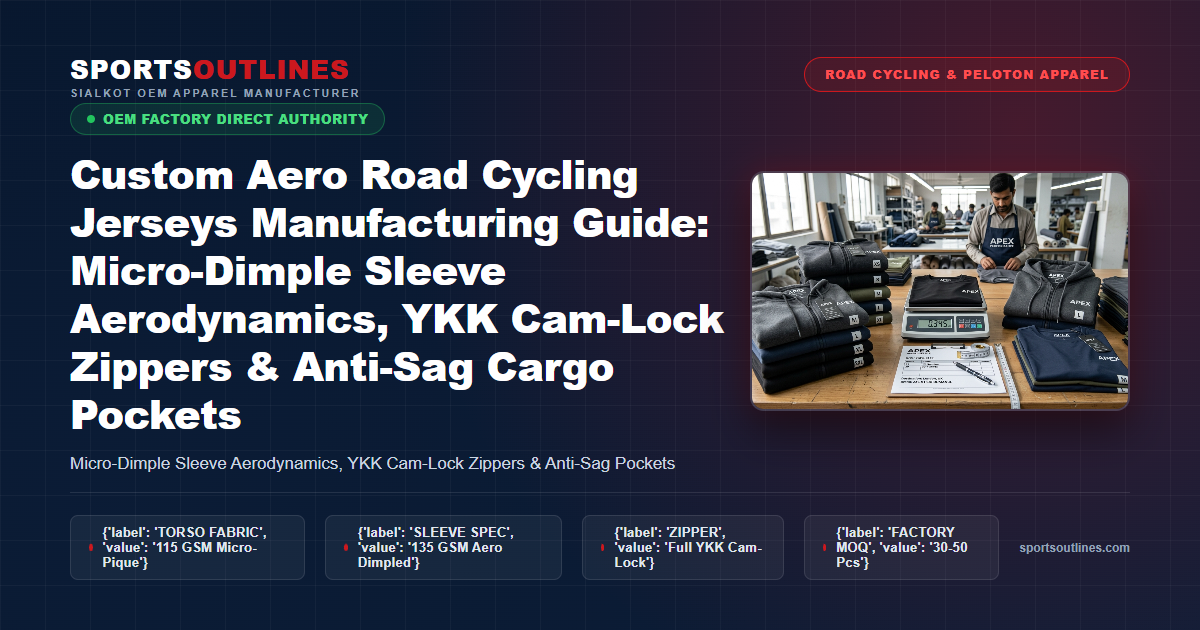
Manufacturing pro-peloton custom aero road cycling jerseys requires precision multi-fabric zoning that reduces aerodynamic drag at race velocities (35 to 55 km/h) while providing thermoregulatory moisture evacuation and stable cargo load management. Elite cycling jerseys combine two distinct performance textiles: an ultralight 110 to 115 GSM micro-pique polyester front/torso panel (86% micro-poly, 14% elastane) for high-velocity capillary ventilation, paired with 135 to 145 GSM textured micro-dimple or ribbed warp-knit aero sleeves (80% polyamide, 20% spandex) that trip laminar airflow into a turbulent boundary layer, delaying flow separation and saving up to 12 to 15 watts of aerodynamic drag. The sleeve ends feature raw-cut laser edges lined with hypoallergenic silicone micro-dot grippers extending down to the elbow crease. The front opening utilizes a full-length genuine YKK or SBS semi-autolock cam-lock zipper with a protective bottom zipper garage to prevent saddle or bib short abrasion. To support three 750ml bidons, tools, and nutrition without rear panel sagging, the rear storage employs an anti-sag triple gusseted cargo pocket system backed by unidirectional horizontal-stretch fabric and bonded interior webbing, plus a hidden zippered water-resistant security pocket. All dimensions conform to Union Cycliste Internationale (UCI) Rule 1.3.033 equipment standards. Direct factory low MOQ at our Sialkot facility starts at 30 to 50 pieces per style/colorway across adult XS–3XL and youth sizes. Physical pre-production prototype samples cost $45 to $85 per jersey delivered via express air in 7 to 10 business days.
- Aerodynamic Sleeves: 135 GSM micro-dimple textured warp knit for boundary layer vortex drag reduction.
- Ventilated Torso: 115 GSM micro-pique high-airflow polyester with hydrophilic moisture wicking.
- Hardware Engineering: Full-length YKK cam-lock zipper with integrated fabric chin guard and bottom garage.
- Anti-Sag Pockets: 3 reinforced rear cargo pockets with horizontal unidirectional stretch and waterproof key pocket.
- Waistband Retention: 45mm rear silicone power-band gripper preventing jersey ride-up in aggressive drops.
- UCI Equipment Compliance: 100% compliant with UCI 1.3.033 surface roughness and logo placement limits.
- Factory Direct Low MOQ: 30–50 jerseys per team order with split adult and junior size curves.
- Physical Prototype Sampling: $45–$85 per custom piece in 7–10 days (strict zero credit/refund policy).
- Direct Sourcing Communication: WhatsApp factory direct at +92 316 7932595 or sportsoutlines.com.
At speeds exceeding 40 kilometers per hour on flat terrain, aerodynamic drag accounts for over 80% of the total mechanical resistance resisting a competitive road cyclist.
In modern professional road racing, gravel cycling, and criterium events, the aerodynamic efficiency of the rider’s jersey is more influential than wheel depth or frame geometry. Traditional club-fit jerseys made from generic heavy polyester create loose shoulder folds and fluttering chest fabric that act like miniature air brakes, creating massive aerodynamic wake turbulence. Furthermore, when riders load their three rear pockets with water bottles, multi-tools, inner tubes, and food, cheap jerseys stretch downward toward the saddle, pulling the front collar into the rider’s throat and throwing the entire bike fit out of balance.
For cycling clubs, pro-am race teams, gran fondo organizers, cycle apparel founders, and bike shop pro dealers across the United States, Canada, the United Kingdom, and Australia, sourcing legitimate race-cut aero jerseys requires working with an OEM manufacturer with deep mastery of boundary-layer aerodynamics, precision zippers, and structural cargo pockets.
At Sports Outlines in Sialkot, Pakistan, our specialized cyclewear technical workshop manufactures bespoke pro-team aero jerseys, thermal gravel shirts, and endurance cycling tops for competitive teams worldwide. This in-depth technical manufacturing guide explains the fluid dynamics of micro-dimple sleeves, YKK cam-lock hardware selection, anti-sag pocket engineering, UCI equipment rules, Points of Measure (POM), standardized lab testing, and low MOQ manufacturing economics.
1. Aerodynamic Physics: Micro-Dimple Sleeves & Boundary Layer Dynamics
In wind tunnel testing, the forward-facing limbs of the cyclist—specifically the arms, shoulders, and chest—are the first surfaces to strike clean, undisturbed ambient air. When smooth airflow encounters a cylindrical object like a cyclist’s bicep, the laminar boundary layer separates prematurely from the trailing edge of the arm, creating a broad, low-pressure turbulent suction zone behind the arm that pulls the rider backward.
To mitigate this drag penalty, Sports Outlines manufactures jersey sleeves and shoulder yokes from 135 to 145 GSM textured micro-dimple or aerodynamically ribbed warp-knit fabrics. Similar to the dimples on a golf ball, the tiny geometric recesses in the knit introduce micro-vortices into the airflow, converting laminar flow into a turbulent boundary layer. This turbulent layer carries higher kinetic energy, allowing the airflow to follow the arm’s contours further around the circumference before separating. The resulting turbulent wake behind the arm is significantly narrower, slashing total aerodynamic pressure drag by up to 7.5% at 45 km/h.
Simultaneously, the main torso and abdominal panels are constructed from 110 to 115 GSM micro-pique knitted polyester. While aerodynamic smoothness is needed on the sleeves, the torso requires massive evaporative capacity to shed thermal body heat generated during alpine climbs. The micro-pique structure creates hundreds of micro-conduits that channel sweat away from the skin, achieving an AATCC 197 vertical wicking height exceeding 85 mm in ten minutes.
2. Collar, Sleeve & Waistband Ergonomics for the Aggressive Drop Position
A cycling jersey must be drafted from patterns cut for the bike position, not the standing mannequin. When a cyclist hinges 45 degrees at the hips to grasp the handlebar brake hoods or tucks deeply into the aerodynamic drops, human torso geometry changes radically: the front chest and abdomen shorten by 8 to 12 cm, the back spine curves and lengthens, and the arms extend forward.
Sports Outlines engineers custom cycling jerseys with pro-ergonomic anatomy:
- Low-Profile Aerodynamic Collar: Traditional high standing collars bunch and flap behind the neck when the head is tilted back to see down the road. Our jerseys incorporate a sleek, low-profile 1.5 cm mandarin collar or a collarless aerodynamic neck with an integrated soft fabric zipper guard that prevents throat pinching.
- Elongated Set-In Aero Sleeves with Raw Laser-Cut Hems: The sleeves are elongated to terminate just above the elbow joint. Instead of bulky folded hems or tight elastic bands that cause the dreaded ‘sausage arm’ effect, the sleeve ends are cleanly cut with automated laser beams and lined on the inner surface with ultra-flat silicone micro-dot beads. The sleeve stays perfectly flush against the skin at all times.
- High-Front Waistband & Deep Dropped Rear Tail: To prevent the zipper from bunching up like an accordion when bent over the handlebars, the front waistband is raised significantly. The rear tail is dropped deeply down the lumbar spine and anchored with a wide 45mm Italian silicone power-band gripper that keeps the pockets firmly in place over the bib shorts.
3. Hardware Engineering: YKK Cam-Lock Zippers & Zipper Garages
In cycling apparel, zipper failure is unacceptable. A zipper that jams during a mountain descent leaves the rider freezing, while a zipper slider that unzips spontaneously during a full-gas sprint can cause a catastrophic crash.
We exclusively specify genuine YKK #3 or SBS semi-autolock cam-lock reverse coil zippers. The cam-lock puller features a dual-action mechanism: when the metal pull tab is flipped down flat, the internal pin locks firmly into the coil teeth, preventing the jersey from unzipping even under heavy chest expansion. When the pull tab is flipped upward, the slider glides effortlessly, allowing the cyclist to vent the jersey single-handedly with a quick pull during steep climbs.
Furthermore, we engineer a microfiber zipper garage at the base of the front hem. This protective fabric envelope encloses the sharp metal zipper stop, preventing it from grinding against the expensive Lycra fabric of the rider’s cycling bib shorts and preventing premature saddle wear.
4. Anti-Sag Cargo Pockets & Waterproof Security Compartments
On a five-hour endurance ride or gravel race, a cyclist carries substantial weight in their rear pockets: two water bottles (up to 1.5 kg total), smartphones, pump, multi-tool, and ride fuel. In standard cheap jerseys, this cargo weight causes the rear panel to sag disastrously below the bicycle saddle, creating annoying sway and catching on the seat during out-of-the-saddle climbing.
Sports Outlines solves this structural flaw through our proprietary Anti-Sag Engineering Matrix:
- Unidirectional Fabric Orientation: The rear lumbar panel is cut from warp-knit fabric with 60% horizontal elasticity (allowing easy pocket entry) but less than 8% vertical elongation. Even when loaded with 2 kilograms of gear, the pockets will not sag downward.
- Interior Structural Load-Bearing Tape: The top hem of the pocket row and the vertical dividers between the three pockets are reinforced with bonded interior polyester stabilizing tape. The weight of the cargo is distributed upward across the entire upper shoulder yoke rather than pulling solely on the lower back hem.
- Pleated Gusset Bottoms: The bottom edge of each pocket features an engineered horizontal expansion pleat, allowing large bidons or rain jackets to expand outward rather than pressing inward against the rider’s lower spine.
- Concealed Waterproof Zippered Security Pocket: Located on the right-hand outer pocket is a hidden vertical pocket lined with a waterproof TPU membrane and closed with an invisible zipper, keeping credit cards, cash, and electronic car key fobs 100% bone-dry against sweat and torrential downpours.
5. Rigorous Laboratory Testing Standards for Cycling Apparel
Every production batch of custom cycling jerseys undergoes exhaustive quality testing in our Sialkot factory. We evaluate zipper pull cycles, pocket load tensile endurance, UV sun protection (UPF rating), and colorfastness against salty road spray.
6. Points of Measure (POM) & Race-Fit Size Grading Specs
In cycling apparel, accurate grading requires distinct adjustments between pro-race fit (skin-tight compression) and club fit (relaxed comfort). The following Points of Measure (POM) chart outlines our standardized adult race-cut cycling jersey specifications (XS to 3XL):
7. B2B Sourcing Economics: Margins, Low MOQs & Prototyping Terms
Premium aero road cycling jerseys from luxury cycling brands (such as Rapha, MAAP, and Pas Normal Studios) command retail prices between $160 and $240 USD. By establishing a direct OEM relationship with Sports Outlines in Sialkot, cycling brands and race teams access pro-tier manufacturing for $18.50 to $24.50 USD per jersey, achieving exceptional 78% to 85% gross margins.
Our flexible production structure offers low factory MOQs starting at 30 to 50 pieces per style/colorway with split sizing. To evaluate fabric aerodynamic texture, zipper glide, and pocket stability prior to volume manufacturing, we produce physical pre-production prototype samples for $45 to $85 per jersey delivered via express air in 7 to 10 business days (under our strict zero sample fee refund/credit policy).
8. Private Label Customization: Sublimation, Branding & Packaging
In cycling culture, aesthetic refinement is celebrated with fanatical dedication. High-end cyclists examine every stitch, seam transition, and sponsor logo alignment. Because cycling jerseys undergo high-velocity wind friction and aggressive sweating, rough badges or poorly positioned heat transfers will quickly fail.
Sports Outlines provides comprehensive OEM private label production:
- All-Over Photographic Dye-Sublimation: We print across flat un-sewn pattern panels using high-resolution Japanese Mimaki digital sublimation printers and Swiss fluor-free inks. Complex team fades, high-visibility neon accents, and microscopic vector sponsor graphics reproduce with razor-sharp fidelity and zero weight increase.
- Zero-Distraction Tagless Neck Heat Transfers: Inner cervical neck labels are applied via ultra-soft polyurethane heat-seal transfers detailing brand identity, size, and care symbols, completely eliminating abrasive woven labels against the nape of the neck.
- High-Luminance Retroreflective Lumbar Strips: A 15 cm retroreflective pip or vertical stripe is sewn into the center rear pocket seam, providing 450 cd/lux retroreflection to ensure rider safety when sharing the road with vehicular traffic.
- Sustainable Boutique Packaging: Finished jerseys are individually packed into recyclable matte polybags or reusable zippered frosted EVA ride pouches, complete with custom printed hangtags, FSC cardboard swing tags, and GS1 barcode labeling ready for global distribution.
Frequently Asked Technical Questions (FAQs)
1. How do micro-dimple sleeves reduce aerodynamic drag in cycling?
Micro-dimple textured fabrics introduce tiny vortices that convert laminar airflow into a turbulent boundary layer around the rider’s arms. This turbulent layer delays flow separation, reducing the low-pressure wake behind the cyclist and saving approximately 12 to 15 watts at 45 km/h.
2. How do you prevent rear cargo pockets from sagging when loaded with heavy bottles?
We use warp-knit fabric with unidirectional stretch (high horizontal stretch, under 8% vertical stretch), reinforced interior structural stabilizing tape along the top pocket hem, and a wide 45mm Italian silicone waist gripper that anchors the jersey to the bib shorts.
3. Why is a full-length YKK cam-lock zipper essential for road cycling?
A cam-lock zipper locks in place when the pull tab is flipped down, preventing unexpected opening during aggressive sprinting. When flipped up, it allows smooth single-handed operation for cooling during steep mountain climbs.
4. What is the difference between a Pro Race Fit and a Club Fit cycling jersey?
Pro Race Fit is designed for skin-tight compression with shorter front body length, elongated raw-cut sleeves, and minimal aerodynamic flutter. Club Fit offers a slightly more generous chest cut and longer front torso for upright endurance riding.
5. What is the minimum order quantity (MOQ) for custom cycling jerseys?
Our direct factory low MOQ is 30 to 50 pieces per style/colorway. This allows independent cycling clubs, boutique brands, and race teams to order custom designs without excess capital outlay.
6. How much does a physical pre-production sample cost and what is the turnaround?
A physical, fully finished prototype sample costs $45 to $85 per jersey depending on aero sleeve fabrics and pocket specifications. Samples are delivered in 7 to 10 business days via DHL/FedEx. Under our strict policy, sample fees are non-refundable and not credited toward bulk orders.
7. Are your cycling jerseys compliant with UCI Rule 1.3.033?
Yes. Our aero fabrics respect UCI Rule 1.3.033 regarding surface roughness and dimensional modifications. The profile variation of our micro-dimpled textiles does not exceed 1 mm, making them 100% legal for UCI WorldTour and national federation competition.
8. What sun protection (UPF rating) do your summer cycling fabrics offer?
Our primary torso and aero sleeve fabrics are tested to AATCC 183 standards and achieve certified UPF 50+ sun protection, blocking over 98% of harmful ultraviolet UVA and UVB radiation during all-day rides.
9. Can we add a hidden zippered pocket for cash and electronic keys?
Yes. We integrate a fourth concealed vertical security pocket on the right hip lined with a sweat-proof TPU barrier, keeping electronics and cards completely dry and secure.
10. What is the proper washing instructions for custom sublimated cycling jerseys?
Close the front zipper fully and turn the jersey inside-out before laundering. Machine wash cold (30°C / 86°F) on a delicate cycle using mild sports detergent. Do not use fabric softeners. Hang dry in shade. Never tumble dry or iron over silicone grippers or reflective transfers.
Engineer Your Custom Aero Cycling Jerseys with Sialkot’s Master OEM Workshop
Equip your race team or cycling apparel label with pro-peloton 135 GSM micro-dimple sleeves, YKK cam-lock zippers, and anti-sag pocket architecture with low factory MOQs of 30–50 pieces.
Related Technical Manufacturing Guides & Global Sourcing Silos:
- Global Sourcing Hubs: USA Sportswear Factory | Canada Apparel OEM | UK Activewear Sourcing | Australia Athletic Wear
- Product Lines: Custom Sublimated Jerseys | Athletic Activewear OEM | Custom Teamwear Sourcing
- Endurance Companion Guides: Custom Marathon Singlets Guide | Custom Split Running Shorts Guide