
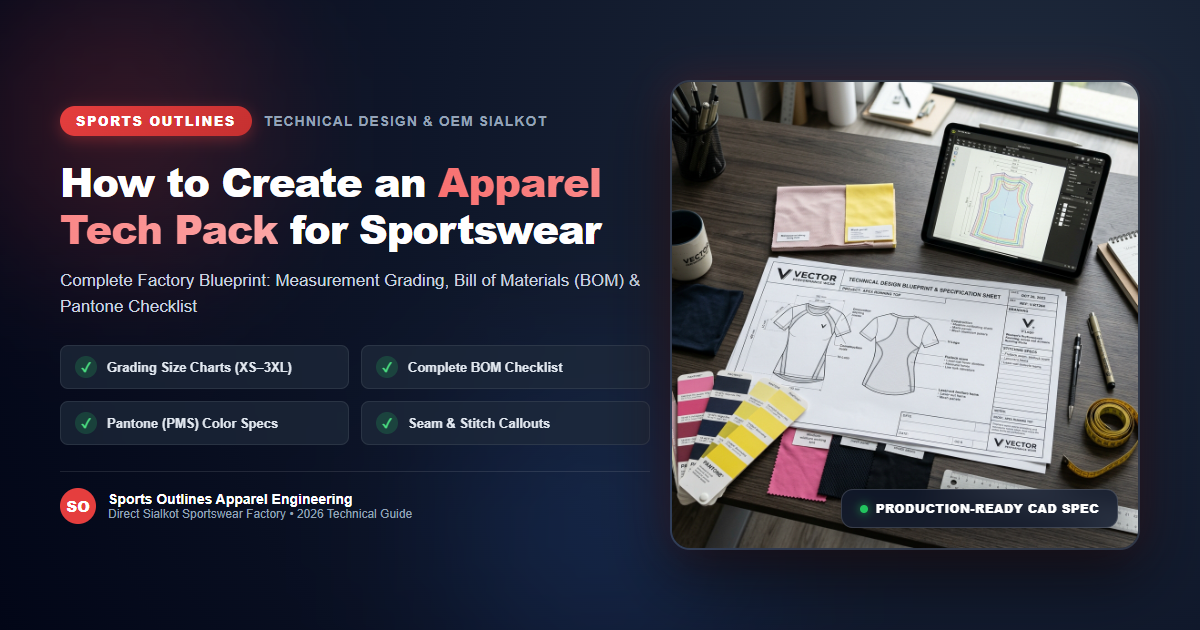
In commercial apparel manufacturing, miscommunication is the #1 killer of startup capital. When founders send overseas garment factories casual reference photos, Instagram screenshots, or vague hand sketches saying “make this in black, size medium”, costly disasters inevitably occur: neck holes too tight, sleeve lengths distorted, poor stitching tension, and dye lots that miss target shades. A professional Apparel Tech Pack (Technical Package) eliminates guesswork, legally binds your manufacturing standards, and transforms your creative sportswear ideas into factory-grade production realities.
📌 In This Technical Guide:
- Section 1: What Exactly is an Apparel Tech Pack (And Why Factories Demand It)?
- Section 2: The 7 Essential Components of a Production-Ready Sportswear Tech Pack
- Section 3: Technical Flat Sketches vs Artistic Fashion Illustrations
- Section 4: Building a Master Grading & Measurement Specification Table
- Section 5: Crafting the Bill of Materials (BOM): Fabrics, Trims, Threads & Zippers
- Section 6: Specifying Pantone (PMS) Codes & Graphic Placement Callouts
- Section 7: Labeling, Packaging, Polybags & Carton Barcode Compliance
- Section 8: Free Tech Pack Review & Digital Engineering Support at Sports Outlines
1. What is an Apparel Tech Pack (And Why Factories Require It)?
An Apparel Tech Pack is the industrial master blueprint used by garment engineers, digital CAD pattern makers, cut-and-sew tailors, and quality control (QC) inspectors. Think of it as the architectural schematic of a building: without it, carpenters cannot build a house to specification.
When you partner with a direct OEM/ODM sportswear manufacturer in Sialkot, Pakistan—such as Sports Outlines—your tech pack serves three critical functions:
- Precision Quoting: It allows factory estimators to calculate exact fabric consumption (in meters/kilograms), thread usage, and machine labor hours to give you accurate unit pricing down to the cent.
- Sampling Integrity: It guarantees your physical pre-production sample (received in 7–10 days) matches your desired athletic fit, drape, and seam tension perfectly before authorizing bulk cut-and-sew.
- Contractual Quality Control (AQL): It provides an objective legal standard. During final Quality Assurance inspections, our QC supervisors compare physical garments against your approved tech pack tolerance allowances (e.g. ±0.5 cm).
2. The 7 Essential Components of a Sportswear Tech Pack
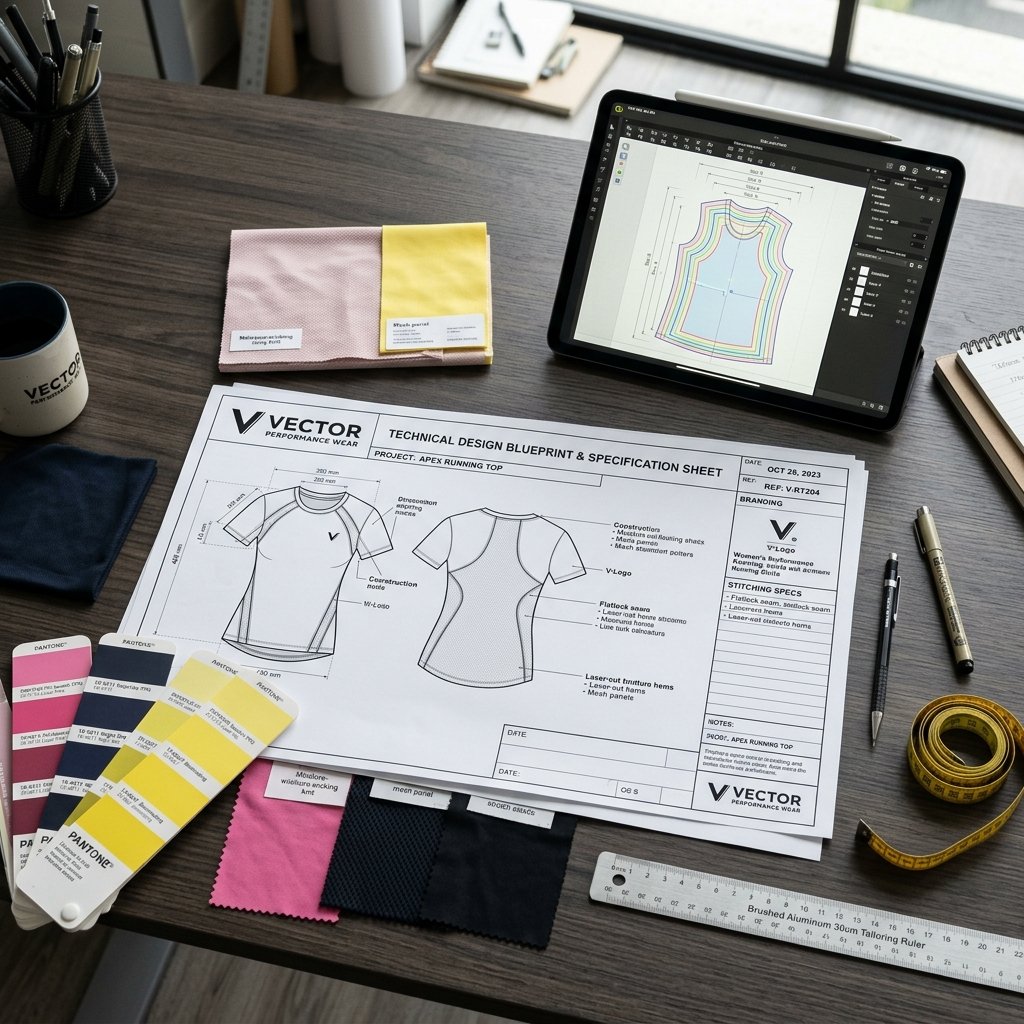
A commercial-ready athletic tech pack is not just a single sketch. It is a comprehensive multi-page document consisting of 7 distinct modules:
- Cover Page / Style Summary: Style name, style code (SKU), garment category (e.g. Performance Running Tee), creation date, revision number, and target season (e.g. SS26).
- Technical Flat Vector Drawings: 2D black-and-white digital line art showing the front, back, interior, and lateral views without shadows, 3D folds, or human models.
- Points of Measurement (POM) & Grading Table: Dimensional specifications across the full size curve (XS, S, M, L, XL, 2XL, 3XL) with tolerance allowances.
- Bill of Materials (BOM): An exhaustive catalog listing every single raw material: primary fabrics, secondary mesh panels, ribbing, sewing threads, zippers, drawcords, and elastic bands.
- Colorway Matrix & Pantone Swatches: Explicit color specifications using universal Pantone Textile Cotton (TCX) or Fashion & Home (TPG) codes.
- Embellishment & Artwork Callouts: Exact centimeter-level placements, graphic scaling, and print methods (Sublimation, Screen Print, 3D Puff Silicone, or High-Density Embroidery).
- Branding, Labeling & Packaging Specs: Heat-seal transfer neck tags, woven loop labels, retail hangtags, barcodes, and custom frosted polybags.
💡 Factory Pro-Tip for Startups: You do NOT need expensive CAD fashion software like Clo3D or Adobe Illustrator to get started. If you have clear benchmark physical samples or digital design concepts, our engineering team at Sports Outlines will translate your ideas into digital production tech packs free of charge when booking production orders.
3. Technical Flat Sketches vs Fashion Illustrations
Founders often confuse fashion design sketches with technical flats:
- Fashion Sketches (Stylistic): Hand-drawn illustrations on stylized 9-head human mannequins with dramatic shading, fabric ripples, and artistic coloring. These are excellent for brand lookbooks and marketing campaigns, but useless for automated laser cutting and sewing lines.
- Technical Flats (Working Drawings): Geometric, dimensionally accurate 2D vector wireframes. Every line represents an actual seam, hem stitch, or panel joint:
- Solid Lines: Represent physical fabric cut edges, seams, and fabric layer intersections.
- Dashed / Dotted Lines: Represent specific machine stitch lines (e.g. twin-needle topstitching or 4-needle flatlock seams).
- Callout Arrows: Direct the sewing operator to specific hardware locations (e.g., bartack reinforcements on pocket stress corners).
4. Master Grading & Measurement Specification Table
The heart of any tech pack is the Measurement Spec Sheet. Because athletic apparel requires active ergonomics, you must define Points of Measurement (POM) along with standard factory grading increments:
| Measurement Point (POM) | Tol. (±) | XS | S | M (Base) | L | XL | 2XL |
|---|---|---|---|---|---|---|---|
| 1/2 Chest Width (1″ below armhole) | 0.5 cm | 46 cm | 49 cm | 52 cm | 55 cm | 58 cm | 61 cm |
| Total Body Length (HSP to bottom hem) | 0.8 cm | 68 cm | 70 cm | 72 cm | 74 cm | 76 cm | 78 cm |
| Across Shoulder Width | 0.4 cm | 40 cm | 42 cm | 44 cm | 46 cm | 48 cm | 50 cm |
| Short Sleeve Length (from shoulder) | 0.4 cm | 20 cm | 21 cm | 22 cm | 23 cm | 24 cm | 25 cm |
| Neck Opening Width (seam to seam) | 0.3 cm | 17 cm | 17.5 cm | 18 cm | 18.5 cm | 19 cm | 19.5 cm |
| Bottom Hem Opening (Straight) | 0.5 cm | 46 cm | 49 cm | 52 cm | 55 cm | 58 cm | 61 cm |
Notice that each measurement has an acceptable Tolerance (Tol. ±). Garment manufacturing involves stretchable fabrics and high-speed sewing machines, so microscopic variations (±0.3cm to ±0.8cm) are standard international tolerances. Sizing specifications must also be adjusted for export markets—see our regional fit guides for buyers in the United States, the United Kingdom, Australia, Canada, and Germany.
5. The Bill of Materials (BOM): Fabrics, Trims & Hardware
The Bill of Materials (BOM) records every single component required to construct your garment. Leaving even one item unlisted (such as thread color or drawstring aglet material) forces the factory to guess—which always leads to delays or aesthetic mismatch.
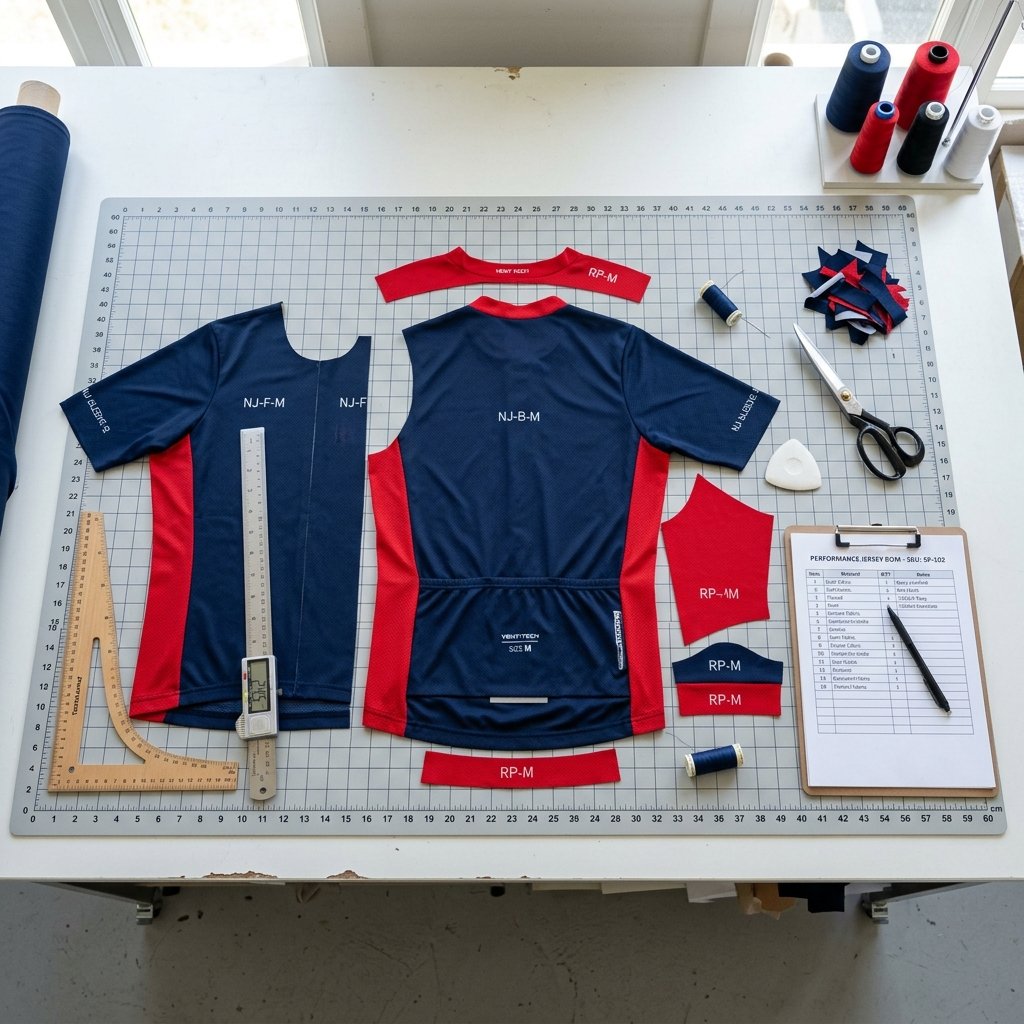
Your BOM table must specify:
- Primary Fabric: Composition (e.g., 88% Polyester / 12% Spandex Interlock), Yarn Count, GSM Weight (e.g., 220 GSM), and Finishing Treatments (Hydrophilic Moisture-Wicking, Anti-Microbial Silver Ion, or UPF 50+ Sun Protection). Explore our complete custom sportswear catalog for technical knit options.
- Secondary Fabric: Breathable Jacquard mesh underarm inserts (140 GSM) or 1×1 rib knit collar bands.
- Stitching Thread: High-tensile bonded polyester core-spun thread (Tex 40 for flatlock, Tex 27 for coverstitch) matched to fabric color.
- Zippers & Pullers: Brand (e.g. genuine YKK #5 reverse coil nylon zipper), tape color code, and custom debossed silicone puller. Ideal for custom jackets and streetwear hoodies.
- Drawcords & Elastic: Flat braided polyester drawstrings with matte dipped silicone aglets, and 3.5cm non-roll jacquard elastic waistbands.
6. Specifying Universal Pantone (PMS) Color Codes
Never use RGB (screen values) or CMYK (paper printing values) when communicating apparel colors to an overseas textile mill. What appears as “Deep Navy” on your iPhone display will appear distinctly purple or teal on a factory dye technician’s monitor.
Always provide Pantone Fashion, Home + Interiors (FHI) color references:
- Pantone TCX (Textile Cotton Edition): e.g., Pantone 19-4052 TCX (Classic Blue) — The worldwide gold standard for garment dyeing and digital sublimation printing.
- Pantone TPG (Textile Paper Green): Lacquer coated paper format used for trims, zipper metal coatings, and silicone labels.
- Lab Dip Protocol: During the sampling stage, our dye house dips fabric swatches in three subtle variance formulations (A, B, C) under standard D65 daylight lamps. You approve your preferred swatch before bulk yardage is dyed.
7. Private Label Branding, Packaging & Barcode Compliance
A great athletic garment looks amateur without branded presentation. Your tech pack must dedicate a full page to packaging and labeling engineering:
- Heat-Transfer Neck Label: Exact dimensions (e.g. 5cm x 5cm), placed 2.5cm below the collar seam. Must include brand logo, size (M), fabric composition (85% Poly / 15% Spandex), wash care icons, and origin statement (“Designed in USA / Made in Pakistan”).
- Retail Hangtags: 400 GSM matte cardstock with debossed UV foil logo, safety pin cord attachment, and scannable EAN-13 or UPC-A barcode stickers for retail store POS systems.
- Frosted Polybags: Biodegradable EVA frosted zipper bags printed with white silk-screen branding, ventilation eyelets, and multi-language child safety suffocation warnings required by Amazon FBA and global customs.
- Carton Packing List: Master double-wall corrugated export cartons (60cm x 40cm x 40cm), packed with silica gel desiccants, moisture-proof poly liners, and labeled with gross weight and carton numbers (e.g. Carton 1 of 12).
Need Help Creating Your Sportswear Tech Pack?
Send us your hand sketches, mood boards, or reference photos. Our in-house technical designers in Sialkot, Pakistan will build your complete digital CAD tech pack, measurement grading chart, and Bill of Materials free of charge with your sampling order.
Pingback: Low MOQ Clothing Manufacturing: How to Launch with 30u201350 Pieces Without Overpaying | Sports Outlines
Pingback: Moisture-Wicking vs Quick-Dry Fabrics: Technical Engineering Guide for Performance Sportswear - Sports Outlines
Pingback: French Terry vs Fleece: The Definitive B2B Sourcing Guide for Custom Hoodies, Sweatshirts & Streetwear - Sports Outlines