In high-performance sportswear manufacturing, apparel founders and product developers frequently treat moisture-wicking and quick-dry as interchangeable marketing buzzwords. In textile physics and polymer engineering, however, they represent two fundamentally distinct thermodynamic and fluid-transport mechanisms. Confusing these two properties leads to catastrophic apparel design failures—such as gym tees that saturate and stick to the skin during heavy workouts, or marathon running singlets that cause skin chaffing due to localized moisture stagnation.
At Sports Outlines, an OEM and ODM performance sportswear manufacturing facility based in Sialkot, Pakistan, we engineer technical textiles for emerging fitness brands, athletic clubs, and global teamwear distributors. This comprehensive B2B technical guide breaks down the physical chemistry of capillary pressure, fiber cross-sectional geometries, international laboratory testing standards (AATCC 195 and AATCC 201), and commercial sourcing guidelines for low minimum order quantity (MOQ) manufacturing.
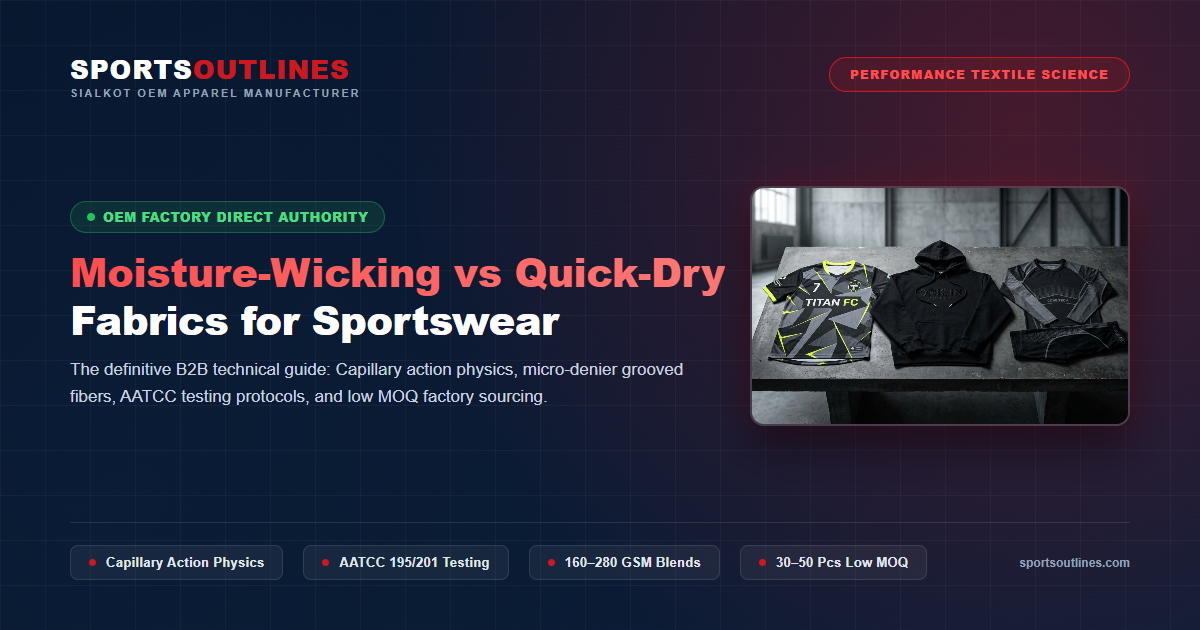
- Moisture-Wicking is a Transport Mechanism: It pulls liquid sweat away from the athlete’s epidermis through microscopic capillary channels created by specially extruded grooved synthetic fibers. Its sole job is keeping the skin dry.
- Quick-Dry is an Evaporative Mechanism: It disperses the transported liquid across an expansive external textile surface area, accelerating phase-change transition from liquid to water vapor in ambient air.
- Why You Need Both in Competitive Sportswear: A fabric that wicks moisture but fails to dry quickly becomes heavy, water-logged, and chilly. A fabric that dries quickly but lacks capillary suction leaves perspiration trapped against the skin. Elite performance apparel combines both in dual-layer bi-component knits.
- Factory Sourcing Thresholds: At Sports Outlines, custom engineered moisture-wicking and quick-dry blends start from 30 to 50 pieces per style/colorway with mixed sizing (XS to 2XL).
1. The Physics of Moisture Wicking: Capillary Pressure & Fiber Geometry
To understand how moisture wicking functions at the microscopic level, one must examine the Young-Laplace equation of capillary dynamics:
Where:
- ΔP represents the capillary driving pressure pulling sweat through the fabric.
- γ is the surface tension of the liquid (sweat/perspiration).
- θ is the wetting contact angle between the droplet and the fiber surface.
- r is the effective capillary radius between adjacent yarn filaments.
As the capillary radius (r) decreases, the suction pressure (ΔP) increases exponentially. This is why high-performance moisture wicking cannot be achieved using standard round-extruded polyester yarns. Instead, performance mills utilize engineered fiber cross-sections:
Engineered Cross-Sectional Geometries
- Trilobal & Multi-Channel Cross Sections (e.g., Coolmax, Micro-Grooved Poly): Instead of a solid cylindrical filament, the extrusion spinneret forces polyester into a cross, cloverleaf, or grooved channel shape. These micro-crevices form continuous longitudinal capillary siphons that transport liquid sweat away from the dermis 300% faster than standard cylindrical yarns.
- Micro-Denier Filaments (Under 1.0 Denier per Filament – DPF): By packing hundreds of ultra-fine filaments into a single thread, the interstitial spacing between fibers is reduced to sub-micron dimensions, creating immense capillary suction force.
- Dual-Face Hydrophobic / Hydrophilic Push-Pull Knits: In premium athletic knits, the inner face resting against the athlete’s skin is knitted with hydrophobic polypropylene or micro-polyester (which repels water), while the outer face is knitted with hydrophilic micro-nylon or specially treated polyester. Liquid sweat is physically pushed away from the skin and pulled to the exterior face by differential surface energy.
2. The Thermodynamics of Quick-Dry: Surface Area & Evaporative Rate
Once liquid sweat has been transported to the outer face of the garment via capillary action, the quick-dry phase begins. Quick-drying is governed by heat transfer and mass transfer boundary layers:
When a liquid droplet remains localized as a bead, its surface area exposed to ambient air is minimal, resulting in slow evaporation. Quick-dry textiles are engineered to force instantaneous droplet spreading—transforming a compact droplet into an ultra-thin liquid film across an interfacial area 10 to 20 times larger. The larger the surface area, the faster ambient thermal energy breaks the hydrogen bonds between water molecules, driving rapid phase change from liquid to vapor.
Chemical Topical Finishes vs. Inherent Yarn Properties
In the apparel manufacturing industry, there are two distinct ways to achieve quick-dry functionality:
- Inherent Polymer Engineering (Permanent Durability): The capillary channels and fast-spreading properties are extruded directly into the physical structure of the synthetic polymer yarn. These properties never wash out, remaining 100% active over 100+ commercial wash cycles. At Sports Outlines, this is our standard specification for high-performance teamwear and activewear.
- Chemical Topical Finishes (Temporary Durability): Standard cheap synthetic fabric is submerged in a chemical hydrophilic surfactant bath during post-dyeing finishing. While effective for the first 5 to 10 washes, these surface-level chemical coatings degrade rapidly, leaving the athlete with a sticky, non-functional garment.
3. Technical Laboratory Testing Standards for Activewear Brands
When purchasing bulk fabric lots or specifying performance standards in your Apparel Tech Pack, you should never rely on supplier claims alone. Tier-1 brands evaluate moisture management using standardized testing protocols from the American Association of Textile Chemists and Colorists (AATCC):
4. Head-to-Head Comparison: Moisture-Wicking vs. Quick-Dry Fabrics
The table below contrasts the fundamental performance, tactile, and financial parameters across commercial textile specifications:
5. Fabric Blend Architectures for Specific Athletic Silhouettes
Different sporting disciplines exert wildly divergent thermal and mechanical loads on athletic apparel. For detailed weight breakdowns, consult our in-depth Sportswear Fabric & GSM Selection Guide. Here are the factory blend standards we recommend:
A. Gym, CrossFit & Training T-Shirts (150–180 GSM)
Recommended Blend: 88% Micro-Polyester / 12% Spandex (Elastane) single jersey or interlock knit.
Why It Works: Micro-denier polyester provides extreme capillary wicking during heavy sets, while 12% spandex ensures 4-way stretch memory without bagging at the elbows or chest. For custom sublimation printing, this blend provides 100% molecular color penetration without fading. (See our comparison on Sublimation vs Screen Printing for Sports Uniforms).
B. Marathon, Track & Running Singlets (120–140 GSM)
Recommended Blend: 100% Recycled Polyester (rPET) Jacquard Air-Mesh.
Why It Works: Endurance athletes generate continuous perspiration over 1 to 4 hours. Lightweight bird’s-eye or pin-dot jacquard mesh maximizes atmospheric contact area, yielding an ultra-fast AATCC 201 drying rate under 9 minutes to eliminate nipple chafing and fabric drag.
C. Squat-Proof Compression Leggings & Biker Shorts (240–280 GSM)
Recommended Blend: 75% Nylon 6,6 / 25% High-Power Spandex double-knit interlock.
Why It Works: Nylon provides silky hand-feel, supreme tensile abrasion resistance, and natural quick-drying properties, while 25% elastane delivers high recovery modulus. The dense interlock construction guarantees 100% opacity (zero transparency under deep squat extension) while wicking sweat from high-friction zones.
6. Managing The “Synthetic Stink”: Antimicrobial & Anti-Odor Technologies
A well-documented downside of synthetic moisture-wicking textiles is their tendency to retain post-workout odor. Unlike natural cotton, which absorbs water internally, polyester fibers are oleophilic (oil-attracting). They readily bind to human apocrine secretions, fatty acids, and sebum. Bacteria on the skin (specifically Corynebacterium) metabolize these lipids into volatile fatty acids (such as isovaleric acid), causing permanent body odor build-up.
To prevent this in private label apparel lines, Sports Outlines integrates three proven antimicrobial finishes during the fabric finishing process:
- Silver Ion Technology (e.g., Silvadur, Polygiene): Microscopic silver ions are permanently embedded into the polymer or bonded to yarn surfaces. When bacteria come into contact with silver ions, cellular respiration is disrupted, preventing bacterial reproduction by 99.9% without affecting wicking kinetics.
- Zinc Pyrithione Finishes: An economical, highly durable antimicrobial treatment that resists washing out for 40 to 60 domestic laundry cycles.
- Chitosan Natural Bio-Finishes: Derived from marine chitin, this eco-certified, hypoallergenic finish provides antimicrobial efficacy for sustainable activewear brands targeting organic and zero-chemical marketing claims.
7. Sourcing Performance Textiles with Low MOQ at Sports Outlines
Traditional overseas textile mills in Asia typically demand massive minimum order quantities of 1,000 to 3,000 meters per color just to dye performance fabric. For emerging sportswear brands, this upfront capital requirement destroys startup viability. (See our comprehensive breakdown in the Cost Breakdown of Custom Sportswear Manufacturing).
At Sports Outlines, we eliminate this barrier by maintaining an active raw material inventory of pre-knitted, laboratory-certified technical synthetic fabrics in our Sialkot factory:
- Low MOQ Flexibility: Full custom cut-and-sew manufacturing starting from 30 to 50 pieces per style/colorway with mixed sizing (XS to 2XL).
- Physical Prototyping Samples ($45–$85 / Piece): Before initiating bulk cutting, we produce complete pre-production physical prototypes in 7 to 10 business days. This allows brand founders to test hand-feel, capillary wicking speed, flatlock seam elasticity, and fit ergonomics under real gym conditions.
- End-to-End OEM/ODM Capabilities: Custom silicone heat transfers, woven neck labels, hangtags, custom polybags, and Italian Kiian digital dye sublimation.
- Global DDP Air Shipping: Direct door-to-door courier delivery via DHL Express and FedEx within 4 to 7 business days to the USA, UK, Canada, Australia, and Germany.
Ready to Engineer High-Performance Custom Sportswear?
Connect directly with our senior textile engineers in Sialkot, Pakistan. Send us your design sketches, Tech Packs, or reference samples to receive custom fabric swatches and instant bulk factory pricing.
Explore Our Regional B2B Sourcing Hubs
We provide dedicated tariff, freight, and sizing consultation tailored to your domestic market:
- USA B2B Sourcing Hub – Section 321 De Minimis customs clearance and US sizing specifications.
- United Kingdom B2B Sourcing Hub – DDP air shipping directly to UK warehouses with zero customs hassle.
- Australia B2B Sourcing Hub – Southern hemisphere seasonal timelines and ultra-breathable UPF 50+ athletic fabrics.
- Canada B2B Sourcing Hub – High-thermal base layers and moisture-wicking winter compression apparel.
- Germany & EU Sourcing Hub – REACH-compliant certified synthetic dyes and European athletic sizing curves.