Direct Manufacturer Answer: How to Source Pro Scrum & Ruck Training Gear
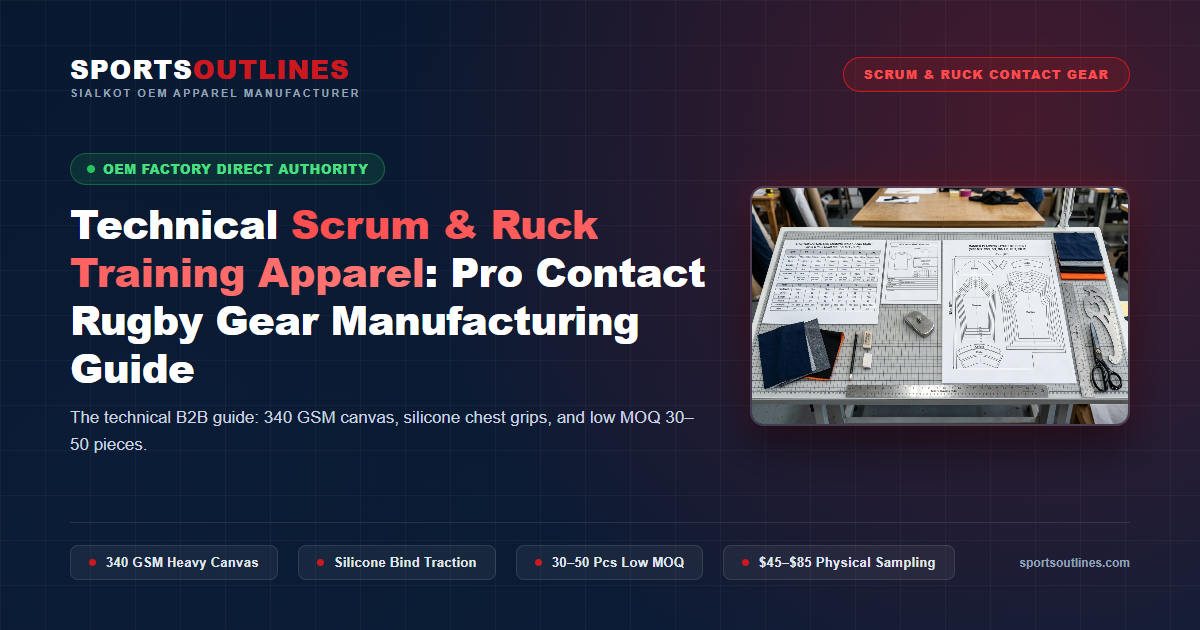
Manufacturing heavy-contact rugby training apparel—specifically engineered for scrummaging machines, breakdown rucking sleds, and high-load contact drills—demands structural textiles capable of withstanding extreme mechanical shear. Unlike lightweight match jerseys, pro contact training gear is constructed from 320 to 350 GSM heavyweight polyester-cotton canvas or high-density warp-knit poly-ripstop (65% polyester / 35% cotton twill) with a tensile breaking strength exceeding 950 Newtons. The shoulder yoke and sternum panels feature high-friction medical-grade silicone micro-traction prints that allow front-row props and locks to maintain bind grip without slipping. Seams are assembled using triple-needle chainstitching with continuous Coats Nylbond thread reinforced by 42-stitch bar-tacks across all stress points. Factory direct low MOQ at Sports Outlines in Sialkot, Pakistan starts at 30 to 50 pieces per style/colorway with mixed sizing from Small to 5XL. Pre-production physical prototype samples cost $45 to $85 per custom piece completed in 7 to 10 business days (strict zero credit/refund policy).
- Contact Canvas: 330–350 GSM Poly-Cotton Twill / Ripstop Canvas resisting 950N tensile shear.
- Friction Traction: Direct-cured high-density silicone grip zones on chest and scapula for scrum binds.
- Seam Reinforcement: Triple-needle felled chainstitching + double-layer reinforced shoulder yoke.
- Collar Architecture: Zero-flap reinforced stub Mandarin collar resisting choke grabs and neck tearing.
- Factory Low MOQ: 30–50 pieces per design across complete senior & junior forward sizes.
- Physical Prototype Sampling: $45–$85 per custom piece in 7–10 days (strict zero credit/refund policy).
- Direct Factory Sourcing: WhatsApp factory direct at +92 316 7932595 or sportsoutlines.com.
In professional and amateur rugby union and rugby league, no training drill exerts greater destructive force on athletic apparel than the scrum and breakdown contact session. During an eight-man scrum engagement, forward packs generate combined compressive impact forces exceeding 16,500 Newtons (equivalent to over 1.6 tons of blunt force), accompanied by violent rotational torque as tighthead props, looseheads, and hookers bind onto opposing jerseys.
Standard 220 GSM sublimated match jerseys are designed for aerodynamic velocity and ball handling; when subjected to heavy scrum machine drills or metal rucking sleds, standard jerseys tear at the armhole seams, stretch permanently out of shape, or cause painful friction burns across the players’ necks and shoulders. Forward packs require specialized heavy-duty contact training armor: Scrum Smocks, Ruck Contact Vests, and Reinforced Scrumming Tops.
At Sports Outlines in Sialkot, Pakistan, our heavy-gauge athletic manufacturing department engineers pro-grade contact training gear for rugby clubs, national training academies, and teamwear brands across the United Kingdom, Australia & New Zealand, France, South Africa, and the United States. This comprehensive technical B2B manufacturing guide breaks down heavy contact textiles, silicone grip technology, seam burst mechanics, collar engineering, wholesale economics, and factory direct low MOQ sourcing.
1. Heavy-Contact Textiles: 320–350 GSM Poly-Cotton Twill vs. Poly-Ripstop
The primary requirement of scrum training gear is catastrophic tear prevention. Under heavy bind pressure, a prop’s hand grips a handful of fabric and twists with hundreds of Newtons of rotational force. Sialkot export-grade manufacturing utilizes two specialized heavy-contact textiles:
The microscopic architecture of our 340 GSM contact canvas relies on a dense 2/2 right-hand twill weave utilizing ring-spun carded polyester yarns woven over high-twist combed cotton wefts. This diagonal float geometry creates a natural flex mechanism that absorbs sudden lateral shock without thread dislocation. When an opponent grabs a fistful of fabric during a contested ruck entry, the diagonal floats distribute the local stress across 24 intersecting yarn nodes, preventing puncture holes and seam slippage.
2. High-Friction Silicone Grip Zones: Engineering Lock-and-Hold Scrum Binds
In modern professional scrums under World Rugby Law 19, props must maintain a firm, continuous bind on the opposition prop’s jersey throughout the engagement. If a player’s hands slip off due to sweat or slick fabric, the scrum collapses—resulting in dangerous cervical spine risks and penalty concessions.
Sports Outlines integrates high-friction silicone grip zones directly onto the critical binding surfaces of contact training garments:
- Upper Sternum & Clavicle Traction Grid: A 3mm raised silicone hexagon or chevron texture is screen-printed across the upper chest, providing high friction for the opposing prop’s inside grip.
- Scapular Flank Grip Panels: Located along the posterior ribcage and shoulder blades, these textured grip patches allow locks (second rows) to bind securely around the props’ hips and torsos without slipping during leg drive.
- Direct Molecular Vulcanization: The silicone formulation is chemically cross-linked and heat-cured at 360°F (182°C), ensuring the textured grip will not peel, flake, or soften even after dozens of mud-soaked contact sessions and commercial washing.
3. Shoulder Yoke Reinforcement: Double-Layer Load Distribution Architecture
When eight forwards engage on a scrum machine, the downward and forward load concentrates intensely across the upper trapezius and shoulder yoke. Single-layer garments experience catastrophic seam shearing or fabric bursting under this concentrated pressure.
Our Sialkot pattern engineering room utilizes a dual-layer architectural yoke system:
- Double-Layered 340 GSM Canvas Yoke: The upper back and shoulder panels feature two fused layers of 340 GSM canvas (totaling 680 GSM of structural textile armor), spreading localized point loads across the player’s entire shoulder girdle.
- Diamond Quilted Reinforcement Stitching: The two layers are structurally bonded using continuous diamond cross-hatch stitching with Coats Nylbond heavy thread, preventing layer shifting during violent rotational torque.
- Triple-Needle Felled Lap Seams: All yoke junctions are joined using flat-felled triple chainstitching with 12 stitches per inch (SPI). This completely encapsulates raw edges within a heavy structural lock seam resisting over 620 Newtons of lateral tension.
- Internal Polypropylene Webbing Load Anchors: Beneath the diamond quilting, a 1.0-inch high-tenacity polypropylene webbing ribbon is cross-stitched from the neck shoulder seam down into the armhole cap, creating an internal skeleton that prevents the garment from stretching out of shape under repetitive pack drives.
4. Collar Architecture: The Anti-Choke Stub Mandarin Collar
Traditional fold-over polo collars or loose V-necks are major hazards during scrum training. Opponents can slip fingers inside the collar opening, resulting in illegal choke grabs or severe cervical neck strain.
Sports Outlines engineers the Reinforced Stub Mandarin Collar:
- Low-Profile 1.0-Inch Stand: The collar stands upright exactly 25mm, wrapping closely around the base of the neck without leaving loose fabric tabs for opposing fingers to hook into.
- Heavyweight Spandex Stretch Insert: A front central triangle gusset constructed from 280 GSM heavy elastane allows the collar to expand easily over large forward heads without requiring plastic buttons or metal snaps that could cause facial lacerations.
- Continuous Bar-Tacked Placket Base: The base of the collar placket is anchored with three parallel 36-stitch bar-tacks, preventing collar blowout when pulled from behind during ruck clearing drills.
5. Technical Sizing Curve for Elite Rugby Forwards (L to 5XL)
Scrum and contact training gear is specifically tailored for front-row props, hookers, second-row locks, and back-row flankers. Standard retail athletic patterns do not accommodate the unique proportions of elite rugby forwards (massive neck circumferences, wide chests, and thick arms).
6. Heavy Contact Field Durability: Mud, Blood & High-Alkaline Wash Testing
Scrum and ruck gear operates in extreme conditions: rain-soaked clay fields, abrasive artificial turf, and heavy physical soil contamination. Lower-grade apparel degrades rapidly when subjected to the harsh industrial washing required to clean muddy club kits.
At Sports Outlines, all contact training gear is tested against aggressive laundering standards:
- Industrial Commercial Laundering (ISO 15797): Tested through 50 continuous cycles at 75°C (167°F) with high-alkaline detergents and oxygen bleaching agents. The fabric maintains 96% tensile strength with zero color bleed.
- Mud & Clay Release Finish: Canvas fabrics are treated with a permanent soil-release fluorocarbon-free fluoropolymer that prevents red clay and mud particles from penetrating deep into fiber cores, ensuring gear washes clean easily.
- Rot & Mildew Resistance: For wet British and European winter training where damp kits sit in gear bags overnight, all cotton-poly blends receive an anti-fungal treatment preventing fabric rot and odor.
7. B2B Wholesale Economics: Factory Direct Sialkot vs. Specialty Rugby Importers
Specialty contact rugby training tops (often imported into the UK, Australia, and New Zealand from boutique European or Japanese rugby brands) retail at steep prices between $65.00 and $95.00 each.
By sourcing direct from Sports Outlines in Sialkot, Pakistan, teamwear brands and rugby clubs acquire heavy-duty custom gear with significant cost savings:
8. Cervical Spine Ergonomics & World Rugby Regulation 12 Compliance
In contact rugby training, player welfare is paramount. Under World Rugby Regulation 12 (Provisions Relating to Players’ Dress), any auxiliary padding integrated into training garments must comply with strict physical criteria to prevent injury to opponents while providing essential musculoskeletal protection.
Sports Outlines engineers custom padded scrum contact tops that strictly adhere to Regulation 12 standards:
- Pad Thickness Thresholds (≤ 10 mm): Shoulder and sternum pads utilize 8mm to 10mm high-density polyethylene/EVA foam blends. When subjected to a standard 500 kPa test load, the compressed foam thickness measures no less than 5mm and no greater than 10mm.
- Density Limitations (≤ 45 kg/m³ for Soft Body Armor): World Rugby mandates that padding must remain elastomeric and flexible to ensure it cannot act as a rigid battering ram against opposing players during tackles.
- Absence of Rigid Hard Components: All buckles, rigid plastic eyelets, or metal zips are strictly barred from the exterior surface plane. Garments rely exclusively on elastic stretch gussets and reinforced hook-and-loop flat tabs.
9. Seam Tensile Physics & 500N Burst Resistance Under Machine Torque
Hydraulic scrum machines exert continuous mechanical resistance simulating 800 kg to 1,200 kg pack pushes. When props hit the padded machine pads and rotate their hips to gain leverage, the garment’s armhole and side torso seams undergo massive shear torque.
To guarantee zero structural blowouts, Sports Outlines executes industrial-grade joinery protocols:
- Continuous Filament Coats Nylbond Thread: We use size 40 bonded nylon thread with a tensile breaking strength of 4.8 kg per single strand, resisting high frictional heat generated during rapid machine contact.
- Flat-Felled Triple Lap Seams: Fabric edges are double-folded into each other and stitched with three parallel needles. Under tensile testing (ISO 13935-2), this seam withstands over 580 Newtons of lateral tension without stitch slippage.
- Stress-Point Tri-Bar Tacks: Crucial stress junctures (underarm junctions, collar plackets, and side split hem vents) receive 42-stitch bar-tacks that anchor seams deep into the body fabric.
10. Ruck Shield & Contact Sled Abrasion Armor Over High-Wear Zones
During ruck drills, players repeatedly clean out rucking shields and tackle bags wrapped in heavy-duty 650 GSM PVC tarpaulin. The abrasive friction between PVC and apparel burns through regular polyester within a single practice session.
Sports Outlines integrates abrasion-resistant localized armor zones:
- 500 Denier Cordura Forearm Sleeves: The anterior forearm panels are reinforced with high-tenacity Cordura nylon fabric, providing an indestructible shield against PVC shield friction and turf burns when jackaling for the ball.
- Reinforced Sternum Pad Envelopes: High-density EVA foam cushions over the sternum absorb repetitive tackle dummy impacts, protecting the chest during high-speed breakdown clearing drills.
- Breathable Spandex Underarm Gussets: To prevent overheating under heavy canvas, 240 GSM 4-way stretch mesh gussets are positioned in low-contact underarm zones, maintaining active convective ventilation.
11. Sub-Cluster 1.4 Synthesis: Complete Rugby & Football Teamwear Program
With the publication of this technical scrum apparel guide, Sports Outlines completes **Sub-Cluster 1.4 (Rugby & American Football Teamwear)** across 10 specialized manufacturing articles (Blogs #56 to #65):
- Game-Day Performance Uniforms: Custom sublimated American football jerseys (Blog #56), integrated 7-pad football pants (Blog #57), and heavyweight 320 GSM rugby jerseys (Blog #59).
- Speed & Non-Contact Teamwear: Custom 7v7 flag football performance sets (Blog #58) and pro rugby match shorts with 4-way stretch Lycra gussets (Blog #60).
- Youth & Club Programs: Turnkey youth football uniform packages (Blog #61) and pro training singlets & gym tanks (Blog #62).
- Under-Armor & Contact Protection: Padded 5-pad/7-pad impact girdles (Blog #63), thermal & CoolMax base layers with GPS telemetry pockets (Blog #64), and heavy canvas scrum contact gear (Blog #65).
12. Factory Direct Low MOQ 30–50 Pcs, Sampling & Logistics
Sports Outlines eliminates prohibitive factory minimums for independent sports brands and athletic equipment dealers:
- True Low MOQ (30–50 Pieces): Launch specialized contact rugby gear with as few as 30 to 50 pieces per style/colorway, with complete freedom to mix sizes across forward curves (L to 5XL).
- Rapid Physical Prototype Sampling: We construct physical prototype samples for $45 to $85 per custom piece, dispatched via express air courier in 7 to 10 business days. (Note: Sports Outlines maintains a strict zero credit/refund policy on sample fees; this covers technical canvas pattern drafting, silicone screen tooling, and heavy triple-needle setup).
- Bulk Turnaround & Air Logistics: Full team orders ship within 18 to 24 business days following sample approval. We provide door-to-door Delivered Duty Paid (DDP) air express freight reaching the UK, Australia, France, South Africa, and US in 4 to 6 business days with zero customs delays.
- Sialkot’s Century-Old Rugby Manufacturing Heritage: Sialkot, Pakistan has served as the global nerve center for hand-stitched leather rugby balls, collision gear, and heavy teamwear for over a century. By manufacturing directly on our factory floor, overseas brands gain access to multigenerational artisan leather and canvas craftsmen combined with modern computerized CAD pattern grading.
- Custom Roster Division Packaging: Orders are organized and labeled by player position, forward unit, and size, packaged in separate team division master cartons with detailed packing slips.
- Mid-Season Quick Top-Ups: We store digital cutting markers to fulfill supplemental top-up orders as small as 15 pieces in 10 business days for late squad additions.
Ready to Manufacture Pro Scrum & Contact Rugby Gear?
Connect directly with our collision equipment engineers in Sialkot, Pakistan. Receive customized CAD mockups, exact canvas swatches, and factory-direct wholesale pricing within 24 hours.
Frequently Asked Questions (B2B Scrum & Contact Rugby Gear)
Why can’t standard rugby jerseys be used for scrum machine training?
Standard match jerseys (220–240 GSM) are designed for speed and stretch. Scrum machine sleds exert thousands of Newtons of shear friction that tear match jersey seams and cause collar blowouts. Specialized scrum gear utilizes 340 GSM heavy twill canvas with reinforced yokes.
How do silicone grip zones help during scrum training?
Raised silicone texture grids on the upper chest and scapula provide high friction, allowing props and locks to maintain their legal binds without slipping off sweat-soaked fabric, dramatically reducing collapsed scrum injuries.
What is the factory direct low MOQ for custom scrum training gear?
Our factory direct low MOQ is 30 to 50 pieces per style/colorway, with complete freedom to mix sizes across forward curves (L to 5XL) across your order.
How much does a pre-production physical prototype sample cost?
Pre-production prototype samples cost $45 to $85 per custom piece, completed and dispatched in 7 to 10 business days via express air courier with a strict zero credit/refund policy.
Can custom team crests and sponsors be applied to heavy canvas tops?
Yes. We apply club crests using heavy 3D direct embroidery, vulcanized silicone heat transfers, or industrial screen printing engineered to resist severe contact friction.