Direct Manufacturer Answer: How to Manufacture Custom Lightweight Running Windbreakers & Packable Shells
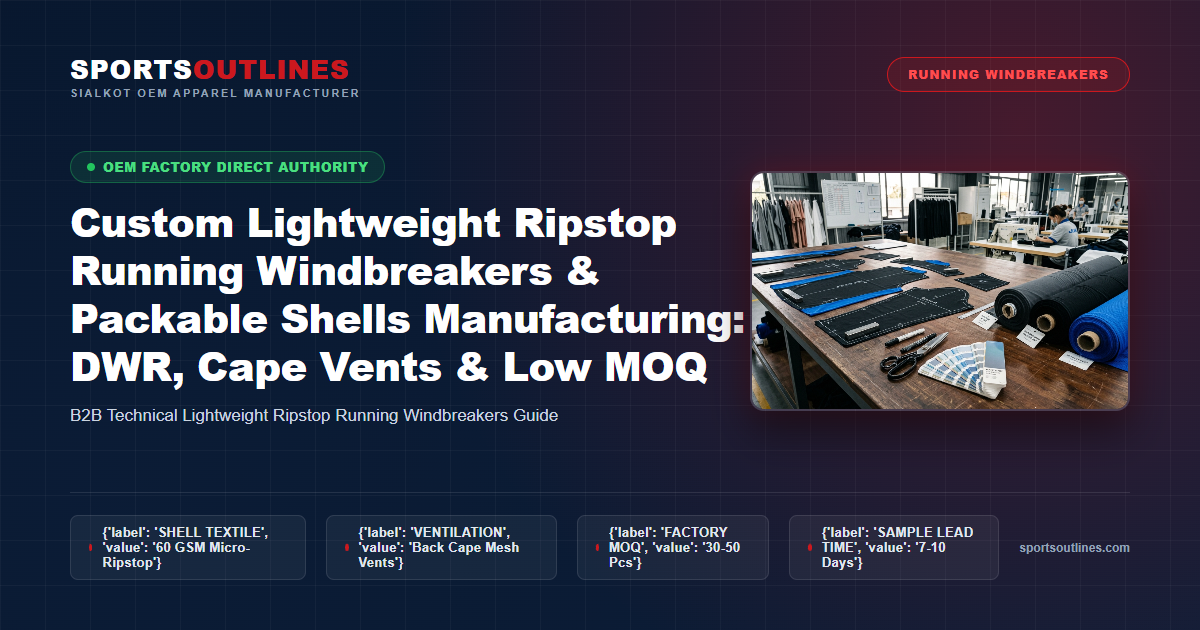
Manufacturing commercial-grade custom lightweight running windbreakers and packable shells requires engineering featherweight 55 to 70 GSM 20-denier micro-ripstop woven textiles (100% Nylon 6.6 or recycled polyester diamond ripstop), treated with eco-friendly C0 PFC-free Durable Water Repellent (DWR) surface finishes, calibrated to a wind permeability index of 4 to 8 CFM (ASTM D737), and paired with functional running architectures including floating back cape vents, packable self-stowage pockets, and 360-degree bio-motion reflective markers. In high-output distance running, trail ultramarathons, and track conditioning, runners reject heavy jackets because they cause overheating and condense sweat vapor into a clammy interior puddle. Commercial running shells weigh under 120 to 140 grams total garment mass, utilizing an ultra-tight micro-ripstop crosshatch grid that deflects piercing headwinds while allowing passive convective heat escape through concealed upper back storm flaps lined with featherweight 65 GSM power mesh. The jacket is engineered with a self-packing chest or lumbar pocket featuring a reversible dual-slider YKK zipper, allowing the entire shell to collapse into a fist-sized pouch with an integrated elastic running wrist band. At Sports Outlines in Sialkot, Pakistan, we manufacture private label lightweight running windbreakers at an accessible low factory MOQ of 30 to 50 pieces per style/colorway with mixed sizing (XS to 3XL). Physical pre-production prototypes are developed in 7 to 10 business days for $45 to $85 per piece under a strict zero refund and zero credit policy.
- Textile Foundation: 60 GSM 20D/24F Micro-Ripstop High-Tenacity Nylon 6.6 with interlocking 2 mm tear-stop crosshatch grid.
- Weather Barrier: Eco-friendly C0 PFC-Free DWR pad-cure finish delivering AATCC 22 Spray Rating ≥ 90.
- Wind & Air Permeability: Calibrated to 4–8 CFM (ASTM D737), blocking gale-force windchill while avoiding interior condensation.
- Ventilation Engineering: Floating back yoke cape vent with laser-perforated airflow apertures and breathable power-mesh liner.
- Packable Stowage: Reversible dual-slider YKK #3 coil zip pocket converting the jacket into an ultra-compact running pouch.
- Night Runner Safety: Certified 3M™ Scotchlite™ 8712 retroreflective transfers (400 cd/lux) positioned across 360° motion points.
- Low Production MOQ: 30–50 pieces per style/colorway across flexible size curves from XS to 3XL.
- Physical Sample Terms: $45–$85 per custom prototype in 7–10 days (strict zero credit or refund policy).
- Direct Sourcing Channel: WhatsApp factory direct at +92 316 7932595 or via sportsoutlines.com.
In distance running, marathon racing, and mountain trail athletics, the weather can transform from crisp morning breezes into biting headwinds and freezing drizzle within minutes. A competitive runner cannot carry a bulky fleece jacket or a heavy waterproof trench; they demand an ultralight, weather-shedding running windbreaker that weighs less than a modern smartphone, blocks bone-chilling wind, and stows away silently into a pocket the moment the sun breaks through the clouds.
The aerodynamic challenge of running outerwear is unique: running at 12 to 18 km/h generates substantial convective wind pressure against the chest and shoulders, accelerating evaporative cooling and causing rapid hypothermic muscle tightness. Yet simultaneously, the human body produces between 800 and 1,200 watts of metabolic heat and up to 1.5 liters of sweat per hour. If a running windbreaker is completely airtight (like a plastic poncho or cheap rain jacket), that moisture vapor is trapped inside, saturating the runner’s base layers and creating an unbearable internal sauna that leads to rapid exhaustion.
A commercial running shell must solve this delicate thermodynamic paradox. It requires calibrated micro-air permeability (4 to 8 CFM), dynamic back cape venting, durable water repellency (DWR), and razor-thin ripstop textiles that pack down effortlessly. When amateur sportswear brands source windbreakers from generic promotional suppliers, they receive stiff, noisy, crinkly polyester jackets that flap loudly in the wind, trap sweat, and feature fragile zippers that jam mid-stride.
At Sports Outlines in Sialkot, Pakistan, our technical outerwear manufacturing floor specializes in ultralight performance woven athletic apparel. We engineer museum-grade running windbreakers utilizing high-tenacity 20D micro-ripstop nylon, precision laser ventilation, packable stowage cavities, and authentic 3M Scotchlite retroreflective safety trims. Whether your brand is catering to urban road runners in the United States, trail runners across the United Kingdom, or marathon communities throughout Australia, Canada, or Germany, our flexible low factory MOQ of 30 to 50 pieces per style empowers you to launch commercial running outerwear with low inventory risk.

1. Textile Science: 20D Micro-Ripstop Weave & Calibrated Air Permeability
The fabric chosen for a running wind shell must balance four conflicting mechanical properties: extreme lightweight (<70 GSM), high tear resistance, wind-blocking capability, and breathability.
To achieve this, we weave our shell fabrics from 20-denier / 24-filament High-Tenacity Nylon 6.6. Nylon 6.6 has a tighter molecular crystalline structure than standard nylon 6 or polyester, providing 28% higher tensile strength and superior abrasion resistance against trail brush and hydration pack friction.
During weaving on high-speed water-jet looms, heavier 40-denier reinforcement yarns are interwoven at precise 2.0 mm x 2.0 mm square intervals. This creates a miniature crosshatch grid matrix (the “ripstop” structure). If a trail runner snags their sleeve on a sharp tree branch, the tear can only travel 2 millimeters before it hits the heavy reinforcement grid, which halts the tear dead in its tracks.
For 85% of road and track running brands, the 60 GSM 20D micro-ripstop nylon is the ideal commercial selection. It delivers a soft, non-crinkly handfeel, resists snagging, and provides that coveted featherweight sensation where the runner forgets they are even wearing a jacket.
2. Ventilation Engineering: Back Yoke Cape Vents & Laser Micro-Perforations
Because running causes high body heat generation, passive fabric breathability alone cannot prevent sweat vapor buildup during uphill climbs or sprint finishes. Sports Outlines integrates active convective ventilation systems directly into the garment pattern:
- Floating Back Yoke Cape Vent: The upper back is drafted with an overlapping horizontal storm flap that floats 3.5 cm over the lower back panel. As the runner strides forward, air enters beneath the flap and expels hot, humid air upward through natural chimney convection.
- Featherweight Power-Mesh Baffle: Beneath the floating cape, an internal panel of 65 GSM hexagonal micro-mesh maintains structural panel stability and keeps the outer shell from sticking to the runner’s sweaty back.
- Laser-Cut Underarm Exhaust Ports: The high-perspiration underarm zone features an array of 24 laser-melted 1.2 mm micro-holes. The laser cauterizes the nylon fibers instantly, eliminating thread fraying without adding the weight of metal eyelets.
3. Packable Stowage Architecture: The Self-Packing Running Pouch
The hallmark of a modern running shell is its packability. If a runner must tie a jacket around their waist when they get warm, the sleeves bounce, rub against the hips, and ruin stride rhythm.
We build our running windbreakers with an integrated self-packing stowage pocket:
- Reversible Dual-Slider YKK Zipper: The chest pocket (or lumbar pocket) is fitted with a specialized YKK #3 coil zipper featuring a flip-over reversible slider puller.
- Rapid Stowage Mechanism: The runner simply turns the pocket inside out, stuffs the entire jacket into the cavity, and zips it shut in under 15 seconds.
- Elasticized Running Wrist Loop: Sewn into the internal pocket seam is a 15 mm soft jacquard elastic loop. The runner can slip the packed pouch over their wrist or attach it to a hydration vest carabiner for bounce-free transport.
Weaving Tension Dynamics & Calendering Heat-Setting
Weaving 20-denier micro-ripstop requires ultra-precise tension controls on high-speed Toyota water-jet looms. Because 20D microfilaments are thinner than human hair, uneven yarn tension creates warp-streak defects and erratic air permeability. Our weaving floor maintains constant warp let-off tensions within ±1.5 cN, producing an extraordinarily uniform thread count of 380 threads per inch (warp: 210, weft: 170).
After dyeing, the woven fabric undergoes a specialized high-pressure thermal calendering process. The textile is fed between heated chrome-steel cylinders at 190°C under 12 metric tons of hydraulic pressure. This thermo-mechanical pressure slightly flattens the rounded cross-sections of the nylon yarns, partially closing the microscopic interstitial gaps between threads. This precision flattening is what locks the fabric’s air permeability permanently into the target 4 to 8 CFM performance window without requiring heavy polyurethane coatings that add weight and destroy breathability.
Micro-French Seams vs 4-Thread Overlock: Wind Flutter Durability
In ultralight shells (<70 GSM), traditional 4-thread overlock stitching is a severe liability. Overlock seams leave raw yarn edges exposed internally that unravel when subjected to high-speed wind flutter, and the bulky thread ridge chafes against bare arms when worn over a sleeveless running singlet.
At Sports Outlines, our running windbreakers are assembled exclusively using narrow 5 mm micro-French seams or double-needle clean-bound felled seams:
- Dual-Pass Encapsulation: The panels are first stitched wrong-sides-together with a 3 mm seam, trimmed with carbide knives, and folded right-sides-together for a second lockstitch pass. All raw edges are 100% encased inside the self-fabric tube.
- High Stitch Density: Stitched at 14 stitches per inch (SPI) using micro-denier core-spun polyester thread (A&E Perma Core 120), providing burst strength exceeding 38 kilograms while weighing less than 1.5 grams of total thread mass per garment.
4. Weatherproof Hood & Hem Architecture
When running into a 30 km/h headwind, a loose hood inflates like a parachute and slides off the head. Our running shells incorporate an aerodynamic 3-piece scuba hood with a bonded visor brim:
- Laminated Visor Stiffener: The front brim of the hood contains a micro-thin flexible EVA foam insert that deflects driving rain away from the runner’s eyes without collapsing under heavy wind.
- Elasticized Facial Aperture: Soft 8 mm folded stretch binding along the hood opening hugs the runner’s brow and cheeks securely.
- Ergonomic Drop Tail & Hem Drawcord: The back hem is curved downward by 6 cm to prevent road spray from splashing the runner’s lower back. A single-hand Cohaesive cord lock allows quick waist cinching while maintaining running pace.
5. Night Safety: 3M Scotchlite 360-Degree Bio-Motion Reflectivity
Because running frequently takes place during predawn hours or late evening, athlete visibility is paramount. Sports Outlines applies authentic 3M™ Scotchlite™ 8712 Glass Bead Reflective Transfers (compliant with EN ISO 20471):
- Optical Retroreflection: Reflective coefficient exceeding 400 cd/(lx·m²), illuminating the runner brightly from up to 250 meters in vehicle headlights.
- Bio-Motion Placement: Reflective chevrons are strategically positioned along the wrist cuffs and lower hem. Because human drivers recognize moving limb patterns significantly faster than stationary torso lights, wrist motion reflectivity drastically enhances pedestrian reaction time.
6. Laboratory Testing Standards: Wind, Water & Hydration Pack Abrasion
Trail runners routinely wear 5-liter to 12-liter hydration vests over ultralight wind shells. The continuous friction of chest straps and back bladders can quickly abrade delicate 20D fabrics. In our Sialkot factory test laboratory, every fabric lot is audited against rigorous standards:
6. Complete POM Sizing & Pattern Grading Specification (XS to 3XL)
Running windbreakers feature a streamlined athletic fit designed to layer comfortably over base layers without billowing like a sail. Below is our master factory Point of Measure (POM) grading chart for Ultralight Running Windbreakers (60 GSM ripstop nylon, drop tail hem, scuba hood):
7. Step-by-Step 11-Stage Factory Manufacturing Workflow
Because featherweight ripstop fabrics are slippery and susceptible to needle-hole puckering, precision manufacturing requires strict assembly protocols:
- Yarn Sourcing & Water-Jet Weaving: 20D nylon 6.6 filament yarns are woven into micro-ripstop greige fabric under continuous yarn tension control.
- Reactive Piece Dyeing & C0 DWR Padding: Rolls undergo pressure beam dyeing followed by padding with C0 PFC-free water-repellent dendrimers and 165°C stenter heat setting.
- CAD Grading & Vacuum-Compressed CNC Cutting: Multi-ply vacuum tables compress the slippery fabric to prevent shifting, cutting panels with micro-carbide CNC blades (±0.5 mm).
- Laser-Cut Perforations & Mesh Baffling: Underarm exhaust ports are laser-cut and power-mesh back baffles are prepared on automated stations.
- 3M Scotchlite Reflective Application: Reflective transfer logos and bio-motion chevrons are heat-pressed at 160°C for 15 seconds under 4.0 bar pneumatic pressure.
- Floating Back Cape Assembly: The upper back storm cape is joined with double-needle topstitching over the mesh exhaust baffle.
- Reversible Packable Pocket Construction: The stowage pocket is constructed with an internal elastic wrist band and YKK reversible coil zip.
- Scuba Hood & Visor Brim Lamination: The 3-piece hood is laminated with its flexible EVA visor insert and finished with stretch facial binding.
- Torso Seam Assembly with Micro-French Seams: Panel seams are joined using narrow 5 mm French seams or 3-thread micro-overlock to eliminate raw fraying edges without adding bulk.
- Laboratory Testing & Water Spray Audits: In-house QA audits spray ratings (AATCC 22 ≥ 90), air permeability (4–8 CFM), and packability stowage volume.
- Final Finishing, Labeling & Polybagging: Jackets are inspected, tunnel-steamed, fitted with recycled hangtags, and folded into individual branded bio-polybags.
8. Garment Care, DWR Thermal Reactivation & Retail Unboxing Packaging
Ultralight running shells require proper maintenance to preserve their water repellency and avoid damaging the micro-ripstop filaments:
- Gentle Machine Wash (≤ 30°C): Wash using a technical performance apparel wash or mild liquid detergent. Avoid powder detergents, which leave granular residues that inhibit water beading.
- Strict Zero Bleach & Softeners: Softeners destroy the microscopic dendritic branches of the C0 DWR treatment.
- Low-Heat Tumble Dry Reactivation: After line drying, tumble drying on low heat for 15 minutes physically re-aligns the hydrophobic polymer chains, restoring water-shedding performance to like-new levels.
- Premium Retail Unboxing: Every windbreaker is packaged in a self-stowed pouch within a frosted, recyclable bio-polybag, complete with branded custom cardstock hangtags that highlight the 3M Scotchlite and C0 DWR technical credentials.
9. Factory Low MOQ & Prototype Sampling Policy
In traditional woven apparel manufacturing, overseas mills mandate 2,000 meters per colorway to weave custom ripstop nylon. Sports Outlines eliminates this barrier with our accessible low-risk production model:
- Low Factory Production MOQ: 30 to 50 pieces per style/colorway, with flexible sizing from XS to 3XL.
- Physical Prototype Sampling: Complete pre-production physical prototypes delivered in 7 to 10 business days for $45 to $85 per piece.
- Strict Sample Policy: Prototype sampling fees cover specialized CAD vectoring, laser setups, and artisan labor. Under our strict zero refund and zero credit policy, all prototype fees are 100% non-refundable and cannot be applied as credits toward bulk orders.
- Bulk Production Turnaround: Commercial bulk production orders are manufactured and dispatched in 18 to 24 business days following prototype sign-off.
- Direct Manufacturer Channel: Communicate directly with our apparel production engineers in Sialkot, Pakistan via WhatsApp at +92 316 7932595 for instant quotes, fabric swatch dispatch, and tech pack reviews.
Launch Your Custom Lightweight Running Windbreakers
Partner directly with Sialkot’s leading technical outerwear factory. Send us your tech packs or sample concepts to develop physical prototypes in 7–10 days with production MOQs starting at just 30–50 pieces.
Frequently Asked Questions (FAQ) – Running Windbreaker Manufacturing
Why is micro-air permeability (CFM) crucial for running windbreakers?
A completely windproof shell (0 CFM) acts like a plastic bag, trapping metabolic body heat and sweat vapor, leading to overheating and wet base layers. A calibrated air permeability of 4 to 8 CFM allows just enough fresh air exchange through the textile micro-pores to disperse moisture vapor while deflecting 95% of convective windchill.
How does the self-packing pocket mechanism work on running shells?
The chest or lumbar pocket is built with a reversible dual-slider YKK zipper and an internal elastic wrist band. When the runner gets warm, they invert the pocket, compress the lightweight jacket into the cavity, and zip it shut. The result is a compact pouch that can be carried bounce-free on the wrist or clipped to a waist belt.
What is the difference between micro-ripstop nylon and standard polyester taffeta?
Micro-ripstop nylon incorporates a grid of heavier reinforcement yarns every 2 mm, which stops tears from expanding. Nylon 6.6 also offers higher tensile strength, greater abrasion resistance, and a softer, quieter drape than stiff, crinkly polyester taffeta, preventing loud flapping noises during stride cycles.
What is your minimum order quantity (MOQ) for custom running windbreakers?
Our low factory production MOQ is 30 to 50 pieces per style/colorway. You can distribute this quantity across sizes XS to 3XL, enabling activewear brands to test new running collections without excessive capital investment.
How much do custom running shell physical samples cost and what is the lead time?
Physical pre-production prototypes are developed in 7 to 10 business days for $45 to $85 per piece. Under our strict zero refund and zero credit policy, prototype development charges are 100% non-refundable and non-creditable toward bulk orders.
Published by the Technical Running Apparel Division at Sports Outlines. For private label manufacturing inquiries and custom tech pack evaluations, contact our Sialkot factory directly via WhatsApp at +92 316 7932595 or explore our related manufacturing guides for athletic quarter-zip pullovers and thermal brushed fleece hoodies.