Direct Manufacturer Answer: How to Manufacture Custom Judo Gis
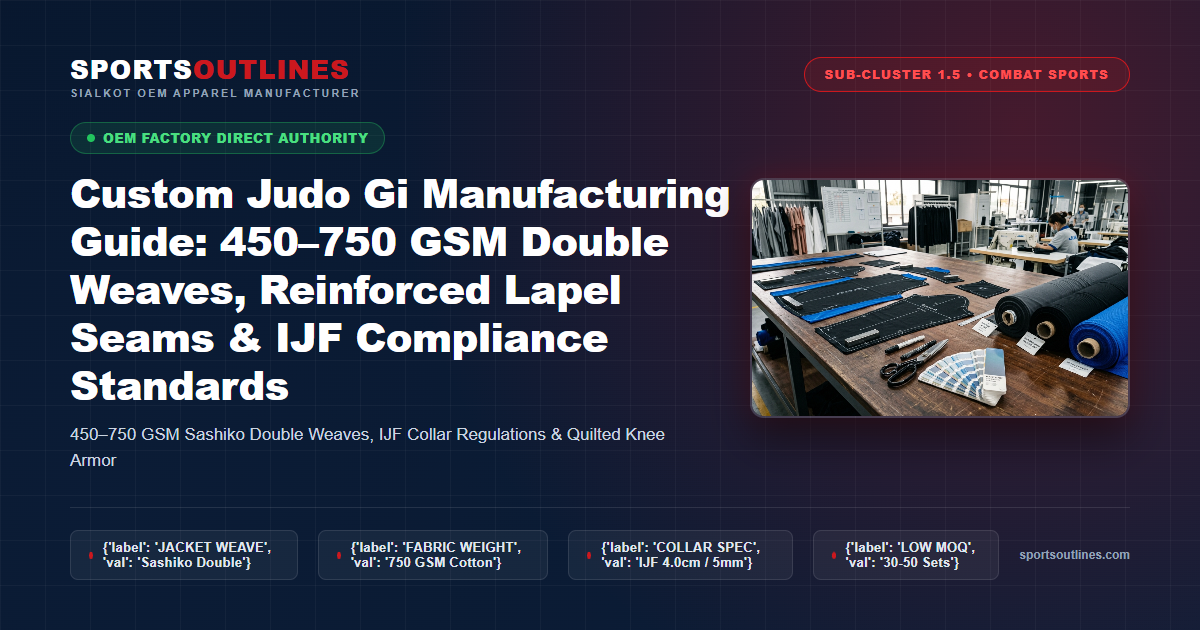
Manufacturing authentic competition-grade Judo Gis (Judogi) requires heavy industrial textile engineering built to withstand violent grip fighting (Kumi-kata), high-amplitude throws (Seoi-nage, Uchi-mata), and intense ground pins (Osaekomi-waza). A regulation Judogi features a dual-textile jacket construction: the upper chest and back are crafted from heavy 450 to 750 GSM Sashiko (rice-grain) double-weave or single-weave 100% cotton, while the lower skirt is woven from a flexible Hishisashi (diamond pattern) weave. The collar and lapel must adhere strictly to International Judo Federation (IJF) technical rules, mandating a maximum lapel width of 4.0 cm, maximum collar thickness of 5.0 mm (allowing official referee grip clearance measuring a minimum of 10 cm of sleeve diameter when arms are outstretched), and 4 to 5 parallel rows of reinforced stitching through dense cotton canvas interlining. The pants are tailored from 280 to 320 GSM heavy cotton twill or ripstop featuring dual-layer quilted knee reinforcements extending from mid-thigh down to the ankle hem. Factory direct low MOQ at our Sialkot facility starts at 30 to 50 uniform sets per design/colorway (available in traditional Bleached White and IJF Royal Blue) across international size codes (0/130 cm to 7/200 cm). Pre-production physical prototype samples cost $45 to $85 per custom set completed in 7 to 10 business days.
- Jacket Fabric Engineering: 450–550 GSM Single Weave (Club/Junior) vs. 650–750 GSM Heavy Double Weave (IJF Tournament Pro).
- Dual Weave Architecture: Upper Sashiko rice-grain weave joined seamlessly to lower Hishisashi diamond skirt weave.
- IJF Lapel Standards: Maximum 4.0 cm width, maximum 5.0 mm thickness, reinforced with high-density cotton canvas core.
- Tensile Breaking Strength: Exceeds 2,200 Newtons under ASTM D5034 testing, eliminating fabric tearing during explosive grip breaks.
- Knee Armor Reinforcement: Quilted dual-layer fabric panels double-topstitched from mid-thigh to lower hem.
- Factory Low MOQ: 30–50 complete Judogi sets per style with flexible height sizing (0 to 7).
- Physical Prototype Sampling: $45–$85 per custom set completed in 7–10 days (strict zero credit/refund policy).
- Direct Factory Sourcing: WhatsApp factory direct at +92 316 7932595 or sportsoutlines.com.
In Judo—the “Gentle Way” founded by Jigoro Kano in 1882—the Judogi is not merely athletic apparel; it is the physical medium through which kinetic energy, leverage, and fulcrum mechanics are applied. Every throw, sweep, choke (Shime-waza), and joint lock (Kansetsu-waza) relies on gripping the jacket lapel, sleeve cuff, or back belt.
For martial arts academy directors, Olympic national governing bodies, and combat sports brand founders in the USA, UK, Australia, and Germany, sourcing custom Judo Gis requires navigating complex textile engineering and strict regulatory frameworks. Off-the-shelf commercial gis frequently suffer from excessive post-wash shrinkage (shrinking 8%–12% after hot washing, rendering uniforms illegal during tournament weigh-ins), collars that are too thick or stiff (resulting in immediate disqualification by IJF Sokuteiki measuring gauges), weak seam stitching that rips under heavy grip stripping, and dye bleeding in blue competition uniforms.
At Sports Outlines in Sialkot, Pakistan, our heavy textile weaving looms and master combat artisans manufacture professional Judogis engineered for global dojos, university teams, and international tournament circuits. This comprehensive B2B manufacturing guide details the yarn spinning physics of Sashiko double weaves, IJF Sokuteiki compliance standards, shrinkage control via industrial sanforization, bespoke embroidery digitizing, and factory direct low MOQ economics.
1. Textile Engineering: Sashiko Rice-Grain Weave vs. Hishisashi Diamond Skirt
Unlike standard woven activewear fabrics, an authentic Judo jacket utilizes two distinct woven textile structures joined horizontally across the mid-torso:
The Biomechanical Physics of the Sashiko Rice-Grain Architecture
The iconic “rice-grain” texture of a Judogi is not decorative; it is a tactical defensive engineering feature. The Sashiko weave uses alternating warp floats that rise above the fabric surface in raised longitudinal ridges. When an opponent’s fingers dig in to secure a sleeve or lapel grip, the raised cotton ridges create high tactile friction that burns the opponent’s fingertips during explosive breaking maneuvers.
In our 750 GSM double-weave fabric, two independent layers of high-twist combed cotton yarn are woven simultaneously on shuttle looms and bound together with interior binder yarns. This multi-layered structure creates high structural stiffness. Under ASTM D5034 Grab Tensile testing, our double-weave fabric withstands over 2,200 Newtons of tensile pulling force without yarn slippage. When an opponent attempts to manipulate the lapel, the jacket resists deformation, maintaining the judoka’s upright posture and neutral center of gravity.
2. International Judo Federation (IJF) Sokuteiki Compliance Rules
At IJF sanctioned tournaments (World Championships, Grand Slams, Olympic Games), every judoka’s uniform is inspected before stepping onto the tatami using a specialized mechanical gauge known as the Sokuteiki. Violating these dimensional criteria results in immediate uniform disqualification:
The Critical Distinction: Judo Gi vs. BJJ Gi Lapel Construction
A frequent manufacturing error made by unspecialized factories is treating a Judo Gi like a Brazilian Jiu-Jitsu (BJJ) Gi. In BJJ, IBJJF rules permit collars with vulcanized synthetic EVA rubber foam cores that make the collar extremely thick and stiff to prevent chokes.
In Judo, EVA rubber lapel cores are strictly forbidden under IJF Article 3. A Judogi lapel must be constructed exclusively from 100% natural compressed cotton canvas filler. The collar must remain pliable enough for the referee to grip and verify flexibility with the Sokuteiki tool. At Sports Outlines, our Judo lapels use 4 layers of dense 380 GSM needle-punched cotton canvas stitched with 5 parallel rows of continuous chainstitching. This produces a collar that is ultra-durable yet 100% compliant with IJF flexibility and thickness rules.
3. Quilted Knee Armor & Reinforced Pant Tailoring
Judo groundwork (Ne-waza) and dropping throw techniques (such as Drop Seoi-nage) subject the knees to violent abrasive impact against rough tatami canvas mats. Standard martial arts pants wear through at the patella within months:
- Extended Quilted Knee Panels: We sew an entire second layer of 300 GSM cotton drill twill over the front pant legs, extending from 10 cm above the knee all the way down to the shin hem. The double layer is diamond-quilted with 15 mm grid stitch spacing to prevent bunching.
- Traditional Flat Cotton Drawcord Waist: While youth sizes can incorporate elastic, competition Judogi pants utilize a traditional unyielding flat woven cotton drawstring threaded through four heavy twill belt loops, anchoring the pants securely around the hips during violent hip throws.
- Double-Stitched Crotch Gusset: A diamond-shaped reinforcement gusset at the perineum is joined with 5-thread safety overlock stitching and topstitched with twin-needle chainstitching using Tex 70 bonded cotton-poly core thread.
4. Color Compliance: Bleached White vs. IJF Royal Blue Vat Dyeing
Judo competition recognizes exactly two uniform colors: pure White and Royal Blue (introduced in 1986 to facilitate clear television broadcasting and referee adjudication):
- Bleached White (Shiro): Raw cotton is bleached using hydrogen peroxide in a stabilized alkaline bath, achieving a clean optical CIE whiteness index of 135–145 without using chlorine bleaches that degrade cotton fiber tensile strength.
- IJF Royal Blue (Ao): Dyed with premium Indanthren vat dyes (Pantone 18-4051 TPX Royal Blue). Vat dyes penetrate the core of the heavy double-weave cotton fibers, achieving a Grade 5 color fastness to perspiration and washing. This guarantees zero blue dye transfer onto opponent white uniforms during sweaty tournament matches.
5. Private Label Customization: Embroidery, Back Numbers & Patches
Building a recognized martial arts brand requires sophisticated embroidery and federation-compliant emblem placement:
6. Standard Judo Gi Sizing Matrix (Numerical Scale vs. Metric Heights)
Judo uniforms use a standardized international height grading scale (from Size 000 up to Size 7):
7. Quality Assurance Protocols: Sanforization & AQL 2.5 Testing
Because a Judogi is made from heavy natural cotton, uncontrolled shrinkage is the number one cause of commercial customer returns. We prevent this through comprehensive industrial processing:
- Rotary Drum Sanforization: All Sashiko and Hishisashi cotton bolts undergo pressurized steam compaction (Sanforization) prior to pattern cutting. Washing shrinkage is strictly controlled below 2.0% in warp and 1.5% in weft, guaranteeing that a Size 4 Judogi remains a legal Size 4 even after 50 commercial laundry cycles.
- Sokuteiki Gauge Pre-Shipment Audit: Every sample from each production lot is measured with an authentic mechanical Sokuteiki tool. We verify that the collar is under 5.0 mm thick, lapel width is exactly 3.8–4.0 cm, and sleeve clearance exceeds 10 cm.
- Lapel Seam Pull Test (ASTM D1683): The jacket collar is placed under 1,800 Newtons of mechanical shear force. Zero seam separation or needle hole rupture is permitted.
- Conveyor Metal Detector Audit: 100% of finished Judogi sets pass through Hashima 9-point conveyor needle detection scanners to guarantee zero broken needle tips are trapped within the heavy multi-layered lapels.
Points of Measure (POM) Tolerances & Tensile Grip-Breaking Thresholds
In international Judo competition, equipment compliance is audited down to millimeter tolerances. Every production batch manufactured at Sports Outlines is subjected to strict Points of Measure (POM) verification:
8. Sourcing Economics: Unit Costs, Sampling Rules & Low Factory MOQ
At Sports Outlines, we remove the high volume barriers that prevent combat clubs and martial arts apparel brands from sourcing custom Judogis. We offer factory direct low MOQ starting at only 30 to 50 sets per style with mixed height size curves:
Sampling Protocol: $45–$85 Physical Prototypes in 7–10 Days
We mandate physical sample approval prior to bulk production. Physical prototypes cost $45 to $85 per custom uniform set. This fee covers digital embroidery digitizing, pattern drafting, precision laser cutting, heavy double-weave assembly, and Sokuteiki dimensional verification over 7 to 10 business days. We maintain a strict zero-refund and zero-credit policy on sample fees. Once approved, the physical prototype serves as the master inspection benchmark for bulk manufacturing.
Manufacture Custom Judo Gis with Low MOQ
Equip your dojo or launch your martial arts apparel brand with competition-ready Judo Gis engineered in Sialkot. From 750 GSM Sashiko double weaves to IJF-regulation cotton collars and quilted knee armor, we deliver world-class combat durability with 30–50 sets low MOQ and fast 7–10 days physical sampling.
9. Frequently Asked Questions (FAQ) — Custom Judo Gi Manufacturing
1. What is the difference between a Single Weave and Double Weave Judo Gi?
A Single Weave Judogi weighs between 450 and 550 GSM, making it lighter, softer, and more breathable for youth competitors and summer training. A Double Weave Judogi weighs 680 to 750 GSM and uses two interlocked fabric layers. It is significantly stiffer, thicker, and harder for opponents to grip, which is essential for national and international competition.
2. Can you use EVA rubber foam inside a Judo Gi collar like in BJJ?
No. International Judo Federation (IJF) regulations strictly prohibit synthetic rubber or EVA foam collar cores. A regulation Judogi collar must be made exclusively from compressed cotton canvas filler, allowing the collar to maintain a maximum thickness of 5.0 mm and pass the official Sokuteiki flexibility test.
3. How do you prevent heavy cotton Judo Gis from shrinking excessively?
All our raw Sashiko and Hishisashi cotton rolls undergo industrial high-pressure steam sanforization before pattern cutting. This pre-shrinks the fibers, keeping post-purchase washing shrinkage below 2.0% in warp and 1.5% in weft, preventing the sleeve cuffs from pulling back above legal limits.
4. What is your minimum order quantity (MOQ) for custom Judo Gis?
Our factory direct low MOQ is 30 to 50 uniform sets per style. You can split this low order volume across standard height sizes (Size 0 to Size 6) and can divide colors between traditional White and Royal Blue.
5. How much does a physical sample prototype cost, and what is the turnaround time?
A physical custom prototype sample costs $45 to $85 per uniform set depending on double-weave weight and embroidery specifications. Turnaround time for pattern drafting, weaving, embroidery, and assembly is 7 to 10 business days, followed by 4 to 6 business days for DHL/FedEx Express air delivery directly from Sialkot.
6. How do you prevent blue Judogis from bleeding color onto white mats and uniforms?
We dye our blue fabrics using premium Indanthren vat dyes (Pantone 18-4051 TPX). Unlike cheap direct dyes, vat dyes bond insolubly within the cotton polymer chains, achieving a Grade 5 color fastness rating that eliminates color rub-off during sweaty grappling exchanges.
7. Can you supply customized printed back numbers (Bibs) sewn directly onto jackets?
Yes. We produce official 30 cm x 30 cm sublimated canvas back numbers featuring competitor surnames, 3-letter country codes, and club sponsor graphics, stitched securely across the upper back according to IJF positioning rules.
Explore Related Combat Sports & Teamwear Manufacturing Guides:
Complete your martial arts collection with our factory guides on Custom BJJ Gis & Kimonos, Custom Taekwondo Doboks, or explore our Factory Sportswear Catalog.