Direct Manufacturer Answer: How to Manufacture Custom BJJ Gis & Kimonos
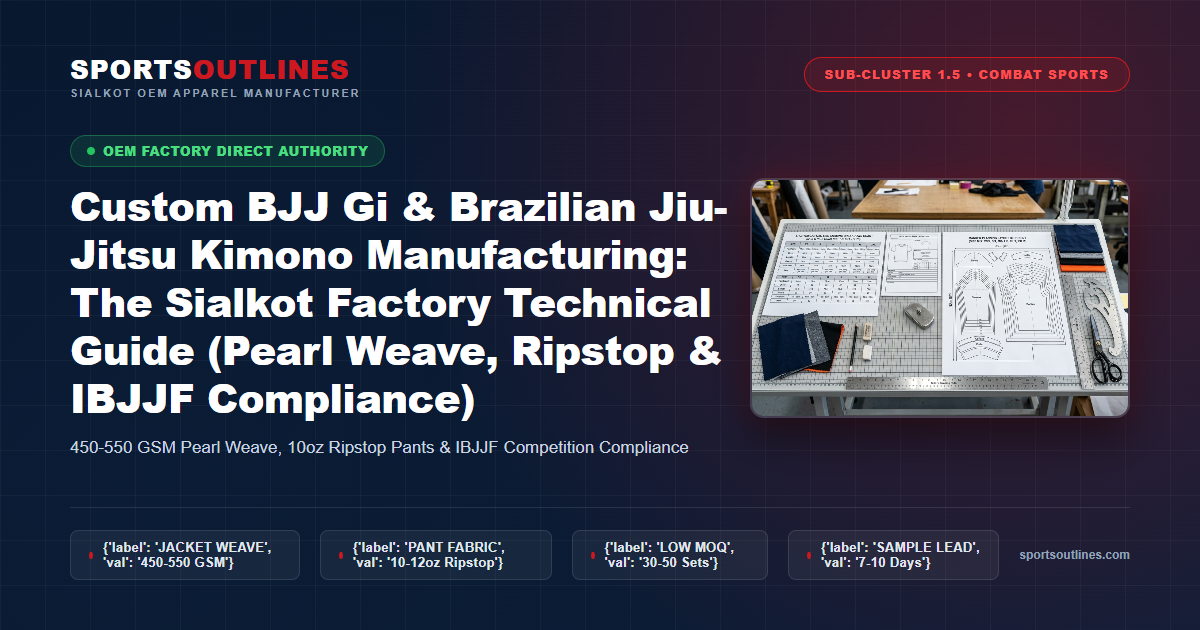
Manufacturing tournament-grade custom Brazilian Jiu-Jitsu (BJJ) gis requires strict adherence to international combat federation guidelines (IBJJF, UAEJJF, AJP) paired with heavy-duty textile engineering capable of absorbing relentless rotational grip friction and tensile pulling forces exceeding 700 Newtons. The gold-standard jacket silhouette is crafted from 450 to 550 GSM 100% cotton Pearl Weave (combining the lightweight comfort of single weave with the structural grip-breaking density of gold weave), featuring a one-piece continuous back panel without a center spine seam. Collars are engineered with an extruded vulcanized EVA closed-cell foam rubber core wrapped in 10oz canvas or ripstop, providing fast-drying anti-microbial resilience and rigid grip defense while maintaining IBJJF lapel limits (maximum 5 cm width, 1.3 cm thickness). Competition pants are cut from 10oz or 12oz crosshatch cotton-polyester Ripstop or heavy military drill canvas, reinforced with pearl-weave crotch gussets and double-layer quilted knee pads running from mid-thigh to the lower shin. Factory direct low MOQ at our Sialkot facility starts at 30 to 50 gi sets per style and colorway across adult (A0–A5) and female/youth size curves. Pre-production physical prototype samples cost $45 to $85 per gi completed in 7 to 10 business days.
- Jacket Fabric Options: 350 GSM Light Pearl Weave, 450 GSM Pro Pearl Weave (Industry Standard), 550 GSM Gold Weave, or 900 GSM Double Weave.
- Collar / Lapel Core: Extruded high-density EVA foam rubber core (odorless, mold-resistant, anti-bacterial, rapid drying).
- Pant Construction: 10oz / 12oz tear-proof Ripstop or 10oz Cotton Drill with 6-loop waist cord tunnel and pearl weave crotch gusset.
- Seam Reinforcement: Triple needle chain-stitching across all load points; 5-row edge tape stitched inside sleeve cuffs and skirt hem.
- Tournament Compliance: 100% engineered to IBJJF Uniform Guidelines (sleeve opening clearance, lapel geometry, patch placement zones).
- Factory Low MOQ: 30–50 sets per model/colorway with flexible size splitting (A0 to A5, F1 to F4, M0 to M4).
- Physical Prototype Sampling: $45–$85 per custom sample in 7–10 days (strict zero credit/refund policy).
- Direct Sialkot Sourcing: WhatsApp factory floor direct at +92 316 7932595 or sportsoutlines.com.
Brazilian Jiu-Jitsu is a combat discipline defined by microscopic leverage, structural pressure, and violent, relentless grip warfare. Unlike traditional karate or judo uniforms, a modern BJJ gi must endure continuous multi-directional pulling, dynamic choke mechanics, friction burns against tatami mats, and frequent commercial wash cycles without shrinking off-spec, tearing at the armpits, or warping its lapel.
For martial arts academy owners, tournament promoters, and fightwear brand founders in the USA, UK, Australia, and Germany, sourcing custom BJJ gis has historically been fraught with quality inconsistencies: jackets shrinking two sizes after three washes, collars losing their stiffness and developing foul bacterial odors, pants ripping along the crotch inseam during high-amplitude guard play, and athletes being disqualified at tournament weigh-ins due to illegal sleeve clearances.
At Sports Outlines in Sialkot, Pakistan—the undisputed global heartland of martial arts and heavy combat apparel craftsmanship—our specialized gi cut-and-sew workshops blend traditional shuttle and dobby weaving with modern vulcanized materials engineering. Whether you are building an ultra-durable 450 GSM academy uniform or an featherweight 350 GSM competition gi for elite tournament competitors, this comprehensive technical manufacturing guide explains the precise textile physics, lapel construction, ripstop pant geometry, IBJJF rulebook compliance, size grading, wholesale unit economics, and factory direct low MOQ sourcing needed to build a market-leading martial arts brand.
1. Textile Engineering: Decoding BJJ Kimono Weave Types & GSM Densities
The foundation of every Brazilian Jiu-Jitsu kimono is its cotton weave architecture. The weave determines the jacket’s weight, breathability, structural grip resistance, tensile breaking point, and retail price point. The table below details the five primary weave architectures engineered in our Sialkot weaving mills:
Why 450 GSM Pearl Weave Dominates 80% of Modern BJJ Brands
Pearl Weave is created by alternating fine spun cotton threads with heavier cords, creating elevated pearl-like beads across the exterior face of the fabric while maintaining a smooth, non-abrasive interior next to the athlete’s skin. This weave structure provides four crucial engineering benefits:
- Optimal Weigh-In Ratio: In IBJJF tournaments, athletes weigh in wearing their complete uniform, including belt. A 450 GSM Pearl Weave A2 jacket weighs approximately 0.95 kg (2.1 lbs). Paired with 10oz ripstop pants (0.45 kg), the entire gi weighs under 1.5 kg, preventing athletes from cutting unnecessary body mass to make weight.
- High Tensile Interlock: The micro-beaded pearl structure prevents thread slippage under lateral shearing force. When an opponent grips the lapel with two hands to execute a flying armbar or collar drag, the fabric distributes the load across thousands of interlocking yarns rather than distorting individual fibers.
- Controlled Pre-Shrinking: Untreated raw cotton can shrink between 8% to 12% in hot water washing. At Sports Outlines, all our pearl weave fabrics undergo specialized sanforization and steam pre-shrinking, reducing lifetime garment shrinkage to less than 2.0% under standard washing conditions.
- Zero-Seam Back Architecture: We cut our jackets from a single continuous bolt of fabric without a horizontal or vertical seam down the back. A center spine seam creates a painful pressure point when an athlete is playing guard on hard mats and introduces a catastrophic failure point under heavy stacking pressure.
2. Collar & Lapel Engineering: The Vulcanized EVA Foam Advantage
The collar (lapel) of a BJJ gi is the primary control lever in both offensive submissions and defensive posture management. In low-cost, amateur kimonos, factories still use compressed cotton canvas or cardboard-like paper filler inside the collar. These traditional fillers present severe liabilities: they absorb gallons of sweat, take 36 hours to dry, cultivate staph and ringworm bacteria, become floppy and soft after two months of training, and frequently warp into wavy, distorted ripples after machine washing.
At Sports Outlines, every custom BJJ kimono lapel is engineered with an advanced high-density vulcanized EVA (Ethylene Vinyl Acetate) closed-cell foam rubber core:
6-Row Precision Lapel Topstitching
The EVA core is secured inside the outer canvas wrapping using six parallel rows of high-tensile polyester core-spun thread running from the collar base to the skirt hem. This multi-row stitching prevents the foam core from shifting or bunching during aggressive collar chokes (Cross Collar, Bow and Arrow, Baseball Bat chokes). The collar edge is double-folded and bound with 1.5 cm heavy seam tape to prevent razor-sharp mat friction burns against the back of the athlete’s neck.
3. Competition Pants Architecture: 10oz Ripstop vs. 12oz Cotton Drill
BJJ pants endure extreme frictional wear against vinyl mats and massive shearing stresses during dynamic leg entanglements (De La Riva, Berimbolo, 50/50 guard). Choosing between ripstop and cotton drill determines the pants’ tactical feel:
A. 10oz Poly-Cotton Ripstop (65% Polyester / 35% Cotton)
Ripstop features a distinctive square crosshatch grid woven with reinforced nylon/polyester reinforcing yarns every 4 to 6 millimeters. If an athlete’s pant leg is punctured or torn by a fingernail or mat edge, the tear cannot propagate past the reinforced grid boundary. Ripstop pants are featherweight (weighing roughly 420–460 grams), dry exceptionally fast, resist sweat accumulation, and maintain a slick exterior that makes pant-grip control exceedingly difficult for opponents.
B. 10oz / 12oz 100% Cotton Canvas Drill
Cotton drill is a traditional twill-weave textile with diagonal parallel ribs. It offers a heavier, softer, more substantial hand-feel that many traditional academies prefer. While slightly heavier when saturated with perspiration, cotton drill conforms naturally to the athlete’s legs and provides superior thermal breathability during winter training sessions.
C. High-Stress Pant Reinforcements & Hardware
Regardless of fabric choice, all Sports Outlines BJJ pants incorporate five mandatory engineering reinforcements:
- Pearl Weave Crotch Gusset: Instead of using standard pant fabric in the crotch, we insert a specialized diamond or curved gusset made from 450 GSM Pearl Weave jacket material. This heavy weave absorbs extreme shear stress during splits, high guard passes, and inverted rolling.
- Dual-Layer Quilted Knee Reinforcement: Double-layer fabric runs from 10 cm above the knee all the way down to the shin hem, anchored by horizontal or cross-quilted stitching. This prevents knee blowouts caused by constant mat pressure and shooting takedowns.
- 6-Point Loop Waistband Tunnel: Cheap pants use 2 or 4 thin belt loops that rip off the waistband within weeks. We install 6 heavy-duty bartacked belt loops made from matching folded ripstop.
- Round Bungee Drawstring Cord: We eliminate flat cotton drawstrings (which tie into impossible knots when soaked in sweat) in favor of high-elastic round tubular polyester bungee drawstrings with sealed aglets.
- Quadruple-Stitched Ankle Cuffs: The lower hem of each pant leg is reinforced with four rows of heavy topstitching and backed by woven interior seam tape to resist pistol-grip pulling.
4. IBJJF Uniform Rulebook: Precision Geometry & Measurement Compliance
In international tournaments sanctioned by the International Brazilian Jiu-Jitsu Federation (IBJJF), the UAEJJF, or AJP, athletes undergo a rigorous pre-fight gi check using official measuring devices (the Kurape measuring tool). A discrepancy of even 5 millimeters can result in immediate disqualification. Our factory patterns are cut and graded strictly according to IBJJF Rule Article 8.1:
Approved Patch & Embroidery Zones
The IBJJF strictly defines allowable zones for brand logos, academy patches, and sponsor embroidery. Patches placed in illegal locations (such as across the lapel fold, too close to the cuff opening, or below the jacket skirt hem) will result in the athlete being ordered to cut the patch off with scissors at the bullpen or face disqualification. We supply CAD templates with shaded IBJJF-safe embroidery zones for the upper arms, chest emblem, upper back, lower back skirt, and front thigh.
5. Private Label Branding & Embellishment Techniques for BJJ Kimonos
A successful martial arts apparel brand requires high-end, tactile branding that stands out on the mats. Our Sialkot facility provides five advanced private label embellishment techniques engineered specifically for heavy cotton weaves:
A. Direct High-Density Japanese Tajima Embroidery
Embroidered directly into the 450 GSM pearl weave jacket using multi-head Tajima embroidery machinery. We utilize 100% trilobal polyester thread with high tensile elongation, ensuring the embroidery never snaps when the gi stretches under load. Backings are constructed with soft tear-away non-woven interlinings to prevent chafing against the athlete’s shoulders.
B. High-Definition Damask Woven Patches & Merrowed Borders
Woven on high-speed Jacquard looms with ultra-fine 50-denier polyester threads to reproduce intricate typography, mascot illustrations, and crests. All patches are finished with a heavy satin merrowed overlock border and double-row topstitched flush to the kimono body, eliminating loose edges that opponents can snag fingers on.
C. Sublimated Rashguard Neck & Shoulder Yoke Linings
To elevate your brand into the luxury tier, we can line the interior upper shoulder yoke with a 220 GSM sublimated 88/12 poly-spandex rashguard lining. This features photorealistic, full-color graphic artwork printed with Italian Kiian inks. The slick rashguard lining provides instant skin glide over the trapezius muscles and wicks moisture away from the athlete’s neck.
D. Custom Woven Seam Tape Reinforcement
We produce 15 mm and 20 mm branded woven jacquard ribbon stitched along the interior jacket skirt hem, sleeve cuffs, and pant cuffs. This tape reinforces cut raw edges against fraying while acting as a continuous, subtle hallmark of craftsmanship.
6. Anatomical Size Grading: Adult Men, Women & Youth Matrices
BJJ sizing does not follow standard Small, Medium, Large conventions. Practitioners require precise alphanumeric sizing based on height-to-weight ratios. The table below represents our standard international size grading matrix:
Note: We also engineer specialized “Fitted” sub-cuts, including “L” (Long/Slim) cuts (e.g., A1L, A2L) with extended wingspans and narrower chest girths for lanky guard players, and “H” (Heavy/Husky) cuts (e.g., A2H) for broad, stocky athletes. Dedicated female cuts (F1–F4) feature narrower shoulder widths, curved hip contours, and shorter torso lengths.
7. Wholesale Unit Economics, Sampling Protocols & Low MOQ Sourcing
In traditional combat sports manufacturing hubs, factories demand minimum production runs of 300 to 500 gis per colorway—imposing a massive capital barrier of $12,000 to $20,000 on emerging martial arts academies and startup fightwear brands. At Sports Outlines, we empower growing brands by providing true low MOQ production starting at 30 to 50 complete gi sets per style.
Rigorous Prototyping Policy: Zero Ambiguity
To protect both the buyer and our production floor, we mandate physical sample creation prior to bulk release. Physical prototypes are billed at $45 to $85 per custom piece/set (depending on weave weight, embroidery stitch count, and interior rashguard printing). This fee covers physical material allocation, custom Tajima embroidery digitizing cards, laser cutting setups, and dedicated bench assembly over 7 to 10 business days. We maintain a strict zero-refund and zero-credit policy on sample fees. Once approved, the physical sample serves as the golden master standard for our ISO 2859-1 AQL 2.5 final inspection.
Ready to Manufacture Custom BJJ Gis with Low Factory MOQ?
Connect directly with our master combat sports patternmakers in Sialkot. From 450 GSM Pearl Weave kimonos to tear-proof ripstop pants and IBJJF-compliant embroideries, we bring your fightwear brand vision to life with 30–50 sets low MOQ and rapid 7–10 days physical sampling.
8. Frequently Asked Questions (FAQ) — BJJ Gi Manufacturing
1. What is the difference between Single Weave, Pearl Weave, and Gold Weave BJJ gis?
Single Weave (350–400 GSM) is lightweight and affordable but softer for opponents to grip and prone to stretching over time. Gold Weave (500–550 GSM) is extremely durable with a ladder texture but stretches when soaked with sweat. Pearl Weave (450–500 GSM) is the modern industry standard, utilizing micro-beaded interlocking cotton yarns that deliver maximum tensile strength, minimal post-wash shrinkage, and optimal weight for IBJJF competition weigh-ins.
2. Why does Sports Outlines use EVA foam collars instead of traditional cotton canvas filling?
Traditional cotton canvas fillers absorb sweat, take over 24 hours to dry, cultivate staph and ringworm bacteria, and become floppy and distorted after washing. Our vulcanized EVA closed-cell foam core absorbs zero moisture, dries in under two hours, remains completely odor- and mildew-resistant, and maintains strict IBJJF-compliant lapel stiffness across years of intense training.
3. Are Sports Outlines custom BJJ gis legal for IBJJF and UAEJJF tournaments?
Yes. All our competition kimono patterns are engineered strictly to IBJJF Rule Article 8.1 standards. This includes exact collar dimensions (max 5 cm width, max 1.3 cm thickness), mandatory 7.0+ cm cuff opening clearance, proper skirt overlap, approved solid tournament colors (White, Royal Blue, Black), and strict adherence to designated embroidery and patch placement zones.
4. What is your minimum order quantity (MOQ) and size breakdown for custom BJJ gis?
Our factory direct low MOQ is 30 to 50 complete gi sets per style and colorway. Within this low order volume, you can split your production run across standard adult sizing (A0, A1, A2, A3, A4, A5), fitted sizes (A1L, A2L), female cuts (F1–F4), or youth sizes (M0–M4) to perfectly align with your academy’s demographic profile.
5. How much does a physical sample cost, and what is the turnaround time?
A physical custom prototype sample costs $45 to $85 per set depending on weave weight, embroidery complexity, and rashguard interior linings. Turnaround time for sample cutting, embroidery, and assembly is 7 to 10 business days, followed by 4 to 6 business days for DHL/FedEx Express air delivery directly from Sialkot to your door.
Explore Related Combat Sports & Teamwear Manufacturing Guides:
Looking for complementary combat sports apparel? Read our factory guides on Custom Compression Base Layers, browse our Factory Sportswear Catalog, or explore international shipping to the USA, UK, and Australia.