Direct Manufacturer Answer: How to Manufacture Custom Cricket Trousers
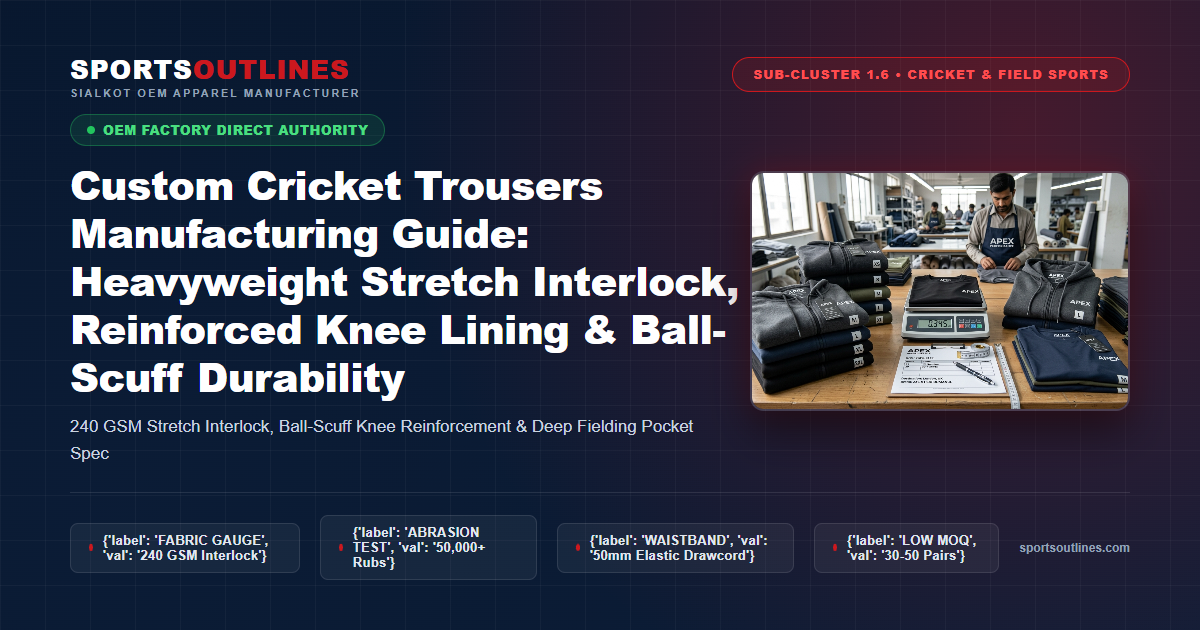
Manufacturing professional custom cricket trousers demands heavy-duty textile engineering capable of withstanding aggressive boundary diving stops, repetitive ball-shining friction, and explosive sliding on abrasive dry turf without tearing, fraying, or developing permanent green grass stains. Elite cricket trousers are constructed from 235 to 250 GSM heavy-gauge double-knit interlock or stretch-twill micro-polyester (92% micro-filament polyester / 8% elastane-spandex) treated with hydrophilic moisture management and fluorocarbon-free soil-release finishes (3M Scotchgard or Teflon fabric protector). To eliminate fabric blowout during high-velocity dives, the garment incorporates internal dual-ply knee reinforcements extending from mid-thigh to upper shin and an ergonomic diamond crotch gusset that disperses shear loads during deep wicketkeeping crouches and low slips fielding. The waist architecture features a 50 mm heavy-tension elastic waistband reinforced with an internal flat drawcord and an integrated continuous silicone wave shirt-gripper track to prevent cricket match shirts from pulling untucked during fast-bowling deliveries. Leg openings offer either a tailored straight-leg cuff or an integrated 18 cm concealed ankle zipper with fabric guard to facilitate effortless dressing over bulky batting pads. Factory direct low MOQ at our Sialkot facility starts at 30 to 50 pairs per design with mixed sizing curves from Youth YS to Adult 4XL. Pre-production physical prototype samples cost $45 to $85 per custom pair completed in 7 to 10 business days.
- Fabric Construction: 240 GSM Heavyweight Double-Knit Stretch Interlock (92/8 Poly-Elastane) with stain-resistant coating.
- Abrasion Resistance: Internal dual-layer knee scuff lining tested to withstand 50,000+ Martindale friction cycles.
- Waistband Mechanics: 50 mm high-retention elastic with internal flat drawcord and silicone wave shirt-grip lining.
- Pocket Engineering: Dual deep angled side fielding pockets (22 cm internal depth) with reinforced bar-tacked corners.
- Ankle Architecture: Classic open-hem tailored cut or optional 18 cm concealed side ankle zippers for pad clearance.
- Factory Low MOQ: 30–50 pairs per team order with mixed adult (XS–4XL) and junior (YS–YXL) size grading.
- Physical Prototype Sampling: $45–$85 per custom pair in 7–10 days (strict zero credit/refund policy).
- Direct Sourcing Communication: WhatsApp factory direct at +92 316 7932595 or sportsoutlines.com.
In modern cricket, the trousers endure far more mechanical abuse than any other piece of player apparel. A match fielder slides across hard, baked outfields at speeds exceeding 20 kilometers per hour to cut off boundary boundaries, wicketkeepers crouch into deep knee flexion for hundreds of deliveries in a single afternoon, and fast bowlers vigorously buff the cricket ball against their outer thigh seam thousands of times to maintain shine for reverse swing.
For cricket club treasurers, school athletic directors, equipment distributors, and sportswear brand founders across the UK, Australia, the USA, and Canada, sourcing cricket trousers from generic garment vendors results in persistent quality failures: flimsy 160 GSM jogging-pant fabrics that wear through at the knees after two matches, waistbands that sag down under the weight of fielding balls in pockets, permanent brown turf stains that resist detergent, and awkward cuts that catch awkwardly on external batting pads.
At Sports Outlines in Sialkot, Pakistan, our specialized combat and cricket tailoring workshops engineer high-durability match trousers for elite international clubs, domestic premier leagues, and private labels. This comprehensive B2B technical guide explains the textile physics of 240 GSM stretch interlock, internal knee reinforcement architecture, silicone waistband shirt retention, stain-release chemistry, sizing matrices, and factory direct low MOQ economics.
1. Textile Engineering: 240 GSM Stretch Interlock vs. 180 GSM Trackpant Knits
A cricket trouser fabric must deliver two opposing structural properties: it must be thick and dense enough to provide 100% opacity and abrasion protection against ground friction, yet flexible enough to allow a wicketkeeper or slips fielder to drop into a full lateral split without seam tension. Standard 160–180 GSM trackpant polyesters fail because they lack the yarn density to survive turf abrasion:
At Sports Outlines, we weave our cricket trousers from 235 to 250 GSM heavy circular double-knit interlock, blended with 92% high-tenacity micro-polyester and 8% DuPont elastane-spandex. This composition gives the trouser genuine 4-way mechanical stretch (over 45% warp elongation with 97% elastic recovery), allowing complete freedom of movement while eliminating bagging at the knees:
2. Anatomical Reinforcement: Internal Knee Lining & Diamond Crotch Gusset
Fielding trousers fail at two predictable anatomical failure points: the knee caps and the crotch junction. When an outfielder slides on their knees to scoop a boundary ball, the surface friction heat instantly reaches over 80°C, which causes single-layer synthetic polyester to melt and tear.
Our engineering team builds two structural reinforcements into every pair of custom cricket trousers:
- Internal Dual-Ply Knee Lining: We stitch an internal protective floating liner crafted from high-density 180 GSM micro-twill across the interior of both knee panels, extending 24 cm vertically from mid-thigh down past the tibial tuberosity. When a player dives, the exterior fabric slides smoothly against the internal liner, absorbing and dispersing the friction heat rather than abrading through to the player’s bare skin.
- Continuous Diamond Inseam Crotch Gusset: In standard casual pants, four seams intersect at a single 90-degree central cross point directly beneath the groin. When a wicketkeeper drops into a full squat or a slips fielder stretches laterally, this focal point bears enormous shear stress that blows the seam apart. We insert an elongated diamond-shaped gusset extending 30 cm along the inner thighs, redistributing tensile load along parallel seams and completely eliminating crotch blowout.
- Reinforced Ball-Shining Thigh Panels: For fast-bowling squads, we offer optional reinforced exterior side panels treated with anti-pilling high-twist yarns, allowing bowlers to polish the red or white leather cricket ball vigorously without wearing holes into the trouser fabric.
3. Waistband Engineering: High-Tension Elastic, Shirt-Gripper Silicone & Drawcords
Nothing looks more unkempt on a cricket pitch than a player whose match shirt constantly pulls untucked from their waistband during every delivery. In multi-day cricket, maintaining an immaculate, tucked-in uniform is a mandatory standard of professional decorum:
At Sports Outlines, we build our trouser waistbands with a specialized triple-lock retention architecture:
- 50 mm Heavy-Tension Knit Jacquard Elastic: The inner core features a 50 mm (2.0 inch) wide high-modulus elastic band with heat-set cross-rubber filaments that resist curling or folding over when an athlete bends forward at the crease.
- Continuous Silicone Wave Shirt-Gripper Strip: We thermally vulcanize dual continuous tracks of 4 mm wave-patterned silicone gel along the inside circumference of the waistband. This high-friction silicone track anchors firmly against the bottom of the player’s cricket polo, preventing the shirt from riding up or pulling untucked during aggressive bowling actions or diving stops.
- Internal Tunnel Flat Drawcord with Bar-Tacked Eyelets: Running through an internal casing is a 12 mm flat-woven polyester drawcord with metal aglets and reinforced eyelet exits, allowing players to cinch the trousers securely to their exact comfort preference without uncomfortable exterior bunching.
4. Pocket Architecture & Ankle Hem Configurations
Cricket players have unique pocket requirements: outfields carry reserve cricket balls, bowlers pocket sweat towels and grip cloths, and umpires store match counter clickers. Standard shallow pockets spill their contents as soon as an athlete sprints:
5. Quality Assurance Protocols: Laboratory Testing & Stain Resistance
Every production run of cricket trousers at Sports Outlines undergoes rigorous laboratory benchmarking to guarantee long-term durability:
6. Points of Measure (POM) Quality Tolerances & Sizing Matrix
Our standardized cricket trouser sizing matrix covers Junior (YS–YXL) and Adult (XS–4XL) athletes, engineered to accommodate athletic protectors and batting inner guards:
Points of Measure (POM) Manufacturing Tolerances
Every completed trouser lot is audited against strict millimeter-level Point of Measure (POM) tolerance windows:
7. Sourcing Economics: Unit Costs, Sampling Rules & Low Factory MOQ
At Sports Outlines, we remove the multi-hundred unit minimum barriers typical of traditional overseas manufacturers. We offer factory direct low MOQ starting at only 30 to 50 pairs per style with split sizing across adult and youth matrices:
Physical Prototype Sampling: $45–$85 in 7–10 Days
Before cutting bulk club orders, we build a physical pre-production prototype sample for your hands-on evaluation. Physical prototype samples cost $45 to $85 per custom pair. This fee covers digital CAD pattern drafting, specialized double-knee assembly, silicone wave waistband printing, precision laser cutting, and laboratory quality testing over 7 to 10 business days. We maintain a firm zero-refund and zero-credit policy on sample fees. Once approved, the prototype becomes the immutable golden standard for the entire production run.
Pre-Shipment Bulk Packaging, Individual Barcoding & Carton Consolidation
Following final inline quality inspection, every finished pair of custom cricket trousers undergoes steam tunnel pressing at 145°C to relax interlock fibers and set sharp creased lines. Trousers are folded according to standardized international teamwear specs, fitted with protective tissue lining between the silicone waistband tracks to avoid contact sticking, and sealed into individual 40-micron recyclable frosted polybags with custom branded warning tags and EAN-13 barcodes. Team orders are packed into 5-ply export master cartons (50 pairs per carton, gross weight under 18 kg) with desiccating silica gel sachets to protect moisture management coatings during transoceanic transit to the UK, Australia, and North America.
Manufacture Custom Cricket Trousers & Pants
Equip your cricket club, school, or teamwear brand with heavy-duty cricket trousers engineered in Sialkot. Featuring 240 GSM stretch interlock, dual-ply knee lining, silicone shirt-grip waistbands, and deep fielding pockets, we offer 30–50 pairs low MOQ and fast 7–10 days physical sampling.
8. Frequently Asked Questions (FAQ) — Custom Cricket Trousers Manufacturing
1. What is the ideal fabric GSM weight for cricket match trousers?
The ideal weight is 235 to 250 GSM heavy circular double-knit interlock or stretch-twill polyester with 8% elastane. This weight provides complete squat opacity, blocks grass friction burns, and prevents rapid tearing when diving on firm turf.
2. How does the internal knee lining prevent fabric blowout during slides?
We stitch an internal floating 180 GSM micro-twill panel beneath both knees. When an outfielder dives, friction heat and abrasive ground force are absorbed between the two fabric layers rather than grinding through to bare skin, doubling trouser wear life.
3. How do you prevent cricket shirts from untucking during play?
Our waistband incorporates a dual continuous track of wave-patterned silicone gel vulcanized along the interior lining. This silicone gripper provides friction retention against the cricket polo hem, locking the shirt inside the trousers through bowling deliveries and dives.
4. Can you manufacture colored trousers for T20 leagues as well as traditional whites?
Yes. We produce traditional cream flannels, optic white tournament trousers, and full all-over sublimated colored trousers featuring custom team gradients, side leg stripe accents, and sponsor logos for T20 franchise tournaments.
5. What is the minimum order quantity (MOQ) for custom cricket trousers?
Our factory direct low MOQ is 30 to 50 pairs per style. You can split this volume across adult (XS–4XL) and youth (YS–YXL) size rosters with customized waist and inseam length combinations.
6. How much does a physical sample prototype cost, and what is the turnaround time?
A physical custom prototype sample costs $45 to $85 per pair. Manufacturing turnaround time is 7 to 10 business days for CAD pattern cutting, double-knee reinforcement, silicone waistband application, and assembly, followed by 4 to 6 business days for air express delivery from Sialkot.
7. Can ankle zippers be added to facilitate dressing over batting pads?
Yes. We offer optional 18 cm concealed side ankle zippers with protective fabric under-plackets. This allows batsmen and wicketkeepers to pull trousers on and off over their cricket footwear and batting pads without difficulty.
8. How do you prevent cricket trousers from tearing at the crotch?
We integrate an elongated diamond crotch gusset joined with 5-thread high-tensile safety overlock stitching. This eliminates the standard 4-way cross seam, redistributing tension across parallel inner thigh seams during deep wicketkeeping crouches and lunges.
9. Do the trousers feature soil and grass stain release treatments?
Yes. Fabrics undergo a fluorocarbon-free Teflon stain-release finishing bath, achieving an AATCC 130 rating of Grade 4.5/5.0. This prevents turf chlorophyll and red leather cricket ball polish from bonding permanently into the polyester fibers.
10. How deep are the side fielding pockets?
Our side pockets feature an extra-deep 22.0 cm internal bag engineered from durable micro-mesh, with reinforced triangular bar-tacked corners. They securely hold 156g cricket balls, sweatbands, and fielding counters without spilling out during sprints.
Explore Related Cricket & Teamwear Manufacturing Guides:
Complete your cricket kit with our factory guides on Custom Cricket Whites, Custom T20 Cricket Jerseys, or browse our Factory Sportswear Catalog.