Direct Manufacturer Answer: How to Manufacture Custom Compression Running Tights
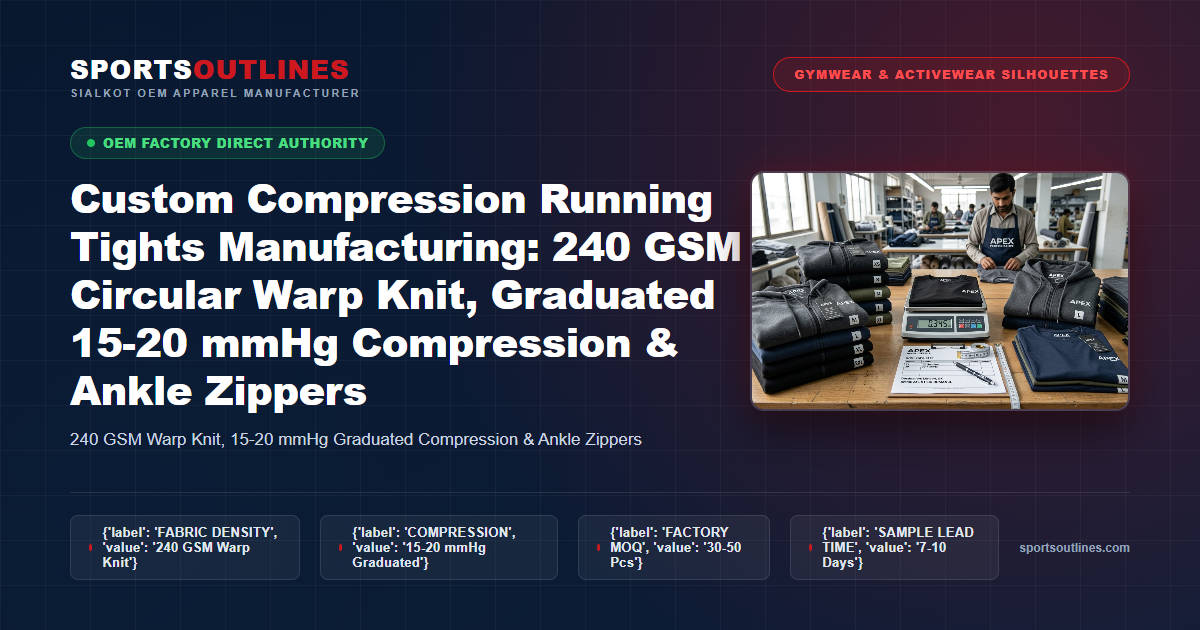
Manufacturing medical-grade and high-performance athletic compression running tights requires calibrating graduated elastane pressure gradients across the lower extremities combined with friction-free aerodynamic cut-and-sew patterning. True athletic compression differs fundamentally from standard tight gym leggings: rather than applying uniform constrictive pressure, pro running tights deliver Class 1 graduated compression (15 to 20 mmHg pressure at the ankle, de-escalating to 12–15 mmHg at the mid-calf, and 8–10 mmHg across the quadriceps) to accelerate venous blood return toward the heart, reduce exercise-induced muscle oscillation, and clear lactic acid. This physiological performance is achieved by knitting 230 to 250 GSM warp-knit tricot or 28-gauge circular interlock from 72% High-Tenacity Micro-Nylon and 28% DuPont Lycra Power elastane. Aerodynamic running features include semi-autolock YKK ankle zippers (15 cm length) backed with interior soft protective plackets that prevent zipper teeth from scratching the Achilles tendon during foot strikes, and continuous 3M Scotchlite 550 cd/lux reflective chevron tape along the lateral calf for 360-degree night visibility. The internal waistband incorporates a flat braided continuous drawcord with reinforced embroidered buttonholes and an envelope-closure moisture-shield zippered lumbar pocket for car keys and energy gels. Seam construction utilizes Yamato 4-needle 6-thread flatlock stitching (ISO 607) engineered with 130% elastic stretch to eliminate stride restriction. Direct OEM/ODM factory production at Sports Outlines in Sialkot, Pakistan, starts at a low MOQ of 30 to 50 pairs per colorway with mixed men’s and women’s sizing (XS to 3XL). Custom physical pre-production prototype samples cost $45 to $85 per piece in 7 to 10 business days with strict zero sample credit or refund policies.
- Compression Standard: Certified graduated 15–20 mmHg ankle-to-thigh gradient (BS 6612).
- Textile Science: 240 GSM 72/28 Micro-Nylon/Lycra Power warp-knit interlock.
- Ankle Entry System: 15 cm YKK semi-autolock ankle zips with protective anti-chafe plackets.
- Night Runner Safety: 3M Scotchlite 550 cd/lux reflective calf and thigh accents (EN ISO 20471).
- Lumbar Cargo Pocket: Sweat-proof membrane zippered rear waistband pocket for phone/keys.
- Seam Architecture: 4-needle 6-thread flatlock seaming with bulked micro-filament threads.
- Low Factory MOQ: 30–50 pairs per style/colorway with mixed men’s & women’s grading.
- Physical Prototyping: $45–$85 per custom piece in 7–10 days (strict zero credit/refund policy).
- Direct Sourcing Communication: WhatsApp factory direct at +92 316 7932595 or sportsoutlines.com.
In distance running, trail ultramarathons, and track sprinting, high-performance compression tights are not a fashion accessory—they are a physiological performance enhancer.
During a 26.2-mile marathon or 100-mile ultramarathon, each foot strike generates ground reaction forces equal to two to three times the runner’s body weight. This shock wave travels up through the calcaneus, calf complex (gastrocnemius and soleus), and quadriceps, causing microscopic muscular oscillation and myofibrillar tears. Generic fashion leggings provide passive skin coverage but zero oscillation dampening; under sweat saturation, they stretch out, sag around the knees, and create debilitating friction chafing along the groin.
True athletic compression wear utilizes calibrated graduated pressure gradients that mechanical engineers measure in millimeters of mercury (mmHg). By exerting the highest compressive force at the lower ankle and progressively reducing tension up the leg, compression tights act as an external muscular pump. They accelerate venotonic blood return back toward the cardiopulmonary system, reducing distal pooling, speeding lactic acid flushing, and lowering perceived exertion during endurance efforts.
For running apparel brands, marathon merchandise lines, track clubs, and triathlon labels across the United States, United Kingdom, Canada, Australia, and Germany, producing legitimate 15–20 mmHg graduated compression tights requires partnering with an OEM factory that understands technical yarn engineering and anatomical pattern grading.
At Sports Outlines in Sialkot, Pakistan, our specialized sportswear facility manufactures technical compression bottoms, running tights, and endurance racing speedsuits. This comprehensive manufacturing guide covers graduated pressure physics, 240 GSM warp-knit textiles, ankle zipper integration, 3M Scotchlite reflective application, ISO/BS testing standards, and low MOQ factory sourcing.
1. Biomechanical Compression Physics: Graduated 15–20 mmHg Gradient
Medical and athletic compression is classified into distinct pressure classes established by the British Standard Institution (BS 6612) and German RAL-GZ 387 medical guidelines. Standard athletic running tights operate within Class 1 (15 to 21 mmHg):
A. The Graduated Hydrostatic Pressure Column
If a pair of tights exerts identical pressure at the thigh as at the ankle, it acts as a tourniquet, impeding blood flow and increasing peripheral pooling. In contrast, graduated compression requires a strict geometric pressure differential:
- Distal Zone (Ankle – 100% Pressure): 18 to 20 mmHg pressure exerted immediately superior to the bimalleolar line. This narrows the deep calf veins, increasing venous flow velocity.
- Medial Zone (Calf – 70% Pressure): 13 to 15 mmHg pressure over the gastrocnemius belly. This stabilizes the calf muscle bundle, reducing vertical oscillation shock by up to 32% during foot strikes.
- Proximal Zone (Thigh – 50% Pressure): 9 to 11 mmHg pressure around the lower and mid-quadriceps. This gently guides blood back into the femoral venous return vessels without restricting hip extension.
B. Textile Architecture: 240 GSM Warp-Knit Tricot vs. Weft Interlock
While yoga leggings utilize circular weft interlock for multi-directional stretch softness, compression tights require Warp-Knit Tricot machines (28 to 32 gauge). In warp knitting, yarns zigzag along the length of the fabric. This creates a high-tenacity, run-resistant structure with an asymmetric stretch ratio: controlled longitudinal stretch (65%) combined with high-modulus lateral compression (110%). Spun from 72% High-Tenacity Micro-Nylon and 28% DuPont Lycra Power elastane, this fabric generates firm, consistent pressure that never bags out even after 50 miles of continuous running.
2. Ankle Zipper Integration: YKK Semi-Autolock with Anti-Chafe Guard
Because genuine compression tights feature an extremely narrow ankle circumference (measuring just 18 to 20 cm relaxed) to deliver 18 mmHg pressure, pulling the garment over the heel of the foot without an entry system is nearly impossible and risks over-stretching the cuff seams. Ankle zippers are mandatory on elite running tights.
However, poorly engineered zippers present severe athlete pain points: exposed metal pulls jingle and unzip during running, while raw zipper teeth scrape painful gouges into the Achilles tendon. Over a 30-kilometer training run, repetitive contact between the stiff zipper slider and the dynamic calcaneal tendon produces acute friction inflammation, often mistaken by runners for tendinitis.
Sports Outlines solves this through Pro Runner Ankle Zipper Engineering:
- YKK ® #3 Semi-Autolock Sliders: We utilize genuine YKK coil zippers with semi-autolock sliders. When the pull-tab is pressed flat against the zipper tape, the internal pin locks into the coil, preventing accidental unzipping even during high-cadence 200 SPM sprinting.
- Full-Length Internal Protective Placket: A continuous 25mm-wide fabric placket made from soft brushed micro-interlock sits directly behind the zipper coils. This creates an impenetrable barrier that keeps the zipper teeth 100% isolated from the runner’s skin and socks.
- Zipper Garage (Bottom Housing): The bottom termination features a folded fabric garage that covers the slider pull, preventing it from catching on trail brush, shoe laces, or timing chips.
- Offset Lateral Placement: Rather than placing the zipper directly over the Achilles tendon where heel collar friction is highest, we shift the zipper 3.5 cm forward onto the lateral malleolus seam for zero-rub comfort.
- Crosswise Seam Bonding: The zipper insertion seam is backed with thermo-polyurethane reinforcement film that stabilizes the warp knit from fraying under high cross-axial entry tension when athletes force their heels through the opening.
3. Lumbar Storage, Drawcords & Night Reflective Safety
Marathoners and road runners train at 5:00 AM and in darkness through autumn and winter. Functional safety and cargo storage are non-negotiable requirements for commercial product success.
When carrying smartphones (weighing upwards of 200 grams) and nutrition gels during a long run, traditional leg pockets can alter stride symmetry. Placing cargo on the lateral thigh adds rotational inertia to the pendulum swing of the leg, slightly increasing hip adductor fatigue over high-mileage runs. To eliminate this metabolic penalty, elite marathoners prefer center-back lumbar storage. The sacral center of gravity experiences the lowest acceleration displacement of any point on the runner’s torso, meaning cargo stored in the rear waistband remains virtually motionless.
- Sweat-Proof Zippered Lumbar Pocket: Integrated into the rear waistband center, this horizontal pocket features an invisible YKK reverse-coil zip and is lined on the skin side with a waterproof TPU barrier membrane. This keeps moisture from body sweat from ruining car key fobs, AirPods, or folded currency during long rain runs.
- Dual Pass-Through Tunnel Loops: On trail running models, the rear waistband incorporates elasticized dual tunnel loops engineered to carry folded lightweight carbon trekking poles or a packed windbreaker shell without bounce.
- Internal Continuous Drawcord: To prevent the tights from sliding downward under heavy sweat load or when carrying cargo, the waistband features a continuous flat-braided non-stretch drawcord routed through reinforced interior eyelets. The continuous loop design ensures the cord cannot pull through or disappear inside the waistband casing during washing.
- 3M ™ Scotchlite 550 cd/lux Reflective Graphics: We apply high-index micro-prismatic retro-reflective transfer tape along the rear calves and thighs. Reflective chevron dashes return light directly back to automobile drivers from distances up to 150 meters, certified to international high-visibility safety standards (EN ISO 20471 / ANSI 107).
4. Seam Construction: Yamato 4-Needle 6-Thread Flatlock Seaming
Running cadence requires up to 10,000 leg cycles per hour. Standard sewing overlock seams produce an abrasive internal thread ridge that tears into runner skin over long distances.
Sports Outlines utilizes dedicated Yamato FD-62SD 4-Needle 6-Thread Flatlock Machinery:
- 100% Flush Seam Bed: Twin trimming knives shear the fabric edges, which are then abutted perfectly flat. The seam sits completely flush against the skin with zero raised ridges.
- Micro-Filament Looper Thread (Coats Gramax): Texturized bulked nylon creates a velvety seam surface that eliminates friction chafing across the inner thighs, groin, and behind the knees.
- Dynamic Elasticity (130%+): The flatlock stitch structure expands and contracts dynamically alongside the 28% Lycra fabric, withstanding intense directional tensile forces up to 340 Newtons without snapping.
- Articulated Diamond Crotch Gusset: An isolated 4-way stretch diamond panel spans the perineum, eliminating 4-way center seam intersection bulk and allowing full hip extension.
5. Quality Control Protocols & Compression Pressure Verification
Every production run of compression running tights manufactured at our Sialkot factory is audited in our textile testing laboratory:
- HOSY Pressure Verification (BS 6612 / RAL-GZ 387): Finished garments are mounted on standardized segmented pneumatic testing legs equipped with pressure transducers to verify exact graduated pressure: 18±2 mmHg at the ankle, de-escalating to 10±2 mmHg at the upper thigh.
- Zipper Burst & Lateral Strength (ASTM D2061): Ankle zippers and plackets undergo crosswise tensile testing to verify that cross-seam forces exceeding 250 Newtons will not cause zipper separation.
- Martindale Abrasion & Pilling (ISO 12945-2): 20,000 rub cycles testing thigh friction resistance to certify Grade 4.5+ pilling-free durability.
- Reflective Wash Durability (ISO 6330): 3M Scotchlite reflective graphics undergo 50 domestic laundry wash cycles at 40°C; retro-reflective luminance must retain over 80% of original candela rating.
- 100% Conveyor Metal Detection: Every pair passes through inline needle detectors to guarantee zero metallic contamination.
6. Sourcing Economics: Low Factory MOQ (30–50 Pairs) & Prototyping
Medical and athletic compression wear typically requires massive factory commitments of 1,000+ units per style. Sports Outlines provides an agile B2B production model designed for emerging running labels, coaching brands, and specialty athletic stores:
- Low Factory MOQ: Orders start at just 30 to 50 pairs per style/colorway. You can freely mix sizes from XS to 3XL across men’s and women’s fits within this production run.
- Physical Pre-Production Prototyping: Production-grade physical samples cost $45 to $85 per pair, completed and dispatched via DHL Express in 7 to 10 business days. This allows live field testing by runners before authorizing bulk manufacturing.
- Strict Commercial Invariants: Sports Outlines maintains transparent B2B pricing: we do not offer free CAD tech packs or sample fee refunds/credits against bulk production. Sampling is an independent precision service ensuring zero bulk production flaws.
- Bulk Manufacturing Lead Time: Production runs of 50 to 500 pairs are completed in 18 to 22 business days following prototype sign-off.
- DDP Express Logistics: Fast air freight via DHL and FedEx arriving in the US, UK, Canada, and Europe in 4 to 7 business days with all customs clearance handled.
7. 6-Stage B2B Sourcing Roadmap for Compression Tights
8. Frequently Asked Questions (B2B Running Tights Manufacturing)
1. What level of compression is standard for performance running tights?
Class 1 graduated compression delivering 15 to 20 mmHg pressure at the ankle, de-escalating to 8 to 10 mmHg at the upper thigh. This optimizes venous circulation while maintaining freedom of movement.
2. Why are ankle zippers necessary on compression tights?
Because the ankle opening must be extremely tight (18–20 cm) to deliver 18 mmHg pressure, pulling the garment over the heel requires an ankle zipper to avoid over-stretching and ripping seams.
3. How do you prevent ankle zippers from scratching the runner’s Achilles?
We install an interior 25mm soft brushed placket behind the zipper that creates a barrier between the teeth and skin, offset the zipper laterally, and cover the pull with a bottom zipper garage.
4. What is the factory minimum order quantity (MOQ)?
Our direct factory low MOQ starts at 30 to 50 pairs per style/colorway. You can mix sizes (XS to 3XL) and offer both men’s and women’s fits within your order.
5. How much does a physical prototype sample cost?
Physical prototype samples cost $45 to $85 per pair depending on zipper configurations, pockets, and reflective details, completed in 7 to 10 business days. Note that sample fees are non-refundable and not credited toward bulk orders.
6. What fabric is used for athletic compression tights?
We use 240 GSM 72/28 Micro-Nylon and Lycra Power warp-knit tricot. This fabric provides high-recovery compression modulus, squat-proof opacity, and long-lasting shape retention.
7. Can you integrate rear zippered pockets for smartphones and keys?
Yes. We engineer center-back lumbar waistband pockets lined with a waterproof TPU moisture barrier that keeps keys, cards, and phones safe from perspiration.
8. What stitching prevents chafing during marathon distances?
We use 4-needle 6-thread flatlock stitching (ISO 607) with texturized micro-nylon thread. This creates completely flat, non-abrasive seams that stretch up to 130% without skin rubbing.
9. How durable are the 3M reflective trims through washing?
Our 3M Scotchlite reflective heat transfers are heat-bonded at 160°C with 5 bar pressure, certified to retain over 80% retro-reflectivity through 50 industrial laundry cycles (ISO 6330).
10. What is the standard bulk manufacturing turnaround?
Bulk production of 50 to 500 pairs takes approximately 18 to 22 business days following sample sign-off, followed by 4 to 7 business days for express air courier delivery.
Manufacture Custom Compression Running Tights Direct with Sialkot’s Master Factory
Equip your running brand or club fleet with 240 GSM warp-knit Lycra Power, graduated 15–20 mmHg compression, YKK ankle zippers, and 3M reflective trims with low factory MOQs of 30–50 pairs.
Related Technical Manufacturing Guides & Global Sourcing Silos:
- Global Sourcing Hubs: USA Sportswear Factory | Canada Apparel OEM | UK Activewear Sourcing | Australia Athletic Wear | Germany Teamwear Factory
- Sub-Cluster 2.1 Guides: Squat-Proof Gym Leggings Guide (Blog #111) | High-Waist Biker Shorts Guide (Blog #112)
- Product Lines: Performance Athletic Wear | Custom Sublimated Teamwear | Custom Sialkot Apparel OEM