Direct Manufacturer Answer: How to Manufacture Custom Sideline Rain Jackets & Team Outerwear
Manufacturing professional custom sideline rain jackets and weather-resistant teamwear outerwear requires specialized waterproof-breathable textile laminations, heat-bonded hot-melt seam sealing, and stormproof architectural tailoring. Authentic sideline teamwear jackets are built around a 100% high-tenacity nylon or polyester micro-ripstop woven shell (75D/100D, 115 to 130 GSM) bonded to an internal microporous TPU or hydrophilic PU membrane delivering a minimum 10,000 mm hydrostatic head waterproof rating (ISO 811) and an 8,000 g/m²/24h moisture vapor breathability rating (JIS L 1099 B-1). The outer textile surface is treated with an eco-conscious C0 fluorocarbon-free Durable Water Repellent (DWR) finish with a 90/10 spray rating to cause rainwater to bead and roll off instantly. To eliminate water penetration at stitching punctures, all critical seams (hood, raglan shoulders, collar, and armholes) are sealed with 20 mm 3-layer hot-melt polyurethane seam-sealing tape applied at 180°C under 4.0 bar pneumatic roller pressure. Functional features include a 3-panel articulated storm hood with an internal stiffened visor, reverse-coil waterproof YKK zippers with internal storm flaps, zippered underarm ventilation ports, and an extended 5.0 cm drop-tail hem with dual bungee barrel cinches. Factory direct low MOQ at our Sialkot facility starts at 30 to 50 pieces per style/colorway with split youth (YS–YXL) and adult (S–3XL) size scaling. Pre-production physical prototype samples cost $45 to $85 per custom jacket delivered in 7 to 10 business days.
- Fabric Construction: 125 GSM High-Tenacity Polyester Ripstop with 10k/8k Hydrophilic TPU Membrane Lamination.
- DWR Chemical Finish: C0 Eco-Friendly Fluorocarbon-Free DWR finish yielding 90+ initial spray rating (AATCC 22).
- Seam Sealing Technology: 20 mm 3-ply hot-melt PU seam tape applied via pneumatic rotary welding machinery.
- Storm Hood Architecture: 3-panel ergonomic hood with molded peak stiffener and dual-axis internal shock-cord toggles.
- Zipper & Hardware: Waterproof PU-coated reverse-coil center front zipper with full-length zipper garage and storm flap.
- Factory Direct Low MOQ: 30–50 jackets per team order with split adult and youth size curves.
- Physical Prototype Sampling: $45–$85 per custom piece in 7–10 days (strict zero credit/refund policy).
- Direct Sourcing Communication: WhatsApp factory direct at +92 316 7932595 or sportsoutlines.com.
Field sports like lacrosse, cricket, field hockey, rugby, and soccer are played in unforgiving outdoor elements. Athletes, coaching staffs, and substitute players spend hours standing exposed along the sideline in freezing wind, persistent autumnal drizzle, and torrential mid-game downpours.
When sports clubs order cheap generic windbreakers or unsealed rain jackets from promotional catalog decorators, the results on the pitch are disastrous: needle perforations along the shoulders act as funnels for freezing water, stiff rubberized coatings trap athlete perspiration causing hypothermic condensation inside the jacket, and flimsy plastic zippers seize after two muddy matches.
For athletic directors, collegiate equipment managers, club chairmen, and teamwear brands across the United States, Canada, the United Kingdom, and Australia, sourcing technical custom sideline rain jackets that deliver genuine 10k/8k weatherproofing with low MOQs represents a crucial competitive advantage.
At Sports Outlines in Sialkot, Pakistan, our specialized outerwear manufacturing division engineers bespoke team bench coats, coach rain jackets, and waterproof athlete warmups for international clubs and performance apparel labels. This comprehensive manufacturing guide covers waterproof membrane physics, DWR fluorocarbon-free chemistry, hot-melt seam sealing mechanics, internal mesh vs. fleece linings, storm hood engineering, Points of Measure (POM), and factory direct low MOQ production economics.
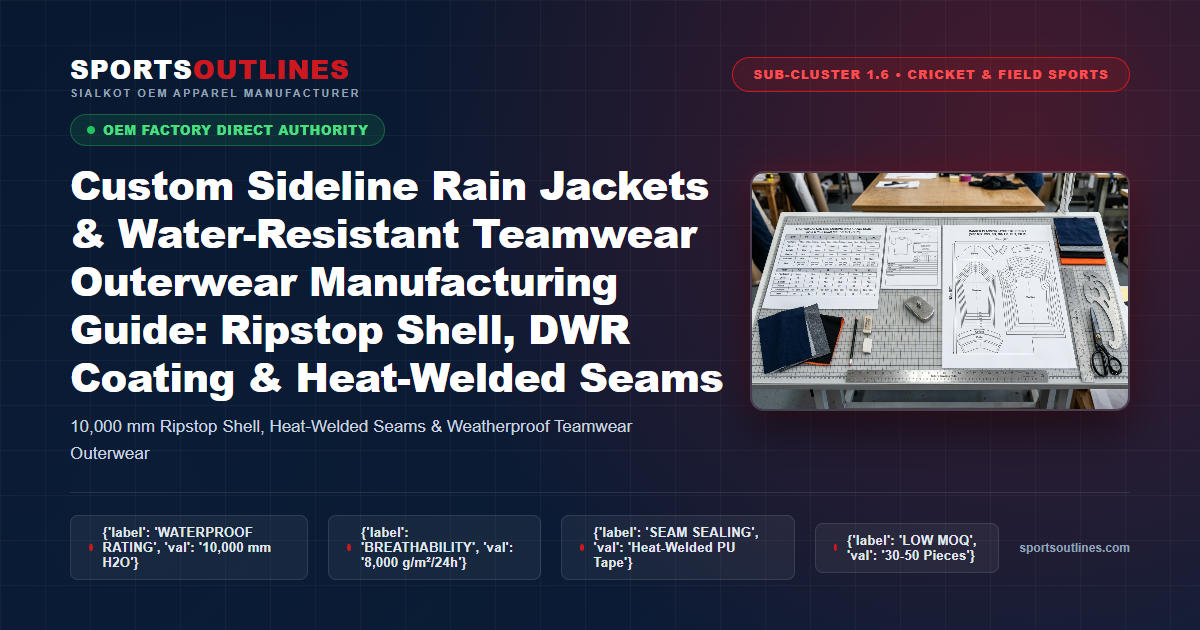
1. The Waterproof-Breathable Triad: Shell, Membrane & DWR Coating
True weather protection requires a balanced three-layer functional barrier that repels liquid water from the outside while allowing vaporized bodily perspiration to escape from the inside:
Layer 1: The Outer Protective Shell (75D / 100D Ripstop)
The outermost textile layer must resist high-friction contact from equipment bags, bench benches, and fence posts. We weave a 115 to 130 GSM 100% polyester or nylon micro-ripstop fabric utilizing a cross-hatch reinforcing grid every 5 mm. If a small puncture occurs during a stormy match, the reinforced grid prevents the tear from propagating across the jacket panel.
Layer 2: The Microporous TPU Membrane (10,000 mm / 8,000 g/m²)
Laminated directly to the underside of the ripstop shell is a monolithic thermoplastic polyurethane (TPU) membrane. This membrane contains billions of microscopic pores per square centimeter. Each pore is approximately 20,000 times smaller than a water droplet, preventing driving rain from penetrating under high wind pressures. Concurrently, the pores are roughly 700 times larger than a water vapor molecule, allowing metabolic heat and sweat vapor to ventilate continuously.
Layer 3: Eco-Conscious C0 Fluorocarbon-Free DWR Coating
Without a surface treatment, the outer face fabric will saturate with water—a condition known in textile engineering as “wetting out.” Although the membrane prevents water from reaching the player’s skin, a wetted-out shell becomes heavy, cold, and blocks breathable vapor escape. We apply an advanced C0 fluorocarbon-free (PFC-free) Durable Water Repellent (DWR) finish that lowers the surface tension of the fibers. Rain droplets form high-contact beads that roll off the jacket instantaneously under gravitational pull.
2. Seam-Sealing Technology: Ultrasonic Hot-Melt Tape Welding
The most critical vulnerability in any rain jacket is the sewing needle. When assembling a jacket, standard sewing machines punch thousands of tiny puncture holes through the fabric. In driving rain, water effortlessly flows through these perforations.
The Hot-Air Pneumatic Seam Sealing Process
To eliminate needle leaks, our cleanroom finishing department utilizes specialized hot-air rotary seam sealing machinery. A 20 mm wide, 3-ply polyurethane hot-melt tape is fed across the internal seam. A precision hot-air nozzle directs a continuous stream of heated air at 180°C to 195°C onto the tape’s adhesive backing while pneumatic rubber pressure rollers press the molten tape firmly against the seam at 4.0 bar pressure. The adhesive flows into the needle holes and thread valleys, curing into an impermeable vulcanized bond.
3. Functional Teamwear Outerwear Architecture
A proper sideline rain jacket must be engineered with athletic movement patterns and coaching operational requirements in mind:
The 3-Panel Articulated Storm Hood with Packable Garage
Generic 2-panel hoods pull tightly against the forehead and block peripheral vision. Our 3-panel ergonomic hood incorporates a central crown panel that contours over the natural shape of the skull or a low-profile baseball cap. The front brim features a laminated EVA peak stiffener that prevents rain from dripping into the athlete’s eyes. When rain subsides, the hood rolls cleanly into an encased collar garage secured with low-profile hook-and-loop tabs.
Drop-Tail Hem & Articulated Raglan Sleeves
When coaches crouch to diagram set plays or players sit on wet aluminum dugout benches, standard jackets ride up and expose the lower back to cold damp air. We extend the rear hem by 5.0 cm to 7.0 cm in an athletic drop-tail arc. The hem is finished with dual internal shock cords and one-handed cord locks. Raglan sleeve patterning eliminates top shoulder seams entirely, maximizing shoulder mobility while discarding the primary leak vector of traditional set-in sleeves.
Zippers, Garages & Storm Plackets
We fit all exterior openings with genuine YKK AquaGuard® or proprietary polyurethane-coated reverse-coil zippers. The zipper coil faces inward, protected by water-repellent PU tape that repels wind and rain. The top collar features a brushed micro-fleece zipper garage that covers the metal slider, preventing painful chin pinches in cold weather.
4. Interior Lining Configurations: Lightweight Mesh vs. Thermal Fleece
Depending on your club’s seasonal climate and regional playing calendar, we engineer three distinct interior lining options:
5. Technical Points of Measure (POM) & Size Grading Matrix
Our standardized Points of Measure (POM) chart covers adult and youth sizing curves:
6. Laboratory Quality Standards & Hydrostatic Testing Protocols
To guarantee that every batch of sideline outerwear performs flawlessly under real-world inclement weather conditions, our Sialkot quality testing lab executes strict ASTM and ISO test procedures:
7. B2B Sourcing Economics: Unit Costs, Sampling Rules & Low Factory MOQ
Traditional outerwear factories in East Asia enforce 500 to 1,000 unit minimums for seam-sealed waterproof rain jackets due to machine setup complexities. At Sports Outlines, our dedicated technical outerwear cell empowers clubs, universities, and private label brands to manufacture custom sideline rain jackets and bench coats starting at only 30 to 50 pieces per style/colorway:
Physical Prototype Sampling Policy: $45–$85 in 7–10 Business Days
Before producing bulk team outerwear orders, we fabricate a physical pre-production sample for your tactile and waterproof evaluation. Physical prototype samples cost $45 to $85 per custom piece (bench coats with heavy thermal fill are $65 to $95). This covers specialized CAD technical grading, rotary hot-melt seam sealing setup, custom embroidery or heat-seal branding, and hydrostatic lab verification over a 7 to 10 business day timeline. We enforce a firm zero-refund and zero-credit policy on all sampling fees. Once approved, the physical prototype represents the definitive production benchmark for bulk manufacturing.
Export Finishing & Climate-Controlled Packaging
Prior to dispatch, each completed jacket undergoes manual pressure-cup water testing along shoulder seams. Garments are iron-steamed at regulated temperatures that protect the PU seam tape, fitted with custom recycled hangtags, and folded with desiccant silica sachets inside heavy-duty 45-micron frosted zip-slider bags. Outer cartons are double-walled 5-ply corrugated cardboard (25 to 30 jackets per box, under 18 kg gross weight), lined with waterproof plastic barrier sheets to protect your goods during DHL/FedEx air freight to North America, the UK, Europe, and Australasia.
Manufacture Custom Sideline Rain Jackets & Team Outerwear
Protect your sports team, coaching staff, or athletic apparel brand with professional 10,000 mm waterproof sideline rain jackets and thermal bench coats engineered in Sialkot. Featuring hot-melt seam sealing, DWR ripstop shells, YKK reverse zippers, and low MOQ of 30–50 pieces with 7–10 days physical sampling.
8. Frequently Asked Questions (FAQ) — Sideline Rain Jacket Manufacturing
1. What is the difference between water-resistant and waterproof rain jackets?
A water-resistant jacket relies solely on a surface DWR chemical coating and can resist brief light mists (under 1,500 mm hydrostatic head). Once pressure is applied or rain intensifies, water penetrates the fabric weave and needle holes. A true waterproof jacket combines a laminated microporous membrane rated at 10,000+ mm H²O with heat-welded PU seam sealing tape covering every needle perforation, preventing water ingress even during hours of torrential downpours.
2. How does hot-melt seam sealing tape prevent water leakage?
When sewing needles pierce waterproof fabrics, they leave thousands of microscopic holes. In our factory, rotary pneumatic seam-sealing machines apply 20 mm 3-ply polyurethane tape at 180°C under 4.0 bar pressure over the interior seams. The adhesive melts into the needle valleys, vulcanizing an impermeable barrier that withstands >10,000 mm water pressure.
3. What is the minimum order quantity (MOQ) for custom sideline rain jackets?
Our factory direct low MOQ is 30 to 50 pieces per style/colorway. You can split this volume across youth (YS to YXL) and adult (S to 3XL) sizes to accommodate both youth varsity athletes and adult coaching staffs.
4. How much does a physical sample prototype cost, and what is the turnaround time?
A physical custom prototype sample costs $45 to $85 per piece ($65 to $95 for heavy insulated bench coats). Prototyping takes 7 to 10 business days for CAD grading, hot-melt seam welding, and logo embroidery, followed by 4 to 6 business days for air delivery. We maintain a strict zero-refund and zero-credit policy on all prototype sampling fees.
5. What branding embellishment methods work best on waterproof jackets?
We recommend high-frequency 3D silicone heat-transfers, reflective screen printing, or embroidered crests with heat-sealed waterproof backing patches. If direct embroidery is chosen, we seal the needle perforations on the interior face with hot-melt waterproof backing tape to prevent chest leaks.
6. Can the rain jacket hood be packed away or detached?
Yes. We offer roll-away collar garages secured with low-profile hook-and-loop tabs or detachable zippered hoods equipped with concealed storm flaps according to your club’s design preferences.
7. What is the difference between micro-mesh and polar fleece lining?
A micro-mesh liner (95 GSM) is featherweight and breathable, ideal for spring, summer, and early autumn athletic warmups where air circulation is needed. Polar fleece lining (220 GSM) provides substantial thermal loft, engineered for late autumn and winter sideline coats to keep inactive players warm in sub-zero temperatures.
8. Are your rain jackets treated with eco-friendly PFC-free chemicals?
Yes. All our outerwear fabrics are treated with non-fluorinated C0 DWR finishes compliant with European REACH standards and OEKO-TEX® Standard 100, ensuring environmental safety and zero hazardous chemical runoff.
9. How do you prevent internal sweat condensation during high activity?
We combine high-MVTR breathable TPU membranes (8,000 g/m²/24h) with zippered underarm ventilation ports (pit zips) and rear shoulder storm capes with interior mesh venting. This allows warm air to convect away from the body during pre-match warmups.
10. Can you manufacture full-length sideline stadium bench parkas?
Yes. We engineer thigh-length and knee-length stadium bench coats featuring 150 GSM hollow-fiber thermal batting, two-way heavy-duty front zippers, fleece-lined handwarmer pockets, and oversized hood blocks that fit over player helmets.
Explore Related Cricket, Field Sports & Teamwear Manufacturing Guides:
Equip your club with our factory guides on Custom Cricket Sweaters & Warmup Tracksuits, Custom Lacrosse Game Jerseys, Custom Field Hockey Uniforms, or view our Full Sportswear Catalog.