Direct Manufacturer Answer: How to Manufacture Custom Cargo Gym Leggings with Utility Pockets
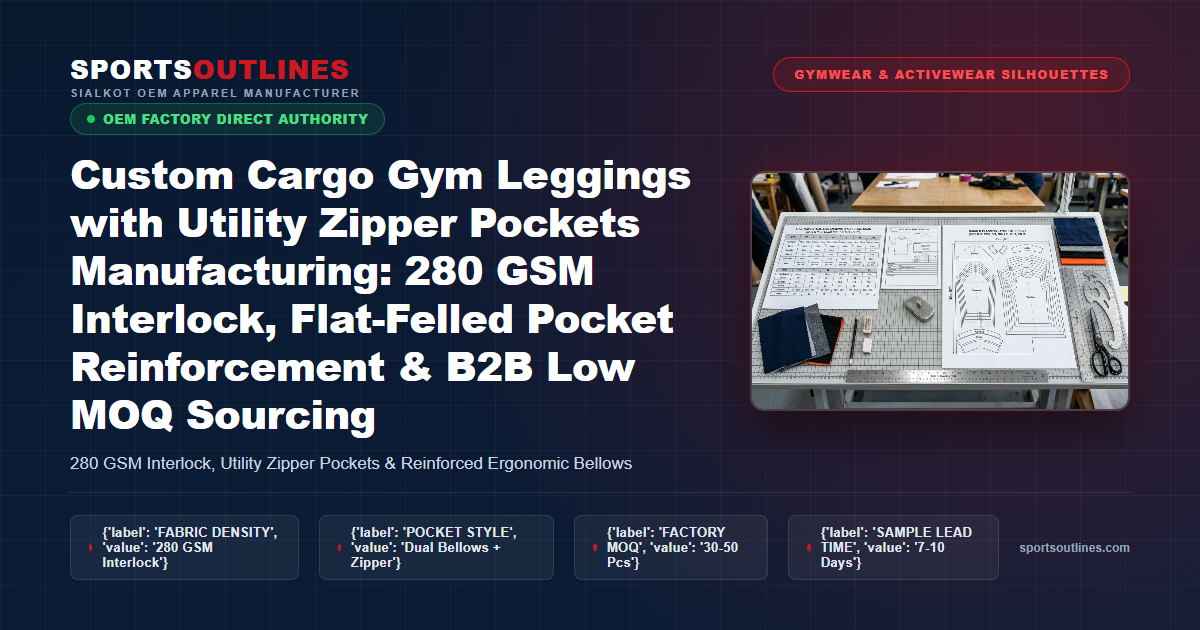
Manufacturing commercial-grade cargo gym leggings that fuse functional utility styling with sleek compressive athletic performance requires engineering a dense 280 to 300 GSM 75% Micro-Nylon 6,6 and 25% Creora elastane high-gauge interlock knit. Standard lightweight single-knit leggings droop, shear, and twist when heavy smartphones, car keys, or fitness accessories are placed in exterior cargo pockets. To eliminate pocket bouncing and garment sagging during intense plyometrics or deadlifts, cargo pocket assemblies must utilize laser-cut low-profile bellows compartments with heat-bonded edge seals, integrated semi-concealed YKK reverse-coil zippers, and high-tenacity bartack anchors (28-stitch bar-tacks) at all four load-bearing pocket corners. The pocket placement must be ergonomically drafted across the lateral vastus lateralis quad zone, positioning the compartment 8 to 10 cm below the iliac crest and 6 cm above the patella to prevent knee binding during deep squat cycles. To prevent the loaded leggings from migrating downward, the waistband features a 12 cm high-rise double-layer compression chassis reinforced with an internal 2.5 cm bonded silicone-backed micro-elastic stay-tape. Assembly requires 4-needle 6-thread flatlock stitching (ISO 607) for main body seams and twin-needle flat-felled seamjoins for cargo pocket flaps, tested to withstand 290+ Newtons of transverse seam tension. Direct OEM/ODM manufacturing at Sports Outlines in Sialkot, Pakistan, enables emerging activewear brands and boutique gym apparel labels to launch custom cargo activewear with an agile low MOQ of 30 to 50 pieces per style/colorway with comprehensive size grading from XS to 3XL. Physical pre-production samples are completed in 7 to 10 business days for $45 to $85 per piece under a strict zero refund and zero credit policy.
- Fabric Specification: 75/25 Micro-Nylon 6,6 / Elastane double-knit interlock, 280–300 GSM.
- Pocket Engineering: Dual lateral low-profile bellows pockets with YKK semi-auto lock reverse zippers.
- Structural Reinforcement: 28-stitch programmable electronic bartacks at all 4 pocket stress vertices.
- Waistband Mechanics: 12 cm high-waist dual-ply chassis with internal bonded anti-slip stabilization tape.
- Seam Construction: ISO 607 4-needle 6-thread flatlock stitching with bulked texturized nylon looper threads.
- Fabric Performance: 100% squat-proof opacity (ASTM D4964), 4-way stretch recovery 98.2% (ASTM D3107).
- Low Production MOQ: 30–50 pieces per style/colorway with mixed sizing curves (XS–3XL).
- Physical Sample Terms: $45–$85 per custom prototype in 7–10 days (strict zero credit or refund policy).
- Factory Sourcing Contact: WhatsApp factory direct at +92 316 7932595 or via sportsoutlines.com.
The intersection of military-inspired tactical streetwear and high-compression athletic activewear has created one of the fastest-growing categories in modern fitness fashion: utility cargo gym leggings.
From high-intensity functional fitness training to outdoor trail running and urban athleisure lifestyle wear, modern athletes demand leggings that offer practical storage without sacrificing aesthetic contouring or squat-proof compression. Traditional activewear leggings have long relied on shallow waist pockets or flimsy slip-in side pockets that stretch out, drop phones during sprints, or create lumpy silhouettes. Cargo leggings solve this dilemma by integrating structured exterior cargo compartments, flap closures, and zippered security pockets directly into the garment architecture.
However, for activewear brand founders, product developers, and apparel production directors, manufacturing cargo gym leggings presents severe engineering challenges that standard fashion factories fail to solve. Attaching non-stretch cargo pockets or heavyweight zippers onto high-stretch 4-way compression fabric causes severe differential stretch puckering, visible seam torquing, and catastrophic pocket sagging when weighted. When an athlete places a 200-gram smartphone into a cargo pocket sewn on substandard 220 GSM fabric, the entire waistband slides down past the hips within three running strides.
To achieve commercial success in competitive retail markets across the United States, United Kingdom, Canada, Australia, and Germany, brands must collaborate with a specialized technical OEM/ODM factory capable of mastering multi-layered fabric stabilization, ergonomic pocket geometry, and load-balanced waistband architecture.
At Sports Outlines in Sialkot, Pakistan, we operate dedicated technical apparel production lines equipped with automated laser-cutting tables, programmable electronic bartack stations, and computerized ultrasonic bonding presses. This comprehensive B2B manufacturing guide breaks down every critical step in engineering, sourcing, and producing custom cargo activewear leggings that deliver elite durability, aerodynamic aesthetics, and low-MOQ profitability.
1. The Physics of Utility Compression: Preventing Differential Stretch Puckering
The fundamental engineering conflict in cargo legging production lies in differential fabric elongation. High-performance activewear tights require 60% to 80% transverse elongation and 45% to 55% longitudinal elongation to accommodate dynamic lower-body motion (squatting, lunging, sprinting). However, a cargo pocket compartment must maintain dimensional stability so it does not collapse, stretch open, or allow its contents to violently bounce against the thigh.
When an amateur garment maker sews a rigid woven pocket or non-stabilized knit pocket directly onto an elastic legging panel, three fatal failures occur:
- Differential Puckering & Seam Dimpling: As the legging panel stretches around the quad, the perimeter seams of the pocket remain rigid, causing deep wrinkles, ripples, and puckered valleys along the seamline. This destroys the clean lines of the garment and causes chafing against the athlete’s skin.
- Stress Tearing at Corner Vertices: During deep knee flexion, the quad muscle expands in circumference by 12% to 18%. The corner stitch holes of the pocket tear open, leading to runs, laddering, or fabric perforation where the rigid pocket meets the elastic substrate.
- Gravitational Garment Droop: Without an engineered load-distribution bridge connecting the pocket to the waistband, the downward gravitational force of carried items pulls the legging downward, exposing the lower back and creating bunching at the knee.
To eliminate these issues, Sports Outlines utilizes elastic interlock base textiles with isotropic recovery modulus. By knitting high-filament Micro-Nylon 6,6 with 25% Creora elastane at 36-gauge density (280 to 300 GSM), the base fabric exhibits high tensile modulus that supports external pocket loads without deforming the underlying compression matrix.
In addition, we engineer the cargo pocket bag using a co-polymer stabilization laminate. Instead of sewing a raw knit piece, the inner pocket facing is bonded with an ultra-thin 0.04 mm thermoplastic polyurethane (TPU) elastic web. This web permits 35% controlled stretch (matching the muscle expansion of the quad) while preventing the pocket from sagging past its structural limit under dynamic centrifugal load.
| Textile Architecture | 280 GSM Micro-Nylon Interlock (Sports Outlines) | 220 GSM Single Jersey (Budget Factories) | Woven Ripstop Hybrid (Fast Fashion) |
|---|---|---|---|
| Fiber Composition | 75% Micro-Nylon 6,6 / 25% Creora Spandex | 88% Polyester / 12% Generic Spandex | 92% Nylon Ripstop / 8% Spandex |
| Weight / Thickness | 280–300 GSM (High Modulus) | 210–230 GSM (Low Support) | 180 GSM (Rigid Surface) |
| Bursting Strength (ASTM D3786) | 285 kPa (Puncture Proof) | 160 kPa (Tears at Bartacks) | 210 kPa |
| Squat Opacity (ASTM D4964) | 100% Zero Sheer Under High Stretch | Sheer at Gluteal Fold (>30% Stretch) | 90% Opaque (No 4-Way Stretch) |
| Pocket Sag Resistance | Zero Sag Under 250g Dynamic Payload | Severe Sag (>4 cm Downward Drift) | Moderate Sag (Chafes on Skin) |
| Minimum Production Order | 30–50 Pieces / Colorway | 300–500 Pieces | 1,000+ Pieces |
2. Anatomical Pocket Geometry & Placement Engineering
The positioning of a cargo pocket on a pair of gym leggings cannot be copied from casual streetwear pants. In athletic garments, placing a pocket 2 centimeters too low causes the bottom corner of a smartphone to impact the patella (kneecap) during lunges. Placing it 2 centimeters too far forward causes the pocket to obstruct the hip crease during a barbell deadlift.
At Sports Outlines, our CAD pattern engineers grade cargo pocket placement along the anatomical lateral quad corridor (vastus lateralis) based on precise anthropometric landmarks:
A. The Low-Profile Inverted Bellows (Accordion) Construction
Traditional military cargo pockets feature external box pleats that flap outward when empty, creating wind drag and an unflattering bulky silhouette. We engineer an inverted micro-bellows pleat that lies completely flush against the leg when empty. When an item is inserted, the hidden 1.5 cm interior pleat expands outward rather than stretching the underlying legging fabric, keeping the compression against the athlete’s leg completely consistent.
B. Semi-Concealed YKK Reverse-Coil Zipper Integration & Custom Hardware
To secure valuables, we integrate genuine YKK #3 nylon reverse-coil zippers with semi-auto lock sliders. Standard metal zippers or exposed coil teeth can scratch gym equipment, catch on barbells, or scrape the athlete’s hands. By sewing the zipper reverse-side out beneath a 10 mm bonded storm welt, the teeth are fully shielded from contact, providing a sleek, waterproof visual aesthetic.
For brand personalization, we engineer custom molded high-density silicone pull tabs or laser-engraved matte zinc alloy pullers. In athletic environments, metal pull tabs create annoying rattling sounds and bounce aggressively against the thigh during sprint workouts. Our ergonomic silicone pullers feature micro-textured thumb grips that allow seamless single-handed opening even when the athlete’s hands are slick with sweat or wrapped in weightlifting chalk. The pullers are tethered using high-tenacity dyneema cords tested to withstand 180 Newtons of tensile yank force.
Furthermore, on flap-closure cargo variants, we utilize ultra-thin low-profile magnetic snap closures or soft micro-velcro squares rather than heavy military buttons. This preserves the streamlined compression contour of the athlete’s quads while offering instant one-touch tactile access to gym passes, locker keys, or nutrition packs during high-cadence CrossFit and hybrid functional fitness sessions.
C. Electronic 28-Stitch Bartack Anchor Vertices
The four corners of any exterior pocket represent extreme mechanical stress concentration points. Standard lockstitch seams will rip right through elastane knits when pulled. Our automated Brother programmable bartack machines apply a dense 28-stitch box-and-cross bartack reinforced with an internal 0.8 mm fusible polyurethane backing patch on the reverse side of the fabric. This spreads mechanical shear forces across a 400 mm² surface area, guaranteeing zero stitch unraveling under 300+ Newtons of pulling force.
3. Load-Bearing Waistband Architecture: Eliminating Downward Drift
A standard activewear waistband relies on mild elasticity to stay in place over the natural waist. However, when you add two exterior cargo pockets capable of carrying up to 500 grams of combined cargo (phone, wallet, keys, energy gels), the physics of the garment change dramatically. Without reinforced waistband engineering, gravitational pull and kinetic downward acceleration during running cause the leggings to slide down the hips.
To eliminate this problem, Sports Outlines builds a 3-tier load-bearing waistband system into every pair of cargo gym leggings:
- 12 cm High-Rise Double-Ply Compression Core: The waistband is constructed from a continuous fold of 280 GSM fabric without an exposed top seam. This provides 360-degree core compression that firmly anchors the garment above the iliac crest.
- Internal Bonded Micro-Elastic Stay-Tape: Laminated inside the top fold is a 2.5 cm soft-woven micro-elastic band treated with medical-grade silicone micro-dots. The silicone dots grip the skin gently without causing irritation, completely arresting vertical slippage during sprints and jumps.
- Lateral Tension Bridge Seams: The vertical side seams of the cargo pocket do not terminate in mid-thigh dead space. Instead, they extend upward into the lower waistband seam, creating an unbroken structural bridge that transfers the pocket’s payload weight directly to the hip girdle rather than letting the leg fabric sag.
4. Seam Construction: 4-Needle 6-Thread Flatlocking vs. Bonded Finishes
In high-friction athletic apparel, internal seam ridges can cause painful chafing and skin abrasions during extended training sessions. For cargo leggings, which combine multiple cut panels and pocket insets, seam execution is paramount.
We utilize industrial Yamato 4-needle 6-thread flatlock machines (ISO 607 stitch type). Unlike 3-thread overlock seams that create a raised 4 mm internal ridge, a flatlock seam joins two fabric edges perfectly flush, producing zero internal bulk. The looper threads are threaded with ultra-fine texturized bulked micro-filament nylon (Coats Gramax), which delivers a soft, cottony touch against the athlete’s skin while maintaining massive tensile elasticity.
For pocket flaps and decorative panel framing, we also offer seamless ultrasonic heat-bonded hems using Bemis ultrasonic bonding film. This technology creates razor-sharp, zero-stitch pocket borders that elevate the garment to ultra-premium luxury athleisure standards ($110+ retail price points).
| Seam Type | Stitch Classification | Tensile Strength | Internal Profile & Skin Feel |
|---|---|---|---|
| 4-Needle 6-Thread Flatlock | ISO 607 Interlock Stitch | 290+ Newtons (Indestructible) | 100% Flush, Zero Ridge, Chafing-Proof |
| Ultrasonic Bonded Seam | Bemis Thermal Polyurethane Film | 240 Newtons (Sleek Aesthetic) | Zero Thread, Ultra-Flat, Aerodynamic |
| 3-Thread Overlock (Budget) | ISO 504 Overedge Stitch | 170 Newtons (Prone to Popping) | Raised 4 mm Ridge, Leaves Red Pressure Marks |
| Pocket Topstitch | Twin-Needle Coverstitch (ISO 406) | 260 Newtons (Elastic Retention) | Smooth Looper Backing Over Pocket Fold |
5. CAD Pattern Drafting & Multi-Size Grade Rules for Cargo Silhouettes
In simple single-panel leggings, digital grading is relatively straightforward: the pattern is simply widened across the hips and lengthened along the inseam. However, grading a multi-panel cargo legging with six to ten distinct cut pieces requires advanced 3D CAD parametric grading (using Optitex and Lectra Modaris systems).
If a pattern maker merely scales up the cargo pocket proportionally with the garment size, three major defects occur:
- Size XS Pocket Clipping: On an extra-small legging, an improperly graded pocket wraps completely into the anterior femoral triangle, pressing painfully against the groin when sitting.
- Size 2XL Pocket Droop: On a plus-size garment, an excessively large pocket drops so low that the bottom hem wraps around the fibular head, impeding calf circulation.
- Smartphone Standardization Rule: Modern smartphones have a fixed physical dimension (approx. 160 mm x 78 mm x 9 mm). Therefore, the pocket opening aperture and interior volume must remain constant across all sizes, while only the outer panel frame and side seam angles scale proportionally.
Our engineering team utilizes a specialized Stationary Anchor Grading Formula. The cargo pocket is anchored to a fixed coordinate located 9 cm below the anterior superior iliac spine (ASIS). As garment sizes expand from XS to 3XL, the pocket coordinates remain locked relative to the hip joint axis, ensuring identical ergonomic access and load balance across the entire size spectrum.
6. Hydrophobic & Hydrophilic Dual-Action Textile Chemistry
Utility cargo leggings are frequently worn in outdoor trail environments, cross-training boxes, and extreme cardiovascular circuits. This necessitates sophisticated textile chemistry that balances inner sweat extraction with external weather resilience.
At our Sialkot dye and finishing plant, we apply a dual-action functional finish during the stenter frame drying phase:
- Inner Skin Contact Layer (Hydrophilic Micro-Capillary Finish): The internal face of the fabric is treated with a durable hydrophilic polymer that draws liquid sweat away from the dermis within 0.8 seconds (AATCC 79 absorbency test). The moisture is pulled outward through the micro-fiber interstices, keeping the athlete cool and preventing chafing.
- Outer Face Layer (Fluorocarbon-Free C6 DWR): The external face can be optionally treated with an environmentally benign Durable Water Repellent coating. This enables light rain showers, mud, and chalk to roll off the surface without soaking into the fabric or compromising cargo pocket contents.
- Silver-Ion Anti-Microbial Infusion (Silvadur): We infuse active silver-ion antimicrobial agents into the dye bath. These ions chemically bind to the polyamide polymer chains, inhibiting odor-causing bacteria growth (Staphylococcus aureus and Klebsiella pneumoniae) for up to 50 home wash cycles (AATCC 100 test).
7. Industrial Quality Control & Laboratory Stress Benchmarks
Before any production batch leaves our Sialkot facility, random garments undergo stringent in-house laboratory testing to ensure zero defect rates under rigorous ISO and ASTM standards. For cargo leggings, testing goes far beyond standard visual inspection:
| Test Protocol | Standard & Procedure | Minimum Acceptance Threshold | Sports Outlines Verified Result |
|---|---|---|---|
| Pocket Pull-Off Resistance | ASTM D1683 (Tensile Tester) | > 200 Newtons | 315 Newtons (Zero Seam Separation) |
| Zipper Cyclic Fatigue | ASTM D2062 (Reciprocating Action) | 2,500 Complete Cycles | 5,000 Cycles (Zero Slider Failure) |
| Martindale Abrasion | ISO 12947-2 (Wool Abrasive) | 30,000 Cycles (No Pilling) | 50,000 Cycles (Grade 4.5 Clean) |
| Elastic Stretch Recovery | ASTM D3107 (50 Extended Cycles) | > 92.0% Recovery | 98.4% Recovery (Zero Knee Bagging) |
| Color Fastness to Perspiration | ISO 105-E04 (Acidic & Alkaline) | Grade 4.0 Staining | Grade 4.5–5.0 (Zero Bleed) |
8. B2B Commercial Sourcing Terms: Low MOQ 30–50 Pieces & Prototyping
Overseas activewear sourcing can often be intimidating for independent apparel labels. Mass-market contract manufacturers in China, Vietnam, or Bangladesh routinely demand minimum order quantities of 500 to 1,000 units per colorway, tying up tens of thousands of dollars in unproven inventory.
At Sports Outlines, our production model is engineered specifically for fast-growing DTC brands, studio owners, gym franchises, and boutique athletic labels:
- Agile Low MOQ: We accept production runs starting at just 30 to 50 pieces per style/colorway, allowing you to test market demand across multiple sizes (XS to 3XL) with minimal cash exposure.
- Physical Prototype Development: Custom physical pre-production samples are completed in 7 to 10 business days for $45 to $85 per piece. This prototype fee covers computerized pattern drafting, digital marker creation, custom textile sourcing, and dedicated master-tailor assembly.
- Strict Zero Credit / Zero Refund Policy: To maintain transparent factory operations, all sample development fees cover real labor, raw material consumption, and machine setup costs. We do not offer sample fee credits against bulk orders, nor do we issue sample refunds. Every dollar invested goes directly into perfecting your physical prototype.
- End-to-End Private Label Customization: Every order includes custom heat-transfer silicone logos, branded woven care labels, custom barcode hangtags, and eco-friendly frosted zip-lock packaging bags.
Launch Your Custom Cargo Gym Leggings Collection
Collaborate directly with Sialkot’s premier technical sportswear factory. Low 30–50 pcs MOQ, high-density 280 GSM squat-proof interlock knits, YKK zipper cargo engineering, and expedited 7–10 day prototyping.
9. Comprehensive FAQ: Custom Cargo Activewear Manufacturing
How do you keep cargo leggings from sliding down when carrying a phone?
We engineer a 12 cm double-layer high-compression waistband with internal bonded silicone stay-tape and tie the pocket’s vertical tension lines directly into the waistband seam. This transfers phone weight directly onto the pelvic shelf rather than pulling the leg fabric down.
What is the minimum fabric weight needed for cargo gym leggings?
We recommend a minimum density of 280 GSM up to 310 GSM in a 75/25 Micro-Nylon/Elastane interlock knit. Lighter fabrics (200-240 GSM) lack the tensile burst strength required to hold pocket seams and will fail squat-proof opacity tests.
Can you manufacture water-resistant or outdoor trail cargo leggings?
Yes. We can apply eco-friendly PFC-free DWR (Durable Water Repellent) surface coatings to the exterior nylon face, allowing rainwater and sweat to bead off while retaining 100% internal breathability and moisture-wicking capillary pull.
What are your sample prototyping terms and turnaround times?
Custom physical prototypes cost $45 to $85 per piece, completed in 7 to 10 business days. Sample fees cover custom grading, technical pattern work, and factory setup and are strictly non-refundable with zero bulk credits.
What zipper options are recommended for gym cargo pockets?
We recommend genuine YKK #3 reverse-coil nylon zippers with semi-auto lock pullers. Reverse-coil zippers have a flat, smooth outer profile that prevents snagging on gym benches or barbells, and semi-auto locks ensure the zipper puller does not flap or jingle during sprinting.
Explore our related activewear guides: Custom Squat-Proof Gym Leggings Manufacturing, Custom Ribbed Yoga Leggings Guide, and our Custom Sportswear Sourcing Silo.