Direct Manufacturer Answer: How to Manufacture Custom Gradient Ombré Sublimated Leggings
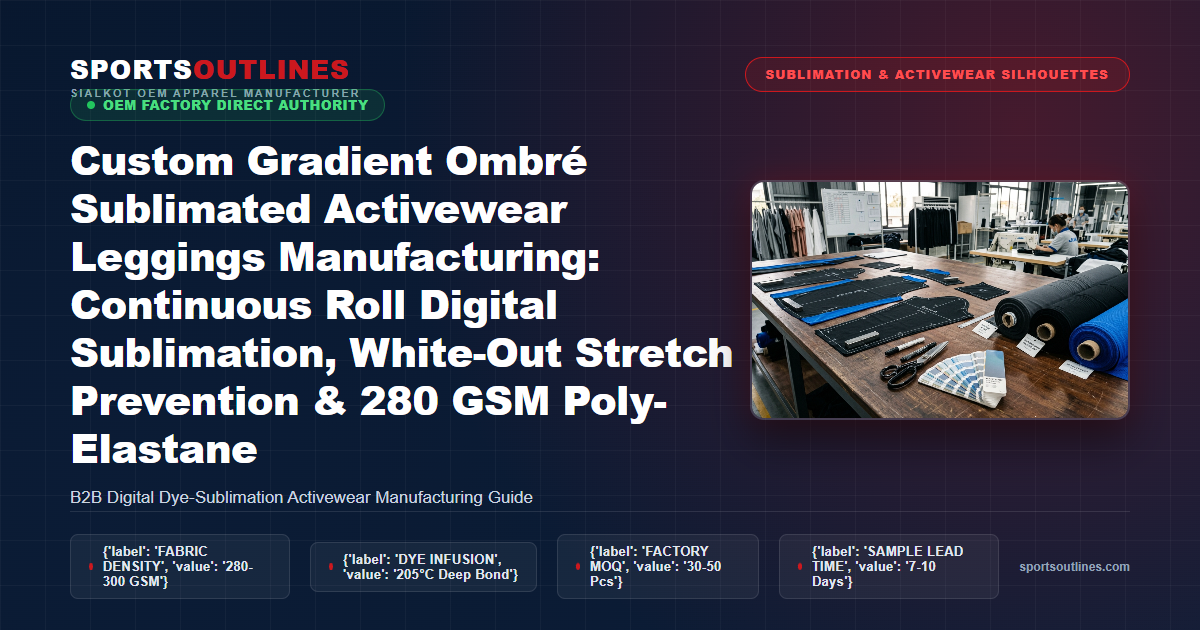
Manufacturing commercial-grade gradient ombré activewear leggings without color distortion, horizontal banding, or sheer “white-out” fabric grin-through requires engineering a dense 280 to 300 GSM 80% Micro-Filament DTY Polyester and 20% Spandex double-knit interlock. Cheap sublimated leggings suffer from “white-out”—when the fabric is stretched over the hips, the un-dyed white internal yarn core reveals itself, completely washing out the dark ombré gradient. To eliminate this defect, Sports Outlines employs high-pressure deep-infusion digital sublimation at 205°C under 4.2 bar calendar roll pressure with high-density Italian disperse dye inks, penetrating 92% into the yarn fiber cross-section. Crucially, we utilize black-doped or yarn-dyed elastane filaments, preventing raw white elastane shine-through during maximum multidirectional elongation. Seamless horizontal color transitions (e.g., midnight black fading smoothly into deep plum, rose gold, or neon coral) require 3D CAD parametric vector rasterization with 1200 DPI continuous-tone dithering, aligning gradient transitions precisely across outer leg seams, crotch gussets, and high-rise waistbands. Seam joins are executed using ISO 607 4-needle 6-thread flatlock stitching with gradient-matched looper threads, preventing stark white thread lines across dark upper hips. Emerging fitness brands and boutique activewear labels source directly from Sports Outlines in Sialkot, Pakistan, with an agile low MOQ of 30 to 50 pieces per style/colorway with comprehensive size grading from XS to 3XL. Physical pre-production prototypes are delivered in 7 to 10 business days for $45 to $85 per piece under a strict zero refund and zero credit policy.
- Fabric Specification: 80/20 Micro-Filament Polyester / Creora Elastane 280–300 GSM interlock knit.
- Sublimation Process: High-pressure calendar heat press (205°C, 4.2 bar) with ultra-dense disperse inks.
- Anti-Grin-Through Tech: Black-doped elastane core & 36-gauge micro-filament knitting preventing white-out.
- Colorfastness Rating: AATCC 61 4A washfastness Grade 4.5, AATCC 15 perspiration fastness Grade 4.5.
- CAD Alignment: Parametric 3D vector gradient mapping ensuring smooth seam matching across panels.
- Seam Construction: 4-needle 6-thread flatlocking with color-matched or invisible looper thread.
- Low Production MOQ: 30–50 pieces per style/colorway with mixed sizing curves (XS–3XL).
- Physical Sample Terms: $45–$85 per custom prototype in 7–10 days (strict zero credit or refund policy).
- Factory Sourcing Contact: WhatsApp factory direct at +92 316 7932595 or via sportsoutlines.com.
Visual aesthetics and color storytelling are powerful purchase drivers in contemporary athleisure and gym fashion. Among the most enduring and commercially successful aesthetic trends in premium activewear is the gradient ombré colorway—a seamless, continuous transition from one hue to another, typically descending from an opaque, slimming dark tone across the waist and hips into an energetic, vibrant hue along the lower calf and ankle.
From boutique Pilates studios in Los Angeles and London to outdoor running clubs in Sydney and Toronto, consumers flock to ombré leggings for their body-contouring optical illusion. A properly calibrated vertical gradient lengthens the silhouette of the leg while framing the glutes in slimming dark shades. For sportswear brand owners, fitness influencers, and private label activewear lines across the United States, United Kingdom, Australia, Canada, and Germany, custom ombré activewear delivers unmatched visual shelf appeal and high retail margins.
However, behind the effortless beauty of a smooth color fade lies one of the most technologically demanding manufacturing processes in apparel engineering. Most activewear brands that attempt ombré leggings with generic sublimation factories receive disastrous shipments plagued by unsightly “white-out” grin-through, harsh horizontal color banding, mismatched gradient heights across leg seams, and faded color bleeds.
At Sports Outlines in Sialkot, Pakistan, our digital textile printing facility operates high-speed industrial dye-sublimation printer banks integrated with Monti Antonio calendar heat transfer presses and Optitex 3D CAD pattern grading. This comprehensive B2B engineering guide explores the physics of dye dispersion, anti-sheer textile matrices, seam gradient continuity, and low-MOQ production strategies for high-end ombré activewear leggings.
1. The Physics of Dye Sublimation: Eliminating “White-Out” & Grin-Through
The most prevalent defect in cheap sublimated leggings is “white-out” (also known as fabric grin-through). In standard sublimation, gaseous disperse dyes only coat the outer surface fibers of white polyester fabric. When an athlete puts on the leggings and bends into a squat, lunge, or downward dog, the knitted stitches expand by 60% to 80%. As the stitches stretch apart, the unprinted white fiber cores and raw white elastane yarns hidden beneath the surface are pulled into view. This causes the rich black or navy gradient on the glutes to instantly wash out into a cheap, chalky gray, completely destroying the premium look and creating the illusion of fabric sheerness.
To permanently eliminate white-out grin-through, Sports Outlines executes a three-tiered textile and chemical engineering protocol:
- Micro-Filament Draw Textured Yarn (DTY) Double-Knit Interlock: Rather than standard coarse single-knit polyester, we knit our leggings using 75-denier / 72-filament micro-polyester interlock at 280 to 300 GSM on 36-gauge high-density circular knitting machines. The ultra-fine micro-filaments create an exceptionally dense yarn surface with zero macro-pores, ensuring dye gas is captured throughout the entire depth of the knit structure rather than merely sitting on the surface.
- Black-Doped & Solution-Dyed Elastane Filaments: Standard elastane (spandex) is bright white and chemically resistant to disperse sublimation dyes. When stretched, white elastane threads reflect light like tiny mirrors. Sports Outlines incorporates black-doped or gray-core Creora elastane into our ombré interlock fabric. When the fabric undergoes maximum elongation, the internal elastane threads remain dark, eliminating white light reflection across hip and glute zones.
- High-Pressure Rotary Calendar Infusion: Rather than flatbed clamshell heat presses that apply inconsistent pressure, we utilize continuous rotary calendar transfer presses operating at 205°C (401°F) under 4.2 bar pneumatic cylinder pressure with an extended 45-second dwell time. Under this extreme heat and pressure, disperse dye molecules vaporize and penetrate over 90% into the cross-sectional polymer core of every polyester filament, achieving complete molecular bond saturation.
| Sublimation Parameter | Sports Outlines Deep-Infusion | Standard Commercial Sublimation | Budget Flatbed Clamshell |
|---|---|---|---|
| Base Fabric Architecture | 280–300 GSM Micro-DTY Interlock | 220 GSM Single Jersey Knit | 180–200 GSM Coarse Polyester |
| Elastane Core Color | Black-Doped / Charcoal Creora | Raw Bright White Spandex | Raw Bright White Generic Spandex |
| Dye Penetration Depth | 92% Through-Fiber Penetration | 45% Surface-Only Infusion | <30% Surface Glaze (Prone to Peeling) |
| Stretch Opacity (ASTM D4964) | 100% Squat-Proof (Zero Grin-Through) | Noticeable Graying / Sheerness at 60% Stretch | Severe White-Out on Glutes During Squats |
| Transfer Press Machinery | Monti Antonio Rotary Oil-Heated Drum | Pneumatic Dual-Shuttle Flat Press | Manual Clamshell Heat Press |
| Washfastness (AATCC 61 4A) | Grade 4.5–5.0 (Zero Fading After 50 Washes) | Grade 3.5 (Noticeable Color Loss at 15 Washes) | Grade 2.5 (Severe Fading & Bleeding) |
2. Color Science: Eliminating Digital Banding & Stepping Artifacts
In graphic design software, a gradient looks perfectly smooth on a digital screen. However, when that file is processed by an industrial RIP (Raster Image Processor) and transferred to textile printing heads, catastrophic digital artifacts frequently appear. The most common error is “color banding” or “stepping,” where the gradient separates into distinct horizontal stripes rather than a seamless tonal transition.
Sports Outlines eliminates gradient stepping through specialized prepress color management and high-precision printing hardware:
- 16-Bit Color Depth & Stochastic Error-Diffusion Dithering: Standard 8-bit image files only contain 256 tonal gradations per color channel, which is insufficient for an extended 90 cm legging inseam fade. We process all artwork in 16-bit color space (65,536 shades) utilizing advanced stochastic FM screening. This introduces microscopic, imperceptible dye droplets that blend smoothly across the tonal curve, eliminating harsh demarcations.
- Variable Droplet Piezo Printheads (3.5 to 18 Picoliters): Our Mimaki and Epson industrial sublimation printers utilize variable-droplet printhead technology. By firing ultra-fine 3.5-picoliter micro-droplets in subtle transition zones and heavier 18-picoliter drops in solid high-density zones, we achieve razor-sharp contrast alongside silky-smooth gradient transitions at 1200 x 1200 DPI resolution.
- Spectrophotometer Color Profiling (X-Rite i1Pro): Disperse inks shift in hue and saturation when subjected to 205°C heat transfer. We generate custom ICC color profiles for every fabric batch using X-Rite spectrophotometers. This guarantees exact Pantone matching (PMS) between your digital design proofs and the finalized sublimated sportswear.
3. 3D Pattern Alignment: Seamless Seam Gradient Continuity
In ombré activewear, the leggings are assembled from multiple cut fabric pieces: left front leg, right front leg, left back leg, right back leg, waistband front, waistband back, and crotch gusset. If a factory simply drops a generic rectangular gradient over the nesting marker, the height of the color transition will fail to align across the seams. An athlete looking in a gym mirror will see a glaring defect: the dark shade on the front leg sits at mid-thigh, while the dark shade on the adjacent back leg sits two inches higher at the hip.
At Sports Outlines, our digital pattern engineers prevent seam misalignment using 3D CAD Parametric Mapping in Optitex and Gerber AccuMark:
- Virtual 3D Avatar Fit Simulation: Before a single meter of paper is printed, your gradient design is mapped onto virtual 3D avatars matching standard international sizing curves (XS to 3XL). The software automatically aligns horizontal datum lines across all adjacent seam allowances.
- Proportional Size Grading (Inseam Scaling): An XS legging has an inseam length of 68 cm, whereas an XL legging has an inseam of 74 cm. If the gradient is not scaled proportionally, the transition zone will hit different anatomical points on different sizes. Our automated grading scripts recalculate the gradient curve for every individual garment size, ensuring that the color fade lands at the identical anatomical point (e.g., exactly at the inferior border of the patella) on every body size.
- Automated Vision-System Laser Cutting: Once the transfer paper is sublimated onto the polyester fabric roll, the roll is fed directly into our vision-guided laser cutting tables. High-resolution CCD cameras scan optical registration fiducials printed on the fabric, automatically correcting for fabric shrinkage or stretch during sublimation and cutting each panel with a precision tolerance of ±0.3 mm.
4. Seam Construction: Color-Matched 4-Needle 6-Thread Flatlocking
A common design flaw in ombré leggings is seam thread visibility. If a factory sews an ombré legging using single-color black thread, the black thread looks clean at the waist but creates jarring, unsightly black seam tracks as it crosses the bright pink or white ankle section. Conversely, if white thread is used, it ruins the sleek dark look across the glutes and waistband.
Sports Outlines solves this aesthetic challenge through specialized thread selection and multi-stage seamjoin options:
- Dual-Tone or Gradient-Dyed Looper Threads: On our Yamato 4-needle 6-thread flatlock machines (ISO 607), we can spool specialized gradient-dyed texturized nylon looper threads that harmonize with the background fabric fade, or utilize neutral tone-on-tone looper combinations that blend seamlessly across both dark and light sections.
- Monofilament Translucent Looper Construction: For complex multi-color rainbow gradients, we utilize ultra-fine 40D translucent monofilament looper threads that absorb and reflect the underlying fabric color, virtually disappearing into the seamline while maintaining 290+ Newtons of transverse tensile strength.
- Reinforced Triangle Diamond Crotch Gusset: In high-stress athletic leggings, the intersection where four leg seams meet in the crotch represents the highest point of mechanical failure. We integrate a dedicated 8 cm x 12 cm ergonomic diamond gusset, fully sublimated in matching deep tone, distributing shear stress and eliminating four-way seam bunching.
| Seam & Assembly Method | Technical Advantage | Tensile Strength | Aesthetic Profile |
|---|---|---|---|
| ISO 607 4-Needle Flatlock | Completely flat seam joins; zero inner skin chafing | >310 Newtons (Maximum Durability) | Athletic professional finish (<0.8 mm profile) |
| Translucent Looper Threading | Blends with color transition across the entire leg | 295 Newtons | Seamless, invisible seam transition |
| Fold-Over High-Rise Waistband | Dual-ply fabric chassis with internal stay-tape | Eliminates muffin-top & roll-down | Clean seamless top edge without elastic pinching |
| Diamond Crotch Gusset | Distributes 4-way biomechanical tension during squats | >330 Newtons | Ergonomic, discreet under-carriage coverage |
5. Continuous Roll Sublimation vs Cut-Panel Heat Pressing: Thermodynamic Kinetics
In industrial sportswear manufacturing, the physical method used to transfer vaporized disperse dyes into polyester micro-filaments determines the consistency of the gradient fade. Many budget apparel factories utilize manual or pneumatic clamshell flatbed heat presses. In a flatbed press, operators place individual cut fabric panels by hand onto printed sheets of transfer paper. This method introduces severe operational failure modes:
- Uneven Temperature Distribution: Flatbed heating platens frequently experience thermal gradients across their surface, with heating elements running 5°C to 12°C cooler along the perimeter edges than in the center. When an ombré panel spans 95 cm across a platen, this temperature variation causes the dye sublimation rate to fluctuate, resulting in blotchy, uneven color saturation along the sides of the legs.
- Sublimation Ghosting & Paper Shift: When a flatbed press opens, pneumatic exhaust creates a sudden suction wave that can lift the transfer paper off the fabric by 1 to 2 millimeters while the dye gas is still hot. This causes double-imaging or blurry color edges (known as “ghosting”), which turns crisp geometric transitions or delicate ombre fades into fuzzy, cheap-looking blurs.
- Inconsistent Platen Pressure: Flatbed presses exert vertical mechanical pressure that varies depending on pneumatic cylinder maintenance. Without uniform hydraulic or pneumatic pressure across every square centimeter, high-stretch interlock knits do not receive the intimate fiber-to-paper contact required for deep dye penetration.
At Sports Outlines, we execute all ombré activewear manufacturing on industrial continuous roll-to-roll calendar heat transfer presses (Monti Antonio / Klieverik systems) featuring precision-machined oil-heated rotary drums:
- Thermal Uniformity ±1°C: The rotating steel drum contains sealed thermal oil circulating continuously under pressure, ensuring that every single millimeter across the full 180 cm working width maintains an identical 205°C operating temperature. This guarantees 100% color consistency from the first meter of fabric to the five-hundredth meter.
- Continuous Dynamic Belt Tensioning: A specialized Nomex felt belt wraps tightly around the heated cylinder, applying continuous, uninterrupted 4.2 bar compressive pressure against the fabric and transfer paper. This continuous feed mechanism eliminates air pockets, wrinkles, and paper shifting, completely eradicating ghosting artifacts.
- High-Grammage Tacky Transfer Paper (85–105 GSM): Rather than cheap 45 GSM lightweight paper that curls and buckles under heat, we print our gradients onto heavy 95 GSM thermal transfer paper coated with a specialized heat-activated adhesive (tacky paper). When entering the heated drum, the paper forms a temporary micro-bond with the polyester fabric, preventing any relative micro-motion between paper and textile during dye transfer, followed by clean release without adhesive residue.
6. Quality Assurance & Laboratory Performance Testing Standards
Activewear leggings endure severe mechanical friction, sweat saturation, UV exposure, and frequent machine washing. Sublimation dyes that perform adequately on casual tees can fail rapidly when subjected to the harsh conditions of high-intensity functional training or hot yoga.
Before any production lot leaves our factory floor in Sialkot, random garment samples undergo a comprehensive battery of ISO and ASTM certified textile performance tests in our internal QC laboratory:
| Testing Parameter | Testing Standard | Sports Outlines Benchmark | Industry Minimum Acceptable |
|---|---|---|---|
| Colorfastness to Washing | AATCC 61 Method 4A (49°C Wash) | Grade 4.5 – 5.0 (Zero Staining) | Grade 3.5 |
| Perspiration Fastness | AATCC 15 (Acid & Alkaline Perspiration) | Grade 4.5 (Zero Color Bleed) | Grade 3.0 |
| Crocking Fastness (Dry / Wet) | AATCC 8 Rotary Crockmeter | Grade 5.0 Dry / Grade 4.5 Wet | Grade 4.0 Dry / Grade 3.0 Wet |
| Martindale Surface Pilling | ISO 12945-2 (5,000 Rub Cycles) | Grade 4.5 (Negligible Pilling) | Grade 3.0 (Moderate Fuzzing) |
| Hydraulic Bursting Strength | ASTM D3786 Diaphragm Burst Tester | >480 kPa (High Tensile Toughness) | 320 kPa |
| Dimensional Stability (Shrinkage) | AATCC 135 (3 Home Launderings) | <1.5% Length & Width Change | <4.0% |
7. Private Label Customization & Low-MOQ Manufacturing Program
Digital dye-sublimation is inherently the most flexible manufacturing technology for custom activewear because it eliminates the high plate setup costs and cylinder engraving minimums associated with traditional wet printing or yarn dyeing. You can print intricate gradients, branded monograms, geometric patterns, and photorealistic textures without additional color separation fees.
Through Sports Outlines’ specialized OEM/ODM facility in Sialkot, emerging activewear brands enjoy enterprise-grade manufacturing advantages:
- Low MOQ of 30 to 50 Pieces: Produce your signature gradient activewear line with an ultra-accessible factory minimum of just 30 to 50 pieces per style/colorway. You can distribute this quantity across our complete size curve (XS to 3XL) with zero penalty.
- Physical Pre-Production Sampling: Receive a complete, wear-testable physical prototype in 7 to 10 business days for $45 to $85 per piece. This allows you to evaluate color vibrancy, squat-proof opacity, stretch recovery, and stitch durability before releasing bulk purchase capital.
- Strict Zero-Refund Policy: In alignment with our transparent B2B operational rules, sample fees are 100% non-refundable and cannot be applied as credits toward subsequent bulk orders. Every prototype requires bespoke CAD grading, digital paper rasterization, calendar heat press calibration, and dedicated seamstress assembly.
- Turnkey Private Label Branding: We complete your garments with branded heat-transfer neck tags, woven side-seam labels, custom silicone hangtags, and custom-printed recyclable polybags ready for direct e-commerce fulfillment or retail distribution.
| Production Phase | Operational Scope | Standard Lead Time | Commercial Protocol |
|---|---|---|---|
| 1. Prepress Proof & 3D Render | Gradient vector validation, color separation, 3D avatar fit | 24–48 Hours | Included with sampling inquiry |
| 2. Physical Wear-Test Prototype | Sublimated, laser-cut & flatlocked sample with brand trims | 7–10 Business Days | $45–$85 / pc (Non-Refundable / Zero Credit Policy) |
| 3. Bulk Production Run | Roll printing, calendar transfer, laser cutting, AQL 2.5 QC | 18–22 Business Days | Low MOQ 30–50 pieces per style/colorway |
| 4. International Air Logistics | Direct courier dispatch (DHL / FedEx Express tracked) | 4–7 Business Days | DDP / DAP door-to-door delivery with customs handling |
6. Frequently Asked B2B Manufacturing Questions (FAQ)
Q1: What causes “white-out” in sublimated leggings and how does Sports Outlines prevent it?
White-out occurs when unprinted internal white fibers or raw white elastane filaments are pulled to the surface under multidirectional fabric stretch. Sports Outlines prevents white-out by using high-density 280–300 GSM micro-DTY polyester interlock, black-doped elastane filaments that do not reflect white light, and 205°C high-pressure rotary calendar sublimation that penetrates over 90% into the yarn cross-section.
Q2: Can we achieve exact Pantone color matching for our custom ombré activewear?
Yes. We calibrate custom ICC color profiles using X-Rite spectrophotometers specifically mapped to our 280 GSM polyester-elastane textile and Italian disperse inks. We match specific Pantone Solid Coated (PMS) colors at both the start and end of the gradient curve with a Delta-E (ΔE) color variance of less than 1.5.
Q3: How do you align the gradient height across different clothing sizes?
Using Optitex 3D CAD parametric grading, our pattern engineers scale the gradient fade proportionally to each individual size’s inseam and outseam dimensions. This guarantees that the transition point (such as knee-to-calf transition) hits at the exact identical anatomical landmark whether the customer wears size XS or 3XL.
Q4: What is your factory MOQ and sample policy for sublimated leggings?
Our factory MOQ is 30 to 50 pieces per style/colorway across mixed sizing. Custom pre-production samples are completed in 7 to 10 business days for $45 to $85 per piece. In accordance with our commercial terms, sample fees are strictly 100% non-refundable and cannot be applied as credits toward bulk orders.
Q5: Will sublimated activewear leggings fade after repeated gym workouts and machine washing?
No. Dye sublimation creates a permanent molecular bond between the disperse dyes and the polyester polymer chains. Unlike screen printing or direct-to-film transfers that sit on the fabric surface and eventually crack, sublimated prints never peel, crack, or fade, maintaining Grade 4.5+ wash and perspiration fastness through 50+ wash cycles.
Start Manufacturing Custom Ombré Activewear Leggings
Work directly with Sialkot’s leading high-precision digital sublimation and activewear manufacturing factory. Deep-infusion dye transfer, zero white-out grin-through, 30-50 pcs low MOQ, and rapid 7-10 day sampling.