Direct Manufacturer Answer: How to Manufacture Custom Equestrian Riding Tights & Breeches
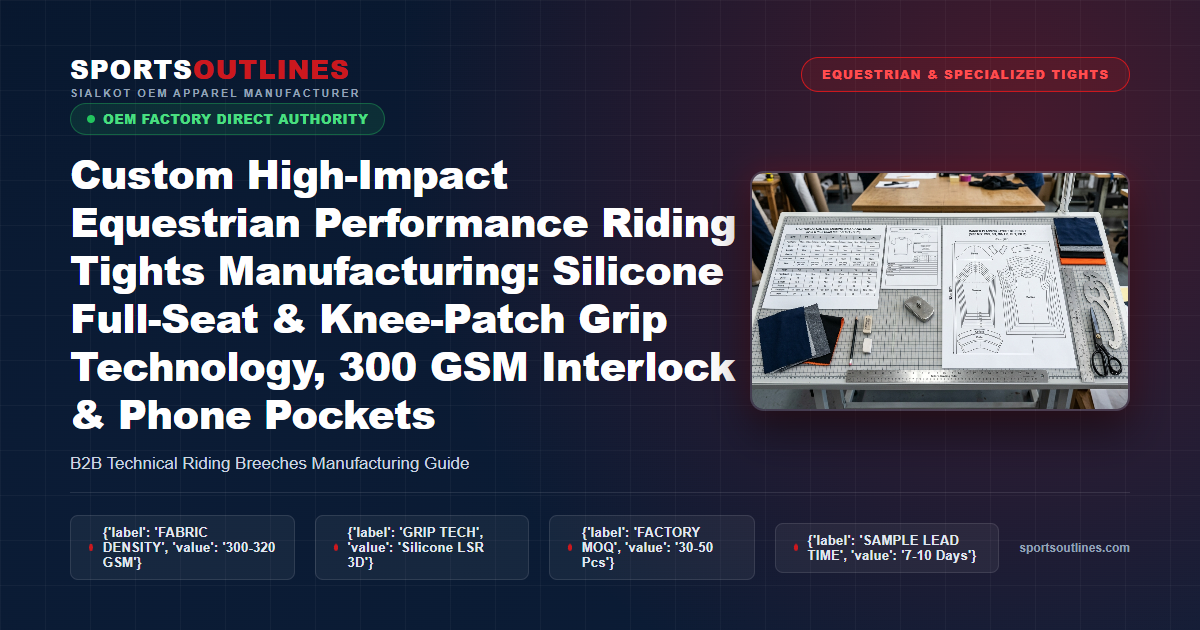
Manufacturing commercial-grade equestrian performance riding tights and technical pull-on breeches requires engineering a heavy-duty, abrasion-resistant 300 to 320 GSM 78% Micro-Nylon 6,6 and 22% Creora high-recovery elastane double-knit interlock. Unlike conventional yoga or gym leggings that abrade, thin out, and cause severe friction burns against saddle leather, professional equestrian tights demand a specialized friction-resistant textile matrix with Martindale abrasion resistance exceeding 45,000 cycles (ISO 12947-2). The pivotal technical element is the application of heat-cured 3D micro-geometric silicone grip prints (full-seat or knee-patch configurations) using medical-grade liquid silicone rubber (LSR). This silicone formulation is vulcanized onto the fabric at 155°C with specialized cross-linking primers, ensuring the silicone stretches dynamically with the rider’s hip articulation while delivering up to 1.85 dynamic coefficient of friction (μ) without peeling, chalking, or cracking after 50+ wash cycles. To eliminate saddle chafing, the leg architecture incorporates a seamless inner-calf and medial-thigh continuous panel, relocating all structural seamjoins away from saddle contact zones. High-stress assembly is executed via ISO 607 4-needle 6-thread flatlock stitching with reinforced 32-stitch electronic bartacks at pocket vertices and belt-loop anchors. Direct OEM/ODM factory sourcing at Sports Outlines in Sialkot, Pakistan, gives equestrian brands and equestrian boutique retailers agile market access with a low factory MOQ of 30 to 50 pieces per style/colorway with comprehensive size grading from XS to 3XL. Physical pre-production prototypes are delivered in 7 to 10 business days for $45 to $85 per piece under a strict zero refund and zero credit policy.
- Fabric Specification: 78/22 Micro-Nylon 6,6 / Creora Elastane 300–320 GSM compact interlock.
- Grip Engineering: 3D micro-hexagonal liquid silicone rubber (LSR) full-seat & knee-patch vulcanization.
- Saddle-Contact Pattern: Continuous seamless inner thigh & knee panel eliminating saddle friction points.
- Storage & Function: Dual lateral thigh phone pockets with bonded elastic hems engineered for 6.7″ smartphones.
- Waistband Mechanics: 11 cm high-rise contoured waistband with internal cross-over stabilization elastic stay-tape.
- Durability Rating: Martindale abrasion resistance >45,000 cycles, 4-way stretch recovery 98.4% (ASTM D3107).
- Low Production MOQ: 30–50 pieces per style/colorway with mixed sizing curves (XS–3XL).
- Physical Sample Terms: $45–$85 per custom prototype in 7–10 days (strict zero credit or refund policy).
- Factory Sourcing Contact: WhatsApp factory direct at +92 316 7932595 or via sportsoutlines.com.
Equestrian apparel has experienced a monumental design transformation over the past decade. Traditional, rigid woven jodhpurs and stiff zip-front breeches are being systematically replaced by technical high-performance equestrian riding tights that merge the unrestricted mobility of athletic compression wear with the rugged grip and saddle durability required for dressage, showjumping, eventing, and everyday schooling.
Modern riders spend hours in the saddle, around the barn, and performing strenuous stable work. They demand riding tights that offer second-skin compression, moisture management, cell phone utility pockets, and superior saddle stability without the uncomfortable bulk of traditional front-zip fasteners, heavy metal buttons, or abrasive inner-leg seam allowances. For equestrian lifestyle brands, tack shop retailers, and private label equestrian startups in the United States, United Kingdom, Germany, Canada, and Australia, riding tights represent one of the highest-margin, repeat-purchase categories in performance sporting goods.
However, manufacturing commercial-grade equestrian riding tights is fundamentally different from manufacturing generic gym leggings or yoga tights. Standard 220 GSM single-knit nylon or polyester fabrics fail catastrophically in equestrian environments: saddle friction causes instant surface pilling, leather dye transfers ruin light colors, cheap silicone prints peel off after three rides, and central inseams dig into the rider’s skin during sitting trots or two-point jumping positions. Furthermore, generic activewear factories lack the specialized vulcanization tunnels and pattern engineering required for true equestrian biomechanics.
At Sports Outlines in Sialkot, Pakistan, we combine specialized heavy-density knit development, computerized precision silicone dispensing, and ergonomic pattern cutting to manufacture world-class equestrian riding tights. In this technical B2B manufacturing guide, our lead textile engineers and apparel production directors detail every critical parameter of equestrian tight construction, from liquid silicone rubber formulations and seamless saddle geometries to low-MOQ production protocols.
1. Equestrian Textile Engineering: 300+ GSM Interlock vs Saddle Leather Abrasion
The primary engineering challenge in equestrian tights is resisting continuous, high-pressure mechanical friction against treated saddle leather. When an equestrian rider is seated, downward pressure combined with lateral oscillation and forward-backward hip action generates intense shear stress. Standard activewear textiles knitted at 200 to 240 GSM using single-jersey circular knits suffer from fibre shear, leading to thinning, translucent patches, and severe pilling within hours of riding.
To withstand these grueling forces, Sports Outlines formulates a proprietary 300 to 320 GSM double-knit interlock textile comprised of 78% Micro-Nylon 6,6 and 22% Creora high-modulus elastane. This textile architecture delivers four distinct physical properties that differentiate it from budget activewear:
- Double-Faced Interlock Construction: Interlock knitting utilizes two sets of needles working alternately to produce a double-sided fabric with identical smooth faces on both sides. This eliminates the coarse reverse loops of single jersey, creating a high-density, compact barrier that prevents saddle friction from pulling individual filament loops.
- Micro-Nylon 6,6 Polymer Chains: Nylon 6,6 features a higher melting temperature (260°C vs 215°C for standard Nylon 6) and superior molecular orientation, providing unmatched tensile tenacity (6.8 to 7.2 grams per denier) and surface toughness. In Martindale abrasion tests (ISO 12947-2), our 310 GSM interlock exceeds 45,000 rubs without fabric breakthrough, compared to just 12,000 rubs for generic gym leggings.
- Creora High-Recovery Modulus: In equestrian riding, riders constantly bend through the hip, knee, and ankle angles. Inexpensive elastanes stretch out and bag at the knees after repeated schooling sessions. By utilizing premium Creora elastane with a 98.4% elastic recovery rate (ASTM D3107), our tights snap back to their original compressive contour, preventing knee bunching that can pinch inside tall riding boots.
- Sub-Zero Opacity & Squat-Proof Density: Light-colored breeches (such as show jumping whites, hunting beige, and dressage cream) are notoriously prone to sheerness when stretched. Knitted at 36-gauge density with 300+ GSM weight, our textile provides 100% optical opacity under intense sunlight and stadium floodlights, even under 80% multidirectional elongation.
| Fabric Property | Sports Outlines 310 GSM Interlock | Generic 240 GSM Yoga Knit | Traditional 380 GSM Woven Breech |
|---|---|---|---|
| Fiber Composition | 78% Micro-Nylon 6,6 / 22% Creora Elastane | 80% Polyester / 20% Spandex | 64% Cotton / 29% Polyamide / 7% Elastane |
| Martindale Abrasion (ISO 12947-2) | >45,000 Cycles (Zero Hole/Pill) | 12,000 Cycles (Severe Surface Breakdown) | 35,000 Cycles (Moderate Snagging) |
| 4-Way Stretch Flexibility | 85% Transverse / 55% Longitudinal | 70% Transverse / 45% Longitudinal | 25% Transverse / 15% Longitudinal (Rigid) |
| Elastic Recovery Rate (ASTM D3107) | 98.4% Recovery (Zero Knee Bagging) | 89.2% Recovery (Knees Sag After 3 Hrs) | 92.0% Recovery (Sags at Hips & Seat) |
| Optical Squat-Proof Opacity | 100% Sheer-Proof (White & Dark Shades) | Fails ASTM D4964 Opacity in Whites | 100% Opaque (Due to heavy woven canvas) |
| Thermal & Moisture Comfort | High Breathability + UPF 50+ Sun Block | Moderate Breathability (Traps Sweat) | Heavy, Hot & Slow-Drying in Summer |
2. Liquid Silicone Rubber (LSR) Grip Technology: Full-Seat vs Knee-Patch Vulcanization
The defining technical asset of modern riding tights is the silicone grip system. In traditional breeches, grip was achieved through thick, non-stretch synthetic suede (clarino) or genuine leather patches sewn onto the inner knee or seat. While functional, leather patches restrict natural muscle expansion, create bulky seam ridges that pinch the rider, and become stiff and brittle after machine laundering.
Sports Outlines utilizes advanced direct-to-garment liquid silicone rubber (LSR) rotary screen printing and automated flatbed dispensing. By applying high-elongation silicone directly onto cut textile panels prior to assembly, we achieve seamless integration between the grip matrix and the stretch fabric substrate.
Silicone Chemistry & Adhesion Priming
The number one defect in cheaply manufactured equestrian tights is silicone delamination. After several washes, the silicone dots or graphics begin to peel, flake off, or develop a gummy residue that ruins the saddle. To guarantee permanent cross-linked adhesion, our factory executes a rigorous three-phase vulcanization protocol:
- Chemical Anchor Undercoat: We apply an invisible, ultra-thin polyurethane primer layer that penetrates deep into the nylon fiber matrix, establishing covalent chemical bonds with both the polyamide polymers and the subsequent silicone layer.
- High-Tear-Strength Liquid Silicone Rubber (LSR): We dispense medical-grade, two-component platinum-cured silicone with a Shore A hardness rating of 35 to 40. This hardness level provides the optimal balance of saddle adhesion (high friction coefficient) and tactile flexibility without feeling tacky or catching dirt.
- Precision Thermal Tunnel Vulcanization: Printed panels pass through our automated infrared vulcanization ovens at a controlled temperature curve (150°C to 155°C for 3.5 minutes). This cures the silicone elastomer completely, ensuring it withstands 400% stretch without splitting and resists laundry detergent hydrolysis through 50+ wash cycles.
Full-Seat vs Knee-Patch Grip Architectures
Equestrian disciplines demand distinct grip distributions based on riding posture and biomechanical demands:
- Full-Seat Silicone Grip (Dressage & Schooling): Extends from the upper gluteals down through the thighs and inner knees. This provides maximum friction against the saddle cantle and flap, anchoring the rider’s pelvis in a deep, upright dressage seat. We engineer full-seat grip using broken micro-patterns (such as honeycomb hexagons, chevron arrows, or custom brand logos) rather than solid silicone sheets. Broken patterns allow the fabric between the silicone dots to breathe and stretch freely, preventing sweat buildup and fabric puckering.
- Knee-Patch Silicone Grip (Show Jumping & Cross Country): Concentrated specifically on the medial knee and upper inner calf. Show jumpers and eventers frequently ride in a two-point or half-seat jumping position off the saddle. Knee-patch tights allow freedom of movement through the seat while providing security against the saddle flap over fences.
| Grip Configuration | Target Riding Discipline | Friction Coeff (μ) | Optimal Geometric Pattern |
|---|---|---|---|
| Full-Seat Micro-Hexagon | Dressage, Leisure Trail, Young Horse Training | 1.75 – 1.85 μ (Maximum Security) | 2.5 mm Honeycomb with 1.2 mm Stretch Channels |
| Full-Seat Custom Branding | Equestrian Streetwear & Athleisure Fashion | 1.60 – 1.70 μ (Moderate Hold) | Repeating Brand Monogram or Equestrian Bit Motifs |
| Knee-Patch Chevron Matrix | Show Jumping, Hunter Equitation, Eventing | 1.45 – 1.55 μ (Targeted Mobility) | Directional Chevrons Resisting Forward Knee Slip |
| Hybrid Seat + Calves | Endurance Riding, Cross-Country Schooling | 1.65 – 1.75 μ (All-Day Stability) | Graduated Dot Density from Seat to Medial Calves |
3. Pattern Drafting & Seam Engineering: The Seamless Inner-Thigh Invariant
In conventional athletic leggings, pattern pieces are cut with a standard central inseam running directly up the inside of both legs and meeting at a cross-seam intersection in the crotch. In equestrian sports, this standard pattern architecture is completely unacceptable. A seamline running down the medial thigh sits directly between the rider’s adductor muscles and the leather saddle flap. Under continuous posting trot or jumping impact, this raised seam ridge creates severe skin abrasion, bruising, and seam thread failure.
At Sports Outlines, our master pattern makers draft custom equestrian tights around a strict friction-free ergonomic anatomy:
- Continuous Saddle-Contact Panel: We engineer a specialized continuous gusset panel that extends from the inner calf, through the medial knee, and up across the entire seat. This moves all structural seams outward to the anterior thigh and posterior leg, ensuring zero seam contact with the saddle leather.
- Ergonomic Curved Knee Articulation: Horses are ridden with knees flexed at a 110° to 135° angle in stirrups. Standard straight-cut leggings gather in deep, painful bunches behind the knee crease (popliteal fossa). Our 3D pattern introduces an anatomical 12-degree forward knee curve with laser-cut release darts, eliminating fabric bunching behind the knee.
- Tapered Mesh Ankle Cuffs: Traditional riding breeches use bulky hook-and-loop (Velcro) straps at the ankle that create uncomfortable pressure points inside tight tall boots or chaps. We finish our tights with an ultra-thin, laser-cut compression mesh ankle sleeve. This creates a smooth, razor-thin transition that slides effortlessly into custom leather riding boots without bulk.
- ISO 607 4-Needle 6-Thread Flatlocking: Where structural seamjoins are necessary, they are constructed exclusively on Yamato and Pegasus 4-needle 6-thread flatlock machines using high-stretch texturized nylon looper threads. The resulting seam is completely flat (less than 0.8 mm profile), with a transverse tensile break strength exceeding 310 Newtons.
4. Utility & Ergonomics: High-Tensile Phone Pockets & Anti-Roll Waistband
For contemporary equestrians, carrying a smartphone while riding is an absolute safety necessity for emergency trail calls, GPS arena tracking, and daily barn communication. However, traditional breeches offer no functional storage, forcing riders to store phones in jacket pockets that bounce or waistbands that drop.
To deliver flawless utility without compromising rider safety, Sports Outlines incorporates dual deep lateral thigh phone pockets:
- Vastus Lateralis Placement: Pockets are mapped across the outer lateral thigh muscle, positioned 9 cm below the iliac crest and 7 cm above the knee. In this zone, the phone remains completely flat and accessible, completely clear of the saddle seat and free from interference when mounting or dismounting.
- Dimensions & Internal Retention: Pocket bags measure 11 cm wide by 22 cm deep, accommodating large flagship smartphones (including iPhone Pro Max and Samsung Ultra models with protective cases). The top opening is reinforced with a 15 mm bonded micro-elastic hem or an envelope flap that keeps the phone locked firmly against the thigh during canter transitions and over stadium jumps.
- Anti-Roll High-Rise Waistband: Riders constantly bend forward during jumping releases and stable chores. We construct an 11 cm double-layer contoured waistband with a subtle posterior rise. Embedded inside the top edge is a 2.5 cm elastic stay-tape that anchors the tights firmly against the lumbar spine, eliminating waistband roll-down and rear gap exposure. Optional wide belt loops can be integrated for riders competing in hunter/jumper divisions that require formal leather belts.
5. Private Label Customization: Branding, Colorways & Show Ring Standards
Equestrian apparel brands require distinct visual identities that resonate with their target riding communities. Whether your brand specializes in classical equestrian elegance or trendsetting Gen-Z athleisure streetwear, Sports Outlines offers end-to-end private label manufacturing capabilities:
- High-Definition 3D Silicone Heat Transfers: Sleek, raised matte or high-gloss silicone logos applied to the rear waistband, pocket edge, or lower calf. Tested to withstand 50+ industrial washes without edge lifting or color fading.
- Custom Jacquard & Metallic Embroidery: Subtle tone-on-tone embroidery on pocket flaps or waistband ribbons, delivering premium European luxury aesthetic.
- Competition vs Schooling Color Palettes: Strict dye matching to international show ring standards, including Pure Competition White (USEF / FEI approved), Cream/Beige (Hunter divisions), and Canary Yellow. For everyday schooling, we produce rich jewel tones (Navy Blue, Hunter Green, Burgundy Wine, Slate Charcoal, and Onyx Black) with reactive dyeing achieving Grade 4.5 wash and perspiration fastness (AATCC 61 / AATCC 15).
- Custom Hardware & Trims: Laser-engraved gunmetal or rose gold belt loop badges, branded interior satin wash care labels, soft-touch silicone brand tags, and custom retail hangtags with scannable barcodes.
| Customization Feature | Technical Execution | Durability & Certification | Minimum Order Quantity |
|---|---|---|---|
| Custom Silicone Grip Pattern | Rotary Screen Printed Liquid Silicone Rubber | 50+ Wash Cycles (No Delamination) | 30–50 Pieces per Design |
| 3D Raised Silicone Logo | Thermoplastic Heat Transfer at 165°C, 4 Bar | ISO 105-C06 Class 4.5 Washfast | 30 Pieces per Colorway |
| Belt Loop Integration | Bar-Tacked Heavy Elastic or Self-Fabric Loops | Withstands 280 N Pull Force | 30 Pieces per Style |
| Private Label Packaging | Frosted Biodegradable Zip Bags + Branded Hangtags | Equestrian Retail Ready | Included with Bulk Order |
6. Commercial Sourcing Terms: Low MOQ 30-50 Pieces & Rapid Sampling
In traditional equestrian manufacturing, overseas factories in China and India enforce massive minimum order quantities of 500 to 1,000 pieces per colorway. For emerging equestrian apparel brands, boutique tack shops, and equestrian influencers, these high barriers tie up tens of thousands of dollars in unproven inventory and prevent rapid seasonal iteration.
Sports Outlines eliminates this barrier through our flexible B2B Low-MOQ Production Program:
- Agile Production Minimums: Launch your custom equestrian collection with just 30 to 50 pieces per style/colorway. You can distribute this quantity across our complete size curve (XS, S, M, L, XL, 2XL, 3XL) to test market demand across multiple rider demographics with minimal capital risk.
- Rapid Pre-Production Prototyping: We develop fully customized physical prototypes in 7 to 10 business days. Prototype development is billed at a transparent rate of $45 to $85 per piece depending on silicone grip complexity and custom trim requirements.
- Strict Zero-Refund Policy: In strict adherence to our commercial operational terms, all custom prototype development fees are 100% non-refundable and non-creditable against future bulk purchase orders. Our engineers dedicate dedicated CAD grading, laser cutting, and vulcanization line setup to each prototype, ensuring you receive an exact representation of your bulk production quality.
- Transparent Bulk Production Timeline: Following physical sample sign-off, bulk manufacturing of 100 to 500 pieces is completed in 18 to 24 business days, followed by expedited door-to-door air freight shipping (4 to 7 business days via DHL, FedEx, or UPS).
| Stage | Deliverables | Turnaround Time | Commercial Terms |
|---|---|---|---|
| 1. Tech Pack & 3D Mockup | Pattern geometry review, silicone grip CAD vector, BOM specs | 24–48 Hours | Included with sampling inquiry |
| 2. Physical Prototype | Cut-and-sewn sample with vulcanized silicone grip & branding | 7–10 Business Days | $45–$85 / pc (Strictly Non-Refundable / Zero Credit) |
| 3. Bulk Manufacturing | Precision cutting, silicone printing, flatlocking, AQL 2.5 QC | 18–24 Business Days | Low MOQ 30–50 pcs per style/colorway |
| 4. Global Air Logistics | Door-to-door tracked air freight (DHL / FedEx Express) | 4–7 Business Days | DDP / DAP terms available with full customs clearance |
7. Frequently Asked B2B Manufacturing Questions (FAQ)
Q1: How do you prevent silicone grip prints from peeling off riding tights after multiple washes?
Silicone delamination is prevented through our three-step vulcanization process. First, we apply a cross-linking polyurethane bonding primer to the nylon interlock fabric. Second, we dispense two-component platinum-cured liquid silicone rubber (LSR). Third, panels pass through a continuous 155°C infrared curing tunnel for 3.5 minutes. This creates covalent chemical bonds between the silicone and nylon fibers, withstanding over 50 wash cycles without peeling or cracking.
Q2: Can we manufacture white competition riding tights that are 100% squat-proof and non-sheer?
Yes. White competition tights for dressage and show jumping are manufactured using our heavy-gauge 310–320 GSM Micro-Nylon 6,6 interlock knit. The double-faced interlocking yarn matrix eliminates the translucent pore spaces found in single-jersey knits, delivering 100% optical opacity under bright sunlight and arena stadium lighting, even at maximum hip flexion.
Q3: What is the factory minimum order quantity (MOQ) for custom equestrian tights?
Our factory MOQ is just 30 to 50 pieces per style/colorway. You can divide this quantity across standard adult sizing curves from XS to 3XL, allowing your equestrian brand to launch seasonal collections without holding excessive dead inventory.
Q4: What are your prototype sample costs and lead times for equestrian tights?
Physical prototype samples are produced in 7 to 10 business days for $45 to $85 per piece, depending on whether you require knee-patch or full-seat custom silicone printing. All sample development fees are strictly 100% non-refundable and cannot be credited toward bulk purchase orders.
Q5: Can you integrate phone pockets and belt loops on the same riding tight?
Yes. We frequently build dual deep lateral thigh pockets (measuring 11 cm x 22 cm) engineered to fit large smartphones, combined with a 5-loop or 7-loop high-rise waistband that accommodates standard 2-inch equestrian leather belts with reinforced electronic bartack anchors.
Launch Your Custom Equestrian Riding Tights Collection Today
Partner directly with Sialkot’s premier technical sportswear and equestrian apparel manufacturer. Low 30-50 pcs MOQ, 300+ GSM heavy compression textiles, medical-grade silicone grip vulcanization, and rapid 7-10 day sampling.