Direct Manufacturer Answer: How to Manufacture Custom Karate Gis
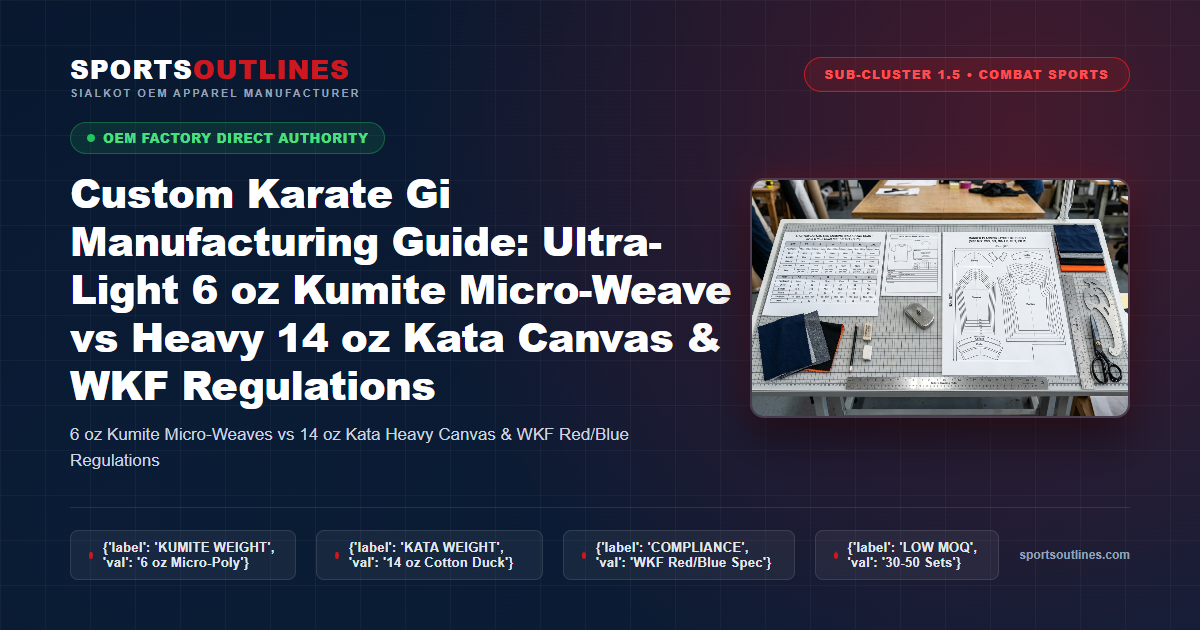
Manufacturing professional custom Karate Gis (Karategi) requires bifurcation into two distinct athletic disciplines: Kumite (Sparring) and Kata (Forms Demonstration). A modern Kumite Gi is constructed from ultra-lightweight 6 to 7 oz (180 to 200 GSM) poly-cotton or 100% micro-polyester jacquard diamond weave. It incorporates integrated 4-way stretch mesh ventilation gussets beneath the armpits and across the inner crotch, eliminating skin friction during lightning-fast reverse punches (Gyaku-Tsuki) and blitz footwork. In contrast, a championship Kata Gi is crafted from heavyweight 12 to 14 oz (380 to 450 GSM) 100% combed cotton duck canvas. It features multiple rows of reinforced chainstitching along 5 cm stiffened hems and lapels to generate thunderous acoustic “snap” resonance during high-velocity terminal lockouts. Both styles comply with World Karate Federation (WKF) competition standards, including red (Aka) and blue (Ao) shoulder embroidery regulations, precise jacket overlap coverage over the hips, and sleeve clearances terminating between mid-forearm and wrists. Factory direct low MOQ at our Sialkot facility starts at 30 to 50 uniform sets per style/order across international sizing (0000/100 cm to 7/200 cm). Pre-production physical prototype samples cost $45 to $85 per custom set completed in 7 to 10 business days.
- Kumite Sparring Specs: 6–7 oz (180–200 GSM) Diamond Micro-Poly Weave with breathable mesh underarm ventilation panels.
- Kata Forms Specs: 12–14 oz (380–450 GSM) 100% Combed Cotton Duck Canvas with heavy 5-row chainstitched acoustic snap hems.
- WKF Federation Compliance: Approved collar dimensions, jacket overlap geometry, and red (Aka) & blue (Ao) shoulder embroidery.
- Inseam Mobility Engineering: 180° diamond crotch gusset joined with 5-thread safety overlocking for unrestricted kicking.
- Pant Retention Options: Traditional Japanese high-rise drawstring waist for masters vs. 5 cm elastic with drawcord for students.
- Factory Low MOQ: 30–50 complete uniform sets per style with flexible size grading across adult and youth matrices.
- Physical Prototype Sampling: $45–$85 per custom set completed in 7–10 days (strict zero credit/refund policy).
- Direct Factory Sourcing: WhatsApp factory direct at +92 316 7932595 or sportsoutlines.com.
In traditional Japanese and Okinawan Karate—from Shotokan and Goju-Ryu to Shito-Ryu and Wado-Ryu—the Karategi is a sacred uniform embodying discipline, humility, and deadly kinetic potential. In modern Olympic and WKF competition, however, Karate has separated into two fundamentally different physical disciplines that require completely distinct garment engineering.
For martial arts academy owners, tournament promoters, and combat apparel founders in the USA, UK, Australia, and Germany, sourcing custom Karate Gis from generic suppliers leads to severe product defects: Kumite Gis made from suffocating fabrics that turn yellow from sweat, Kata Gis that droop limply without an audible snap, and non-compliant shoulder embroidery rejected at WKF championship inspection desks.
At Sports Outlines in Sialkot, Pakistan, our specialized martial arts tailoring floor builds competition-certified Karategis for international dojo associations, national federations, and premium combat lifestyle brands worldwide. This comprehensive technical guide breaks down the engineering differences between Kumite and Kata uniforms, WKF red/blue shoulder embroidery rules, shrinkage control via steam sanforization, sizing grading, and factory direct low MOQ economics.
1. The Architectural Divide: Kumite (Sparring) vs. Kata (Forms) Uniforms
A generic “all-purpose” Karate Gi cannot satisfy modern tournament standards. Athletes require specialized garment geometry and textile weights engineered for their specific competitive discipline:
The Science of the Kata “Snap” (Acoustic Pressure Dynamics)
In Kata competition, judges evaluate kinetic acceleration, body tension (Kime), and timing. When a master karateka throws a reverse punch, knife-hand block (Shuto-Uke), or front kick (Mae-Geri), the sudden terminal deceleration compresses air between the overlapping layers of heavy canvas, producing a sharp, explosive acoustic crack.
To maximize acoustic volume in our 14 oz Kata Gis, we use 100% ring-spun combed cotton yarns (Ne 16/2 x 16/2) woven in an extra-tight plain duck canvas structure. The sleeve openings, jacket hem, and pant cuffs are reinforced with five parallel rows of heavy lockstitching through an internal 35 mm stiffened canvas interlining. When a technique decelerates, this weighted hem snaps forward like a mechanical whip, amplifying the audible sound wave by up to 12 decibels without fraying the fabric edges.
2. World Karate Federation (WKF) Competition Compliance Standards
At WKF sanctioned tournaments (Premier League, Series A, World Championships), athletes must present compliant uniforms at the inspection desk prior to competition:
3. Crotch Gusset Engineering & Waistband Systems
High-speed kicking mobility in Kumite requires complete freedom in the hip adductor and groin regions:
- 180-Degree Diamond Inseam Gusset: In traditional pants, center cross-seams bind when kicking high roundhouse (Mawashi-Geri) or hook kicks (Ura-Mawashi-Geri). Our pants incorporate an elongated diamond gusset extending from mid-thigh to mid-thigh, eliminating tensile binding.
- 4-Way Stretch Ventilation Mesh (Kumite Edition): In Kumite pants, the central diamond gusset is cut from 200 GSM poly-spandex micro-mesh. This allows hot air to escape from the groin while providing zero mechanical resistance when extending kicks.
- High-Waisted Traditional Drawstring (Kata Edition): Kata masters favor a traditional Japanese high-rise cut with an unyielding 100% cotton tubular drawstring threaded through heavy canvas loops, providing rigid core lumbar compression.
- Dual Elastic & Internal Drawcord (Club Edition): For student and club lines, we engineer a 50 mm multi-channel elastic waistband with an internal flat braided drawstring, ensuring fast dressing and secure fit for youth athletes.
4. Sizing Matrix: Japanese Height Grading (0000 to 7)
Karate Gis are graded according to international metric practitioner heights:
5. Quality Assurance Protocols: Shrinkage Control & AQL 2.5 Standards
At Sports Outlines, our martial arts apparel manufacturing lines operate under strict ISO 9001 and AQL 2.5 quality control standards to deliver world-class tournament reliability:
- Rotary Sanforization for 14 oz Canvas: Raw heavy cotton canvas undergoes continuous rotary steam compaction, keeping washing shrinkage strictly under 2.0% in warp and 1.5% in weft. This ensures sleeves and pant cuffs remain within legal WKF tolerances through repeated hot water washing cycles.
- Tensile Seam Shear Testing (ASTM D1683): Crotch gussets and armhole sleeve seams are tested to withstand over 380 Newtons of tensile strain without thread rupture, preventing blowouts during dynamic jumping spinning kicks.
- Spectrophotometer Whiteness Audit (ISO 105-J02): White Karategi fabrics achieve an optical whiteness index exceeding 140 (CIE illuminant D65), producing an immaculate, radiant presentation under tournament broadcast lighting without chalky residue.
- Hashima Conveyor Metal Detection: 100% of finished Karategis pass through automated 9-point conveyor needle detection scanners to ensure zero broken needle fragments remain trapped in garments.
Laboratory Mechanical Auditing & Acoustic Snap Testing
To guarantee that Kumite uniforms deliver frictionless speed while Kata uniforms project decisive acoustic snap feedback, our in-house textile laboratory subjects every fabric lot to calibrated physical benchmarks:
6. Points of Measure (POM) Manufacturing Tolerances
Every completed production run at Sports Outlines is audited on calibrated hardwood inspection tables against strict Points of Measure (POM) tolerance windows to comply with WKF competition regulations:
7. Sourcing Economics: Unit Costs, Sampling Rules & Low Factory MOQ
At Sports Outlines, we eliminate the large minimum volume requirements of overseas manufacturers. We offer factory direct low MOQ starting at only 30 to 50 sets per style with mixed height size curves:
Sampling Protocol: $45–$85 Physical Prototypes in 7–10 Days
We mandate physical sample approval prior to bulk production. Physical prototypes cost $45 to $85 per custom uniform set. This fee covers digital embroidery digitizing, pattern drafting, precision laser cutting, assembly, and WKF specification verification over 7 to 10 business days. We maintain a strict zero-refund and zero-credit policy on sample fees. Once approved, the physical prototype serves as the golden standard for bulk manufacturing.
Manufacture Custom Karate Gis with Low MOQ
Equip your dojo or launch your martial arts apparel line with championship-ready Karate Gis engineered in Sialkot. From ultra-light 6 oz Kumite micro-weaves to 14 oz heavy Kata canvas with acoustic snap resonance, we deliver world-class craftsmanship with 30–50 sets low MOQ and fast 7–10 days physical sampling.
8. Frequently Asked Questions (FAQ) — Custom Karate Gi Manufacturing
1. What is the difference between a Kumite Gi and a Kata Gi?
A Kumite Gi is ultra-lightweight (6 to 7 oz) made from micro-polyester diamond weaves with mesh ventilation zones, engineered for maximum punching speed and zero sweat cling. A Kata Gi is heavyweight (12 to 14 oz) made from dense cotton duck canvas with stiffened hems, designed to maintain crisp geometric posture and generate a sharp acoustic snap sound during forms execution.
2. What are the World Karate Federation (WKF) rules for shoulder embroidery?
Under WKF regulations for sanctioned tournaments, competitors must wear manufacturer shoulder embroidery in either Red (Aka) or Blue (Ao) depending on their assigned competition corner. The embroidery extends across both shoulders along the sleeve seam, measuring a maximum length of 25 cm.
3. How do you engineer the acoustic snap in 14 oz Kata uniforms?
We weave our Kata canvas using 100% ring-spun combed cotton yarns (Ne 16/2) in a tight duck weave. Sleeve hems, jacket skirts, and pant cuffs are reinforced with five parallel rows of heavy lockstitching through an internal 35 mm stiffened canvas core, creating a weighted whip effect that pops audibly upon rapid deceleration.
4. What is your minimum order quantity (MOQ) for custom Karate Gis?
Our factory direct low MOQ is 30 to 50 uniform sets per style. You can split this low order volume across standard height sizes (Size 0000/100 cm to Size 7/200 cm) and can divide orders between red and blue shoulder embroidery variants.
5. How much does a physical sample prototype cost, and what is the turnaround time?
A physical custom prototype sample costs $45 to $85 per uniform set depending on whether it is a 6 oz Kumite micro-weave or 14 oz heavy Kata canvas. Turnaround time for pattern drafting, embroidery digitizing, and assembly is 7 to 10 business days, followed by 4 to 6 business days for DHL/FedEx Express air delivery directly from Sialkot.
6. How do you control shrinkage in heavy 100% cotton Kata uniforms?
All raw cotton canvas rolls undergo high-pressure industrial rotary steam sanforization prior to pattern cutting. Washing shrinkage is strictly contained below 2.0% in warp and 1.5% in weft, ensuring that sleeve and pant lengths remain within legal tournament margins after washing.
7. Can you produce traditional Japanese drawstring pants as well as elastic waistbands?
Yes. We manufacture both traditional high-waist drawstring pants (favored by black belts and Kata traditionalists) and 50 mm elastic waistbands with internal flat drawstrings (favored by youth programs and modern Kumite athletes).
8. Can dojos order traditional unbleached natural canvas (Kizara) instead of optic white?
Yes. While WKF Olympic rules require radiant optic white (ISO whiteness index exceeding 140), traditional Japanese karate schools (Shotokan, Goju-Ryu, Kyokushin) frequently order our unbleached 12 oz and 14 oz natural cotton canvas (Kizara). This fabric preserves raw ecru cotton fibers, provides superior sweat absorption, and softens with age into a buttery, indestructible armor without chemical optical brighteners.
9. How do you prevent skin irritation from internal WKF shoulder embroidery backing?
Direct high-density embroidery threads can create rough internal friction against an athlete’s shoulders during high-repetition striking. At Sports Outlines, all custom embroidery—including mandatory WKF Red and Blue shoulder typography—is backed with an ultra-soft heat-sealed tricot or satin comfort lining. This shields the skin completely, preventing abrasion while anchoring the embroidery stitches through intense perspiration.
10. What seam engineering prevents crotch blowout during extreme jumping kicks?
High-amplitude kicks (such as Tobi Ushiro Mawashi Geri) place violent shear loads across the pant inseam. We engineer a 180-degree diamond crotch gusset joined with 5-thread high-tensile safety overlocking, reinforced by dual rows of exterior topstitching. This multi-panel geometry disperses mechanical stress across the entire thigh axis rather than concentrating force at a single 4-way cross seam, completely eliminating seam blowout.
Explore Related Combat Sports & Teamwear Manufacturing Guides:
Complete your martial arts collection with our factory guides on Custom Taekwondo Doboks, Custom Judo Gis, or explore our Factory Sportswear Catalog.