Direct Manufacturer Answer: How to Manufacture Custom High-Impact Encapsulation Sports Bras
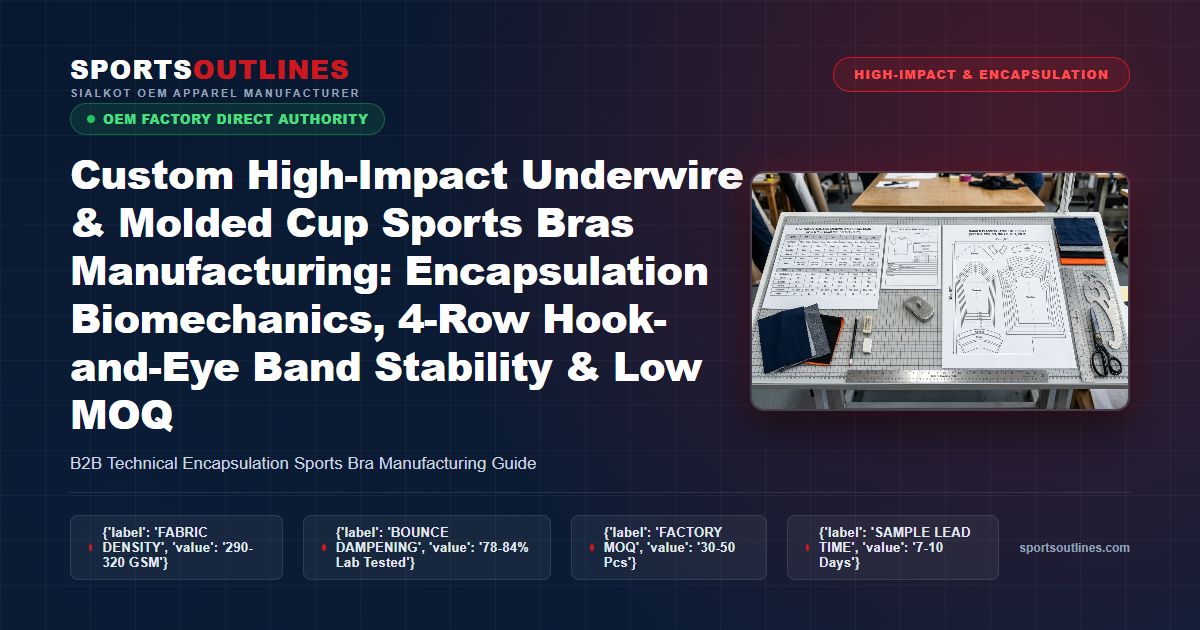
Manufacturing commercial-grade, high-impact athletic sports bras requires transitioning from basic single-panel compression to individual molded cup encapsulation biomechanics. Where compression bras flatten breast tissue against the thoracic cage (often causing Cooper’s ligament stress, displacement, and respiratory restriction during vigorous running), encapsulation sports bras support each breast independently using thermoformed high-resilience polyurethane or spacer fabric molded cups paired with cushioned, flex-alloy encapsulated underwires or high-modulus bonded cradle anchors. The shell is engineered from a heavy-gauge 290 to 320 GSM 75% Micro-Nylon 6,6 and 25% Creora high-recovery elastane double-knit interlock, delivering multi-directional stability and greater than 98% elastic recovery under repeated cyclic strain. The underband delivers approximately 80% of total structural support and is constructed with a wide 38 mm to 50 mm brushed microfiber plush elastic core secured by a 3-row or 4-row heavy-duty padded hook-and-eye closure system. Structural shoulder straps utilize padded spacer foam laminates with non-stretch micro-stabilizers to prevent downward vertical breast displacement (Δz) exceeding 2 cm during high-g athletic impacts. At Sports Outlines in Sialkot, Pakistan, we manufacture custom private label high-impact sports bras with an agile low factory MOQ of 30 to 50 pieces per style/colorway across extended cup and band curves from 32B to 42G. Physical pre-production prototypes are developed in 7 to 10 business days for $45 to $85 per piece under a strict zero refund and zero credit policy.
- Structural Archetype: Dual-layer encapsulation biomechanics with individually molded 3D cups.
- Textile Matrix: 75/25 Micro-Nylon 6,6 / Creora Elastane 290–320 GSM heavy interlock + 3D spacer lining.
- Underwire Cushioning: Nylon-coated spring-steel or flex-titanium wire encased in triple-plush microfiber channeling.
- Band Support System: 45 mm high-tension plush underband with 3×4 or 4×4 padded hook-and-eye fastener closure.
- Shoulder Architecture: Ergonomic gel-padded or laminated spacer straps with non-stretch anterior stabilizers.
- Biomechanical Performance: 74% to 83% reduction in multidirectional breast displacement during treadmill sprint tests.
- Low Production MOQ: 30–50 pieces per style/colorway across flexible cup and band grading matrices (32B–42G).
- Physical Sample Terms: $45–$85 per custom prototype in 7–10 days (strict zero credit or refund policy).
- Factory Sourcing Contact: WhatsApp factory direct at +92 316 7932595 or via sportsoutlines.com.
In performance sports apparel engineering, few garments present greater biomechanical and structural complexity than the high-impact underwire and molded cup encapsulation sports bra. While generic fitness apparel brands frequently flood the market with simple pull-over compression crops, serious runners, cross-training athletes, and full-busted gym-goers continually seek genuine encapsulation bras capable of eliminating high-frequency breast displacement without causing skin abrasion, chest restriction, or aesthetic uniboob compression.
During vigorous athletic activities such as distance running, plyometric training, equestrian riding, and HIIT workouts, unsupported or poorly supported breast tissue moves in a complex three-dimensional figure-eight trajectory. Research conducted by biomechanical sports labs demonstrates that female breasts can accelerate up to 8g, moving upwards, downwards, laterally, and anterior-posteriorly by as much as 15 centimeters per stride. Because the breast has no skeletal or muscular support—relying exclusively on fragile, non-elastic Cooper’s ligaments and superficial fascial skin tension—repetitive high-impact strain induces irreversible tissue stretching, severe ligament fatigue, and acute exercise-induced mastalgia.
For emerging activewear startups, premium direct-to-consumer (D2C) brands, and athletic boutique retailers in the United States, United Kingdom, Australia, Canada, and Germany, high-impact sports bras represent the single highest customer retention vehicle in their entire product catalog. A customer who discovers a sports bra that completely halts bounce while remaining comfortable during a half-marathon or deadlift session develops lifelong brand loyalty and repeat purchasing habits across associated sportswear and squat-proof gym leggings collections.
However, executing a commercially viable, technically flawless molded cup high-impact sports bra requires factory infrastructure far beyond standard cut-and-sew apparel assembly. It requires precision thermoforming aluminum molds, specialized plush-lined wire-channel tunneling machines, calibrated underband tension gauges, and deep intimate apparel grade grading algorithms. At Sports Outlines in Sialkot, Pakistan, our specialized bra manufacturing facility bridges the gap between surgical intimate apparel precision and high-performance athletic textile engineering.
1. Biomechanical Fundamentals: Compression vs. Encapsulation vs. Combination Systems
To engineer an elite athletic sports bra, activewear founders must understand the fundamental physical principles of breast support. In traditional sports apparel, manufacturers rely on three primary structural paradigms:
- 1. Pure Compression Systems: Standard pull-over crop tops press breast tissue flat against the chest wall in an attempt to restrict mass displacement through surface tension. While effective for smaller breast sizes (cup sizes A and B) during low-to-moderate velocity movements, compression bras suffer catastrophic mechanical failure for cup sizes C through G. During vertical impact phases, the compressed breast mass acts as a single unified load, pushing downward and causing the lower elastic band to roll, pinch, or slide up the ribcage. Furthermore, the uniform compressive force restricts diaphragmatic breathing during maximum cardiovascular exertion.
- 2. Pure Encapsulation Systems: Originating in luxury lingerie and medical support orthotics, encapsulation models isolate each breast into a dedicated structural cradle and molded cup pocket. Rather than crushing breast tissue against the ribs, encapsulation maintains the anatomical curvature of each breast, stabilizing the superior, lateral, and inferior margins independently. Encapsulation delivers superior 3D motion control—specifically dampening lateral and rotational sheer forces that compression garments fail to arrest.
- 3. Combination Hybrid Architecture (The Gold Standard): Modern elite high-impact sports bras manufactured by Sports Outlines utilize a sophisticated hybrid architecture. We construct an interior intimate encapsulation chassis comprising individual thermoformed cups and cushioned underwire cradles, overlaid with an external high-modulus compression panel. This dual-layer system harnesses the independent isolation of encapsulation while providing an outer aerodynamic compressive envelope that dampens secondary harmonic resonance during sprints and high-cadence strides.
2. Molded Cup Technology: Spacer Fabric vs. High-Resilience Polyurethane Foam
At the heart of every encapsulation sports bra lies the molded cup. The cup performs three indispensable functions: it shapes the silhouette to prevent breast flattening, it provides structural rigidity that halts upward and downward displacement, and it prevents modesty show-through during sub-ambient temperature exposure or intense sweat saturation. At Sports Outlines, we engineer cups using two primary material technologies:
A. 3D Knitted Spacer Fabric Cups (Breathable & Ultra-Lightweight)
3D spacer fabric represents the frontier of modern high-performance sports bra engineering. Instead of a solid foam block, spacer fabric consists of two micro-knitted textile faces connected by thousands of vertical monofilament micro-struts (typically 1.5 mm to 3.0 mm in thickness). When thermoformed over heated CNC aluminum breast molds at 185°C, the spacer fabric adopts a permanent, three-dimensional cup geometry that offers remarkable advantages:
- Unrivaled Air Permeability: Airflow rates exceed 180 cm³/cm²/s (ASTM D737), allowing sweat vapor to evaporate directly through the cup core rather than accumulating against the skin.
- Zero Water Absorption: Unlike conventional sponge foams that soak up moisture like a sponge during distance running, hydrophobic spacer monofilaments resist water retention, maintaining an ultra-light dry weight throughout a 2-hour workout.
- Anisotropic Structural Elasticity: We calibrate the knit orientation so the cup provides minimal stretch in the vertical axis (preventing bounce) while offering compliant horizontal flexibility to adapt to natural anatomical cup variations.
B. High-Resilience Micro-Perforated Polyurethane (PU) Foam Cups
For heavy impact running, boxing, and high-impact athletics where maximum cup firmness and nipple concealment are paramount, thermoformed polyurethane foam remains the benchmark. However, standard low-density PU foam degrades, yellows, and retains heat. Sports Outlines utilizes premium open-cell high-resilience (HR) polyurethane foam engineered with microscopic laser or mechanical pin-hole perforations.
Our thermoforming process utilizes differential heat zones: the apex of the cup is molded to a refined 2.5 mm thickness to preserve delicacy, while the lower crescent cradle is engineered to a supportive 4.5 mm thickness to provide structural lift. Every molded cup is heat-bonded to an interior lining of hydrophilic micro-polyester mesh, ensuring rapid capillary wicking away from the breast fold (inframammary crease).
3. Underwire Engineering & Anti-Chafe Channel Cushioning
Integrating an underwire into an athletic sports bra is an exercise in extreme mechanical balance. In standard daily lingerie, underwires frequently cause acute discomfort, digging into the sternum or poking through the outer casing after repeated machine laundering. In high-impact athletic sportswear, where the athlete’s ribcage expands dynamically and twists across sagittal and frontal planes, an improperly engineered underwire will cause skin ulcerations, bruising, and immediate product returns.
At Sports Outlines, we eliminate underwire failures through a three-tier hardware and tunneling protocol:
- Flex-Titanium & Memory Alloy Core Wire: Rather than using rigid carbon steel that bends permanently when twisted, we offer ultra-flexible nickel-titanium (Nitinol) or high-grade spring-steel wire coated in a double dip of thermoplastic nylon resin. The wire possesses a 3D curved geometry that rests completely flush against the thoracic ribcage, flexing outward during deep diaphragmatic breaths and snapping back into its supportive curvature instantly.
- Triple-Plush Ultrasonic Wire Tunneling: The wire is never stitched directly against the bra fabric. Instead, it is housed within a specialized 11 mm wide, triple-layer plush microfiber casing. The interior layer of the channel is padded with a 1.5 mm high-density open-cell micro-foam cushion, completely isolating the metal wire from the athlete’s skin. The casing is bonded and twin-needle stitched using Coats Gramax continuous filament texturized sewing thread, providing burst strengths exceeding 220 Newtons.
- Extended End-Caps & Floating Wire Anchors: To prevent underwire puncture at the armpit (axilla) or sternum (center gore), our engineers build a 15 mm empty expansion clearance inside the channel endpoints. The ends of the wire are capped with medical-grade rounded epoxy spheres. The wire literally ‘floats’ within its cushioned sleeve, expanding during arm swings and upper body rotations without exerting localized pressure points against delicate lymph nodes or rib cartilage.
4. The Foundation: Underband Stability, Hook-and-Eye Closures & Load Distribution
A common misconception among apparel designers is that sports bra support originates from the shoulder straps. Biomechanical research unequivocally disproves this: between 75% and 85% of total upward vertical breast support is generated by the lower thoracic underband. If the underband is loose, narrow, or structurally deficient, the entire gravitational load shifts to the trapezius muscles via the shoulder straps, causing neck strain, headaches, and shoulder grooving.
Our engineering team incorporates a reinforced rigid non-stretch center gore between the cups. In cheap sports bras, the center bridge is made of stretchy jersey; when the athlete jumps, the cups pull apart, allowing breasts to collide and rub together. By locking the center gore with non-stretch monofilament nylon tricot, the cups remain permanently anchored to the sternum, achieving complete mechanical isolation.
5. Shoulder Strap Dynamics: Conversion Mechanisms & Pressure Relief
While the band provides primary support, shoulder straps govern the vertical displacement ceiling. During the downward deceleration phase of running, breast inertia pulls downward on the straps with forces exceeding 40 Newtons per side. If the straps are constructed from standard stretchy elastic, they elongate, allowing the breasts to drop before snapping back upward in a destabilizing rebound.
Sports Outlines engineers shoulder straps utilizing segmented non-stretch stabilization zones:
- Anterior Non-Stretch Zone: The front portion of the strap connecting from the top of the cup over the shoulder apex is lined with a non-stretch stabilizer tape. This prevents the strap from stretching vertically when the breast descends during foot strike.
- Cushioned Pressure Dispersion Core: Over the clavicle and upper trapezius, the strap widens to 25 mm or 30 mm and incorporates an integrated 3 mm perforated neoprene or laminated EVA foam core. This distributes downward pressure across a 300% wider surface area, preventing shoulder furrows and nerve compression.
- Posterior Micro-Adjustment: The back section of the strap features high-tensile, low-profile coated zinc alloy sliders and rings. These allow the athlete to adjust strap tension precisely by the millimeter to match their torso length.
- Convertible Racerback J-Hook or Cross-Back Hardware: For runners requiring added scapular freedom and elevated bounce control, we integrate low-profile coated alloy J-hooks. With a single click, the athlete converts the traditional H-back strap layout into an aggressive racerback configuration. Biomechanical tracking confirms that converting to a racerback increases vertical breast stability by an additional 11% to 14% by pulling the vector load inward toward the spine.
6. Extended Sizing Architecture & Intimate Apparel Pattern Grading
The Achilles’ heel of most fitness wear factories is apparel grading. Conventional activewear factories grade garments using simple scalar perimeter increases: a Size L is simply 5 cm wider all around than a Size M. This simplistic approach fails catastrophically in sports bras. In a proper bra matrix, band size and cup size are independent Cartesian variables:
- A 32DD athlete has a narrow 70 cm ribcage combined with an 88 cm bust circumference. She requires high band compression, narrow wire curvature, and deep cup volume.
- A 38B athlete has a broad 85 cm ribcage with an 93 cm bust circumference. She requires an elongated band circumference, wide wire radius, and shallow cup depth.
- If a factory grades a sports bra merely as Small, Medium, Large, and Extra-Large, over 65% of female athletic consumers will experience poor fit, chafing, or structural bounce. When designing your technical apparel tech packs, specifying dual-axis band and cup grading is imperative.
At Sports Outlines, our computerized CAD pattern engineering department grades high-impact sports bras across true intimate apparel matrices, supporting up to 36 distinct band-and-cup combinations (30C to 42G). We account for sister sizing mechanics (e.g., recognizing that a 34D, 36C, and 38B share identical cup volumes despite differing band lengths) and automatically adjust underwire curvature radii and hook-and-eye heights for every individual sizing cluster.
6.1 International Sizing Conversion Matrices
For international sportswear brands selling across multichannel e-commerce storefronts in North America, Great Britain, the European Union, and Australasia, sports bra labeling requires synchronized international conversion. In the United Kingdom and Australia, cup progression retains double-letter steps (D, DD, E, F, FF, G), whereas European metric sizing adopts centimeter-based underbust increments (70, 75, 80, 85, 90) with singular alphabetical cup progressions. At Sports Outlines, our automated labeling system prints multilingual, multi-regional care tags that clearly state US, UK, EU, and AU sizing equivalencies, eliminating cross-border sizing confusion and minimizing return rates.
Pairing these high-support sports bras with matching lower-body garments like our compression running tights or textured honeycomb gym leggings provides fitness brands with cohesive athletic sets that command premium retail price points ($68 to $110 per set).
7. Quality Control, AQL 2.5 Standards & Rigorous Biomechanical Testing Protocols
Due to the multi-component nature of encapsulation sports bras (often involving up to 28 discrete raw material inputs per bra), quality control must be executed at every production milestone. At our Sialkot manufacturing plant, each bulk production run adheres to strict ISO 9001 and AQL 2.5 Major / 4.0 Minor inspection standards:
8. Factory Sourcing Parameters: Low MOQ, Prototype Terms & Private Label Branding
Traditionally, apparel founders attempting to develop high-impact molded underwire sports bras encountered insurmountable barriers to entry. Giant intimates conglomerates in China and Vietnam routinely require minimum order quantities of 3,000 to 5,000 pieces per size and style, demanding upfront tooling investments of $15,000+ for aluminum cup molds. This effectively shut independent activewear startups out of the high-impact sports bra category.
Sports Outlines disrupts this outdated supply chain barrier. By maintaining an in-house library of pre-engineered ISO-certified aluminum cup molds and high-modulus PowerNet components, we empower independent brands to enter the premium high-support bra sector with agile, low-risk capital deployment:
- Agile Production MOQ: 30 to 50 pieces per style/colorway across standard band and cup assortments.
- Custom Private Label Branding: High-definition silicone heat-transfer logos on underbands, custom woven jacquard underband elastic, branded zinc alloy sliders, custom satin care labels, and premium retail hangtags with FSC certification.
- Fast-Track Prototyping: Fully functional, physically wearable pre-production samples delivered to your door in 7 to 10 business days.
- Transparent Sample Cost Policy: Custom prototype samples are priced at $45 to $85 per piece based on component complexity (wire casing, molding, multi-hook closures). Under our strict operational policy, sample fees are 100% non-refundable and non-creditable against future bulk production orders. We cover actual physical materials, CNC machine setup, and master cutter wages without hidden subsidies.
- Direct International Doorstep Freight: Direct courier shipping (DHL Express / FedEx Priority / Air Cargo) to brand warehouses in North America, Europe, Australia, and the Middle East in 4 to 6 business days with DDP clearance support.
Ready to Launch Your High-Impact Sports Bra Line?
Collaborate directly with the technical apparel engineers at Sports Outlines in Sialkot, Pakistan. Access molded spacer cup technology, cushioned underwires, and low MOQ 30-50 pcs production with fast 7-10 day prototyping.