When outfitting a competitive sports team, launching a private label athletic brand, or designing performance activewear, selecting between dye sublimation and screen printing represents one of the most critical manufacturing decisions you will make. This choice dictates far more than mere visual aesthetics; it fundamentally determines garment breathability, sweat evaporation dynamics, tensile durability across repeated wash cycles, upfront tooling costs, and minimum order quantity (MOQ) thresholds.
In high-intensity contact sports—such as soccer, basketball, rugby, and track & field—apparel must withstand friction, moisture, and high tension without cracking or trapping heat against the athlete’s skin. At Sports Outlines, an OEM custom sportswear manufacturing facility based in Sialkot, Pakistan, we operate both high-speed automated screen printing lines and wide-format digital dye sublimation presses. This comprehensive technical guide breaks down the physical chemistry, unit economics, and production realities to help brand founders, athletic directors, and team equipment managers make an authoritative, data-driven sourcing decision.
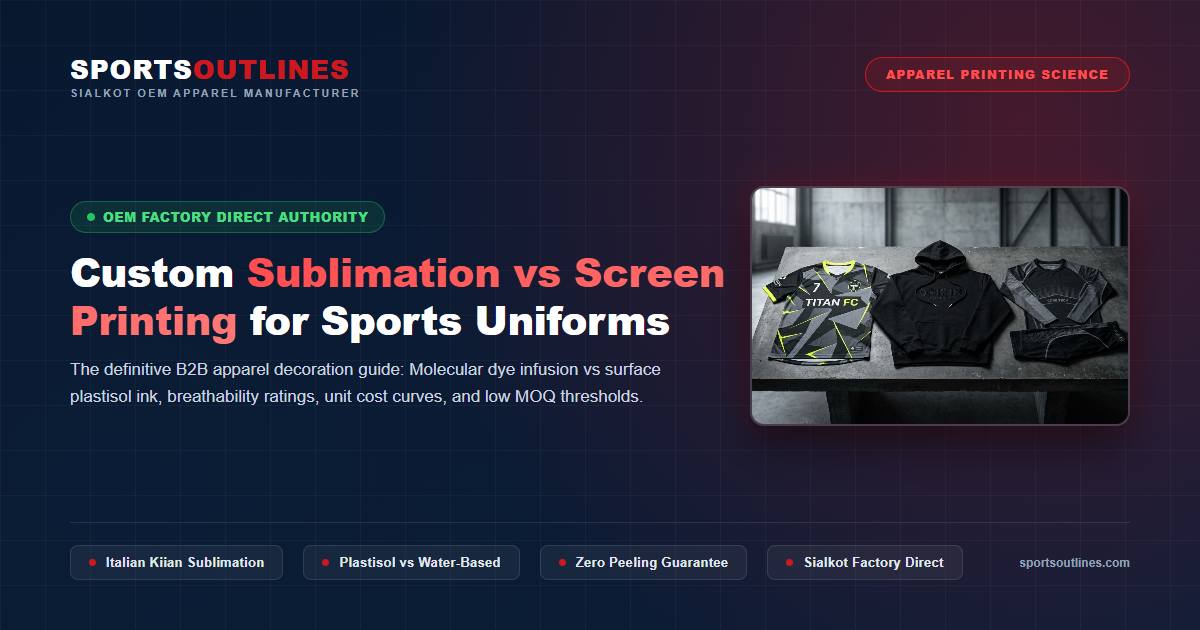
- Choose All-Over Dye Sublimation if: You are producing custom team jerseys (soccer, basketball, rugby, cycling) on 100% polyester or poly-spandex blends, require unlimited photorealistic colors, player names and numbers with zero setup fees, and require zero weight added to the fabric.
- Choose Screen Printing if: You are manufacturing natural fiber garments (100% cotton, French Terry, CVC fleece hoodies), producing bulk orders (over 200–500 pieces per identical design), or require tactile textured effects such as high-density 3D puff, metallic foil, or gel inks.
- Unit Cost Break-Even Point: Sublimation has flat per-unit costs and zero screen setup fees, making it superior for low MOQ batches (30–50 pieces). Screen printing carries high setup costs ($25–$40 per color screen) but scales down in price on large homogenous production runs.
- Durability Difference: Sublimated graphics are chemically molecularized into the polyester fiber and literally cannot peel, crack, or wash out. Screen prints sit as a layer on top of fabric, requiring careful curing to prevent micro-fissures and fading over time.
1. The Underlying Science: Molecular Infusion vs. Surface Ink Layering
To understand why these two decoration technologies perform so differently on the playing field, one must examine their fundamental physical chemistry:
The Molecular Mechanics of Dye Sublimation
Dye sublimation is a thermodynamic transition process where solid disperse dye particles bypass the liquid phase entirely and transition directly into a high-energy gas when subjected to extreme heat (typically 380°F to 400°F / 195°C to 205°C) and calibrated mechanical pressure. Under this intense thermal load, the synthetic polymer chains within polyester fibers expand, opening micro-pores. The vaporized dye molecules penetrate deeply into these open molecular chambers.
As the fabric cools upon exiting the rotary calender press, the polyester polymer chains close shut, permanently trapping the dye inside the fiber core. The result is not an ink deposit resting on top of a textile; rather, the polyester fiber itself has been dyed at the molecular level. There is zero tactile “hand-feel,” zero stiffness, and zero interference with the fabric’s technical capillary wicking channels. At Sports Outlines, we utilize authentic Italian Kiian digital sublimation inks, which ensure vibrant, UV-stable color reproduction across the entire Pantone PMS spectrum without carcinogenic disperse dyes.
The Surface Mechanics of Screen Printing
Screen printing (serigraphy) operates through an entirely mechanical deposition methodology. Liquid ink—formulated either as PVC plastisol, water-based polyurethane dispersion, or discharge chemistry—is pushed through a tensioned mesh screen stencil using a rubber squeegee onto the surface of an already-knitted fabric or assembled garment. Each distinct color requires its own precision-burned mesh screen and individual print head pass.
Once applied, the wet garment passes through an infrared conveyor curing chamber (typically 320°F / 160°C for plastisol). Heat causes the PVC resin particles and plasticizer plasticizers to fuse into a solid, flexible film. Crucially, the ink film sits entirely on top of the textile surface. While high-grade water-based inks soak partially into natural cotton yarns, plastisol ink forms a noticeable rubberized barrier that can block the breathability of athletic mesh.
2. Athletic Performance & Durability: On-Field Testing Comparison
When athletes sprint, tackle, and sweat, uniform decoration experiences extreme mechanical abrasion and thermal stress. Here is how each printing method holds up in real-world sports conditions:
For sports requiring intense sweat management—such as basketball jerseys, soccer shirts, and marathon singlets—sublimation is indisputably superior. When an athlete sweats, a heavy plastisol screen print creates a barrier known in the apparel trade as a “sweat shield.” Moisture cannot escape through the rubber ink film, causing the jersey to stick to the chest and inducing chafing. Because sublimation dyes the yarn itself, the fabric’s micro-mesh holes remain 100% open, allowing our moisture-wicking interlock fabrics (detailed in our Sportswear Fabric & GSM Guide) to perform at maximum efficiency.
3. Unit Economics & Pricing Math: When Does Screen Printing Beat Sublimation?
A common misconception among sports club managers is that screen printing is always cheaper than sublimation. In reality, the financial equation depends entirely on order quantity, design complexity, and color count. Let us break down the mathematical cost curve:
Screen Printing Cost Formula: High Fixed Setup + Low Variable CMT
Screen printing incurs significant fixed preparation expenses: film positive output, darkroom screen emulsion exposure, screen setup calibration, and ink mixing. If a multi-color team crest and sponsor logo require 6 colors, you incur 6 screen setup fees ($25 × 6 = $150 minimum setup):
If you order only 30 jerseys, that $150 fixed setup fee adds $5.00 per jersey before ink and labor are even calculated! Furthermore, individual player names and numbers require separate stencils or secondary vinyl heat pressing, driving costs even higher.
Sublimation Cost Formula: Zero Fixed Setup + Flat Linear Variable Cost
Digital dye sublimation requires zero mesh screens. The artwork—including club crest, sponsor gradients, geometric patterns, individual player surnames, and squad numbers—is printed simultaneously onto high-speed transfer paper from a digital RIP queue:
Whether you print 1 color or 1,000 photographic gradients, the cost per square meter remains identical. Every single athlete’s name and squad number can be customized without a single cent in additional tooling fees.
Note: Direct wholesale pricing based on Sialkot OEM factory manufacturing benchmarks at Sports Outlines. To model specific budget requirements across different order tiers, review our detailed Manufacturing Cost Breakdown.
4. Fabric Compatibility Matrix: Polyester vs. Cotton & Blends
The single most critical technical constraint governing this decision is textile composition:
- Dye Sublimation ONLY Bonds with Polymers: Sublimation dyes have zero chemical affinity for natural cotton, wool, or rayon fibers. Sublimation requires at least 85% to 100% polyester or nylon. If you attempt to sublimate a 50/50 poly-cotton blend, only the polyester fibers will accept the gas molecules; the cotton fibers will reject the dye, resulting in a washed-out vintage appearance that fades rapidly in the laundry.
- Screen Printing Adheres to Virtually Everything: Because screen printing is a surface-bonding process, plastisol, water-based, and discharge inks adhere flawlessly to 100% Combed Cotton, French Terry, CVC (Chief Value Cotton), poly-cotton fleece, canvas, and nylon windbreaker shells.
Factory Tip: The Hybrid Solution for Modern Athleisure
Many successful activewear brands leverage a hybrid embellishment architecture. For their performance match uniforms and gym tops, they utilize all-over dye sublimation on 160–180 GSM polyester-spandex interlock. For their post-workout lifestyle streetwear—such as 420 GSM oversized French Terry hoodies and joggers—they utilize soft-feel water-based screen printing or 3D silicone heat transfers (available across our Casual Wear & Hoodies Collection).
5. Environmental Sustainability & Chemical Compliance
Global environmental compliance standards—including the EU REACH directive, US CPSIA regulations, and OEKO-TEX Standard 100—have placed apparel printing under strict scrutiny:
- Sublimation is a Zero-Water, Closed-Loop Process: Dye sublimation produces zero wastewater runoff. The ink is printed directly onto paper, and the heat press transfers the dye with zero chemical post-washing required. Unused paper is recyclable, making sublimation exceptionally clean.
- Screen Printing Requires Careful Washout Handling: Screen making requires chemical emulsions, blockout solvents, and screen reclaiming agents. Traditional plastisol inks contain PVC resins and phthalate plasticizers that require responsible disposal. At Sports Outlines, our screen printing facility utilizes 100% phthalate-free plastisols and water-based inks connected to a dedicated effluent treatment system.
6. International Sourcing Guide: Delivery to USA, UK, Australia, Canada & Europe
Sourcing custom sublimated uniforms and screen-printed teamwear directly from Sialkot, Pakistan eliminates intermediate brand licensing fees while ensuring rapid dispatch directly to your commercial doorstep or club facility:
ASTM standard youth and adult sports sizing with Section 301 customs clearance handled. DDP express delivery in 4–6 days to California, Texas, Florida, and across the US via our USA Sportswear Sourcing Silo.
Sublimated soccer, rugby, and netball kits graded to British sizing. Direct GBP pricing and door-to-door delivery in 4–6 days via our UK Manufacturing Hub.
AFL guernseys, cricket whites, and rugby league jerseys featuring high-UV Kiian inks. Direct delivery to Sydney, Melbourne, Brisbane in 5–7 days via our Australia Sourcing Hub.
Dedicated export accounts managing CBSA Canadian duties and EU VAT compliance for seamless European delivery via our Canada Silo and Germany Silo.
7. Frequently Asked Questions (FAQ)
Can you sublimate on cotton t-shirts or hoodies?
No. Dye sublimation chemically bonds only with synthetic polymer chains in polyester and nylon. On 100% cotton garments, screen printing (water-based or plastisol) or direct-to-film (DTF) transfers must be used instead.
Will sublimated uniform numbers and sponsor logos crack over time?
No. Sublimated graphics literally cannot crack or peel because there is no ink layer on top of the fabric; the polyester yarn itself has been dyed at the molecular level. It maintains its integrity through 100+ commercial wash cycles.
What is the minimum order quantity (MOQ) for custom sublimated sports uniforms?
At Sports Outlines, our startup MOQ begins at 30 to 50 pieces per design with mixed size grading included (XS to 2XL), allowing sports clubs and new brands to launch without massive inventory costs.
Can I order a physical sample before approving bulk uniform production?
Yes. We produce complete physical pre-production prototype samples ($45 to $85 depending on design complexity) within 7 to 10 business days to verify fit, color accuracy, and stitch density before bulk manufacturing begins.
Ready to Manufacture Custom Uniforms with True Low MOQ?
Consult directly with our Sialkot apparel engineering team. Whether you need 30 custom sublimated soccer kits or 500 screen-printed gym hoodies, Sports Outlines delivers premium factory direct craftsmanship with express worldwide DDP shipping.
Pingback: Custom Soccer Team Kits: Sublimated Polyester, Sizing Curves & Low MOQ Sourcing - Sports Outlines
Pingback: Custom Goalkeeper Jerseys: Padded Elbows, Breathable Honeycomb Mesh & Cut-and-Sew Specs - Sports Outlines