Direct Manufacturer Answer: How to Manufacture Custom Cut-and-Sew Mesh Paneled Sports Bras
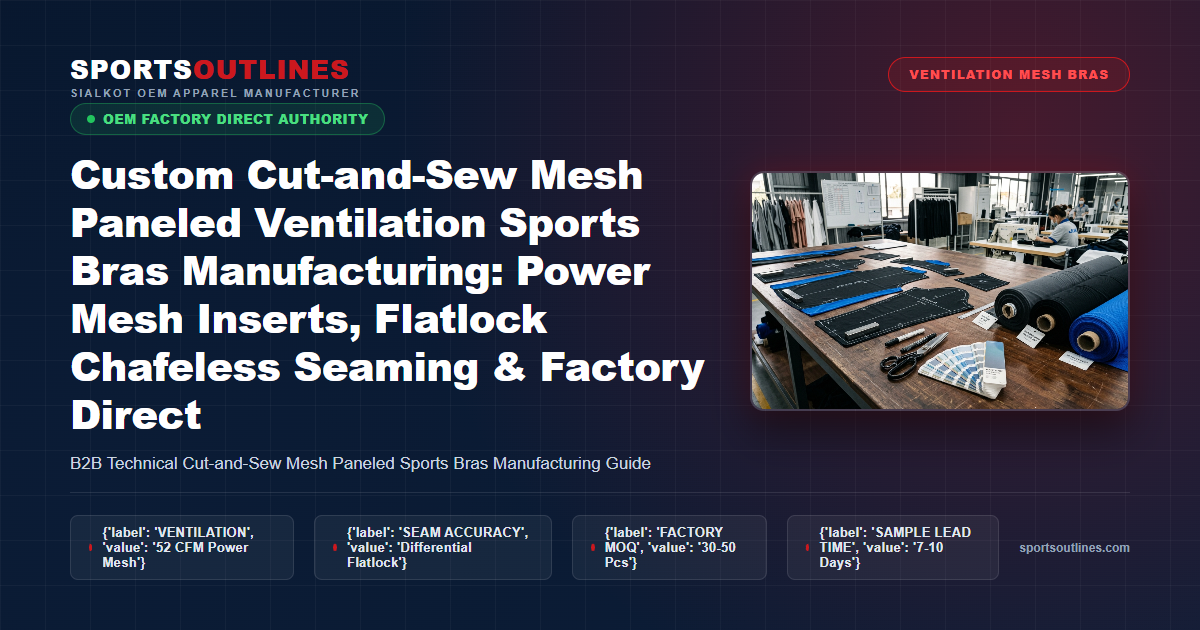
Manufacturing commercial-grade custom cut-and-sew mesh paneled ventilation sports bras requires precision multi-textile engineering that unites high-compressive structural interlock with open-pore breathability without sacrificing dimensional integrity. In poorly assembled mesh sports bras, the join seams between rigid solid knit panels and elastic mesh inserts inevitably pucker, tear under cyclic tension, or cause chafing across moving scapular planes. Our factory solves this by pairing a heavyweight 280 to 300 GSM 75% Micro-Nylon 6,6 and 25% Spandex double-knit interlock body with a specialized 160 to 180 GSM high-recovery warp-knit Power Mesh (82% Nylon / 18% Spandex) mapped directly over high-perspiration thoracic heat channels (the sternum cleft, sub-mammary underbust crease, and interscapular spinal groove). The power mesh provides an air permeability rating of 48 to 55 CFM (ASTM D737) while maintaining high bursting strength (>280 kPa under ASTM D3786). Join seams are executed strictly using ISO 607 4-needle 6-thread flatlock stitching calibrated with differential-feed feed dogs (ratio 1.12:1) and bulked micro-denier looper threads that absorb shear stress. The garment is anchored by an encased 38 mm to 42 mm brushed plush elastic underband. At Sports Outlines in Sialkot, Pakistan, we produce private label mesh paneled sports bras with an agile low factory MOQ of 30 to 50 pieces per style/colorway with mixed sizing (XS to 2XL). Physical pre-production prototypes are completed in 7 to 10 business days for $45 to $85 per piece under a strict zero refund and zero credit policy.
- Structural Silhouette: Cut-and-sew multi-panel racerback or cross-back sports bra with zoned mesh ventilation inserts.
- Solid Shell Matrix: 75% Micro-Nylon 6,6 / 25% Spandex high-density double-knit interlock (280–300 GSM).
- Ventilation Mesh Textile: 82% Nylon / 18% Spandex warp-knit hexagonal power mesh (160–180 GSM, 52 CFM air permeability).
- Thoracic Heat Zone Mapping: Sternum channel, sub-bust drainage canal, and posterior interscapular spine panel.
- Seam Construction: ISO 607 4-needle 6-thread flatlock stitching with differential-feed tension calibration.
- Underband Anchorage: 40 mm plush microfiber encased knitted elastic core delivering high-recovery ribcage hold.
- Low Production MOQ: 30–50 pieces per style/colorway across flexible size curves from XS to 2XL.
- Physical Sample Terms: $45–$85 per custom prototype in 7–10 days (strict zero credit or refund policy).
- Factory Sourcing Contact: WhatsApp factory direct at +92 316 7932595 or via sportsoutlines.com.
In high-intensity athletic conditioning, marathon running, CrossFit, and indoor cycling, core thermal regulation is the primary determinant of athlete endurance. During vigorous aerobic training, the female torso generates significant metabolic heat, with sweat production concentrating intensely along the sternum, beneath the breasts, and along the thoracic spine. When female athletes wear solid, unventilated compression bras, moisture becomes trapped against the skin, leading to skin chafing, contact dermatitis, and rapid thermal fatigue.
The cut-and-sew mesh paneled ventilation sports bra is specifically engineered to solve this physiological challenge. By integrating high-tensile power mesh inserts directly into high-perspiration zones while maintaining heavyweight compressive interlock panels across the bust cradle, the garment achieves an optimal equilibrium: maximum bounce reduction combined with continuous convective cooling.
For direct-to-consumer (D2C) activewear labels, premium fitness apparel brands, and gymwear startups in the United States, United Kingdom, Australia, Canada, and Germany, mesh paneled sports bras represent a high-margin technical staple. When styled with laser-cut mesh paneled gym leggings, they create a cohesive, high-tech athletic uniform that commands premium retail price points ($56 to $68 USD).
At Sports Outlines in Sialkot, Pakistan, our cut-and-sew activewear division utilizes computerized pattern engineering, automated multi-ply laser cutters, and specialized flatlock workstations with differential-feed synchronization. We manufacture private label mesh sports bras backed by accessible low 30 to 50 piece MOQs.
1. Thoracic Perspiration Mapping: Engineering Targeted Ventilation Zones
Thermal mapping research conducted by sports science laboratories demonstrates that sweat gland density and metabolic heat dissipation are not distributed uniformly across the female torso. During sustained aerobic exercise, sweat accumulation concentrates heavily within three distinct anatomical corridors:
- The Sternal Cleft Zone: The central depression between the breasts experiences high localized heat buildup with restricted natural evaporation. Solid compression fabrics trap moisture here, leading to fungal heat rash and chafing. Our CAD patterns introduce a tapered diamond or teardrop Power Mesh insert extending from the high neckline to 20 mm above the underband, creating an active micro-climate chimney that vents hot vapor upward through convective chimney currents.
- The Inframammary Canal: The crease beneath the breast tissue represents the highest friction and sweat pooling area on the entire upper body. Under repetitive breast oscillation, trapped moisture softens the stratum corneum skin layer, causing maceration and abrasions. We integrate horizontal power mesh gussets or dual-layer mesh lining bands directly above the underband to facilitate immediate capillary sweat drainage and continuous lateral ventilation.
- The Interscapular Posterior Spine: The spinal groove between the shoulder blades accounts for over 35% of total upper-back perspiration during aerobic endurance sessions. Our patterns feature a broad triangular or hexagonal Power Mesh racerback panel that allows convective ambient air to cool the thoracic spine as the athlete moves, dropping skin micro-climate temperatures by up to 1.8°C.
- Lateral Axillary Heat Release: The lateral chest wall beneath the axilla generates substantial friction heat as arms swing forward and backward during sprint intervals. We insert curved ergonomic power mesh crescents that shield the sensitive axillary lymph tissue while venting core torso heat.
By strategically restricting open-pore mesh to these precise low-stress, high-perspiration coordinates, our patternmakers preserve full compressive containment across the anterior bust envelope. The high-modulus 290 GSM solid interlock absorbs 85% of multi-directional breast bounce forces, while the strategically integrated power mesh panels handle 100% of the athlete’s thermodynamic heat transfer requirements.
2. Technical Power Mesh Selection: Warp-Knit Density & Tensile Recovery
Not all mesh fabrics are suitable for athletic bra production. Many inexperienced garment factories make the catastrophic mistake of sourcing lightweight lingerie mesh (90–120 GSM) or low-recovery fashion tulle. When subjected to repetitive athletic tension, fashion mesh tears along the seam line, sags permanently within three wash cycles, and offers zero compressive hold.
At Sports Outlines, our material standard for ventilation sports bras is an authentic 160 to 180 GSM high-recovery warp-knit Power Mesh composed of 82% High-Tenacity Nylon 6,6 and 18% Creora® Elastane:
- Raschel Warp-Knit Machine Construction: Unlike circular knit fabrics which unravel if a single thread breaks, our power mesh is knit on multi-bar Raschel warp-knitting machines. Each yarn loop is locked into adjacent wales, providing complete ladder-resistance (run-proof technology) even if pierced by sharp gym equipment or jewelry.
- Hexagonal Micro-Aperture Geometry: The open pores are engineered with a uniform hexagonal cell geometry (pore diameter 0.8 mm to 1.1 mm). This size allows rapid vapor diffusion while maintaining a clean, high-end athletic appearance that conceals skin texture.
- High Recovery Modulus (18% Spandex): Incorporating 18% premium elastane ensures the mesh provides active compression matching the adjacent solid interlock panels, preventing unsightly bagging or dimensional distortion after repeated laundering.
3. Seam Engineering: 4-Needle Flatlock Differential-Feed Synchronization
The most technically challenging phase of manufacturing a multi-panel mesh sports bra occurs at the junction seam where 290 GSM solid interlock meets 170 GSM power mesh. Because these two textiles possess significantly different thickness, weight, and elongation moduli, sewing them together with standard sewing equipment causes severe seam puckering, wavy ripples, or thread cracking under tension.
At Sports Outlines, our production engineering line implements specialized parameters to ensure flawless flatlock assembly:
- Calibrated Differential-Feed Ratio: Our industrial Yamato and Pegasus 4-needle flatlock machines feature independent front and rear feed dogs. We set the differential feed ratio to exactly 1.12:1. This slightly pre-gathers the more stretchy power mesh relative to the solid interlock during feeding, yielding a completely flat, ripple-free seam that lies parallel to the skin.
- Bulked Microfiber Looper Threads: We utilize high-bulk textured polyester threads (75 denier / 72 filaments) in the upper and lower loopers. The fluffy multi-filament thread forms a soft, protective cushion bed over the raw cut edges of the mesh, preventing scratchy monofilament ends from pricking the athlete’s skin.
- High Stitch Density (14–16 SPI): Operating at 14 to 16 stitches per inch ensures the flatlock seam stretches up to 135% without thread popping, easily absorbing the dynamic chest expansions of heavy deadlifts and deep breathing.
- Clean-Folded Elastic Binding at Edges: Where mesh panels form the neckline or outer armhole edges, they are finished with a double-folded micro-plush elastic binding (10 mm) sewn with twin-needle chainstitching, providing a soft, durable perimeter that never curls.
4. Internal Cup Stabilization & Dual-Layer Power Net Lining
Even with large exterior mesh panels, a sports bra must deliver reliable chest support and modesty. To achieve this, Sports Outlines implements an independent internal suspension architecture:
- Dual-Layer Power Net Lining: The internal front bust panels are lined with breathable 180 GSM power net. This creates a compressive containment envelope that stabilizes breast tissue independently of the outer decorative mesh panels.
- Concealed Lateral Slit Pockets: The lining includes ultrasonic-bonded side slits for removable molded foam cups. Athletes can easily insert, adjust, or remove the padding as desired.
- Perforated Foam Cookies: Removable foam inserts feature 4 mm laser micro-perforations that align with the exterior mesh panels, ensuring sweat vapor passes directly through the pad and evaporates into ambient air.
5. Comprehensive Points of Measure (POM) Technical Grading Specification
Accurate size grading for multi-panel garments is paramount. Because mesh inserts stretch differently than solid panels, grading increments must be calculated to preserve proportional panel placement across all sizes. Below is our factory-calibrated Points of Measure (POM) specification sheet for custom cut-and-sew mesh sports bras graded from XS to 2XL.
6. Production Economics: Low MOQ, Tiered Pricing & Prototyping Terms
Multi-panel cut-and-sew apparel typically carries higher production labor costs because cutting 7 to 10 independent pattern pieces and stitching them on specialized flatlock machines requires skilled operators. Large overseas factories typically mandate minimum runs of 600 to 1,000 units per style to offset machine setup times.
At Sports Outlines in Sialkot, Pakistan, our lean cellular manufacturing teams excel at multi-panel activewear assembly. We offer factory-direct manufacturing starting at just 30 to 50 pieces per style/colorway. You can combine solid and mesh contrasts (e.g., Black Interlock with Slate Mesh, or Burgundy Interlock with Black Power Mesh) across mixed size breakdowns from XS to 2XL.
Transparent Prototyping Terms: We charge a flat fee of $45 to $85 per physical prototype piece. This covers multi-panel digital pattern grading, computerized laser table plotting, differential feed machine tension setup, and express air courier delivery via DHL or FedEx. We enforce a strict zero-credit and zero-refund policy on all sampling fees. Multi-panel garment sampling requires precision pattern-matching and seam synchronization; paying for this standalone engineering phase guarantees your final bulk production run fits impeccably with zero seam rippling.
7. Quality Control Workflow & ISO 2859-1 AQL 2.5 Standards
To guarantee that every batch of custom mesh ventilation sports bras meets international retail distribution standards, Sports Outlines enforces rigorous quality control under ISO 2859-1 AQL 2.5 Level II standards:
- Differential Seam Wave Inspection: Every joined mesh panel is laid flat under zero tension on illuminated inspection light tables to verify that the join seam exhibits zero wavy waviness or gathering (<1 mm deviation from a true straight contour).
- Cross-Seam Tensile Stress Pull Test: Join seams are pulled manually to 100% full stretch to confirm that the flatlock stitching expands synchronously with the mesh without skipped stitches, needle cuts, or looper thread cracking.
- Power Mesh Pore Uniformity Audit: All mesh rolls are inspected for snagged yarns, broken hexagonal cells, or ladder runs before laser cutting begins.
- 9-Point Conveyor Metal Detection: Finished sports bras pass through an automated electromagnetic metal detector tunnel calibrated to 0.8 mm Fe sensitivity, ensuring complete consumer safety.
- Retail-Ready Presentation Packaging: Every garment is fitted with custom 400 GSM matte cardstock swing hangtags, heat-sealed brand neck labels, and individual frosted zip polybags with printed barcodes ready for Amazon FBA or Shopify 3PL fulfillment.
8. Frequently Asked Questions (B2B Mesh Sports Bra Sourcing)
Q1: What type of mesh is used for high-performance athletic sports bras?
We exclusively use 160 to 180 GSM warp-knit Power Mesh (82% Nylon / 18% Spandex). This textile is ladder-resistant, features high bursting strength (>280 kPa), and delivers 52 CFM air permeability while providing four-way compressive recovery.
Q2: How do you prevent seam puckering where mesh joins solid interlock?
We calibrate our 4-needle 6-thread flatlock machines with a 1.12:1 differential feed ratio. This feeds the stretchier power mesh at a synchronized rate with the heavier 290 GSM interlock, producing completely flat, ripple-free seams.
Q3: What impact level does a cut-and-sew mesh paneled sports bra support?
Depending on panel placement, our mesh designs support medium to high-impact activities (CrossFit, running, HIIT, spinning). The solid interlock bust cradle provides rigid containment while the mesh panels maximize cooling.
Q4: What is your factory Minimum Order Quantity (MOQ) for custom mesh bras?
Our factory MOQ is 30 to 50 pieces per style/colorway with mixed size breakdowns from XS to 2XL. You can combine contrasting mesh and solid fabrics to create unique multi-tone colorways.
Q5: How much do physical prototypes cost and what is the turnaround time?
Physical prototypes cost $45 to $85 per piece, produced and shipped in 7 to 10 business days via DHL Express. All sample fees are strictly non-refundable and not credited toward bulk production.
Q6: Can the mesh bra include removable molded padding cups?
Yes. Every bra features an internal 180 GSM power net lining with concealed lateral slit pockets and perforated, breathable, molded polyurethane foam cookies that ensure modesty without restricting ventilation.
Q7: How do you prevent flatlock seams from scratching against sensitive skin?
We use high-bulk, multi-filament textured polyester looper threads (75D/72F). These threads bloom into an ultra-soft, plush cushion bed that covers all cut fabric edges, completely eliminating skin scratchiness.
Q8: What logo branding options work best on mesh paneled designs?
We recommend applying 3D raised silicone heat transfers on the solid interlock sections (such as the chest apex or underband) and reflective 3M silver transfers along the racerback strap. We avoid printing directly onto open-pore mesh to maintain print crispness.
Q9: Can you manufacture matching mesh paneled leggings or shorts?
Yes. We produce complete matching sets including mesh paneled gym leggings and biker shorts cut from the exact same solid and mesh fabric rolls for 100% color and texture continuity.
Q10: What international export shipping options are supported?
We offer express DDP air freight (4–7 business days via DHL/FedEx) and consolidated ocean sea freight (22–30 business days) with full customs clearance directly to warehouses in North America, Europe, the UK, and Australia.
Manufacture Custom Mesh Paneled Sports Bras with Sialkot’s Premier Factory
Combine maximum thoracic cooling with high-impact compressive containment. Premium 170 GSM Power Mesh, 290 GSM Micro-Nylon interlock, differential flatlock stitching, and factory-direct low MOQs from 30 to 50 pieces.