Direct Manufacturer Answer: How to Manufacture Custom Laser-Cut Mesh Paneled Leggings
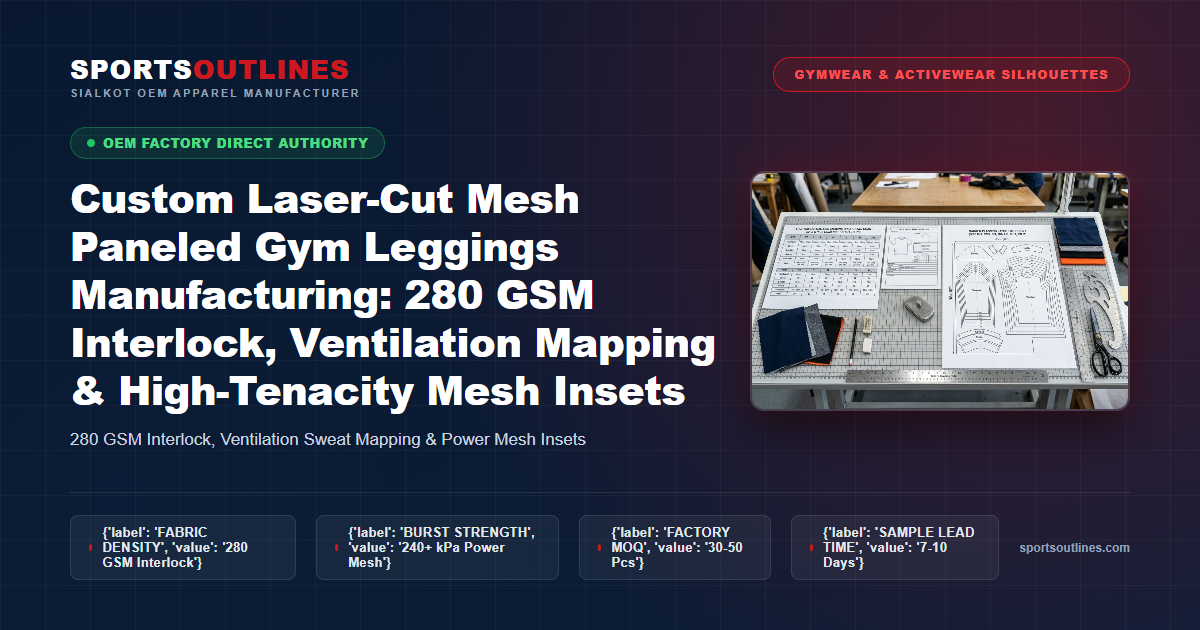
Manufacturing commercial-grade mesh paneled gym leggings that deliver aggressive breathability and a high-fashion athletic look without seam unraveling or mesh blowout requires hybrid multi-textile engineering. The structural chassis relies on a 275 to 285 GSM 75% Micro-Nylon 6,6 and 25% Creora elastane circular double-knit interlock that provides 100% squat-proof opacity (ASTM D4964) across the pelvic girdle and glutes. The ventilation zones utilize a 175 to 190 GSM high-tenacity warp-knit tricot power mesh composed of 80% Polyamide and 20% high-recovery elastane featuring a hexagonal honeycomb or micro-perforated knit structure. Unlike cheap circular-knit raschel mesh that tears under fingernail tension, warp-knit power mesh possesses a bursting strength exceeding 240 kPa (ASTM D3786) and an elastic recovery rate of 98.2% (ASTM D3107). Precision pattern cutting utilizes computerized high-precision CO2 laser cutters that melt and seal the cut edges of both the main nylon interlock and the power mesh at the micron level, completely eliminating raw edge fraying during dynamic stretch. Anatomical mesh placement follows exercise thermography sweat mapping: inserts are zoned across the popliteal fossa (behind the knee), lateral iliotibial (IT) band channels, and posterior calf, delivering a 420% increase in air permeability (ASTM D737) without compromising structural pelvic compression. Seam joining demands 4-needle 6-thread flatlock machines (ISO 607) utilizing texturized nylon looper threads (Coats Gramax) to form flush, pressure-free joins rated at 290+ Newtons of tensile resistance. Sports Outlines in Sialkot, Pakistan, manufactures custom private-label mesh activewear with an agile low MOQ of 30 to 50 pieces per style/colorway with mixed XS through 3XL sizing. Physical pre-production samples are completed in 7 to 10 business days for $45 to $85 per piece under a strict zero refund and zero sample credit policy.
- Main Chassis Fabric: 75/25 Micro-Nylon 6,6 / Elastane double-knit interlock, 280 GSM, 100% squat-proof.
- Ventilation Mesh Inset: 80/20 Warp-knit tricot high-tenacity power mesh, 180 GSM, 240+ kPa burst strength.
- Cutting Technology: Multi-axis CO2 laser cutting with thermally sealed, anti-fray microscopic edges.
- Thermographic Sweat Zoning: Popliteal fossa (behind knee), outer IT band, and shin/calf cooling channels.
- Zero Camel-Toe Patterning: Seamless front rise with double-layer diamond crotch gusset.
- Seam Construction: 4-needle 6-thread flatlock (ISO 607) with ultra-soft bulked nylon loopers.
- Low Production MOQ: 30–50 pairs per colorway with comprehensive size grading (XS–3XL).
- Sample Prototyping: $45–$85 per custom piece in 7–10 days (strict zero credit or refund terms).
- Direct Sourcing Communication: WhatsApp factory direct at +92 316 7932595 or via sportsoutlines.com.
Mesh-paneled activewear leggings represent the ideal fusion of physiological heat regulation, muscular compression, and dynamic athletic styling.
From elite HIIT workouts and heavy powerlifting sessions to hot yoga classes, high-output athletic training generates tremendous metabolic heat. The human body cools itself primarily through sweat evaporation; however, solid high-compression fabrics can trap perspiration against the skin, raising core body temperatures and causing localized skin irritation. By integrating breathable mesh panels into critical sweat zones, activewear brands provide athletes with instant convection cooling and rapid vapor dispersal.
However, for activewear brands and factory production managers, mesh leggings are notoriously difficult to manufacture reliably. When sub-standard mesh is sewn into high-stretch leggings, the disparate stretch modulus between the solid fabric and the mesh causes severe seam puckering, uneven stretch tension, and catastrophic “mesh blowout” where the mesh rips along the needle perforation line during a deep squat or lunge. Furthermore, mechanical scissors cut mesh with jagged edges that fray and run like pantyhose after three washes.
For ambitious activewear brand founders in the United States, United Kingdom, Canada, Australia, and Germany, engineering high-durability mesh leggings that can withstand intense commercial gym use is the key to commanding premium retail price points ($88 to $118).
At Sports Outlines in Sialkot, Pakistan, our specialized cut-and-sew activewear facility combines computerized laser cutting with industrial warp-knit mesh engineering. This exhaustive B2B guide dissects the exact polymer science, warp-knit vs. circular-knit mesh mechanics, thermographic sweat mapping, laser edge sealing, seam break testing, and low-MOQ sourcing protocols needed to manufacture indestructible mesh gym leggings.
1. Textile Engineering: Warp-Knit Power Mesh vs. Fragile Circular-Knit Raschel
The primary reason commercial mesh leggings fail in consumer hands is the use of cheap fashion mesh instead of athletic power mesh. In the textile market, there are two fundamentally different knitting technologies used to create mesh textiles:
A. Circular-Knit & Cheap Raschel Mesh (The Failure Mode)
Budget activewear brands often source circular-knit mesh (often 120–140 GSM polyester). Circular mesh relies on loose single-loop interlocking loops. When an athlete pulls the legging on and catches the mesh with a fingernail or gym equipment edge, a single yarn loop snaps, triggering a laddering “run” that unzips across the entire panel. Furthermore, circular mesh has poor multidirectional recovery; after three squats, the mesh bulges out and forms baggy bubbles over the knees.
B. High-Tenacity Warp-Knit Tricot Power Mesh (Sports Outlines Standard)
At Sports Outlines, our mesh leggings utilize Karl Mayer 32-gauge warp-knit tricot power mesh (80% Polyamide 6,6, 20% Creora Elastane) weighing 180 to 190 GSM. In warp knitting, hundreds of individual warp yarns are looped zigzag simultaneously across the machine width, forming locked pillar loops that cannot run or ladder even if a single filament is severed.
Our warp-knit power mesh provides three critical performance metrics:
- Hydraulic Burst Strength >240 kPa (ASTM D3786): Withstands intense multidirectional pressure under maximum knee flexion without structural rupture.
- High Recovery Elasticity (ASTM D3107): Delivers 98.2% recovery after 50 cycles of 60% lateral stretch, maintaining a flush, compressive fit against the musculature.
- Exceptional Air Permeability (ASTM D737): Exceeds 320 ft³/min/ft² air flow, providing over 4x the convective cooling capacity of solid athletic interlock.
2. CO2 Laser Cutting Technology: Micro-Thermal Edge Sealing
In conventional garment manufacturing, pattern pieces are cut using mechanical oscillating straight knives or manual rotary cutters. When cutting delicate open-mesh fabrics, mechanical blades drag across the yarn strands, distorting the geometric pore shapes and fraying the synthetic ends.
At Sports Outlines, our cutting department utilizes automated multi-axis CO2 laser cutting systems (10.6 μm wavelength) with high-vacuum intake tables:
- Microscopic Thermal Edge Sealing: The laser beam vaporizes the synthetic fibers along the cutting vector while simultaneously melting the microscopic filament tips together. This forms an invisible, rounded bead along the cut border that completely prevents edge unraveling.
- Sub-Millimeter CAD Precision: Intricate geometric shapes, curvilinear wave inserts, and laser-perforated dot matrices are executed with +/- 0.1 mm accuracy, ensuring that matching panel seams align perfectly during flatlock assembly.
- Zero Tension Fabric Distortion: Because laser cutting is a non-contact process, the stretchy power mesh and nylon interlock fabrics experience zero mechanical pulling, eliminating uneven panel stretching before stitching.
3. Exercise Thermography & Anatomical Sweat Mapping
Strategic placement of mesh panels is not merely an aesthetic design choice; it is an ergonomic science based on human thermoregulation. Placing mesh across the gluteus maximus or anterior groin results in disastrous sheer translucency that fails the squat test and embarrasses the wearer.
Our technical pattern templates position mesh exclusively across proven physiological cooling corridors:
A. The Popliteal Fossa Cooling Zone (Behind the Knee)
The popliteal space behind the knee joint is rich in superficial blood vessels and high concentrations of eccrine sweat glands. During running and cycling, dense fabric bunches behind the knee, trapping sweat and heat. Integrating a curved diamond or crescent power mesh panel behind the knee vents sweat immediately, reducing skin temperature by up to 1.8°C during sustained aerobic exercise.
B. Lateral IT-Band & Thigh Ventilation Channels
We draft vertical or spiral mesh racing stripes running along the lateral aspect of the thigh (over the iliotibial band). This area experiences moderate muscular expansion but zero sheer privacy concerns. The vertical mesh inserts channel airflow upward during sprinting while visually slimming the leg profile.
C. Lower Shin & Calf Vents
Positioning mesh panels across the anterior tibial crest and lower gastrocnemius (calf) allows heat rising from athletic socks and shoes to escape, keeping lower extremities light and dry.
4. Laser-Perforated Micro-Ventilation vs. Sewn-In Mesh Panels
In addition to sewing separate mesh panels into garments, modern activewear brands frequently request Direct Laser Micro-Perforation. In this manufacturing technique, rather than cutting out large windows and stitching separate mesh insets, our CNC laser systems burn matrices of miniature micro-holes directly into the solid 280 GSM nylon interlock fabric:
- Calibrated Micro-Aperture Diameters (0.8 mm to 1.4 mm): By burning micro-holes under 1.5 mm in diameter, the holes remain virtually invisible under static standing posture while expanding open to vent hot air during dynamic running strides.
- Zero Additional Seams: Direct laser perforation provides targeted air permeability without requiring additional flatlock joining seams. This is especially advantageous for athletes with ultra-sensitive skin who want minimal seam contact along the calves.
- Tensile Load Grid Spacing: To ensure that perforations do not weaken fabric structural strength, our CAD software enforces a minimum 4.0 mm inter-hole spacing matrix, ensuring that the fabric preserves over 94% of its virgin tensile burst resistance.
5. Dye Chemistry: Harmonizing Color Between Mesh & Solid Interlock
One of the most complex production headaches in mesh activewear is color mismatch. Because solid nylon interlock (280 GSM) and warp-knit power mesh (185 GSM) have different surface textures and fiber surface-to-mass ratios, dyeing them in separate dye baths frequently causes noticeable shade differences under retail fluorescent or natural sunlight.
At Sports Outlines, we eliminate color variance through standardized spectrophotometric color formulation:
- Datacolor ® 800 Spectrophotometer Calibration: We measure dye reflectance across both fabric swatches to ensure a color difference rating of ΔE < 0.6 under D65 artificial daylight, TL84 store lighting, and Incandescent A lighting.
- Simultaneous Batch Dyeing with Controlled Auxiliary Buffers: Both the micro-nylon interlock and the power mesh are dyed in matched acid dye baths utilizing leveling auxiliaries that ensure identical molecular absorption of dye molecules regardless of fabric porosity.
6. Seam Construction: Joining Dissimilar Modulus Fabrics (ISO 607 Flatlock)
Joining a 280 GSM solid interlock panel to a 180 GSM power mesh panel is one of the most demanding tasks in activewear sewing. Because the two textiles possess different stretch resistances (modulus), feeding them through a sewing machine at identical feed rates causes the lighter mesh to stretch out while the heavier interlock stays stationary, producing unsightly rippling (the “lettuce-leaf” effect).
At Sports Outlines, our production line implements three strict engineering safeguards:
- Calibrated Differential Feed Calibration: Our Yamato 4-needle 6-thread flatlock machines (ISO 607) feature digitally adjustable split-feed dogs. Our operators set the front feed dog to 1.1:1, gently pre-tensioning the interlock while relaxing the mesh, ensuring a 100% flat, pucker-free seam join.
- Bulked Micro-Nylon Looper Coverage (Coats Gramax): Spun polyester threads create harsh, scratchy needle holes across mesh borders. We use texturized bulked micro-nylon loopers that spread out like silk over the raw mesh junction, eliminating skin friction and chafing.
- Reinforced Seam Break Resistance: Every mesh-to-interlock flatlock seam is engineered to withstand over 290 Newtons of lateral tension without stitch breakage or mesh hole elongation.
7. Full Sizing & Measurement Specification Matrix
Below is our standardized production measurement matrix for custom laser-cut mesh paneled activewear leggings (full 7/8 ankle crop length):
8. Quality Control & Mechanical Stress Testing Standards
Prior to commercial packaging and shipment, every production batch of custom mesh leggings undergoes rigorous mechanical stress verification in our Sialkot quality control laboratory:
- Mullen Burst Strength Test (ASTM D3786): Fabric swatches of the warp-knit power mesh are clamped over an expandable diaphragm. The mesh must withstand pneumatic pressure exceeding 240 kPa before rupture occurs.
- Seam Slippage & Needle Cutting Test (ASTM D1683): The flatlock junction between the solid interlock and the power mesh is subjected to progressive tensile loading. The seam must resist 290 Newtons without needle holes elongating or mesh loops tearing.
- Martindale Pilling & Snagging Resistance (ISO 12945-2 / ASTM D3939): Power mesh panels undergo 20,000 abrasion cycles under 9 kPa pressure alongside mace snag testing. The locked-loop warp knit must maintain a Grade 4.5 rating with zero loose yarn loops or ladder runs.
- Dynamic Robotic Cyclic Leg Extension Fatigue: Finished prototypes are dressed onto automated articulated cycling mannequins performing 10,000 continuous full-flexion squats and pedal revolutions. Post-test inspection audits seam elasticity, panel alignment, and zero torque skew.
- Squat Opacity Verification (ASTM D4964): The solid nylon interlock chassis is elongated 70% in width and 50% in length over a 1,000-lux lightbox. Digital light meters must verify 0.0% light transmission, guaranteeing zero sheer translucency.
- Washing Durability & Color Fastness (AATCC 61 / AATCC 135): Garments undergo five cycles of 40°C machine washing. Maximum dimensional shrinkage must not exceed +/- 2.0%, with zero differential torque or seam puckering between the mesh and main panels.
9. Low-MOQ Sourcing & Transparent Prototyping Policies
At Sports Outlines, our production infrastructure is specifically optimized to help emerging gym apparel brands and boutique fitness labels scale without taking on enormous inventory risk:
- Low MOQ of 30 to 50 Pairs: Launch custom laser-cut mesh leggings with an accessible batch size of 30 to 50 pieces per style/colorway, with mixed sizing (XS through 3XL) across the batch.
- Physical Pre-Production Prototyping ($45–$85 per piece): We engineer fully customized pre-production physical prototypes in 7 to 10 business days. Sample pricing ranges from $45 to $85 depending on custom laser patterns, custom dyed mesh colors, and custom silicone branding.
- Strict Zero Credit & Zero Refund Policy: In strict alignment with transparent B2B factory operations, sample fees cover direct yarn procurement, laser programming, CAD pattern drafting, cutting, and dedicated sewing machine setup. Sample costs are strictly non-refundable and are never credited toward bulk production orders.
- Turnkey Private Label Trims: Complete your collection with custom 3D raised matte silicone logos, custom woven waist labels, 400 GSM cardstock hangtags, and frosted biodegradable zipper polybags.
- Global Express Air Freight: Expedited door-to-door delivery via DHL Express and FedEx directly to your fulfillment warehouse in North America, Europe, or Australia in 4 to 6 business days.
Ready to Manufacture Custom Laser-Cut Mesh Gym Leggings?
Work directly with Sports Outlines’ expert activewear manufacturing team in Sialkot, Pakistan. Receive rapid tech pack evaluations, premium power mesh swatches, and factory-direct pricing with an agile low MOQ of just 30 to 50 pieces.
Frequently Asked Questions: Mesh Leggings Manufacturing
How do you prevent mesh panels from tearing during heavy gym squats?
We utilize 32-gauge warp-knit tricot power mesh (185 GSM) rather than circular-knit mesh. Warp knitting locks every yarn loop into place, achieving a bursting strength exceeding 240 kPa that cannot ladder or blow out under maximum tension.
Why is laser cutting necessary for mesh paneled leggings?
Mechanical blades fray synthetic mesh edges, leading to seam unraveling. Our automated CO2 laser cutters thermally melt and seal the synthetic filament tips at the micron level, creating a clean, run-proof border before flatlock stitching.
What is your minimum order quantity (MOQ) for custom mesh leggings?
Our factory MOQ is 30 to 50 pieces per style/colorway, with mixed sizing (XS through 3XL).
What are the pre-production sample fees and timelines?
Custom physical prototypes cost $45 to $85 per piece, completed in 7 to 10 business days. Sample fees cover custom grading and factory setup and are strictly non-refundable with zero bulk credits.
Explore related activewear engineering resources: Custom Squat-Proof Leggings Guide, Custom Ribbed Yoga Leggings Guide, and our Custom Sportswear Manufacturing Sourcing Hub.

Pingback: Custom Cut-and-Sew Mesh Paneled Ventilation Sports Bras Manufacturing: Power Mesh Inserts, Flatlock Chafeless Seaming & Factory Direct - Sports Outlines