Direct Manufacturer Answer: How to Manufacture Custom Acid-Washed & Vintage Washed Gym Hoodies
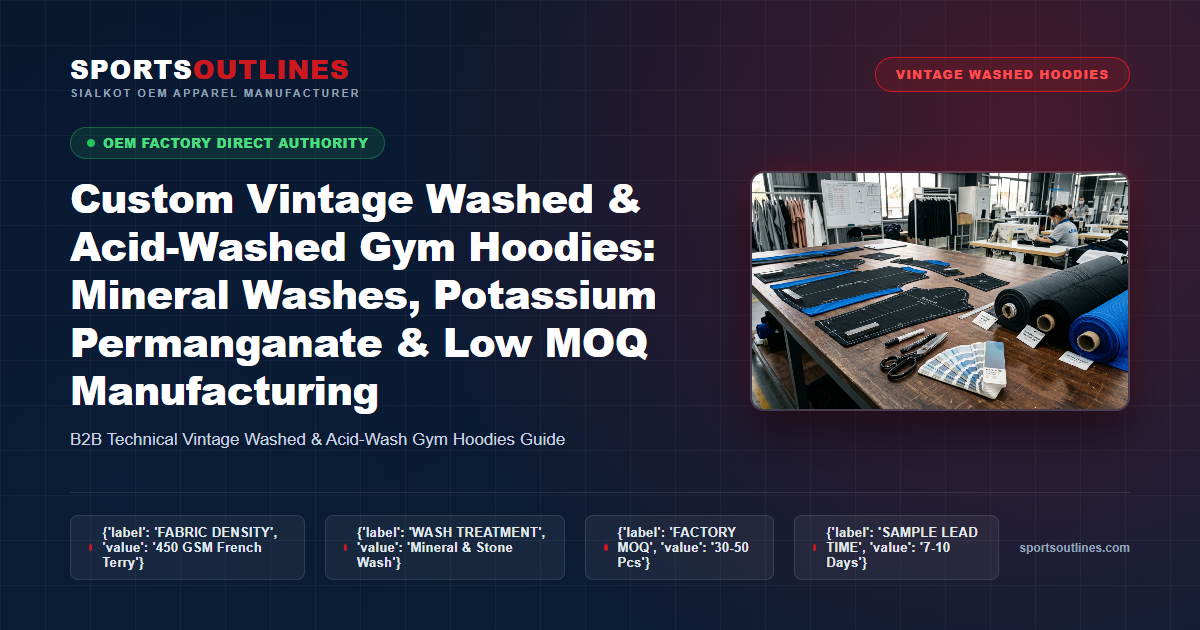
Manufacturing commercial-grade custom acid-washed, mineral-washed, and vintage-distressed gym hoodies requires engineering heavy 420 to 480 GSM 100% combed cotton loopback French terry or compact fleece textiles, treated with specialized chemical and mechanical wet-processing treatments—including potassium permanganate (PP) localized spray neutralization, porous pumice stone tumbling, bio-cellulase enzyme washes, and pigment dye exhaust washdowns. In high-end fitness streetwear and bodybuilding aesthetics, the vintage washed hoodie delivers a broken-in, heritage chalky look with rich contrast fading along thick seam ridges and rib trims. Manufacturing vintage apparel demands preshrunk pattern grading featuring calibrated +8% to +12% dimensional pattern allowances to absorb wash-tank shrinkage, heavy 100% cotton sewing threads that take up garment washdown evenly with the shell, double-reinforced pocket seams to survive stone-wash tumbling abrasion, and 450 GSM 2×2 cotton ribbing containing 5% spandex for permanent waist recovery. At Sports Outlines in Sialkot, Pakistan, we produce private label vintage-washed and acid-washed athletic hoodies at an accessible low factory MOQ of 30 to 50 pieces per style/colorway with complete size grading from XS to 3XL. Physical pre-production prototypes are developed in 7 to 10 business days for $45 to $85 per piece under a strict zero refund and zero credit policy.
- Textile Foundation: 450 GSM 100% Combed Ring-Spun Cotton Heavy French Terry engineered specifically for garment washdown.
- Washdown Chemistry: Controlled potassium permanganate (PP) misting neutralized with sodium metabisulfite for clean marble highlights.
- Mechanical Softening: Bio-enzymatic cellulase stone washing breaking down cellulose micro-fibrils for a velvety, peach-skin handfeel.
- Pattern Compensation: Calibrated CAD patterns factoring +10% lengthwise and +6% widthwise wash shrinkage for exact finished POM fit.
- Thread & Seam Durability: Tex-80 heavy core-spun sewing threads and automated 42-stitch bar-tacks resisting industrial stone tumbling.
- Rib Trim Elasticity: 450 GSM 2×2 cotton-spandex (95/5) flat-knit rib trims maintaining recovery across intense enzyme wash cycles.
- Low Production MOQ: 30–50 pieces per style/colorway across flexible size curves from XS to 3XL.
- Physical Sample Terms: $45–$85 per custom prototype in 7–10 days (strict zero credit or refund policy).
- Direct Sourcing Channel: WhatsApp factory direct at +92 316 7932595 or via sportsoutlines.com.
In modern fitness culture and activewear streetwear, the pristine, flat-colored gym hoodie has surrendered its dominance to the vintage washed, mineral-washed, and acid-distressed aesthetic. From golden-era bodybuilding gyms to luxury streetwear runways, athletes and fashion-forward gymgoers crave the broken-in comfort, textured seams, and weathered character of a hoodie that looks like a prized artifact from decades of intense iron-pumping.
Achieving an authentic vintage wash is one of the most chemically sophisticated processes in apparel manufacturing. It cannot be replicated through simple digital printing or superficial fabric spraying. True vintage wash requires subjecting heavy cotton garments to controlled chemical oxidation and mechanical abrasion inside industrial washing drums: pumice stones soaked in bleaching liquor, bio-enzymes that digest surface fuzz, and precision acid washes that highlight seam highs while leaving low valleys dark.
However, amateur factories routinely ruin vintage wash programs. The most notorious pitfalls include: ragged blowouts and shredded pocket edges caused by uncontrolled stone tumbling, blotchy chemical streaks that look like accidental chlorine stains, polyester core threads that remain bright white while the cotton fades around them, and severe post-wash shrinkage that turns a planned Large hoodie into an unwearable Small.
At Sports Outlines in Sialkot, Pakistan, we operate modern industrial garment wet-processing facilities, belly washing drums, ozone fading chambers, and automated pattern cutters. Whether your fitness streetwear brand is based in the United States, the United Kingdom, Australia, Canada, or Germany, our flexible low factory MOQ of 30 to 50 pieces per style allows you to develop custom vintage wash collections with repeatable enterprise quality and minimal inventory exposure.

1. Wash Chemistry: 4 Distinct Vintage Wet-Processing Techniques
In our Sialkot wet-processing division, we utilize four distinct industrial wash methodologies to create unique vintage surface aesthetics:
- Method 1: Acid Wash / Marble Wash (Pumice Stone Bleaching): Porous volcanic pumice stones are soaked in a controlled sodium hypochlorite or potassium permanganate solution until saturated. The stones are drained until damp and tumbled dry with dry dyed hoodies inside industrial belly washers. The stones randomly contact raised seams, hood edges, and pocket lips, discharging color only at impact points to create high-contrast 1980s marbleized marbling.
- Method 2: Potassium Permanganate (PP) Manual & Robot Spray: For modern ombre fades and localized distress, hoodies are mounted on inflated mannequin dummies. Skilled technicians spray a fine mist of potassium permanganate across the chest, shoulders, and hood apex. The purple chemical oxidizes the cotton indigo or reactive dye. Garments are immediately immersed in a hot sodium metabisulfite neutralizing bath, which clears the purple to reveal clean, chalky, sun-faded highlights.
- Method 3: Bio-Enzymatic Cellulase Stone Wash (Velvet Hand): To produce an ultra-luxurious vintage handfeel without harsh chemicals, garments are tumbled with neutral bio-cellulase enzymes. These natural enzymes selectively hydrolyze and digest protruding micro-fibrils on the cotton yarn surface, permanently eliminating pilling and leaving a peached, velvety, butter-soft handfeel.
- Method 4: Pigment Dyeing & Cold-Water Exhaust Washdown: Hoodies are constructed from unbleached optic-white raw cotton (prepared for dyeing) and submerged in pigment dye baths. Pigment dyes have no direct chemical affinity for cotton and adhere only to the fiber surface via binding resins. During subsequent enzyme washes, the pigment naturally washes away from raised seams and ribbing, establishing a gorgeous high-low vintage patina.
Eco-Friendly Ozone Gas Fading & Water-Saving Sustainable Wash
For environmentally conscious fitness brands demanding authentic vintage aesthetics with a minimal ecological footprint, Sports Outlines operates sealed ozone (O3) gas fading chambers. Instead of utilizing thousands of gallons of hot chemical wash liquor, dry pigment-dyed or reactive-dyed garments are tumbled in cool air enriched with ozone gas.
Ozone is a powerful natural oxidizer that reacts with dyed cotton surface molecules, gently bleaching and breaking down surface tint without compromising the core cellulose fiber strength. This dry-process bleaching slashes factory water consumption by 65% and reduces thermal energy use by 80%, delivering an authentic, sun-bleached California vintage fade that meets strict Global Organic Textile Standard (GOTS) and OEKO-TEX Eco-Passport requirements.
2. Pattern Engineering & Shrinkage Compensation (+8% to +12%)
The single greatest technical challenge in manufacturing vintage washed gym hoodies is controlling dimensional shrinkage. When heavy 450 GSM cotton terry is subjected to 60°C hot wash tanks, vigorous mechanical tumbling, and high-temperature gas drying, cotton loops contract aggressively:
- Differential Shrinkage Matrix: Cotton knitted loops do not shrink symmetrically. Lengthwise shrinkage (along the vertical wale direction) typically ranges from +8% to +12%, while crosswise shrinkage (along the course direction) is +4% to +6%.
- Pre-Production Wash Testing: Before cutting bulk orders, we cut and sew three complete prototype blanks in raw fabric. These test garments undergo the exact intended chemical wash cycle. We measure dimensional changes at all 28 POM points and generate a custom CAD shrinkage compensation profile for the cutting markers.
- Thread Selection (Core-Spun Cotton vs Poly): Standard synthetic polyester threads do not absorb pigment dyes or bleach with chemical oxidizers. If an inexperienced factory uses standard poly thread on an acid-washed black hoodie, the fabric will turn vintage charcoal grey while the stitching remains glaringly bright jet-black. We employ 100% long-staple cotton sewing threads (Tex-80) or special dye-accepting corespun threads that wash down in perfect harmony with the body textile.
Spiral Torquing Prevention & Grainline Alignment
A devastating defect in poorly manufactured washed hoodies is spiral torquing—where the garment’s side seams twist diagonally across the wearer’s stomach after washing. In single jersey or lower-grade terry knits, residual knitting torque releases violently during high-temperature wet tumbling, forcing the vertical fabric grain to rotate up to 15 degrees.
To eliminate seam twisting across all vintage collections, Sports Outlines uses torque-balanced 3-end loopback knitting with opposing twist yarns (Z-twist face yarns paired with S-twist tie yarns). Furthermore, prior to automated CAD knife cutting, our pattern markers are laser-aligned precisely parallel to the knitted fabric wales. Even when garments undergo intense 90-minute pumice stone washing cycles, the side seams remain laser-straight along the torso, achieving an AATCC 179 skewness rating of less than 1.0%.
3. Structural Reinforcement for Industrial Stone Tumbling
Industrial washing drums act like giant rock grinders. Heavy pumice stones crashing against wet garments generate extreme centrifugal tearing forces. Without specialized construction reinforcement, pocket corners rip, seams bust open, and hood hems fray into tatters:
- Automated 42-Stitch Triangular Bar-Tacks: All four corners of the front kangaroo pocket receive heavy-gauge triangular bar-tacks prior to the wash cycle. This secures the pocket mouths against centrifugal stone impact forces.
- Double-Fold Seam Encapsulation: Seams are overlocked with 4 heavy threads and topstitched with a 1/4-inch twin-needle coverstitch. This completely encapsulates raw cut edges, preventing fraying fibers from escaping into wash bath filters.
- High-Spandex 2×2 Ribbing (450 GSM): Repeated hot-water wash cycles relax low-grade ribbing, causing waistbands to flare outward like skirts. We use custom 2×2 flat-knit ribbing containing 5% DuPont Lycra elastane that snaps back securely around the waist and wrists even after intensive stone tumbling.
4. Vintage Embellishment: Cracked Inks, Distressed Embroidery & Laser Burns
Branding on vintage hoodies must look authentic and naturally weathered, matching the garment’s distressed character:
- Cracked Plastisol Screen Printing: We formulate specialized cracked-ink bases that are cured at 160°C. When the hoodie passes through industrial stone washing drums, the print naturally fractures into fine hairline cracks that look like a 30-year-old vintage concert or gym tee.
- Post-Wash Direct Embroidery: To prevent embroidery threads from unraveling during stone tumbling, high-density embroidery is stitched after the garment wash cycle. We use matte spun-polyester threads that mirror the chalky luster of the washed terry.
- Pre-Wash Chenille Varsity Patches: When fuzzy chenille varsity letters are sewn onto raw blanks before enzyme stone washing, the loops tease out slightly and the felt edges soften, creating an authentic 1970s Ivy League athletic appearance.
- Laser-Distressed Hem & Cuff Grinding: For aggressive streetwear styling, we use CO2 laser cutters to micro-abrade pocket lips, cuffs, and hood rims, producing subtle fraying with pinpoint digital repeatability.
Digital Laser Micro-Abrasion vs Manual Sanding Grinding
In traditional denim and streetwear factories, edge fraying along pocket lips and cuffs is executed manually by workers using rotary sandpaper dremels. While manual grinding produces a distressed look, it lacks commercial repeatability: some garments end up with massive holes while others receive almost no abrasion.
Sports Outlines utilizes computerized Galvo CO2 laser etching systems. The laser beam vaporizes surface cellulose fibers to an exact depth of 0.15 mm without compromising structural yarn integrity. When the garment subsequently enters the enzyme stone wash bath, the laser-treated zones naturally distress into soft, feathered wear marks that are 100% identical across every piece in your production run.
5. Complete POM Sizing & Pattern Grading Specification (XS to 3XL)
Below is our master factory Point of Measure (POM) grading chart for Custom Vintage Washed & Acid-Washed Gym Hoodies (Finished post-wash measurements; 450 GSM French terry, boxy vintage fit, preshrunk):
6. Step-by-Step 11-Stage Factory Manufacturing Workflow
From raw combed cotton yarn spinning through chemical washdown to finished retail packaging, here is our standardized 11-stage factory workflow:
- Yarn Combing & 3-End French Terry Knitting: 100% combed cotton yarns are circular-knitted into 450 GSM heavy loopback fabric rolls.
- Computerized Cutting with Wash Shrinkage Allowances: Patterns are cut with calibrated +10% lengthwise and +6% widthwise CAD allowances.
- Heavy-Duty Sewing with 100% Cotton Core Threads: Garment blanks are assembled using 4-thread overlock and Tex-80 cotton threads that take up wash down evenly.
- Automated 42-Stitch Pocket Corner Bar-Tacking: All four kangaroo pocket corners are secured to withstand industrial wash tumbling.
- Primary Garment Dyeing / Pigment Exhaustion: Assembled blanks are submerged in reactive or pigment dye vats inside industrial dyeing machines.
- Potassium Permanganate Spray Application: For mineral/acid fade aesthetics, garments receive localized PP misting on 3D mannequin forms.
- Pumice Stone Tumbling & Bio-Enzymatic Washing: Hoodies are tumbled with pumice stones and bio-cellulase enzymes to distress seams and soften fibers.
- Chemical Neutralization & Thorough Rinsing: Acid agents are neutralized with sodium metabisulfite and rinsed clean to stabilize fabric pH at 6.5.
- Tumble Softening & Hydro-Extraction: Garments are hydro-extracted and hot-air tumbled with silicone-free bio-softeners.
- Post-Wash Embellishment & Quality Control: Hoodies receive distressed screen printing or embroidery, followed by comprehensive 28-point POM dimensional audits.
- Tunnel Finishing, Tagging & Export Polybagging: Finished hoodies are tunnel-steamed, fitted with custom vintage woven labels and hangtags, and sealed in individual frosted LDPE polybags.
Laboratory Performance Testing & Quality Benchmark Suite
To guarantee that custom acid-washed and vintage-treated gym hoodies maintain structural fiber integrity and colorfast stability across hundreds of workouts, Sports Outlines tests every production lot against rigorous international textile standards:
Vintage Care Instructions & Retail Packaging Standards
To preserve the broken-in vintage patina, high-low seam contrast, and ultra-soft handfeel of 450 GSM acid-washed gym hoodies, activewear brands must instruct consumers on proper care. Because vintage garments have undergone extensive industrial washing, they are inherently preshrunk; however, harsh chlorinated bleaches or high-heat drying can cause uncontrolled color degradation.
We advise washing hoodies inside out in cool water (30°C) with like colors, using gentle liquid detergents. Avoid chlorine or stain-removing bleaching agents that can strip the vintage mineral fade. Tumble dry on low heat or hang dry in natural shade. For retail brand delivery and streetwear unboxing, Sports Outlines packages each individual vintage hoodie inside custom frosted, zip-slider LDPE polybags (70 microns thick), featuring breathable anti-humidity micro-vents, desiccant packets, and scannable GS1-standard EAN/UPC barcode tags.
7. Factory Low MOQ & Prototype Sampling Policy
In traditional overseas manufacturing, industrial wet-processing laundries mandate 500 to 1,000 units per wash formula just to fill a single wash wheel. Sports Outlines empowers boutique gymwear labels through our accessible low-risk production model:
- Low Factory Production MOQ: 30 to 50 pieces per style/colorway, with flexible size curves from XS to 3XL.
- Physical Prototype Sampling: Complete pre-production physical prototypes delivered in 7 to 10 business days for $45 to $85 per piece.
- Strict Sample Policy: Prototype sampling fees cover specialized CAD vectoring, sample wash lab formulations, stone-wash trials, and artisan labor. Under our strict zero refund and zero credit policy, all prototype fees are 100% non-refundable and cannot be applied as credits toward bulk orders.
- Bulk Production Turnaround: Commercial bulk production orders are manufactured and dispatched in 18 to 24 business days following prototype sign-off.
- Direct Manufacturer Channel: Communicate directly with our apparel production engineers in Sialkot, Pakistan via WhatsApp at +92 316 7932595 for instant quotes, fabric swatch dispatch, and tech pack reviews.
Manufacture Custom Vintage Washed & Acid-Washed Gym Hoodies
Partner directly with Sialkot’s premier garment dye and vintage wash activewear factory. Send us your tech packs or sample concepts to develop physical prototypes in 7–10 days with production MOQs starting at just 30–50 pieces.
Frequently Asked Questions (FAQ) – Vintage Washed Gym Hoodie Manufacturing
Will an acid-washed gym hoodie continue to shrink after the customer buys it?
No. Because our vintage washed hoodies undergo multiple rigorous cycles of hot-water washing, stone tumbling, and gas-fired drying during factory wet-processing, all residual fabric tension is eliminated. Finished garments achieve an AATCC 135 dimensional stability rating of less than 1.0% residual shrinkage.
Why does stitching on cheap vintage hoodies look white while the fabric is faded?
Cheap manufacturers use synthetic polyester thread that does not absorb garment dye or fade under chemical washes. Sports Outlines stitches vintage garments exclusively with 100% long-staple cotton thread (Tex-80) or specially treated corespun thread that washes down identically with the body fabric.
Can vintage washed hoodies feature cracked-ink screen printing?
Yes. We formulate specialized cracked plastisol inks cured at 160°C. When tumbled in pumice stone wash wheels, the ink naturally separates into authentic micro-cracks that match the vintage character of the washed fabric.
What is your minimum order quantity (MOQ) for custom acid-wash gym hoodies?
Our low factory production MOQ is 30 to 50 pieces per style/colorway. You can distribute this quantity across sizes XS to 3XL, enabling boutique fitness streetwear brands to launch vintage collections with minimal inventory risk.
How much do custom vintage wash physical samples cost and what is the lead time?
Physical pre-production prototypes are developed in 7 to 10 business days for $45 to $85 per piece. Under our strict zero refund and zero credit policy, prototype development charges are 100% non-refundable and non-creditable toward bulk orders.
Published by the Wet-Processing & Vintage Apparel Engineering Division at Sports Outlines. For private label manufacturing inquiries and custom tech pack evaluations, contact our Sialkot factory directly via WhatsApp at +92 316 7932595 or explore our related manufacturing guides for oversized gym pump cover hoodies and heavyweight gym hoodies.