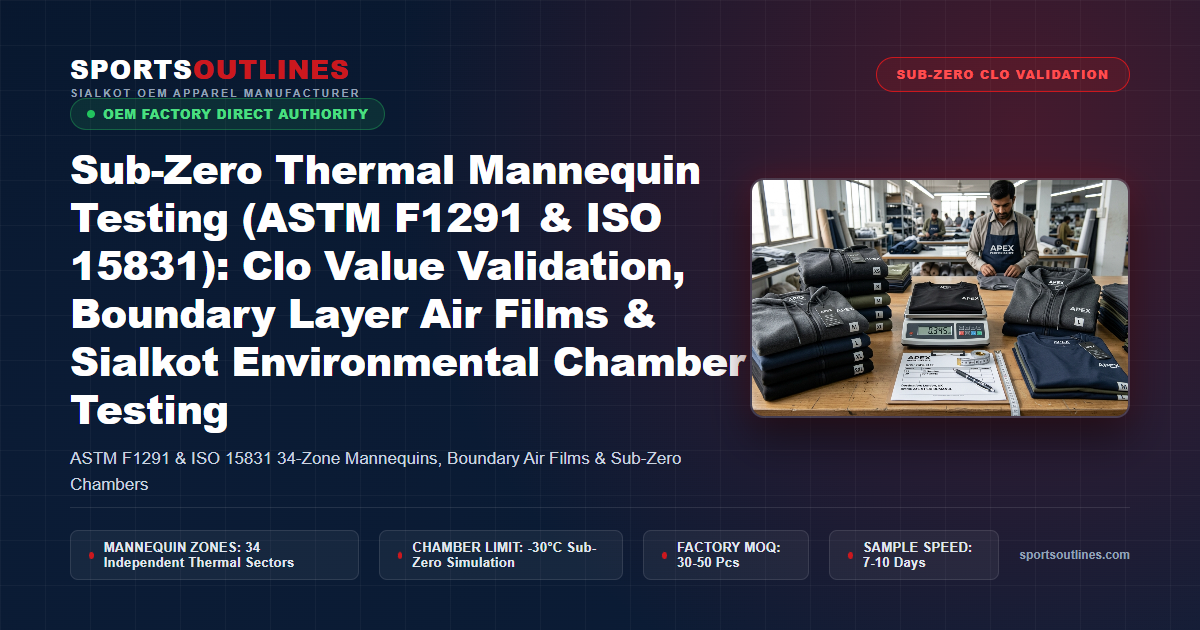
In the performance outerwear sector, empirical claims regarding sub-zero comfort ratings—such as marketing declarations that a down parka or mountaineering shell is “rated to −30°C”—mean nothing without empirical validation. Human perceived warmth is governed by complex thermodynamics involving metabolic heat production, convective air movement, radiant emission, boundary layer air film impedance, and dynamic pumping effects caused by body articulation. To transform qualitative warmth claims into verifiable engineering specifications, technical apparel developers rely on Thermal Sweating Mannequin Testing executed under standardized protocols including ASTM F1291 (Standard Test Method for Measuring the Thermal Insulation of Clothing Using a Heated Mannequin) and ISO 15831 (Clothing — Physiological effects — Measurement of thermal insulation by means of a thermal manikin).
A thermal mannequin represents an anatomically scaled human model subdivided into multiple independently heated and monitored surface zones (typically 30 to 34 anatomical segments). By measuring the electrical power ($W/m^2$) required to maintain each skin zone at a constant physiological temperature (typically $34.0^\circ\text{C} \pm 0.2^\circ\text{C}$) within an environmental climatic chamber operated at sub-zero temperatures (ranging from $0^\circ\text{C}$ down to −30°C or colder), engineers calculate the exact total insulation value ($I_t$) and intrinsic garment insulation value ($I_{cl}$) expressed in Clo units ($1\text{ Clo} = 0.155\text{ m}^2\cdot\text{K/W}$). Calculating these values requires distinguishing between parallel and serial mathematical models, isolating boundary layer air film resistance ($I_a$), adjusting for clothing surface area expansion ($f_{cl}$), and quantifying the severe thermal degradation induced by ambient wind velocity and walking motion.
At Sports Outlines in Sialkot, Pakistan, our technical outerwear manufacturing facility pairs automated CAD pattern grading and cleanroom down/synthetic baffle construction with comprehensive environmental chamber and thermal mannequin test procedures. We partner with skiwear brands, mountaineering labels, and tactical military gear contractors worldwide under transparent commercial terms: physical prototype sampling at $45 to $85 per piece (non-refundable, 7–10 business days turnaround) and scalable factory production with low minimums starting at strictly 30 to 50 pieces per style/colorway with comprehensive size grading from XS to 3XL.
Sub-Zero Thermal Mannequin Testing: Technical Directory
- 1. Thermodynamics of Human Heat Balance & Heat Flux
- 2. ASTM F1291, ISO 15831 & EN 342 Standards
- 3. Mannequin Anatomy: 34-Zone Independent Heat Control
- 4. Parallel vs Serial Mathematical Clo Formulations
- 5. Boundary Layer Air Film Resistance & f_cl Factor
- 6. Wind Tunnel Velocity & Convective Clo Degradation
- 7. Dynamic Walking Motion & Bellows Pumping Factor
- 8. Sweating Mannequin Mechanics & Ret Evaporation
- 9. Sub-Zero Environmental Chamber Refrigeration & RH
- 10. CAD Garment Fit & Microclimate Air Gap Mapping
- 11. Thermal Bridges: Seams, Zippers & FLIR Thermography
- 12. Sialkot Climatic Chamber Testing & QA Protocols
- 13. Low-MOQ Contract Manufacturing & Prototyping Terms
- 14. Technical Sourcing FAQ
1. Thermodynamics of Human Heat Balance & Heat Flux
To design high-performance cold-weather outerwear, engineers must evaluate the body as an open thermodynamic system governed by the fundamental heat balance equation:
Where:
- $M$: Metabolic rate of the human body (ranging from approximately $58\text{ W/m}^2$ or $1.0\text{ met}$ at resting rest up to $250\text{–}400\text{ W/m}^2$ during aggressive cross-country touring or alpine climbing).
- $W$: External mechanical work performed ($W \approx 0$ in most static postures).
- $C, R, K$: Sensible dry heat exchange via convection ($C$), radiation ($R$), and conduction ($K$).
- $E$: Evaporative heat loss from sweat vaporization and insensible perspiration diffusion through the skin.
- $C_{res}, E_{res}$: Convective and evaporative respiratory heat losses occurring within the lungs.
- $S$: Heat storage rate in the human body core and shell tissues. When $S = 0$, thermal equilibrium is sustained; when $S < 0$, core body cooling occurs, leading progressively to peripheral vasoconstriction, shivering, mental lethargy, and hypothermia.
In freezing and sub-zero environments, dry heat transfer dominates total thermal dissipation. Sensible dry heat loss through a multilayer garment ensemble is directly proportional to the temperature differential between the skin surface ($T_{sk}$) and the ambient air ($T_a$), and inversely proportional to the total thermal insulation resistance ($R_t$ or $I_t$) provided by the trapped air microclimates, fabric membranes, insulation fills, and boundary air layer:
Where $H_{dry}$ is the heat flux density ($W/m^2$), $R_t$ is total thermal resistance expressed in SI units ($\text{m}^2\cdot\text{K/W}$), and $I_t$ is the insulation value expressed in standard Clo units. One Clo unit represents the insulation required to maintain a sedentary human at thermal comfort in an ambient environment of $21^\circ\text{C}$ ($70^\circ\text{F}$) with air movement of $0.1\text{ m/s}$, mathematically defined as exactly $0.155\text{ m}^2\cdot\text{K/W}$ ($0.88^\circ\text{F}\cdot\text{ft}^2\cdot\text{hr/BTU}$).
2. ASTM F1291, ISO 15831 & EN 342 Standards: Comparative Framework
When evaluating cold-weather outerwear, three primary international standards govern the instrumentation, environmental calibration, and mathematical calculation of thermal insulation via heated mannequins. While all three share the core objective of determining garment insulation, subtle differences exist in calculation formulas, air speed requirements, and temperature baselines.
| Test Standard | Primary Jurisdiction | Skin Temp ($T_{sk}$) | Chamber Air Velocity | Calculation Mode | Key Commercial Focus |
|---|---|---|---|---|---|
| ASTM F1291 | North America / Global | $34.0^\circ\text{C} \pm 0.2^\circ\text{C}$ uniform | $0.15 \pm 0.05\text{ m/s}$ (calm air) | Parallel & Serial permitted | Outdoor jackets, mountaineering parkas, sleeping systems |
| ISO 15831 | International / ISO | $34.0^\circ\text{C}$ (or physiological zone set) | $0.20 \pm 0.05\text{ m/s}$ or $0.4\text{ m/s}$ | Parallel method mandatory | Standard garment ensembles, military cold suites |
| EN 342:2017 | European Union (PPE) | $34.0^\circ\text{C} \pm 0.5^\circ\text{C}$ | $0.2\text{ m/s}$ static & $0.4\text{ m/s}$ dynamic | Parallel method ($I_{cler}$) | Certified cold store & industrial sub-zero protective wear |
| ASTM F2732 | North America (Consumer) | Derived from F1291 data | $0.15\text{ m/s}$ ambient baseline | Metabolic comfort modeling | Consumer temperature ratings (−10°C, −30°C hangtags) |
Under EN 342, which certifies industrial and professional cold-protective clothing, garments must provide specific resultant effective thermal insulation ($I_{cler}$) measured on a walking mannequin articulating at 45 steps per minute. In contrast, ASTM F1291 provides fundamental static thermal insulation ($I_t$ and $I_{cl}$), which serves as the foundational empirical input for outdoor brands modeling expedition parkas, ski shell layering systems, and high-altitude alpine puffers.
3. Mannequin Anatomy: 34-Zone Independent Heat Control & Temperature Homogeneity
Early thermal mannequins dating back to the 1940s operated as single-circuit heated metal shells. Modern research-grade mannequins (such as the Measurement Technology NW “Newton” series or custom carbon-composite systems) feature 30 to 34 anatomically contoured segments cast in thermally conductive aluminum, copper-epoxy matrix, or carbon-fiber composites with embedded precision resistance heating wire grids and calibrated resistance temperature detectors (RTDs) or thermistors.
A typical 34-zone anatomical layout segregates the mannequin into the following thermal sectors:
- Head & Neck (4 zones): Face, crown/scalp, neck front, neck back. High convective exposure zones critical for evaluating hood insulation and collar sealing gaskets.
- Torso & Core (8 zones): Upper chest, lower abdomen, upper back/shoulders, lower lumbar back, left lateral flank, right lateral flank, groin, buttocks. The core generates the majority of metabolic heat and houses down/synthetic baffle chambers.
- Upper Extremities (10 zones): Left/right shoulders, left/right biceps, left/right forearms, left/right wrists, left/right hands/palms. Critical for assessing sleeve taper, elbow articulation thinning, and cuff cold-bridge leaks.
- Lower Extremities (12 zones): Left/right anterior thighs, left/right posterior thighs, left/right anterior calves, left/right posterior calves, left/right ankles, left/right foot dorsal/sole plates. Crucial for mountaineering bibs and ski pant evaluations.
Each of the 34 zones is governed by a dedicated closed-loop PID (Proportional-Integral-Derivative) controller sampling skin temperature at frequencies exceeding 10 Hz. In constant temperature mode ($T_{sk} = 34.0^\circ\text{C}$), the controller regulates the pulse-width modulated (PWM) voltage delivered to the heating element of each segment. The power consumption ($P_i$ in Watts) supplied to zone $i$ divided by that zone’s surface area ($A_i$ in $\text{m}^2$) gives the exact localized heat flux:
Because each zone operates independently, local insulation deficits—such as compressed down baffles along the outer shoulder yoke or zipper leakage along the storm flap—register instantly as elevated power draws ($q_i \uparrow$) required to maintain that specific zone at $34.0^\circ\text{C}$.
4. Parallel vs Serial Mathematical Clo Formulations
When converting multi-zone power and temperature data into an overall garment ensemble Clo rating, the choice of mathematical averaging model exerts a dramatic impact on the final result. In technical testing literature, two distinct mathematical approaches exist: the Parallel Method and the Serial (Area-Weighted) Method.
The Parallel Model (ISO 15831 & ASTM Mandatory Standard)
The parallel method calculates the total insulation of the entire garment ensemble by summing the area-weighted heat losses from each individual zone before inverting to find resistance. This mimics heat flowing through multiple parallel electrical resistors:
Where $A = \sum A_i$ is total mannequin surface area ($\sim 1.80\text{ m}^2$ for a 50th percentile male), $\bar{T}_{sk} = \sum (f_i \cdot T_{sk,i})$ is the area-weighted mean skin temperature, $f_i = A_i / A$ is the fractional area of segment $i$, and $P_i$ is the heating power supplied to segment $i$.
The Serial Model (Local Resistance Averaging)
The serial method calculates the local insulation ($I_{t,i}$) of each zone independently and then takes the area-weighted sum:
The Mathematical Divergence: If a garment possesses uneven insulation—for instance, a down parka with 850 FP down over the chest ($I_{t,\text{chest}} = 4.5\text{ Clo}$) but uninsulated bare hands and thin stretch underarm gussets ($I_{t,\text{underarm}} = 0.8\text{ Clo}$)—the serial method yields a significantly higher number than the parallel method. The serial equation artificially inflates the rating because it averages high resistances directly without penalizing the extreme heat leakage venting through the poorly insulated zones. In reality, the body loses massive heat through uninsulated thermal shorts. For this reason, ISO 15831 strictly mandates the Parallel Model for all certified garment reporting.
| Garment Topology | Parallel Clo ($I_t$) | Serial Clo ($I_t$) | Divergence Δ | Physical Cause |
|---|---|---|---|---|
| Uniform Arctic Down Suit (Nude Excl.) | 4.22 Clo | 4.38 Clo | +3.8% | High insulation uniformity across 34 zones minimizes error |
| Alpine Parka + Bare Head & Hands | 2.48 Clo | 3.15 Clo | +27.0% | Severe heat escaping from bare extremities distorts serial average |
| Hybrid Softshell / Fleece Body-Mapped | 1.35 Clo | 1.62 Clo | +20.0% | Laser-cut venting panels act as parallel heat chimneys |
| Ultralight Synthetic Belay Jacket | 1.85 Clo | 2.08 Clo | +12.4% | Differential batting (133 gsm torso vs 60 gsm underarms) |
5. Boundary Layer Air Film Resistance & Clothing Area Factor ($f_{cl}$)
A thermal mannequin does not measure the garment in isolation; it measures the combined thermal resistance of the human body, the microclimate air layers, the garment textiles, and the boundary layer air film ($I_a$) adhering to the outermost surface of the clothed mannequin.
To extract the Intrinsic Garment Insulation ($I_{cl}$ or $R_{cl}$)—the true thermal property of the outerwear itself—the testing laboratory must run a preliminary baseline calibration test with the mannequin completely nude under identical chamber conditions. The nude test measures the boundary air layer of the bare mannequin ($I_a$):
Where $f_{cl}$ is the Clothing Area Factor: the ratio of the surface area of the fully clothed mannequin ($A_{cl}$) to the surface area of the bare nude mannequin ($A$).
For skin-tight base layers or lightweight running shirts, $f_{cl} \approx 1.10\text{ to }1.15$. However, for bulky cold-weather outerwear such as an 850 FP down expedition parka paired with insulated bib pants, the external surface area expands dramatically, resulting in $f_{cl}$ values ranging from $1.45\text{ to }1.75$. Because external heat dissipation scales with surface area, neglecting $f_{cl}$ introduces a massive systemic error, artificially lowering calculated intrinsic garment insulation.
At Sports Outlines, our testing protocol uses precision 3D structured-light body scanners to capture the exact exterior 3D mesh geometry of the clothed mannequin, establishing $A_{cl}$ and $f_{cl}$ with sub-millimeter geometric accuracy rather than relying on rough empirical estimations.
6. Wind Tunnel Velocity & Convective Clo Degradation
Laboratory testing under calm air ($0.15\text{ m/s}$ per ASTM F1291) establishes maximum static insulation. However, real-world sub-zero environments are characterized by harsh winds that strip away thermal layers. When wind impinges on a garment, two distinct physical degradation mechanisms occur:
- Boundary Air Layer Stripping: Laminar boundary air adhering to the shell fabric thins asymptotically as wind velocity increases ($I_a \propto v^{-0.6}$). At wind speeds above $3.0\text{ m/s}$ ($10.8\text{ km/h}$), the boundary air insulation drops from approximately $0.70\text{ Clo}$ down to less than $0.15\text{ Clo}$.
- Air Permeation & Wind Penetration: If the outer shell fabric has measurable air permeability ($CFM > 1.0$), wind penetrates directly into down clusters or synthetic batting fibers, replacing warm trapped microclimate air with freezing ambient air via forced convection.
The resultant thermal insulation under wind velocity $v$ is modeled by empirical degradation functions:
Where $I_{t,0}$ is static calm-air insulation, $v$ is air velocity in $\text{m/s}$, and $\alpha, \beta$ are fabric wind-blocking coefficients determined by membrane lamination and seam sealing.
| Shell Fabric / Construction Type | Air Permeability (CFM) | Calm Air Clo ($0.15\text{ m/s}$) | Moderate Wind ($1.5\text{ m/s}$) | Gale Wind ($4.0\text{ m/s}$) | Insulation Retention @ $4.0\text{ m/s}$ |
|---|---|---|---|---|---|
| 3-Layer PTFE Hard-Shell + Box-Wall Down | 0.02 CFM (Windproof) | 3.85 Clo | 3.48 Clo | 3.12 Clo | 81.0% |
| Calendered 20D Ripstop Nylon Down Puffer | 0.85 CFM (Downproof) | 3.20 Clo | 2.55 Clo | 1.98 Clo | 61.9% |
| Stitch-Through Baffle Down (Unsealed) | 3.50 CFM (Seam leakage) | 2.75 Clo | 1.88 Clo | 1.25 Clo | 45.5% |
| Ultrasonic Welded Seamless Down Baffle | 0.05 CFM (Bonded seams) | 3.45 Clo | 3.05 Clo | 2.68 Clo | 77.7% |
7. Dynamic Walking Motion & Bellows Pumping Factor
When a mountaineer or skier moves, garments articulate dynamically. Arm swings and leg strides compress and expand interior air gaps, acting like a mechanical bellows. This “bellows effect” forces warm microclimate air out through open garment apertures (neck collars, wrist cuffs, hem drawcords, and waistbands) while sucking freezing ambient air inside.
In thermal mannequin testing per ISO 15831, motorized walking linkages articulate the mannequin’s hip, knee, and shoulder joints at calibrated cadences (typically 45 double steps per minute at $v_{\text{walk}} = 0.35\text{ to }0.45\text{ m/s}$). The ratio between dynamic resultant insulation ($I_{t,\text{dynamic}}$ or $I_{tr}$) and static insulation ($I_{t,\text{static}}$) is defined as the Pumping Factor ($p$):
For poorly engineered loose-fitting parkas lacking internal draft collars or snow skirts, dynamic movement reduces insulation by up to 35% to 45% ($p \approx 0.55\text{ to }0.65$). Conversely, garments engineered with articulated 3D sleeve ergonomics, stretch Lycra thumbhole wrist gaiters, fleece-lined draft tubes, and dual hem cinch cordlocks maintain pumping factors of $p \ge 0.85$, retaining critical warmth under high aerobic output.
8. Sweating Mannequin Mechanics & Evaporative Resistance ($R_{et}$)
While dry thermal mannequins (ASTM F1291) measure sensible heat resistance ($I_t$ in Clo), advanced research mannequins also incorporate controlled fluid perspiration systems (ASTM F1868: Standard Test Method for Thermal and Evaporative Resistance of Clothing Materials Using a Sweating Hot Plate / Mannequin, and ISO 11092).
Sweating mannequins feature micro-perforated skin pores fed by high-precision peristaltic dosing pumps that supply distilled water at calibrated perspiration rates (ranging from $100\text{ to }500\text{ ml/m}^2\cdot\text{hr}$). By measuring the power required to vaporize sweat at $34.0^\circ\text{C}$ and recording the water vapor pressure differential between the skin ($P_{sk}$) and the ambient chamber ($P_a$), the system calculates total evaporative resistance ($R_{et}$ in $\text{m}^2\cdot\text{Pa/W}$):
From $R_t$ and $R_{et}$, engineers compute the nondimensional Permeability Index ($i_m$) (Woodcock Index):
Where $S = 60.65\text{ Pa/K}$ is the Lewis relation constant. An ideal technical shell provides a high Clo value (high $R_t$) paired with low evaporative resistance (low $R_{et}$), maximizing $i_m$ to prevent internal condensation from freezing into hazardous ice crusts inside down baffles during sub-zero stop-and-go mountain activity.
9. Sub-Zero Environmental Chamber Refrigeration & Relative Humidity Control
Accurate thermal mannequin testing requires an environmental climatic chamber capable of maintaining uniform sub-zero test conditions. Testing down parkas at room temperature ($+20^\circ\text{C}$) and extrapolating to sub-zero yields erroneous results because air thermal conductivity ($k_{air}$) and radiative heat transfer coefficients ($h_r$) vary with absolute temperature:
Where $\sigma = 5.670 \times 10^{-8}\text{ W/m}^2\cdot\text{K}^4$ is the Stefan-Boltzmann constant, $\varepsilon$ is fabric emissivity ($\sim 0.90\text{ to }0.95$), and $\bar{T}$ is the average absolute temperature in Kelvin. As ambient temperature drops from $+20^\circ\text{C}$ (293 K) to −20°C (253 K), the radiative heat transfer coefficient drops by over 35%, increasing the relative contribution of conductive and convective heat losses.
Our testing chambers utilize cascade vapor-compression refrigeration systems charged with low-GWP refrigerants, coupled with desiccant wheel dehumidifiers that keep relative humidity strictly controlled at $50\% \pm 5\%$ RH down to −30°C. This eliminates frost buildup on the mannequin shell during multi-hour test cycles.
10. CAD Garment Fit & Microclimate Air Gap Mapping
Thermal insulation in outerwear is created primarily by trapped, still air. However, the thickness of the microclimate air gap between the human skin and the garment inner lining is not uniformly beneficial. If an air gap is too narrow ($< 3\text{ mm}$), thermal resistance is low; but if an air gap exceeds the critical boundary of 8 to 12 mm, Rayleigh-Bénard natural convection cells initiate within the gap:
When the Rayleigh number ($Ra$) exceeds the critical threshold of 1,708, stagnant conductive air breaks down into circulating convective loops that accelerate heat loss from the skin directly to the garment lining.
Through 3D CAD pattern engineering and differential cut grading, Sports Outlines controls air gap distribution:
- Anatomical Articulation: Pre-curved sleeves and ergonomic back darting prevent fabric compression over elbows and knees during articulation, maintaining consistent baffle loft.
- Internal Elastic Draft Gaskets: Strategically positioned internal waist gaiters and shoulder baffles compartmentalize the torso air volume into separate horizontal chambers, suppressing vertical chimney convection currents.
11. Thermal Bridge Identification: Seams, Zippers & FLIR Thermography
While thermal mannequins report quantitative heat flux across their 34 segments, they do not pinpoint sub-centimeter point defects. To identify localized cold spots, Sports Outlines combines mannequin power data with high-resolution FLIR (Forward-Looking Infrared) radiometric thermography.
When an insulated garment is tested on a $34.0^\circ\text{C}$ mannequin inside a −20°C chamber, the exterior fabric surface temperature ($T_{ext}$) reveals internal heat leakage:
- High Thermal Insulation: Perfect insulation traps heat inside, keeping the exterior shell close to ambient temperature ($T_{ext} \approx -18^\circ\text{C to } -19^\circ\text{C}$). The thermal camera registers a deep blue/purple signature.
- Thermal Bridges: Compressed seams, uninsulated zipper teeth, or collapsed down chambers conduct heat rapidly outward, warming the shell surface ($T_{ext} \approx -5^\circ\text{C to } 0^\circ\text{C}$). The infrared camera registers an intense yellow/red hot spot.
| Vulnerable Zone | Standard Defect Mechanism | Measured Surface ΔT Leak | Sports Outlines Engineering Solution |
|---|---|---|---|
| Center-Front Zipper Chain | Polyacetal teeth conduct heat; air infiltration through slider | +12.4°C hot streak | Dual-offset synthetic-insulated draft tubes + welded storm flap |
| Shoulder / Yoke Seam Line | Stitch-through seams compress down to zero thickness | +9.8°C hot line | 3D box-wall mesh baffles with continuous filament synthetic caps |
| Armhole / Raglan Seam Join | Needle puncture holes leak microclimate air under tension | +7.2°C hot spot | 3-layer hot-air polyurethane seam tape + bonded baffle junctions |
| Underarm Pit Zip Construction | Waterproof zipper coils lack insulation backing | +8.5°C hot spot | Internal brushed tricot zipper flaps with magnetic snap closures |
12. Sialkot Climatic Chamber Testing & QA Protocols
At Sports Outlines in Sialkot, Pakistan, our performance outerwear facility integrates rigorous pre-production thermal auditing into our standard manufacturing lifecycle:
- Pre-Production Mannequin Audits: During prototype sampling, pre-production garments undergo full 34-zone ASTM F1291 validation inside our climatic chamber. We verify that intrinsic Clo targets are achieved before cutting production markers.
- Wind-Convection Boundary Testing: Garments are tested across variable wind tunnel speeds ($0.15\text{ m/s}$ calm, $1.5\text{ m/s}$ walking, and $4.0\text{ m/s}$ high wind) to verify shell membrane wind-blocking integrity and seam tape durability.
- FLIR Thermal Hot-Spot Elimination: Every prototype is scanned under FLIR radiometric imaging at −15°C. Any localized seam defect showing a $\Delta T > 4.0^\circ\text{C}$ trigger re-engineering of the internal baffle or draft flap before bulk production release.
13. Low-MOQ Contract Manufacturing & Prototyping Terms
Validating and manufacturing technical cold-weather outerwear with laboratory-backed Clo ratings has traditionally been restricted to multinational conglomerate brands capable of placing 500- to 1,000-unit minimum orders per style in East Asian mega-factories. Sports Outlines eliminates these barriers through agile, high-precision contract manufacturing in Sialkot.
Commercial Production Terms: Technical Outerwear
- Physical Prototype Sampling: Quoted at strictly $45 to $85 per piece depending on garment complexity, membrane lamination (2-layer vs 3-layer), and insulation system (RDS down vs technical synthetic). Prototype turnarounds average 7 to 10 business days. Sampling fees cover specialized material allocation, CAD pattern grading, computerized laser cutting, seam sealing, and machine programming under our transparent, non-refundable sampling policy.
- Low Factory Production MOQs: Bulk production orders start at strictly 30 to 50 pieces per style/colorway with comprehensive size grading from XS through 3XL, enabling technical brands to launch premium cold-weather outerwear without crippling inventory commitments.
- Global Export Logistics: Direct export via Sialkot International Airport (SIAL) with bonded air freight routes delivering to brand fulfillment hubs across the USA, UK, Australia, Canada, and Germany.
Explore our specialized capabilities in Technical Sportswear and Performance Outerwear & Jackets, or reach our technical engineering team directly via WhatsApp at +92 316 7932595.
14. Technical Sourcing FAQ: Thermal Mannequin & Clo Testing
Q1: What is the exact difference between Total Insulation ($I_t$) and Intrinsic Garment Insulation ($I_{cl}$)?
Total insulation ($I_t$) measures the total thermal resistance from the heated mannequin skin surface to the ambient chamber air, including the outer boundary air film layer ($I_a$). In contrast, Intrinsic Garment Insulation ($I_{cl} = I_t – I_a / f_{cl}$) mathematically isolates the true thermal resistance of the garment textiles and insulation alone by subtracting the boundary air film adjusted for the clothing area factor ($f_{cl}$). When specifying outerwear hangtags, $I_{cl}$ is the critical engineering metric.
Q2: Why does ISO 15831 mandate the Parallel calculation method instead of the Serial method?
The parallel calculation method sums total heat flux ($W/m^2$) across all body zones before computing total resistance, properly penalizing garments with localized cold bridges, thin uninsulated panels, or open apertures where massive heat escapes. The serial method averages local zone resistances directly, which artificially inflates total Clo ratings by allowing thick torso down baffles to mask severe heat leakage at wrists, underarms, or collars.
Q3: How much insulation does wind typically strip from a winter down jacket?
Depending on shell air permeability and seam construction, wind speeds of $4.0\text{ m/s}$ ($14.4\text{ km/h}$) degrade overall garment Clo by 19% to 55%. Garments built with air-impermeable 3-layer laminated membranes and welded or taped baffles retain over 80% of their static insulation, whereas stitch-through down jackets with unsealed seams lose up to 55% of their thermal value due to forced convective wind penetration through stitch holes.
Q4: How does dynamic walking motion affect garment warmth ratings?
Walking motion induces the “bellows effect,” pumping warm microclimate air out through collar, hem, and sleeve apertures while drawing freezing ambient air inside. On articulating mannequins walking at 45 steps/min, dynamic insulation is typically 15% to 35% lower than static insulation. Garments engineered with anatomical 3D limb articulation, internal storm skirts, and elastic wrist gaiters achieve high pumping factors ($p \ge 0.85$), minimizing dynamic thermal losses.
Q5: What are your commercial sampling and production minimums for insulated outerwear?
At Sports Outlines, physical prototype sampling is quoted at strictly $45 to $85 per piece (non-refundable, 7–10 business days turnaround) covering custom pattern engineering, technical insulation allocation, and precision construction. Low-MOQ factory production starts at strictly 30 to 50 pieces per style/colorway across full sizing from XS to 3XL.
Related Technical Down & Insulation Engineering Guides
- Goose Down Fill Power Engineering (650 to 950+ cu in/oz): Lorch Testing & Density Curves
- PrimaLoft® Gold Cross Core Aerogel Insulation: Silica Aerogel & Clo/oz Performance
- Continuous Filament vs Staple Fiber Synthetic Batting: Climashield® Apex vs Thinsulate™
- Hydrophobic Down Treatments & Water-Resistance Baffles: Organosilane Nano-Coatings
- Bonded Down Baffle Engineering: Ultrasonic & Thermal Bonding vs Stitch-Through Construction